Chapter 11 – Monopolistic Competition and Oligopoly (+ Appendix)
1. Monopolistic competition means:
2. Monopolistic competition is characterized by a:
Chapter 11 – Monopolistic Competition and Oligopoly (+ Appendix)
3. Under monopolistic competition entry to the industry is:
4. Monopolistic competition resembles pure competition because:
5. Which of the following is not a basic characteristic of monopolistic competition?
Chapter 11 – Monopolistic Competition and Oligopoly (+ Appendix)
6. Nonprice competition refers to:
7. The restaurant, legal assistance, and clothing industries are each illustrations of:
8. If the number of firms in a monopolistically competitive industry increases and the degree
of product differentiation diminishes:
Chapter 11 – Monopolistic Competition and Oligopoly (+ Appendix)
9. Economic analysis of a monopolistically competitive industry is more complicated than
that of pure competition because:
10. A monopolistically competitive industry combines elements of both competition and
monopoly. The monopoly element results from:
11. A significant difference between a monopolistically competitive firm and a purely
competitive firm is that the:
Chapter 11 – Monopolistic Competition and Oligopoly (+ Appendix)
12. A monopolistically competitive industry combines elements of both competition and
monopoly. It is correct to say that the competitive element results from:
13. Monopolistically competitive and purely competitive industries are similar in that:
14. The monopolistic competition model assumes that:
Chapter 11 – Monopolistic Competition and Oligopoly (+ Appendix)
15. Use your basic knowledge and your understanding of market structures to answer this
question. Which of the following companies most closely approximates a monopolistic
competitor?
16. A monopolistically competitive firm has a:
17. The monopolistically competitive seller’s demand curve will become more elastic the:
Chapter 11 – Monopolistic Competition and Oligopoly (+ Appendix)
18. The larger the number of firms and the smaller the degree of product differentiation the:
19. The demand curve of a monopolistically competitive producer is:
20. A monopolistically competitive firm’s marginal revenue curve:
Chapter 11 – Monopolistic Competition and Oligopoly (+ Appendix)
21. The price elasticity of a monopolistically competitive firm’s demand curve varies:
22. In the short-run, a profit-maximizing monopolistically competitive firm sets it price:
23. In the long-run, a profit-maximizing monopolistically competitive firm sets it price:
Chapter 11 – Monopolistic Competition and Oligopoly (+ Appendix)
24. In the short-run, the price charged by a monopolistically competitive firm attempting to
maximize profits:
25. In the long-run, the price charged by the monopolistically competitive firm attempting to
maximize profits:
26. Monopolistically competitive firms:
Chapter 11 – Monopolistic Competition and Oligopoly (+ Appendix)
27. The monopolistically competitive seller maximizes profit by producing at the point
where:
28. In the long-run, the price charged by a monopolistically competitive firm seeking to
maximize profit will:
29. Which of the following is correct for a monopolistically competitive firm in long-run
equilibrium?
Chapter 11 – Monopolistic Competition and Oligopoly (+ Appendix)
30. In the long-run, economic theory predicts that a monopolistically competitive firm will:
31. Excess capacity refers to the:
Chapter 11 – Monopolistic Competition and Oligopoly (+ Appendix)
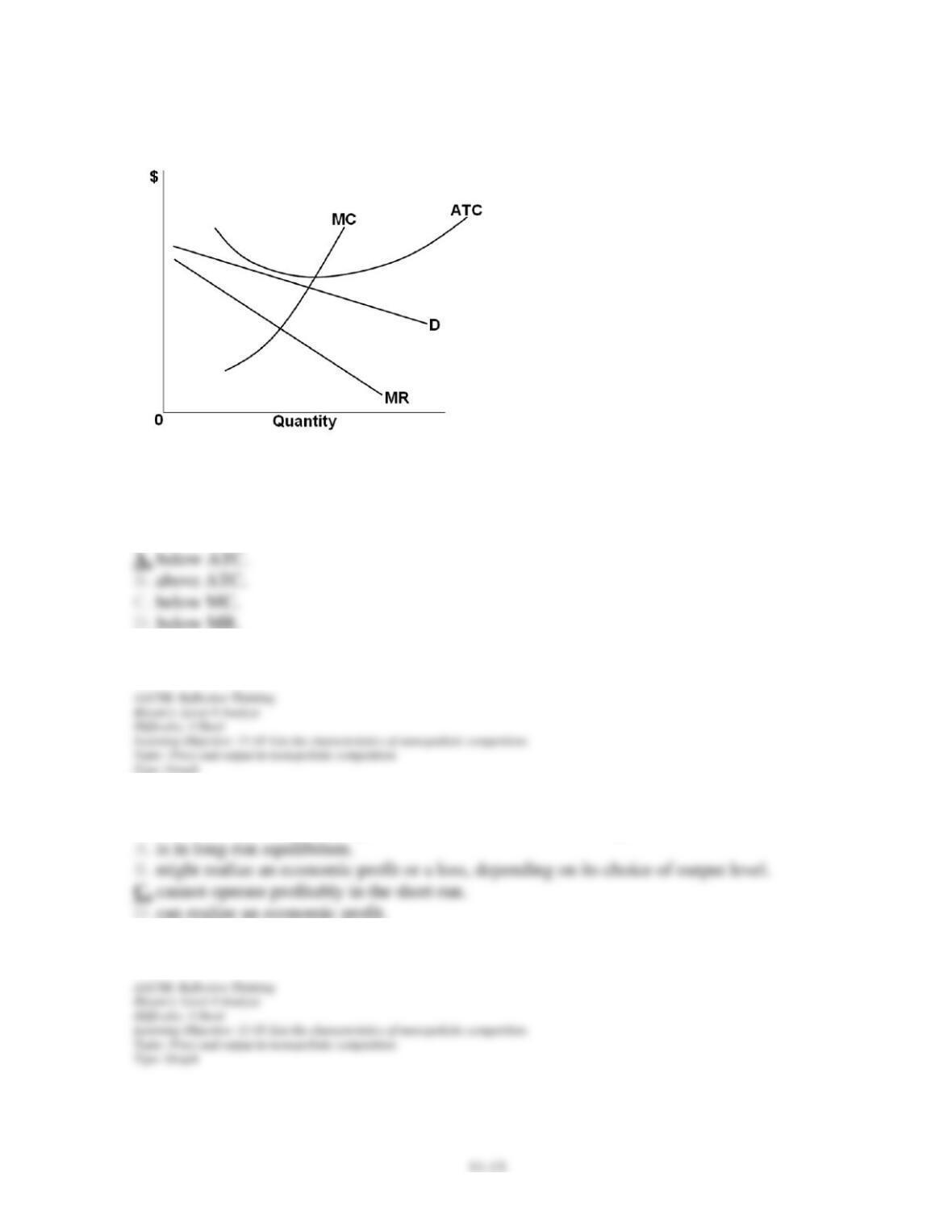
32. Refer to the above diagram for a monopolistically competitive firm in short-run
equilibrium. This firm’s profit-maximizing price will be:
33. Refer to the above diagram for a monopolistically competitive firm in short-run
equilibrium. The profit-maximizing output for this firm will be:
34. Refer to the above diagram for a monopolistically competitive firm in short-run
equilibrium. This firm will realize an economic:
Chapter 11 – Monopolistic Competition and Oligopoly (+ Appendix)
35. In short-run equilibrium, the monopolistically competitive firm shown above will set its
price:
36. The monopolistically competitive firm shown in the above figure:
Chapter 11 – Monopolistic Competition and Oligopoly (+ Appendix)
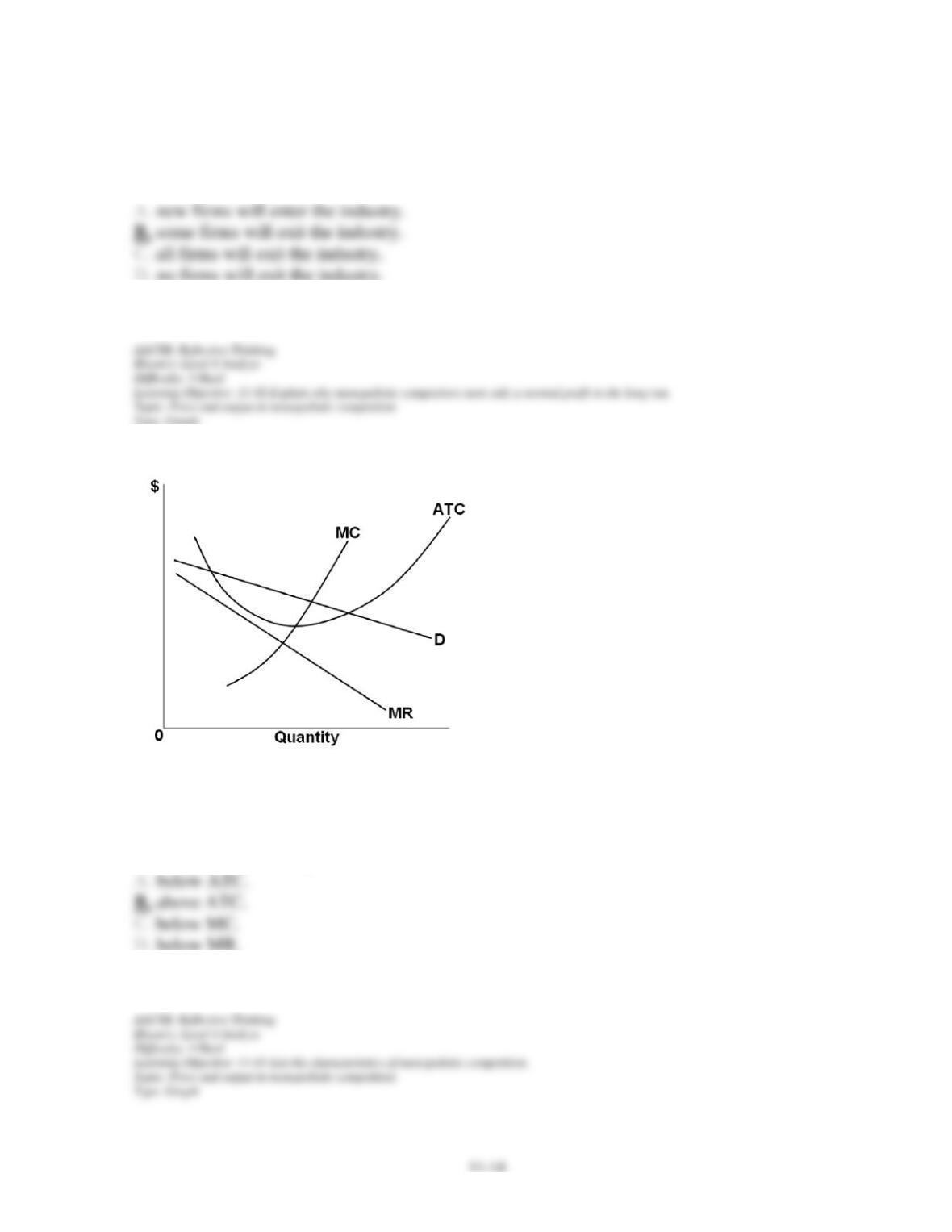
37. If all monopolistically competitive firms in the industry have profit circumstances similar
to the firm shown above:
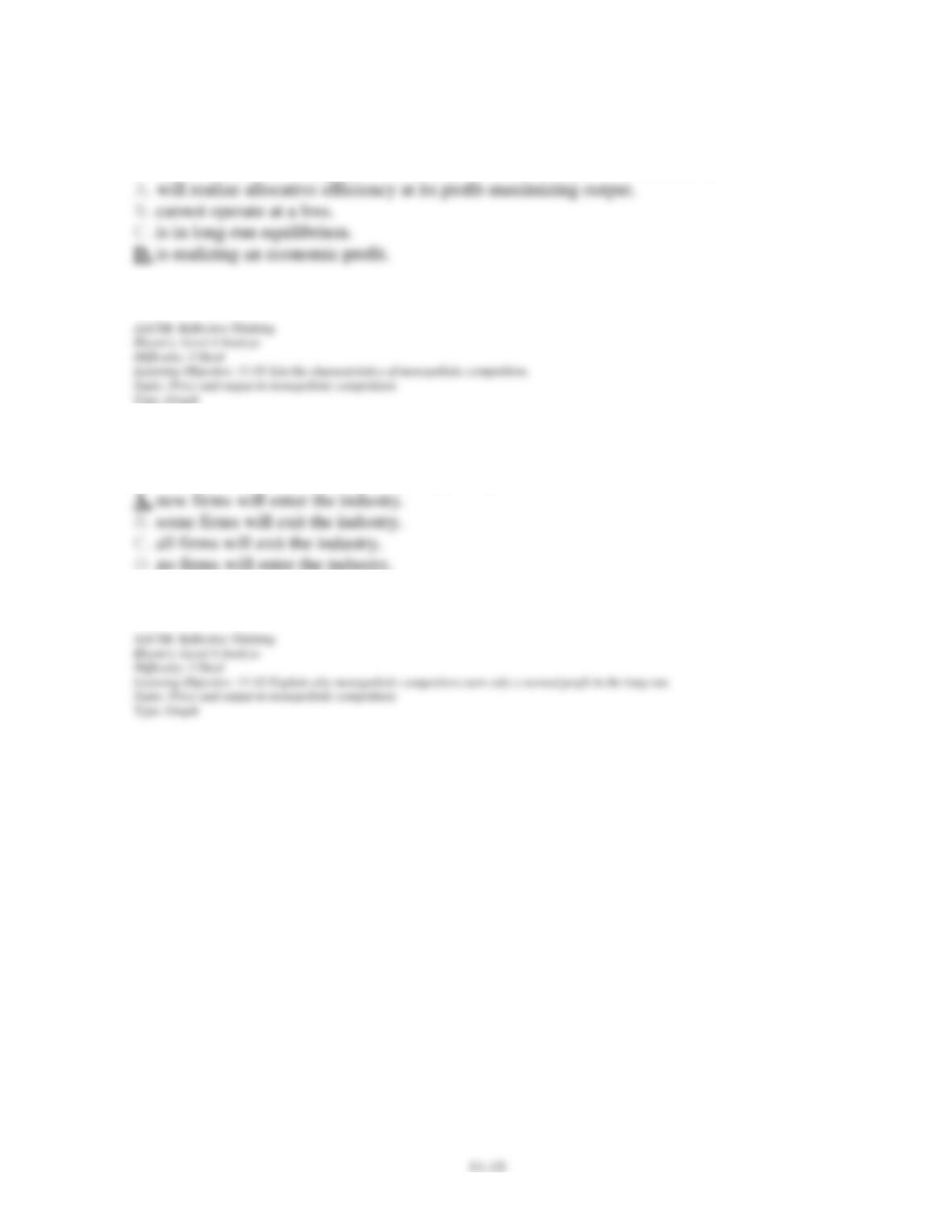
38. Refer to the above diagram. In short-run equilibrium, the monopolistically competitive
firm shown will set its price:
Chapter 11 – Monopolistic Competition and Oligopoly (+ Appendix)
39. Refer to the above diagram. The monopolistically competitive firm shown:
40. Refer to the above diagram. If all monopolistically competitive firms in the industry have
profit circumstances similar to the firm shown above:
Chapter 11 – Monopolistic Competition and Oligopoly (+ Appendix)
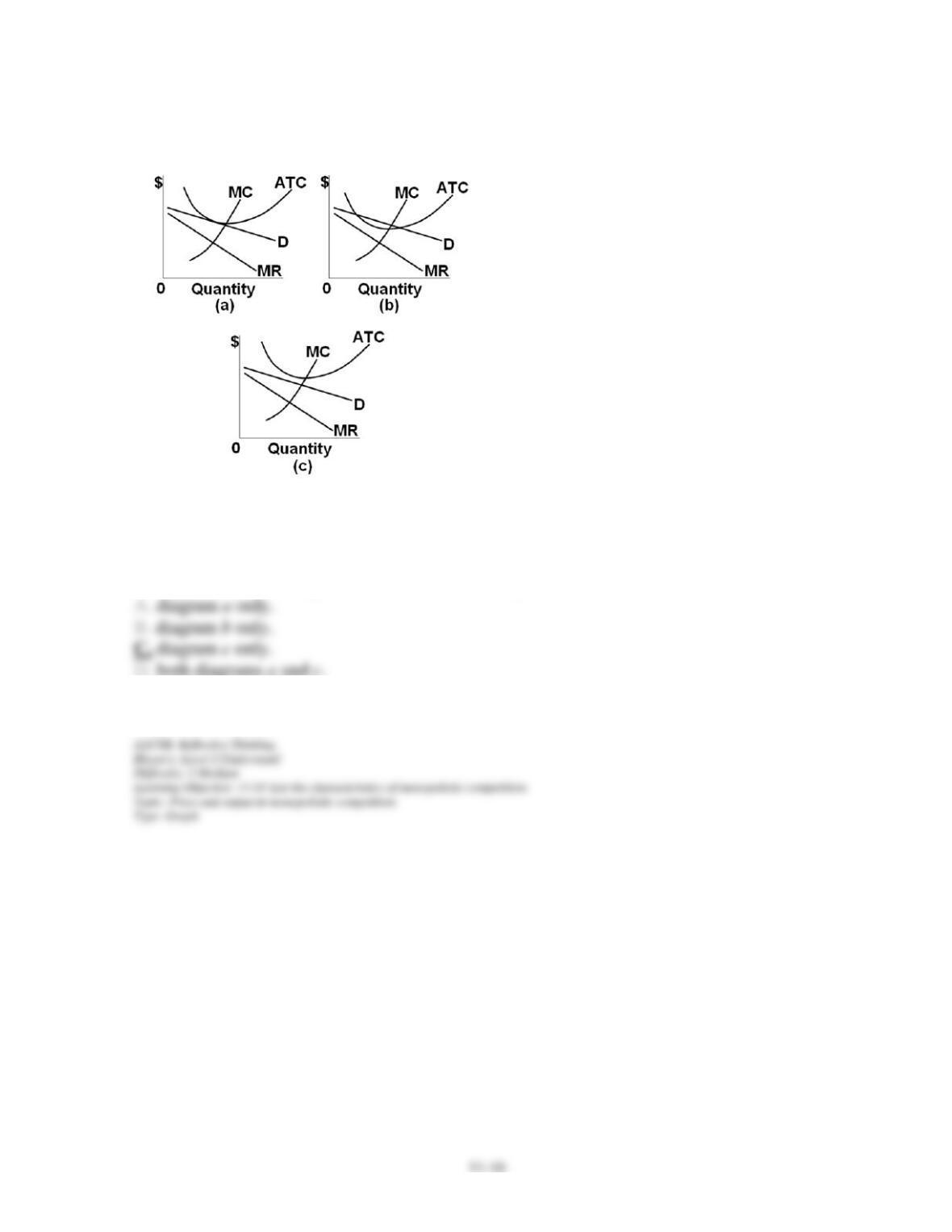
41. Refer to the above diagrams, which pertain to monopolistically competitive firms. Short-
run equilibrium entailing economic loss is shown by:
Chapter 11 – Monopolistic Competition and Oligopoly (+ Appendix)
42. Refer to the above diagrams, which pertain to monopolistically competitive firms. A
short-run equilibrium entailing economic profits is shown by:
43. Refer to the above diagrams, which pertain to monopolistically competitive firms. Long-
run equilibrium is shown by:
44. Which of the following is not characteristic of long-run equilibrium under monopolistic
competition?
Chapter 11 – Monopolistic Competition and Oligopoly (+ Appendix)
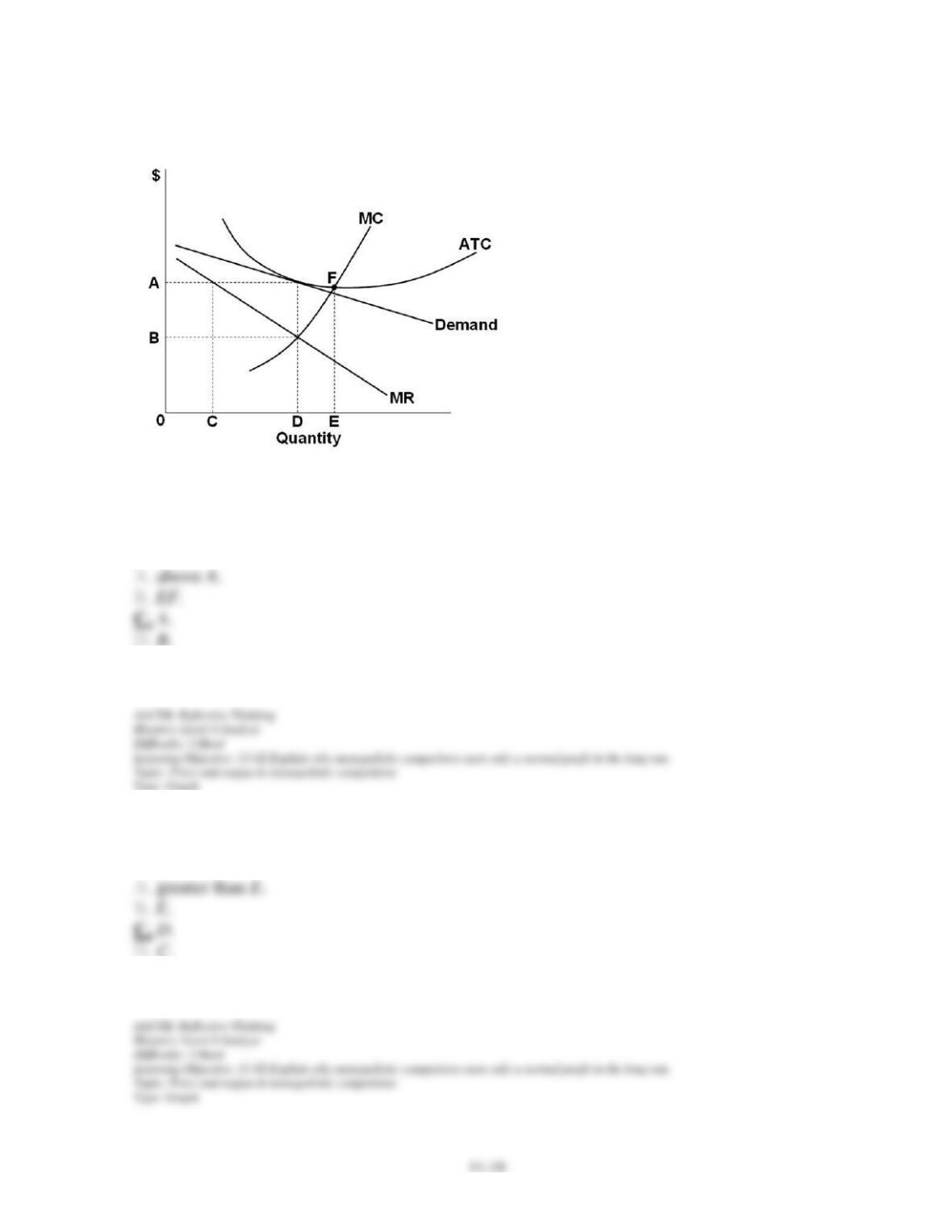
45. Refer to the above diagram for a monopolistically competitive firm. Long-run equilibrium
price will be:
46. Refer to the above diagram for a monopolistically competitive firm. Long-run equilibrium
output will be:
Chapter 11 – Monopolistic Competition and Oligopoly (+ Appendix)
47. Refer to the above diagram for a monopolistically competitive firm. If more firms were to
enter the industry and product differentiation were to weaken, then:
48. Long-run equilibrium for a monopolistically competitive firm where economic profits are
zero results from:
49. When a monopolistically competitive firm is in long-run equilibrium:
Chapter 11 – Monopolistic Competition and Oligopoly (+ Appendix)
50. If some firms leave a monopolistically competitive industry, the demand curves of the
remaining firms will:
51. When a monopolistically competitive firm is in long-run equilibrium:
52. Other things equal, if more firms enter a monopolistically competitive industry: