11.2 The Aggregate Supply Curve
1) In the long run ________.
A) the amount of output an economy can produce is determined by real variables like capital,
labor and technological advances
B) aggregate supply is fixed at the potential level of output
C) there is enough time for prices to fully adjust so the classical dichotomy holds
D) all of the above
E) none of the above
2) In the long run ________.
A) the aggregate supply is vertical with respect to output
B) the Phillips curve is vertical with respect to unemployment
C) fluctuations in the inflation rate have no impact on output and unemployment
D) all of the above
E) none of the above
3) In the long run ________.
A) the aggregate supply is vertical with respect to unemployment
B) the Phillips curve is vertical at a given level of expected inflation
C) the economy reaches the potential output level consistent with the natural rate of
unemployment
D) all of the above
E) none of the above
4) The natural rate of output is ________.
A) independent of the inflation rate
B) always lower than potential output
C) unrelated to the natural rate of unemployment
D) all of the above
E) none of the above
5) When wages and prices are completely flexible ________.
A) inflation is determined by expected inflation and price shocks
B) labor hoarding occurs
C) unemployment is disconnected from the real economy
D) all of the above
E) none of the above
6) Which of the following shows a negative relationship between the output and unemployment
gaps?
A) the AS curve
B) the Phillips curve
C) Okun’s law
D) the classical dichotomy
E) none of the above
7) Which of the following never assumes, either implicitly or explicitly, independence between
nominal and real variables?
A) the AS curve
B) the Phillips curve
C) Okun’s law
D) the classical dichotomy
E) none of the above
8) Which of the following best approximates Okun’s law?
A) a 1 percent increase in output leads to a 2 percent decrease in unemployment
B) a 1 percent increase in output leads to a 1 percent decrease in unemployment
C) a 2 percent increase in output leads to a 4 percent increase in unemployment
D) a 2 percent increase in output leads to a 1 percent decrease in unemployment
E) none of the above
9) According to Okun’s law, an increase in which of the following is associated with an increase
in unemployment?
A) inflation
B) output
C) expected inflation
D) autonomous expenditure
E) potential output
10) Which of the following is true in regards to Okun’s law?
A) employment does not increase commensurately with output rises because firms tend to hoard
labor
B) when demand increases, firms tend to work their employees harder and longer
C) it is Okun’s prediction of the negative relationship between the output and unemployment
gaps that allows the modern Phillips curve to be translated into the AS curve
D) all of the above
E) none of the above
11) The short-run aggregate supply curve shows that inflation will change as a result of changes
in ________.
A) output
B) potential output
C) expected inflation
D) price shocks
E) all of the above
12) The short-run aggregate supply curve shows that a change in inflation will cause (a)
change(s) in ________.
A) output
B) potential output
C) expected inflation
D) price shocks
E) all of the above
13) According to the short-run aggregate supply curve, if output minus potential output equals
zero, then ________.
A) unemployment might be zero
B) inflation might be stable
C) expected inflation must be stable
D) price shocks must be zero
E) none of the above
14) In the short run ________.
A) inflation is negatively related to the output gap
B) if output rises above its potential level, the unemployment rate falls and firms will lower
wages
C) if the labor market tightens, firms will raise prices more rapidly to keep up with upward wage
pressures and inflation will ensue
D) all of the above
E) none of the above
15) Which statement(s) is (are) consistent with a positive relationship between inflation and the
output gap?
A) If output rises above its potential level, the unemployment rate falls and firms will raise
wages and prices more rapidly.
B) In the short run, the AS curve is upward sloping.
C) Through Okun’s law, the negative relationship between the output and unemployment gaps
allows the modern Phillips curve to be translated into the AS curve.
D) all of the above
E) none of the above
16) In the short run ________.
A) the more flexible wages and prices are, the more inflation responds to the output gap
B) the more sticky wages and prices are, the more difficult to tell the difference between the
short run and long run aggregate supply curves
C) if wages and prices are sticky, aggregate output is always at its potential level
D) all of the above
E) none of the above
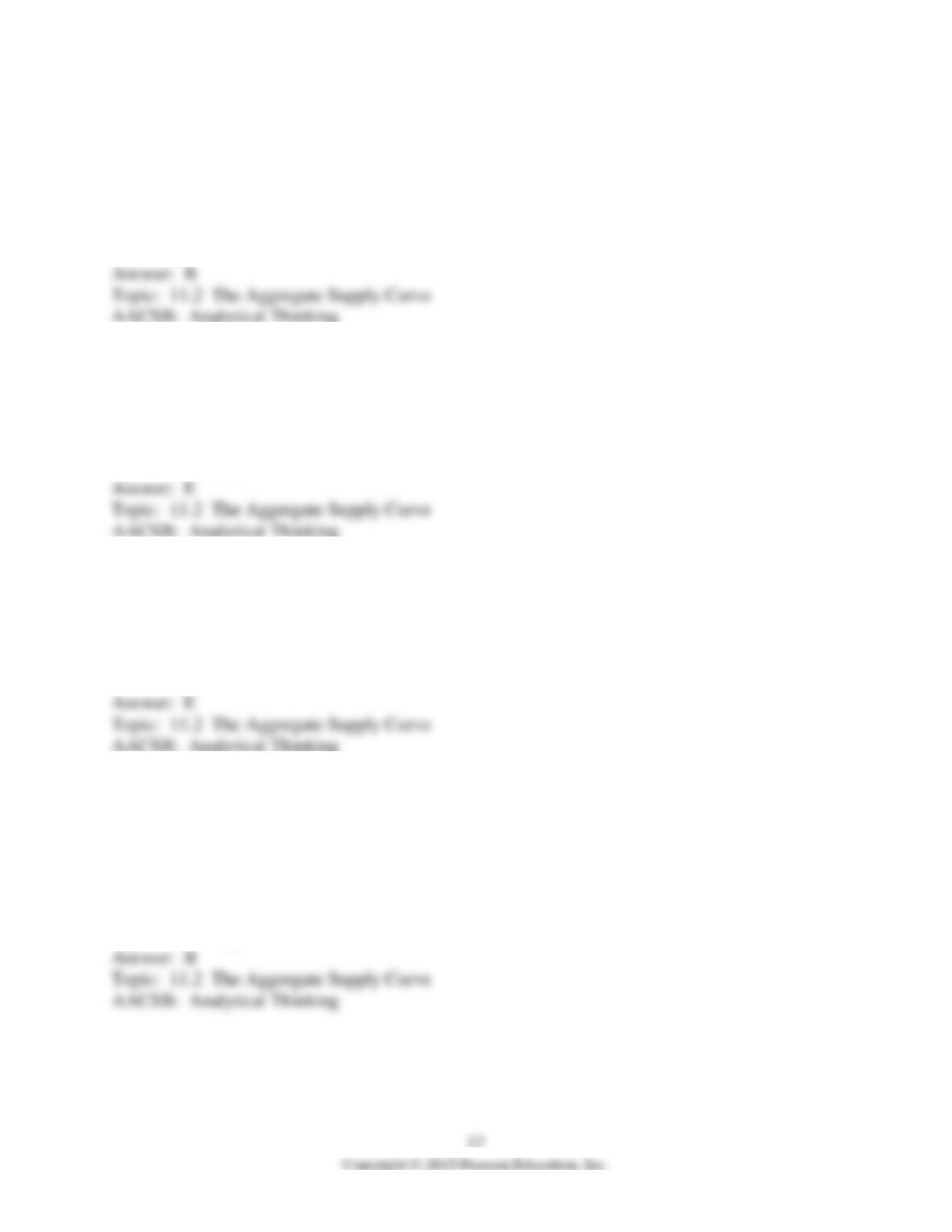
17) If the output gap is constant at minus 2 and the inflation rate has fallen from 6 percent to 5
percent, then next period’s short-run aggregate supply curve might be ________.
A) π = 5 – 0.5 (13 – 15)
B) π = 5 + 0.5 (13 – 15)
C) π = 4 + 0.5 (13 – 15)
D) π = 5 + 2 (11 – 15)
E) none of the above
18) When a price shock occurs, the inflation rate is affected ________.
A) only in the period of the price shock
B) only in the period after the price shock
C) only if the price shock causes a change in output
D) only if the price shock persists for more than one period
E) none of the above
19) When a price shock has occurred, inflation returns to its pre-shock rate ________.
A) in the period following the price shock
B) in the period when output has returned to its pre-shock rate
C) once the output gap has returned to zero
D) only in the long run
E) none of the above
20) Suppose the output gap is zero, and policy makers wish to reduce the inflation rate from 10
percent to 5 percent. Which of these policies seems best?
A) contractionary policies to reduce output at least 5 percent below potential output
B) a convincing declaration of the inflation rate target, so that expected inflation falls to 5
percent
C) no policy action; inflation will fall on its own, eventually
D) no policy action; inflation will converge to its long-run rate, regardless of policy
E) price and wage controls to counteract their stickiness
18
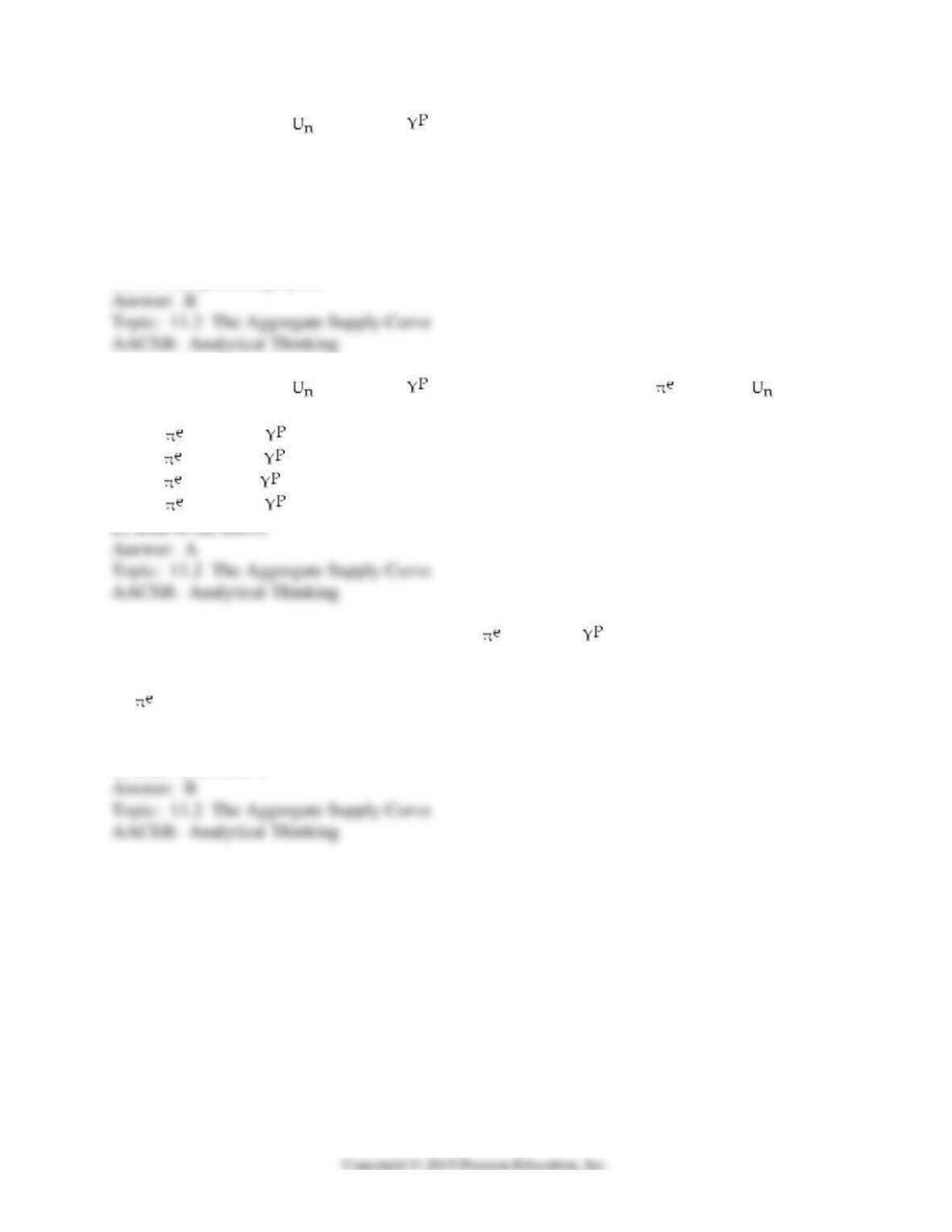
21) If Okun’s law is U – = – 0.5 (Y – ), and potential output grows at 2% per year, then a
recession that causes output to decrease by one percentage point will cause unemployment to
increase by ________.
A) 1 percentage point
B) 1.5 percentage points
C) 2 percentage points
D) 3 percentage points
E) one-half percentage point
22) If Okun’s law is U – = – 0.6 (Y – ), and the Phillips curve is π = – 2.5 (U – ) + ρ,
then the short-run aggregate supply curve is ________.
A) π = + 1.5 (Y – ) + ρ
B) π = + 4.2 (Y – ) + ρ
C) π = – 2.5 (Y – ) + ρ
D) π = – 2.5 (Y + ) + ρ
23) If the short-run aggregate supply curve is π = + 1.2 (Y – ) + ρ, output equals potential
output and there is a price shock of minus two, then the inflation rate is ________.
A) 2
B) – 2
C) minus 2
D) minus 2.4
E) none of the above
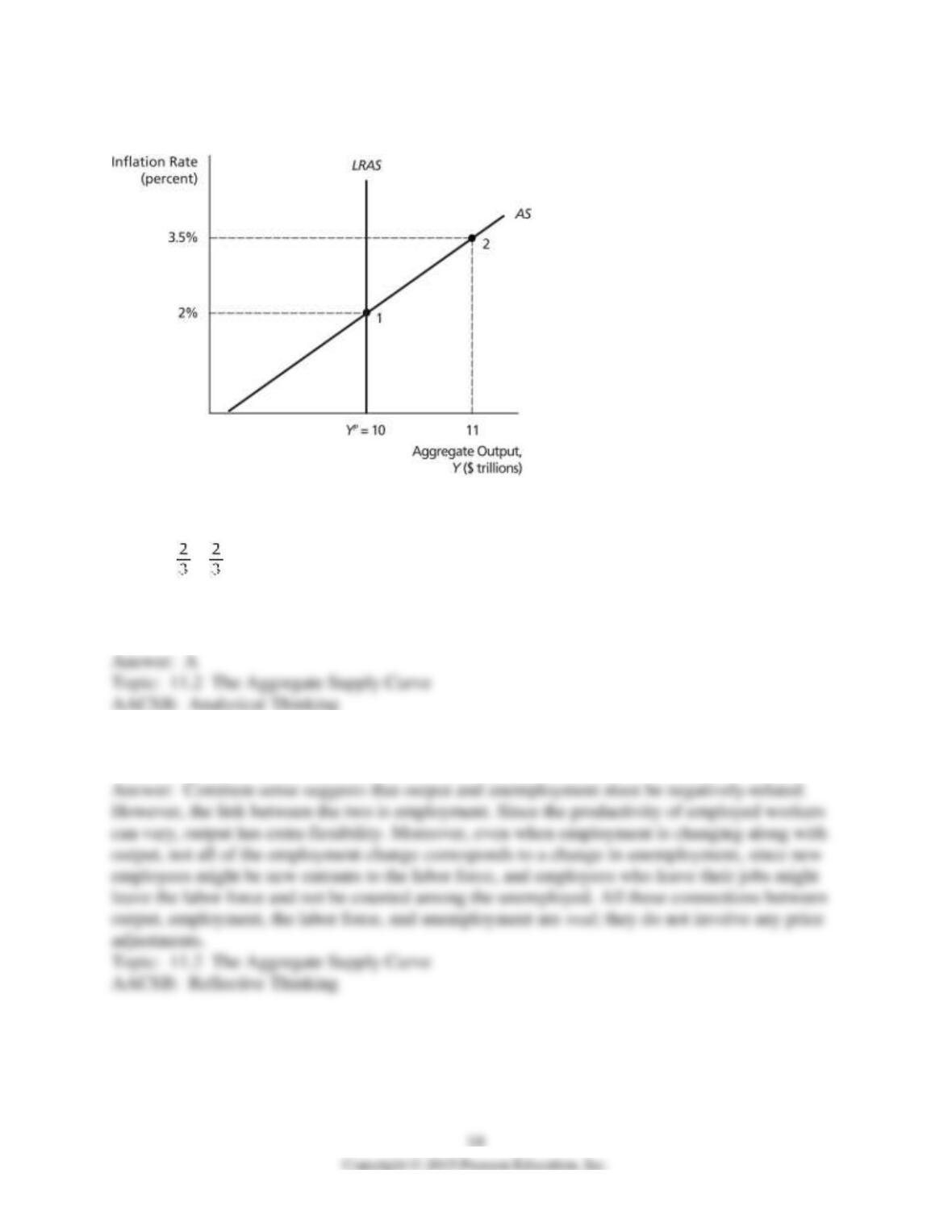
Aggregate Supply Curves (1)
24) Based on the graph above, the short-run aggregate supply curve is ________.
A) π = 2 + 1.5 (Y – 10) + ρ
B) Y = 8 + (π) + ρ
C) π = 2 + (Y – 11) + ρ
D) π = 3.5 + 2 (Y – 10) + ρ
E) none of the above
25) Why are changes in the output gap larger than changes in the unemployment gap? Why is the
relationship expressed in Okun’s law not affected by inflation or expected inflation?
26) Unprecedented stimulative policies throughout the global economy have sparked debate over
the inflationary implications. Defenders of the policies argue that, even if the policies raise
inflationary expectations, actual inflation will remain low. Critics charge that current policies are
nearly certain to result in excessive inflation. What does the aggregate supply curve have to say?
11.3 Shifts in Aggregate Supply Curves
1) Technological advances lead to ________.
A) a shift of the short run AS curve up
B) a shift of the long run AS curve to the left
C) an upward movement along the long run AS curve
D) all of the above
E) none of the above
2) If the natural rate of unemployment declines ________.
A) labor is more heavily utilized
B) potential output increases
C) the long run aggregate supply curve shifts to the right
D) all of the above
E) none of the above
3) If the Fed were to announce that fighting inflation is not a high priority for the immediate
future ________.
A) households might expect higher inflation
B) the short run aggregate supply would shift upwards
C) firms might begin raising their prices to keep up with expected inflation
D) all of the above
E) none of the above
4) In 2005 hurricane Katrina devastated large portions of the Gulf Coast economy. Many
refineries went offline disrupting oil refining and distribution. What do you think was a likely
result?
A) the restricted supply constituted a cost push shock that would have shifted the long run AS
curve to the right
B) the restricted supply constituted a cost push shock that would have shifted the short run AS
curve to the left
C) the restricted supply constituted a cost push shock that would have meant an upward
movement along the Phillips curve
D) all of the above
E) none of the above
5) ________ may cause a shift of the long-run aggregate supply curve.
A) A major earthquake
B) A change in expected inflation
C) A price shock
D) all of the above
E) none of the above
6) In the short run, if current output remains persistently above potential ________.
A) inflation will rise causing a movement along the aggregate supply curve
B) expected inflation will rise causing an upward shift of the aggregate supply curve
C) the aggregate supply curve will shift until current output returns to its potential level
D) all of the above
E) none of the above
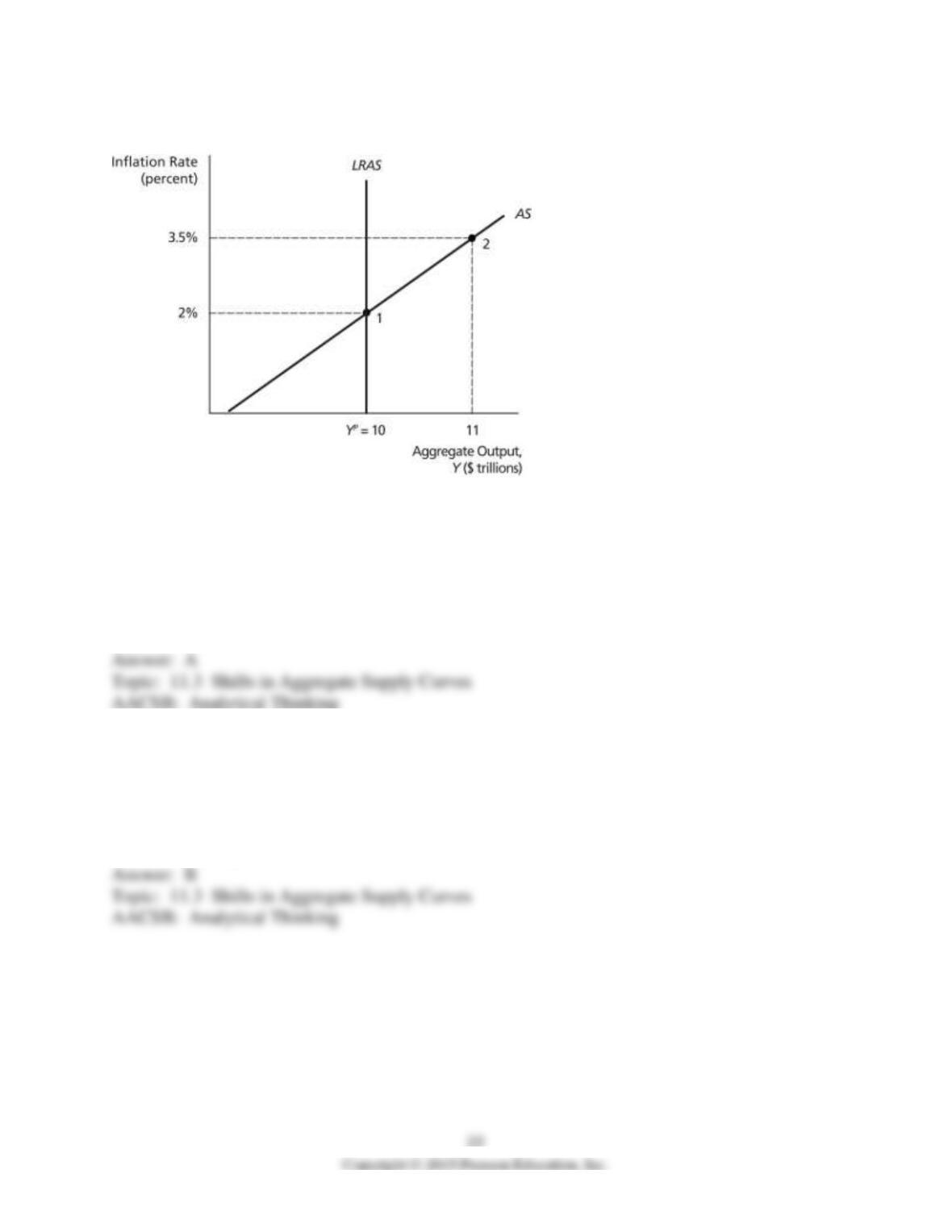
Aggregate Supply Curves (1)
7) Based on the graph above, if the economy is at point 2, then (assuming no price shocks and no
changes in actual and potential output) the inflation rate next period will be ________ percent.
A) 5
B) 3.5
C) 4.5
D) 4
E) none of the above
8) Based on the graph above, a cause of movement from point 1 to point 2 might be ________.
A) a positive price shock
B) government policy that lowers unemployment
C) an increase in potential output
D) an increase in expected inflation
E) none of the above
23
9) Based on the graph above, suppose the economy is at point 2, then output falls to 10 and there
is a price shock of one percent. The inflation rate next period will be ________ percent.
A) 5
B) 3.5
C) 4.5
D) 4
E) none of the above
10) If the short-run aggregate supply curve is shifting down repeatedly, it is rather likely that
________.
A) output is declining repeatedly, relative to potential output
B) the long-run aggregate supply curve is shifting to the left
C) negative price shocks are recurring
D) all of the above
E) none of the above
11) What factors cause a shift in the long-run aggregate supply curve? Might any of these cause
the short-run aggregate supply curve to shift, also?
12) The short-run aggregate supply curve is π = + 0.8 (Y – 20) + ρ. Suppose inflation last year
was 5 percent, current output is 20, and there is a price shock of 2 percent. Suppose, further, that
potential output rises next year to 21, while output remains at 20 and next year’s price shock is
zero. Calculate and explain next year’s inflation.
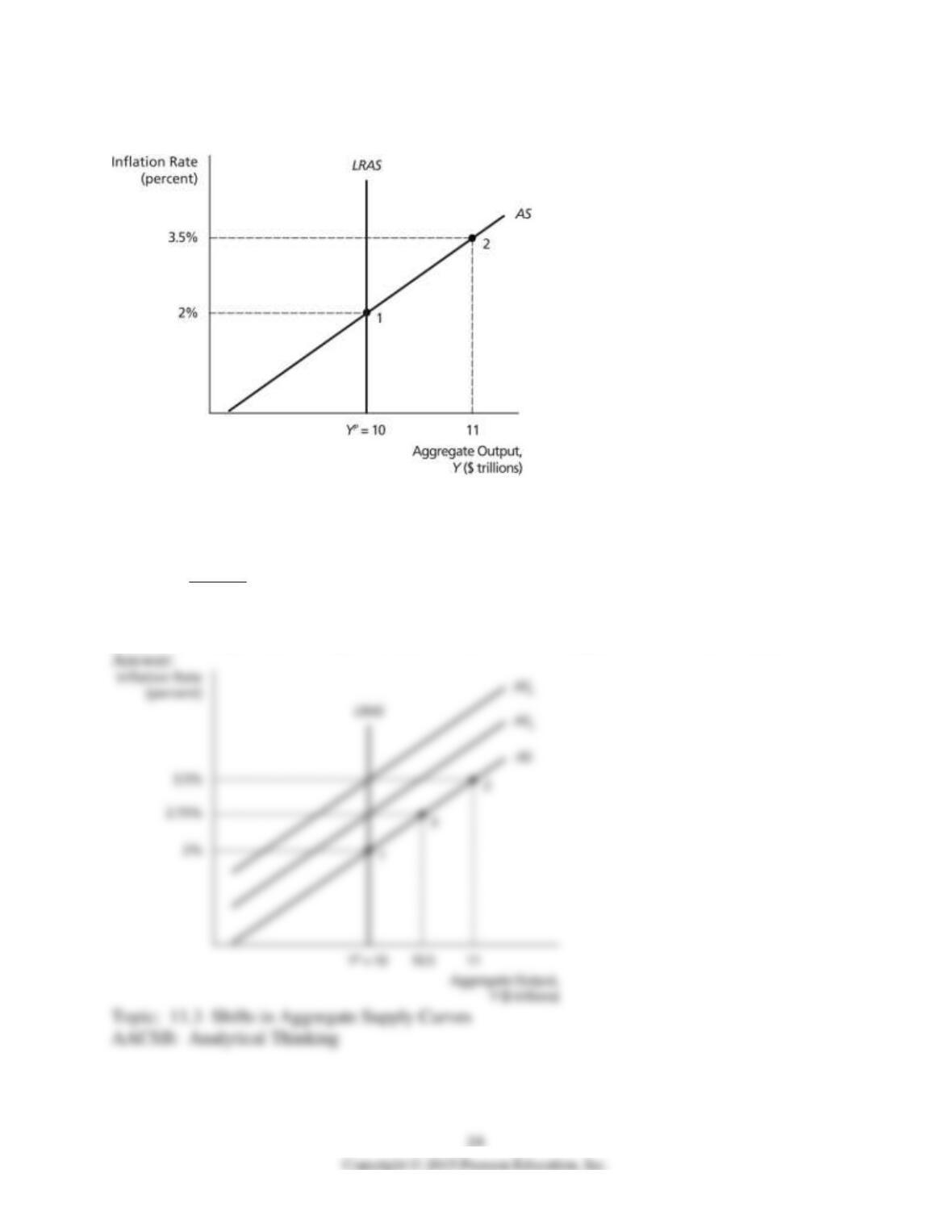
Aggregate Supply Curves (2)
13) On the graph above,
(a) draw the new short-run aggregate supply curve that results when the economy has been at
point 2 for one period, ceteris paribus (do not label the new output level or inflation rate)
(b) on the original AS curve, add a point “3” where output is 10.5. On the vertical axis, label the
rate of inflation that corresponds to output of 10.5.
(c) draw the new short-run aggregate supply curve that results when the economy has been at
point 3 for one period, ceteris paribus (do not label the new output level or inflation rate)