14) Using the Keynesian model, the effect of a government-imposed ceiling on interest rates paid
on personal checking accounts that is lower than the current market interest rate would be to
cause ________ in the real interest rate and ________ in output in the short run.
A) a decrease; a decrease
B) a decrease; no change
C) a decrease; an increase
D) an increase; a decrease
15) In the Keynesian model, an increase in government purchases affects output by
A) increasing labor supply, because workers feel effectively poorer.
B) increasing saving to pay for future taxes, lowering the real interest rate and shifting the IS
curve to the left.
C) increasing the real interest rate due to crowding out, reducing aggregate demand.
D) increasing aggregate demand as national saving declines.
16) In the Keynesian model in the short run, a decrease in government purchases causes output
to ________ and the real interest rate to ________.
A) fall; rise
B) fall; fall
C) rise; rise
D) rise; fall
17) In the Keynesian model in the long run, an increase in taxes causes the price level to
________ and the real interest rate to ________.
A) fall; rise
B) fall; fall
C) rise; rise
D) rise; fall
18) Suppose the government decided to tighten monetary policy and decrease government
expenditures. In the short run in the Keynesian model, the effect of these policies would be to
________ the real interest rate and ________ the level of output.
A) lower; decrease
B) lower; have an ambiguous effect on
C) have an ambiguous effect on; decrease
D) raise; decrease
19) Suppose the government decided to ease monetary policy, then increase taxes. In the short
run in the Keynesian model, the effect of these policies would be to ________ the real interest
rate and ________ the level of output.
A) lower; increase
B) lower; decrease
C) lower; have an ambiguous effect on
D) have an ambiguous effect on; increase
20) The 1980s were characterized by ________ monetary policy and ________ fiscal policy.
A) tight; easy
B) tight; tight
C) easy; easy
D) easy; tight
21) Easy monetary policy and tight fiscal policy lead to
A) high real interest rates.
B) low real interest rates.
C) roughly unchanged real interest rates.
D) roughly unchanged real interest rates only when Ricardian equivalence holds; otherwise, low
real interest rates.
22) A monopolistically competitive firm prices its product using the markup pricing formula P =
1.25MC, where MC is the marginal cost of producing an additional unit. Suppose the demand for
the firm’s product is given by Q = 2000 – 0.1P, so the revenue from selling Q units of the product
is PQ = 2000P – 0.1P2.
(a) If the marginal cost of producing each unit of the product is $10,000, calculate the price of
the product, the quantity produced, and the firm’s revenues, costs, and profits.
(b) Now suppose the marginal cost rises to $11,000. The firm can keep the price of the product
unchanged, or it can change the product’s price at a total cost of $700,000. Calculate the price,
quantity, revenues, costs, and profits as in part (a) both for changing the price and leaving the
price unchanged. Should the firm change the price of its product?
23) (a) Draw a figure, using the Keynesian IS–LM framework, of an economy in recession.
(b) Now suppose the IS curve shifts up and to the right far enough that if the real interest rate is
unchanged, output will increase beyond full employment. If the Fed’s goal is to move output to
its full-employment level, what must happen to the real interest rate? What is the effect on the
price level?
(c) Suppose, before the Fed can act, that the government announces a restrictive fiscal policy,
shifting the IS curve down and to the left relative to its position in part (b) What is the Fed likely
to do (relative to what it would do if fiscal policy wasn’t restrictive) if its goal is to target full-
employment output? What happens to the real interest rate relative to what it is in part (b)?
24) (a) Draw a figure, using the Keynesian IS–LM framework, of an economy in recession.
(b) If the Fed’s goal is to move output to its full-employment level, what should it do with
monetary policy? What will happen to the real interest rate? What is the effect on the price level?
Show the result in your diagram.
(c) Suppose the Fed decides to keep the money supply unchanged. How could the government
use fiscal policy to move the economy to full employment? Show the result in your diagram.
(d) How does the real interest rate differ between parts (b) and (c)?
25) According to the Keynesian IS–LM model, what is the effect of each of the following on
output, the real interest rate, employment, and the price level? Distinguish between the short run
and the long run.
(a) Expected inflation rises.
(b) Wealth increases.
(c) Labor supply decreases due to a change in demographics.
(d) The future marginal product of capital decreases.
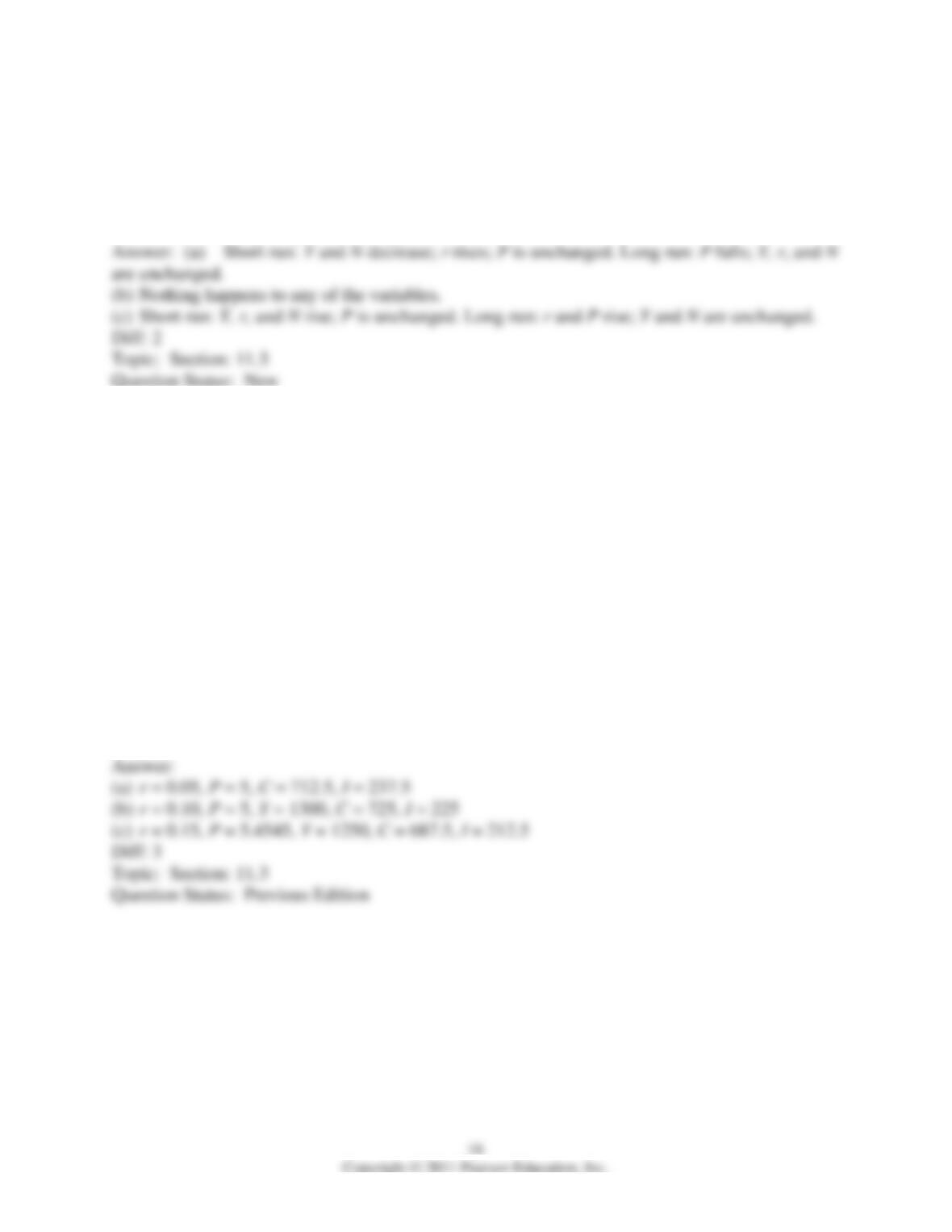
26) According to the Keynesian IS–LM model, what is the effect of each of the following on
output, the real interest rate, employment, and the price level? Distinguish between the short run
and the long run.
(a) Expected inflation decreases.
(b) Labor supply increases due to a change in demographics.
(c) The future marginal product of capital increases.
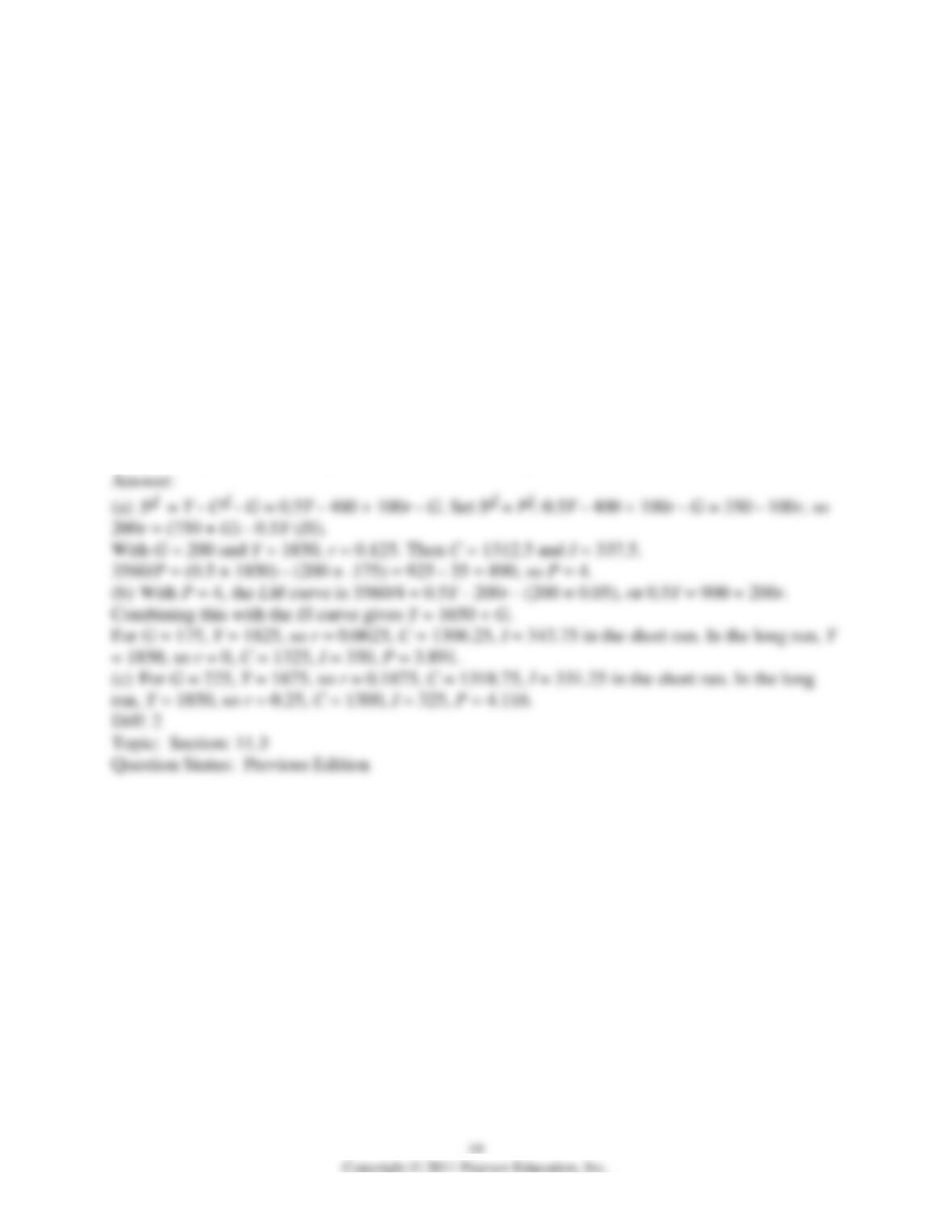
27) A Keynesian economy is described by the following equations.
Cd = 250 + 0.5(Y – T) – 250r
Id = 250 – 250r
G = 300
T = 300
L = 0.5Y – 500r + πe
M = 3000
Y
= 1250
πe = 0
(a) Calculate the values of the real interest rate, the price level, consumption, and investment for
the economy in general equilibrium.
(b) Now suppose government purchases increase to 350 with no change in taxes. What will be
the real interest rate, the price level, output, consumption, and investment in the short run?
(c) What will be the real interest rate, the price level, output, consumption, and investment in the
long run?
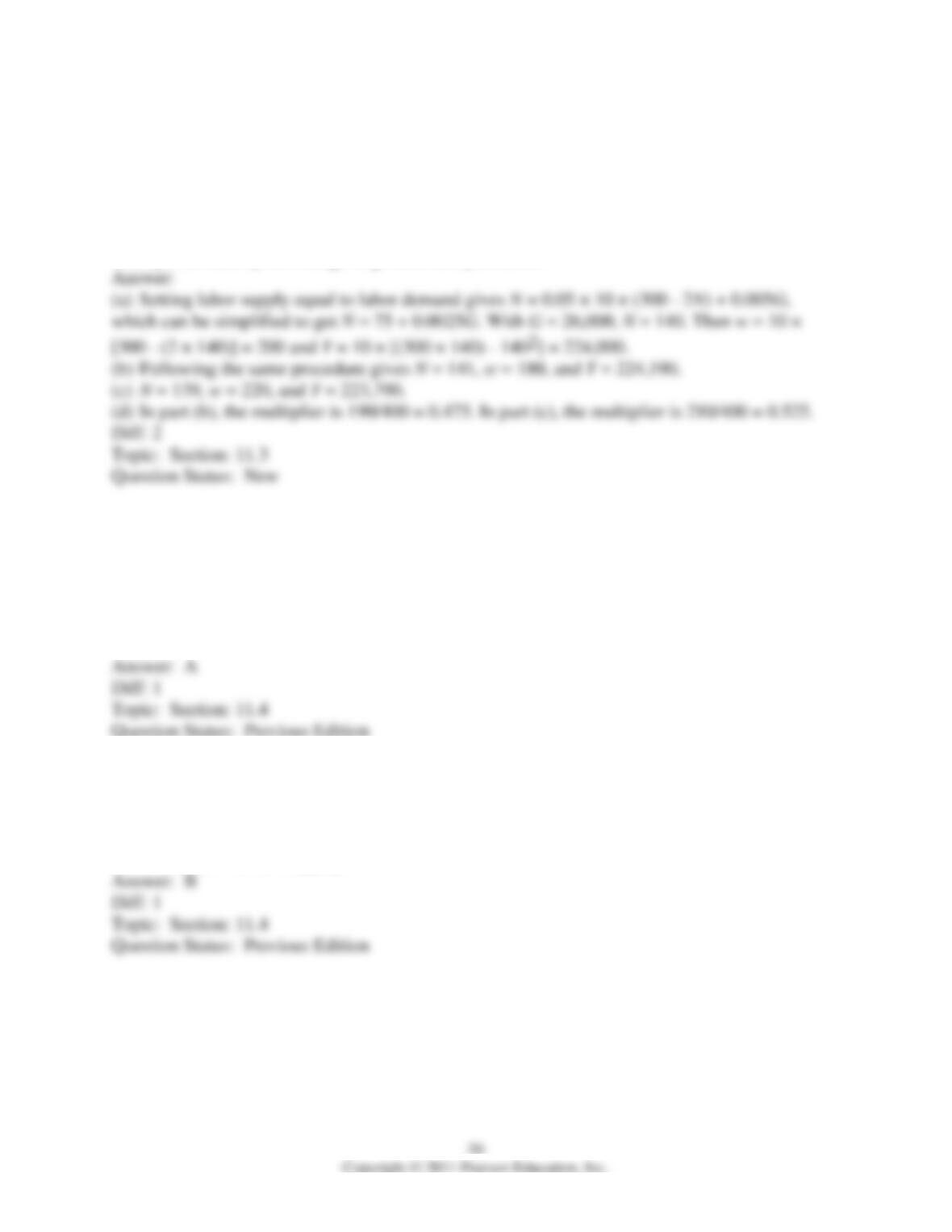
28) The following equations describe a Keynesian model of the economy.
Cd= 500 + 0.5(Y – T) – 100r
Id = 350 – 100r
L = 0.5Y – 200i
πe = 0.05, G = T = 200,
Y
= 1850
M = 3560
(a) Find the full-employment equilibrium values of the real interest rate, consumption,
investment, and the price level.
(b) Suppose government purchases decline to 175, with no change in taxes. What happens to the
real interest rate, output, consumption, and investment in the short run (in which the price level is
fixed)? What happens in the long run to the real interest rate, consumption, investment, and the
price level?
(c) Suppose instead that government purchases rise to 225, with no change in taxes, starting
from the equilibrium in part (a). What happens to the real interest rate, output, consumption, and
investment in the short run (in which the price level is fixed)? What happens in the long run to
the real interest rate, consumption, investment, and the price level?
29) Suppose the economy’s production function is Y = A(300N – N2). The marginal product of
labor is MPN = A(300 – 2N). Suppose that A = 10. The supply of labor is NS = 0.05w + 0.005G.
(a) If G is 26,000, what are the real wage, employment, and output?
(b) If G rises to 26,400, what are the real wage, employment, and output?
(c) If G falls to 25,600, what are the real wage, employment, and output?
(d) In cases (b) and (c), what is the government purchases multiplier; that is, what is the change
in output divided by the change in government purchases?
11.4 The Keynesian Theory of Business Cycles and Macroeconomic Stabilization
1) According to Keynesians, the primary source of business cycle fluctuations is
A) aggregate demand shocks.
B) productivity shocks.
C) oil price shocks.
D) consumer confidence shocks.
2) The Keynesian theory is consistent with the business cycle fact that inflation is
A) procyclical and leading.
B) procyclical and lagging.
C) countercyclical and leading.
D) countercyclical and lagging.
3) The idea that firms retain some workers in a recession, whom they would otherwise lay off, to
avoid the costs of hiring and training, is called
A) the gift exchange motive.
B) worker pooling.
C) labor hoarding.
D) union busting.
4) The use of macroeconomic policies to smooth or moderate the business cycle is known as
A) aggregate demand management.
B) aggregate supply management.
C) automatic stabilization.
D) discretionary policy.
5) In the Keynesian model, the difference between using monetary and fiscal policy to eliminate
a recession is that
A) monetary policy will eliminate a recession quicker than fiscal policy will.
B) fiscal policy will eliminate a recession quicker than monetary policy will.
C) an expansionary monetary policy will leave the economy with a lower real interest rate than
an expansionary fiscal policy.
D) an expansionary fiscal policy will leave the economy with a lower real interest rate than an
expansionary monetary policy.
6) In the Keynesian model, the difference between no intervention by the government during a
recession and intervention using expansionary monetary or fiscal policy is that no intervention
will return the economy to its equilibrium level of output
A) faster than intervention will and at a lower price level.
B) slower than intervention will and at a higher price level.
C) slower than intervention will and at a lower price level.
D) faster than intervention will and at a higher price level.
7) A problem with the use of aggregate demand management to stabilize the business cycle is
that
A) monetary policy isn’t available to use when interest rates are already rising because of higher
inflation.
B) fiscal policy takes a long time to have any impact on the economy.
C) monetary policy is difficult to use, because the decision-making process is long and
complicated.
D) the precise amount that output will change in response to monetary or fiscal policy isn’t
known.
8) In the 1990s, nominal interest rates in Japan were approximately
A) 0%.
B) 10%.
C) 100%.
D) 1000%.
9) A situation in which expansionary monetary policy has no effect on the economy is known as
A) macroeconomic stabilization.
B) a liquidity trap.
C) a depression.
D) capital flight.
10) In the long run in the Keynesian model, a beneficial supply shock would leave the economy
with a higher level of output, but also a ________ real interest rate and a ________ price level.
A) higher; lower
B) lower; higher
C) lower; lower
D) higher; higher
11) In the short run in the Keynesian model, a sharp increase in oil prices would leave the
economy with a ________ level of output and a ________ real interest rate.
A) higher; lower
B) lower; higher
C) lower; lower
D) higher; higher
12) Recent research by Keynesians and classicals has led to
A) a reconciliation of the types of models they use.
B) the recognition by classical economists that prices adjust very slowly.
C) convincing evidence that TFP shocks are the dominant force affecting the business cycle.
D) the refutation of the efficiency wage model.
13) You are the liaison between the Federal Reserve Board and the U.S. Treasury Department.
Your goal is to coordinate policy efforts to achieve full-employment output in the economy
while keeping a fixed real interest rate. You must recommend tightening or easing both monetary
and fiscal policies to do this. What would your recommendation be in each of the following
situations?
(a) People decide to increase saving.
(b) Expected inflation declines.
(c) The future marginal productivity of capital declines.
(d) There’s an adverse oil price shock in which the LM curve moves farther to the left than does
the FE line.
14) You are the chairperson of the Board of Governors of the Federal Reserve. You believe in a
Keynesian model of the economy, and your goal is to keep the economy at the full-employment
level of output. How would you respond (tightening or easing policy) in each of the following
cases?
(a) Government purchases increase
(b) Corporate tax rates increase
(c) Expected inflation increases
(d) There’s a beneficial oil price shock (and the LM curve shifts more to the right than the FE
line)
15) Describe the situation of the Japanese economy in the 1990s. What should the Japanese
government have done differently, according to critics, to improve the economy?
16) Describe the effects of an oil price shock in a Keynesian model; why are such supply shocks
difficult to handle using macroeconomic stabilization policies?
17) For each of the following changes, what happens to the real interest rate and output in the
long run, after the price level has adjusted to restore general equilibrium? How would the results
differ, if at all, between the classical and Keynesian model? Draw a diagram for each part to
illustrate your result.
(a) Wealth rises.
(b) Money supply rises.
(c) The future marginal productivity of capital increases.
(d) Expected inflation declines.
(e) Future income declines.