1. The sum of the unemployment rate and the inflation rate is known as:
a.
the macroeconomic index.
b.
the mortality rate.
c.
the market index.
d.
the misery index.
e.
a coincident indicator.
2. When the government uses taxes and spending to affect national economy, it is engaging in:
a.
fiscal policy.
b.
monetary policy.
c.
interest rate policy.
d.
trade policy.
e.
exchange rate policy.
MACR.BOYE.16.55 – ch. 11, 1
United States – The Role of Government
Fiscal Policy and Aggregate Demand
3. The GDP gap is:
a.
the product of the potential real GDP and the equilibrium level of real GDP.
b.
the distance between the current level of real gross domestic product and full employment real GDP.
c.
the difference between potential real GDP and the equilibrium level of real GDP.
d.
the difference between the present value of all of government’s projected financial obligations and the present
value of all projected future tax and other receipts.
e.
the difference between the actual output of an economy and its potential output.
MACR.BOYE.16.55 – ch. 11, 1
United States – The Role of Government
Fiscal Policy and Aggregate Demand
4. Which of the following will be observed if the U.S. federal government reduces fiscal spending, keeping other things
constant?
a.
The aggregate demand curve will shift to the right.
MACR.BOYE.16.55 – ch. 11, 1
United States – Analytic – BB-Legal
b.
The aggregate expenditure in the economy will decrease.
c.
The economy will approach potential GDP.
d.
The marginal propensity to consume will increase.
e.
The average price level will increase.
5. Which of the following can be categorized under fiscal policy?
a.
Increase in money supply
b.
Decrease in money supply
c.
Increase in federal funds rate
d.
Decrease in reserve requirement
e.
Increase in tax rates
MACR.BOYE.16.55 – ch. 11, 1
United States – The Role of Government
Fiscal Policy and Aggregate Demand
6. If the government wants to close a GDP gap, it should:
a.
borrow funds from the public by issuing bonds.
b.
lower taxes and raise government spending.
c.
lower government spending on social security.
d.
raise both direct and indirect tax rates.
e.
adopt contractionary fiscal policies to control inflation.
MACR.BOYE.16.55 – ch. 11, 1
Fiscal Policy and Aggregate Demand
7. If aggregate demand intersects aggregate supply in the horizontal range of the aggregate supply curve, then, other
things equal, an increase in government spending will:
a.
raise real GDP by the amount indicated by the government spending multiplier and leave the price level
unchanged.
b.
lower real GDP by an amount equal to the increased spending and reduce inflation.
c.
raise the price level and leave real GDP unchanged.
d.
raise both real GDP and the price level by a multiple of the initial spending increase.
MACR.BOYE.16.55 – ch. 11, 1
Fiscal Policy and Aggregate Demand
e.
have no effect on real GDP or the price level, because all private investment will be crowded out.
8. Suppose the equilibrium level of income exceeds the full employment level of income and there is high inflation.
Hence, the government decides to implement a fiscal policy that will act to reduce national output and prices. This can be
accomplished by:
a.
increasing government spending such that aggregate expenditures are increased.
b.
raising taxes and government spending by the same amount such that aggregate supply is decreased and
aggregate demand is increased.
c.
decreasing government spending such that aggregate demand is reduced.
d.
lowering average tax rates such that aggregate supply is increased.
e.
increasing transfer payments such that aggregate expenditures decline.
MACR.BOYE.16.55 – ch. 11, 1
United States – The Role of Government
Fiscal Policy and Aggregate Demand
9. Which of the following statements about taxation is incorrect?
a.
A tax cut affects aggregate demand indirectly.
b.
A tax cut raises income and expenditures.
c.
Cutting taxes by $20 is not the same as increasing government spending by $20.
d.
A change in taxes does not affect consumption.
e.
An increase in taxes decreases income and expenditures.
MACR.BOYE.16.55 – ch. 11, 1
United States – The Role of Government
Fiscal Policy and Aggregate Demand
10. Suppose the Congress enacts a 5 percent decrease in annual military expenditures. Other things equal, this can be
associated with:
a.
a change in the slope of the aggregate demand curve.
b.
a leftward shift of the aggregate demand curve.
c.
a rightward shift of the aggregate demand curve.
d.
a movement down along the aggregate demand curve.
e.
a movement up along the aggregate demand curve.
MACR.BOYE.16.55 – ch. 11, 1
Fiscal Policy and Aggregate Demand
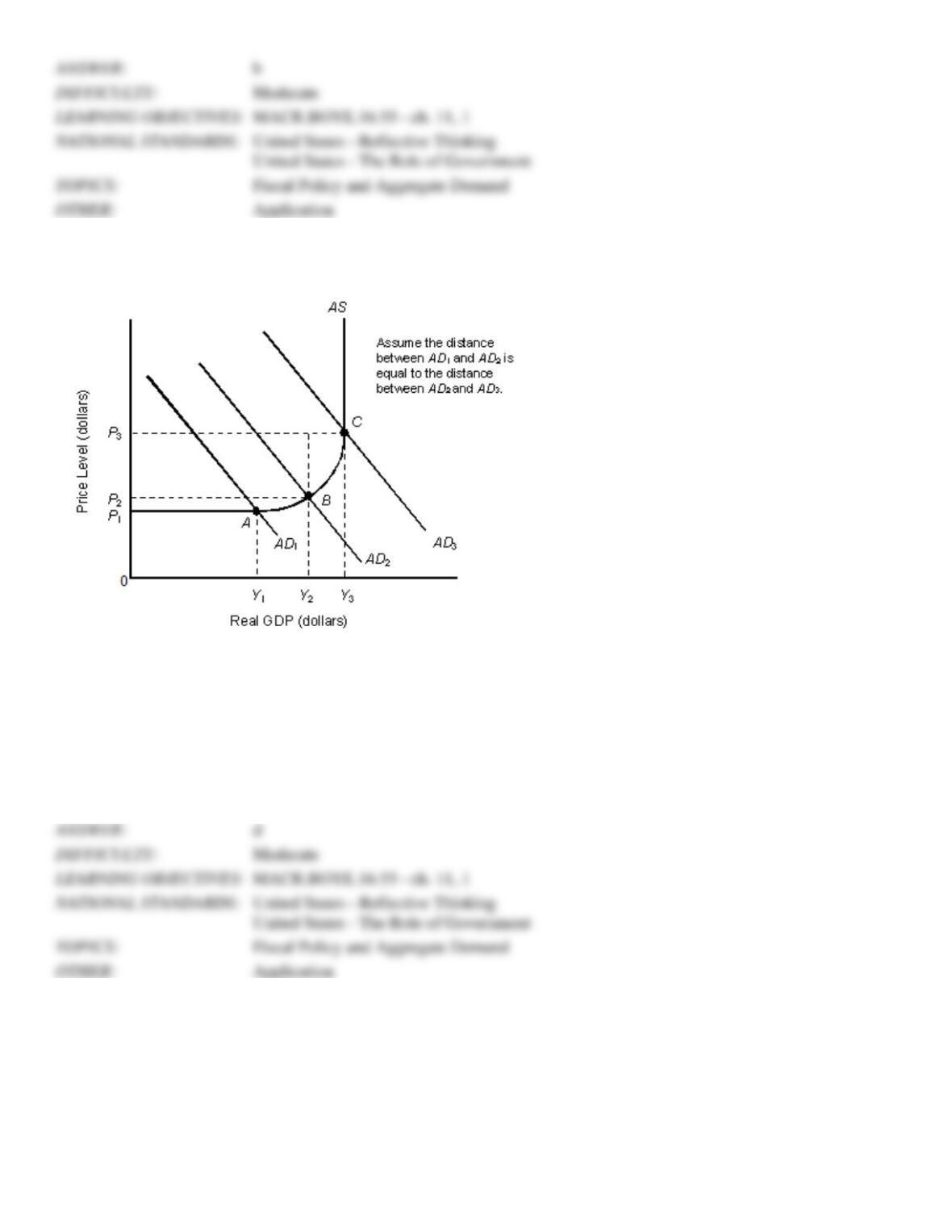
The figure given below shows the macroeconomic equilibria of a country.
Figure 11.1
11. Refer to Figure 11.1. If the economy is in equilibrium at point C, then, other things equal, an increase in government
spending will:
a.
decrease the price level.
b.
lower real GDP and leave the price level unchanged.
c.
lower real GDP and increase the price level.
d.
increase the price level and leave real GDP unchanged.
e.
have no effect on real GDP or the price level.
MACR.BOYE.16.55 – ch. 11, 1
Fiscal Policy and Aggregate Demand
12. Refer to Figure 11.1. A decrease in government spending would be most effective in reducing the price level if:
a.
the economy were in equilibrium at point A.
b.
the economy were in equilibrium at point B.
c.
there is a rightward shift in the aggregate supply curve.
d.
the economy were in equilibrium at point C.
e.
there is a leftward shift in the aggregate supply curve.
MACR.BOYE.16.55 – ch. 11, 1
United States – The Role of Government
Fiscal Policy and Aggregate Demand
13. Fiscal policy is most effective in controlling inflation when the economy operates in the _____ region of the aggregate
supply curve.
a.
horizontal
b.
vertical
c.
upward rising
d.
downward sloping
e.
backward bending
b
Moderate
MACR.BOYE.16.55 – ch. 11, 1
United States – The Role of Government
Fiscal Policy and Aggregate Demand
Analysis
14. _____, the lesser will be the effect of an increase in government spending on real GDP.
a.
The smaller the crowding-out effect
b.
The smaller the percentage of government spending financed by tax increases
c.
The larger the government budget surplus
d.
The more rapidly money is converted into goods
e.
The steeper the aggregate supply curve
Moderate
MACR.BOYE.16.55 – ch. 11, 1
United States – Reflective Thinking
Fiscal Policy and Aggregate Demand
Analysis
Revised
15. Which of the following statements is true of government spending?
a.
An increase in government spending raises the equilibrium level of income by a multiple of the original
spending increase.
b.
Government spending is a part of monetary policy, not fiscal policy.
c.
A decline in government spending brings about an expansion in the economy.
d.
An increase in government spending increases the recessionary gap in the economy.
e.
An increase in government spending shifts the aggregate demand curve downward by a fraction of the rise in
government spending.
d
Moderate
MACR.BOYE.16.55 – ch. 11, 1
United States – The Role of Government
Fiscal Policy and Aggregate Demand
Application
Revised
16. Calculate the government spending multiplier if, an increase in government spending by $5 million increases real
GDP by $25 million.
a.
0.2
b.
0.5
c.
2
d.
5
e.
6
d
Moderate
MACR.BOYE.16.55 – ch. 11, 1
United States – The Role of Government
Fiscal Policy and Aggregate Demand
Application
17. Government spending equals the sum of _____, _____, and _____.
a.
taxes; changes in the reserves of the central bank; changes in net exports
b.
taxes; change in government debt; change in government-issued money
c.
taxes; public expenditures; private deductible expenditures
d.
public expenditures; business investment; change in government debt
e.
public debt; welfare expenditures; social security expenditures
b
Easy
MACR.BOYE.16.55 – ch. 11, 1
United States – The Role of Government
Fiscal Policy and Aggregate Demand
Knowledge
18. Which of the following is not a means of financing government spending?
a.
Government subsidies
b.
Personal income taxes
c.
Printing new money
d.
Issuing government bonds
e.
Capital gains taxes
Moderate
MACR.BOYE.16.55 – ch. 11, 1
United States – The Role of Government
Fiscal Policy and Aggregate Demand
Knowledge
Revised
19. If government spending in a country declines by $10 billion and, at the same time, taxes increase by an equal amount,
what is the total effect in the economy?
a.
Equilibrium real GDP increases
b.
Equilibrium real GDP increases by $20 billion
c.
Equilibrium real GDP is unchanged
d.
Equilibrium real GDP decreases by more than $10 billion and less than $20 billion
e.
Equilibrium real GDP decreases by more than $20 billion
MACR.BOYE.16.55 – ch. 11, 1
United States – The Role of Government
Fiscal Policy and Aggregate Demand
The figure given below depicts the tax revenue for different tax rates applied by the government.
Figure 11.2
20. Refer to Figure 11.2. If you were a member of the Congress that aims to increase tax revenue collections, what would
you recommend if the current tax rate was 80 percent?
a.
Increasing the tax rate to 100 percent
b.
Decreasing the tax rate to 30 percent
c.
Decreasing the tax rate to 70 percent
d.
Increasing the tax rate to 90 percent
e.
Decreasing the tax rate to zero percent
MACR.BOYE.16.55 – ch. 11, 1
Fiscal Policy and Aggregate Demand
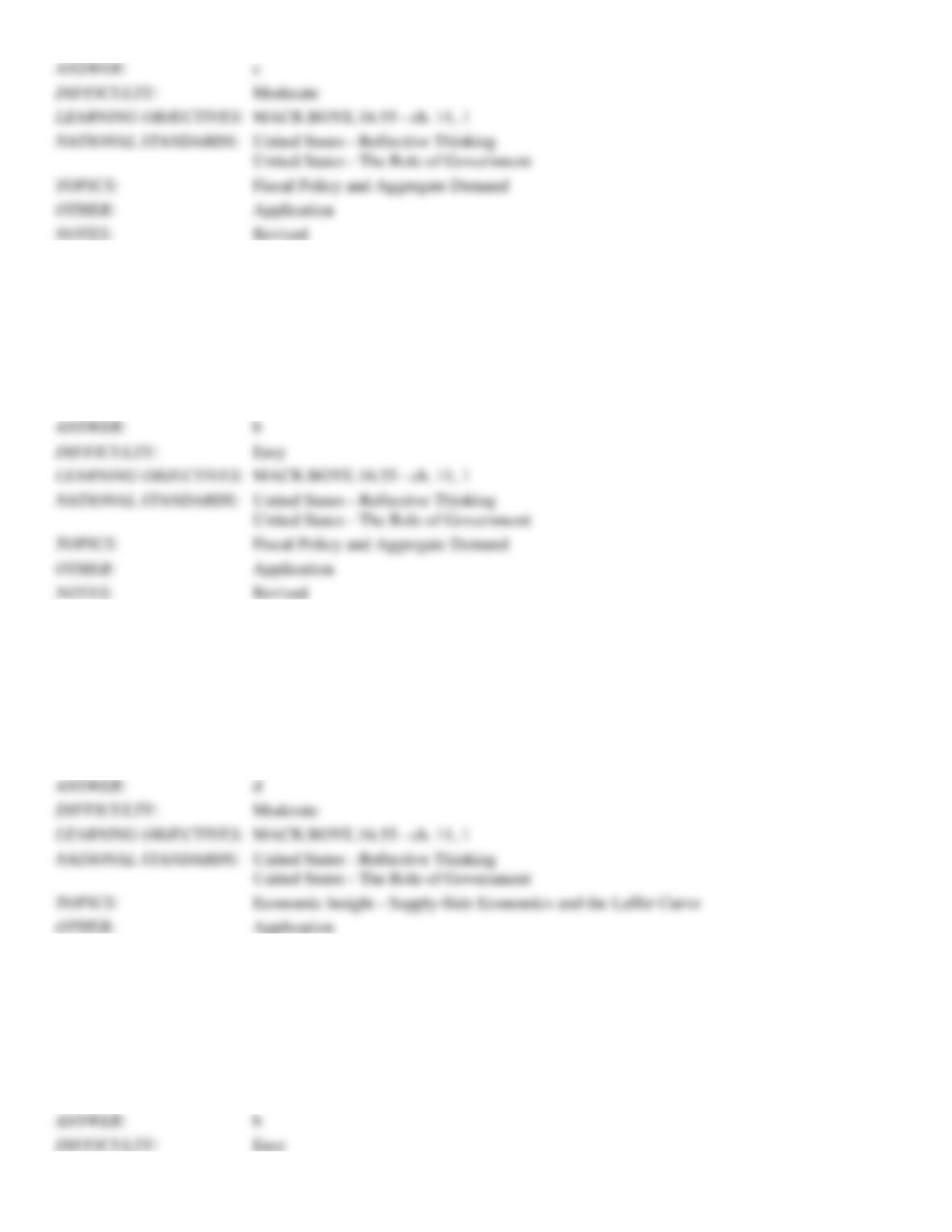
21. Refer to Figure 11.2. If the tax rate were 100 percent, then:
a.
tax revenue would be maximized.
b.
no one would be willing to work.
c.
there would be a strong incentive to work.
d.
tax revenue would be greater than if the tax rate were 70 percent.
e.
tax revenue would be less than if the tax rate were zero percent.
Easy
MACR.BOYE.16.55 – ch. 11, 1
United States – The Role of Government
Fiscal Policy and Aggregate Demand
Application
22. Which of the following is depicted in Figure 11.2?
a.
The Lorenz curve
b.
The community indifference curve
c.
The aggregate labor supply curve
d.
The Laffer curve
e.
The Engel curve
Moderate
MACR.BOYE.16.55 – ch. 11, 1
United States – The Role of Government
Economic Insight – Supply-Side Economics and the Laffer Curve
Application
23. The emphasis on the greater incentives to produce, created by lower taxes, has come to be known as:
a.
the trickle-down economics.
b.
the supply-side economics.
c.
the paradox of thrift.
d.
the permanent income hypothesis.
e.
monetarism.
b
Moderate
MACR.BOYE.16.55 – ch. 11, 1
United States – The Role of Government
Fiscal Policy and Aggregate Demand
Application
24. Critics of the supply-side tax cuts proposed by the Reagan administration argued that lower taxes would:
a.
increase the budget deficit.
b.
decrease money supply in the economy.
c.
reduce the aggregate price level.
d.
reduce the disposable income of households.
e.
reduce the volume of international trade.
MACR.BOYE.16.55 – ch. 11, 1
United States – The Role of Government
Economic Insight – Supply-Side Economics and the Laffer Curve
25. If consumers spend _____ of a change in their disposable income, then a tax increase of $100 would lower
consumption by $70.
a.
35 percent
b.
100 percent
c.
80 percent
d.
70 percent
e.
50 percent
MACR.BOYE.16.55 – ch. 11, 1
United States – The Role of Government
Fiscal Policy and Aggregate Demand
26. In the late 1990s, debt-financed government spending decreased in Mexico. Following this decrease, consumption
spending increased. Ricardian equivalence would explain this increase in consumption as the result of:
a.
people’s expectation of higher future taxes required to pay off government debt.
b.
people’s expectation of lower future taxes that induce them to save less.
c.
automatic stabilization of the economy.
d.
the crowding out effect.
e.
an increase in current household disposable income.
United States – Reflective Thinking
MACR.BOYE.16.55 – ch. 11, 1
Fiscal Policy and Aggregate Demand
27. Which of the following correctly explain Ricardian equivalence?
a.
Government spending that is financed by borrowing has a smaller effect on the economy than government
spending financed by raising taxes.
b.
Consumers do not base current spending on future expected tax liabilities.
c.
Government borrowing can function like increased current taxes, reducing current household and
business expenditures.
d.
The government should balance its budget by equating revenue and expenditure in every fiscal year.
e.
Government spending does not crowd out private investment.
MACR.BOYE.16.55 – ch. 11, 1
United States – Analytic – BB-Legal
United States – The Role of Government
Fiscal Policy and Aggregate Demand
28. Ricardian equivalence can be said to hold if:
a.
taxation has greater effect on private spending than government borrowing.
b.
taxation has a lesser effect on private spending than government borrowing.
c.
government borrowing does not affect private consumption while taxation has a negative impact on private
consumption.
d.
government spending activities financed by taxation and those financed by borrowing have the same effect on
private spending.
e.
government spending activities financed by taxation and those financed by borrowing have no effect on
private spending.
MACR.BOYE.16.55 – ch. 11, 1
United States – Analytic – BB-Legal
United States – The Role of Government
Fiscal Policy and Aggregate Demand
The figure given below depicts the macroeconomic equilibrium in a country.
United States – The Role of Government
Fiscal Policy and Aggregate Demand
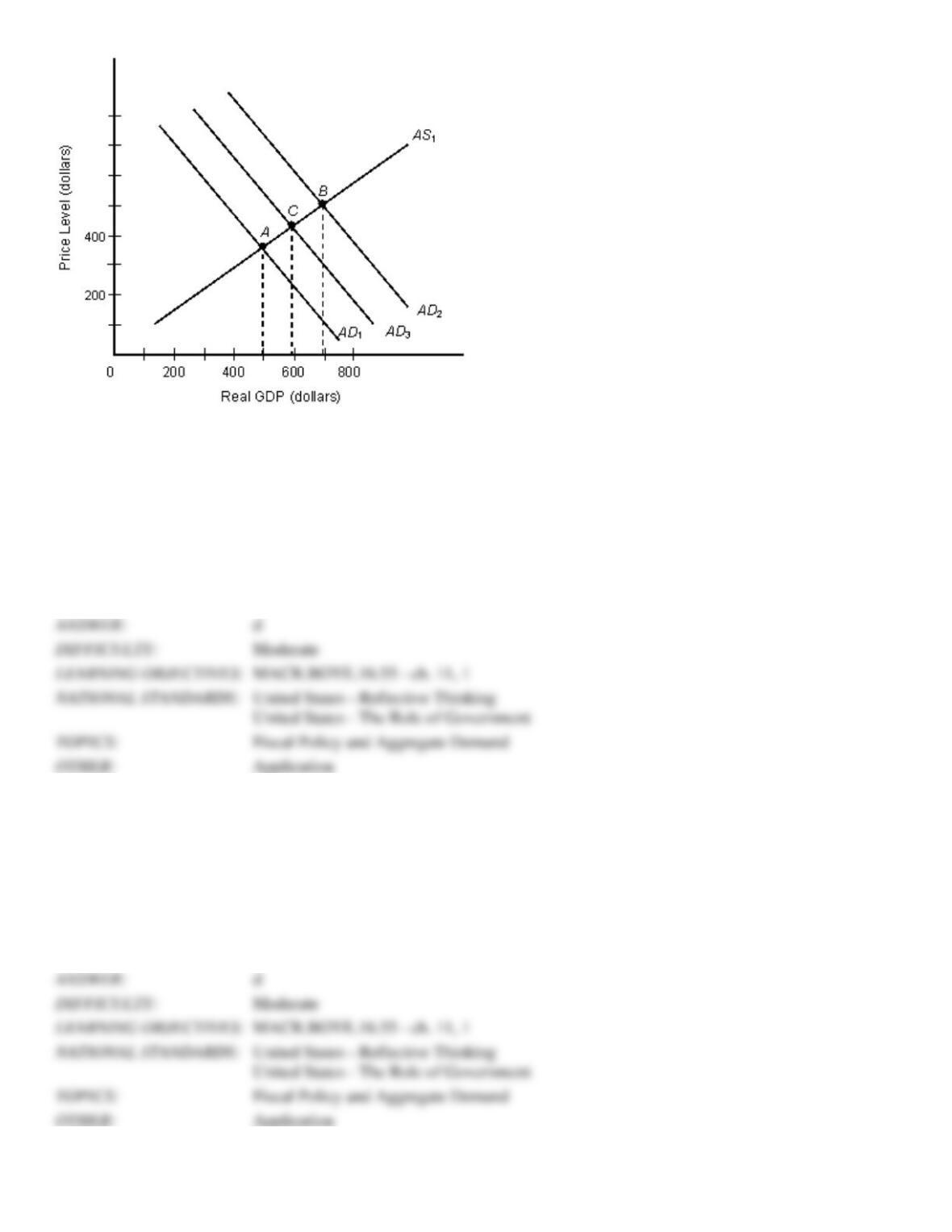
29. Refer to Figure 11.3. Assume that the increase in aggregate demand from AD1 to AD2 was the result of government
spending that was financed by borrowing. Assuming that the Ricardian equivalence holds and people expect taxes to rise
in future, the equilibrium income will be:
a.
$800.
b.
less than $500.
c.
more than $800.
d.
less than $700.
e.
$700.
30. Suppose an economy is in equilibrium. Also suppose that consumer expectations change as the threat of war increases
the likelihood of an increase in taxes. This would result in:
a.
an increase in equilibrium income.
b.
no change in equilibrium income.
c.
a downward shift of the aggregate supply curve.
d.
a decrease in equilibrium income.
e.
a change in the slope of the aggregate supply curve.
d
Moderate
MACR.BOYE.16.55 – ch. 11, 1
Fiscal Policy and Aggregate Demand
Application
d
Moderate
MACR.BOYE.16.55 – ch. 11, 1
United States – The Role of Government
Fiscal Policy and Aggregate Demand
Application
31. A drop in consumption or investment spending caused by increased government spending is referred to as:
a.
the multiplier effect.
b.
an expansionary gap.
c.
Ricardian equivalence.
d.
the paradox of thrift.
e.
crowding out.
32. In the presence of the crowding out effect, the purchase of Treasury bonds by the government will result in:
a.
an increase in the interest rates.
b.
a decrease in the price of bonds.
c.
a decline in the private sector spending.
d.
an increase in the private sector spending.
e.
a decrease in the rate of inflation.
MACR.BOYE.16.55 – ch. 11, 1
Fiscal Policy and Aggregate Demand
33. Assume that fewer businesses offer new bonds to raise investment funds when government borrowing increases
interest rates. This would be an example of:
a.
Ricardian equivalence.
b.
overestimating the tax multiplier.
c.
crowding out.
d.
increased consumption.
e.
the balanced-budget multiplier.
MACR.BOYE.16.55 – ch. 11, 1
United States – The Role of Government
Fiscal Policy and Aggregate Demand
34. If crowding out exists, the expansionary effect of government spending will be:
a.
smaller than intended.
MACR.BOYE.16.55 – ch. 11, 1
Fiscal Policy and Aggregate Demand
b.
negative.
c.
infinite.
d.
larger than intended.
e.
zero.
35. Identify the correct statement.
a.
It is absolutely compulsory for the government to earn a profitable return on the money it earns by selling
bonds.
b.
When government borrowing rises, interest rates decline, thereby driving up private investment.
c.
When interest rates rise, fewer number of corporations offer new bonds to raise investment funds.
d.
An increase in interest rate reduces the cost of borrowing by the firms.
e.
When interest rates fall, the firm’s cost of raising funds through bonds increases.
MACR.BOYE.16.55 – ch. 11, 1
United States – Analytic – BB-Legal
United States – The Role of Government
Knowledge
36. Which of the following is true of fiscal policy before the Great Depression of the 1930s?
a.
Fiscal policy was made at the federal level.
b.
Policies associated with national defense were made at the state level.
c.
Environmental degradation and education were the focus areas of the federal government while other areas of
government policy were dealt by individual states.
d.
The federal budget was determined mostly by economists and not by politicians.
e.
National defense and foreign trade were the focus areas of the federal government while other areas of
government policy were dealt by individual states.
Moderate
MACR.BOYE.16.56 – ch. 11, 2
United States – Analytic – BB-Legal
United States – The Role of Government
Fiscal Policy in the United States
Knowledge
37. Which of the following trends has been observed in federal revenues and expenditures over time?
a.
Expenditures were lower than the revenues in the 1998-2001 period.
b.
Expenditures were lower than the revenues in the 1930s.
Moderate
MACR.BOYE.16.55 – ch. 11, 1
United States – Analytic – BB-Legal
Fiscal Policy and Aggregate Demand
Knowledge
c.
Expenditures were higher than the revenues in the 1998-2001 period.
d.
Expenditures were more or less equal to the revenues in the 1930s.
e.
Expenditures were more or less equal to the revenues in the 1998-2001 period.
38. The ratio of U.S. government spending to GDP reached its peak during:
a.
World War I.
b.
World War II.
c.
the Great Depression.
d.
the real estate crisis.
e.
the bursting of the stock market bubble.
MACR.BOYE.16.56 – ch. 11, 2
United States – The Role of Government
Fiscal Policy in the United States
39. Starting with a situation where there is a substantial budget deficit, when tax revenues grow faster than federal
expenditures, the government will experience:
a.
a balanced budget.
b.
an increasing national debt.
c.
a declining budget surplus.
d.
a declining budget deficit.
e.
an increasing budget deficit.
MACR.BOYE.16.56 – ch. 11, 2
United States – The Role of Government
Fiscal Policy in the United States
40. Discretionary fiscal policy is best defined as:
a.
the deliberate change in tax laws and government spending to change equilibrium income.
b.
the deliberate manipulation of the money supply to expand the economy.
c.
the arbitrary fluctuation in tax laws and budget requirements.
d.
the automatic change in certain fiscal instruments when real GDP changes.
MACR.BOYE.16.56 – ch. 11, 2
United States – The Role of Government
Fiscal Policy in the United States
e.
the policy action taken by the Congress to reduce the federal budget deficit.
41. _____ refers to the changes in government spending and taxation that are aimed at achieving a policy goal.
a.
Discretionary monetary policy
b.
Discretionary fiscal policy
c.
Discretionary foreign trade policy
d.
Discretionary exchange rate policy
e.
Discretionary interest rate policy
MACR.BOYE.16.56 – ch. 11, 2
United States – The Role of Government
Fiscal Policy in the United States
42. _____ are elements of fiscal policy that automatically change in value as national income changes.
a.
Statistical discrepancies
b.
Exchange rates
c.
Budget deficits
d.
Automatic stabilizers
e.
Supply-side shocks
MACR.BOYE.16.56 – ch. 11, 2
Fiscal Policy in the United States
43. Which of the following can be considered as an automatic stabilizer in the economy?
a.
Real exchange rate
b.
Real interest rate
c.
Unemployment insurance
d.
Money supply
e.
Disposable income
MACR.BOYE.16.56 – ch. 11, 2
Fiscal Policy in the United States