Macroeconomics, 12e (Parkin)
Chapter 11 Expenditure Multipliers
1 Fixed Prices and Expenditure Plans
1) In the Keynesian model of aggregate expenditure, real GDP is determined by the
A) price level.
B) level of aggregate demand.
C) level of aggregate supply.
D) level of taxes.
2) The Keynesian model of aggregate expenditure describes the economy in
A) the short run.
B) the long run.
C) both the short run and the long run.
D) only a strong expansion.
3) The Keynesian model of aggregate expenditure assumes that
A) individual firms’ prices are flexible but the price level is fixed.
B) both individual firms’ prices and the price level are flexible.
C) both individual firms’ prices and the price level are fixed.
D) individual firms’ prices are fixed but the price level is flexible.
4) In the Keynesian model of aggregate expenditure, we assume that firms will
A) not change prices.
B) change prices only when inventory levels rise.
C) raise prices when inventory levels fall.
D) change prices immediately after a fluctuation in aggregate demand, to maintain profits.
5) According to the Keynesian theory, the typical firm
A) changes its prices frequently in response to fluctuations in aggregate demand.
B) lowers its prices when inventories are decreasing.
C) does not change its prices immediately when aggregate demand fluctuates.
D) lowers its prices if sales exceed production.
6) If firms set prices and then keep them fixed for a period of time, their fixed prices imply that
A) the aggregate price level is fixed and that aggregate demand determines the quantity of goods
and services sold.
B) prices are set by aggregate demand and supply.
C) the aggregate price level adjusts continuously.
D) the aggregate price level is fixed and that aggregate supply determines the quantity of goods
and services sold.
7) In the very short term, in the Keynesian model, which of the following is fixed and does not
change when GDP changes?
A) planned investment
B) planned consumption
C) planned imports
D) All of the above answers are correct.
8) In the very short term, planned investment ________ when GDP changes and planned
consumption expenditure ________ when GDP changes.
A) changes; changes.
B) changes; does not change
C) does not change; changes
D) does not change; does not change
9) The components of aggregate expenditure include
I. imports.
II. consumption.
III. government transfer payments.
A) I and II
B) II only
C) II and III
D) I, II and III
10) In the very short run, the components of aggregate planned expenditure that depend on the
level of real GDP are
A) planned consumption expenditure and planned imports.
B) planned investment and planned imports.
C) planned investment and planned exports.
D) planned government expenditure on goods and services and planned imports.
11) An increase in real GDP leads to
A) a decrease aggregate planned expenditure.
B) no change in aggregate planned expenditure.
C) an increase in aggregate planned expenditure.
D) a change in aggregate planned expenditure but whether the change is an increase or a
decrease depends on whether nominal GDP increases or decreases.
12) Disposable income is
A) income minus saving.
B) income minus taxes plus transfer payments.
C) income plus transfer payments minus consumption expenditure.
D) total income divided by the price level.
13) Which of the following statements is FALSE?
A) Disposable income – saving = consumption expenditure.
B) Consumption expenditure + saving = disposable income.
C) Saving = disposable income – consumption expenditure.
D) Consumption expenditure = saving – disposable income.
14) Disposable income is equal to
A) consumption expenditure minus taxes plus transfer payments.
B) aggregate income minus taxes plus government expenditures on goods and services.
C) aggregate income minus taxes plus transfer payments.
D) aggregate income plus transfer payments.
15) Real GDP
A) is always greater then aggregate income.
B) is always less than aggregate income.
C) might be less than or more than aggregate income depending on consumption.
D) is equal to aggregate income.
16) Disposable income is divided into
A) consumption and taxes.
B) saving and taxes.
C) consumption, saving, and taxes.
D) consumption and saving.
17) Saving equals
A) disposable income minus taxes.
B) disposable income minus consumption expenditure.
C) disposable income plus consumption expenditure.
D) consumption expenditure minus disposable income.
18) A consumption function shows a
A) negative (inverse) relationship between consumption expenditure and saving.
B) positive (direct) relationship between consumption expenditure and the price level.
C) negative (inverse) relationship between consumption expenditure and disposable income.
D) positive (direct) relationship between consumption expenditure and disposable income.
19) The consumption function relates consumption expenditure to
A) the interest rate.
B) disposable income.
C) saving.
D) the price level.
20) The consumption function relates the consumption expenditure decisions of households to
A) the level of disposable income.
B) investment decisions of firms.
C) saving decisions of households.
D) the nominal interest rate.
21) The graph of the consumption function has consumption expenditure on the vertical axis and
A) the interest rate on the horizontal axis.
B) time on the horizontal axis.
C) disposable income on the horizontal axis.
D) the Consumer Price Index on the horizontal axis.
22) The consumption function shows how much
A) all households plan to consume at each level of real disposable income.
B) all households plan to consume at each possible real interest rate.
C) real disposable income people will earn at each income tax bracket.
D) all households plan to consume at each level of savings.
23) The slope of the consumption function is
A) less than 1.
B) 1.
C) greater than 1.
D) negative.
24) The slope of the consumption function is
A) less than the slope of the 45-degree line but not equal to zero.
B) greater than the slope of the 45-degree line.
C) equal to the slope of the 45-degree line.
D) equal to zero.
25) A movement along the consumption function is the result of changes in
A) the real interest rate.
B) disposable income.
C) expected future income.
D) the price level
26) There is a movement along the consumption function if there is ________.
A) an increase in autonomous consumption
B) a decrease in the real interest rate
C) an increase in the expected future income
D) an increase in disposable income
27) A movement along the consumption function to higher levels of consumption expenditure
arises because
A) the level of disposable income decreases.
B) household wealth rises.
C) the level of disposable income increases.
D) the level of desired saving rises.
28) If disposable income increases
A) the consumption function shifts upward.
B) there is a movement upward along the consumption function.
C) the consumption function shifts downward.
D) there is movement downward along the consumption function.
29) The positive slope of the consumption function indicates that
A) consumers spend less out of each extra dollar of income.
B) the amount of household wealth is subject to change.
C) when prices fall consumers spend more.
D) consumers increase their total consumption expenditure when disposable income increases.
30) As disposable income increases, consumption expenditures
A) increase by the same amount.
B) increase by a smaller amount.
C) increase by a larger amount.
D) remain constant.
31) If real disposable income increases by $1500, consumption expenditures will
A) stay constant.
B) decrease by less than $1500.
C) increase by less than $1500.
D) increase by more than $1500.
32) Between 2013 and 2014 the government estimates that disposable income in the United
States decreased. Consequently, as a result of this change, consumption expenditure
A) remained constant.
B) decreased.
C) increased.
D) More information is needed about how taxes changed between 2013 and 2014.
33) Which of the following will NOT shift the consumption function upward?
A) an increase in disposable income
B) a fall in the real interest rate
C) an increase in wealth
D) an increase in price
34) An increase in expected future income ________.
A) decreases consumption expenditure
B) increases saving
C) shifts the consumption function upward
D) shifts the saving function upward
35) Autonomous consumption is that portion of consumption expenditure that is not influenced
by
A) income.
B) preferences.
C) prices.
D) the legal authorities.
36) Autonomous consumption
A) increases with income.
B) is independent of income.
C) is independent of income and must be equal to zero.
D) decreases with income.
37) ________ consumption is consumption that will occur ________ the level of GDP and
disposable income.
A) Autonomous; independent of
B) Autonomous; depending on
C) Induced; independent of
D) None of the above answers is correct.
38) Autonomous consumption is equal to
A) saving when consumption equals disposable income.
B) consumption when disposable income is zero.
C) consumption caused by an increase in disposable income.
D) dissaving when disposable income is greater than zero.
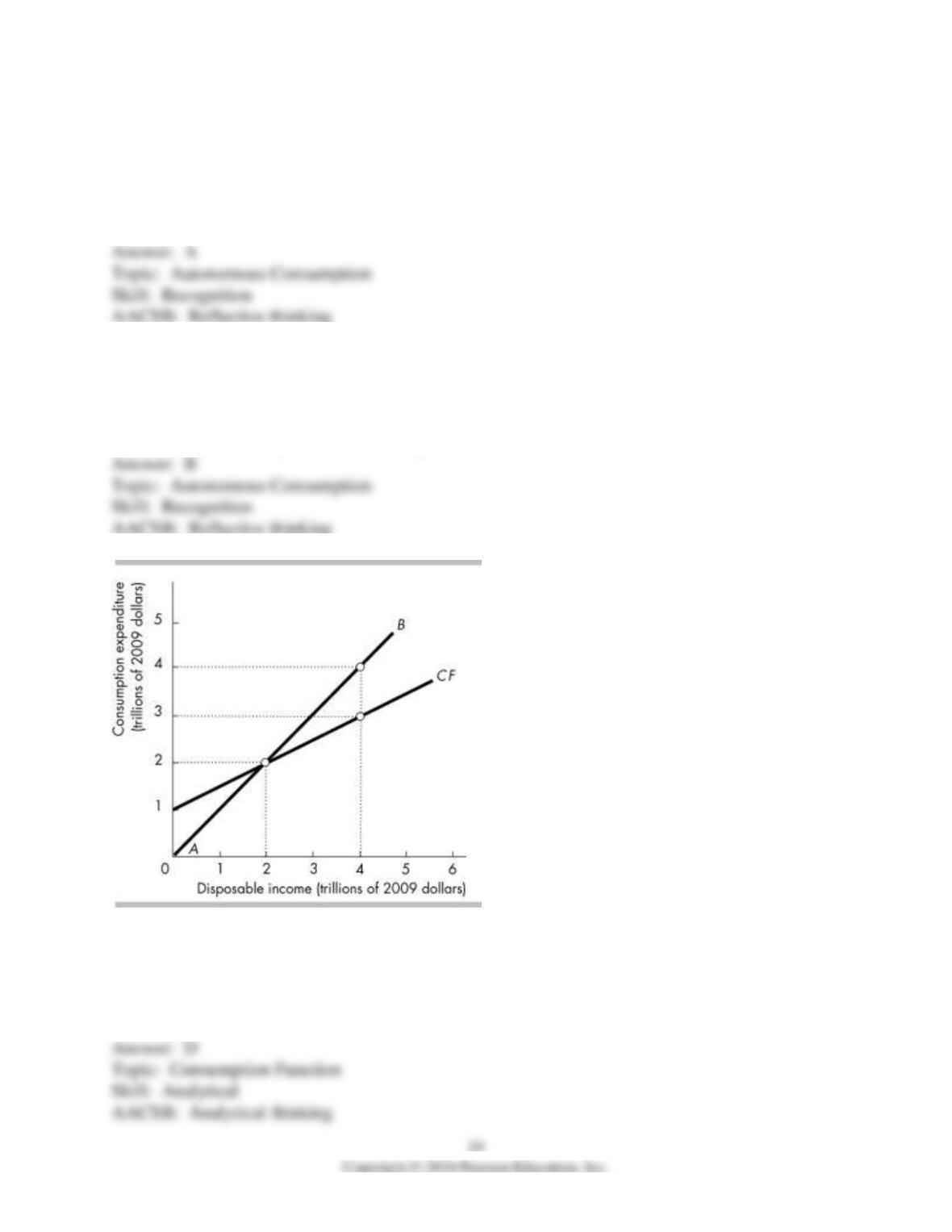
39) In the above figure, consumption and disposable income are equal at
A) any point along the consumption function.
B) a saving level of $1 trillion and disposable income level of $4 trillion.
C) a disposable income level of $0.
D) a disposable income level of $2 trillion.
40) In the above figure, at a disposable income level of $2 trillion, saving equals
A) disposable income.
B) zero.
C) $4 trillion.
D) consumption expenditures.
41) In the above figure, the line AB is called
A) the saving function.
B) the consumption function.
C) the 45-degree line.
D) the expenditure function.
42) Induced consumption is equal to
A) saving when consumption equals disposable income.
B) consumption when disposable income is zero.
C) consumption caused by an increase in disposable income.
D) dissaving when disposable income is greater than zero.
43) In a diagram with the consumption function, the 45-degree line indicates all points where
A) consumption expenditures and saving are equal.
B) saving and investment are equal.
C) consumption expenditures and disposable income are equal.
D) saving and disposable income are equal.
44) In a diagram with the consumption function, the ________ shows all points where disposable
income equals consumption expenditures.
A) consumption function
B) aggregate demand curve
C) 45-degree line
D) saving function
45) Consumption expenditures equal disposable income
A) at every point on the consumption function.
B) at every point on the saving function.
C) at every point on the 45-degree line.
D) when saving equals disposable income.
46) With consumption expenditure on the vertical axis and disposable income on the horizontal
axis, the consumption function intersects the 45-degree line at $8 trillion. This result indicates
that
A) autonomous consumption spending is $8 trillion.
B) consumption spending is $8 trillion when disposable income is $8 trillion.
C) consumption spending is less than $8 trillion because taxes must be paid.
D) consumption spending is more than $8 trillion because taxes have been paid.
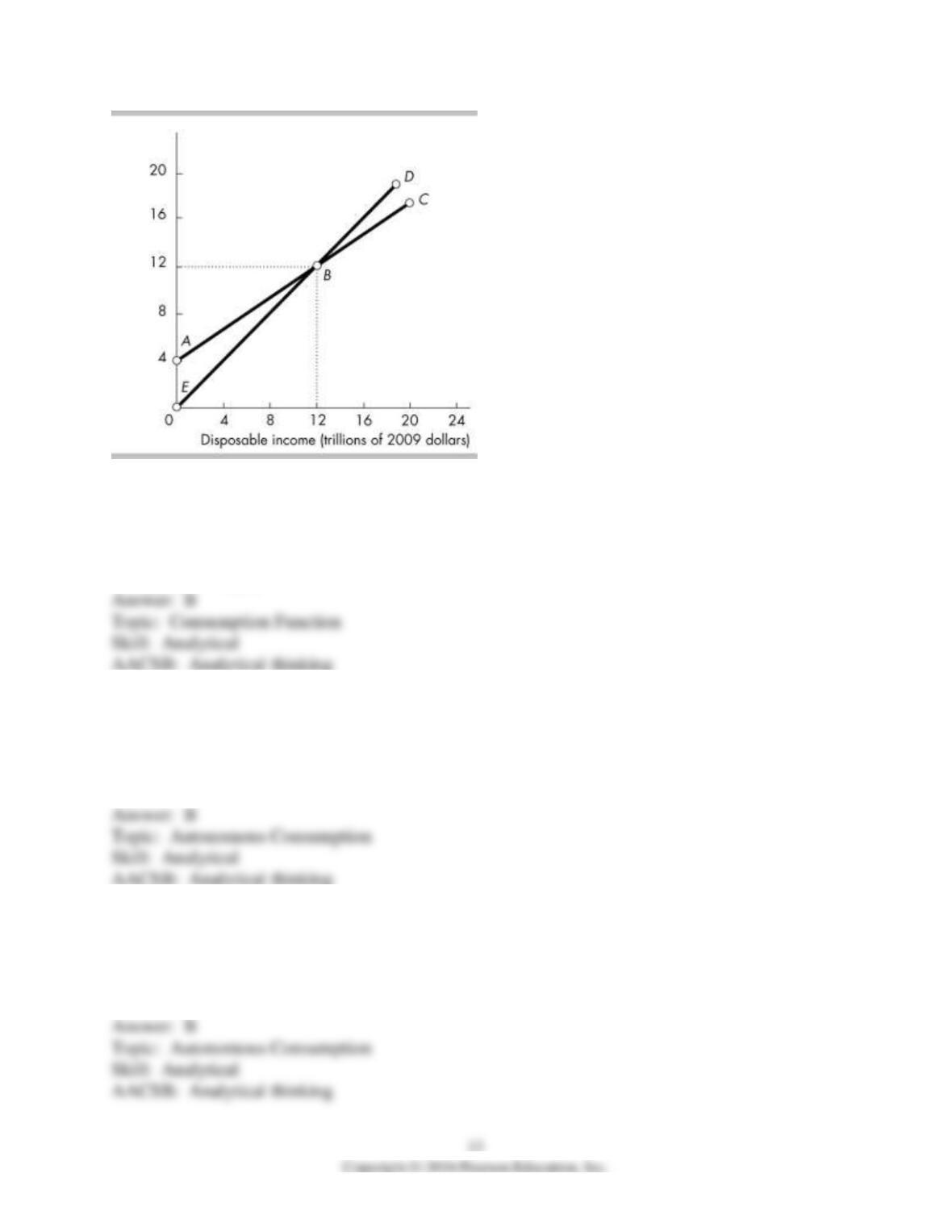
47) In the above figure, line ABC is called
A) the 45-degree line.
B) the consumption function.
C) the saving function.
D) aggregate supply.
48) In the above figure, autonomous consumption equals
A) 0.
B) $4 trillion.
C) $12 trillion.
D) -$4 trillion.
49) In the above figure, when disposable income is $12 trillion , induced consumption equals
A) $4 trillion.
B) $8 trillion.
C) $12 trillion.
D) $16 trillion.
50) When disposable income equals $800 billion, planned consumption expenditure equals $600
billion, and when disposable income equals $1,000 billion, planned consumption expenditure
equals $640 billion. What is planned saving when disposable income is $800 billion?
A) $200 billion
B) $360 billion
C) $560 billion
D) $1,400 billion
51) As real disposable income increases, consumption expenditure ________ and saving
________.
A) increases; increases
B) increases; decreases
C) decreases; increases
D) decreases; decreases
52) Planned saving equals
A) disposable income minus planned consumption expenditure.
B) planned consumption expenditure minus disposable income.
C) zero when disposable income is less than planned consumption expenditure.
D) planned consumption expenditure plus disposable income.
53) “Dissaving” occurs when
A) income exceeds consumption expenditure.
B) saving is negative.
C) the consumption function is below the 45-degree line drawn from the origin.
D) saving is positive.
54) Dissaving
A) is equal to consumption expenditure when disposable income is greater than zero.
B) is equal to the amount of saving when consumption is less than disposable income.
C) is equal to taxation when disposable income is zero.
D) occurs when consumption is greater than disposable income.
55) ________ consumption expenditure is greater than disposable income.
A) It is always the case that
B) Saving is positive whenever
C) Dissaving occurs whenever
D) None of the above answers is correct because it is impossible for consumption expenditure to
be greater than disposable income.
56) When disposable income equals consumption expenditure, then
A) saving is zero.
B) the MPC = zero.
C) the MPS = zero.
D) None of the above is correct.
57) Where the consumption function crosses the 45° line
A) consumption expenditure equals saving.
B) saving is positive.
C) saving is negative.
D) consumption expenditure equals disposable income.
58) When the consumption function lies above the 45-degree line, households
A) spend on consumption an increasing percentage of any increase in income.
B) spend on consumption a decreasing percentage of any increase in income.
C) are dissaving.
D) save all of any increase in income.
59) If the consumption function lies below the 45-degree line, then saving at these levels of
disposable income will
A) be positive.
B) be negative.
C) equal zero.
D) be some amount that cannot be determined without additional information.
60) The vertical distance between the 45-degree line and the consumption line represents
A) investment.
B) total consumption expenditure.
C) the difference between consumption expenditure and investment.
D) saving or dissaving.
61) Saving rather than dissaving occurs at any level of disposable income at which
A) the consumption function is above the 45-degree line.
B) the consumption function intersects the saving/income curve.
C) the consumption function is below the 45-degree line.
D) autonomous consumption is positive.
62) The saving function shows a ________ relationship between ________.
A) positive; disposable income and saving
B) positive; disposable income and dissaving
C) negative; disposable income and consumption expenditure
D) negative; real GDP and saving
63) An increase in disposable income
A) shifts the saving function upward.
B) results in a movement upward along the saving function.
C) shifts the saving function downward.
D) results in a movement downward along the saving function.
64) A movement along the saving function occurs when
A) the real interest rate rises.
B) wealth increases.
C) disposable income decreases.
D) None of the above answers is correct.
65) As disposable income increases, there is a ________ the saving function.
A) leftward shift of the
B) movement along
C) rightward shift of
D) change in the slope of
66) At a level of disposable income of $0, consumption expenditure is $3500. Therefore when
disposable income is $0
A) saving and dissaving equal $0.
B) saving equals -$3500.
C) saving equals $3500.
D) the MPC = zero.
67) When disposable income is 0, consumption is $2000. Then
A) saving = $0.
B) saving = -$2000.
C) saving = $2000.
D) the MPC = 0.2.
68) An increase in disposable income shifts
A) both the consumption and savings functions upward.
B) the consumption function upward and leads to a movement along the savings function.
C) both the consumption and savings functions downward.
D) neither the consumption function or the savings function because it leads to a movement
along both the consumption and savings function.
69) What is the marginal propensity to consume?
A) the change in consumption expenditure divided by the change in disposable income
B) the percentage of disposable income that is consumed
C) one minus the fraction of total disposable income that is saved
D) the percentage of total income that is consumed
70) The marginal propensity to consume refers to
A) the additional saving that occurs out of an additional dollar of disposable income.
B) the additional consumption expenditure that occurs out of an additional dollar of disposable
income.
C) the additional consumption expenditure that occurs out of an additional dollar of investment.
D) the ratio of total consumption expenditure to total disposable income.
71) The marginal propensity to consume is the
A) fraction of a change in disposable income spent on consumption expenditure.
B) amount saving increases when consumption expenditure decreases.
C) fraction of a change in saving spent on consumption expenditure.
D) fraction of a change in consumption expenditure that is not saved.
72) The marginal propensity to consume is the ________.
A) fraction of total disposable income consumed
B) fraction of GDP consumed
C) fraction of a change in disposable income that is consumed.
D) total amount of disposable income consumed
73) The MPC is the fraction of
A) total disposable income that is consumed.
B) total disposable income that is not consumed.
C) a change in disposable income that is consumed.
D) a change in disposable income that is saved.
74) The marginal propensity to consume is equal to
A) what people spend out of total disposable income.
B) the desired amount of consumption expenditure as a proportion of disposable income.
C) the average, after-tax consumption amount.
D) the change in consumption expenditure resulting from a change in disposable income.
75) The marginal propensity to consume measures
A) how much of a given level of disposable income is consumed.
B) what percentage of disposable income goes to saving.
C) how much consumption expenditure occurs at the equilibrium level of income.
D) the fraction of a change in disposable income that is spent on consumption expenditure.
76) The marginal propensity to consume is
A) total consumption expenditure divided by the change in disposable income.
B) the change in consumption expenditure divided by total disposable income.
C) the change in consumption expenditure divided by the change in disposable income.
D) the change in consumption expenditure divided by total saving.
77) The marginal propensity to consume is found by
A) dividing consumption expenditure by disposable income.
B) dividing disposable income by consumption expenditure.
C) dividing the change in disposable income by the change in consumption expenditure.
D) dividing the change in consumption expenditure by the change in disposable income.