
Macroeconomics, 9e (Abel/Bernanke/Croushore)
Chapter 11 Keynesianism: The Macroeconomics of Wage and Price Rigidity
11.1 Real-Wage Rigidity
1) The existence of labor unions could contribute to real-wage rigidity, except that in the United
States
A) labor unions are outlawed.
B) most workers aren’t in unions.
C) unions are interested in benefits, not wages.
D) unions try to increase employment rather than negotiating over wages.
2) Keynesians are skeptical of the classical theory that recessions are periods of increased
mismatch between workers and jobs because
A) help-wanted advertising falls during recessions.
B) help-wanted advertising rises during recessions.
C) workers spend a lot of time searching for work in recessions.
D) people are indifferent between being employed or not.
3) The gift exchange motive suggests that
A) workers value benefits like health insurance more than job security.
B) workers prefer a nice work environment, even if they must accept lower wages.
C) workers who feel well treated will work harder and more efficiently.
D) workers will shirk if they are paid a low wage.
4) A model in which workers won’t be concerned about the possibility of being fired if they don’t
work hard, because their wage is so low, is called
A) a cost—benefit model.
B) a job—stress model.
C) a gift—exchange model.
D) a shirking model.
5) The effort curve is
A) horizontal, because work effort is independent of the real wage.
B) negatively sloped, because of diminishing marginal returns to labor.
C) positively sloped, because of the law of increasing cost.
D) S-shaped, because a small increase in the real wage will increase work effort more at an
intermediate wage than at a low wage or at a high wage.
6) According to the efficiency wage model, firms will pay the real wage that
A) maximizes workers’ marginal productivity.
B) maximizes the marginal productivity of capital and the marginal productivity of labor
together.
C) maximizes effort per dollar of real wage.
D) minimizes hiring and training costs to the firm.
7) Assuming no change in the effort curve of employees, the efficiency wage model implies that
A) the real wage is rigid and equals the efficiency wage.
B) the real wage exceeds the marginal productivity of labor.
C) an increase in the marginal productivity of capital will increase the real wage.
D) the real wage is procyclical.
8) Real-wage rigidity in the Keynesian efficiency wage diagram of the labor market is depicted
by
A) a vertical labor supply curve at the efficient level of employment,
B) a vertical labor demand curve at the efficient level of employment.
C) a horizontal line at the efficiency wage.
D) a steep, positively sloped labor supply curve depicting various efficiency wages at various
employment levels.
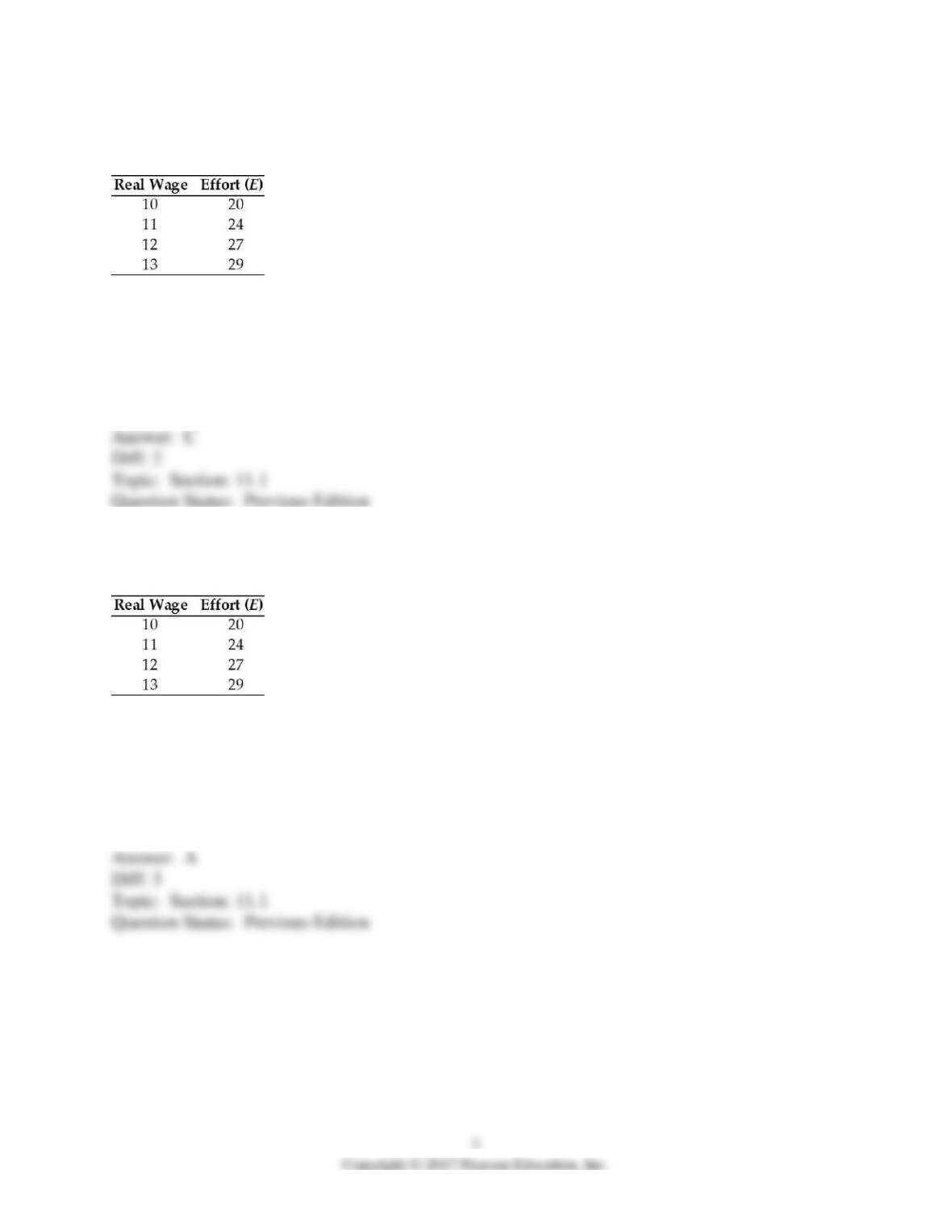
9) A firm faces the following relationship between the real wage it pays and the effort exerted by
its workers.
The marginal product of labor for this firm is given by MPN = E (100 – N)/9. The firm will
choose to pay a wage such that the effort level is
A) 20.
B) 24.
C) 27.
D) 29.
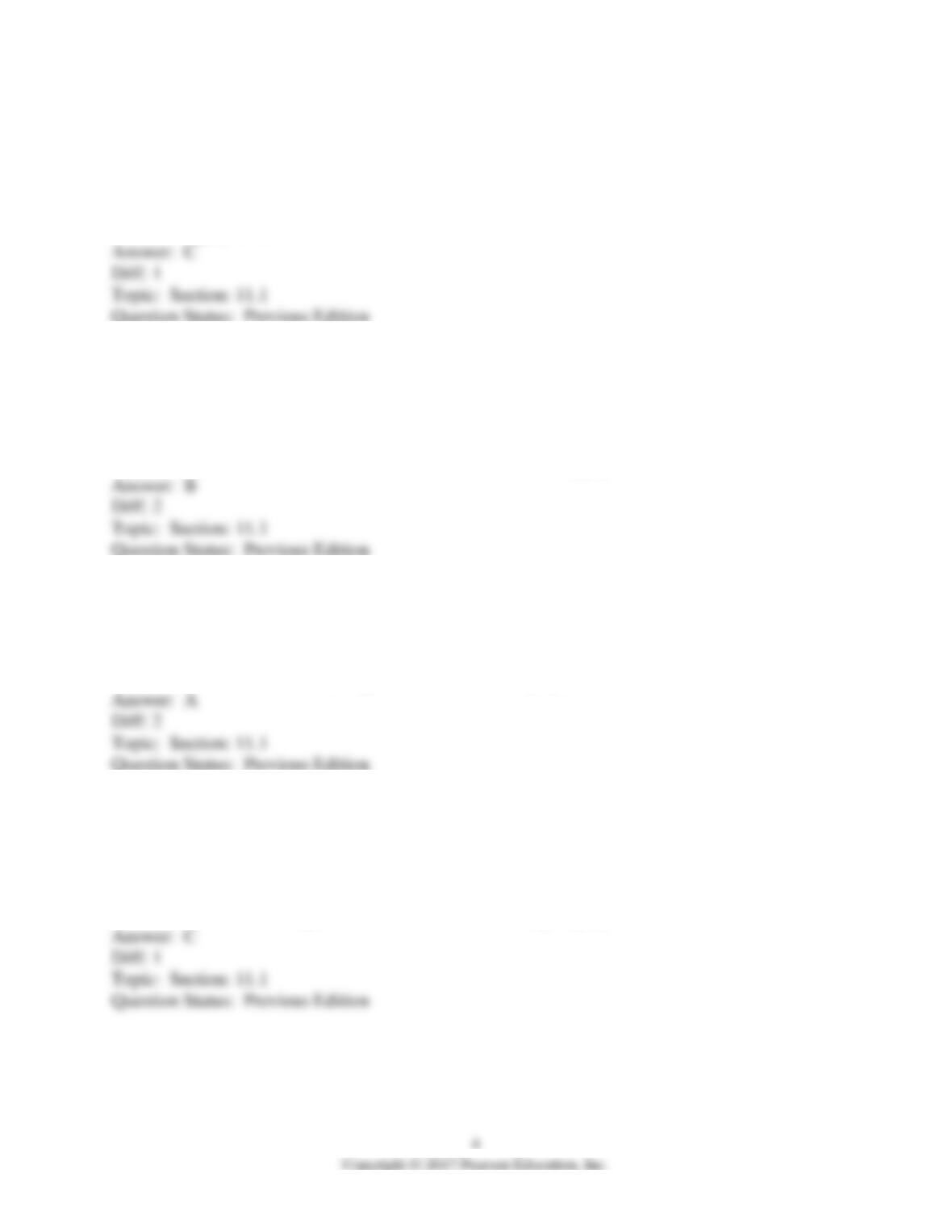
10) A firm faces the following relationship between the real wage it pays and the effort exerted
by its workers.
The marginal product of labor for this firm is given by MPN = E (100 – N)/9. How many workers
will the firm employ?
A) 96
B) 92
C) 88
D) 80
11) In the efficiency wage model with the efficiency wage above the market-clearing wage, the
level of employment depends on
A) the intersection of labor supply and labor demand.
B) the marginal productivity of capital and the marginal productivity of labor.
C) labor demand alone.
D) labor supply alone.
12) In the efficiency wage model with the efficiency wage above the market-clearing wage,
when employment is at its full-employment level
A) labor supply equals labor demand.
B) there is an excess supply of labor.
C) there is an excess demand for labor.
D) there could be either an excess demand for, or an excess supply of, labor.
13) In the efficiency wage model, an increase in productivity will cause
A) no change in the real wage.
B) an increase in the real wage.
C) a decrease in the real wage.
D) an increase in both the real wage and the level of employment.
14) In the efficiency wage model, if the real wage is higher than the market-clearing wage so that
there is an excess supply of labor
A) firms will hire new workers at lower wages.
B) firms will replace high-paid workers with low-paid, formerly unemployed workers.
C) employers will not hire workers who are willing to work for a lower wage.
D) firms will demand a higher level of effort from existing employees.
15) According to the efficiency wage model, during a recession, firms will not reduce real wages
because
A) unions would go on strike, reducing profitability.
B) this would reduce worker effort and productivity.
C) the equilibrium real wage has increased.
D) legally, they can’t.
16) The efficiency wage model can be modified to allow real wages to vary over the business
cycle by assuming that
A) workers’ effort may depend on the unemployment rate and the real wage.
B) during a recession, labor supply will decrease, reducing the efficiency wage.
C) during a recession, productivity will fall, causing a reduction in the efficiency wage.
D) during a boom, labor demand will increase, causing the efficiency wage to rise.
17) In the Keynesian model, the real wage is mildly procyclical because
A) demand for labor fluctuates with the demand for final goods.
B) firms take advantage of recessions to pay slightly lower wages, since there’s excess labor
supply.
C) workers’ effort may depend on the unemployment rate and the real wage.
D) the supply of labor fluctuates with the business cycle.
18) In the efficiency wage model, an increase in productivity would
A) increase output but decrease the real wage.
B) decrease the real wage but have no effect on output.
C) increase output but have no effect on the real wage.
D) have no effect on either output or the real wage.
19) In the Keynesian model with efficiency wages
A) the full-employment line is determined where the quantity of labor demanded equals the
quantity of labor supplied.
B) the full-employment level is determined at the intersection of the labor demand curve and the
efficiency wage line.
C) an increase in labor supply increases employment.
D) a decrease in labor supply shifts the FE line to the left.
20) In the Keynesian model, the full-employment level of output is the amount of output
produced when
A) the quantity of labor demanded equals the quantity of labor supplied.
B) the market wage exceeds the efficiency wage.
C) labor is paid an efficiency wage, and the real wage equals the marginal product of labor.
D) the real wage exceeds the nominal wage.
21) Why might firms pay an efficiency wage rather than a market-clearing wage?
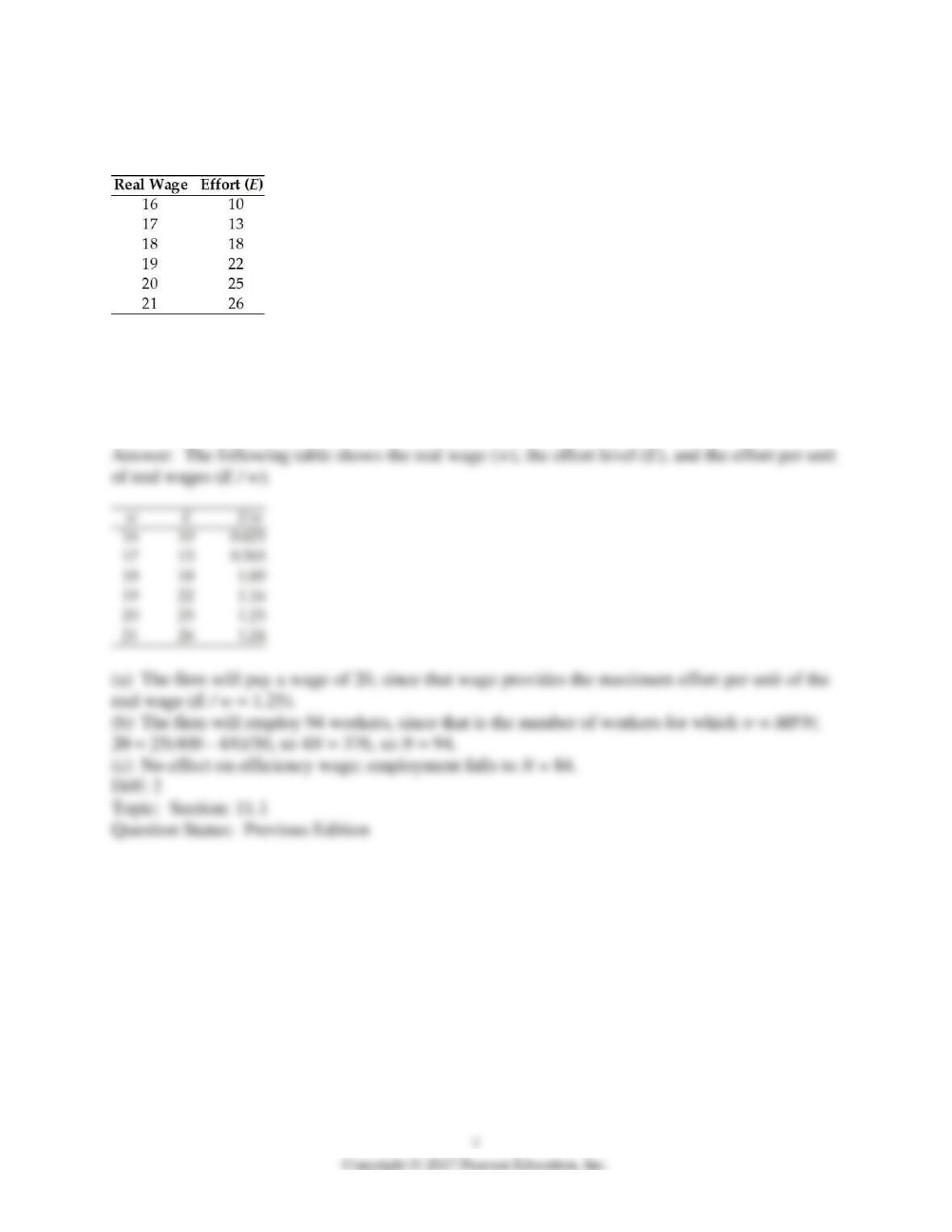
22) The effort of a firm’s workers depends on their real wage according to the following
schedule.
The marginal product of labor is MPN = E(400 – 4N)/30.
(a) What is the efficiency wage?
(b) How many workers will the firm hire?
(c) Suppose an adverse productivity shock reduces the marginal product of labor to MPN =
E(360 – 4N)/30. How would your answers to parts (a) and (b) change?
23) Describe how each of the following changes would affect the equilibrium in the labor market
in terms of the level of the real wage and quantity of employment in equilibrium:
(a) Increased immigration leads to higher labor supply at each real wage
(b) The effort curve makes a parallel shift upward
(c) Labor productivity increases (that is, the marginal product of labor increases at each level of
employment).
11.2 Price Stickiness
1) A firm is a price taker if it
A) always sells its output at the industry-determined price.
B) takes consumer demand into consideration in setting its price.
C) takes its production costs into consideration in setting its price.
D) uses a pricing strategy to gain market share.
2) In an economy where firms in most industries are purely competitive firms, individual firms in
each industry would produce ________ products and have a ________ share of industry output.
A) differentiated; large
B) differentiated; small
C) standardized; large
D) standardized; small
3) A model in which individual producers act as price setters, because there are only a few sellers
and the product they sell is not standardized, is called
A) imperfect competition.
B) perfect competition.
C) monopoly.
D) monopsony.
4) In the Keynesian model, firms are best characterized as
A) perfectly competitive.
B) irrational.
C) price takers.
D) monopolistically competitive.
5) In an economy where firms in most industries are monopolistically competitive firms,
individual firms in each industry would produce ________ products and have a ________ share
of industry output.
A) differentiated; large
B) differentiated; small
C) standardized; large
D) standardized; small
6) When the demand for an imperfect competitor’s product is greater than it planned, the firm
will
A) increase the price of the product until supply equals demand.
B) meet the demand at its set price.
C) reduce the price until supply equals demand.
D) allow a shortage of the product to develop, without changing the product’s price.
7) If the menu cost theory is true, then firms that change prices less frequently than other firms
are likely to be in
A) more competitive industries.
B) service, rather than manufacturing, industries.
C) growing, rather than declining, industries.
D) less competitive industries.
8) The theory that firms will be slow to change their products’ prices in response to changes in
demand because there are costs to changing prices is called
A) transactions cost theory.
B) cost—benefit theory.
C) menu cost theory.
D) gift exchange theory.
9) In the Keynesian model, a firm’s high menu costs cause
A) real-wage rigidity.
B) full employment.
C) price stickiness.
D) efficiency wages.
10) According to the menu cost theory, firms will be slow in changing their prices because
A) if prices changed frequently, individuals would reduce their demand for that good because of
uncertainty.
B) frequent price changes would be a sign of monopolistic behavior.
C) the cost of changing the price might exceed the additional revenue the price change would
generate.
D) demand for their product would fall because consumers would purchase goods from firms
that had not raised their prices.
11) The cost to a firm of producing one more unit of output
A) usually exceeds the firm’s price.
B) is significantly less than the firm’s price for purely competitive firms operating in long-run
equilibrium.
C) usually equals the firm’s price for monopolistically competitive firms.
D) is the firm’s marginal cost.
12) In setting the price of its product, a monopolistic competitor sets the price equal to its
marginal cost plus an amount called the
A) markup.
B) profit.
C) rent.
D) menu cost.
13) Firms that charge a price for their output in excess of marginal cost in the short run
A) are not maximizing profits.
B) cannot find buyers for their output.
C) are charging a markup.
D) will suffer huge losses.
14) According to Nakamura and Steinsson’s research, prices are ________ sticky than Bils and
Klenow found because the latter failed to account for ________.
A) more; sales
B) more; taxes
C) less; taxes
D) less; sales
15) If firms are price setters, a small decline in the demand for their outputs will cause them to
A) reduce price and reduce the level of output produced.
B) reduce output in the short run, but reduce price in the long run.
C) reduce price in the short run, but reduce output only in the long run.
D) increase price in the short run to offset the effect on profits of a decline in output.
16) Because of price stickiness in the Keynesian model, a decline in investment demand will not
cause the
A) LM curve to shift down and to the right in the short run.
B) LM curve to shift in the long run.
C) IS curve to shift down and to the left in the short run.
D) IS curve to shift in the long run.
17) Describe the empirical research on the stickiness of prices. Given some doubt on how sticky
prices are, why is it nevertheless useful for the Keynesian model to assume that prices are sticky,
especially when analyzing monetary policy?
18) In the Keynesian model in the short run, what is likely to happen to employment after each
of the following shocks?
(a) An increase in taxes
(b) An increase in consumer spending generated by a reduced desire for saving
(c) An increase in the money supply
Answer:
11.3 Monetary and Fiscal Policy in the Keynesian Model
1) In the Keynesian model in the short run, the amount of employment is determined by the
effective labor demand curve and the level of
A) prices.
B) output.
C) the real interest rate.
D) the supply of labor.
2) In the Keynesian model, short-run equilibrium occurs
A) where the IS and LM curves intersect.
B) where the IS curve, LM curve, and FE lines intersect.
C) where the IS curve intersects the FE line.
D) where the LM curve intersects the FE line.
3) In the Keynesian model, when the economy is not in long-run equilibrium, then the short-run
equilibrium point is not on which curve?
A) SRAS
B) FE
C) IS
D) LM
4) In the Keynesian model in the short run, a decrease in the money supply will cause
A) a decrease in output and an increase in the real interest rate.
B) an increase in the real interest rate but no change in output.
C) a decrease in the real interest rate and a decrease in output.
D) no change in either the real interest rate or output.
5) In the Keynesian model in the short run, an increase in the money supply will cause
A) an increase in output and a decrease in the real interest rate.
B) a decrease in the real interest rate but no change in output.
C) an increase in the real interest rate and an increase in output.
D) no change in either the real interest rate or output.
6) The distinguishing feature that determines whether an analysis is classical or Keynesian is
A) the speed of price adjustment.
B) the slope of the aggregate demand curve.
C) the degree of monopoly power in the economy.
D) the assumption about the transmission mechanism of monetary policy.
7) In the Keynesian model, money is
A) neutral in both the short run and the long run.
B) neutral in neither the short run nor the long run.
C) neutral in the short run, but not in the long run.
D) neutral in the long run, but not in the short run.
8) In the Keynesian model in the long run, a decrease in the money supply will cause
A) a decrease in output and an increase in the real interest rate.
B) an increase in the real interest rate but no change in output.
C) a decrease in the real interest rate and a decrease in output.
D) no change in either the real interest rate or output.
9) In the Keynesian model in the long run, an increase in the money supply will cause
A) an increase in output and a decrease in the real interest rate.
B) a decrease in the real interest rate but no change in output.
C) an increase in the real interest rate and an increase in output.
D) no change in either the real interest rate or output.
10) In the Keynesian model, which curve is vertical?
A) LRAS
B) SRAS
C) AD
D) NS
11) In the Keynesian model in the long run, a decrease in the money supply will cause ________
in the real interest rate and ________ in the price level.
A) an increase; an increase
B) a decrease; a decrease
C) no change; an increase
D) no change; a decrease
12) According to Keynesians, the primary reason money is not neutral is
A) rational expectations.
B) price stickiness.
C) reverse causation.
D) misperceptions over the aggregate price level.
13) In the Keynesian model in the long run, an increase in the money supply will raise
A) the price level but not the level of output.
B) the level of output but not the price level.
C) both the level of output and the price level.
D) neither the level of output nor the price level.
14) Using the Keynesian model, the effect of an increase in the effective tax rate on capital
would be to cause ________ in the real interest rate and ________ in output in the short run.
A) a decrease; a decrease
B) a decrease; no change
C) an increase; an increase
D) no change; a decrease