11.5 Explaining Short-Run Variations in Inflation
1) Inflation that is caused solely by an increase in aggregate demand is called
A) demand-push inflation.
B) demand-pull inflation.
C) cost-push inflation.
D) cost-pull inflation.
2) The significant increases in oil prices during the late 2000s was an example of
A) an aggregate demand shock that increased the price level and increased the rate of growth of
real Gross Domestic Product (GDP).
B) an aggregate demand shock that reduced the price level and reduced the rate of growth of real
Gross Domestic Product (GDP).
C) an aggregate supply shock that increased the price level and reduced the rate of growth of real
Gross Domestic Product (GDP).
D) an aggregate supply shock that reduced the price level and increased the rate of growth of real
Gross Domestic Product (GDP).
3) Suppose that last year $1 U.S. exchanged for 1.2 euros. If this year $1 exchanges for 1.1
euros, then we can conclude that
A) the dollar is weaker this year than it was last year and this will cause the United States’ short-
run aggregate supply (SRAS) curve to shift to the left.
B) the dollar is weaker this year than it was last year and this will cause the United States’ short-
run aggregate supply (SRAS) to shift to the right.
C) the dollar is stronger this year than it was last year and this will cause the United States’ short-
run aggregate supply (SRAS) curve to shift to the left.
D) the dollar is stronger this year than it was last year and this will cause the United States’ short-
run aggregate supply (SRAS) curve to shift to the right.
4) If the U.S. dollar becomes stronger in international foreign exchange markets, imported goods
become less expensive. One immediate result of this is that
A) net exports decrease.
B) net exports increase.
C) domestic employment rises.
D) real Gross Domestic Product (GDP) increases.
5) A stronger U.S. dollar leads to ________ in SRAS and ________ in AD simultaneously.
A) a leftward shift; a rightward shift
B) a rightward shift; a leftward shift
C) a rightward shift; a rightward shift
D) a leftward shift; a leftward shift
6) If the U.S. dollar becomes weaker in international markets, the net effects will include
A) a decrease in short-run aggregate supply (SRAS) and an increase in aggregate demand.
B) an increase in short-run aggregate supply (SRAS) and a decrease in aggregate demand.
C) a decrease in both short run aggregate supply (SRAS) and aggregate demand.
D) an increase in both short run aggregate supply (SRAS) and aggregate demand.
7) Demand-pull inflation is
A) inflation caused by increases in aggregate demand that generate an even larger increase in
aggregate supply.
B) inflation caused by increases in aggregate demand that are not matched by increases in
aggregate supply.
C) inflation caused by reductions in short-run aggregate supply.
D) inflation caused by reductions in long-run aggregate supply.
8) Cost-push inflation is
A) inflation caused by increases in aggregate demand that generate an even larger increase in
aggregate supply.
B) inflation caused by increases in aggregate demand that are not matched by increases in
aggregate supply.
C) inflation caused by decreases in aggregate supply that generate an even larger decrease in
aggregate demand.
D) inflation caused by decreases in aggregate supply that are not matched by decreases in
aggregate demand.
9) Which of the following can cause inflation?
A) increases in short-run aggregate supply
B) increases in long-run aggregate supply
C) decreases in short-run aggregate supply
D) decreases in aggregate demand
10) The inflation associated with the oil price shocks in the 1970s after OPEC restricted the
supply of oil is an example of
A) cost-push inflation due to a supply shock.
B) cost-push inflation due to a demand shock.
C) demand-pull inflation due to a demand shock.
D) demand-pull inflation due to a supply shock.
11) After some tornadoes in Alabama, unemployment is low as there is a great deal of
construction work and businesses run at full capacity. This suggests that
A) the economy is operating above the full-employment level and will eventually adjust back to
long-run aggregate supply.
B) living standards are falling as employment and economic activity are too high.
C) the economy is operating below its long-run level and living standards are less than they
would have been without the hurricane.
D) the hurricane is beneficial since it is increasing employment and replacing less efficient
capital with newer and more efficient capital.
12) A weaker U.S. dollar in world exchange markets means that
A) a dollar buys more units of foreign currency than it could before.
B) a dollar buys less units of foreign currency than it could before.
C) a dollar buys the same amount of foreign currency than it could before, with gold backing up
the value of the dollar.
D) foreigners buy the dollars that they have.
13) A stronger dollar leads to lower input prices for U.S. firms because
A) U.S. workers are willing to work for less pay because of the stronger dollar.
B) U.S. producers of intermediate goods lower prices in order to benefit from the stronger dollar.
C) both imports of raw materials and intermediate goods are lower in prices.
D) both exports of raw materials and intermediate goods are lower in prices.
14) One effect of a stronger dollar is
A) an increase in U.S. exports and a reduction in U.S. imports.
B) a reduction in U.S. exports and an increase in U.S. imports.
C) an increase in net exports.
D) an increase in both imports and exports. The effect on net exports is uncertain.
15) The net effect of a stronger dollar on real GDP is
A) an increase in real GDP.
B) a decrease in real GDP.
C) an increase in the price level.
D) dependent on whether the increase in aggregate supply is more or less than the decrease in
aggregate demand.

16) Suppose we observe the price level increasing and real GDP decreasing. An explanation for
this is that
A) the dollar weakened and the effect on aggregate supply was less than the effect on aggregate
demand.
B) the dollar weakened and the effect on aggregate supply was greater than the effect on
aggregate demand.
C) the dollar strengthened and the effect on aggregate supply was less than the effect on
aggregate demand.
D) the dollar strengthened and the effect on aggregate supply was greater than the effect on
aggregate demand.
17) Equilibrium real GDP rises after the dollar strengthened. From this, we can conclude that
A) the increase in aggregate demand was greater than the decrease in aggregate supply.
B) the decrease in aggregate demand was less than the increase in aggregate supply.
C) the decrease in aggregate demand was more than the increase in aggregate supply.
D) the increase in aggregate demand was less than the decrease in aggregate supply.
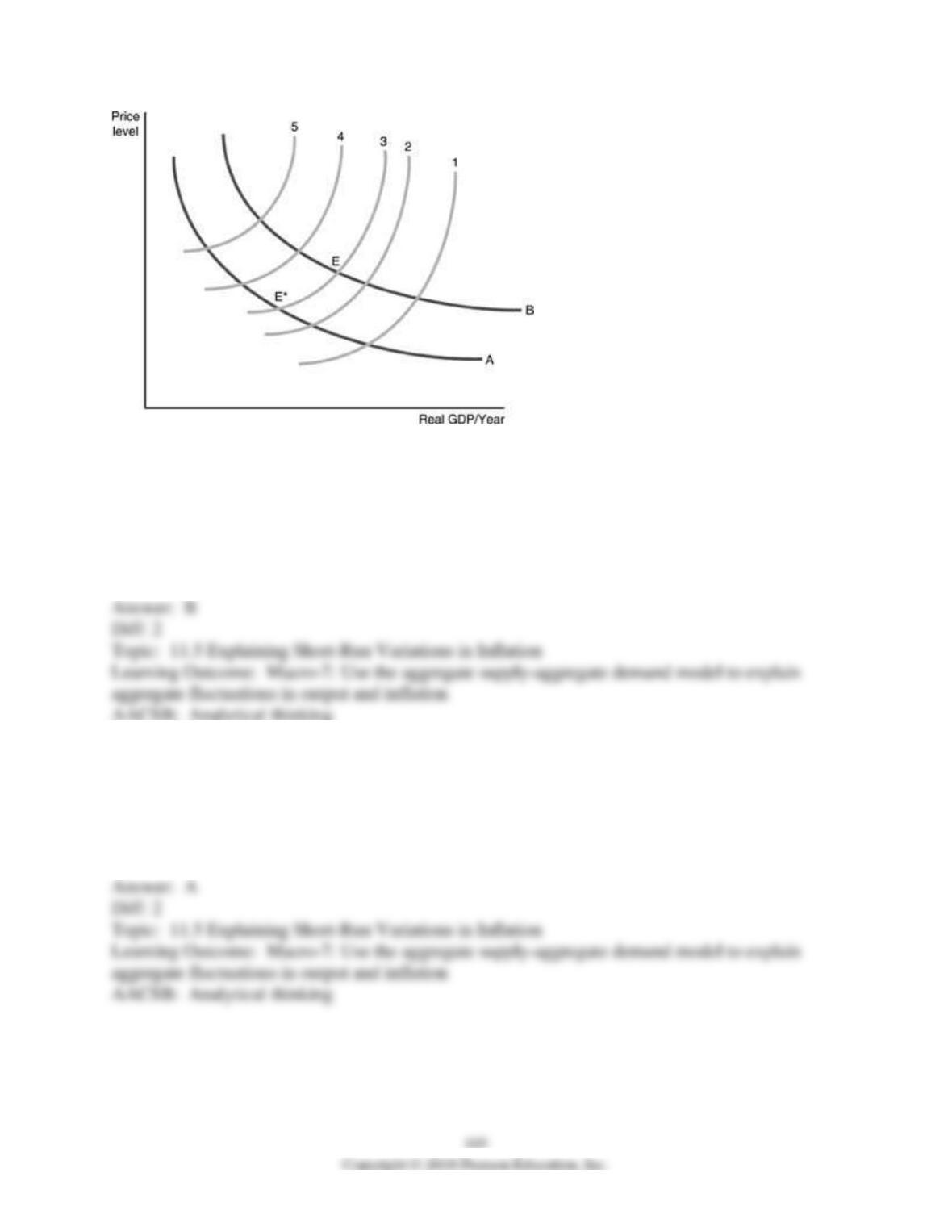
18) Refer to the above figure. Suppose the economy is at E. A stronger dollar leads to a lower
real GDP. Which of the aggregate supply curves must be the relevant curve after the change in
the value of the dollar?
A) 1
B) 2
C) 4
D) 5
19) Refer to the above figure. Suppose the economy is at E originally, when the dollar increases
in value. Which aggregate supply curve applies if the value of real GDP increases?
A) 1
B) 2
C) 4
D) 5
20) Refer to the above figure. Suppose we are at E* and the dollar weakens. Which aggregate
supply curve must apply if the price level increases?
A) 3 only
B) 4 only
C) 5 only
D) 4 or 5
21) Suppose the Chinese yuan increases in its value relative to the U.S. dollar. In the U.S.
economy,
A) the price level will increase and real GDP will fall if the increase in aggregate demand is less
than the decrease in aggregate supply.
B) the price level will increase and real GDP will fall if the decrease in aggregate demand is
more than the increase in aggregate supply.
C) the price level will fall and real GDP will increase if the increase in aggregate supply is
greater than the decrease in aggregate demand.
D) the price level will fall and real GDP will decrease if the decrease in aggregate demand is less
than the increase in aggregate supply.
22) Cost-push inflation occurs
A) when the aggregate supply curve shifts to the left, while aggregate demand remains stable.
B) when the aggregate supply curve shifts to the right, while aggregate demand remains stable.
C) when the aggregate demand curve shifts to the left, while aggregate supply remains stable.
D) when the aggregate demand curve shifts to the right, while aggregate supply remains stable.
23) Demand-pull inflation occurs
A) when the aggregate supply curve shifts to the left, while aggregate demand remains stable.
B) when the aggregate supply curve shifts to the right, while aggregate demand remains stable.
C) when the aggregate demand curve shifts to the left, while aggregate supply remains stable.
D) when the aggregate demand curve shifts to the right, while aggregate supply remains stable.
24) If the price level should increase in the near term due to decreases in the short-run aggregate
supply, the result would be
A) demand-pull inflation.
B) demand-pull recession.
C) cost-push inflation.
D) cost-pull expansion.
25) Suppose the government increases government spending. Which of the following will tend to
occur as a result of this policy in a Keynesian model?
A) an inflationary gap
B) demand-pull inflation
C) a movement along the short-run aggregate supply curve
D) all of the above

26) Other things being equal, if energy prices rise in a country, then there would be
A) cost-push inflation.
B) demand-pull inflation.
C) cost-push deflation.
D) more production and a lower price level.
27) An increase in aggregate demand will tend to cause which of the following?
A) a deflationary gap
B) a recessionary gap
C) cost-push inflation
D) none of the above
28) Inflation caused by continually decreasing short-run aggregate supply is
A) cost-pull inflation.
B) cost-push inflation.
C) demand-pull inflation.
D) demand-push inflation.
29) Oil prices increased significantly in 2008. According to the Keynesian model, this increase in
oil prices should have caused which of the following to occur?
A) demand-pull inflation
B) demand-push inflation
C) cost-push inflation
D) cost-pull inflation
30) Cost-push inflation can be shown on an aggregate supply aggregate demand diagram as
A) a rightward shift of the aggregate supply curve with no change in aggregate demand.
B) a rightward shift in the aggregate demand curve with no change in aggregate supply.
C) a leftward shift in the aggregate demand curve with no change in aggregate supply.
D) a leftward shift in the aggregate supply curve with no change in aggregate demand.
31) Demand-pull inflation is caused by
A) aggregate demand increasing along a horizontal aggregate supply curve.
B) aggregate demand decreasing along a horizontal aggregate supply curve.
C) aggregate demand decreasing along an upward sloping or a vertical aggregate supply curve.
D) aggregate demand increasing along an upward sloping or a vertical aggregate supply curve.
32) In the original Austin Powers, Dr. Evil is cryogenically frozen for thirty years (from the late
1960s to the late 1990s). Upon his return he hatches a plan to extort one million dollars from
various world governments. His henchmen are unimpressed. What type(s) of inflation have made
Dr. Evil’s proposed blackmail amount seem too small?
A) cost-push inflation
B) demand-pull inflation
C) both cost-price and price-pull inflation
D) both cost-push and demand-pull inflation
33) Natural disasters like severe earthquakes are devastating to the economy as well as to the
individuals harmed due to
A) supply shocks.
B) demand shocks.
C) demand-pull inflation.
D) demand-pull deflation.
34) Suppose the U.S. dollar gains strength against the euro (and against other major currencies).
This strengthening of the dollar will cause which of the following to occur?
A) The aggregate demand curve will shift to the right and the short-run aggregate supply will
shift to the right.
B) The aggregate demand curve will shift to the left and the short-run aggregate supply will shift
to the right.
C) The aggregate demand curve will shift to the right and the short-run aggregate supply will
shift to the left.
D) the aggregate demand curve will shift to the left and the short-run aggregate supply will shift
to the left.
35) Suppose the U.S. dollar weakens against the euro (and against other major currencies). This
weakening of the dollar will cause which of the following to occur?
A) The aggregate demand curve will shift to the right and the short-run aggregate supply will
shift to the right.
B) The aggregate demand curve will shift to the left and the short-run aggregate supply will shift
to the right.
C) The aggregate demand curve will shift to the right and the short-run aggregate supply will
shift to the left.
D) The aggregate demand curve will shift to the left and the short-run aggregate supply will shift
to the left.
36) The exchange rate last month was $1= 1 Swiss francs. This month it is $1 = 0.95 Swiss
francs. We can say that the value of the dollar
A) fell, causing net exports to increase and aggregate demand to rise.
B) fell, causing net exports to decrease and aggregate demand to fall.
C) increased, causing net exports to decrease and aggregate demand to fall.
D) increased, causing net exports to decrease and aggregate demand to rise.
37) The exchange rate last year was $1 = 1.1 euros. This year it is $1 = 1.2 euros. We can say
that the value of the dollar
A) fell; causing net exports to increase and aggregate demand to rise.
B) fell; causing net exports to decrease and aggregate demand to fall.
C) increased; causing net exports to decrease and aggregate demand to fall.
D) increased; causing net exports to decrease and aggregate demand to rise.

38) A depreciation of the U.S. dollar ________ the price of U.S. imports, and ________ the price
of U.S. exports.
A) decreases, decreases
B) increases, increases
C) increases, decreases
D) decreases, increases
39) Suppose the U.S. dollar weakens against the euro (and against other major currencies). We
know with certainty that this weakening of the dollar will cause which of the following to occur?
A) a recessionary gap
B) an inflationary gap
C) a deflationary gap
D) none of the above
40) Suppose the euro appreciates against the dollar. This causes U.S. exports to become less
expensive for consumers in the European Union, which would likely cause the U.S.
A) aggregate supply to shift leftward.
B) aggregate supply to shift rightward.
C) aggregate demand to shift leftward.
D) aggregate demand to shift rightward.
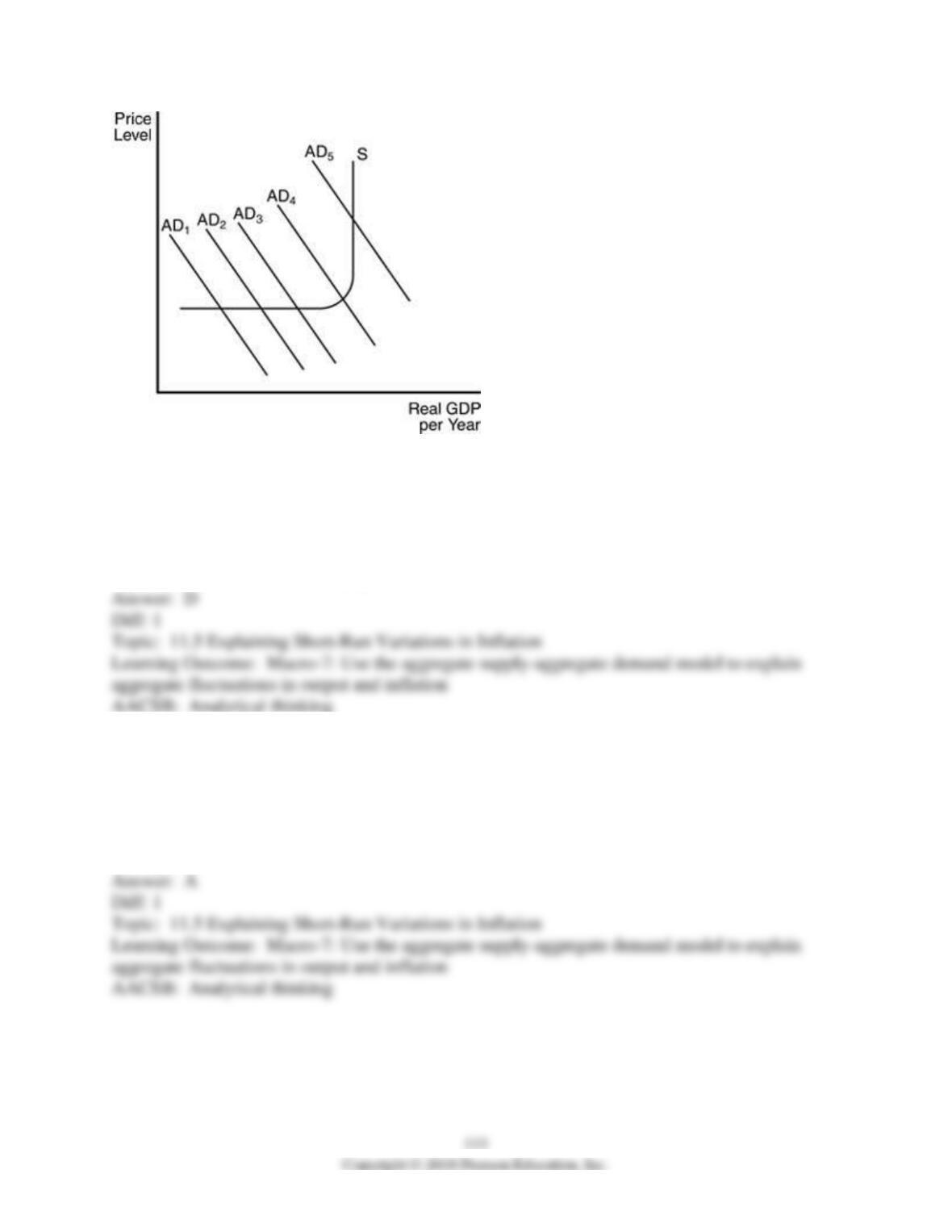
41) Refer to the above figure. If the aggregate demand curve shifts beyond AD5, which of the
following would we NOT expect?
A) strong demand-pull inflation
B) no increase in real Gross Domestic Product (GDP)
C) strong and rapid increases in the price level
D) increases in real net domestic product
42) Refer to the above figure. If the aggregate demand curve shifts beyond AD5, then the
economy will experience
A) demand-pull inflation.
B) cost-push inflation.
C) structural inflation.
D) stagflation.
43) When the value of the dollar increases, the net effect on the economy
A) will be an increase in short-run aggregate supply and a decrease in aggregate demand.
B) will be decrease in short-run aggregate supply and an increase in aggregate demand.
C) will be an increase in both aggregate demand and aggregate supply.
D) will be a decrease in both aggregate demand and aggregate supply.
44) When the value of the dollar decreases, the net effect on the economy
A) will be an increase in short-run aggregate supply and a decrease in aggregate demand.
B) will be decrease in short-run aggregate supply and an increase in aggregate demand.
C) will be an increase in both aggregate demand and aggregate supply.
D) will be a decrease in both aggregate demand and aggregate supply.
45) What effect does a stronger dollar have on aggregate supply? Why?
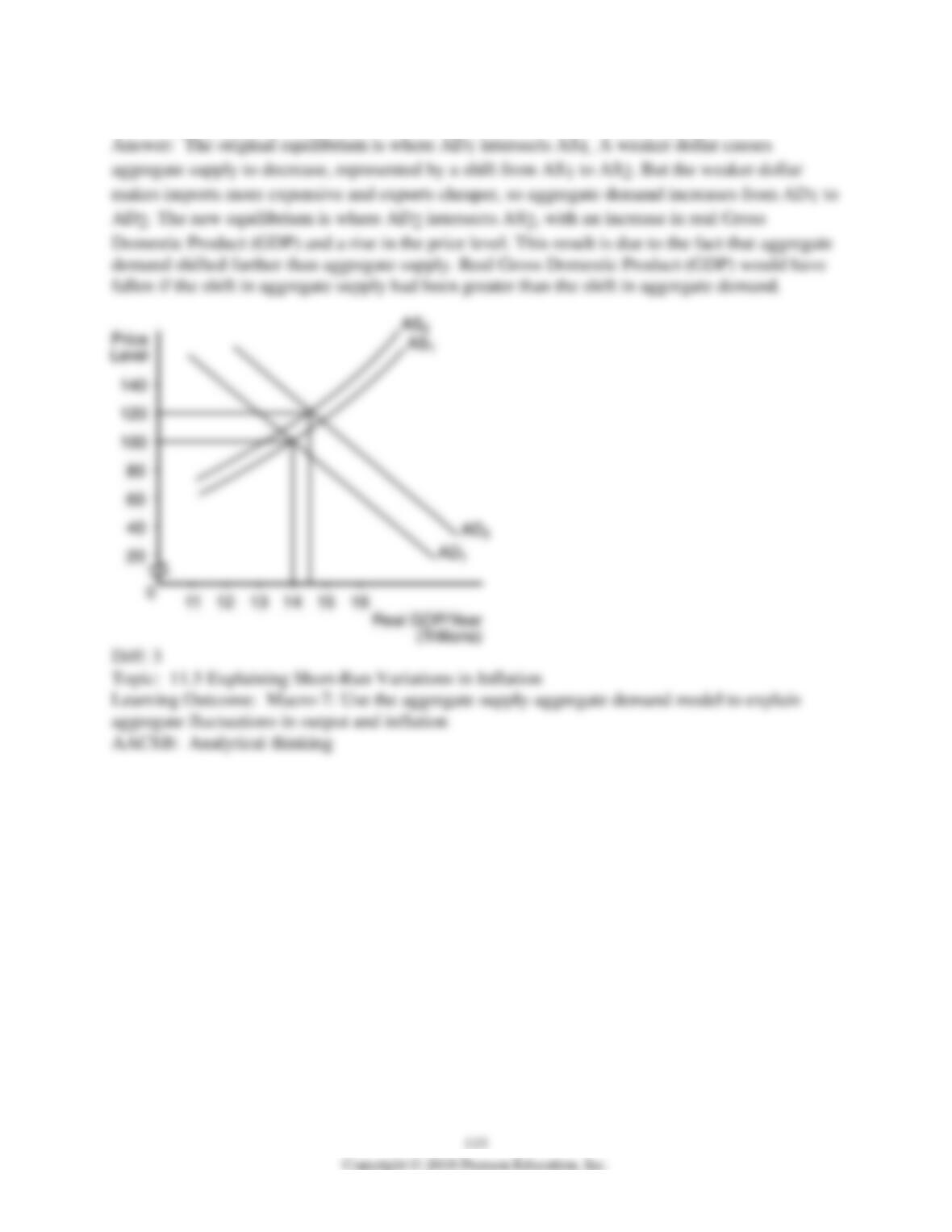
46) Using a graph, show the effects of a weaker dollar on the economy. Explain.