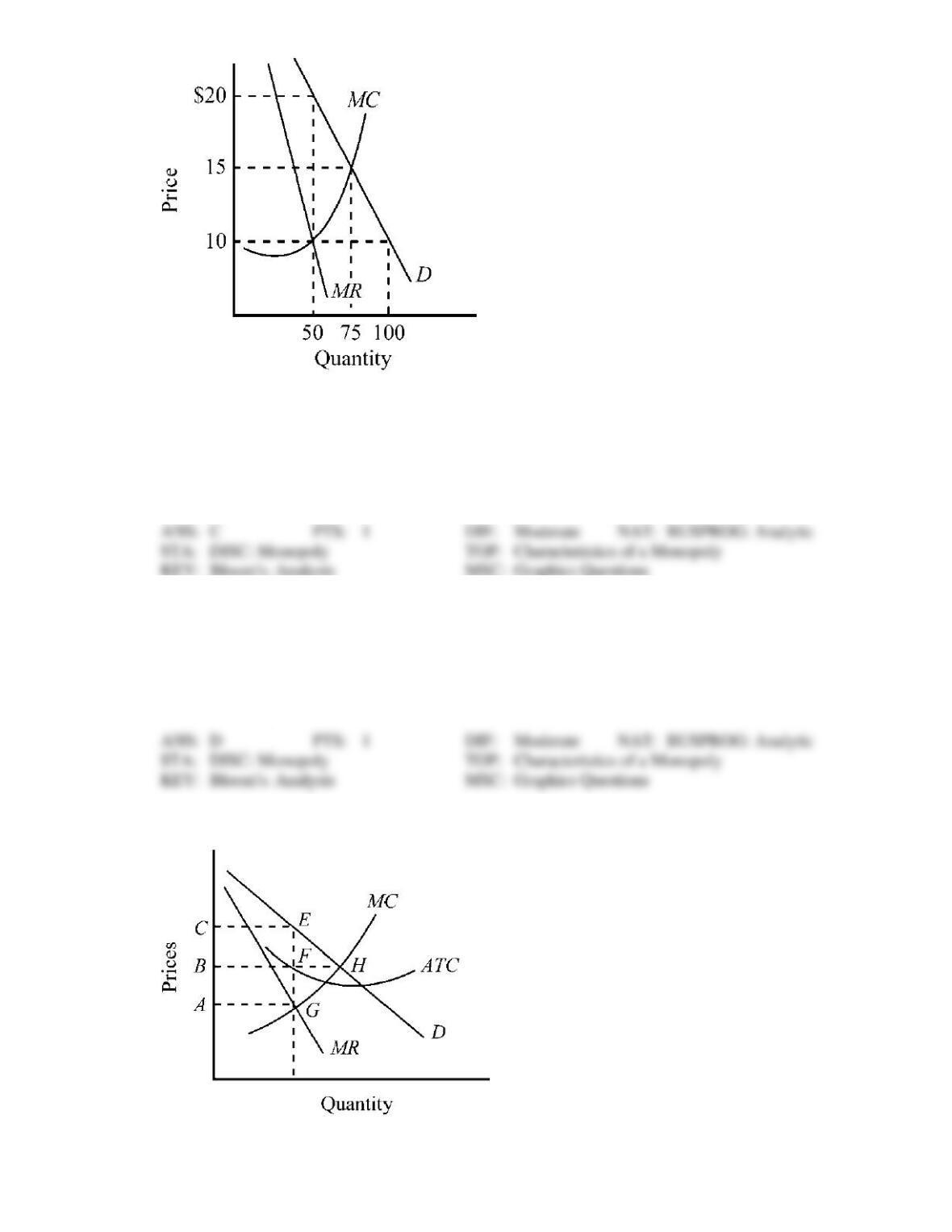
172. The demand and cost conditions in an industry are as depicted in Figure 11-8. In the viewpoint of
economic efficiency, what would the ideal price and output be?
a.
price, $10; quantity produced, 100
b.
price, $15; quantity produced, 50
c.
price, $15; quantity produced, 75
d.
price, $20; quantity produced, 50
173. If the output in the industry is produced by a monopolist, at what price will the good sell and what
quantity will be produced in Figure 11–8?
a.
price, $10; quantity produced, 100
b.
price, $15; quantity produced, 50
c.
price, $15; quantity produced, 75
d.
price, $20; quantity produced, 50
Figure 11-9
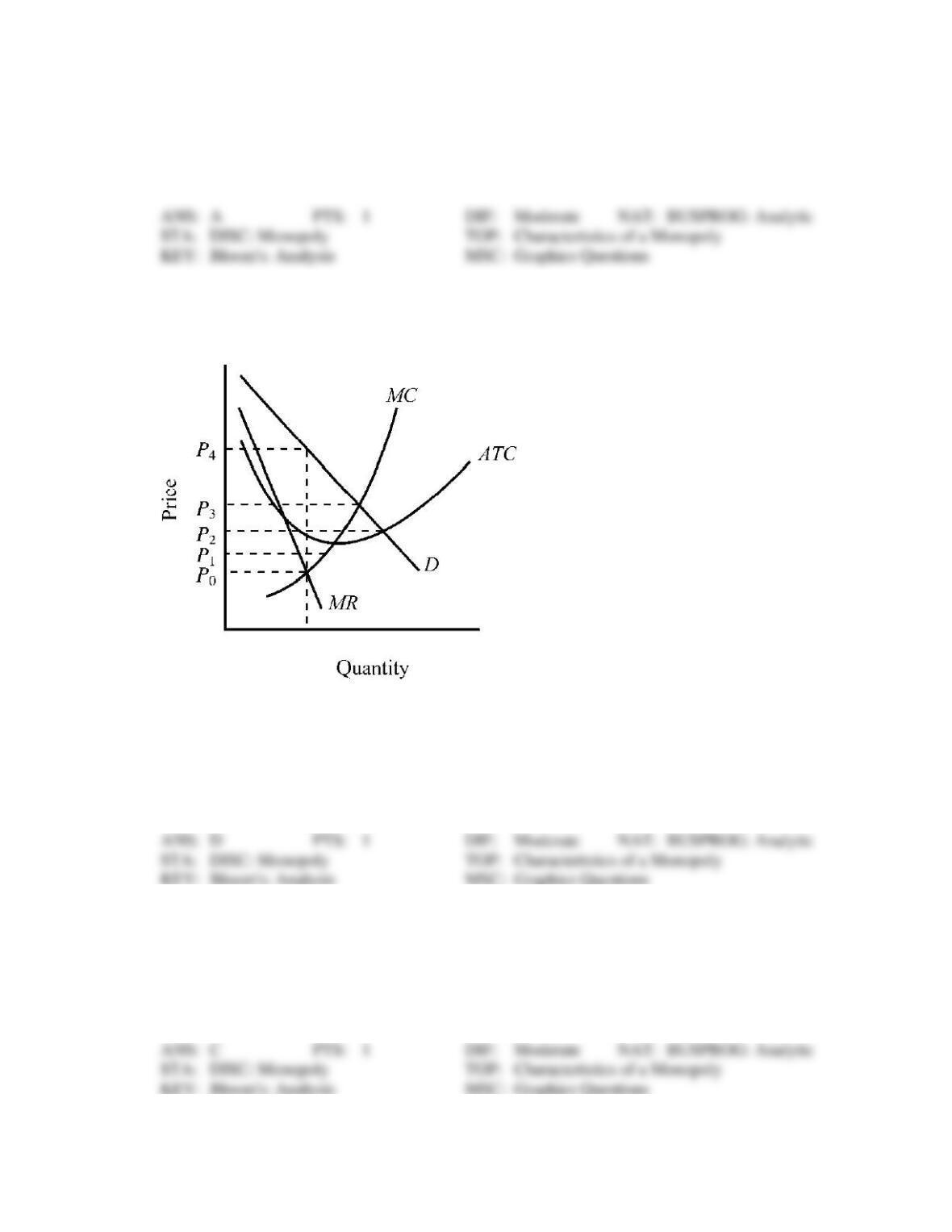
174. From Figure 11-9, indicate the maximum profit a pure monopolist with the cost and demand
conditions above would be able to achieve.
a.
BFEC
b.
AGEC
c.
BHEC
d.
EFH
Use the figure to answer the following question(s).
Figure 11-10
175. Given the cost and revenue curves illustrated in Figure 11-10, what price will a profit-maximizing
monopolist charge?
a.
P1
b.
P2
c.
P3
d.
P4
176. If the monopolist is regulated by the “marginal cost pricing” technique, what price in Figure 11-10 will
be charged?
a.
P1
b.
P2
c.
P3
d.
P4
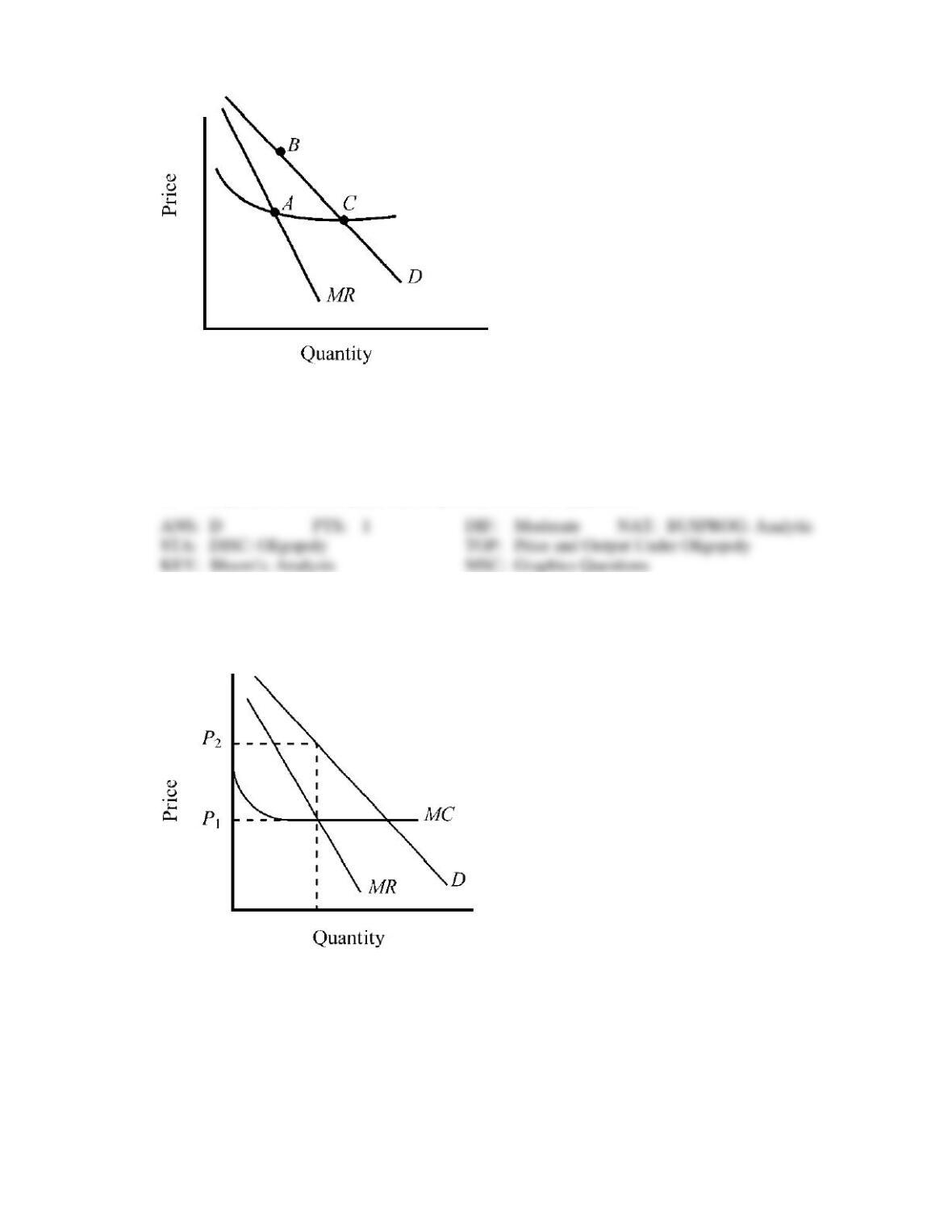
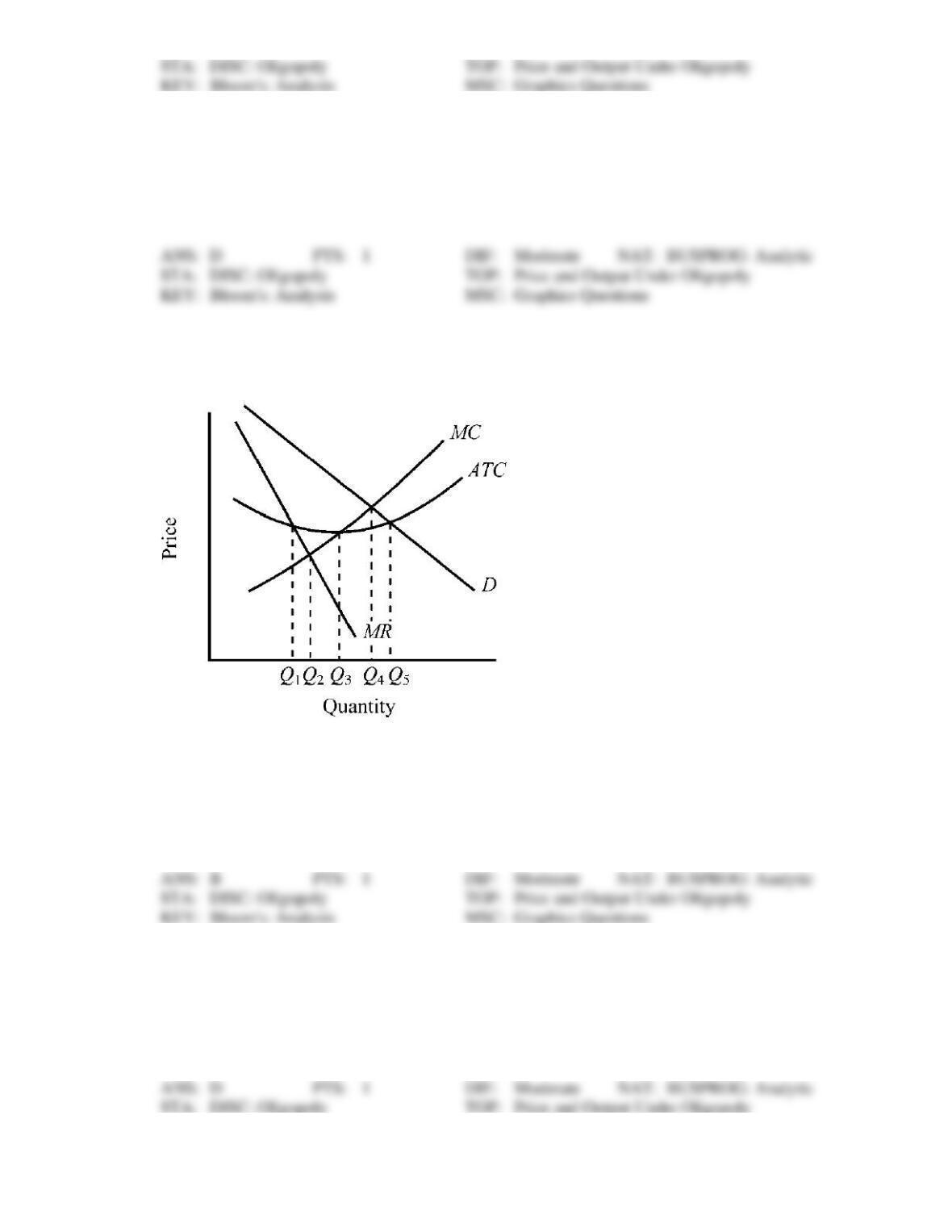
Figure 11-11
177. According to the graph of an oligopolistic industry in Figure 11-11 (points A and C lie on the MC
curve), which of the following statements is correct?
a.
With perfect collusion, price and outputs are indicated by point A.
b.
Without collusion, price and outputs are indicated by point B.
c.
With perfect collusion, price and outputs are indicated by point C.
d.
With perfect collusion, price and outputs are indicated by point B.
Use the figure to answer the following question(s).
Figure 11-12
178. Figure 11-12 indicates the industry cost and demand conditions for a product produced in an
oligopolistic industry. The price of this product is most likely to be
a.
greater than P2.
b.
P2.
c.
P1.
d.
in the range between P1 and P2.
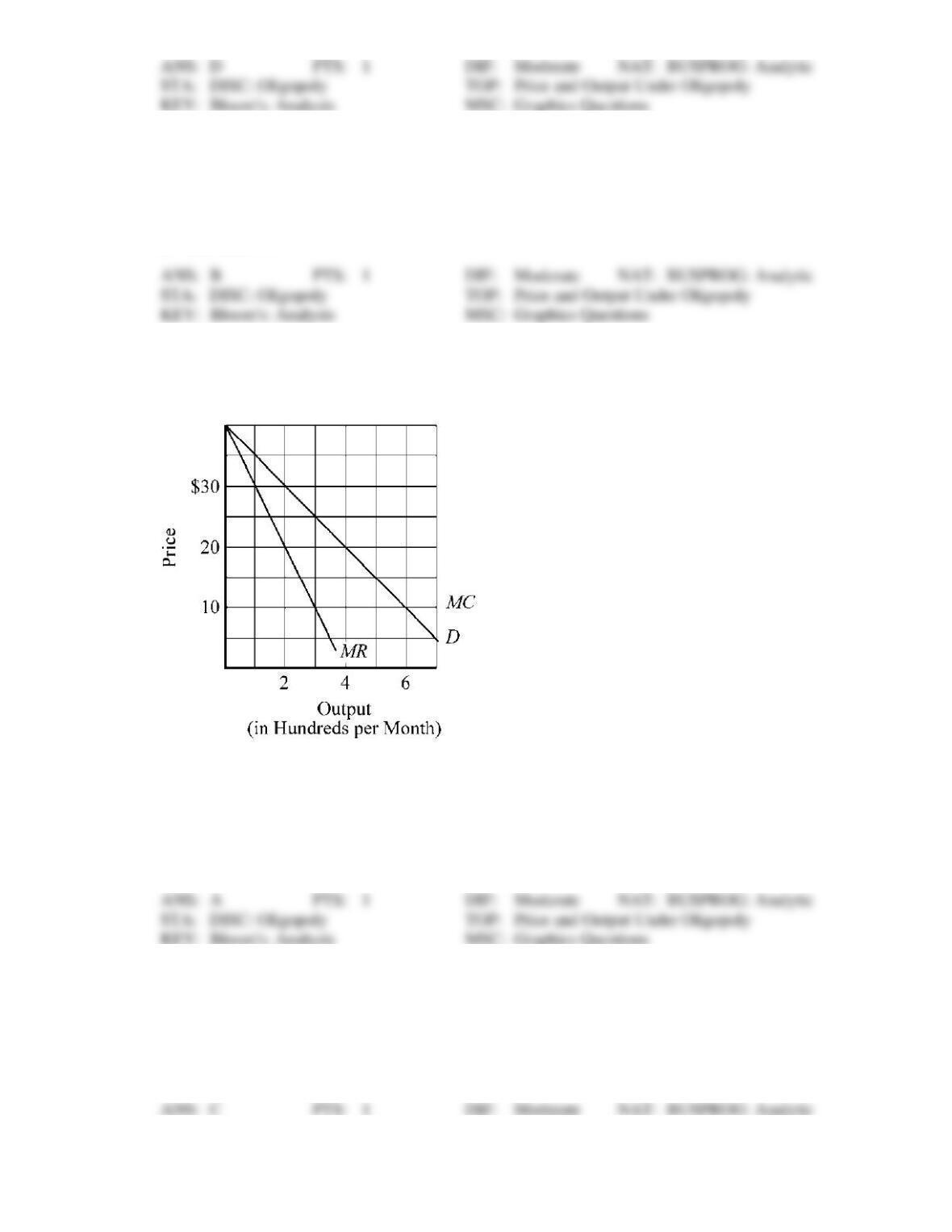
179. If the firms in this oligopolistic industry depicted in Figure 11-12 can collude effectively and restrict
the entry of potential competitors, the price of their product will tend to be
a.
greater than P2.
b.
close to P2.
c.
approximately equal to P1.
d.
less than P1.
Use the figure to answer the following question(s).
Figure 11-13
180. If the firms in the industry depicted in Figure 11-13 compete with each other, what would the
industry’s price and output be?
a.
price, $10; output, 600
b.
price, $15; output, 500
c.
price, $20; output, 400
d.
price, $25; output, 300
181. If the firms in the industry depicted in Figure 11-13 can effectively operate as a cartel, what would the
industry’s price and output be?
a.
price, $10; output, 600
b.
price, $20; output, 400
c.
price, $25; output, 300
d.
price, $30; output, 200
182. Using Figure 11-13, determine the maximum joint monthly profit of the firms if they operate as a
cartel.
a.
zero
b.
$1,500
c.
$3,000
d.
$4,500
Use the figure to answer the following question(s).
Figure 11-14
183. What quantity would the industry depicted in Figure 11-14 produce if member firms were successfully
colluding?
a.
Q1
b.
Q2
c.
Q3
d.
Q4
184. Using Figure 11-14, determine what quantity these firms would produce, in the short run, if the firms
were engaging in vigorous competition.
a.
Q1
b.
Q2
c.
Q3
d.
Q4
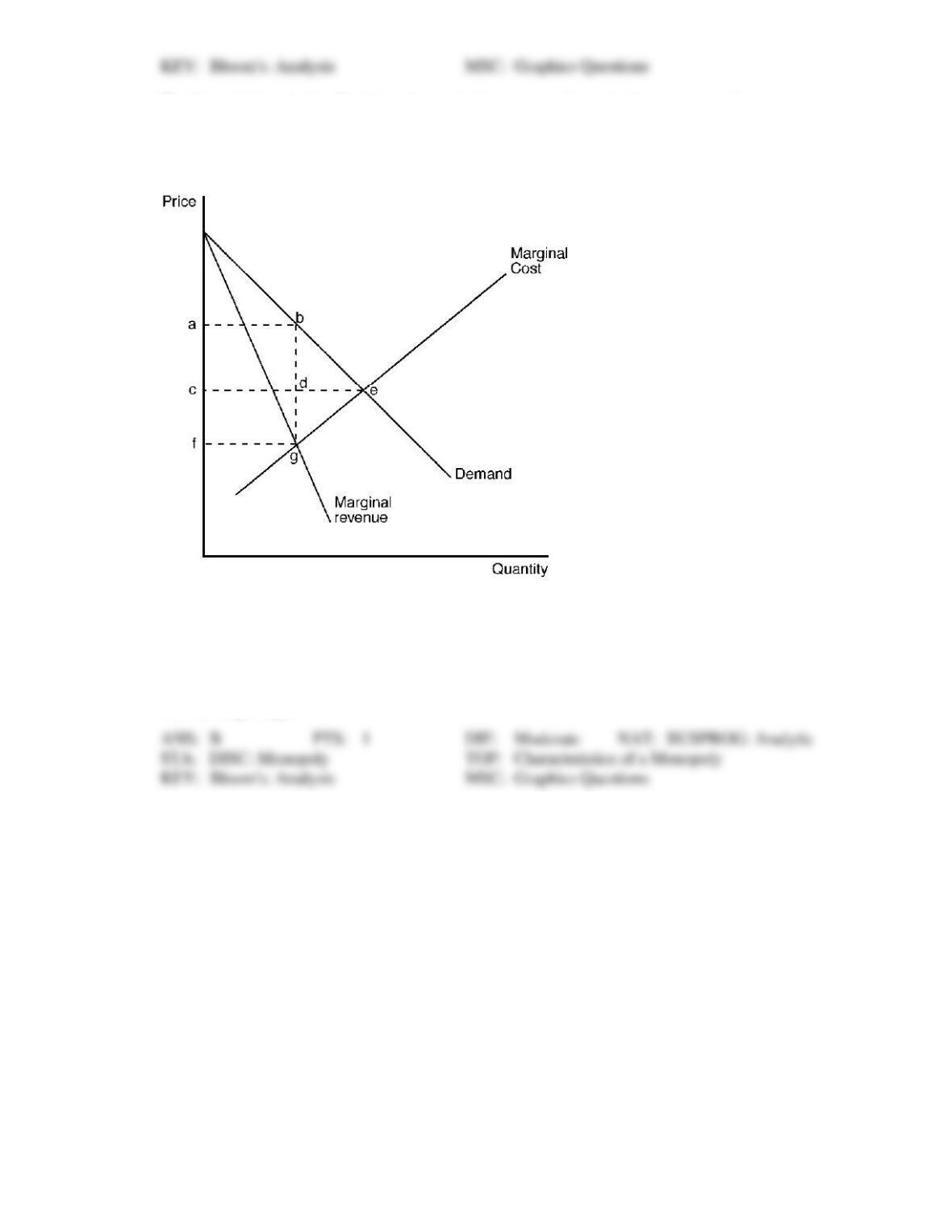
The figure below depicts the demand, marginal revenue and marginal cost curves of a
profit-maximizing monopolist.
Figure 11-15
185. Refer to Figure 11-15. Which of the following areas represents the deadweight loss due to monopoly
pricing?
a.
Triangle bde
b.
Triangle bge
c.
Rectangle acdb
d.
Rectangle cfgd
Figure 11-16
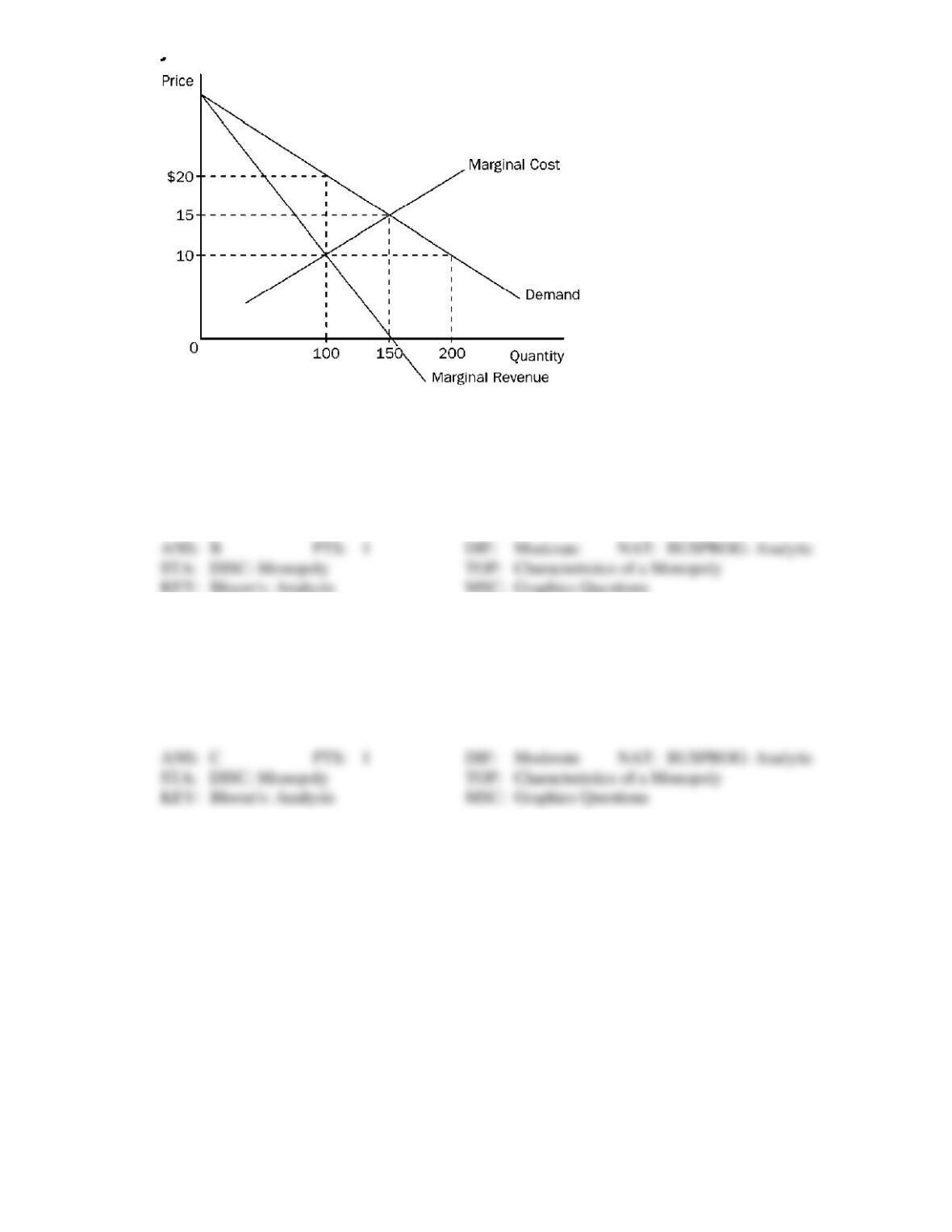
186. Refer to Figure 11-16. To maximize its profit, a monopolist would choose which of the following
outcomes?
a.
100 units of output and a price of $10 per unit
b.
100 units of output and a price of $20 per unit
c.
150 units of output and a price of $15 per unit
d.
200 units of output and a price of $20 per unit
187. Refer to Figure 11-16. The allocative inefficiency caused by a profit-maximizing monopoly amounts
to
a.
$150.
b.
$200.
c.
$250.
d.
$300.
The figure below illustrates the cost and revenue structure for a monopoly firm.
Figure 11-17
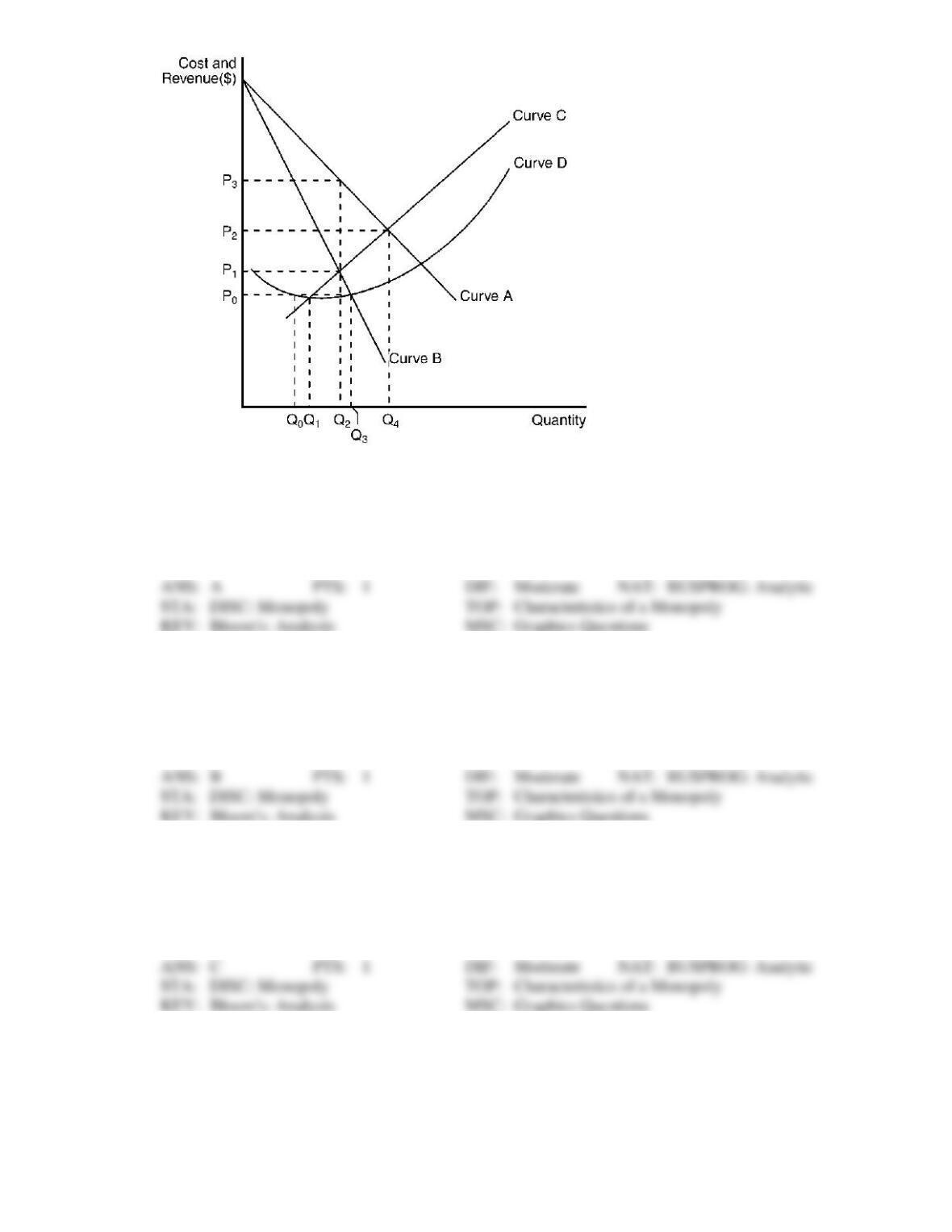
188. Refer to Figure 11-17. The demand curve for a monopoly firm is depicted by curve
a.
A.
b.
B.
c.
C.
d.
D.
189. Refer to Figure 11-17. The marginal revenue curve for a monopoly firm is depicted by curve
a.
A.
b.
B.
c.
C.
d.
D.
190. Refer to Figure 11-17. The marginal cost curve for a monopoly firm is depicted by curve
a.
A.
b.
B.
c.
C.
d.
D.
191. Refer to Figure 11-17. The average total cost curve for a monopoly firm is depicted by curve
a.
A.
b.
B.
c.
C.
d.
D.
192. Refer to Figure 11-17. If the monopoly firm is currently producing Q3 units of output, then a decrease
in output will necessarily cause profit to
a.
remain unchanged.
b.
decrease.
c.
increase as long as the new level of output is at least Q2.
d.
increase as long as the new level of output is at least Q1.
193. Refer to Figure 11-17. If the monopoly firm wants to maximize its profit, it should operate at a level of
output equal to
a.
Q1.
b.
Q2.
c.
Q3.
d.
Q4.
194. Refer to Figure 11-17. Profit will be maximized by charging a price equal to
a.
P0.
b.
P1.
c.
P2.
d.
P3.
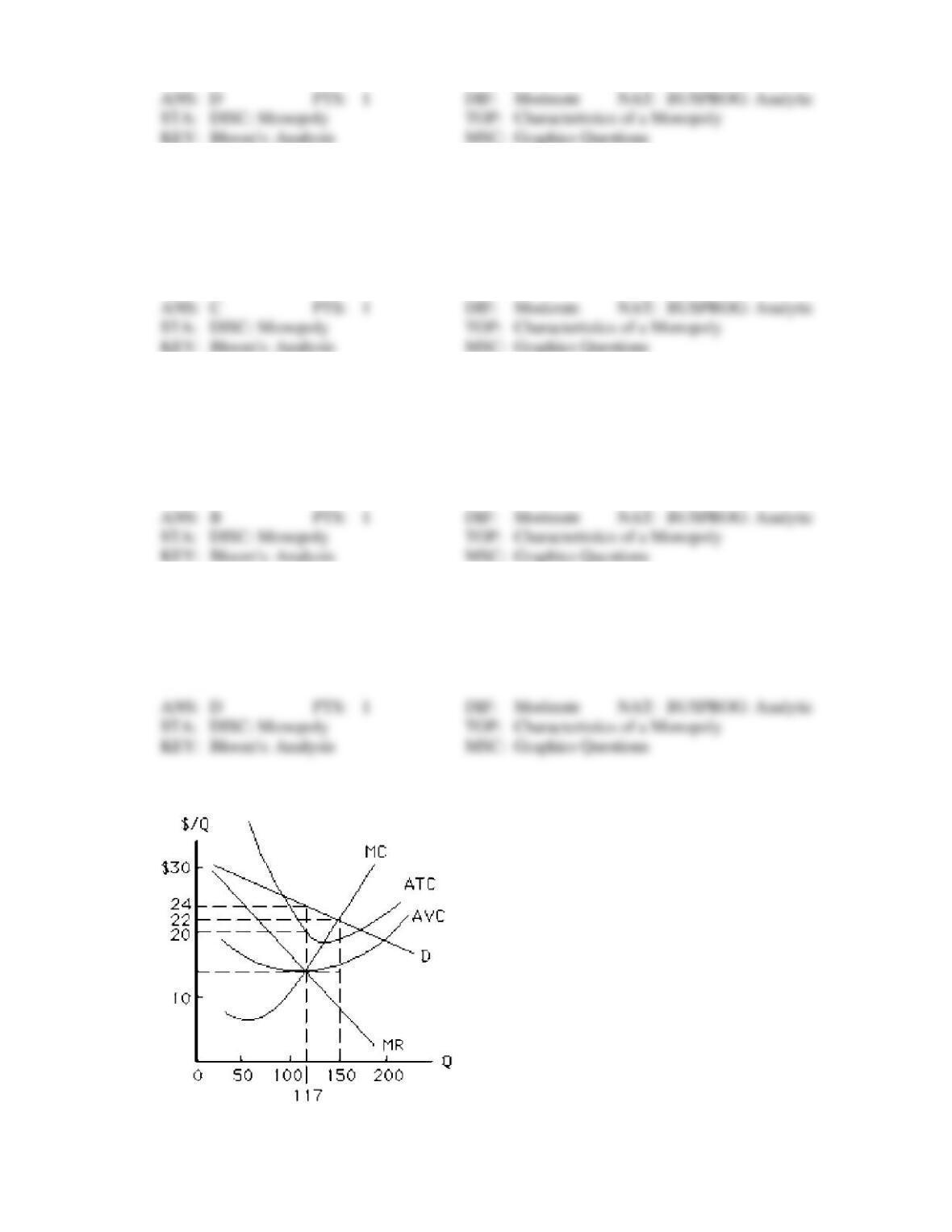
Figure 11-18
195. The profit-maximizing output and price for the firm in Figure 11-18, which charges the same price to
all customers, are
a.
117 and $14
b.
150 and $22
c.
150 and $14
d.
117 and $22
e.
117 and $24
196. The total revenue for the firm in Figure 11-18, a monopolist that maximizes profit while charging all
customers the same price, is
a.
$2,574
b.
$2,808
c.
$2,100
d.
$1,638
e.
$3,300
197. The total cost for the firm in Figure 11-18, a monopolist that maximizes profit while charging all
customers the same price, is
a.
$3,300
b.
$3,400
c.
$2,808
d.
$2,340
e.
$1,638
198. The firm in Figure 11-18, a monopolist that maximizes profit by charging all customers the same
price, is making a profit of
a.
$0
b.
$234
c.
$482
d.
$960
e.
$468
Figure 11-19
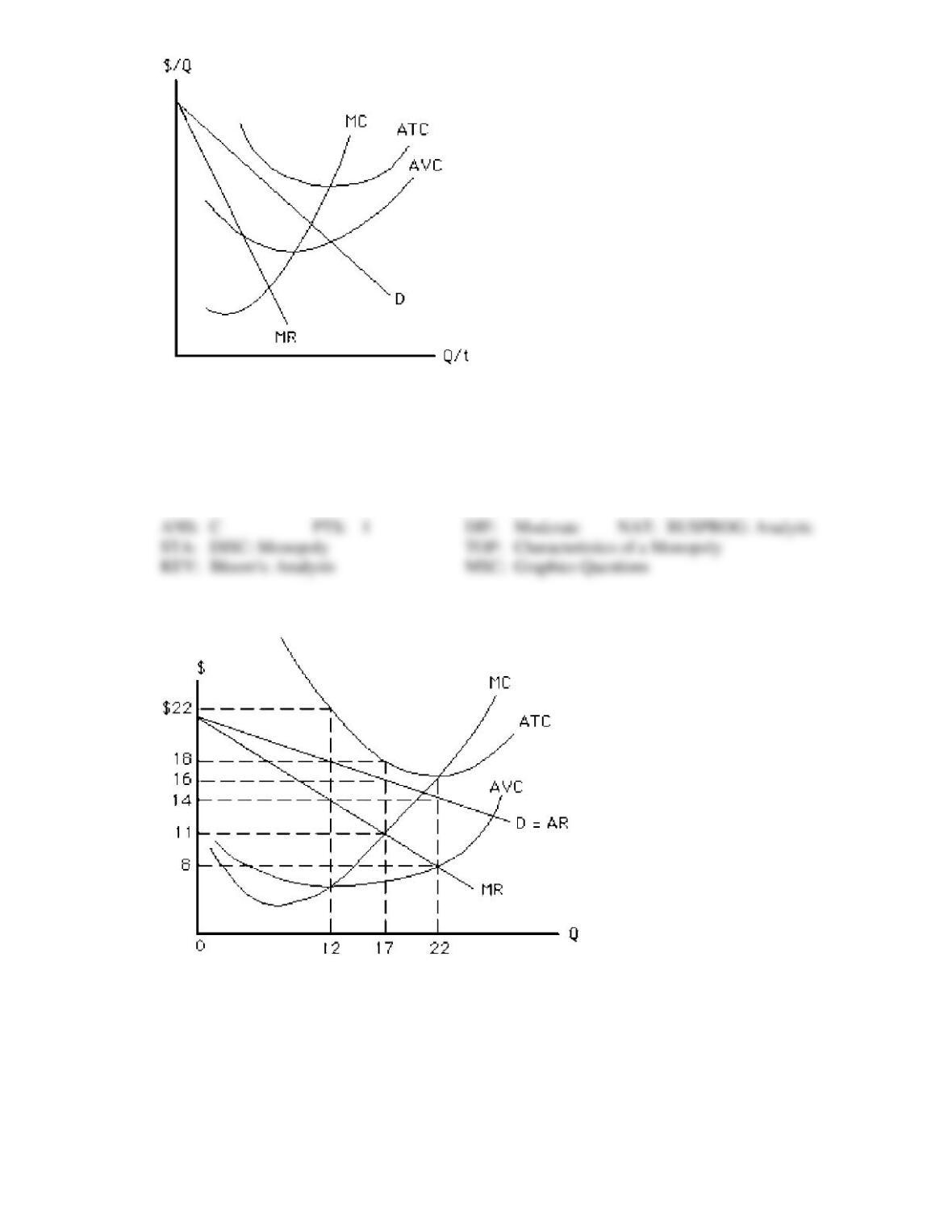
199. In the short run, the monopolist depicted in Figure 11-19 should
a.
shut down because P < AVC at some output levels.
b.
shut down because P < ATC at all output levels.
c.
continue producing because P > AVC at some output levels.
d.
continue producing because P > ATC at all output levels.
e.
continue producing because monopolists never shut down.
Figure 11-20
200. The production level that will maximize the profit for the monopoly in Figure 11-20 is
a.
0
b.
22
c.
17
d.
12
e.
more than 22
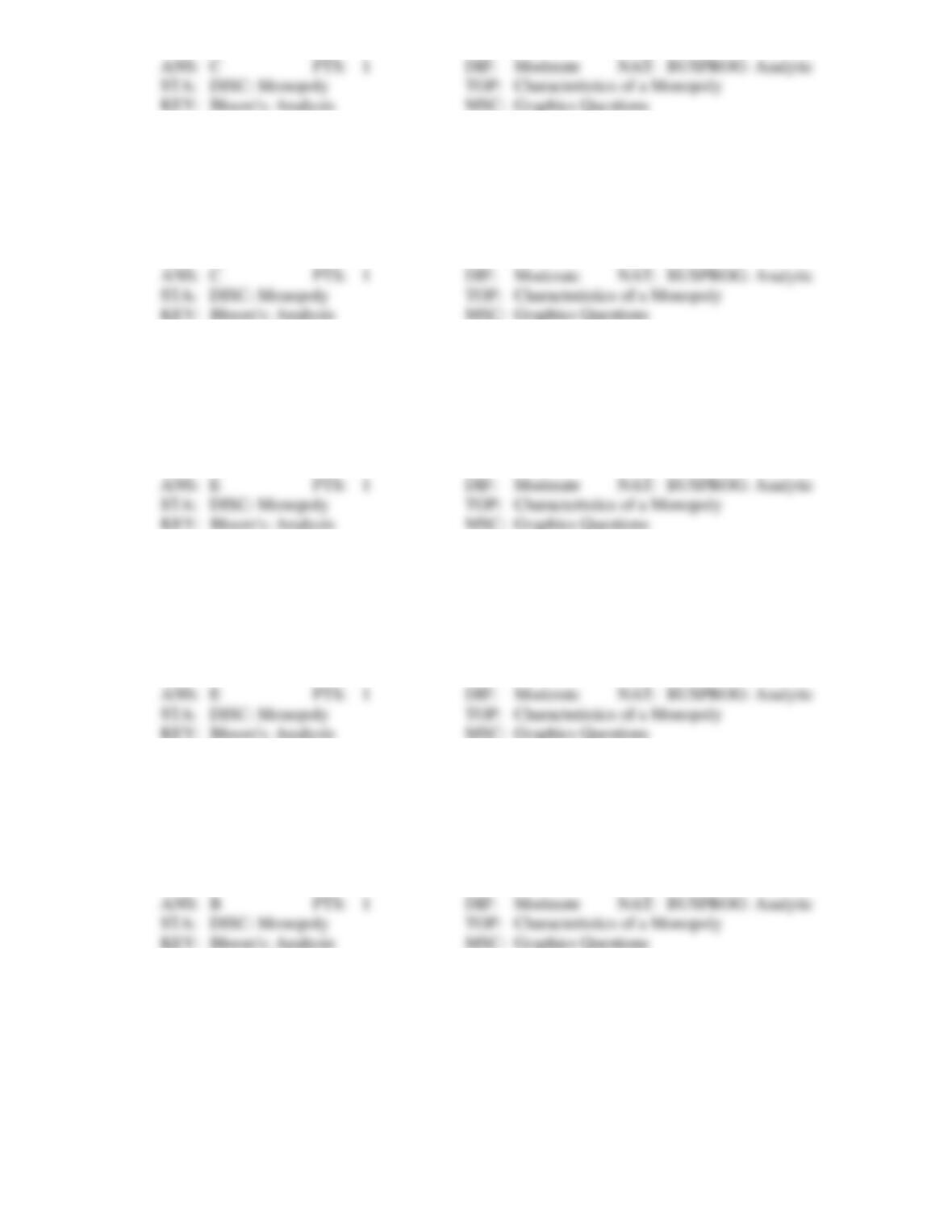
201. The profit-maximizing price the monopoly will charge in Figure 11-20 is
a.
irrelevant since the firm should shut down
b.
$11
c.
$16
d.
$18
e.
$22
202. The firm in Figure 11-20 will have an economic
a.
profit of $85
b.
loss of $48
c.
profit of $132
d.
loss of $96
e.
loss of $34
203. At the profit-maximizing level of production, the monopoly in Figure 11-20 will have total revenue of
a.
$308
b.
$187
c.
$216
d.
$306
e.
$272
204. At the profit-maximizing level of production, the monopoly in Figure 11-20 will have total cost of
a.
$264
b.
$306
c.
$216
d.
$187
e.
$176
205. At the profit-maximizing level of production, the monopoly in Figure 11-20 will have a
a.
profit per unit of output of $2.
b.
loss per unit of output of $2.
c.
loss per unit of output of $5.
d.
profit per unit of output of $5.
e.
loss per unit of output of $4.
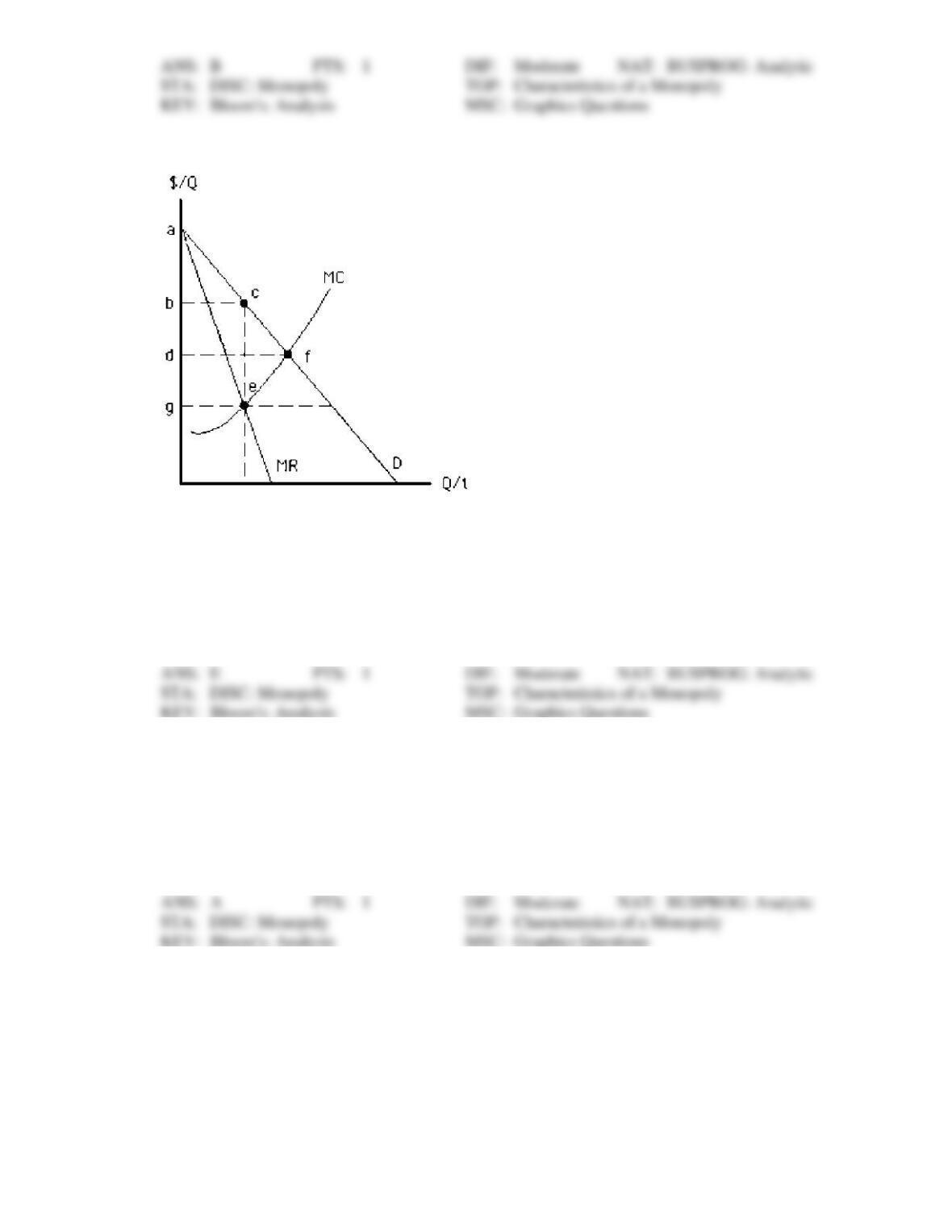
Figure 11-21
206. In Figure 11-21, the increase in consumer surplus that occurs when price is set equal to marginal cost
rather than at the profit-maximizing level, as it would be in an unregulated monopoly, is shown by area
a.
abc
b.
adf
c.
cef
d.
dfeg
e.
bcfd
207. The welfare loss associated with the unregulated natural monopoly in Figure 11-21 is shown by the
area
a.
cef
b.
abc
c.
adf
d.
dfeg
e.
bcfd
208. A monopoly is best defined as
a.
a single seller of a product that has characteristics very similar to the products produced in
other industries.
b.
a single seller of a well-defined product for which there are no good substitutes operating
in a market with high barriers to entry.
c.
a market in which a small number of rival sellers produce the entire market output.
d.
any firm operating in a contestable market.
209. Which of the following firms best fits the definition of a monopoly?
a.
McDonald’s, because it is the only firm who produces the Big Mac
b.
a local cable company that has been granted the only license to sell cable in a city by the
town council
c.
Ford Motor Company, because there are significant economies of scale in the production
of automobiles
d.
Harvard University, because it has a reputation as being one of the top universities in the
country
210. Which of the following is not a barrier that limits the entry of potential competitors into a market?
a.
government licensing
b.
control over an essential resource
c.
an elastic demand for a product
d.
patent rights
211. When significant economies of scale are present in the production process, an industry will tend
naturally toward monopoly because
a.
one firm will be able to produce the entire market output at a lower cost than several
smaller firms.
b.
marginal revenue will be less than market price, giving firms the incentive to equate
marginal cost with price instead of equating marginal cost and marginal revenue.
c.
economies of scale can only be present when firms produce identical products and there is
no reason to have more than one firm producing the same exact product.
d.
consumers will be unwilling to compare the prices charged by several different firms.
212. How will the price and output of an unregulated monopolist compare with the ideal levels that might
be reached if the market was competitive?
a.
The output of the monopolist will be larger and the price lower.
b.
The output of the monopolist will be larger and the price higher.
c.
The output of the monopolist will be smaller and the price lower.
d.
The output of the monopolist will be smaller and the price higher.
213. Allowing firms to receive patents on new inventions
a.
increases the price consumers pay for patented products.
b.
gives firms a greater incentive to conduct research and development to invent new
products.
c.
results in much lower prices than would be present if other firms were allowed to compete.
d.
does both a and b, but not c.
214. Which of the following is true?
a.
A monopolist is always guaranteed to earn positive economic profits regardless of their
cost of production or the price they charge.
b.
A monopolist will charge the highest price possible for their product because no matter
what price they charge, people will still have to buy it.
c.
A monopolist has no incentive to find more cost-efficient methods of production because
they are protected from competition from other sellers.
d.
None of the above are correct.
215. Which of the following statements accurately describes a difference between a firm that is a
monopolist and one that is in a competitive, open price-taker market?
a.
Marginal revenue and price are equal for a price taker but not a monopolist.
b.
Monopolists can earn economic profits in the long run, but price takers cannot.
c.
A price taker sells its output at a price equal to marginal cost, while a monopolist sells its
output at a price higher than marginal cost.
d.
All of the above are true.
216. To maximize profit, the monopolist, whose cost and demand conditions are shown below, should
charge a price of
Price
Output
Total Cost
$7
1
$7
6
2
8
5
3
10
4
4
13
3
5
17
a.
$4.
b.
$5.
c.
$6.
d.
$7.
217. Which of the following statements accurately describes a difference between a firm that is a
monopolist and one that is in a competitive price-searcher market?
a.
A competitive price searcher produces at the output level where marginal cost equals
marginal revenue; a monopolist does not.
b.
A monopolist faces a downward-sloping demand curve; a competitive price searcher does
not.
c.
A monopolist charges a price higher than marginal cost; a competitive price searcher does
not.
d.
In the long run, a competitive price searcher will earn zero economic profit because of low
entry barriers, while a monopolist may earn positive economic profits in the long run.
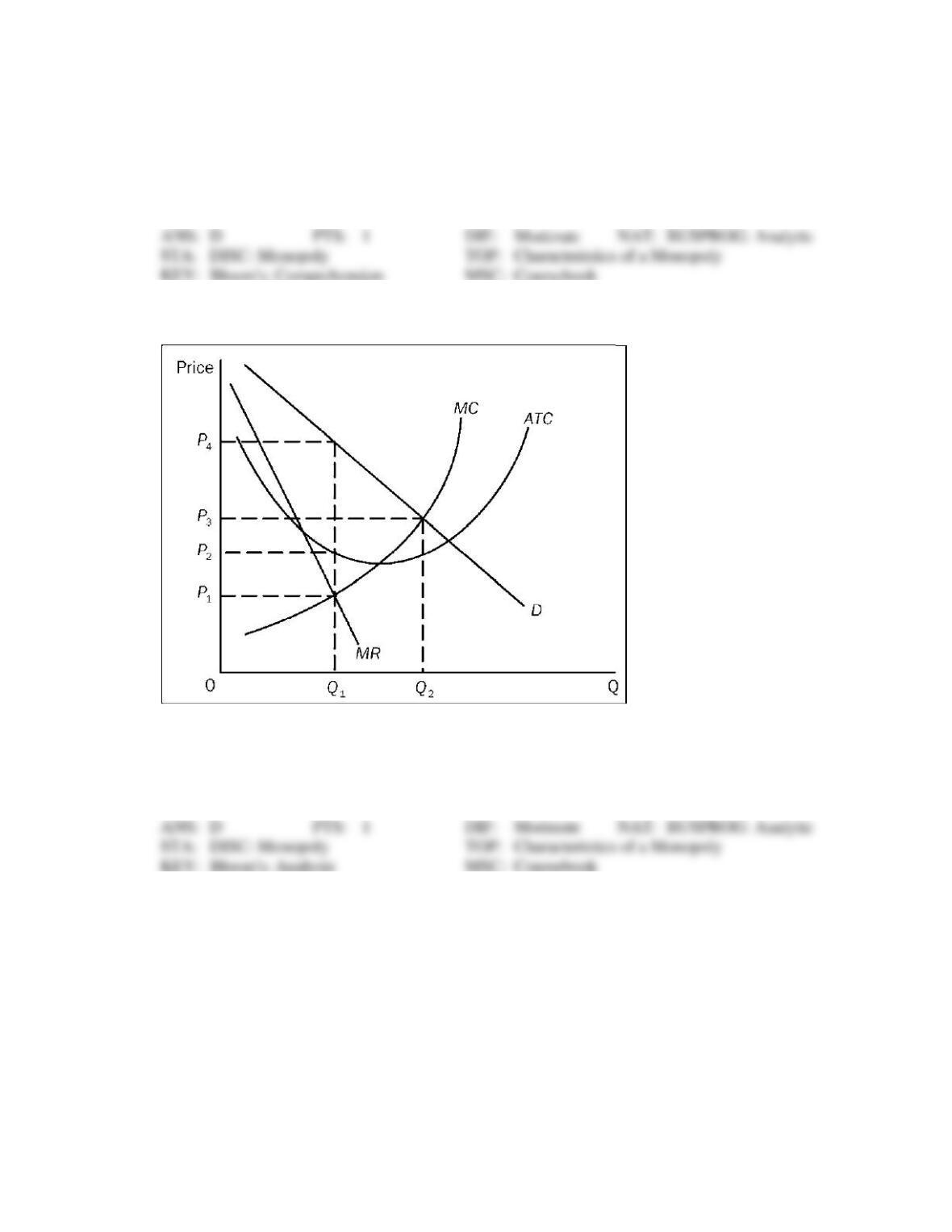
218. To maximize profits, the monopolist shown in the figure would produce output of
a.
Q1 and charge a price of P1.
b.
Q1 and charge a price of P2.
c.
Q2 and charge a price of P3.
d.
Q1 and charge a price of P4.
219. The profit-maximizing monopolist shown in the figure would
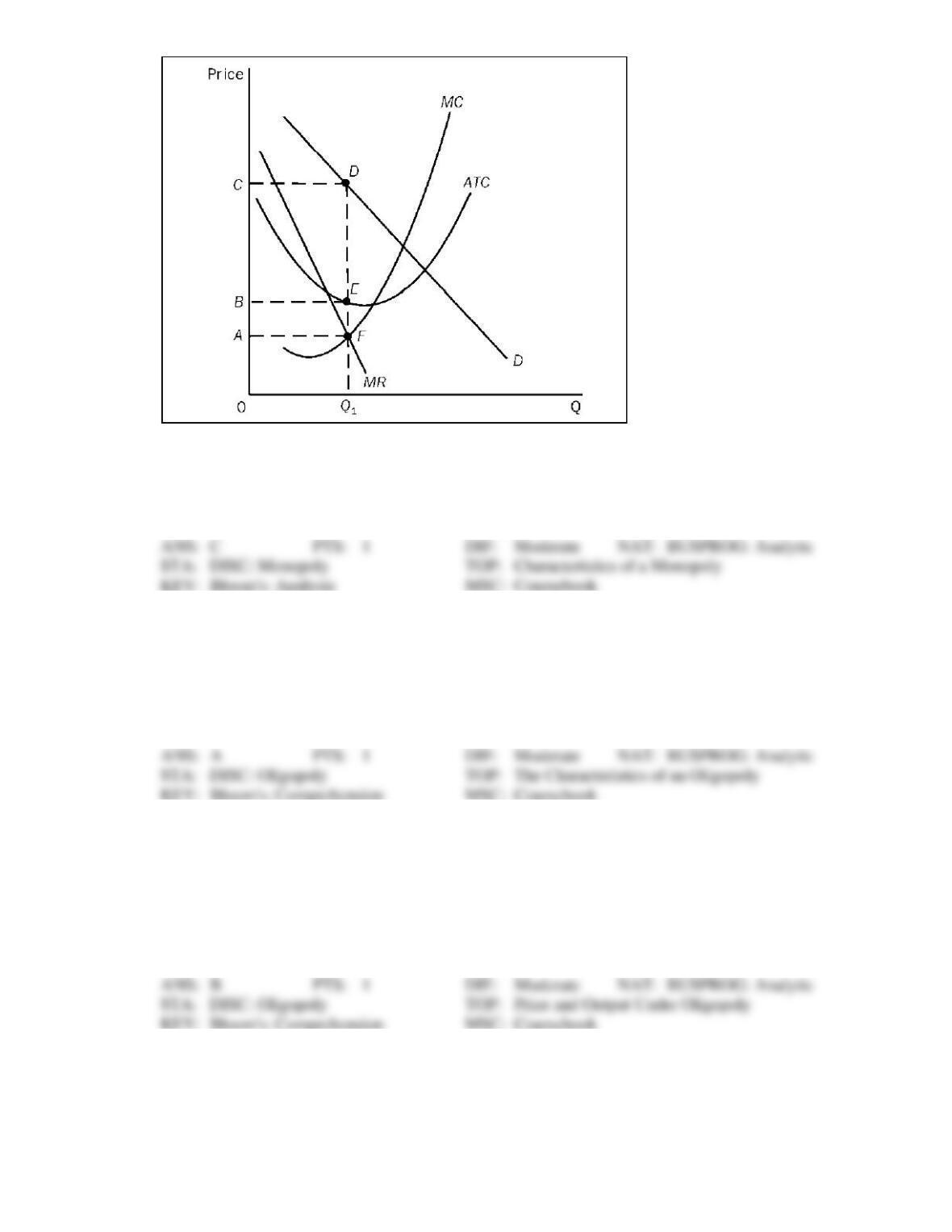
a.
charge a price equal to C and earn an economic profit of AFDC.
b.
charge a price equal to C and earn an economic profit of AFEB.
c.
charge a price equal to C and earn an economic profit of BEDC.
d.
charge a price equal to A and earn an economic profit of AFDC.
220. A market situation in which only a small number of mutually interdependent, rival sellers exists is
known as a(n)
a.
oligopoly market.
b.
monopoly market.
c.
open price-taker market.
d.
competitive price-searcher market.
221. In general, an organization of sellers designed to coordinate supply decisions so that the joint profits of
the members is maximized is called a(n) ____. If they are successful, the total market output and price
will most closely approximate the output and price in a(n) ____ market. (Fill in the blanks.)
a.
cooperative; open price-taker
b.
cartel; monopoly
c.
cartel; open price-taker
d.
OPEC; competitive price-searcher
222. To increase joint profits, a cartel will attempt to
a.
restrict output in order to increase the market price of the good produced.
b.
restrict output in order to decrease the market price of the good produced.
c.
expand output in order to increase the market price of the good produced.
d.
expand output in order to decrease the market price of the good produced.
223. The oil industry is dominated by a cartel known as OPEC, and the cocaine industry is dominated by
the Columbian cocaine cartel. If these cartels are being successful,
a.
the price of oil is higher than if the cartel did not exist, but the price of cocaine is lower.
b.
the price of cocaine is higher than if the cartel did not exist, but the price of oil is lower.
c.
both goods have higher prices than if the cartels did not exist, and both have lower levels
of total output.
d.
both goods have higher prices than if the cartels did not exist, and both also have higher
levels of total output.
224. Laws designed to prevent monopoly and promote competition are known as
a.
antitrust laws.
b.
statutory amendments.
c.
fair-pricing legislation.
d.
breakup bills.
225. Which of the following would increase the likelihood that firms in an industry could successfully
collude?
a.
a large number of firms in the industry
b.
unstable demand conditions in the industry
c.
high barriers to entry in the industry
d.
product characteristics that make it difficult for firms to detect other firms that cheat on the
agreement
226. (I) Oligopolistic firms have an incentive to collude to increase profits.
(II) Oligopolistic firms have an incentive to cheat on collusive agreements to increase profits.
a.
I is true; II is false.
b.
I is false; II is true.
c.
Both I and II are false.
d.
Both I and II are true.
227. If a local government began licensing funeral homes in the area, effectively making them into a cartel,
we would expect
a.
the price of funeral services to rise, and the number of funerals performed in the area to
fall.
b.
the price of funeral services to rise, and the number of funerals performed in the area to
increase as well.
c.
the price of funeral services to fall, and the number of funerals performed in the area to
increase.
d.
the price of funeral services to fall, and the number of funerals performed in the area to
fall as well.
228. A major problem with regulatory agencies is that they
a.
have no real legal power over the industries they are supposed to regulate.
b.
tend to be too tough on the firms they are regulating, forcing them into a loss position.
c.
often underestimate the firm’s cost of production and consequently force regulated firms
into a loss position.
d.
often come to represent the interests of established firms in the industry and use their
power to limit competition.
229. An expansion in the number of plumbers in a local area has resulted in lower profits. The local
plumbing contractors have called a meeting to discuss ways to improve their long-run profitability. Of
the four plans being discussed seriously, which would most likely increase their long-run profits?
a.
passage of legislation requiring new contractors to be licensed, which would require
passing a stiff licensing exam and paying a $5,000 fee
b.
an “off-the-record” agreement that each plumbing contractor would increase his or her
prices by an average of 7 percent
c.
passage of legislation requiring the local government to share the cost of installing all
private sewage systems
d.
repeal of the current tax on installations of plumbing units