30) Explain why the multiplier is greater than 1.
31) What effect does an increase in the MPC have on the slope of the AE curve?
32) What is the relationship between the MPC and the slope of the AE curve?
33) What is the relationship between the slope of the aggregate expenditure curve and the
multiplier?
34) What is the mathematical formula for the multiplier? Why is there a multiplier?
35) Explain what happens to equilibrium expenditure if autonomous expenditure increases by
$100 million.
36) Suppose the MPC = 0.90 and there are no taxes or imports. What dos the multiplier equal? If
the initial equilibrium aggregate expenditure is $12 trillion, what will be the effect on aggregate
expenditure of a $100 billion increase in investment?
37) How do imports and income taxes affect the multiplier? Why do they have this effect?
38) “If the income tax rate is high enough, the multiplier can be negative.” Is the previous
statement correct or incorrect?
39) Discuss how the marginal propensity to consume, imports, and income tax rates influence the
multiplier.
40) List and explain factors that determine the size of the multiplier in the aggregate expenditure
model when prices are constant.
41) How does the concept of the multiplier help explain business cycle turning points?
42) Discuss the relationship between the business cycle and changes in autonomous
expenditures.
43) “When the price level increases, aggregate planned expenditure increases and equilibrium
expenditure increases.” Is the preceding statement correct or incorrect? Briefly explain your
answer.
44) How does an increase in the price level affect the aggregate expenditure curve and the
aggregate demand curve?
45) An increase in the price level shifts the aggregate expenditure curve downward and results in
a movement along the aggregate demand curve. Why does an increase in the price level result in
a shift in the aggregate expenditure curve rather than a movement along it?
46) What is the relationship between the aggregate expenditure curve and the aggregate demand
curve? Explain the relationship.
8 Numeric and Graphing Questions
Disposable
income (trillions
of 2009 dollars)
Consumption
expenditure
(trillions of 2009
dollars)
0.0
0.8
1.0
1.6
2.0
2.4
3.0
3.2
4.0
4.0
1) The above table has data on the consumption function in the nation of Mojo.
a) What is the amount of autonomous consumption expenditure?
b) What is the marginal propensity to consume?
2) When disposal income is $5.0 trillion, consumption expenditure is $4.5 trillion. When
disposal income is $6.0 trillion, consumption expenditure is $5.0 trillion. What is the marginal
propensity to consume?
3) When Audrey’s disposable income is $40,000, her consumption expenditure is $39,000. When
her disposable income is $50,000, Audrey’s consumption expenditure is $47,000. What is
Audrey’s marginal propensity to consume?
Real GDP
(billions of
2009 dollars)
C
(billions of
2009 dollars)
I
(billions of
2009 dollars)
G
(billions of
2009 dollars)
100
150
150
150
200
200
150
150
300
250
150
150
400
300
150
150
500
350
150
150
600
400
150
150
700
450
150
150
800
500
150
150
900
550
150
150
4) The above table gives information for the nation of North Hampton. There are no imports to
or exports from North Hampton.
a) Find aggregate planned expenditure for each level of real GDP.
b) What is the equilibrium level of real GDP?
dollars)
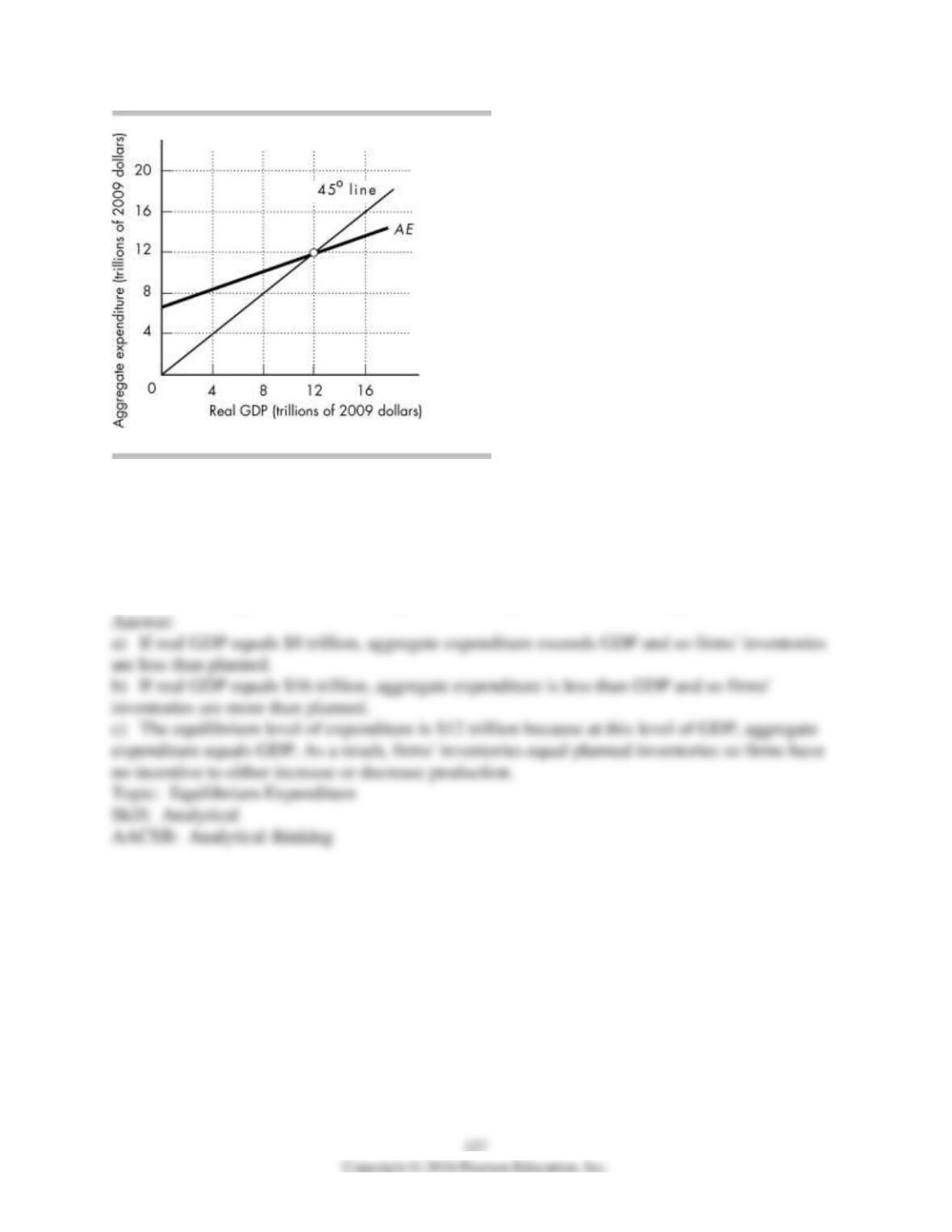
5) The above figure shows the AE curve and 45° line for an economy.
a) If real GDP equals $8 trillion, how do firms’ inventories compare to their planned
inventories?
b) If real GDP equals $16 trillion, how do firms’ inventories compare to their planned
inventories?
c) What is the equilibrium level of expenditure? Why is this amount the equilibrium?
6) The slope of the AE curve is .80. What is the multiplier? Everything else the same, by how
much does equilibrium aggregate expenditure increase if
a) exports increase from $1.75 trillion to $2.25 trillion.
b) government expenditure on goods and services decrease from $2.0 trillion to $1.8 trillion.
c) investment increases from $1.2 trillion to $2.3 trillion.
7) Suppose a country has no income taxes or imports. If the MPC is 0.75, what does the
multiplier equal?
8) Suppose the economy has no income taxes or imports. The MPC equals 0.8. What does the
expenditure model predict will be the change in real GDP if investment increases by $200
billion?
9) Suppose the economy has no income taxes or imports. How is the size of the expenditure
multiplier related to the marginal propensity to consume? What is the multiplier if the MPC
equals 0.25? If the MPC equals 0.50? If the MPC equals 0.90?
1) Components of aggregate expenditure include saving, consumption expenditure, investment
and government expenditure.
2) In the very short term, planned investment, planned government expenditure, planned exports,
planned consumption, and planned imports are all fixed and do not change when GDP changes.
3) The positive relationship between consumption expenditure and disposable income is shown
by a movement along the consumption function.
4) A change in the real interest rate creates a movement along the consumption function.
5) A movement along the consumption function is the result of changes in disposable income.
6) If wealth increases, the consumption function shifts upward.
7) As disposable income increases, saving increases.
8) The marginal propensity to consume must increase as disposable income increases.
9) The autonomous components of aggregate expenditures are consumption, savings, and
investment.
10) Components of induced aggregate expenditure include government expenditure, investment
and consumption expenditure.
11) When aggregate planned expenditure is greater than real GDP, inventories decrease.
12) Actual aggregate expenditure does not always equal real GDP.
13) If the price level is constant, a change in investment has a multiplied impact on real GDP.
14) In the short run, the multiplier typically is less than 1.
15) If the change in autonomous investment equals $1 trillion and the change in real GDP equals
$4 trillion, the multiplier equals 1/4.
16) If the multiplier is 3, a $750,000 increase in autonomous expenditure increases equilibrium
expenditure by $2.25 million.
17) If there are no income taxes or imports, the multiplier equals 1/(1 – marginal propensity to
consume).
18) Income taxes reduce the size of the multiplier.
132
19) Imports and income taxes make the multiplier larger than it would otherwise be.
20) In the short run, an upward shift in the aggregate expenditure curve leads to a leftward shift
in the short-run aggregate supply curve.
21) A fall in the price level shifts the aggregate expenditure curve upward and increases the
quantity of real GDP demanded.
22) The short-run impact changes in autonomous spending have on real GDP and the price level
depends on aggregate supply.
10 Extended Problems
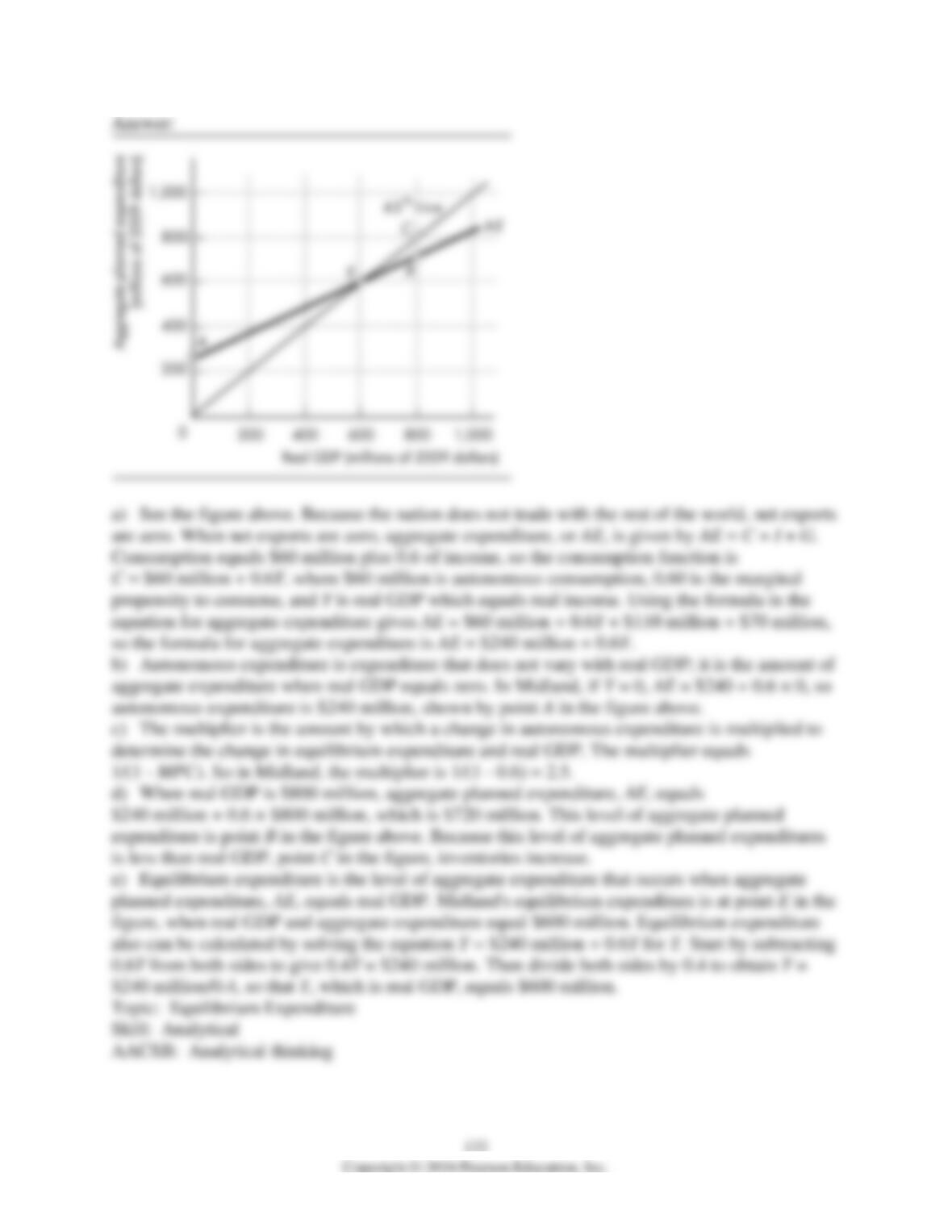
1) In the country of Midland, autonomous consumption expenditure is $60 million, and the
marginal propensity to consume is 0.6. Investment is $110 million, government expenditure is
$70 million, and there are no income taxes. Investment and government expenditure are
constant—they do not vary with income. The nation does not trade with the rest of the world.
a) Draw the aggregate expenditure curve.
b) What is the autonomous aggregate expenditure?
c) What is the size of the multiplier in Midland’s economy?
d) What is aggregate planned expenditure and what is happening to inventories when real GDP
is $800 million?
e) What is the economy’s equilibrium aggregate expenditure?
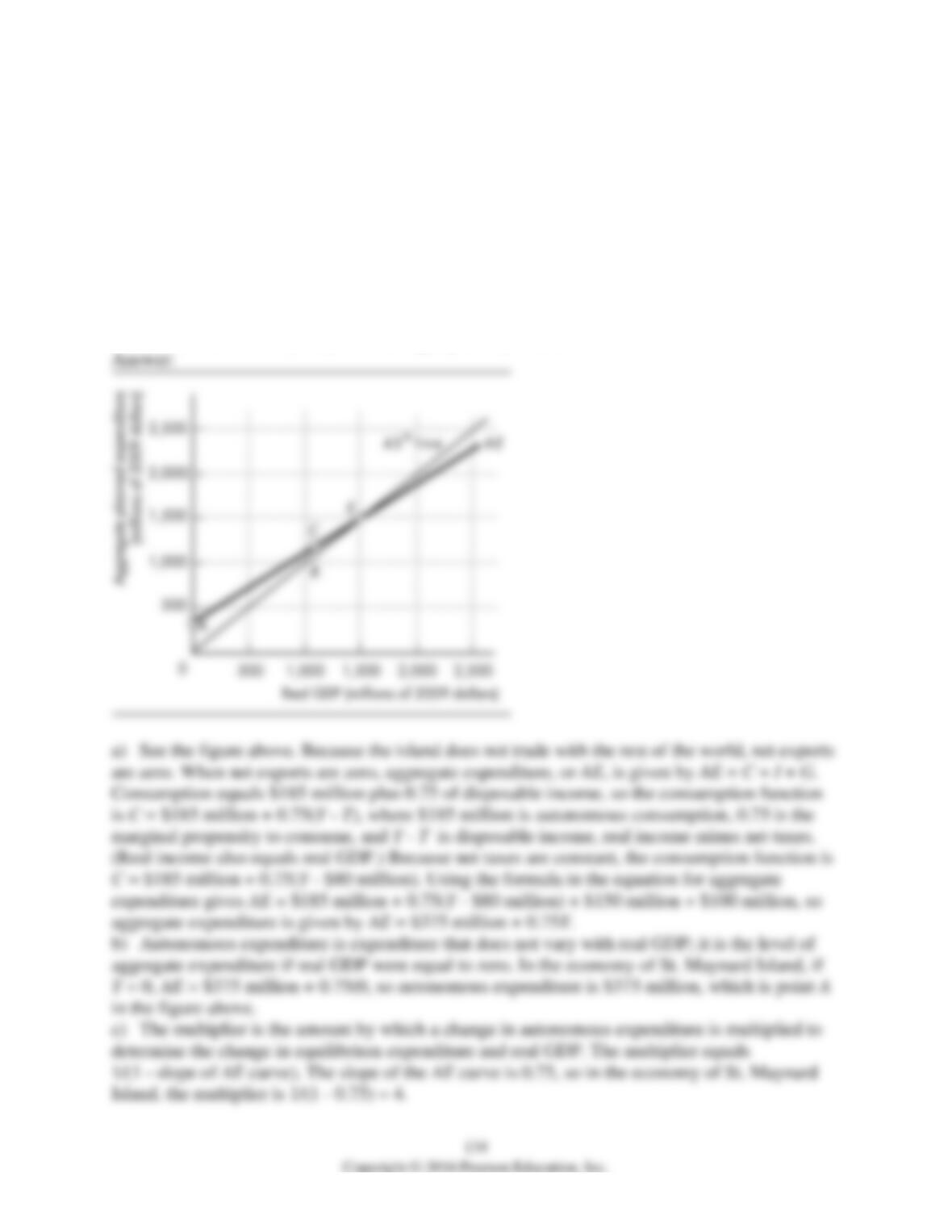
2) In the economy of St. Maynard Island, autonomous consumption expenditure is $185 million,
and the marginal propensity to consume is 0.75. Investment is $150 million, government
expenditure is $100 million, and net taxes are $80 million. Investment, government expenditure,
and taxes are constant—they do not vary with income. The island does not trade with the rest of
the world.
a) Draw the aggregate expenditure curve.
b) What is the island’s autonomous aggregate expenditure?
c) What is the size of the multiplier in St. Maynard Island’s economy?
d) What is the island’s aggregate planned expenditure and what is happening to inventories
when real GDP is $1,100 million?
e) What is the economy’s equilibrium aggregate expenditure?
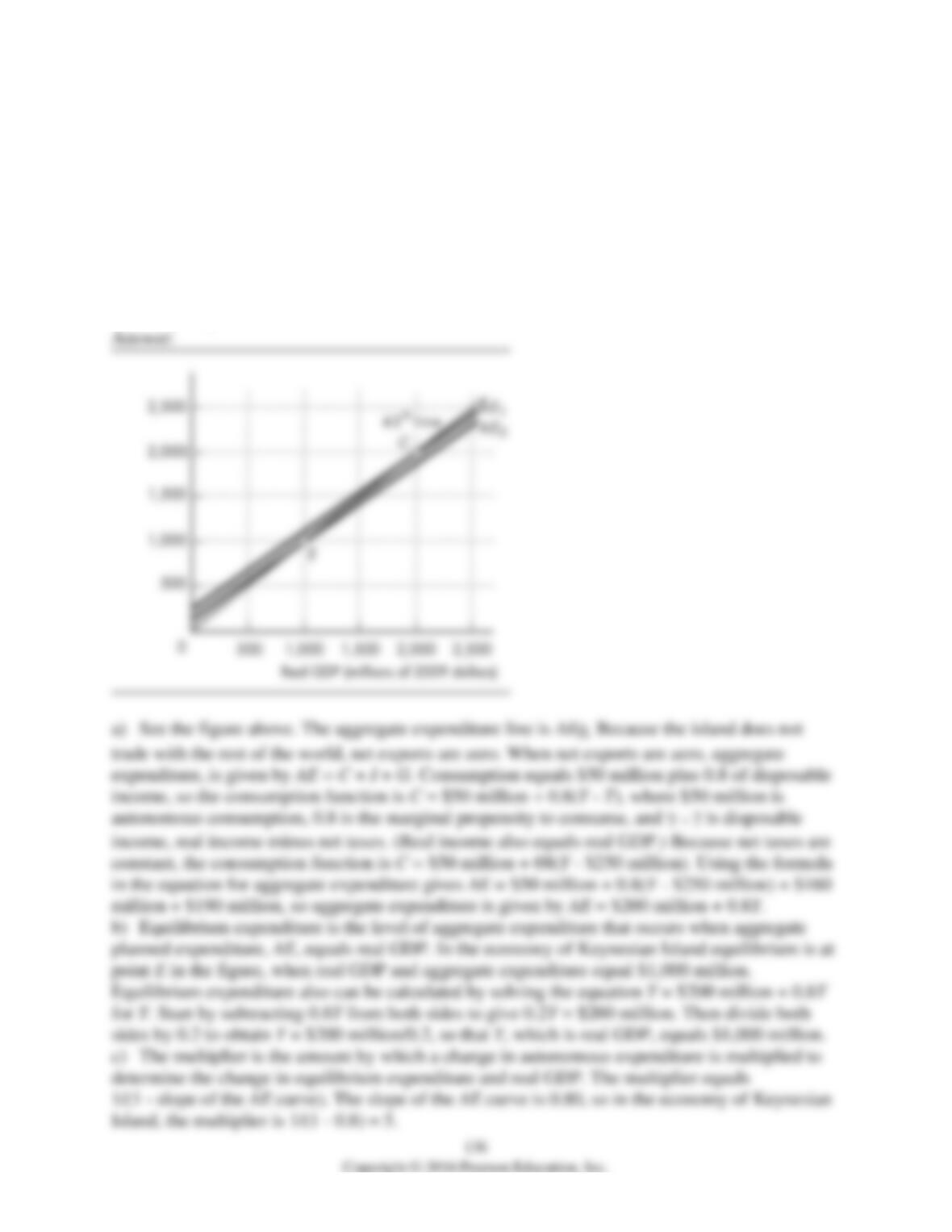
3) In the economy of Keynesian Island, autonomous consumption expenditure is $50 million,
and the marginal propensity to consume is 0.8. Investment is $160 million, government
expenditure is $190 million, and net taxes are $250 million. Investment, government purchases,
and taxes are constant—they do not vary with income. The island does not trade with the rest of
the world.
a) Draw the aggregate expenditure curve.
b) What is equilibrium real GDP for Keynesian Island?
c) What is the size of the multiplier in Keynesian Island’s economy?
d) If the government increases its purchases by $200 million, what will be the change in the
economy’s equilibrium real GDP?
137