
74) The full-employment rate of output can
A) be surpassed in the long run only if input prices are flexible.
B) not be surpassed in either the short run or the long run.
C) be surpassed only when firms are not yet producing at full capacity.
D) be surpassed only in the short run.
75) In the short run, real GDP can increase beyond a level consistent with the long-run growth
path if
A) labor productivity improves.
B) the price level decreases accordingly.
C) we measure in nominal terms instead of real terms.
D) there is an increase in marginal tax rates.
76) Which of the following is NOT a reason why real GDP can be expanded beyond a level
consistent with its long-run growth path in modern Keynesian analysis?
A) In the short run, existing workers can work more hours.
B) Prices and wages are flexible, allowing for needed adjustments.
C) The existing capital stock can be used more intensively.
D) Higher prices induce firms to hire more workers.
77) If short-run aggregate supply is upward sloping, the assumption is that
A) prices are perfectly sticky.
B) prices are set by government mandate.
C) prices are constant.
D) prices adjust gradually.
78) An upward sloping short-run aggregate supply curve suggests that
A) real GDP is determined by aggregate supply.
B) prices and wages are completely inflexible.
C) prices and wages are completely flexible.
D) prices and wages adjust in part to short-run demand changes.
79) In the modern Keynesian model, over much of its range the short-run aggregate supply
(SRAS) curve is
A) horizontal.
B) vertical.
C) upward sloping.
D) downward sloping.
80) The short-run aggregate supply curve in modern Keynesian analysis
A) is a horizontal line the same as in the Keynesian model.
B) is a vertical line the same as in the classical model.
C) is an upward sloping curve.
D) is a negatively sloped curve.
81) There is a distinction between the long-run aggregate supply (LRAS) curve and the short-run
aggregate supply (SRAS) curve. In the long run
A) technology is fixed, but not in the short run.
B) the price level is constant in the long run, but fluctuates in the short run.
C) the aggregate supply curve is horizontal, while in the short run it is upward sloping.
D) all adjustments to changes in the price level have been made, but in the short run all changes
in the price level do not occur.
82) If the price level kept increasing, the short-run aggregate supply (SRAS) curve would get
steeper because
A) all the unemployed would eventually be hired.
B) there are limits to how long workers can work long hours and capital can go without proper
maintenance.
C) the rate at which capacity can be expanded increases indefinitely.
D) the long-run aggregate supply curve is horizontal.
83) In the short run, if the price level rises, then the overall economy can temporarily produce
beyond its nominal capacity. One reason for this is that
A) workers can be switched from counted to uncounted production.
B) existing capital equipment can be used more intensively.
C) wage rates rise almost simultaneously with the price level.
D) the unemployment rate usually rises dramatically along with the price level.
84) The long-run aggregate supply curve is vertical at $100 billion, but the short-run aggregate
supply curve intersects the aggregate demand curve at $120 billion. From this, we know that
A) the economy is operating below full capacity in the short run, and will have to adjust by
hiring more workers, thus reducing unemployment.
B) the price level is too high. The only way long-run equilibrium can be restored is to lower the
price level.
C) adjustments will have to occur so that the long-run aggregate supply equals $120 billion.
D) adjustments will have to occur so that the short-run aggregate supply intersects the aggregate
demand curve at $100 billion.
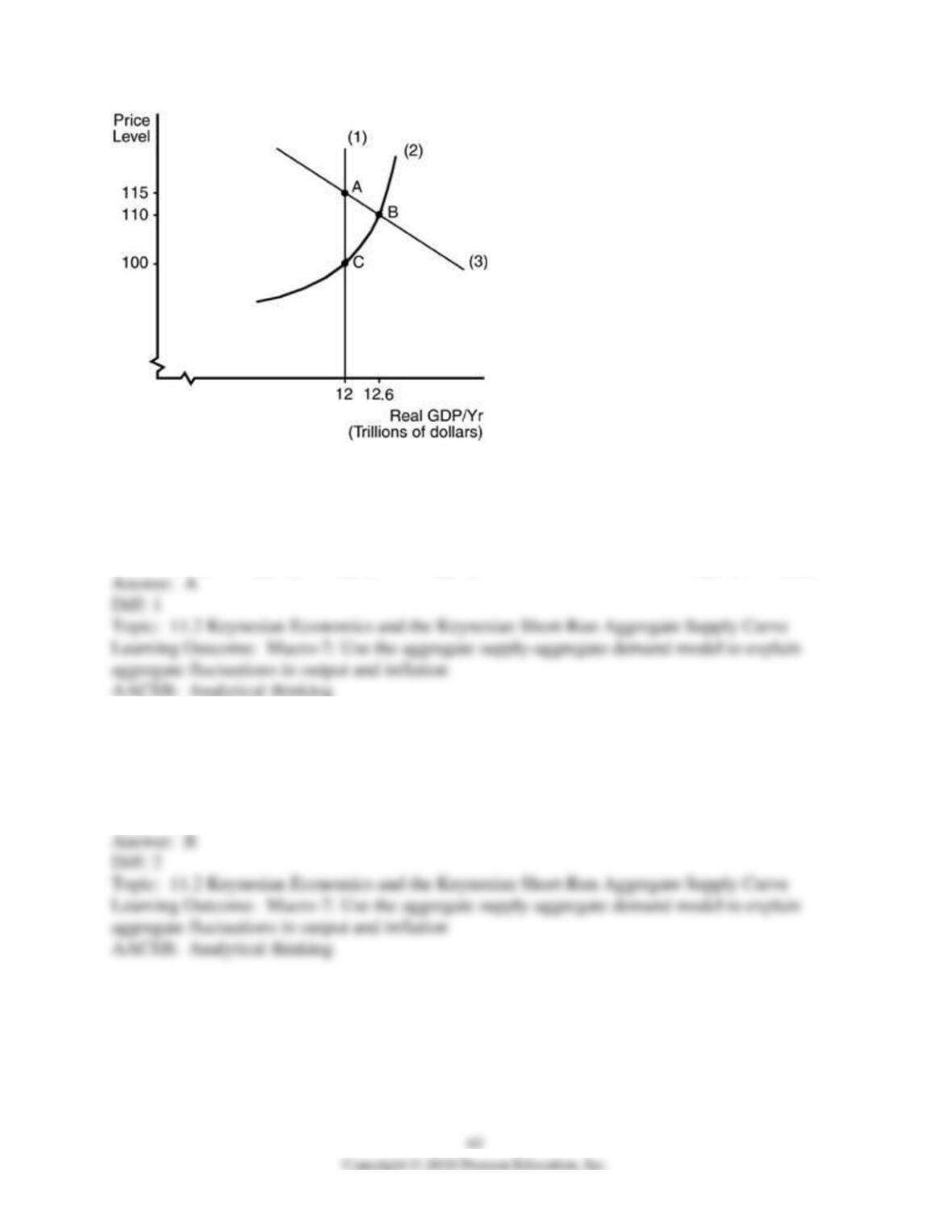
85) Identify the 3 curves in the above figure.
A) (1) is long-run aggregate supply, (2) is short-run aggregate supply, (3) is aggregate demand.
B) (1) is aggregate demand, (2) is short-run aggregate supply, (3) is long-run aggregate supply.
C) (1) is short-run aggregate supply, (2) is long-run aggregate supply, (3) is aggregate demand.
D) (1) is long-run aggregate supply, (2) is aggregate demand, (3) is short-run aggregate supply.
86) Which point or points on the above figure illustrate a short-run equilibrium?
A) Point A
B) Point B
C) Point C
D) Points A and C
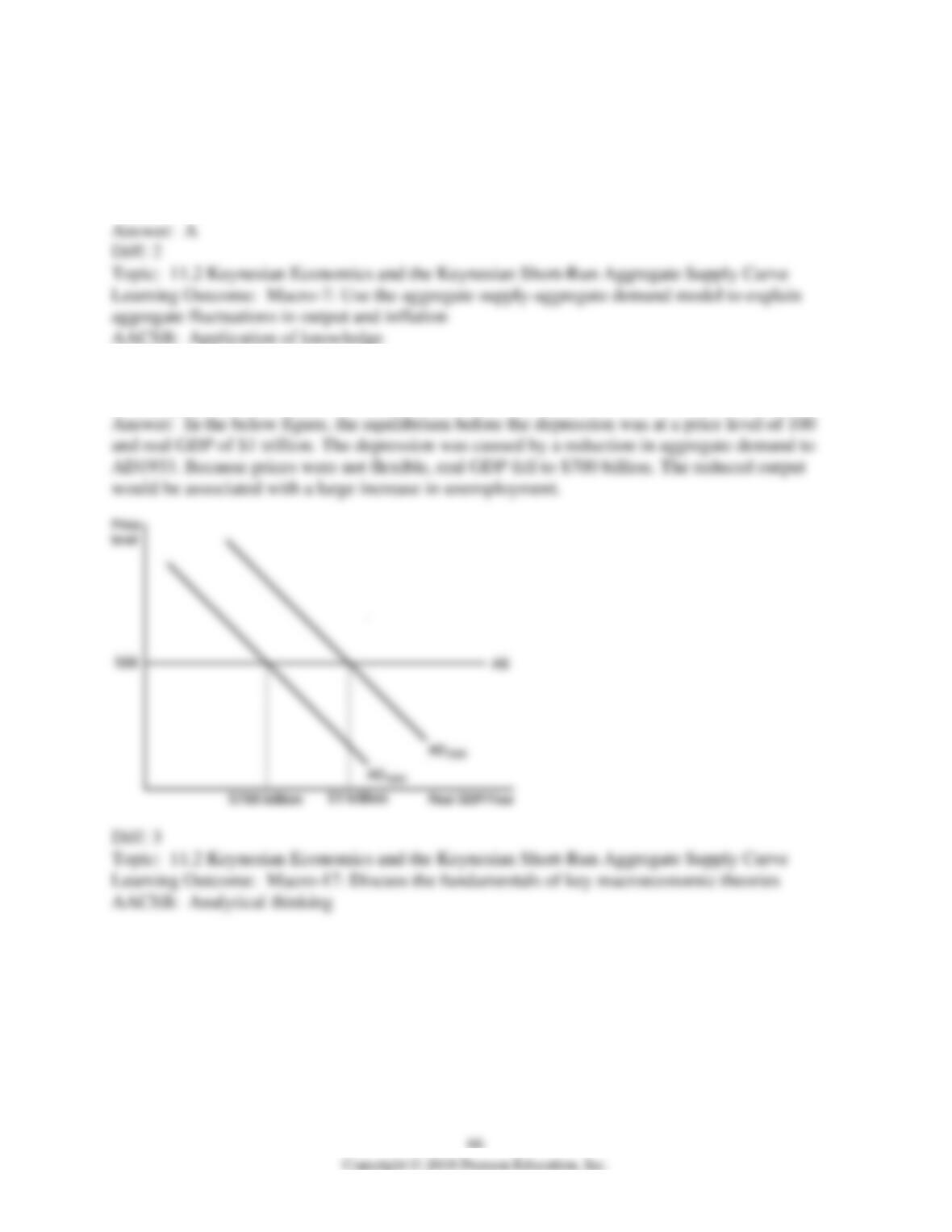
87) According to the above figure, what will the price level be in the new long-run equilibrium?
A) 115
B) 110
C) 100
D) Less than 100
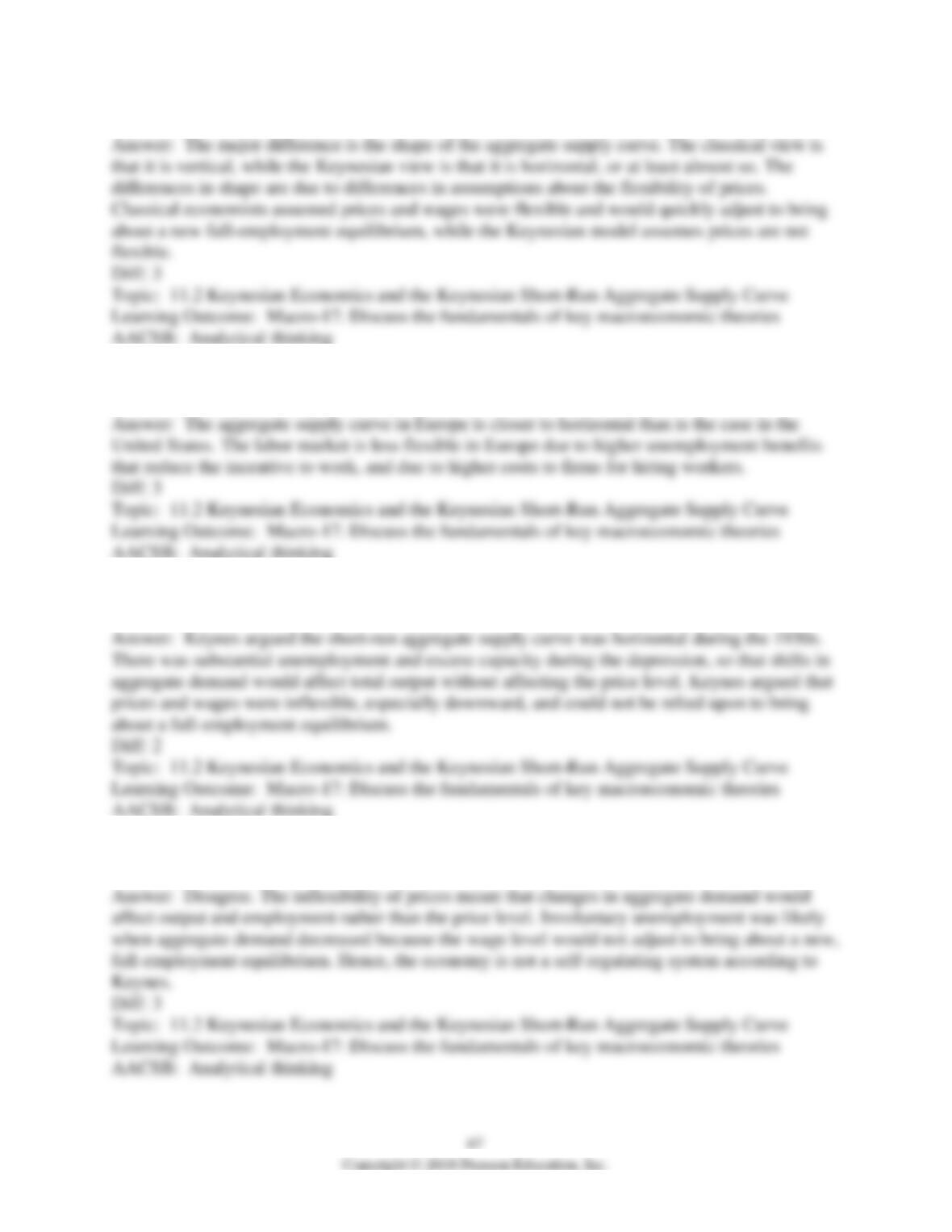
88) Using a graph, analyze the Great Depression from a Keynesian perspective. What happened
to unemployment?
89) What is the major difference between the classical model and the Keynesian model? Explain.
90) For several years, the U.S. unemployment rate has been below the European unemployment
rate. Offer a Keynesian explanation for this.
91) What shape did the short-run aggregate supply curve have during the 1930s, according to
Keynes? Explain.
92) “According to Keynes, the economy is essentially a self-regulating system.” Do you agree or
disagree? Why?
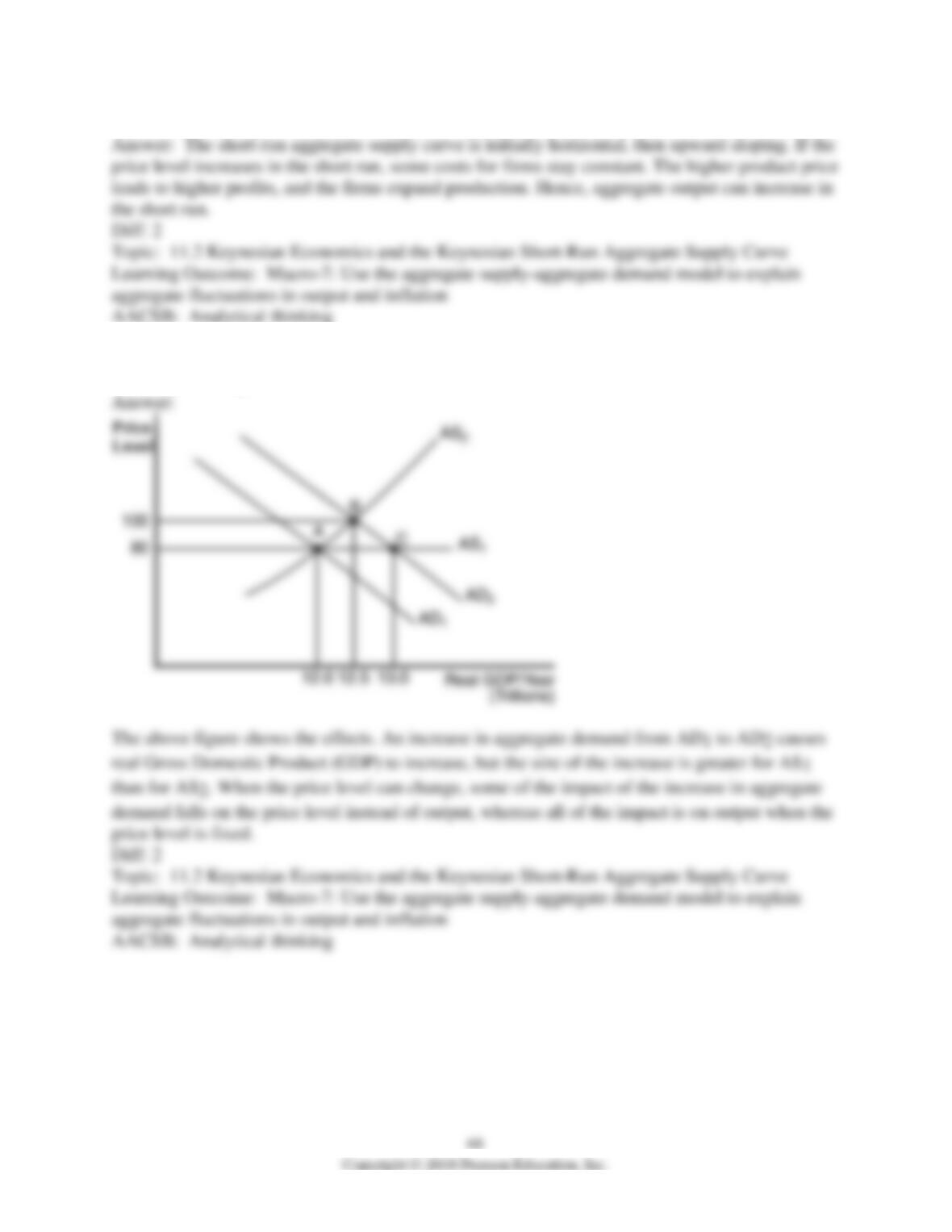
93) What is the shape of the modern short-run aggregate supply (SRAS) curve? Why?
94) Compare the effects of an increase in aggregate demand when the price level is fixed versus
when it can change.
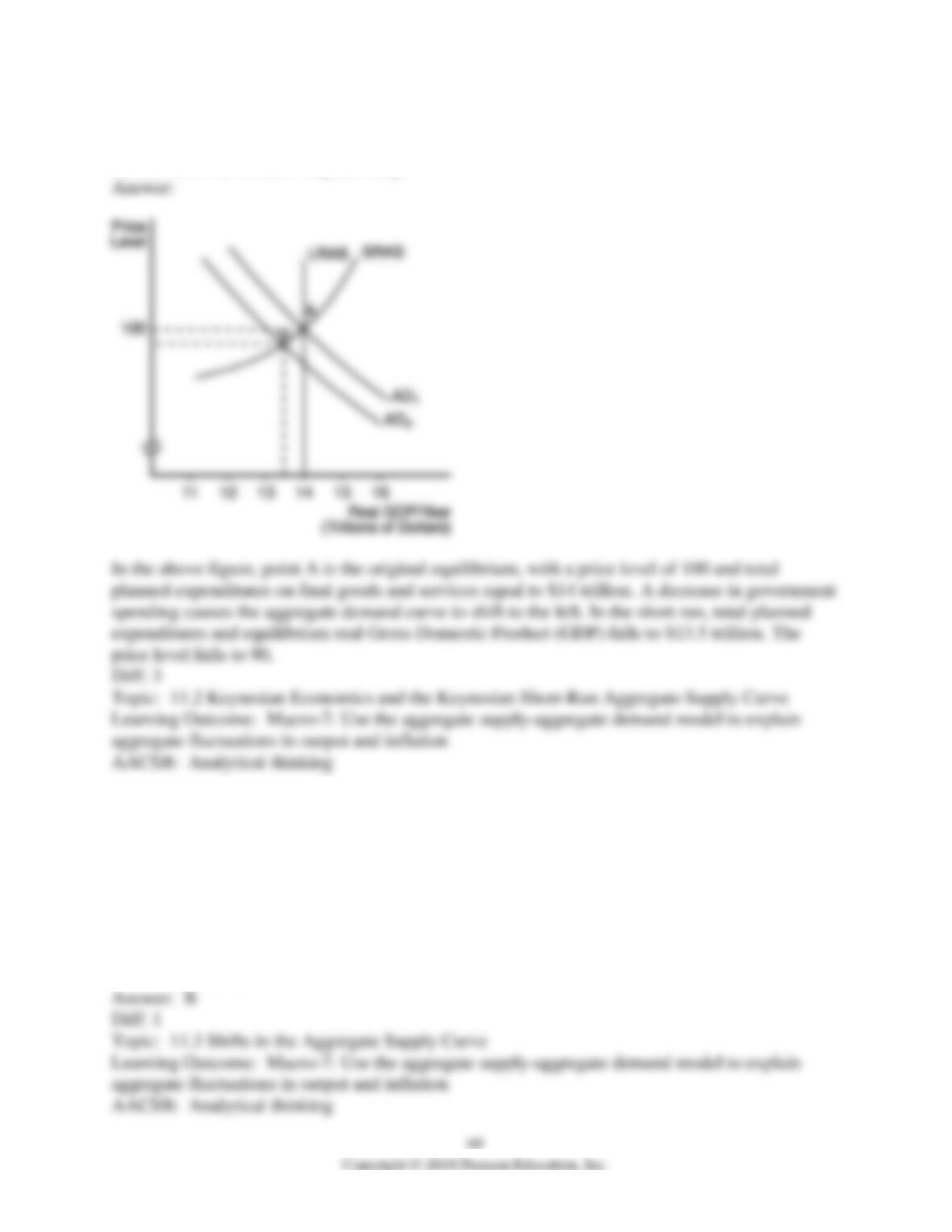
95) Suppose the economy in the diagram below is in long-run equilibrium. If government
spending decreases and causes a movement from point A to point B in the diagram below, what
are the short-run effects? Explain fully.
11.3 Shifts in the Aggregate Supply Curve
1) Economic growth due to labor force expansion or capital investments will result in
I. A leftward shift of short-run aggregate supply.
II. A rightward shift in long-run aggregate supply.
A) I only
B) II only
C) Both I and II
D) Neither I nor II
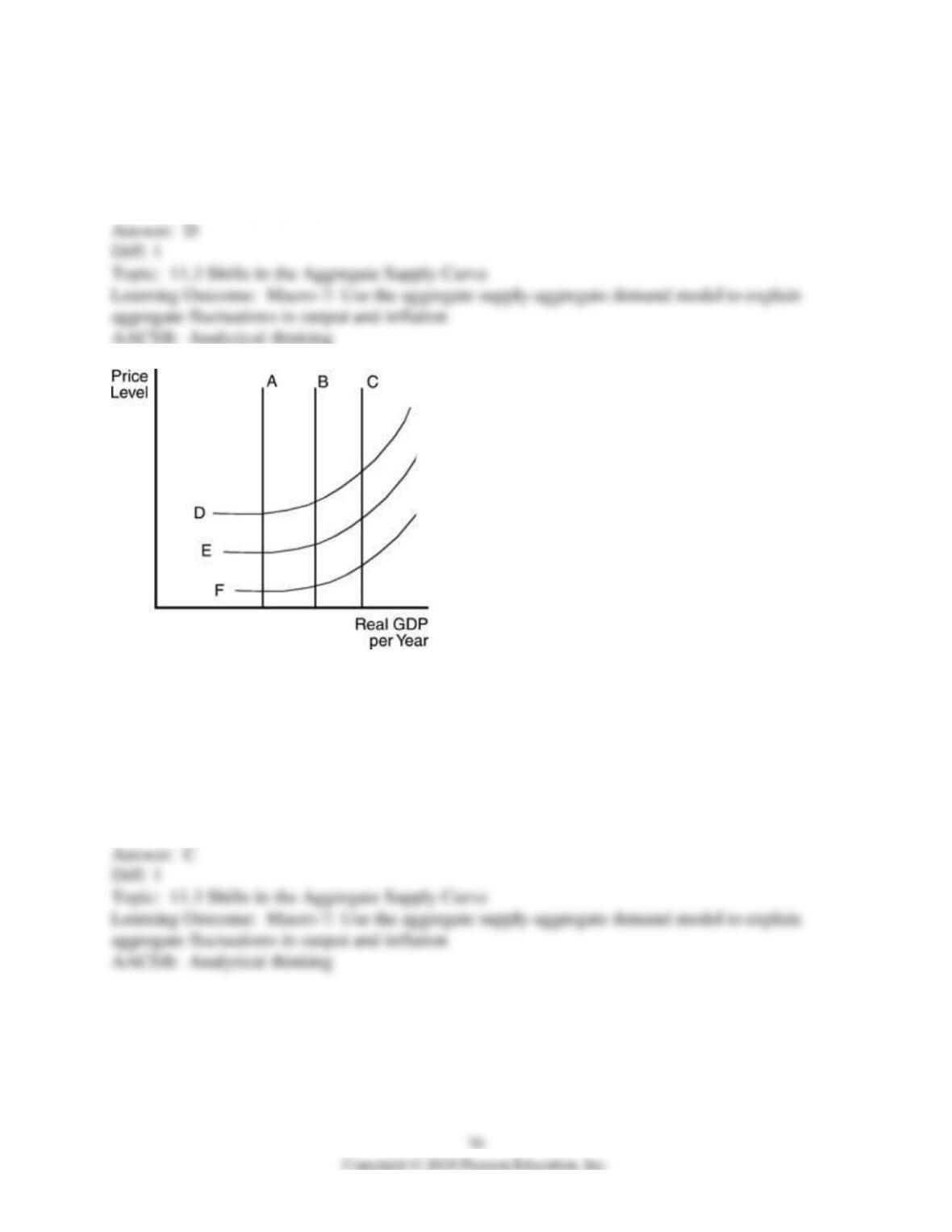
2) Which of the following will cause an increase in aggregate supply?
A) an increase in aggregate demand
B) an increase in the price level
C) an increase in marginal tax rates
D) a decrease in input prices
3) Refer to the above figure. Assume that B is the current long-run aggregate supply (LRAS)
curve and that E is the current short-run aggregate supply (SRAS) curve. If a new discovery of
large oil fields in Florida led to an increase in the nation’s productive capacities, then we could
expect the LRAS curve and the SRAS curve to
A) remain B and E.
B) move to A and D.
C) move to C and F.
D) move to A and F.

4) Refer to the above figure. Assume that B is the current long-run aggregate supply (LRAS)
curve and E is the current short-run aggregate supply (SRAS) curve. If a 90-day embargo of oil
from the Middle East to the United States were announced, and if after that 90-day period oil
prices were expected to return to normal pre-embargo prices, then you would expect
A) the LRAS and the SRAS to remain at B and E, respectively.
B) the LRAS to remain at B, but the SRAS to shift to D.
C) the LRAS to remain at B, but the SRAS to shift to F.
D) the LRAS to shift to C, and the SRAS to shift to F.
5) Which of the following is NOT an event that causes BOTH the short-run aggregate supply
(SRAS) curve and the long-run aggregate supply (LRAS) curve to shift?
A) a change in an economy’s endowments of the factors of production
B) technological changes
C) a change in an economy’s labor supply
D) a temporary change in the price of a key input
6) Which of the following will NOT shift the short-run aggregate supply (SRAS) curve?
A) a change in the wage rate
B) technological progress
C) a reduction in energy prices
D) a change in the consumer spending

7) Which of the following causes a rightward shift of the short-run aggregate supply (SRAS)
curve?
A) an increase in the wage rate
B) an increase in firms’ production without adding inputs
C) a reduction in the price of a raw material
D) an increase in the overall price level
8) All of the following will shift the short-run aggregate supply (SRAS) curve EXCEPT
A) a change in the price level.
B) a change in the price of labor.
C) a change in the prices of raw materials.
D) technological progress.
9) As real GDP per year increases along the short-run aggregate supply (SRAS) curve, the SRAS
curve
A) becomes increasingly steep.
B) begins to level out.
C) shifts inward.
D) does not change.

10) Both the long-run and short-run aggregate supply curves will shift when
A) the government increases defense spending.
B) an event occurs which is expected to last only a short period of time.
C) they are both upward sloping.
D) the endowments of the factors of production change.
11) Which of the following would increase aggregate supply?
A) increased training and education
B) a reduction in input prices
C) a discovery of new raw materials
D) all of the above
12) The discovery of new oil deposits will cause
A) the long-run aggregate supply curve to shift to the right and the short-run aggregate supply
curve to shift to the left.
B) the long-run aggregate supply curve to shift to the right, but not the short-run aggregate
supply.
C) the short-run aggregate supply curve to shift to the right, but not the long-run aggregate
supply curve.
D) both the long-run and the short-run aggregate supply curves to shift to the right.

13) A major hurricane causes production problems in Gulf Coast region of the United States.
This would cause
A) the short-run aggregate supply curve to shift to the left, but there would be no effect on the
long-run aggregate supply curve.
B) the short-run aggregate supply curve to shift to the left, and the long-run aggregate supply
curve would shift to the right.
C) both the short-run and the long-run aggregate supply curves to shift to the right in equal
amounts.
D) both the short-run and the long-run aggregate supply curves to shift to the left, but the long-
run aggregate supply curve would shift more than the short-run curve.
14) The short-run aggregate supply curve would shift and the long-run aggregate supply curve
would remain fixed if
A) there was a temporary shock to aggregate demand.
B) there was a temporary shock that influenced the supply side.
C) there was a permanent increase in aggregate demand along with a permanent decrease in
aggregate supply.
D) there was a permanent increase in aggregate demand.
15) The short-run aggregate supply curve would shift and the long-run aggregate supply curve
would remain fixed if
A) bad weather that affects transportation for two days.
B) there was an increase in immigration.
C) the retirement age increased by two years.
D) tough new environmental laws were passed.

16) A reduction in nominal wages will cause which of the following?
A) a movement along the short-run aggregate supply curve
B) a shift of both the short-run and long-run aggregate supply curves
C) a rightward shift in the short-run aggregate supply curve
D) a leftward shift in the short-run aggregate supply curve to shift to the left
17) A permanent reduction in international trade barriers would
A) decrease long-run aggregate supply.
B) increase long-run aggregate supply.
C) decrease aggregate demand.
D) increase aggregate demand.
18) A short-lived increase in oil prices caused by destruction of oil-producing and oil-refining
facilities by a large hurricane will
A) shift the SRAS curve to the right.
B) shift the LRAS curve to the right.
C) shift the SRAS curve to the left.
D) shift the AD curve to the right.

19) If there is a change in the U.S. endowment of factors of production, then there would be
A) a shift in just LRAS.
B) a shift in both LRAS and SRAS.
C) shifts in just SRAS.
D) a movement along the SRAS curve.
20) All items below will decrease short-run aggregate supply EXCEPT
A) a decrease in the marginal tax rates.
B) an increase in the prices of inputs.
C) a decrease in training and education.
D) a decrease in labor supply.
21) Which of the following decreases aggregate supply?
A) discoveries of new natural resources
B) an increase in competition
C) an increase in educational attainment
D) a decrease in labor supply
22) A temporary embargo on oil from Saudi Arabia going in to the United States would
A) shift both the short-run and long-run aggregate supply curves to the left.
B) shift only the long-run aggregate supply curve to the left.
C) shift the long-run aggregate supply curve to the right.
D) shift only the short-run aggregate supply curve to the left.

23) A new discovery of large volumes of previously unknown oil deposits in Texas would
A) shift the short-run and long-run aggregate supply curves to the right.
B) shift only the short-run aggregate supply curve to the right.
C) shift only the long-run aggregate supply curve to the right.
D) not affect either the short-run or long-run aggregate supply curves.
24) Consider a nation in which most workers are unionized. If all the nation’s unions band
together and succeed in boosting wages established by long-term labor contracts, then
A) there is a leftward shift in just LRAS.
B) there is a leftward shift in both LRAS and SRAS.
C) there is a rightward shift in just SRAS.
D) there is a rightward movement along the SRAS curve.
25) All of the following will cause the aggregate supply curve to shift to the right EXCEPT
A) discoveries of raw materials.
B) a reduction in input prices.
C) an increase in marginal tax rates.
D) a reduction in international trade barriers.

26) A temporary increase in the price of oil would
A) increase both short-run and long-run aggregate supply.
B) increase short-run aggregate supply and decrease long-run aggregate supply.
C) decrease short-run aggregate supply and leave long-run aggregate supply unchanged.
D) decrease both short-run and long-run aggregate supply.
27) Which of the following will NOT shift the Keynesian short-run aggregate supply curve?
A) a change in technology
B) a change in profit expectations
C) a change in input prices
D) a change in the price level
28) Which of the following will shift the Keynesian short-run aggregate supply curve downward
and to the right?
A) a rise in the price level
B) a fall in the price level
C) a decrease in input costs
D) an increase in input costs
11.4 Consequences of Changes in Aggregate Demand
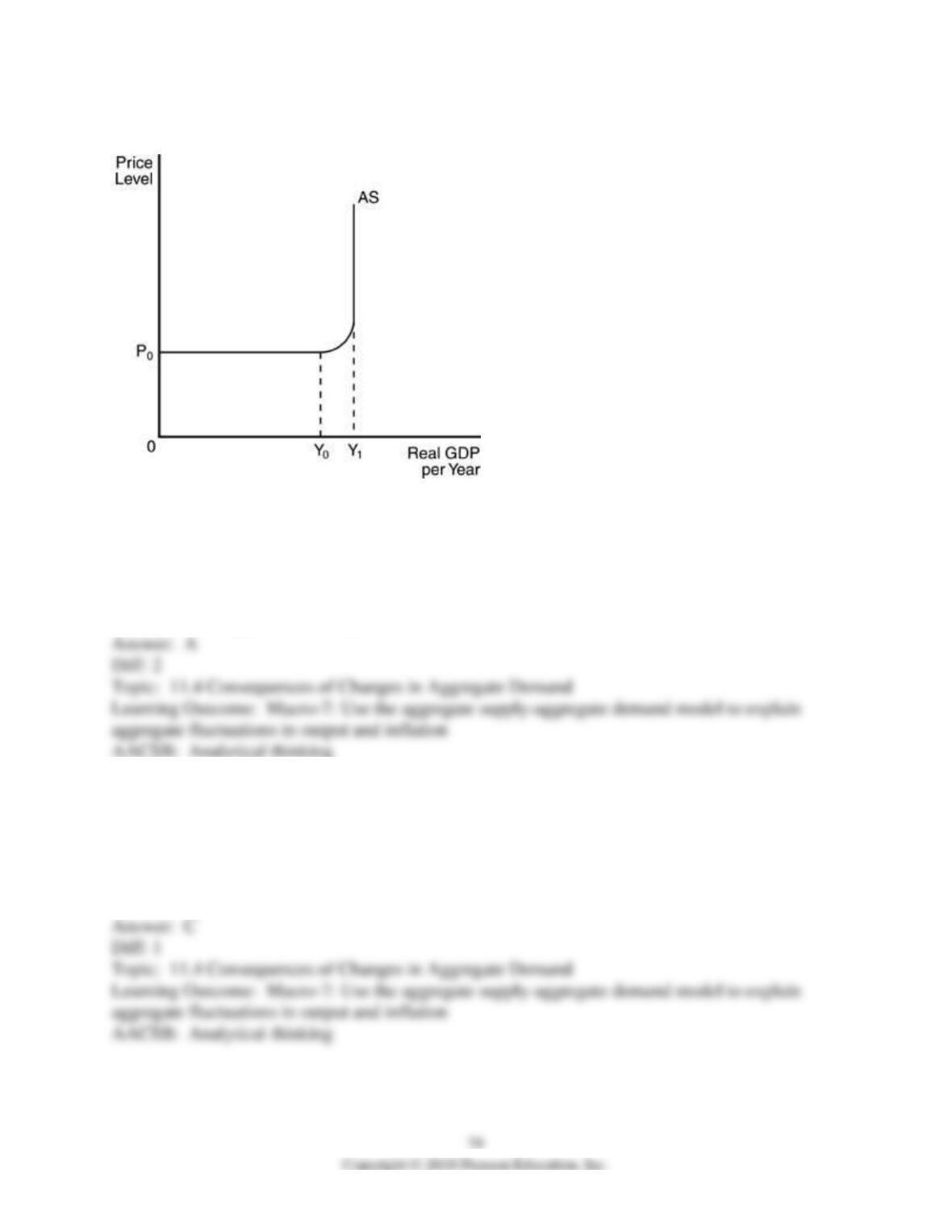
1) Refer to the above figure. An increase in aggregate demand between real Gross Domestic
Product (GDP) levels Y0 and Y1
A) would most likely result in some inflation.
B) would not increase output since the economy is already working at full capacity.
C) would have no effect on the price level.
D) would cause price levels to fall.
2) Refer to the above figure. An increase in aggregate demand beyond real Gross Domestic
Product (GDP) level Y1 would result in
A) higher real GDP but not a higher price level.
B) a lower price level but no change in real GDP.
C) a higher price level but no change in real GDP.
D) a lower price level and an increases in real GDP.

3) The gap that exists when equilibrium real Gross Domestic Product (GDP) is less than full
employment real Gross Domestic Product (GDP) is called a(n)
A) employment gap.
B) inflationary gap.
C) recessionary gap.
D) supply gap.
4) Economic growth will NOT result in deflation if aggregate demand shifts
A) outward to the right at the same speed as aggregate supply.
B) inward to the left at the same speed as aggregate supply.
C) outward to the right as aggregate supply shifts inward to the left.
D) inward to the left as aggregate supply shifts outward to the right.
5) An unexpected event that causes the aggregate demand curve to shift inward or outward is an
A) aggregate demand shock.
B) aggregate supply shock.
C) aggregate supply increase.
D) aggregate supply decrease.