64) An economy saves 20 percent of any increase in income and there are no income taxes or
imports. Then, an increase in investment of $2 billion leads to a short run increase in real GDP of
A) $2 billion.
B) $10 billion.
C) $0.4 billion.
D) $1.6 billion.
65) Equilibrium real GDP is $400 billion, the MPC = 0.9, and there are no income taxes or
imports. Investment increases $40 billion. If the price level is constant, after the increase in
investment, equilibrium real GDP will be
A) $440 billion.
B) $360 billion.
C) $600 billion.
D) $800 billion.
66) Equilibrium real GDP is $500 billion, government expenditures are $80 billion, the MPC =
0.9, and there are no income taxes or imports. Suppose that government expenditures increase to
$100 billion. If the price level is constant, after the increase in government expenditures,
equilibrium real GDP will be
A) $520 billion.
B) $580 billion.
C) $600 billion.
D) $700 billion.
Real GDP
(trillions of 2005
dollars)
Aggregate
expenditure (trillions
of 2005 dollars)
0
0.3
1.0
1.2
2.0
2.1
3.0
3.0
4.0
3.9
5.0
4.8
67) The data in the above table indicate that autonomous expenditure is
A) $0.3 trillion.
B) $3.0 trillion.
C) $4.8 trillion.
D) indeterminate from the information given.
68) In the above table, equilibrium expenditure is
A) $0.3 trillion.
B) $3.0 trillion.
C) $4.8 trillion.
D) None of the above answers are correct.
69) The data in the above table indicate that the slope of the AE curve is
A) 0.30.
B) 0.50.
C) 0.90.
D) indeterminate from the information given.
70) In the above table, suppose investment decreases by $0.1 trillion. The multiplier equals
A) 5.0.
B) 9.0.
C) 10.0.
Real GDP
(dollars)
Consumption
expenditure
(dollars)
Investment
(dollars)
Government
expenditure
(dollars)
3,000
2,500
500
500
4,000
3,250
500
500
5,000
4,000
500
500
6,000
4,750
500
500
7,000
5,500
500
500
8,000
6,250
500
500
71) In the above table, there are no taxes (so that that real GDP equals disposable income) and no
imports or exports. If real GDP decreases from $6,000 to $5,000, the marginal propensity to
consume is
A) -750.
B) -0.75.
C) 0.75.
D) 0.80.
72) In the above table, there are no taxes and no imports or exports. The equilibrium level of
expenditure for this economy is
A) any level because investment always equals government expenditures.
B) no level because consumption expenditure is always less than real GDP.
C) $3,000.
D) $5,000.
73) In the above table, there are no taxes and no imports or exports. The total level of
expenditure in the economy when real GDP is $7,000 is
A) $7,000.
B) $6,500.
C) $13,500.
D) 0.75.
74) In the above table, there are no taxes and no imports or exports. The change in unplanned
inventories when real GDP is $7,000 is
A) $6,500.
B) $500.
C) -$500.
D) $1,500.
75) In the above table, there are no taxes and no imports or exports. If current real GDP is equal
to $7,000, then firms will
A) not change production because $7,000 is the equilibrium level of real GDP.
B) increase production to rebuild inventories to their target level.
C) decrease production to restore inventories to their target level.
D) None of the above answers is correct.
76) In the above table, there are no taxes and no imports or exports. The value of the multiplier
for this economy is
A) 0.75.
B) 1.33.
C) 4.0.
D) 0.25.
77) In the above table, there are no taxes and no imports or exports. Suppose that investment
increases from $500 to $750 at each level of real GDP. After the increase, what is the level of
planned expenditure when real GDP equals $5,000?
A) $5,000
B) $5,250
C) $1,000
D) $250
78) In the above table, there are no taxes and no imports or exports. Investment increases from
$500 to $750. After the increase in investment, the new equilibrium level of output is
A) $5,000.
B) $7,000.
C) $6,000.
D) $5,750.
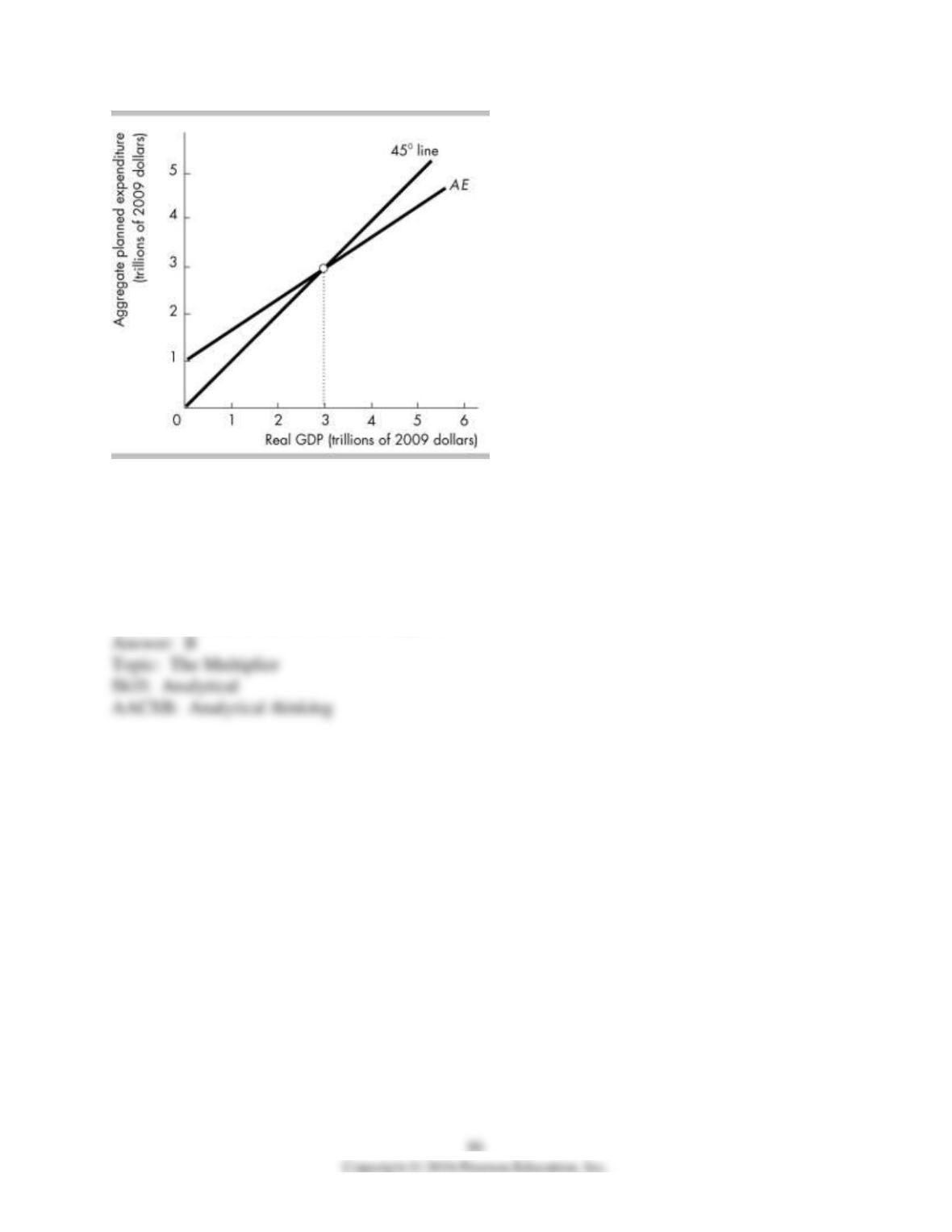
79) Suppose the price level is fixed. If investment increases by $1 trillion and the aggregate
expenditure curve is shown in the figure above, in response equilibrium expenditure increases by
________.
A) $1 trillion
B) $3 trillion
C) less than $1 trillion
D) indeterminate from the information given
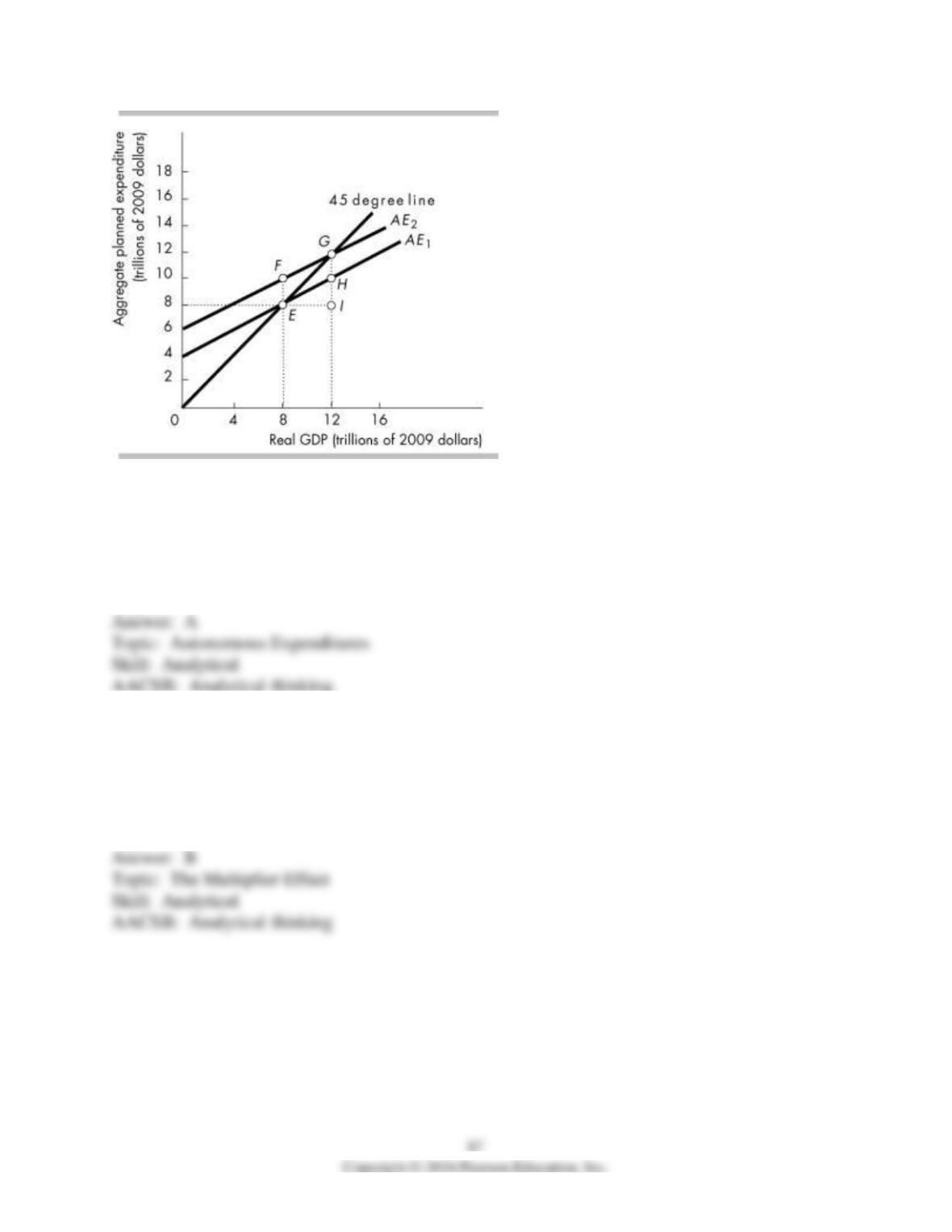
80) In the above figure, an increase in autonomous expenditure is depicted by the movement
from point E to
A) point F.
B) point G.
C) point H.
D) point I.
81) In the above figure, the increase in autonomous expenditure moves the economy from point
E to
A) point F.
B) point G.
C) point H.
D) point I.
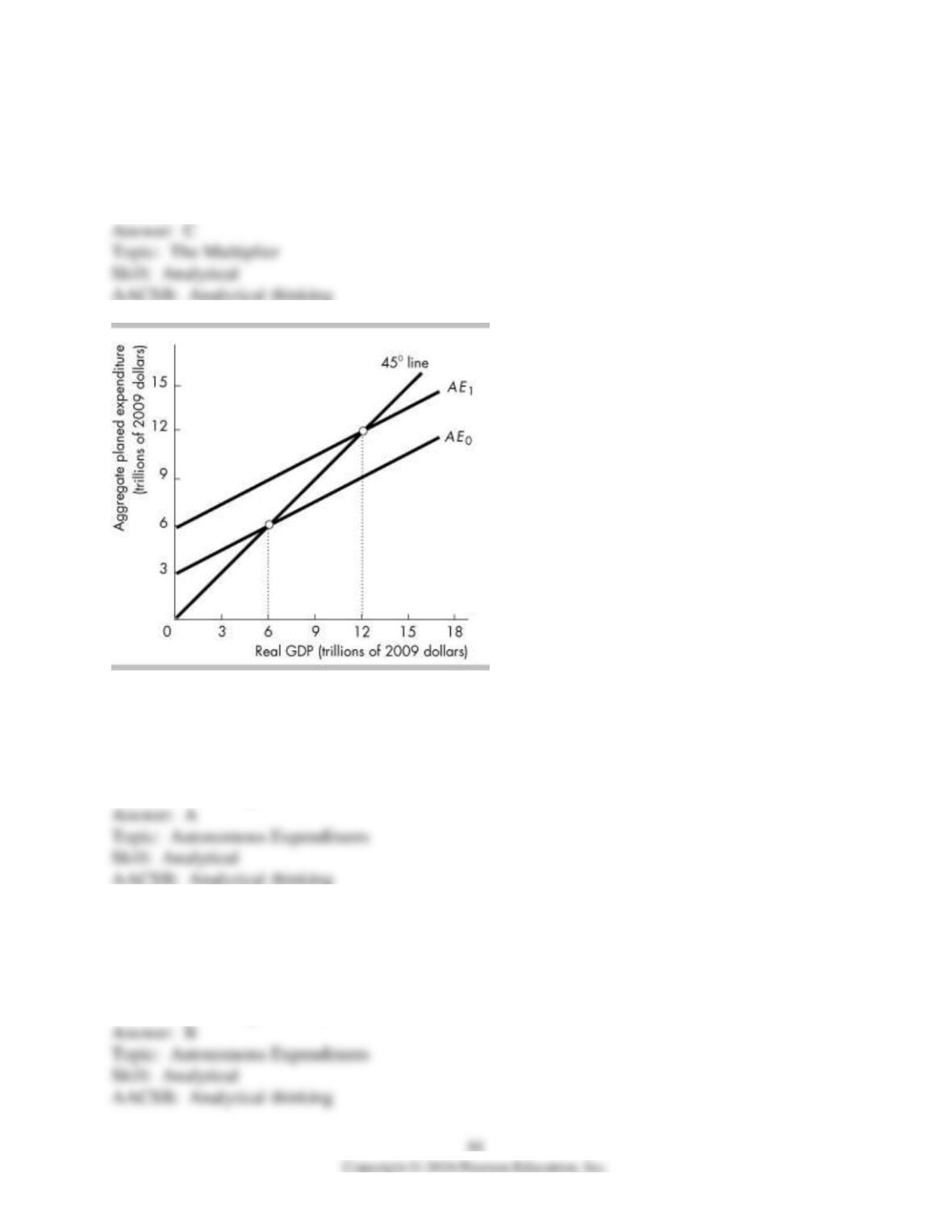
82) In the above figure, the multiplier is equal to
A) zero.
B) one.
C) two.
D) three.
83) In the above figure, autonomous expenditure along AE0 equals
A) $3 trillion.
B) $6 trillion.
C) $12 trillion.
D) an amount not given in the above answers.
84) In the above figure, autonomous expenditure along AE1 equals
A) $3 trillion.
B) $6 trillion.
C) $12 trillion.
D) an amount not given in the above answers.
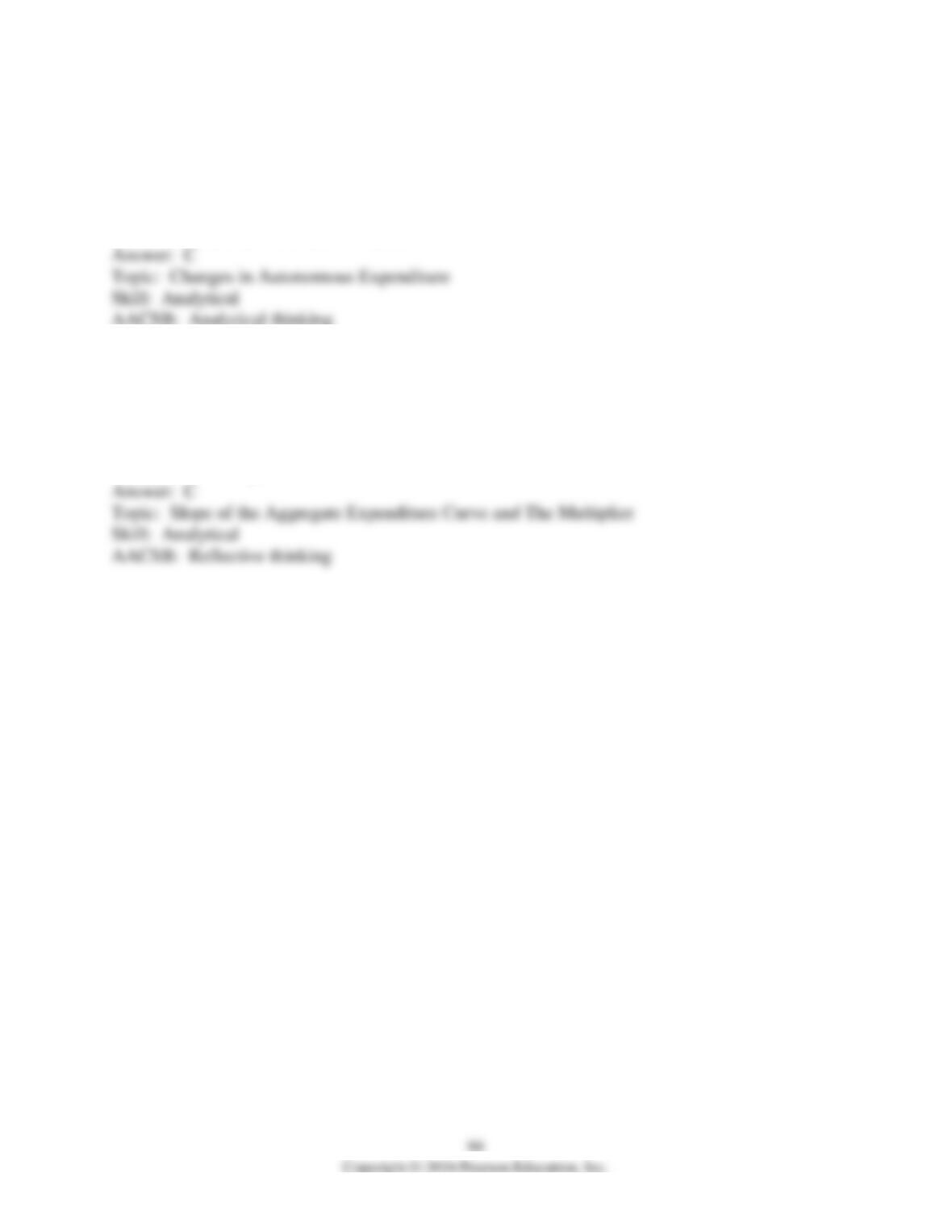
85) If AE0 is the aggregate planned expenditure curve, then equilibrium real GDP in the figure
above is
A) $3 trillion.
B) $6 trillion.
C) $12 trillion.
D) None of the above answers is correct.
86) In the above figure, equilibrium expenditure along AE1 is
A) $3 trillion.
B) $6 trillion.
C) $12 trillion.
D) an amount not given in the above answers.
87) In the above figure, the shift from AE0 to AE1 might have been caused by
A) an increase in government expenditures.
B) an increase in the real interest rate.
C) an increase in the price level.
D) All of the above answers are correct.
88) The value of the multiplier in the economy illustrated in the figure above is
A) 2.0.
B) 2.5.
C) 4.0.
D) 10.0.
89) In the above figure, AE0 is the aggregate planned expenditure curve and then investment
increases by an additional $3 trillion. As a result, the new equilibrium GDP will be
A) $3 trillion.
B) $6 trillion.
C) $12 trillion.
D) None of the above answers is correct.
90) The presence of income taxes and imports make the slope of the aggregate expenditure curve
A) the same as it would be without income taxes and exports.
B) steeper than it would be without income taxes and exports.
C) flatter than it would be without income taxes and exports.
D) probably different than it would be without income taxes and exports but income taxes make
it steeper while imports make it flatter.
91) In the figure above, the multiplier equals
A) 0.5.
B) 2.5.
C) 10.0.
D) some amount that cannot be calculated without additional information.
92) In the figure above, if income taxes increase,
A) the AE curve becomes steeper.
B) the AE curve becomes flatter.
C) there is a movement leftward along the unchanged AE curve.
D) there is a movement rightward along the unchanged AE curve.
93) Imports
A) increase the size of the multiplier because imports make disposable income less than real
GDP.
B) decrease the size of the multiplier because spending on imports does not increase real GDP in
the domestic nation.
C) increase the size of the multiplier because imports are paid for by exports.
D) decrease the size of the multiplier because imports lead to an increase in taxes and
government purchases.
94) The relationship between net exports and GDP makes the slope of the aggregate expenditure
curve
A) flatter than it would be otherwise.
B) steeper than it would be otherwise.
C) neither flatter nor steeper than it would be otherwise.
D) steeper at low levels of GDP and flatter at high levels of GDP.
95) If the marginal propensity to import increases, then the
A) multiplier will decrease in value.
B) multiplier will increase in value.
C) multiplier will not change in value.
D) effect on the multiplier will depend on what happens to exports.
96) The presence of imports ________ the size of the U.S. multiplier because with an increase of
U.S. real GDP, ________.
A) increases; U.S. consumers buy goods from other countries
B) increases; U.S. firms can sell goods to other countries
C) decreases; U.S. consumers buy goods from other countries
D) decreases; U.S. firms can sell goods to other countries
97) Changes in which of the following will affect the size of the multiplier?
I. marginal propensity to import
II. marginal propensity to consume
III. marginal income tax rate
A) I only
B) II only
C) I and II only
D) I, II, and III
98) The presence of income taxes and imports make the multiplier
A) fall in value but remain positive.
B) rise in value.
C) not change in value.
D) become negative.
99) In 2013 the government increased Social Security income taxes by 2 percentage points and
increased the income tax rate on Americans making more than $400,000 by 4.6 percentage
points. These tax hikes
A) decreased the size of the multiplier.
B) increased the size of the multiplier.
C) had no effect on the size of the multiplier.
D) None of the above answers are correct because the effect on the size of the multiplier is
ambiguous.
100) You observe that unplanned inventories are increasing. You predict that there will be
________.
A) a business cycle
B) an expansion
C) a trough
D) a recession
101) Business cycle turning points are
A) unaffected by, and unrelated to the multiplier.
B) easy to predict.
C) brought about by changes in autonomous expenditures that are then subject to the multiplier
effect.
D) None of the above is correct.
102) Which of the following does NOT occur as the economy moves from an expansion to a
recession?
A) An initial decrease in autonomous spending is the trigger that creates the business cycle
turning point.
B) The change in planned spending exceeds the change in real GDP.
C) The multiplier process reinforces any decrease in spending and pushes the economy into
recession.
D) Incomes fall during recessions as firms cut production in response to unplanned increases in
inventories.
103) Which of the following is INCORRECT?
A) Expansions usually begin with an increase in autonomous spending.
B) Firms experience unplanned decreases in inventories as expansions begin.
C) Firms increase production in response to unplanned decreases in inventories.
D) The multiplier dampens the increase in income that occurs during expansions and brings the
economy to a new equilibrium GDP.
104) A decrease in autonomous expenditure shifts the AE curve
A) downward and leaves its slope unchanged.
B) downward and makes it steeper.
C) downward and makes it flatter.
D) upward and makes it steeper.
105) If investment increases by $150 and, in response, equilibrium expenditure rises by $600
A) the multiplier is 0.25.
B) the multiplier is 4.0.
C) the MPC is 4.
D) the slope of the AE curve is 3.0.
1) The aggregate demand curve slopes downward because of
A) the multiplier.
B) the MPC.
C) wealth and substitution effects.
D) import and taxation effects.
2) If the price level rises, the purchasing power of wealth
A) increases.
B) does not change.
C) decreases.
D) increases at first but in the long run decreases.
3) The intertemporal substitution effect of a change in the price level results from a
A) change in the price of current goods relative to future goods.
B) change in the purchasing power of wealth.
C) change in the price of foreign goods relative to domestic goods.
D) Both answers B and C are correct.
4) Intertemporal substitution means changes in purchases
A) through time.
B) between imports and exports.
C) across different stores.
D) across different goods and services.
5) The larger the multiplier, the ________ the AE curve and the ________ the AD curve from an
increase in investment.
A) steeper; smaller the shift in
B) steeper; larger the shift in
C) flatter; larger the movement along
D) flatter; smaller the movement along
6) If investment decreases, the AE curve shifts
A) upward and the AD curve shifts rightward.
B) downward and the AD curve shifts leftward.
C) upward and there is a movement along the AD curve.
D) downward and there is a movement along the AD curve.
7) Which of the following shifts the aggregate demand curve rightward?
A) an increase in the price level
B) an increase in the income tax rate
C) an increase in government expenditure
D) a decrease in investment
8) An increase in investment spending results in a ________ the aggregate expenditure curve and
________ the aggregate demand curve.
A) movement along; a shift in
B) shift in; a movement along
C) shift in; has no effect on
D) shift in; a shift in
9) Which of the following shifts the aggregate expenditure curve AND shifts the aggregate
demand curve?
I. a decrease in investment
II. a change in the price level
III. an increase in exports
A) I and II
B) I and III
C) II and III
D) III only
10) Because the short-run aggregate expenditure model assumes that the price level is ________,
its predicted effect of changes in autonomous expenditure on equilibrium output is ________
than the prediction of the AD/SAS model.
A) fixed; greater
B) fixed; less
C) flexible; greater
D) flexible; less
11) A fall in the price level
A) shifts the aggregate expenditure curve upward and increases the quantity of real GDP
demanded.
B) shifts the aggregate demand curve rightward and increases equilibrium GDP.
C) decreases aggregate planned expenditures and shifts the aggregate demand curve leftward.
D) shifts both the aggregate expenditures curve and aggregate demand curve upward.
12) An increase in the price level results in a
A) downward shift in the AE curve and a movement up along the AD curve.
B) downward shift in both the AE and AD curves.
C) downward shift in the AD curve and a movement down along the AE curve.
D) leftward movement along both the AE and AD curves.
13) A shift in the aggregate expenditure curve as a result of an increase in the price level results
in a
A) leftward shift in the aggregate demand curve.
B) movement down along the aggregate demand curve.
C) rightward shift in the aggregate demand curve.
D) movement up along the aggregate demand curve.
14) Any change in the price level will result in a
A) shift in the AE curve and a movement along the AD curve.
B) movement along the AE curve and a shift of the AD curve.
C) shift in the AE and AD curves in the same direction.
D) shift in the AE and AD curves in opposite directions.
15) If the price level increases, the AE curve shifts
A) upward and the AD curve shifts leftward.
B) downward and the AD curve shifts rightward.
C) upward and there is movement along the AD curve.
D) downward and there is movement along the AD curve.
16) An increase in ________ shifts the AE curve ________ and an increase in ________ shifts
the aggregate demand curve ________.
A) autonomous expenditure; upward; the price level; leftward
B) the price level; downward; autonomous expenditure; rightward
C) the price level; upward; autonomous expenditure; leftward
D) autonomous expenditure; upward; the price level; rightward
17) The multiplier measures the
A) horizontal shift in the aggregate demand curve from an increase in autonomous spending.
B) vertical shift in the aggregate demand curve from an increase in autonomous spending.
C) horizontal difference between two points on the same aggregate demand curve.
D) vertical difference between two points on the same aggregate demand curve.
18) An increase in the price level decreases planned expenditure because
A) real wealth decreases, thus decreasing expenditure.
B) current prices rise relative to future prices, increasing expenditure.
C) domestic prices rise relative to foreign prices, increasing net exports.
D) the real interest rate rises, increasing consumption expenditure.
19) An increase in the price level decreases planned expenditures because
A) real wealth increases, decreasing expenditure.
B) current prices rise relative to future prices, decreasing expenditure.
C) domestic prices rise relative to foreign prices, increasing net exports.
D) the real interest rate rises, increasing expenditure.
20) When autonomous expenditure changes, the horizontal distance by which the aggregate
demand curve shifts
A) depends on the size of the multiplier.
B) depends on the size of the wealth effect.
C) is increased by the existence of automatic stabilizers.
D) is determined by the inverse of the multiplier.
21) In general, an increase in autonomous expenditure that is NOT created by a change in the
price level results in a
A) rightward shift of the AD curve.
B) movement upward along the AD curve.
C) movement downward along the AD curve.
D) leftward shift of the AD curve.
22) Suppose that in a particular economy, the multiplier is equal to 5. In terms of aggregate
demand and aggregate supply, this value for the multiplier means that after an increase in
investment
A) at each level of real GDP, the aggregate demand curve shifts upward by an amount equal to 5
times the change in investment.
B) at each level of real GDP, the aggregate supply curve shifts upward by an amount equal to 5
times the change in investment.
C) at each price level, the aggregate supply curve shifts rightward by an amount equal to 5 times
the change in investment.
D) at each price level, the aggregate demand curve shifts rightward by an amount equal to 5
times the change in investment.