9) Refer to the above figure. Suppose the current aggregate demand is represented by AD2. If
aggregate demand falls to line AD3, then
A) the new equilibrium will be at j.
B) the new equilibrium will be at k.
C) the new equilibrium real Gross Domestic Product (GDP) will be x.
D) a new price level will be established at a.
10) Keynes argued that
I. Capitalism did not always lead to full employment.
II. Nominal prices were more important than relative prices.
A) I only
B) II only
C) Both I and II
D) Neither I nor II
11) The original Keynesian economic theory states that
A) the short-run aggregate supply (SRAS) curve is always vertical.
B) many prices would not decline even when aggregate demand decreases.
C) wages tend to fall more quickly than the overall price level.
D) the economy naturally self-regulates so as to reach full employment quickly.
12) Keynes argued that an economy could be in equilibrium when the economy was
A) operating at maximum potential capacity.
B) operating with some unutilized productive capacity.
C) trying to operate at some output level beyond its potential capacity.
D) operating either at full productive capacity or at less than full capacity.
13) Keynes and his followers believed that
A) capitalism was one economic system that guaranteed full employment.
B) wages and prices in the short run were flexible.
C) the economy could not operate at any level of real Gross Domestic Product (GDP) less than
full capacity.
D) there was no guarantee that a capitalist economy would reach a full employment equilibrium.
14) A key component of the Keynesian model is that
A) prices are sticky.
B) prices are flexible.
C) wages are flexible.
D) people are not fooled by money illusion.
15) According to Keynes, once a system attains an economy-wide equilibrium
A) there may or may not be excess productive capacity.
B) planned consumption will be zero.
C) planned investment will be zero.
D) the economy will be at full productive capacity.
16) The Keynesian portion of the short-run aggregate supply (SRAS) curve
A) is horizontal.
B) is vertical.
C) slopes upward.
D) slopes downward.
17) The simple Keynesian model assumes that
A) gross private domestic investment exceeds net investment by the capital consumption
allowance.
B) prices, especially the price of wages, are “sticky downward.”
C) there will never be any excess capacity in the short run.
D) aggregate demand will always equal aggregate supply.
18) The Keynesian portion of the short-run aggregate supply (SRAS) curve implies
A) an upward slope.
B) the price level does not change.
C) a downward slope.
D) flexible prices and wages.
19) The Keynesian short-run aggregate supply (SRAS) curve
A) shows that real Gross Domestic Product (GDP) will increase only if the price level increases.
B) assumes a full-employment level of real Gross Domestic Product (GDP).
C) is horizontal.
D) does not reflect any changes in nominal Gross Domestic Product (GDP).
20) In an economic downturn, sticky wages and prices reduce the economy’s speed of adjustment
because
A) businesses are unable to adjust quickly to changes in aggregate demand.
B) they cause deflation.
C) hyperinflation will likely occur.
D) union workers would likely quit and look for work elsewhere.
21) Keynes suggested that the short-run aggregate supply (SRAS) curve
A) is vertical.
B) is horizontal.
C) slopes downward.
D) slopes upward.
22) Keynesian economics predicts that if government policy makers deem current equilibrium
real Gross Domestic Product (GDP) to be “too low,” then an appropriate policy action would be
to
A) do nothing, because the economy is self-adjusting.
B) raise government spending, thereby increasing aggregate demand and pushing up real Gross
Domestic Product (GDP) with little or no inflationary consequences.
C) increase taxes, thereby causing aggregate demand to increase and inducing a rise in real Gross
Domestic Product (GDP) with little or no inflationary consequences.
D) reduce the money stock, thereby causing aggregate demand to decrease and inducing a rise in
fall in the price level that generates an increase in total planned expenditures.
23) The short-run aggregate supply (SRAS) curve represents the relationship between
A) the price level and the real Gross Domestic Product (GDP) without full adjustment or full
information.
B) the price level and the real Gross Domestic Product (GDP) without full adjustment but with
full information.
C) the price level and the nominal Gross Domestic Product (GDP).
D) the decisions of producers and the decisions of consumers.
24) In the short run, an increase in the price level induces firms to expand production because
A) prices of inputs are held constant, so the higher prices for firms’ products imply that it is
profitable to expand production.
B) each firm must keep its production level up to the level of its rivals, and some firms will
expand production as the price level increases.
C) higher prices allow firms to hire more inputs by offering higher prices for inputs, which
increases productivity and profits.
D) they can increase profits by increasing maintenance costs.
25) The relationship between the price level and the real Gross Domestic Product (GDP) without
full adjustment or full information is represented by
A) the long-run aggregate supply curve.
B) the short-run aggregate supply curve.
C) the aggregate demand curve.
D) the distance between the long-run aggregate supply curve and the short-run aggregate supply
curve.
26) According to Keynes, the classical model could not explain
A) a recession or depression.
B) periods of rising unemployment.
C) a long-term economic decline.
D) periods of rising interest rates.
27) In the simple Keynesian portion of the upward sloping short-run aggregate supply curve
A) equilibrium real GDP is demand-determined.
B) equilibrium real GDP is supply-determined.
C) equilibrium real GDP is neither determined by aggregate supply nor by aggregate demand.
D) equilibrium real GDP is determined by both aggregate supply and aggregate demand.
28) The short-run aggregate supply curve is horizontal when
A) prices are inflexible and the economy is at full employment.
B) there are unemployed resources and prices do not increase when aggregate demand increases.
C) there are unemployed resources and prices do not decrease when aggregate supply increases.
D) there are no unemployed resources and prices do not increase when aggregate demand or
supply increases.
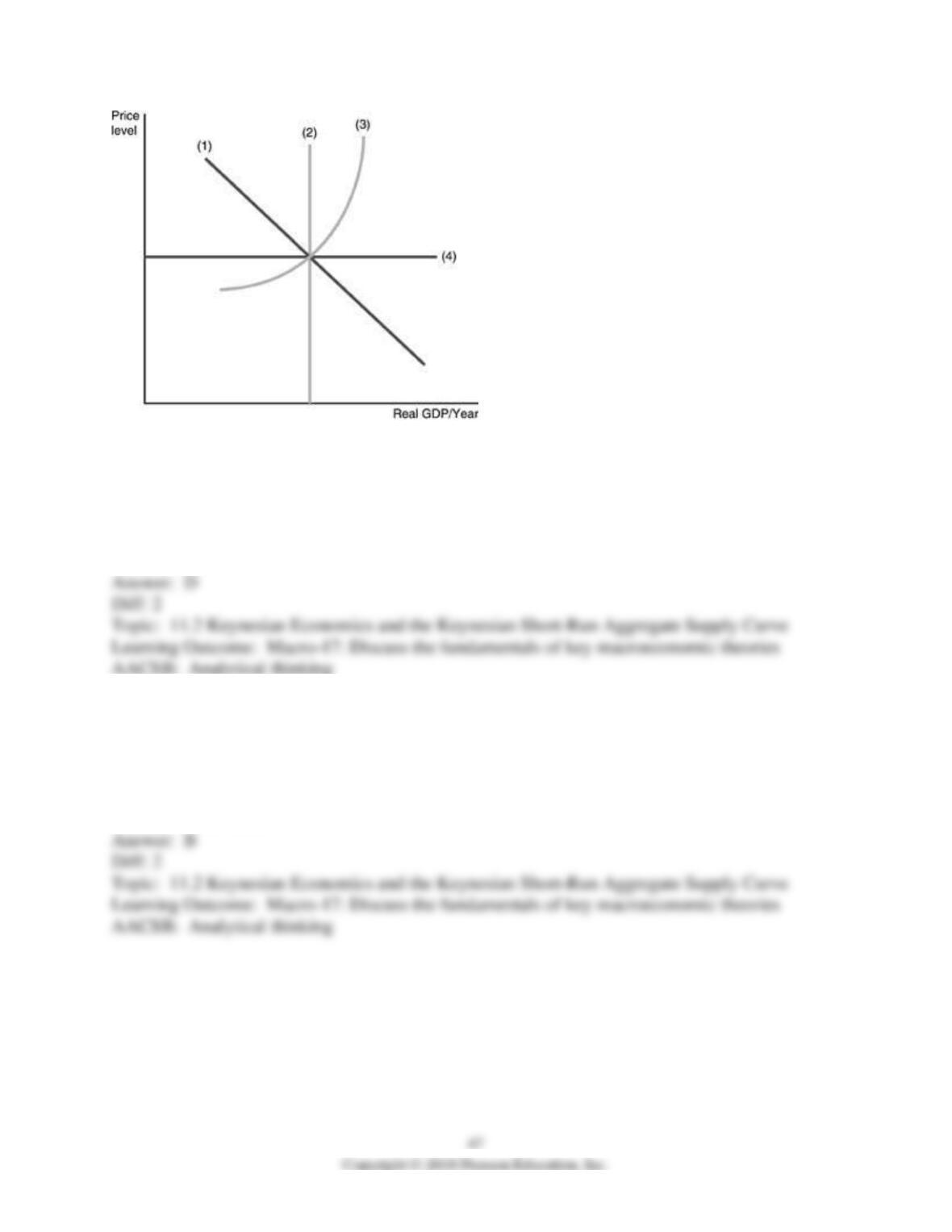
29) Refer to the above figure. The classical aggregate supply curve is represented by ________
and the Keynesian short-run aggregate supply curve is represented by ________.
A) curve 2; curve 1
B) curve 2; curve 3
C) curve 3; curve 4
D) curve 2; curve 4
30) Real GDP is ________ determined in the classical model and ________ determined in the
Keynesian model.
A) supply; supply
B) supply; demand
C) demand; supply
D) demand; demand
31) In the Keynesian model, to understand the determination of income and employment it is
necessary to understand
A) how aggregate supply is determined.
B) how aggregate demand is determined.
C) how long-run aggregate supply is determined.
D) how interest rates are determined.
32) According to Keynes, wages are inflexible because
A) of the minimum wage set by government.
B) of long-term contracts.
C) workers do not behave in their own self-interest.
D) workers are not rational.
33) Which of the following is a TRUE statement?
A) A decrease in aggregate demand was not possible according to the classical economists but
was possible according to Keynes.
B) A decrease in aggregate demand has no short-run effects according to the classical economists
but had significant effects according to Keynes.
C) Classical economists believed real GDP adjusted more than prices when aggregate demand
fell, while Keynes argued that prices adjusted more than output.
D) Classical economists believed price adjusted more than output when aggregate demand fell,
while Keynes argued real GDP adjusted more than prices.
34) The simplified Keynesian model
A) holds the price level constant.
B) holds real GDP constant.
C) assumes investment and saving are always equal.
D) assumes unemployment is unrelated to real GDP.
35) According to Keynes
A) the short-run aggregate supply curve is vertical.
B) nominal wages are sticky.
C) money illusion does not exist.
D) markets are perfectly competitive.
36) The approach to understanding the determination of real GDP and the price level that
emphasizes incomplete adjustment in the prices of many goods is
A) the classical model.
B) the Keynesian model.
C) Say’s law.
D) the aggregate demand model.
37) To explain the existence of excess capacity, Keynes argued that
A) prices and wages are flexible, and eventually markets would go back to equilibrium.
B) the long run average cost curve should not occur at the full employment level.
C) the aggregate demand curve can be manipulated by advertising.
D) prices and wages are inflexible in the downward direction.
38) Which of the following is a basic difference between the classical model and the Keynesian
model in which the Keynesian short-run aggregate supply curve exists?
A) The classical model assumes that the long run aggregate supply curve is vertical, while the
Keynesian model assumes the long run aggregate supply curve is horizontal.
B) The classical model assumes that the position of the long run aggregate supply curve is
determined by full employment, while the Keynesian model assumes that the long run aggregate
supply curve will be to the left of full employment.
C) The classical model assumes that the level of real GDP is supply determined, while the
Keynesian model assumes that it is demand determined.
D) The classical model uses real GDP, while the Keynesian model uses nominal GDP.
39) The Keynesian short-run aggregate supply curve is horizontal because
A) it represents the full employment level of real GDP.
B) it reflects the absence of money illusion.
C) it reflects wage and price inflexibility.
D) it represents Say’s law.
40) In the Keynesian model in which the Keynesian short-run aggregate supply curve exists
A) the short-run aggregate supply curve determines real GDP.
B) the aggregate demand curve determines the price level.
C) unemployment cannot persist for long periods of time.
D) aggregate demand determines real GDP per year.
41) Q: How many economists does it take to change a light bulb?
A: All. Because then you will generate employment, more consumption, moving the aggregate
demand curve to the right.
This joke represents the view of
A) classical economists.
B) Keynesian economists.
C) economists who contend that money illusion never occurs.
D) economists who conclude that wages and prices are very flexible.
42) Which one of the following statements is TRUE?
A) The classical model cannot explain periods of prolonged unemployment.
B) The Keynesian model cannot explain periods of prolonged unemployment.
C) The Keynesian model assumes complete flexibility of wages and prices.
D) The Keynesian model shows that the level of real GDP is supply-determined.
43) Keynes argued that because of sticky prices and wages
A) the short-run aggregate supply curve could be horizontal.
B) the short-run aggregate supply curve is probably vertical.
C) the long-run aggregate supply curve slopes downward.
D) the aggregate demand curve is vertical.
44) In the Keynesian model which includes the Keynesian short-run aggregate supply curve
A) an increase in aggregate demand would causes the price level to rise, but does not change the
level of real GDP.
B) an increase in aggregate demand causes real GDP to rise without changing the price level.
C) an increase in aggregate demand changes neither the price level nor the level of real GDP.
D) an increase in aggregate demand causes real GDP and the price level to decrease.
45) If the economy is operating at a point at which short-run aggregate supply is horizontal, then
A) real GDP cannot expand.
B) real GDP cannot contract.
C) increases in aggregate demand do not increase the price level.
D) then increases in aggregate demand do not increase real GDP.
46) Why is persistent unemployment a possibility in the Keynesian model but NOT in the
classical model?
A) The Keynesian model assumes that people work for motives other than those of earning an
income for themselves and supporting a family.
B) The Keynesian model assumes that nominal wages are inflexible downward.
C) The Keynesian model assumes that the level of real GDP is inflexible.
D) The Keynesian model assumes that workers can lose their jobs to foreign competition during
economic downturns.
47) The Keynesian short-run aggregate supply curve
A) is horizontal.
B) is vertical.
C) is downward sloping.
D) is upward sloping.
48) Which one of the following statements is TRUE?
A) The shape of the Keynesian short-run aggregate supply curve is based on the conclusion that
domestic workers are harmed by imports.
B) The shape of the Keynesian short-run aggregate supply curve is based on the conclusion that
there is no correlation between the level of real GDP and the employment level.
C) The shape of the Keynesian short-run aggregate supply curve is based on the conclusion that
increases in aggregate demand can boost output in the short term.
D) The shape of the Keynesian short-run aggregate supply curve is based on the conclusion that
increases in aggregate demand will increase the price level, but will leave real GDP unaffected in
the short term.
49) Which one of the following statements is TRUE?
A) The actual behavior of prices and real GDP during the decade of the 1930s is consistent with
the classical model.
B) The actual behavior of prices and real GDP during the decade of the 1930s is consistent with
the Keynesian model.
C) The actual behavior of prices and real GDP during the decade of the 1930s is consistent with
the idea that increases in aggregate demand will increase the price level but will leave real GDP
unchanged.
D) The actual behavior of prices and real GDP during the decade of the 1930s is consistent with
a vertical short-run aggregate supply curve.
50) The short-run aggregate supply curve is horizontal if
A) resources were fully utilized.
B) there are unutilized resources in the economy.
C) resources are perfectly adaptable between production processes.
D) there are high inflation rates.
51) The Keynesian contention that the short-run aggregate supply curve is horizontal is based on
the assumption that there are
A) sticky prices.
B) flexible prices.
C) real prices.
D) upward sloping prices.
52) The short-run aggregate supply curve is a relationship between
A) unemployment and real GDP.
B) inflation and time.
C) real GDP and price level.
D) capital goods and consumer goods.
53) The Keynesian short-run aggregate supply curve is demonstrated graphically as a
A) vertical line.
B) horizontal line.
C) upward sloping curve.
D) downward sloping curve.
54) Keynesian economists argue that
A) equilibrium real GDP is demand-determined.
B) equilibrium real GDP is supply-determined.
C) equilibrium real GDP can be reached only in a theoretical economy.
D) reaching equilibrium real GDP always results in inflation.
55) Keynesian economists argue that
A) prices and wages are flexible.
B) prices and wages must be set by government.
C) prices and wages are subject to downward “stickiness.”
D) prices and wages depend on minimum wage law.
56) Keynesian economists argue that
A) the natural rate of unemployment is below the actual rate.
B) unemployment is a long-lasting phenomenon in the economy.
C) unemployment only exists during periods of war in the economy.
D) the natural rate of unemployment is zero.
57) John Maynard Keynes developed his economic theories in the
A) 1890s.
B) 1900s.
C) 1930s.
D) 1990s.
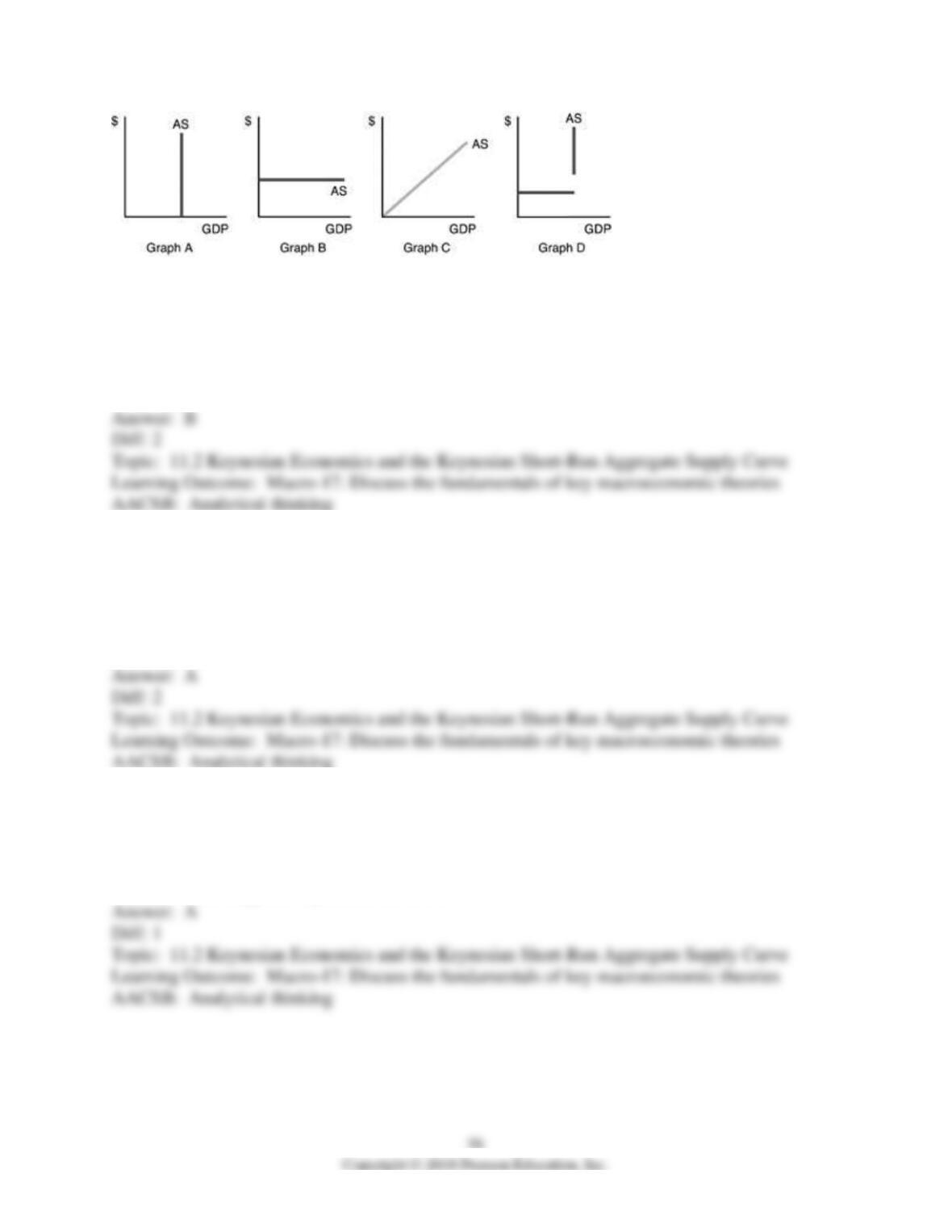
58) Refer to the above figure. Which of the graphs is consistent with the Keynesian short-run
aggregate supply curve?
A) Graph A
B) Graph B
C) Graph C
D) Graph D
59) Refer to the above figure. Which of the graphs is consistent with the long-run aggregate
supply curve?
A) Graph A
B) Graph B
C) Graph C
D) Graph D
60) The horizontal short-run aggregate supply curve
A) assumes that wages and all other input prices are constant.
B) shows that real GDP can be increased only when prices increase.
C) assumes that there is full employment in the economy.
D) assumes that opportunity cost is constant.
61) According to Keynes, the “stickiness” of wage rates could best be explained by
A) minimum wage laws.
B) unions and long-term labor contracts.
C) short-term labor contracts.
D) government interference.
62) According to Keynesian economics, if there are unutilized resources in the economy and
aggregate demand increases
A) real GDP will rise and price level will remain constant.
B) real GDP will fall and price level will remain constant.
C) real GDP will rise and price level will rise.
D) real GDP will rise and price level will fall.
63) According to Keynesian economics, if there are unutilized resources in the economy and
aggregate demand decreases
A) real GDP will rise and price level will remain constant.
B) real GDP will fall and price level will remain constant.
C) real GDP will rise and price level will rise.
D) real GDP will rise and price level will fall.
64) Keynesian economists would likely argue that the classical model is which of the following?
A) a long-run theory
B) a short-run theory
C) both a long-run and short-run theory
D) a sticky price theory
65) Some economists believe that a positive aggregate demand shock to an economy with large
amounts of excess capacity and unemployment does NOT necessarily cause an increase in
prices. Economists who adhere to this belief are followers of
A) classical economics.
B) Say’s laws of economics.
C) Keynesian economics.
D) supply-side economics.
66) What is the underlying assumption of the original, simplified Keynesian model?
A) The relevant range of the short-run aggregate supply curve (SRAS) is vertical.
B) The relevant range of the aggregate supply curve (AS) is vertical.
C) The relevant range of the short-run aggregate supply curve (SRAS) is horizontal.
D) The relevant range of the long-run aggregate supply curve (LRAS) is horizontal.
67) How does the original, simplified Keynesian model compare with modern Keynesian
analysis?
A) The original Keynesian model assumed price flexibility whereas the modern analysis does
not.
B) In both cases, the short-run aggregate supply curve (SRAS) is horizontal.
C) Modern analysis shows an upward sloping SRAS to reflect some price flexibility. The
original Keynesian model’s SRAS is horizontal and assumes sticky prices.
D) all of the above
68) The Keynesian short-run aggregate supply curve in the simplified Keynesian model is
unrealistic because
A) a vertical curve does not make economic sense.
B) prices and wages will never decrease.
C) the classical model is better in explaining how the economy operates.
D) some price adjustments do take place in the short run.
69) The horizontal portion of the short-run aggregate supply curve in which there is excessive
unemployment and unused capacity in the economy is
A) Say’s law.
B) the classical short-run aggregate supply curve.
C) the Keynesian short-run aggregate supply curve.
D) exists when prices are flexible.
70) The short-run aggregate supply curve in modern Keynesian analysis is
A) horizontal.
B) vertical.
C) upward sloping.
D) downward sloping.
71) The short-run aggregate supply curve is positively sloped because
A) real interest rates rather than nominal rates are used.
B) some price adjustments take place in the short-run.
C) no price adjustments take place in the short-run.
D) complete price adjustments take place in the short-run.
72) The short-run aggregate supply curve in modern Keynesian analysis represents the
relationship between
A) the real output of goods and services in the economy and the price level.
B) the real output of goods and services in the economy and the price level when people have
fully adjusted their behavior.
C) the real output of goods and services in the economy and the price level when people have not
fully adjusted their behavior.
D) the nominal output of goods and services and the real output of goods and services.
73) Along a short-run aggregate supply curve, which of the following is (are) held constant?
A) real GDP
B) aggregate demand
C) input prices
D) relative prices of goods and services