133. In Figure 11-5 are the cost and revenue curves of a monopolist in the theater market, Crown Theater, which is the
only movie theater in the city. At its profit-maximizing quantity of tickets sold, movie goers will buy ____ tickets.
a.
60
b.
100
c.
120
d.
140
DISC: Monopoly
United States – BPROG: Reflective Thinking – BPROG: Analysis
The Monopolist’s Supply Decision
BLOOMS: Application
134. In Figure 11–5, Crown Theater, a monopolist movie theater, will make a profit of ____ at its profit-maximizing price
and quantity of theater tickets.
a.
$450
b.
$150
c.
$300
d.
$750
DISC: Monopoly
United States – BPROG: Reflective Thinking – BPROG: Analysis
The Monopolist’s Supply Decision
BLOOMS: Application
135. In which of the following ways is a monopolist different from a perfect competitor?
a.
Average cost will continually drop as output expands.
b.
Price is above marginal revenue.
c.
Average total cost equals average fixed costs plus average variable costs.
d.
The demand curve for the industry has a negative slope.
DISC: Perfect competition
United States – BPROG: Reflective Thinking – BPROG: Analysis
Perfect competition
The Monopolist’s Supply Decision
136. Compared to a perfectly competitive firm, a monopolist
a.
is less likely to advertise.
b.
will, according to Schumpeter, invest fewer resources in research and development.
c.
usually produces an inefficiently small level of output.
d.
is less likely to face government regulation.
DISC: Monopoly
United States – BPROG: Analytic
Perfect competition
The Monopolist’s Supply Decision
137. Which of the following can be said about a monopoly?
a.
Monopolies are always inefficient and are therefore the least desirable form of market.
b.
They can cause a shift in the demand curve to benefit society.
c.
They may aid in innovation.
d.
All of the above are correct.
DISC: Monopoly
United States – BPROG: Analytic
138. Compared to perfect competition, monopoly
a.
provides less output.
b.
charges a higher price.
c.
results in higher cost (inefficient) production.
d.
All of the above are correct.
DISC: Monopoly
United States – BPROG: Analytic
The Monopolist’s Supply Decision
139. In the long run, a profit-maximizing monopolist
a.
earns zero economic profit.
b.
produces the same amount as a perfectly competitive industry.
c.
receives a higher price for his output than a perfectly competitive firm.
d.
produces at the output level that minimizes his long-run average total cost.
DISC: Monopoly
United States – BPROG: Analytic
The Monopolist’s Supply Decision
140. In the long run, profit-maximizing monopolists facing a downward-sloping demand curve
a.
may earn profits greater than their opportunity costs of capital.
b.
do not produce every possible unit of output for which marginal utility is greater than or equal to marginal
cost.
c.
may or may not have lower costs than perfectly competitive firms in the same industry.
d.
All of the above are correct.
DISC: Monopoly
United States – BPROG: Analytic
The Monopolist’s Supply Decision
141. In the long run,
a.
both monopolists and perfectly competitive firms produce at minimum long-run average total cost.
b.
a monopolist will exit the industry if he is earning zero economic profit.
c.
a monopolist will always charge a higher price than he charges in the short run.
d.
consumer surplus is smaller if an industry is a monopoly than if it is perfectly competitive.
DISC: Monopoly
United States – BPRPOG: Analysis
The Monopolist’s Supply Decision
Figure 11-6
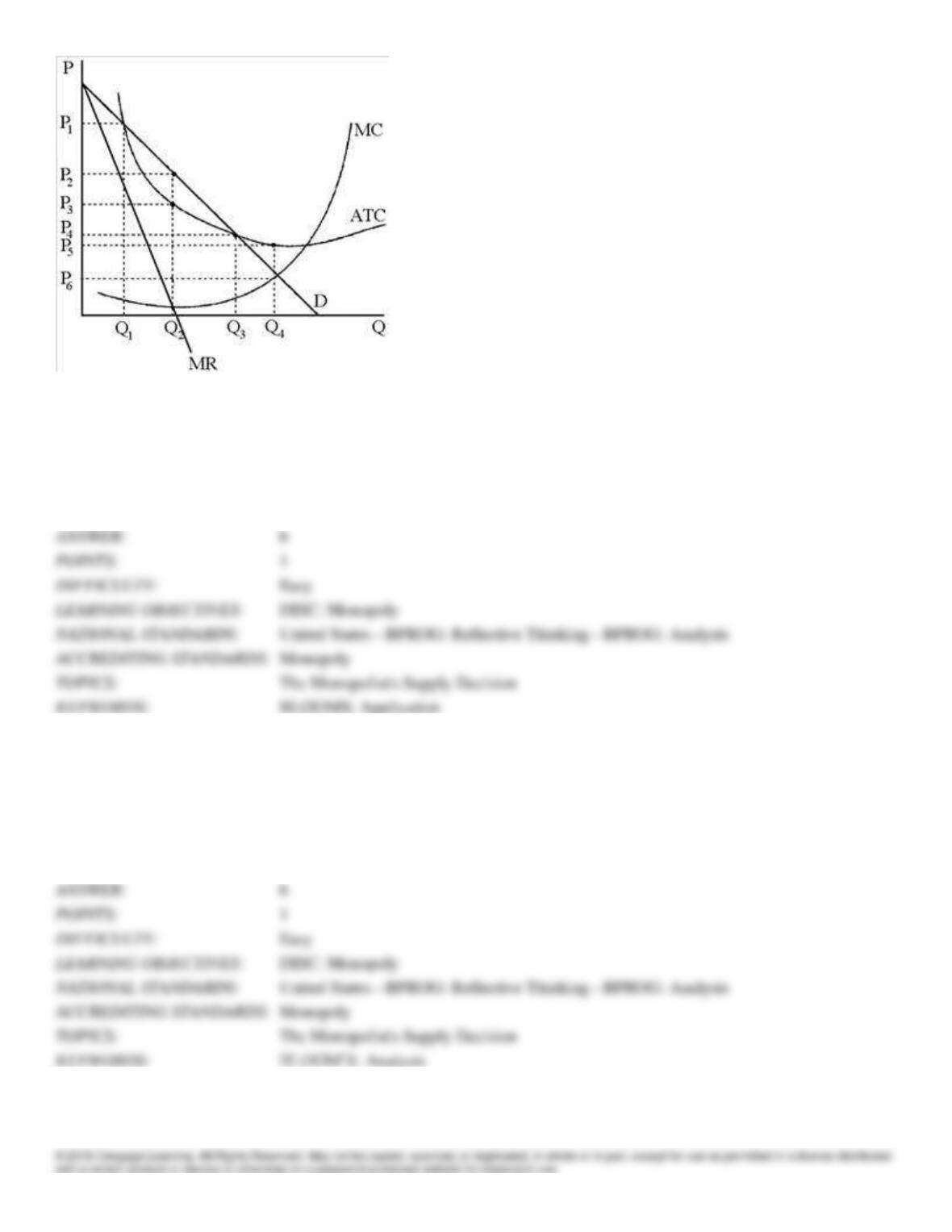
142. The profit-maximizing monopolist in Figure 11-6 will produce ____ units of output.
a.
Q1
b.
Q2
c.
Q3
d.
Q4
Easy
Monopoly
143. The profit-maximizing monopolist in Figure 11-6 will sell its output at
a.
P1.
b.
P2.
c.
P3.
d.
P4.
Easy
Monopoly
144. At its optimal output level, the profit-maximizing monopolist in Figure 11-6 will earn a profit equal to
a.
zero.
b.
(P2 − P3)Q.
c.
P > Q.
d.
(P5 − P6 )Q.
DISC: Monopoly
United States – BPROG: Reflective Thinking – BPROG: Analysis
The Monopolist’s Supply Decision
145. The industry described in Figure 11-6
a.
is not a natural monopoly because no firm would produce in the long run unless the government intervened in
the market.
b.
is not a natural monopoly because the average total cost curve is U-shaped.
c.
is a natural monopoly because the economic profit is positive for a monopolist if the government doesn’t
intervene.
d.
is a natural monopoly because price is less than average total cost at the output that would be produced by the
industry under perfect competition.
DISC: Monopoly
United States – BPROG: Reflective Thinking – BPROG: Analysis
The Monopolist’s Supply Decision
146. Monopoly as a market structure leads to
a.
prices equal to average cost.
b.
quick response to economic change.
c.
prices that equal minimum long-run average cost.
d.
persistent economic profits.
DISC: Monopoly
United States – BPROG: Analytic
The Monopolist’s Supply Decision
Figure 11-7
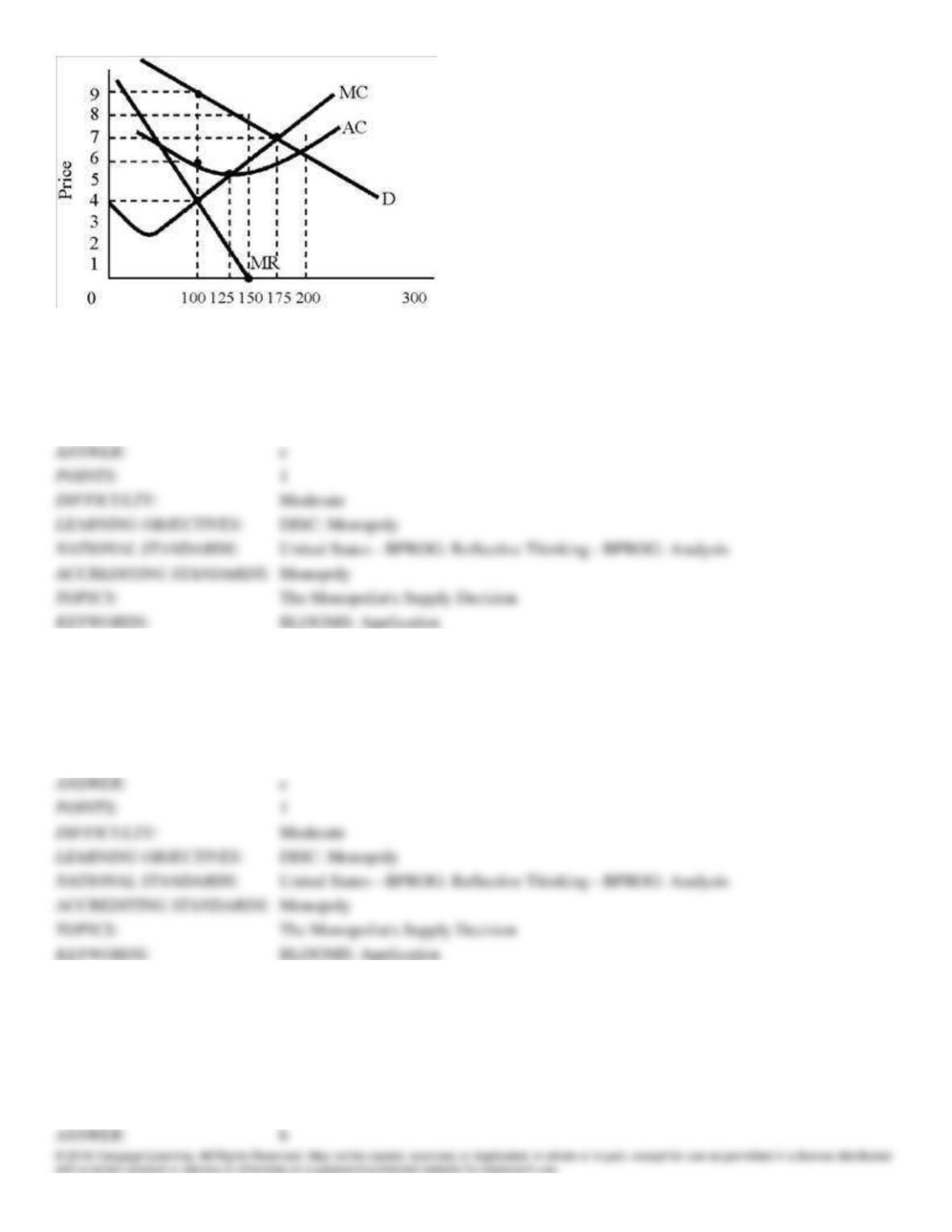
147. The firm in Figure 11-7 is an unregulated monopolist; it will produce which of the following?
a.
175 units at a price of 7
b.
100 units at a price of 6
c.
100 units at a price of 9
d.
150 units at a price of about 7.5
148. The firm in Figure 11-7 is an unregulated monopolist; it will earn long-run profits of how much?
a.
500
b.
400
c.
300
d.
200
149. For the firm in Figure 11–7, an unregulated monopolist, output falls below the efficient level in the short run by how
much?
a.
50
b.
75
c.
35
d.
100
DISC: Monopoly
United States – BPROG: Reflective Thinking – BPROG: Analysis
The Monopolist’s Supply Decision
BLOOMS: Application
150. For the firm in Figure 11–7, an unregulated monopolist, profit-maximizing output is below the long-run competitive
level by how much?
a.
100
b.
75
c.
50
d.
25
DISC: Monopoly
United States – BPROG: Reflective Thinking – BPROG: Analysis
The Monopolist’s Supply Decision
151. Monopolists may in the long run
a.
earn positive economic profit.
b.
be protected by barriers to entry.
c.
grow wealthy at the expense of their consumers.
d.
All of the above are correct.
DISC: Monopoly
United States – BPROG: Analytic
The Monopolist’s Supply Decision
152. It is not true in the long run of monopolies that
a.
other firms seeking positive economic profit enter the market.
b.
they earn positive economic profit.
c.
they sell their output at a price greater than marginal cost.
d.
they benefit from barriers to entry.
DISC: Monopoly
United States – BPROG: Analytic
The Monopolist’s Supply Decision
Figure 11-8
153. Given the average cost curve shown in Figure 11-8 for dry cleaning, where Q1 is the quantity demanded in a small
town, and Q2 for a larger town, you would expect dry cleaning to be a monopoly
a.
in a small town, but not a large one.
b.
in both large and small towns.
c.
in a large town, but not a small one.
d.
only if the process is patented.
DISC: Monopoly
United States – BPROG: Reflective Thinking – BPROG: Analysis
The Monopolist’s Supply Decision
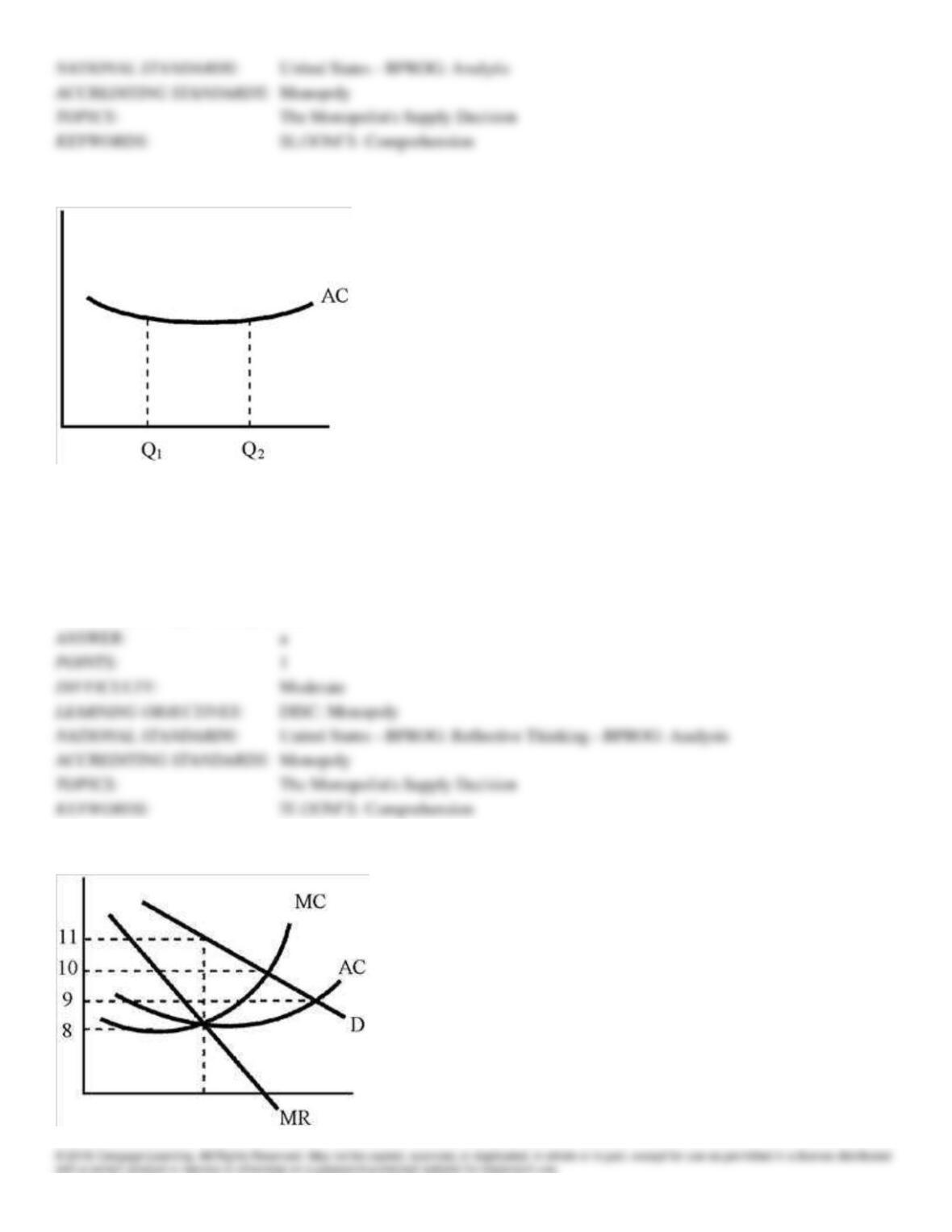
Figure 11-9
154. In Figure 11–9, how much more than the long-run competitive price will the profit-maximizing monopolist charge?
a.
$1
b.
$2
c.
$3
d.
$11
DISC: Monopoly
United States – BPROG: Reflective Thinking – BPROG: Analysis
The Monopolist’s Supply Decision
BLOOMS: Application
155. In Figure 11–9, how much more than the short-run competitive price will the profit-maximizing monopolist charge?
a.
$1
b.
$2
c.
$3
d.
$10
DISC: Monopoly
United States – BPROG: Reflective Thinking – BPROG: Analysis
The Monopolist’s Supply Decision
BLOOMS: Application
156. In Figure 11–9, which of the following is true?
a.
MC = P
b.
MC = MR
c.
MU > MR
d.
MU < MC
DISC: Monopoly
United States – BPROG: Reflective Thinking – BPROG: Analysis
The Monopolist’s Supply Decision
157. What is true for monopoly that is not true for perfect competition?
a.
The industry demand curve is downward sloping.
b.
Profit is maximized where MR = MC.
c.
The firm and the industry are exactly the same entity.
d.
Positive economic profits may be earned in the short run.
c
Moderate
DISC: Perfect competition
United States – BPROG: Analytic
Perfect competition
The Monopolist’s Supply Decision
158. In assessing the difference between monopoly performance and that of perfect competition, the best approach is to
a.
measure the output of the monopolist and the output of the perfectly competitive firm.
b.
measure the output of the monopolist and the output of the perfectly competitive industry.
c.
measure the output purchased by consumers from the monopolist and from the perfectly competitive firm.
d.
calculate the marginal cost of the monopolist and of the perfectly competitive firm.
Difficult
DISC: Perfect competition
United States – BPROG: Reflective Thinking – BPROG: Analysis
Perfect competition
The Monopolist’s Supply Decision
159. The average total cost curve of a natural monopoly is always
a.
upward sloping.
b.
horizontal.
c.
downward sloping at all points.
d.
downward sloping where it crosses the market demand curve for the good.
Moderate
DISC: Monopoly
United States – BPROG: Analytic
Monopoly
The Monopolist’s Supply Decision
160. Compared to perfect competition, monopoly in the long run
a.
restricts output.
b.
charges a higher price.
c.
produces at less than minimum average cost.
d.
All of the above are correct.
Easy
DISC: Monopoly
United States – BPROG: Analytic
The Monopolist’s Supply Decision
161. In the long run under monopoly,
a.
the MC curve will lie to the left of the output at which AC and AR meet.
b.
MC = MR = P.
c.
MC = MR = AR.
d.
the MC curve will lie to the right of the output at which AC and AR meet.
DISC: Monopoly
United States – BPROG: Analytic
The Monopolist’s Supply Decision
162. Because a monopolist must cut its price to increase its sales by one unit,
a.
MR > P at every output level.
b.
MC > MR at every output level.
c.
P > MR at every output level.
d.
MC > P at every output level.
DISC: Monopoly
United States – BPROG: Analytic
The Monopolist’s Supply Decision
163. Economists object to monopoly because
a.
monopoly profits go to the rich.
b.
monopolies overproduce to maximize profits.
c.
monopolies are usually polluters.
d.
monopolists keep output below efficient levels.
DISC: Monopoly
United States – BPROG: Analytic
The Monopolist’s Supply Decision
164. The monopoly producer
a.
sets MU equal to P.
b.
sets MR = MC.
c.
has MC > MU.
d.
sets MR = P.
DISC: Monopoly
United States – BPROG: Analytic
The Monopolist’s Supply Decision
165. Under monopoly
a.
too small a share of society’s resources is used to produce the monopolized commodity.
b.
Adam Smith’s invisible hand assures efficient resource allocation.
c.
too large a share of society’s resources is being used to produce the monopolized commodity.
d.
MC > MU.
DISC: Monopoly
United States – BPROG: Analytic
The Monopolist’s Supply Decision
166. Successful advertising by a monopolist will
a.
reduce the gap between the monopoly and competitive output.
b.
increase the gap between the monopoly and competitive output.
c.
cause the monopolist to overproduce.
d.
cause the monopolist to decrease output.
DISC: Monopoly
United States – BPROG: Analytic
Can Anything Good be Said About Monopoly?
167. Advertising by the monopolist
a.
is not done because the monopolist has the only supply of the product and doesn’t need to advertise.
b.
would have the effect of shifting its demand curve to the left.
c.
may lead to expanded production by the monopolist.
d.
makes no sense because there are no substitute commodities available to consumers.
DISC: Monopoly
United States – BPROG: Analytic
Can Anything Good be Said About Monopoly?
168. A monopolist’s cost curves will
a.
be identical to those of a competitive firm.
b.
be higher than a competitive firm’s cost curves.
c.
be peculiar to the individual producer since there is only one.
d.
drop more steeply as output increases.
DISC: Monopoly
United States – BPROG: Analytic
Can Anything Good be Said About Monopoly?
169. A monopolist’s cost curves may shift up because of
a.
advertising expenditure.
b.
bureaucratic inefficiencies.
c.
coordination problems.
d.
All of the above are correct.
DISC: Monopolistic competition
United States – BPROG: Analytic
Monopolistic competition
Can Anything Good be Said About Monopoly?
170. A monopolist’s cost curves may shift down because
a.
large-scale input purchases may permit the monopolist to take quantity discounts.
b.
of advertising expenditure.
c.
competitors are pushed out of the market.
d.
of bureaucratic inefficiencies.
DISC: Monopoly
United States – BPROG: Reflective Thinking – BPROG: Analysis
Can Anything Good be Said About Monopoly?
171. A 50 percent tax on the profits of a monopolist will
a.
be totally shifted to the consumer.
b.
raise price and lower quantity.
c.
cause no change in profit-maximizing price and quantity.
d.
change price but not quantity.
DISC: Monopoly
United States – BPROG: Reflective Thinking – BPROG: Analysis
Price Discrimination Under Monopoly
172. Providing medical services for smaller fees to the poor than to the rich is
a.
misplaced charity.
b.
benevolent pricing.
c.
price discrimination.
d.
social pricing.
DISC: Monopoly
United States – BPROG: Analytic
Price Discrimination Under Monopoly
173. Which of the following observations concerning price discrimination is true?
a.
It only occurs in monopolies.
b.
It is easier for a monopolist than for a firm that is affected by competition.
c.
It means that sales to all customers are equally profitable.
d.
It is considered as a bad business practice under all circumstance.
DISC: Monopoly
United States – BPROG: Reflective Thinking – BPROG: Analysis