75
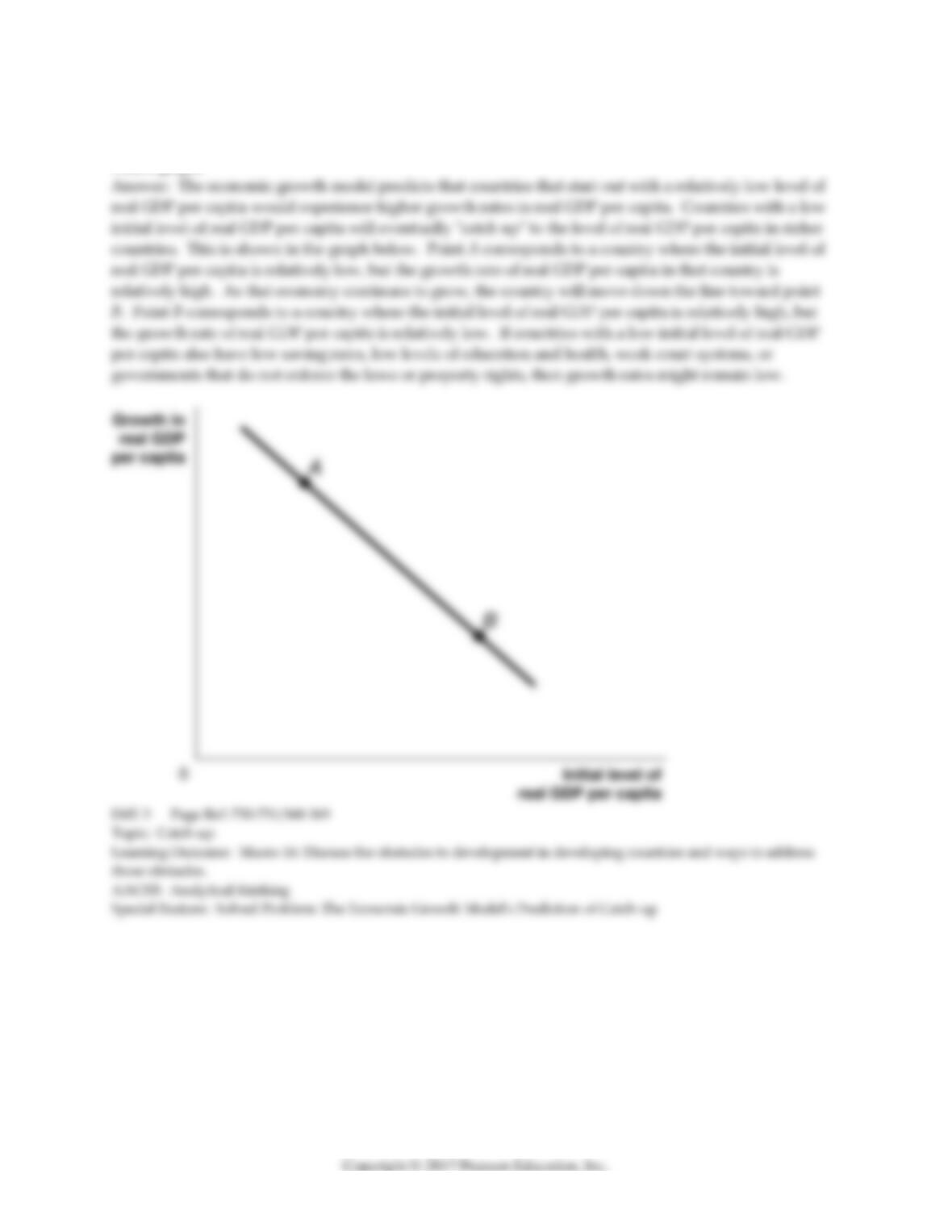
64) Would you expect to see higher or lower growth rates for countries that start out with a relatively
low level of real GDP per capita? Explain using the concept of “catch-up” and support your answer
with a graph.
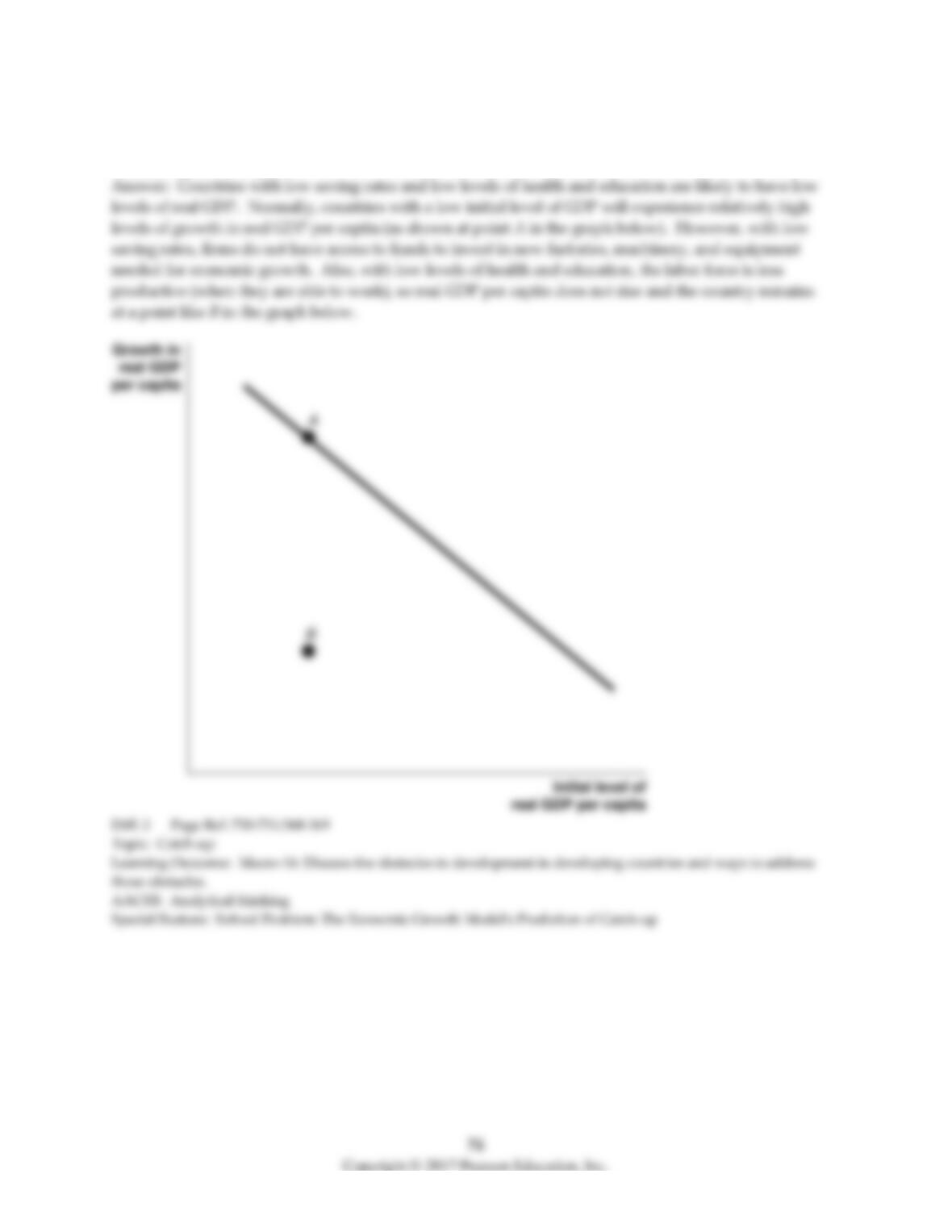
65) Draw a graph of “catch-up” that shows where you would expect to see a country with low saving
rates and low levels of health and education. How would you expect real GDP per capita to grow in a
country like this? Explain.
11.5 Growth Policies
1) The term “brain drain” refers to
A) highly educated individuals who leave developing countries for high-income countries.
B) the diminishing returns to studying for an exam.
C) the negative impact on brain function of an individual’s overinvestment in human capital.
D) the decreased quality of the college-educated workforce.
2) Disease, poor nutrition, and substandard health care in developing nations can reduce growth in an
economy by
A) reducing physical capital.
B) reducing human capital.
C) increasing labor productivity.
D) increasing technological change.
3) Enforcing property rights in an economy will
A) cause the market system to work less efficiently.
B) decrease the level of foreign portfolio investment.
C) encourage corruption and expand the underground economy.
D) raise the level of investment.
4) All of the following policies are ways for a country to promote long-run economic growth except
A) increasing vaccinations against infectious diseases.
B) undergoing political reform to decrease corruption.
C) enacting stronger laws to protect property rights.
D) imposing stricter regulations to limit foreign direct investment.
5) Robert Lucas, a Nobel laureate in economics, argues that there are ________ returns to human capital.
A) increasing
B) decreasing
C) constant
D) negative
6) You are an economic advisor to the president. You are asked to recommend a policy to promote
long-term economic growth in the economy. Which of the following policies would you choose?
A) a reduction in sales taxes
B) an investment tax credit
C) a reduction in taxes on luxury yachts
D) all of the above
7) Which of the following policies would not help promote economic growth?
A) a law requiring that the funds in an individual retirement account be taxed
B) a law restricting elected officials from accepting expensive gifts and trips from private individuals
C) a law that funds prenatal care for all expectant mothers
D) a law that subsidizes research in nanotechnology
8) A policy that offers parents a tax reduction based on how much they are saving for their children’s
college education should ________ the equilibrium level of loanable funds and ________ the rate of
long-term growth.
A) decrease; increase
B) increase; decrease
C) decrease; decrease
D) increase; increase
9) In 1973, the Club of Rome published a book titled The Limits to Growth, which predicted that
economic growth would likely end in high-income countries because of
A) declining populations.
B) rapid increases in government debt.
C) increases in outsourcing of the production of goods and services to low-income countries.
D) increasing pollution and the depletion of natural resources.
10) All of the following are reasons why China is unlikely to maintain high enough rates of productivity
growth to catch-up with the standard of living in the United States except
A) the United States invests more in research and development. than does China.
B) much of China’s growth is likely due to the transition from a centrally-planned economy to a market
economy.
C) because of the low birth rate in China, the labor force will soon decline.
D) the Chinese migration of rural workers to more productive urban jobs.
11) Corruption
A) curtails economic growth.
B) raises the rate of growth as bribes enhance income.
C) is eliminated by foreign direct investment.
D) acts as a magnet for foreign direct investment.
12) The United States
A) currently is one of the most corrupt countries.
B) has never had a significant problem with corruption.
C) had a significant problem with corruption in the 1930s.
D) currently ranks among the least corrupt countries.
13) If property rights are not enforced in a country,
A) the market system will still work smoothly.
B) entrepreneurs are unlikely to risk their own funds investing in such an economy.
C) that country’s growth rate will not be affected.
D) that country will grow more rapidly because of the reduction of law suits.
14) Robert Lucas, a Nobel laureate in economics, argues that there are increasing returns to
A) knowledge capital.
B) physical capital.
C) financial capital.
D) human capital.
15) Robert Lucas argues that there are ________ returns to human capital, and these productivity
increases are not completely captured by individuals as they decide how much education to purchase.
As a result, the market produces ________ education and training.
A) increasing; too much
B) decreasing; too much
C) increasing; too little
D) decreasing; too little
16) Which of the following policies is designed specifically to directly promote technological change in
an economy?
A) government subsidization of research and development
B) tax incentives to promote investment in 401K plans
C) laws to strengthen property rights
D) a vaccination program to combat infectious diseases
17) Policies to promote growth by increasing saving and investment work through
A) decreasing the supply of loanable funds, lowering the interest rate, raising the level of investment in
physical capital.
B) increasing the supply of loanable funds, increasing the interest rate, raising the level of investment in
physical capital.
C) increasing the supply of loanable funds, lowering the interest rate, lowering the level of investment
in physical capital.
D) increasing the supply of loanable funds, lowering the interest rate, raising the level of investment in
physical capital.
18) Not enforcing property rights in an economy will
A) cause the market system to work efficiently.
B) not change the level of investment.
C) lower the level of investment.
D) raise the level of investment.
19) What is “brain drain”?
A) the tendency for highly educated workers in high-income countries to move to low-income countries
to volunteer their services
B) increased recruiting efforts that attempt to raise the average level of education in developed nations
C) foreign direct investment that flows from a developed country to a developing country
D) the loss of highly educated people from a low-income country as they move to higher-income
opportunities in foreign countries
20) How can economic growth help a country combat “brain drain”?
A) Economic growth increases the incomes of low-skilled workers relative to high-skilled workers.
B) Economic growth opens up opportunities for better jobs and higher incomes for skilled workers.
C) Economic growth allows highly skilled persons to earn more in a foreign country than in their native
country.
D) Economic growth combined with decreasing returns to human capital require workers to achieve
steadily higher and higher levels of education over time.
21) Which of the following is a normative statement about economic growth?
A) Economic growth is associated with higher labor productivity growth.
B) Economic growth increases GDP per capita.
C) Economic growth hurts developing countries.
D) Foreign direct investment stimulates economic growth.
22) How can freedom of the press promote economic growth?
A) A free press can act as a watchdog for corruption, increasing chances for economic growth.
B) A free press can be more easily swayed to report only one side of any issue.
C) A free press reduces the likelihood that judges will protect private property rights.
D) A free press does not promote economic growth.
23) The rapid growth of China’s economy relative to the United States has benefitted U.S. consumers
because
A) competition from China has made jobs harder to find in the United States.
B) U.S. consumers can purchase more lower-priced goods made in China.
C) the United States has comparative advantage in more goods than China does.
D) goods made in China are always of higher quality than goods made in the United States.
24) In 2014, GDP per capita was ________ in the United States than in China, and since 1980, the growth
rate of real GDP per capita has been ________ in the United States than in China.
A) higher; higher
B) higher; lower
C) lower; higher
D) lower; lower
25) Which of the following is not a reason why China is unlikely to maintain high enough rates of
productivity growth to catch up with the standard of living in the United States?
A) The United States invests more in research and development than does China.
B) Much of China’s growth is likely due to the transition from a centrally-planned economy to a market
economy.
C) Because of the low birth rate in China, the labor force will soon decline.
D) The Chinese migration of rural workers to more productive urban jobs.
26) Foreign portfolio investment occurs when an individual or firm buys stock or bonds issued in
another country.
27) Recent rapid economic growth in India and China has reduced the amount of “brain drain” in those
countries.
28) The question of whether economic growth is desirable is a positive question, easily settled by
economic analysis.
29) Political stability is not a prerequisite to economic growth.
30) Increased foreign direct investment in India has contributed to its recent economic growth.
31) Some researchers have been unable to find evidence of increasing returns to human capital.
32) List four types of government policies which can aid economic growth.
33) Does globalization promote economic growth, and how does globalization affect the welfare of a
given country’s citizens?
34) How do government policies that enforce property rights affect economic growth?
35) How does government support of health and education programs foster economic growth?
36) Your friend does not understand the benefits of globalization. Outline for your friend the positive
economic aspects of globalization.
37) You have been hired as an economic advisor for a developing country. You have been asked to focus
on education as a means for the country’s development. Explain to the prime minister how improving
education and training can contribute to his country’s economic growth, and why it is important for the
government to take a proactive role in promoting education.