6) If the economy is near full capacity, the effect of a negative aggregate demand shock is to
A) increase the level of aggregate demand.
B) cause the price level to fall.
C) increase the firm’s cost of producing at every level of output.
D) increase the level of employment.
7) One possible result of a fall in aggregate demand coupled with a stable short-run aggregate
supply is
A) a recession.
B) an increase in employment levels.
C) an economic expansion.
D) a rise in the stock market.
8) If equilibrium level of real Gross Domestic Product (GDP) is less than the full-employment
real Gross Domestic Product (GDP) consistent with the position of the economy’s long-run
aggregate supply (LRAS) curve, then the difference between full-employment real Gross
Domestic Product (GDP) and current equilibrium real Gross Domestic Product (GDP) is
A) an aggregate demand shock.
B) an aggregate supply shock.
C) a recessionary gap.
D) an inflationary gap.
9) If equilibrium level of real Gross Domestic Product (GDP) is greater than the full-employment
real Gross Domestic Product (GDP) consistent with the position of the economy’s long-run
aggregate supply (LRAS) curve, then the difference between full-employment real Gross
Domestic Product (GDP) and current equilibrium real Gross Domestic Product (GDP) is
A) an aggregate demand shock.
B) the level of output consistent with natural unemployment.
C) a recessionary gap.
D) an inflationary gap.
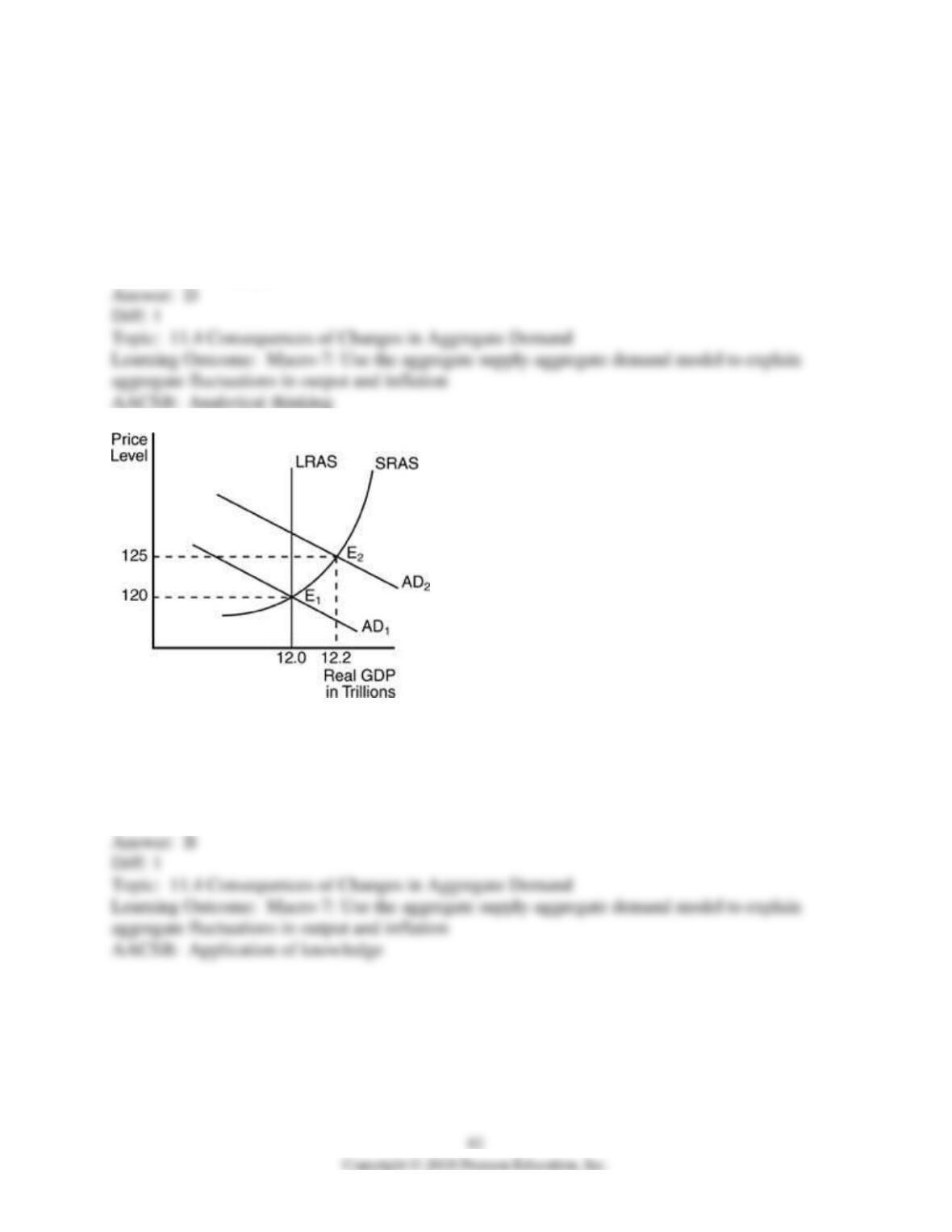
10) In the above figure, the inflationary gap can correctly be identified as
A) the difference between 125 and 120.
B) the difference between 12.2 trillion and 12 trillion.
C) LRAS minus SRAS.
D) AD1.
11) In the above figure, an increase in aggregate demand has resulted in
A) a decline in the price level.
B) economic growth.
C) an inflationary gap.
D) a recessionary gap.
12) The reason that it is possible for the economy in the above figure to be at E2 rather than at
E1 is that
A) in the long run there is always less than full employment.
B) in the short run the economy can produce more than it can in a long-run full-adjustment
situation.
C) AD always shifts outward and never shifts inward.
D) the economy must be in a recession.
13) In the above figure, the economy would most likely move from AD1 to AD2 because of
A) an aggregate supply shock.
B) an aggregate demand shock.
C) a recession.
D) a depression.
14) A short-run equilibrium occurs
A) at the intersection of the long-run aggregate supply curve and the aggregate demand curve.
B) at the intersection of the short-run aggregate supply curve and the long-run aggregate supply
curve.
C) at the intersection of the short-run aggregate supply curve and the aggregate demand curve.
D) at the real GDP associated with full employment.
15) Assume equilibrium real GDP per year is equal to full-employment real GDP. Which of the
following will cause a recessionary gap?
A) an increase in aggregate demand
B) a reduction in aggregate demand
C) a discovery of a new raw material
D) a temporary reduction in the price of oil
16) In the Keynesian model, an aggregate demand shock
A) will cause the aggregate demand curve to shift, leading to a change in the price level and real
GDP.
B) will cause the aggregate demand curve to shift, leading to a change in the price level but not
real GDP.
C) will cause the aggregate demand curve to shift, leading to a change in real GDP but not the
price level.
D) will not lead to a shift of the aggregate demand curve.
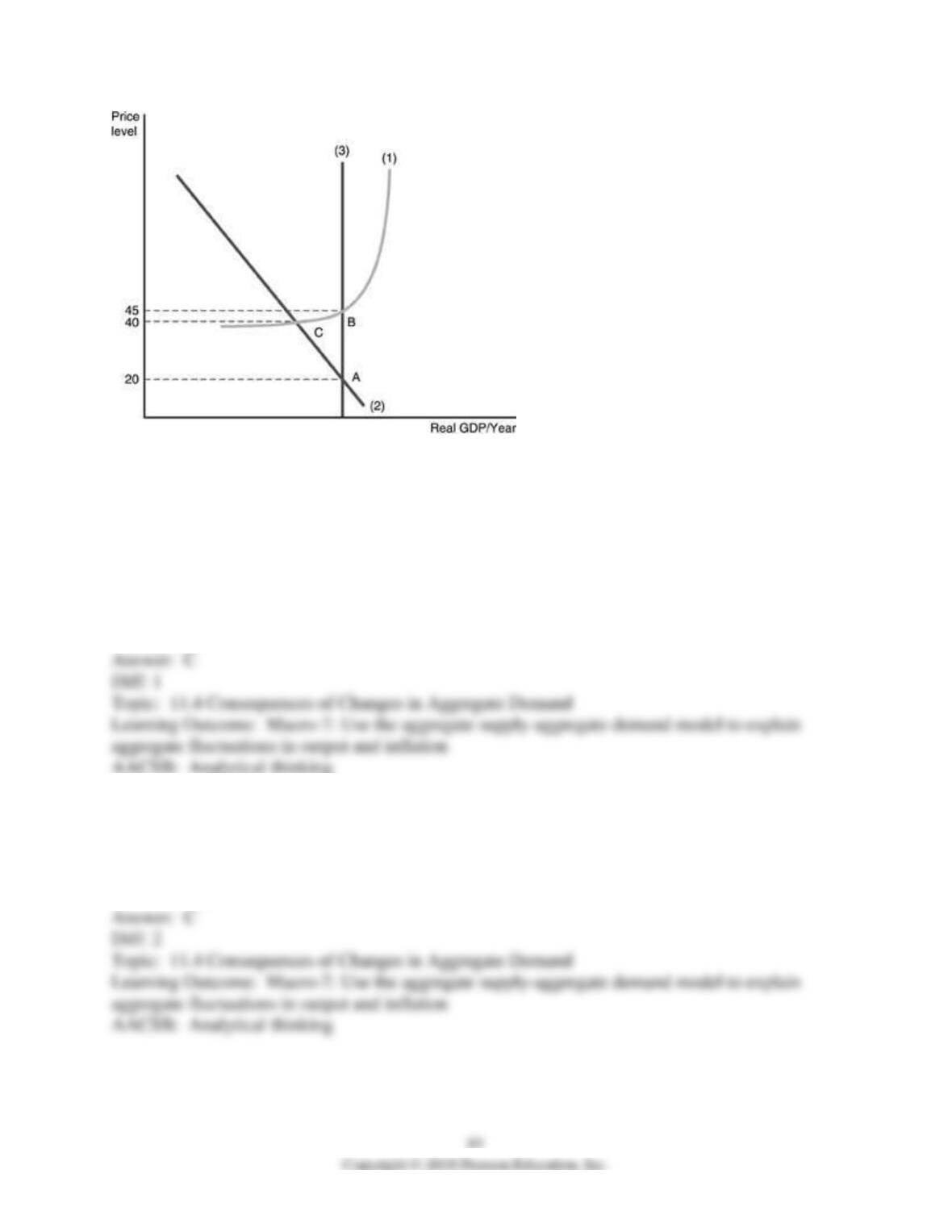
17) The three curves in the above figure are
A) (1) the long-run aggregate supply curve, (2) the aggregate demand curve, and (3) the short-
run aggregate supply curve.
B) (1) the long-run aggregate supply curve, (2) the short-run aggregate supply curve, and (3) the
aggregate demand curve.
C) (1) the short-run aggregate supply curve, (2) the aggregate demand curve, and (3) the long-
run aggregate supply curve.
D) (1) the aggregate supply curve, (2) the short-run aggregate demand curve, and (3) the long-
run aggregate demand curve.
18) Refer to the above figure. Which point or points represent(s) a short-run equilibrium?
A) A only
B) B only
C) C only
D) both A and B
19) Refer to the above figure. Which point or points represent(s) a long-run equilibrium?
A) A only
B) B only
C) C only
D) both A and B
20) Refer to the above figure. At the initial long-run equilibrium, the price level is ________,
and the price level will be ________.
A) 20; 45
B) 20; 40
C) 40; 45
D) 20; 20
21) Refer to the above figure. Suppose the original long-run equilibrium was at point B. What
could have caused the move to the current equilibrium?
A) Decreases in the price level caused short-run aggregate supply to fall.
B) Input prices must have increased, causing long-run aggregate supply to increase.
C) Aggregate demand must have decreased.
D) A temporary reduction in production due to bad weather.
22) Suppose that the current price level is 110, real GDP is $100 billion, and long-run aggregate
supply is $95 billion. We can conclude that
A) the price level will fall until long-run aggregate supply shifts to $100 billion.
B) the price level will fall and input prices will rise until real GDP pulls long-run aggregate
supply up to $100 billion.
C) input prices will rise until real GDP is $95 billion.
D) aggregate demand will increase until both short-run and long-run aggregate supply equal
$100 billion.
23) Holding the level of prices fixed implies that a given decrease in aggregate demand
A) will have a smaller effect on real GDP than would be the case if prices were more flexible.
B) will have a larger effect on real GDP than would be the case if prices were more flexible.
C) has the same effect on real GDP as when prices are more flexible.
D) has a smaller effect on nominal GDP than when prices are more flexible.
24) Suppose we observe rising nominal GDP, a rising price level, and constant unemployment as
a result of an increase in aggregate demand. We would conclude that the aggregate supply curve
is
A) upward sloping.
B) downward sloping.
C) vertical.
D) horizontal.
25) If aggregate demand and nominal GDP increase while the price level is constant, we would
conclude that
A) the economy is already at full employment.
B) the aggregate supply curve is upward sloping.
C) the aggregate supply curve is horizontal.
D) the aggregate demand curve is vertical.
26) If we observe an increase in real GDP and an increase in the price level after an increase in
aggregate demand, we can conclude that
A) the aggregate supply curve is upward sloping.
B) the aggregate supply curve is horizontal.
C) the aggregate supply curve is vertical.
D) the economy is now at full employment.
27) A change in tastes for U.S. produced goods will
A) shift both the aggregate demand curve and the long-run aggregate supply curve.
B) shift the aggregate demand curve.
C) shift the short-run aggregate supply curve.
D) shift the long-run aggregate supply curve.
28) Assume equilibrium real GDP per year is equal to full-employment real GDP. If aggregate
demand falls, then
A) the price level will increase in the short run and decrease in the long run.
B) there will be an expansionary gap.
C) there will be a recessionary gap.
D) long-run aggregate supply will eventually decrease too.
29) The short-run and long-run aggregate supply curves remain stable, and a decrease in
aggregate demand occurs. What is the result in the short run?
A) An increase in the price level and real GDP will occur.
B) A period of expansion and a rise in the unemployment rate could occur.
C) A period of recession and a rise in the unemployment rate could occur.
D) The price level will fall but real GDP will remain the same.
30) An inflationary gap occurs when
A) aggregate demand falls, but other things remain constant.
B) short-run aggregate supply falls, but other things remain constant.
C) the short-run equilibrium level of real GDP is greater than long-run aggregate supply.
D) the short-run equilibrium level of real GDP is less than long-run aggregate supply.
31) The gap that exists when equilibrium real GDP is less than full-employment real GDP is
A) the short-run aggregate supply curve.
B) money illusion.
C) a recessionary gap.
D) an inflationary gap.
32) The gap that exists when equilibrium real GDP is greater than the level of real GDP shown
by the position of the long-run aggregate supply curve is
A) the short-run aggregate supply curve.
B) money illusion.
C) a recessionary gap.
D) an inflationary gap.
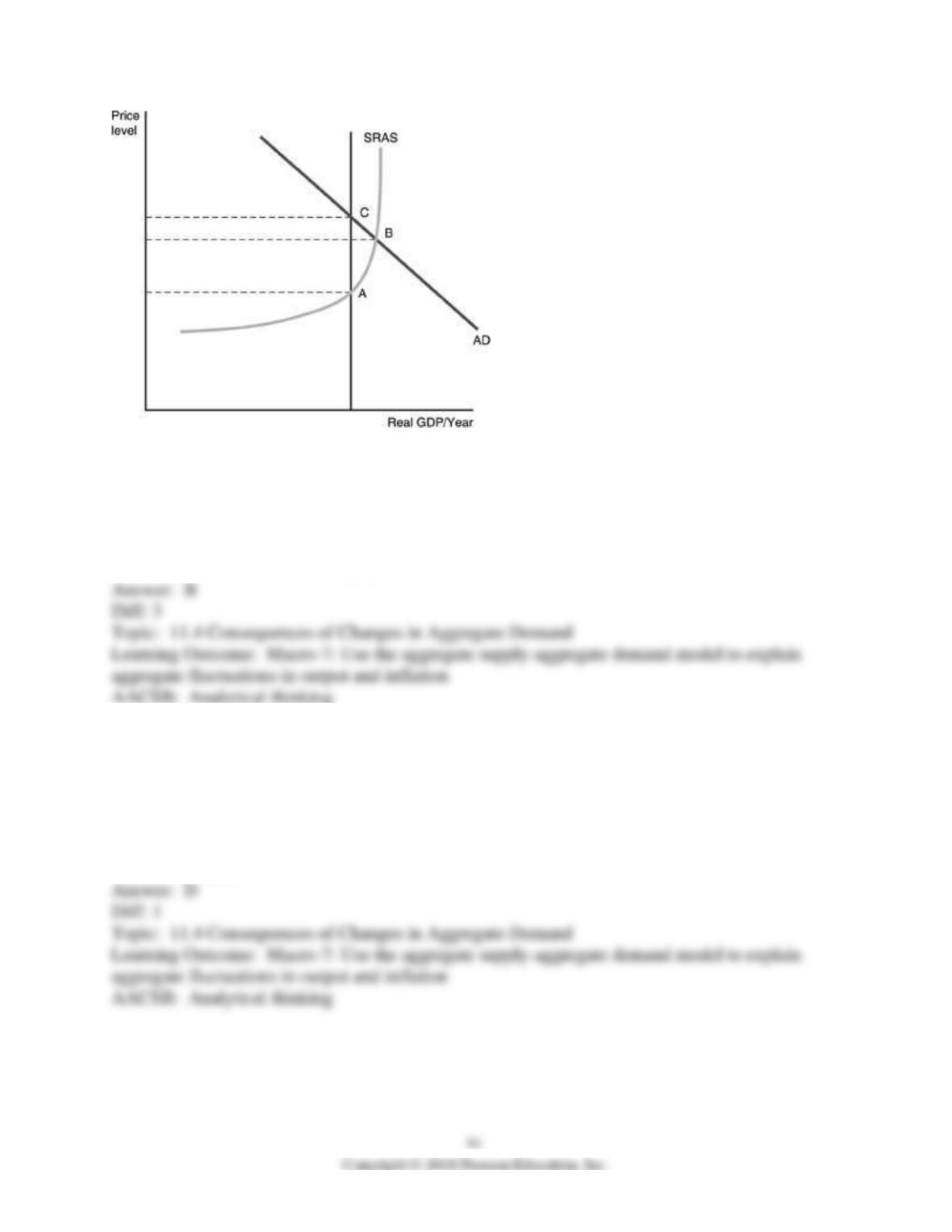
33) Refer to the above figure. Suppose the economy had been at point A and now is at B. What
could have caused the movement to B?
A) Unusually good weather causes the wheat crop to be larger than normal.
B) Government spending increased causing aggregate demand to increase.
C) Winter storms cause factories in the north to be shut down for several weeks.
D) Both the labor force and the population increased.
34) A recessionary gap occurs when
A) aggregate demand falls, but other things remain constant.
B) short-run aggregate supply falls, but other things remain constant.
C) the short-run equilibrium level of real GDP is greater than the level consistent with the long-
run aggregate supply curve.
D) the short-run equilibrium level of real GDP is less than the level consistent with the long-run
aggregate supply curve.
35) An example of an aggregate supply shock is
A) inflation caused by a surge in demand.
B) the reduction of oil supply by the OPEC nations in the early 1970s.
C) the increase in the labor force due to the baby-boomer generation reaching working age.
D) the increase in ice-cream sales every summer.
36) A recessionary gap is the amount by which
A) total planned real expenditures exceed total planned production in the long run.
B) the short-run equilibrium level nominal GDP is above the short-run real GDP.
C) the short-run equilibrium level nominal GDP is below the short-run real GDP.
D) the short-run equilibrium level of real GDP is below the full-employment level of real GDP.
37) An inflationary gap is the amount by which
A) total planned production exceeds total planned real expenditures in the long run.
B) the short-run equilibrium level of nominal GDP is above the short-run level of real GDP.
C) the short-run equilibrium level of nominal GDP is below the short-run level of real GDP.
D) the short-run equilibrium level of real GDP is above the full-employment level of real GDP.
38) If the U.S. government were to relax its restrictions on offshore oil well drilling in Alaska,
the result to aggregate supply would be to
A) cause a shift in the SRAS to the left.
B) cause a shift in the LRAS to the left.
C) cause no long-term shifts in aggregate supply.
D) cause a shift in both LRAS and SRAS to the right.
39) In the short run, if aggregate demand shifts to the left while the position of the short-run
aggregate supply curve does NOT change, then
A) the level of economic activity rises.
B) a recessionary gap occurs.
C) there is no change in real GDP and the price level.
D) an inflationary gap occurs.
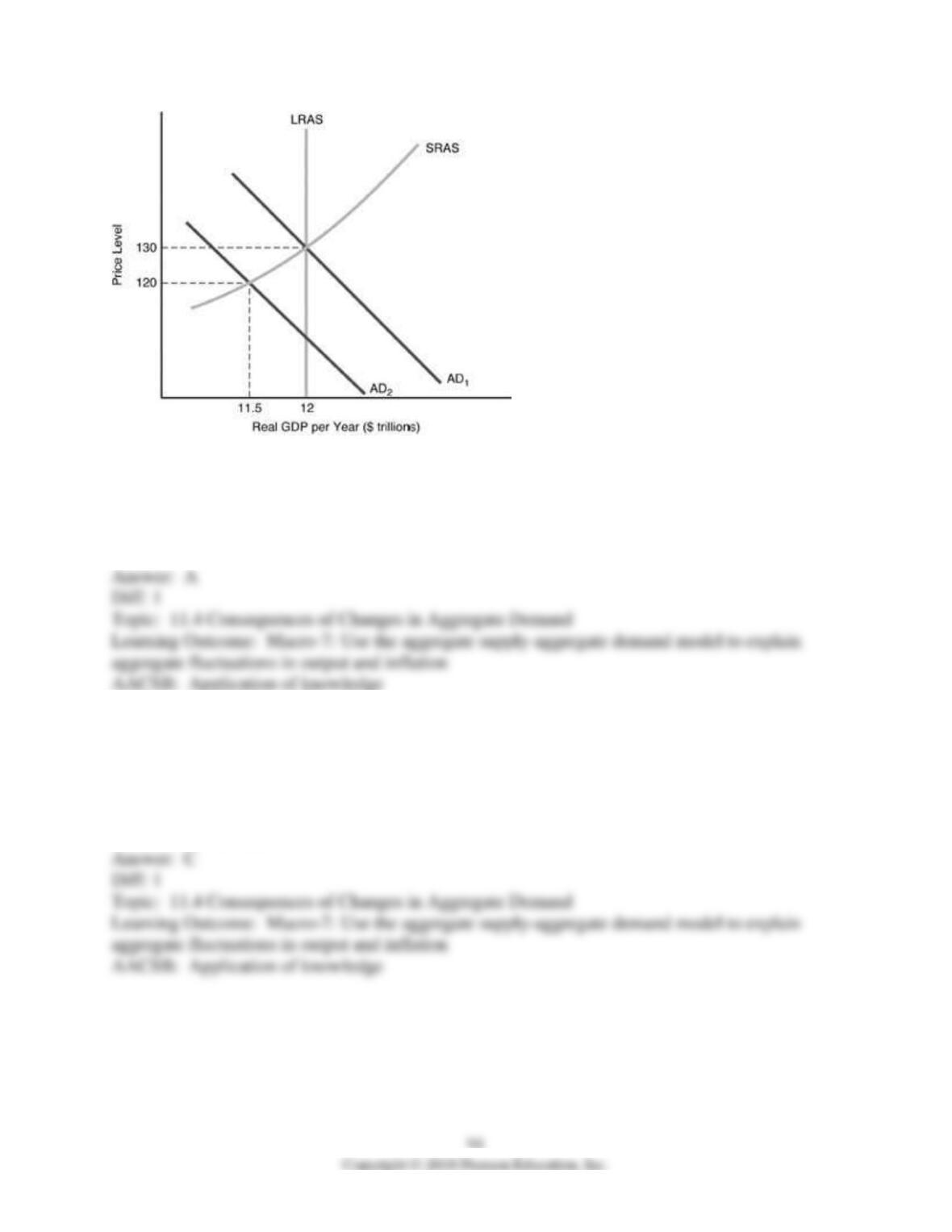
40) In the above figure, what are the long-run equilibrium price level and real GDP?
A) 130 and $12 trillion
B) 130 and $11.5 trillion
C) 120 and $11.5 trillion
D) 120 and $12 trillion
41) In the above figure, if the relevant aggregate demand curve is AD2, what are the short-run
equilibrium price level and real GDP?
A) 130 and $12 trillion
B) 130 and $11.5 trillion
C) 120 and $11.5 trillion
D) 120 and $12 trillion
42) In the above figure, if the relevant aggregate demand curve is AD2, what type of gap exists
and how large is it?
A) inflationary gap of $500 billion
B) inflationary gap of $1 trillion
C) recessionary gap of $1 trillion
D) recessionary gap of $500 billion
43) In the above figure, what could cause the shift of aggregate demand from AD1 to AD2?
A) depletion of raw materials
B) an increase in input prices
C) a decrease in consumer confidence
D) an increase in international trade barriers
44) If the equilibrium level of real GDP per year is greater than the full-employment level of
GDP, then
A) a recessionary gap occurs.
B) the economy is at full employment with no price changes.
C) the economy expands the level of real GDP.
D) an inflationary gap occurs.
45) Which of the following actions would cause the aggregate demand curve to shift to the left?
A) an increase in consumer spending caused by a cut in the personal income tax rate
B) an increase in government spending caused by increased spending on highways and bridge
construction
C) a decrease net export spending caused by an appreciation of the home currency
D) an increase in exports caused by an increase in economic activity in the European Union
46) A recessionary gap results when
A) aggregate demand is below the level consistent with full employment.
B) aggregate demand is above the level consistent with full employment.
C) aggregate supply and aggregate demand are not in short-run equilibrium.
D) aggregate supply decreases.
47) If the full-employment level of real GDP is greater than the equilibrium level of real GDP,
the nation would be experiencing a(n)
A) inflationary gap.
B) recessionary gap.
C) demand-pull inflation.
D) rising prices.
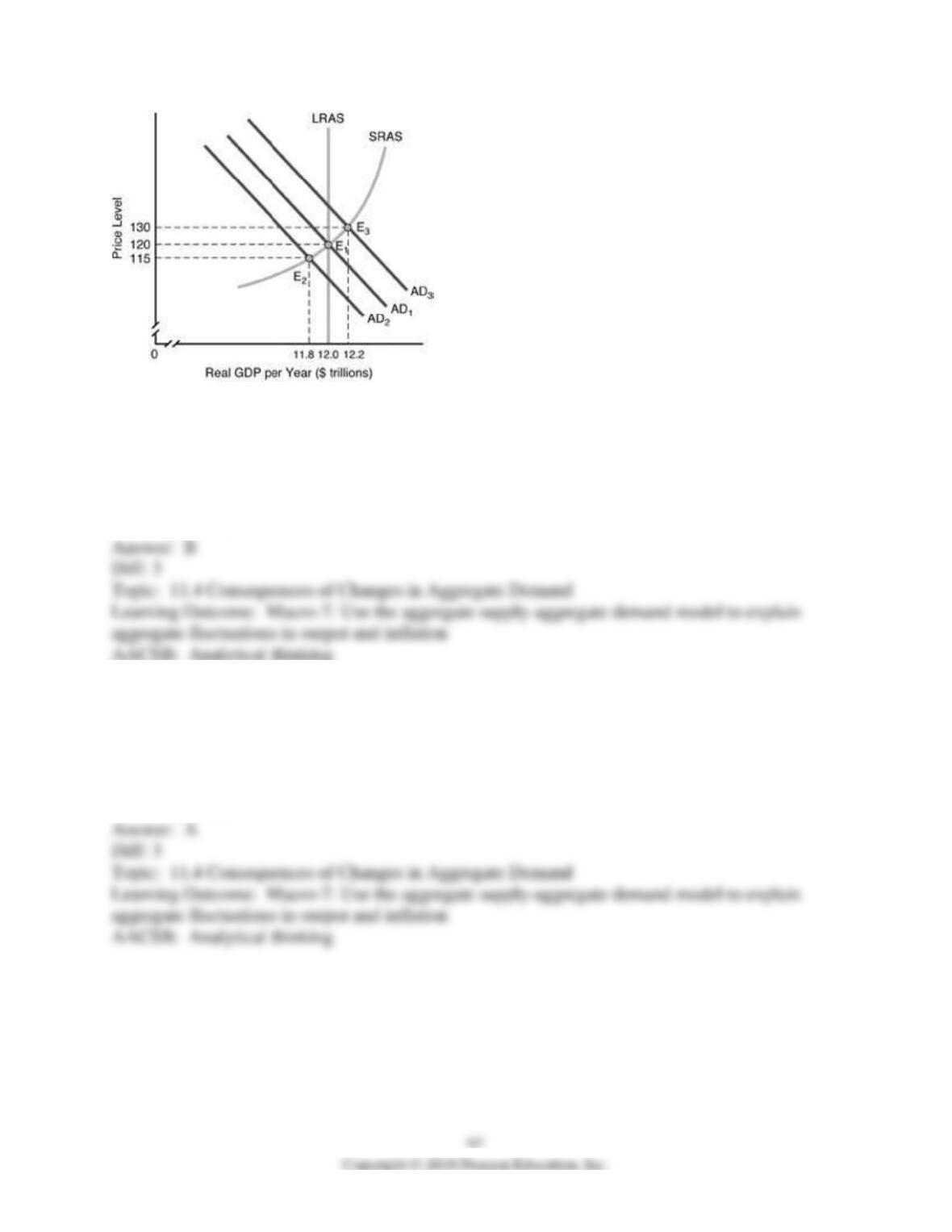
48) Consider the above figure. If the aggregate demand fell from AD1 to AD2, our nation would
be experiencing
A) an inflationary gap.
B) a recessionary gap.
C) overemployment.
D) rising prices.
49) Consider the above figure. If the aggregate demand curve rose from AD1 to AD3, our nation
would be experiencing
A) an inflationary gap.
B) a recessionary gap.
C) unemployment.
D) falling prices.
50) Consider the above figure. If the aggregate demand went from AD2 to AD3, our nation
would have gone from
A) a recessionary gap to an inflationary gap.
B) a recessionary gap to full-employment real GDP.
C) an inflationary gap to full-employment GDP.
D) full-employment real GDP to an inflationary gap.
51) According to modern Keynesian analysis, an increase in aggregate demand leads to a higher
price level because the
A) aggregate demand curve is upward sloping.
B) short-run aggregate supply curve is upward sloping.
C) aggregate demand curve is upward horizontal.
D) short-run aggregate supply curve is vertical.
52) Suppose aggregate demand is increasing over time. Would the modern Keynesian model
assume that the price level would always be constant? Explain.