2 Real GDP with a Fixed Price Level
1) Read the two statements below and indicate if they are true or false.
I. Autonomous expenditures change when GDP changes.
II. Aggregate planned expenditure is the sum of planned consumption expenditure, investment,
government expenditure, and net exports.
A) I and II are both true.
B) I and II are both false.
C) I is true and II is false
D) I is false and II is true.
2) Aggregate expenditure equals
A) C + I + G + X – M.
B) G + X – M.
C) C + I + G.
D) C + I + G + X.
3) The aggregate expenditure curve shows
A) how consumption changes in response to a change in disposable income.
B) how planned aggregate expenditure and real GDP are related.
C) a negative relationship between the price level and real GDP.
D) Both answers B and C are correct.
4) The graph of the aggregate expenditure curve has ________ on the y-axis and ________ on
the x-axis.
A) real GDP; aggregate planned expenditure
B) aggregate actual expenditure; real GDP
C) household expenditures; real GDP
D) aggregate planned expenditure; real GDP
5) The slope of the aggregate expenditure curve equals the change in
A) planned expenditure divided by the change in real GDP.
B) autonomous expenditure divided by the change in real GDP.
C) government expenditure divided by the change in real GDP.
D) real GDP divided by the change in planned expenditure.
6) The slope of the aggregate expenditure curve is
A) 0.
B) greater than 0 and less than 1.
C) 1.
D) greater than 1.
7) One reason the aggregate expenditure curve slopes upward is because ________ increases
when real GDP increases.
A) investment
B) consumption expenditure
C) government expenditure on goods and services
D) exports
8) The sum of the components of aggregate expenditure that vary with real GDP is called
A) induced expenditures.
B) the MPC.
C) autonomous expenditures.
D) autonomous consumption.
9) Induced expenditure includes ________.
A) induced consumption and government expenditure
B) induced consumption expenditure and imports
C) all autonomous expenditure
D) induced consumption expenditure and exports
10) Any expenditure component that depends on the level of real GDP is called
A) spurious expenditure.
B) equilibrium expenditure.
C) induced expenditure.
D) autonomous expenditure.
11) As a nation’s GDP increases, that nation’s
A) autonomous consumption increases.
B) autonomous consumption decreases.
C) exports increase.
D) imports increase.
12) A change in imports caused by rising U.S. incomes is
A) an increase in autonomous expenditure.
B) a decrease in autonomous expenditure.
C) an increase in induced exports.
D) a change in induced expenditure.
13) The part of aggregate planned expenditure that does not vary with real GDP ________.
A) equals equilibrium expenditure
B) is autonomous expenditure
C) is induced expenditure
D) equals zero
14) The sum of the components of aggregate expenditure that are not influenced by real GDP is
called
A) induced expenditures.
B) the MPC.
C) autonomous expenditures.
D) autonomous consumption.
15) Autonomous expenditure is not influenced by
A) the price level.
B) the interest rate.
C) real GDP.
D) any other variable.
16) Expenditure that does NOT depend on real GDP is called
A) spurious expenditure.
B) equilibrium expenditure.
C) induced expenditure.
D) autonomous expenditure.
17) Autonomous expenditure refers to
A) aggregate expenditure solely prompted by policy.
B) changes in short-run aggregate supply.
C) aggregate expenditure that does not change when real GDP changes.
D) aggregate expenditure that varies because of changes in real GDP.
18) All else being constant, autonomous expenditure
A) increases as real GDP increases.
B) increases as real GDP decreases.
C) does not change with changes in real GDP.
D) is assumed to be zero.
19) An increase in U.S. exports because of increasing foreign incomes represents ________ in
the United States.
A) an increase in autonomous expenditure
B) a decrease in autonomous expenditure
C) an increase in induced expenditure
D) a decrease in induced expenditure
20) An increase in investment by U.S. firms that is intended to maintain U.S. competitiveness in
world markets represents ________ in the United States.
A) an increase in autonomous expenditure
B) a decrease in autonomous expenditure
C) an increase in induced expenditure
D) a decrease in induced expenditure
21) Which of the following is NOT an autonomous expenditure in the aggregate expenditures
model?
A) investment
B) government expenditures
C) imports
D) exports
22) A decrease in autonomous consumption will
A) shift the aggregate expenditure function downward.
B) decrease the marginal propensity to save.
C) decrease the marginal propensity to consume.
D) change the slope of the aggregate expenditure curve.
23) Aggregate planned expenditure
A) always equals actual aggregate expenditure.
B) is always less than actual aggregate expenditure.
C) is always greater than actual aggregate expenditure.
D) equals actual aggregate expenditure at the equilibrium level of real GDP.
24) Actual aggregate expenditure is
A) always equal to real GDP.
B) only equal to real GDP at the equilibrium level of aggregate planned expenditure.
C) never greater than real GDP but can be less than real GDP.
D) never less than real GDP but can be greater than real GDP.
25) When aggregate planned expenditure is less than real GDP, unplanned
A) consumption expenditure occurs.
B) investment occurs.
C) government expenditures are made.
D) exports are made.
26) The difference between planned and unplanned spending is ________.
A) always negative
B) inventories
C) unplanned changes in inventories
D) always positive
27) When there is unplanned inventory investment, aggregate planned expenditure is ________
real GDP and actual investment is ________ planned investment.
A) greater than; greater than
B) greater than; less than
C) less than; greater than
D) less than; less than
28) If aggregate planned expenditure exceeds real GDP
A) firms are not maximizing their profits.
B) planned investment is greater than planned saving.
C) actual inventories decrease below their target.
D) planned consumption expenditure is less than actual consumption expenditure.
29) If planned expenditures equal $16 trillion when real GDP is $16.5 trillion, then
A) inventories will decrease by $0.5 trillion.
B) actual investment will exceed planned investment.
C) there will be excess demand for most goods.
D) the economy must have a trade surplus to sell the excess goods and services.
30) Suppose that in 2014, firms discover that their inventories are falling below their planned
levels. Which of the following statements is CORRECT?
A) The level of aggregate savings must equal the level of desired investment.
B) Even though firms are trying, they are unable to maximize profits.
C) Aggregate demand is less than aggregate supply.
D) Real GDP is less than equilibrium expenditure.
31) Actual expenditure might differ from planned expenditure because
A) actual consumption expenditure differs from planned consumption expenditure.
B) actual investment differs from planned investment.
C) actual government expenditure differ from planned government expenditure.
D) actual net exports differ from planned net exports.
32) If real GDP is $16 trillion and planned aggregate expenditure is $16.5 trillion, inventories
will be
A) below their target and real GDP will increase.
B) below their target and real GDP will decrease.
C) above their target and real GDP will decrease.
D) above their target and real GDP will increase.
33) Which of the following statements is CORRECT?
A) Actual aggregate expenditures does not always equal real GDP.
B) Planned investment exceeds actual investment when real GDP is greater than aggregate
planned expenditures.
C) Actual investment exceeds planned investment when real GDP is less than aggregate planned
expenditures.
D) None of the above is correct.
34) If prices are fixed, when aggregate planned expenditure exceeds real GDP, then
A) inventories decrease, signaling firms to increase production and increase real GDP.
B) inventories increase, signaling firms to decrease production and decrease real GDP.
C) profits fall, signaling firms to decrease production and decrease real GDP.
D) None of the above answers are correct.
35) When real GDP exceeds aggregate planned expenditure
A) actual inventories decrease below their target.
B) the circular flow will increase.
C) GDP will decrease.
D) a higher level of equilibrium income will prevail.
36) If aggregate planned expenditure is less than real GDP
A) real GDP will increase.
B) real GDP remain unchanged.
C) real GDP will either decrease or increase, depending on the MPC.
D) inventories will increase above their target level and real GDP will decrease.
37) Suppose the equilibrium level of expenditure is $13 trillion. If real GDP is $12 trillion, then
inventories are ________ their target levels and real GDP will ________.
A) above; increase
B) above; decrease
C) below; increase
D) below; decrease
38) Suppose the equilibrium level of expenditure is $13 trillion. If real GDP is $14 trillion, then
planned expenditures
A) exceed real GDP, and real GDP will increase.
B) are less than real GDP, and real GDP will decrease.
C) are equal to real GDP, and there will be no change in real GDP.
D) are less than real GDP, and real GDP will increase.
39) If aggregate planned expenditure is less than real GDP then
A) consumers increase their planned expenditure until aggregate planned expenditure increases
to equal real GDP.
B) firms increase their planned expenditure until aggregate planned expenditure increases to
equal real GDP.
C) firms’ inventories will increase and real GDP will decrease as production falls.
D) firms’ inventories will decrease and real GDP will decrease as production falls.
40) When investment is less than planned investment, aggregate planned expenditure is
________ than actual aggregate expenditure and inventories are ________ than planned.
A) greater; greater
B) greater; less
C) less; greater
D) less; less
41) When investment exceeds planned investment, aggregate planned expenditure is ________
than actual aggregate expenditure and inventories are ________ than planned.
A) greater; greater
B) greater; less
C) less; greater
D) less; less
42) In the aggregate expenditure model, when real GDP is greater than aggregate planned
expenditure
A) unplanned inventories are being accumulated.
B) inventories are being depleted.
C) inventories are not being changed.
D) this cannot happen, because the two variables are always equal.
43) Equilibrium expenditure is defined as the level of aggregate expenditure where
A) actual aggregate expenditure equals real GDP.
B) total inventories equal zero.
C) aggregate planned expenditure equals real GDP.
D) spending equals output.
44) When the economy is in equilibrium
A) planned investment equals actual investment.
B) planned savings will equal zero.
C) there can be no unemployment.
D) changes in autonomous spending will have no impact on real GDP.
45) At equilibrium expenditure
A) consumers’ expenditures on goods and services equal firms’ purchases of investment goods.
B) firms hold no inventories of raw materials or final goods.
C) aggregate planned expenditure equals real GDP.
D) aggregate planned expenditure equals real GDP minus net exports.
46) At equilibrium expenditure, unplanned changes in inventory
A) must be positive.
B) must be zero.
C) must be negative.
D) might be either positive or negative.
47) Equilibrium expenditure occurs where
A) the aggregate expenditure curve crosses the 45-degree line.
B) planned expenditures exceed national income.
C) savings exceed planned investment.
D) All of the answers are correct.
48) Equilibrium expenditure occurs where the aggregate expenditure curve crosses the
A) 45-degree line.
B) horizontal axis.
C) vertical axis.
D) consumption function.
Real
GDP
C
I
G
X – M
2500
1430
540
400
90
2400
1360
540
400
100
2300
1290
540
400
110
2200
1220
540
400
120
2100
1150
540
400
130
49) In the above table, C is consumption expenditure, I is investment, G is government
expenditure, and X – M is net exports. All entries are in dollars. The equilibrium level of real
GDP is
A) $2,500.
B) $2,400.
C) $2,300.
D) $2,200.
50) In the above table, C is consumption expenditure, I is investment, G is government
expenditure, and X – M is net exports. All entries are in dollars. The slope of the aggregate
expenditure function is
A) -0.10.
B) 0.10.
C) 0.60.
D) 0.70.
Real
GDP
C
I
G
X
M
100
75
25
95
10
1
200
150
25
95
10
2
300
225
25
95
10
3
400
300
25
95
10
4
500
375
25
95
10
5
600
450
25
95
10
6
700
525
25
95
10
7
800
600
25
95
10
8
900
675
25
95
10
9
1000
750
25
95
10
10
51) In the above table, C is consumption expenditure, I is investment, G is government
expenditure, X is exports, and M is imports. All entries are in dollars. What is the marginal
propensity to consume?
A) 0.20
B) 0.25
C) 0.75
D) 0.80
52) In the above table, C is consumption expenditure, I is investment, G is government
expenditure, X is exports, and M is imports. All entries are in dollars. What is the level of
aggregate planned expenditure when real GDP is equal to $900 billion?
A) $675
B) $796
C) $814
D) $1,714
53) In the above table, C is consumption expenditure, I is investment, G is government
expenditure, X is exports, and M is imports. All entries are in dollars. What is the unplanned
inventory change when GDP is equal to $400?
A) $26
B) -$26
C) $5
D) -$5
54) In the above table, C is consumption expenditure, I is investment, G is government
expenditure, X is exports, and M is imports. All entries are in dollars. What is the equilibrium
expenditure?
A) $200
B) $500
C) $700
D) $1,000
55) In the above table, C is consumption expenditure, I is investment, G is government
expenditure, X is exports, and M is imports. All entries are in dollars. If investment increased by
$26 to $51 then equilibrium expenditure will
A) increase by $25.
B) decrease by $50.
C) increase by $100.
D) decrease by $100.
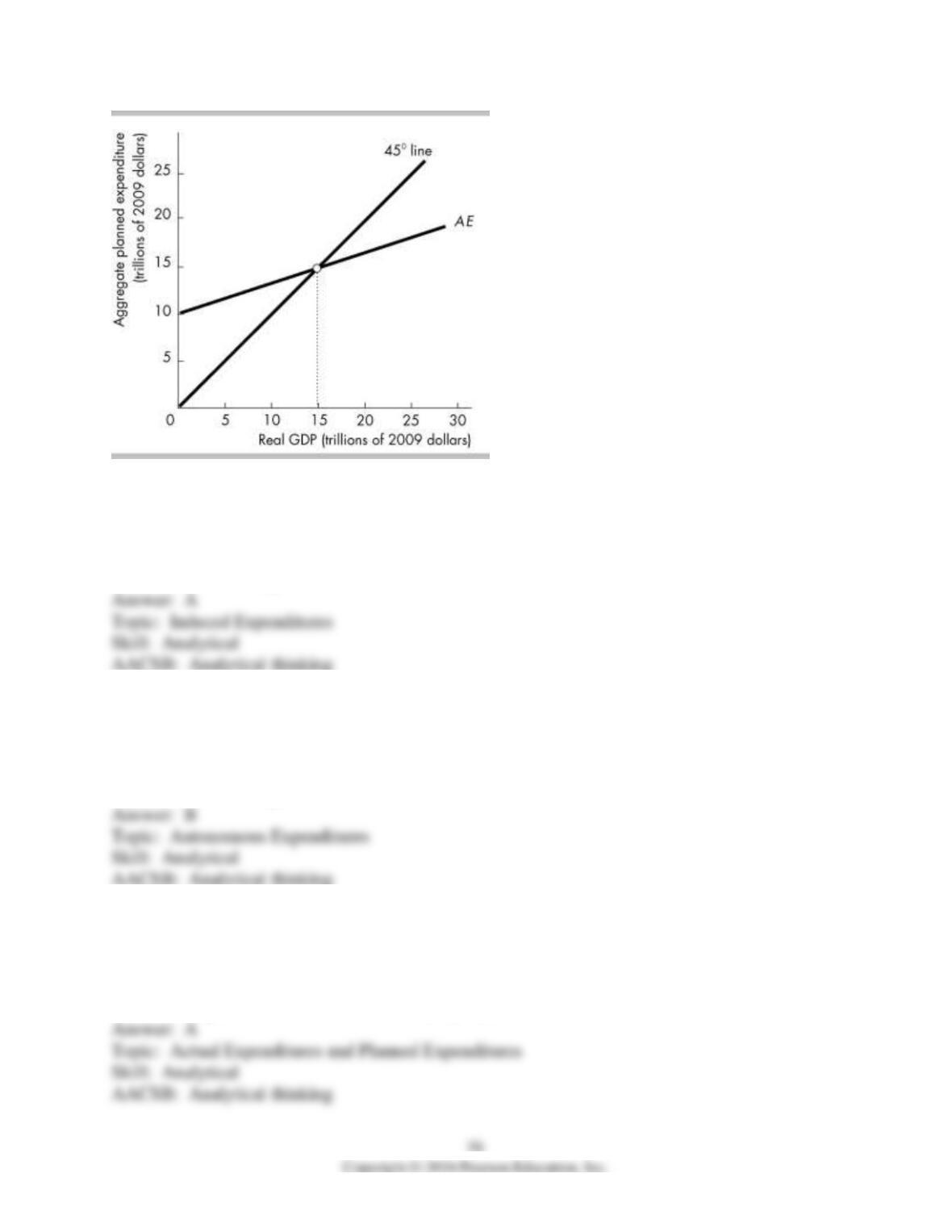
56) In the above figure, at the equilibrium, induced expenditure is
A) $5 trillion.
B) $10 trillion.
C) $15 trillion.
D) some amount not given in the above answers.
57) In the above figure, autonomous expenditure is
A) $5 trillion.
B) $10 trillion.
C) $15 trillion.
D) some amount not given in the above answers.
58) In the above figure, if real GDP is below $15 trillion, inventories will be
A) below target levels, so firms will increase production.
B) below target levels, so firms will decrease production.
C) above target levels, so firms will increase production.
D) above target levels, so firms will decrease production.
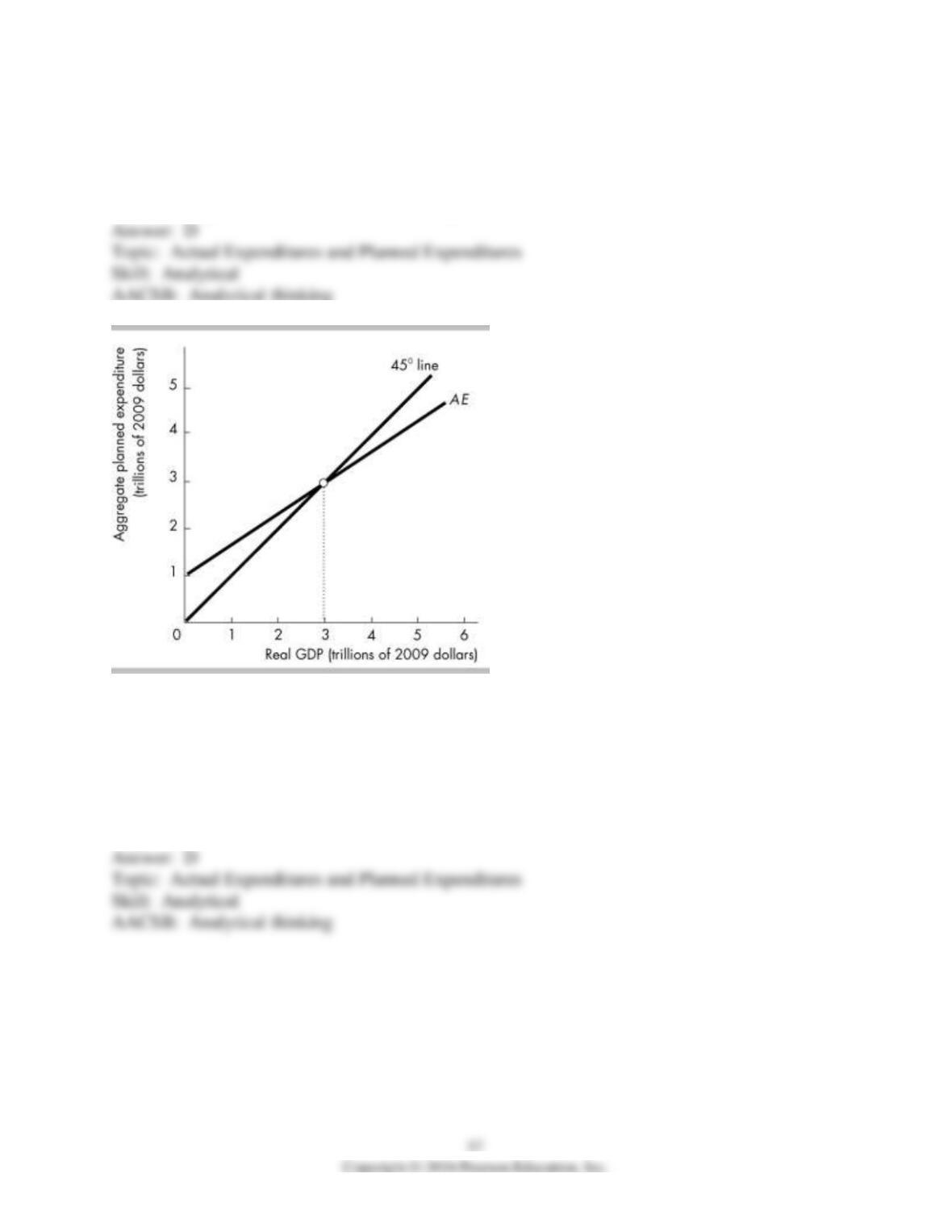
59) In the above figure, if real GDP is greater than $15 trillion, inventories will be
A) below target levels so firms will increase production.
B) below target levels so firms will decrease production.
C) above target levels so firms will increase production.
D) above target levels so firms will decrease production.
60) The figure shows Tropical Isle’s aggregate planned expenditure curve. When aggregate
planned expenditure is $2 trillion, aggregate planned expenditure is ________ than real GDP,
firms’ inventories ________, and firms ________ their production.
A) greater; increase; decrease
B) less; decrease; increase
C) less; increase; decrease
D) greater; decrease; increase
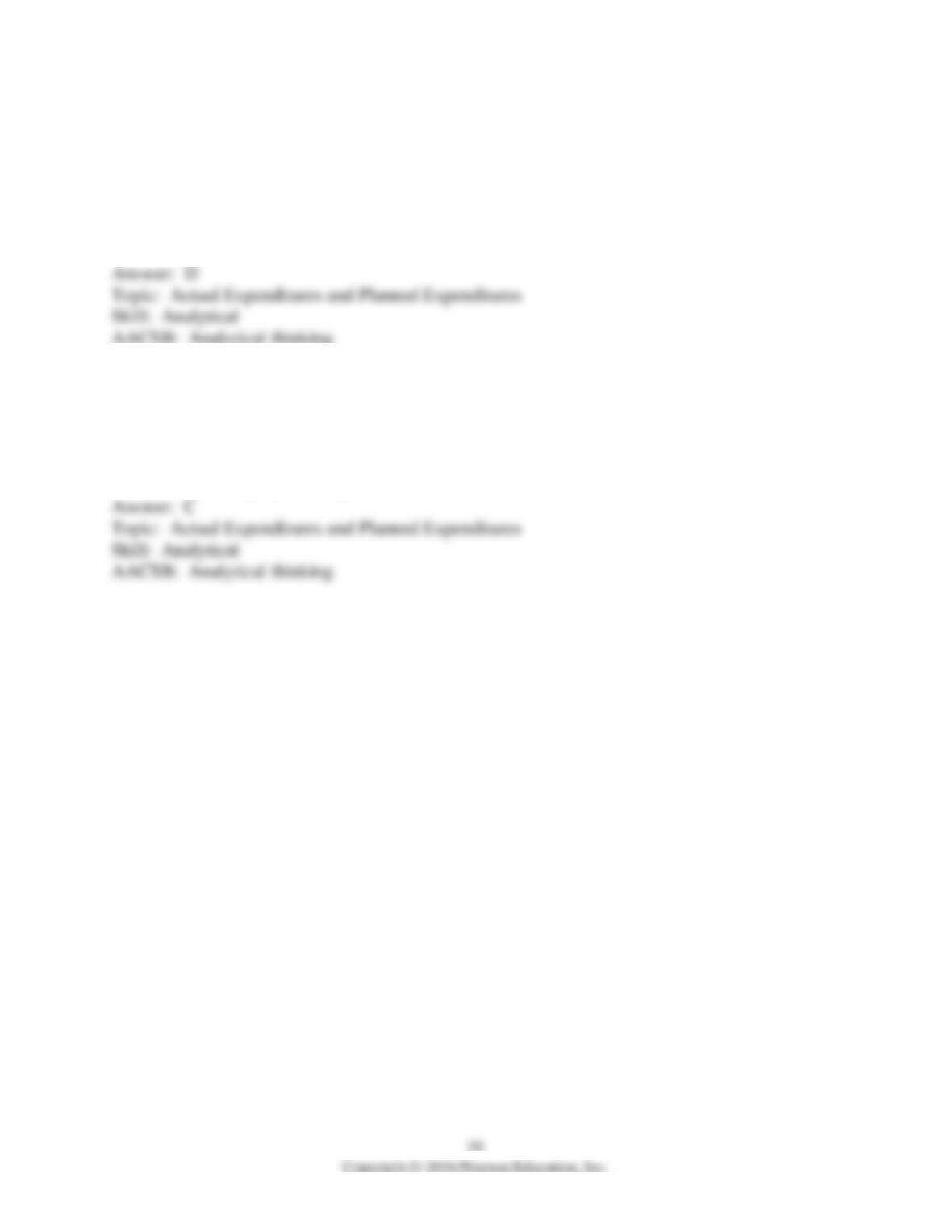
61) The figure shows Tropical Isle’s aggregate planned expenditure curve. When aggregate
planned expenditure is $4 trillion, aggregate planned expenditure is ________ than real GDP,
firms’ inventories ________, and firms ________ their production.
A) greater; increase; decrease
B) less; decrease; increase
C) greater, decrease; increase
D) less, increase; decrease
62) Real GDP equals $20 billion and aggregate planned expenditure is $30 billion. There is an
unplanned ________ in inventories of ________ and real GDP will ________.
A) increase; $10 billion; increase
B) increase; $50 billion; decrease
C) decrease; $10 billion; increase
D) decrease; $10 billion; decrease
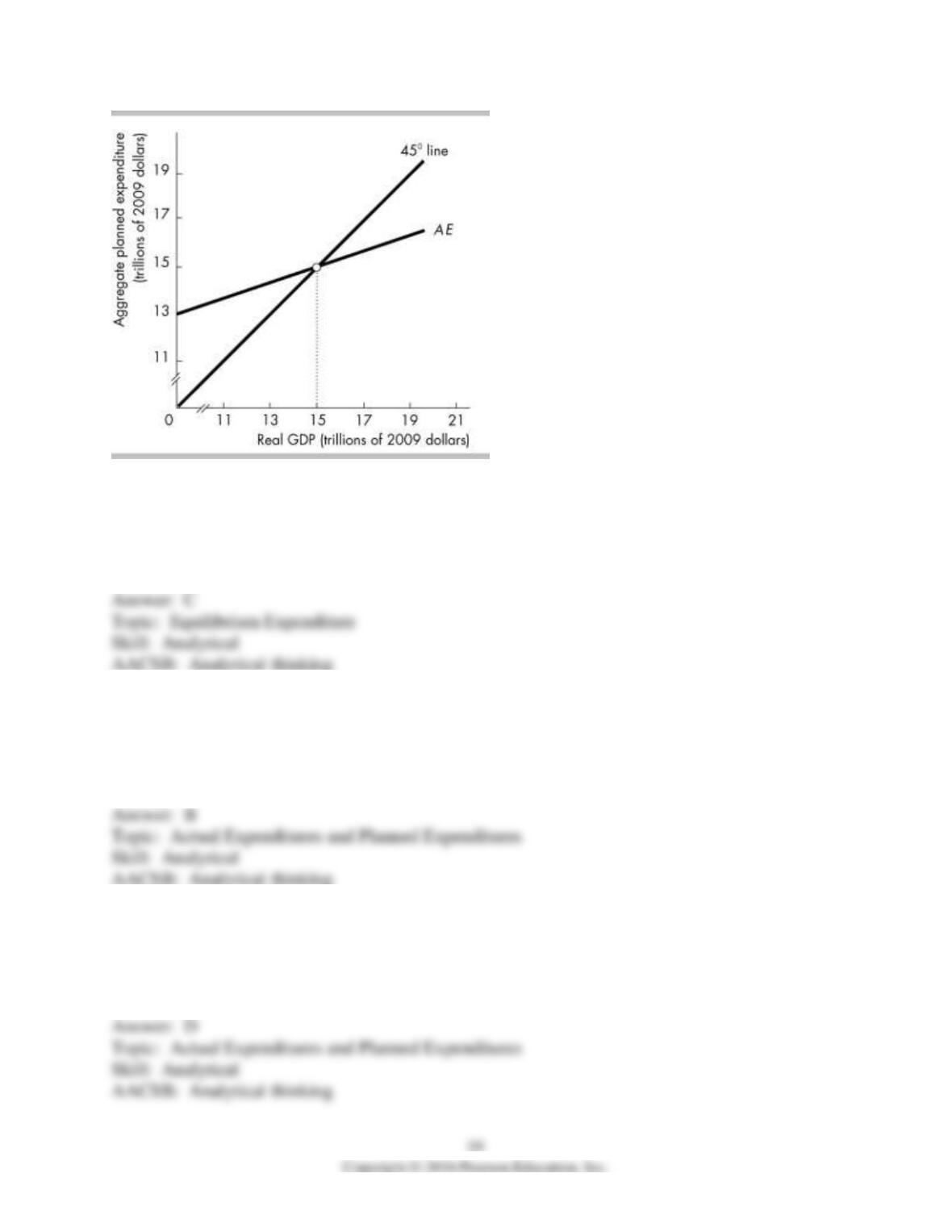
63) In the above figure, if real GDP equals $15 trillion, there would be
A) an increase in autonomous consumption expenditure.
B) an increase in autonomous inventories.
C) no change in GDP.
D) an unplanned increase in firms’ inventories.
64) In the above figure, if real GDP equals $17 trillion
A) actual and planned investment will both increase.
B) unplanned inventories will increase.
C) actual investment will decrease but planned investment will increase.
D) unplanned inventories will decrease.
65) In the above figure, if real GDP equals $13 trillion
A) actual and planned investment will both increase.
B) unplanned inventories will increase.
C) actual investment will decrease but planned investment will increase.
D) unplanned inventories will decrease.
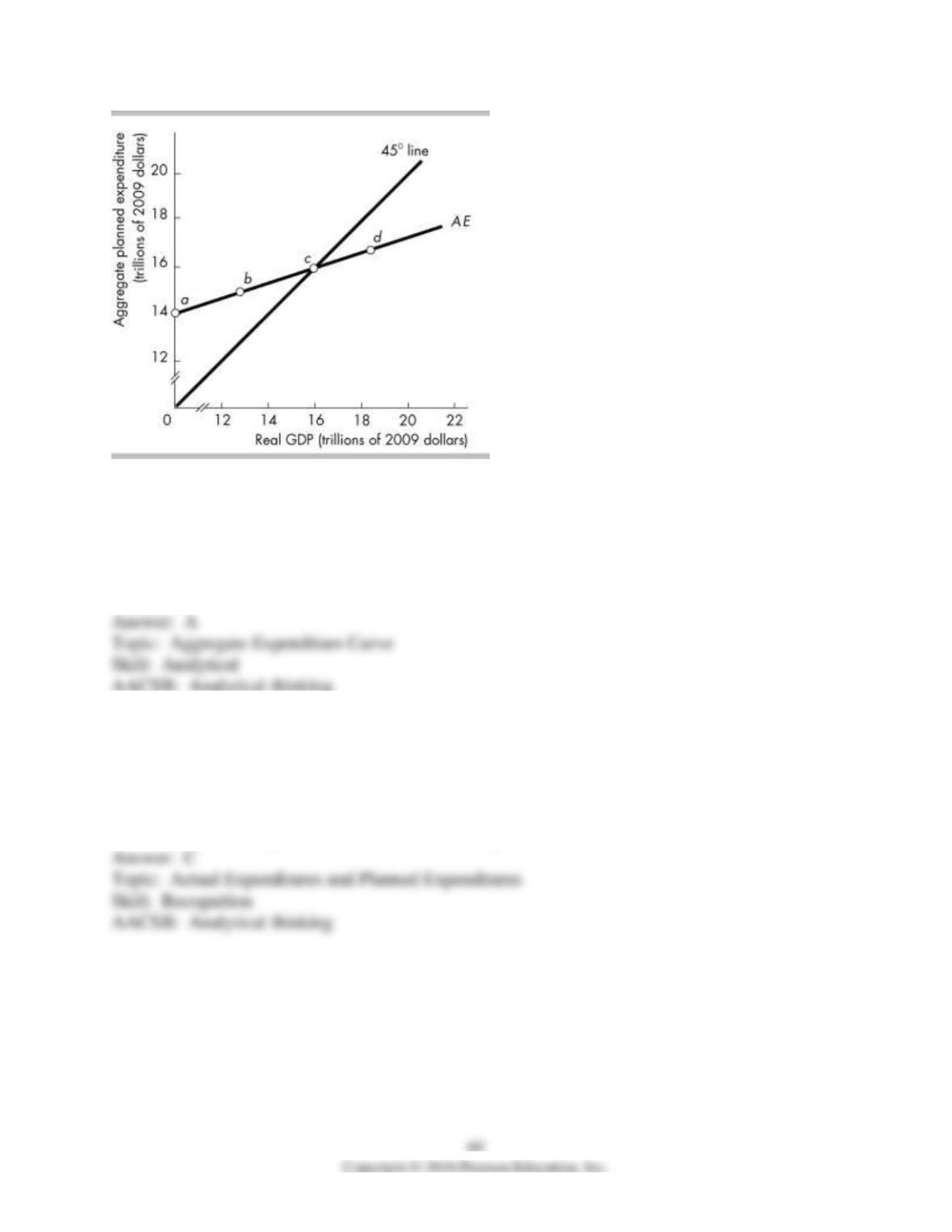
66) In the above figure, if the marginal propensity to consume increases, the slope of the AE
curve would
A) increase.
B) decrease.
C) stay the same but the AE curve would shift upwards.
D) stay the same but the AE curve would shift downwards.
67) In the above figure, point d represents the point where planned expenditures are ________
real GDP.
A) greater than
B) equal to
C) less than
D) There is not enough information to answer the question.