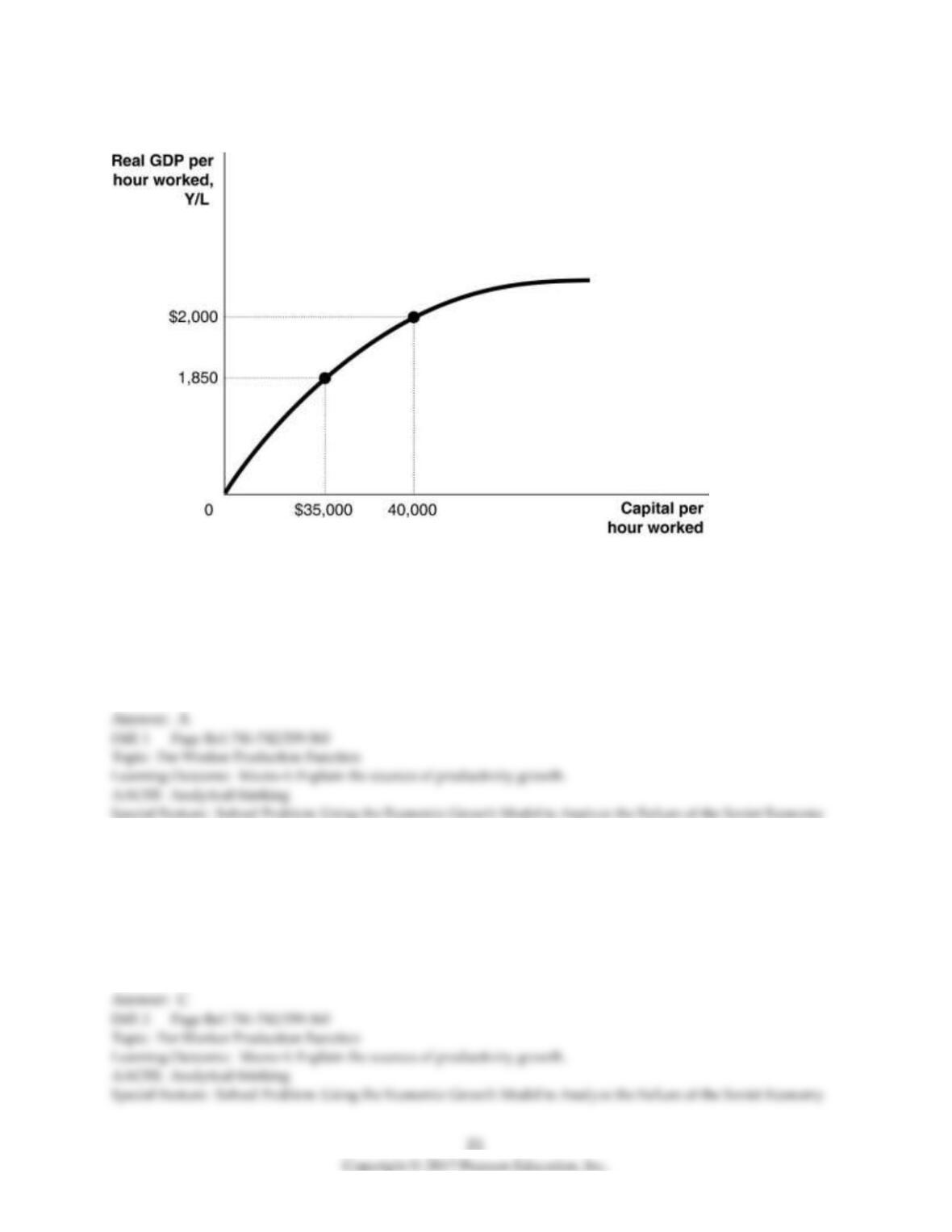
Figure 11-2
25) Refer to Figure 11-2. Based on the per-worker production function above, if the economy raises
capital per hour worked from $35,000 to $40,000, by how much will real GDP per hour worked
increase?
A) $150
B) $1,850
C) $2,000
D) $5,000
26) Refer to Figure 11-2. Assuming no technological change, if the United States increases capital per
hour worked by $40,000 every year between 2012 and 2016, we would expect to see
A) real GDP per hour worked will increase by the same increment each year between 2012 and 2016.
B) real GDP per hour worked will be lower in 2016 than it was in 2012.
C) the per-worker production function will get flatter over time.
D) the per-worker production function will shift up every year there is increase in capital per hour
worked.

27) According to new growth theory,
A) technological change is influenced by economic incentives.
B) centrally-planned economies are the most efficient.
C) growth in real GDP per capita occurs only if there are increasing returns.
D) economic growth is determined by forces outside the control of the market system.
28) Paul Romer, an economist at Stanford University, is most closely associated with what economic
theory?
A) new growth theory
B) labor productivity theory
C) the process of creative destruction
D) the Communist Manifesto
29) According to new growth theory,
A) physical capital is nonexcludable.
B) knowledge capital is excludable.
C) knowledge capital is subject to increasing returns.
D) knowledge capital is rival and excludable.
30) Knowledge capital is
A) rival.
B) nonrival.
C) nonexcludable.
D) both B and C

31) Knowledge capital is nonrival in the sense that
A) two people can use the same knowledge to develop and produce a product.
B) firms do not compete to be the first to develop new technologies.
C) no single company can be excluded from the benefits of new technologies.
D) firms can benefit from the research and development of rival firms without paying for that benefit.
32) Firms free ride on the research and development of other firms when they
A) buy a firm’s newly developed product, and then give it away to consumers.
B) use knowledge other firms have developed without paying for that knowledge.
C) license a new technology from a firm that developed the new technology.
D) choose a level of research and development that is inefficiently high.
33) Which of the following government provisions would help increase the accumulation of knowledge
capital?
A) patents
B) copyrights
C) education subsidies
D) All of the above are correct.

34) Because firms can free ride on the research and development of other firms,
A) firms choose a level of research and development where the marginal cost of research is equal to the
economy’s marginal return of research.
B) firms choose a level of research and development where the marginal cost of research is above the
economy’s marginal return of research.
C) firms choose a level of research and development where the marginal cost of research is below the
economy’s marginal return of research.
D) firms choose a level of research and development where the marginal cost of research is below the
individual firm’s marginal return of research.
35) A patent grants an inventor exclusive rights to a product for how long?
A) 14 years
B) 17 years
C) 20 years
D) the lifetime of the product
36) Why do some firms choose not to file for a patent and instead try to keep the results of their research
a trade secret?
A) because firms must disclose information about the product or process being patented in a patent
application
B) because trade secrets are never divulged
C) because a patent only gives the inventor exclusive rights to a product or process for 5 years
D) because trade secrets provide the same exclusive legal rights to a product as a patent does

37) Which of the following government policies would most likely result in an increase in economic
growth?
A) a decrease in the life of a patent from 20 years to 15 years
B) a decrease in the interest rate at which the government provides student loans
C) a decrease in government spending on grants issued through the National Institutes of Health
D) decreased copyright protection on music and movies
38) According to Joseph Schumpeter, economic growth is achieved through
A) focusing only on making old products better rather than inventing new ones.
B) centralizing economic production.
C) a process termed “creative destruction.”
D) removing the entrepreneur from the production function.
39) Creative destruction means that
A) firms develop new products that replace old products in the economy, thereby encouraging
economic growth.
B) economic growth can only be sustained if capital depreciates rapidly.
C) knowledge capital can be created through a system of government subsidies for education and
research and development.
D) research and development should only be financed if research and development is incremental (a
result of making small changes to existing products).
40) An economic growth model
A) explains changes in nominal GDP per capita in the long run.
B) explains changes in real GDP per capita in the long run.
C) explains changes in nominal GDP per capita in the short run.
D) explains changes in real GDP per capita in the short run.

26
41) Which factors explain labor productivity?
A) technological change; the quantity of labor per hour worked
B) diminishing returns; the quantity of labor per hour worked
C) diminishing returns; the quantity of capital per hour worked
D) technological change; the quantity of capital per hour worked
42) The per-worker production function shows the relationship between ________ per hour worked and
________ per hour worked, holding ________ constant.
A) labor; real GDP; technology
B) capital; real GDP; technology
C) labor; capital; real GDP
D) capital; labor; real GDP
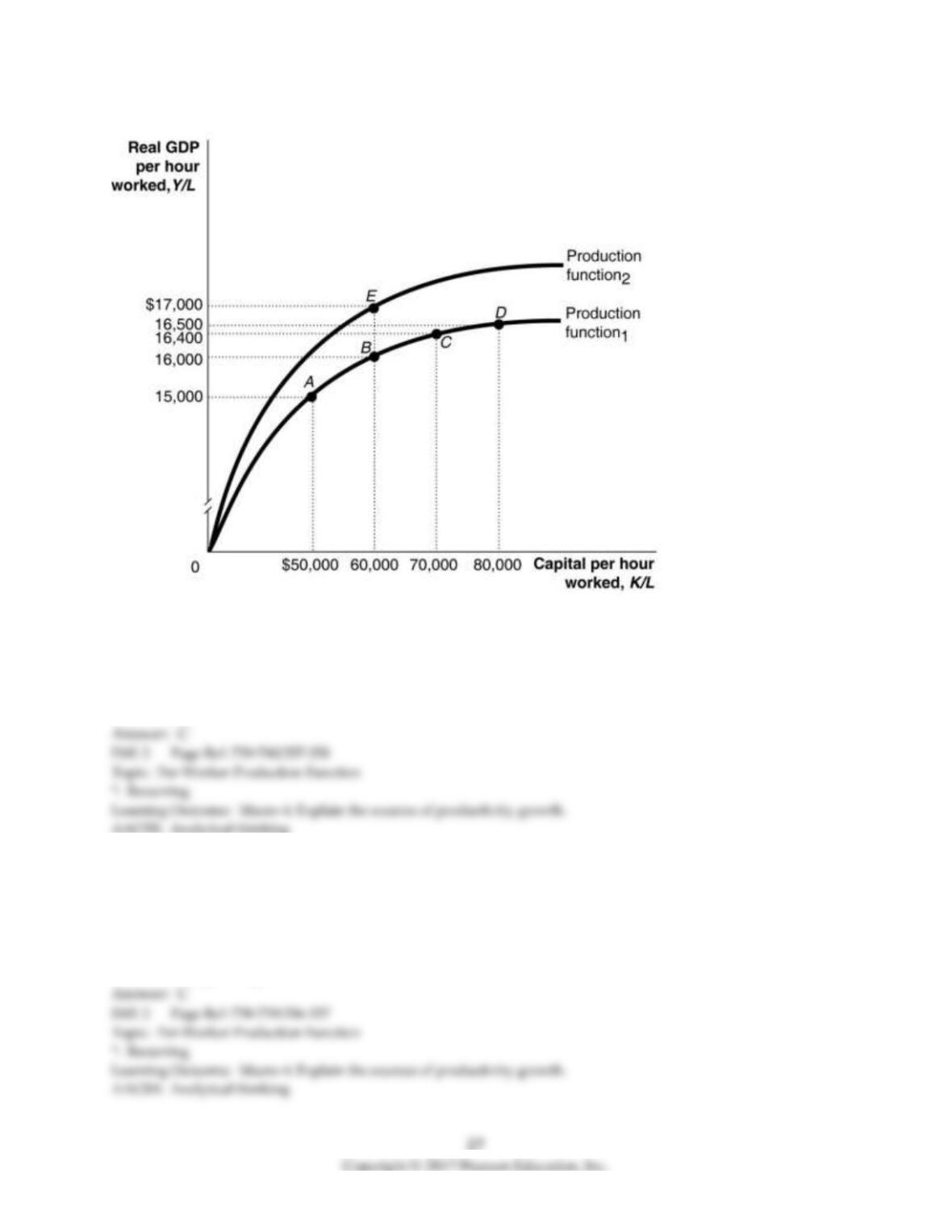
Figure 11-3
43) Refer to Figure 11-3. Technological change is shown in the figure above by the movement from
A) B to C.
B) B to D.
C) B to E.
D) B to A.
44) Refer to Figure 11-3. Which of the following would cause an economy to move from a point like A in
the figure above to a point like B?
A) an improvement in technology
B) a decrease in capital per hour worked
C) an increase in capital per hour worked
D) a technological regression

45) The per-worker production function has a ________ slope, indicating that increases in capital per
hour worked ________ real GDP.
A) negative; increase
B) positive; increase
C) negative; decrease
D) positive; decrease
46) A small economy increased its capital per hour worked (K/L) from $40,000 to $50,000. As a result,
real GDP per worker (Y/L) grew from $20,000 to $25,000. If the economy increases its capital per hour
worked by another $10,000 to $60,000, but there is no change in technology, by how much more and in
what direction will output per worker change?
A) Output per worker will increase by exactly $5,000.
B) Output per worker will increase by more than $5,000.
C) Output per worker will increase by less than $5,000.
D) Output per worker will fall by more than $5,000.
47) What is human capital?
A) labor productivity
B) buildings, equipment, and machinery owned by individuals rather than firms
C) buildings, equipment, and machinery owned by firms
D) the accumulated knowledge and skills that workers acquire from education, training, and their life
experiences

29
48) If there is a change in the ability of a firm to produce a given level of output with a given level of
inputs, we say there is
A) human capital investment.
B) technological change.
C) an increase in labor productivity.
D) a movement along a given per-worker production function.
49) Technological change will
A) shift the per-worker production function up.
B) shift the per-worker production function down.
C) move the economy to a point beneath the per-worker production function.
D) move the economy along a given per-worker production function.
50) In the long run, a country will experience an increasing standard of living only if it experiences
A) a high rate of consumption.
B) continuous technological change.
C) a high rate of labor force growth.
D) a slow rate of population growth.
Article Summary
Due in part to a lackluster economy, Mexico is experiencing an exodus of some of its brightest and
most educated citizens. More than 20 percent of Mexicans with bachelor’s degrees are living in the
United States, 28 percent working on higher education degrees are doing so in the United States, and
27 percent of Mexicans with doctorates are working in the United States. The three main reasons
given for this exodus are money, politics, and safety. Pay gaps are wide between university positions
in the two countries, scholarship money is scarce in Mexico and is subject to political bureaucracy
and nepotism, and a 2014 study from Mexico’s National Autonomous University reported that 76
percent of high-skilled workers stated that violence was a reason for their departure from the
country.
Source: Christopher Woody, “‘Not nostalgic about their country’: Latin America’s brain drain is
accelerating,” Business Insider, August 24, 2015.
51) Refer to the Article Summary. If, after the outflow of educated workers in Mexico, it now takes more
capital per hour worked to get the same amount of GDP per hour worked, this indicates ________ the
per-worker production function in Mexico.
A) a movement up
B) a movement down
C) an upward shift of
D) a downward shift of
52) Refer to the Article Summary. In Mexico, many educated workers are leaving the country, but in
some countries, less-educated workers are the primary workers who leave. Should an outflow of
workers leave a country with a smaller but more productive workforce and the capital per hour worked
does not change, there would be ________ the per-worker production function in that country.
A) a movement up
B) a movement down
C) an upward shift of
D) a downward shift of

53) Which of the following describes the Soviet Union’s economy through most of the second half of the
20th century?
A) The Soviet economy grew rapidly in the latter half of the 20th century.
B) The Soviet economy increased capital per worker very slowly from 1950 through 1980.
C) The Soviet economy grew slowly because of the slow rate of technological change.
D) The Soviet economy grew because it added labor through immigration policy in the 1950s.
54) The Soviet Union consistently increased the amount of capital available to its workers, but found
that increases in capital resulted in progressively smaller and smaller increases in GDP per worker. This
phenomenon is referred to as
A) a rising standard of living.
B) diminishing returns to capital.
C) new growth theory.
D) a shift of the per-worker production function.
55) New growth theory
A) states that the rate of technological change is determined outside the working of the market system.
B) does not adequately explain the factors that determine productivity.
C) states that the rate of technological change is caused by economic incentives.
D) states that the rate of technological change is unaffected by economic incentives.
56) If the per-worker production function shifts up,
A) it now takes more capital per hour worked to get the same amount of real GDP per hour worked.
B) an economy can increase its real GDP per hour worked without changing the level of capital per hour
worked.
C) the per-worker production function becomes flatter.
D) negative technological change has occurred in the economy.

32
57) Knowledge capital is ________ in production and ________. As a result, firms ________ free ride.
A) nonrival; nonexcludable; can
B) nonrival; excludable; can
C) rival; nonexcludable; cannot
D) nonrival; nonexcludable; cannot
58) An increase in ________ shifts the production function ________, and makes it possible to produce a
higher level of GDP with ________ capital per hour worked.
A) technology; down; the same amount of
B) technology; up; the same amount of
C) consumption; up; a lesser amount
D) labor productivity; down; the same amount of
59) In a small Asian country, it is estimated that a $10,000 increase in capital per hour worked will
increase real GDP per hour worked by $600. Based on this information, what is the slope of the per-
worker production function in this range?
A) 0.06
B) 6.6
C) 66.6
D) 666

60) In a small Asian country, it is estimated that changing the level of capital from $8 million to $12
million will increase real GDP from $5 million to $6 million. If the number of hours worked in the labor
force does not change, what does this information tell you about the slope of the per-worker production
function in this range?
A) The slope is –4.
B) The slope is 1/4.
C) The slope is 4.
D) The slope is 8.
61) In a small Asian country, it is estimated that changing the level of capital from $8 million to $12
million will increase real GDP from $4 million to $6 million. What level of GDP would you expect the
economy to be able to reach if spending on capital continued to rise to $16 million, assuming no
technological change and no change in the hours of work?
A) GDP would increase further, but by less than $2 million.
B) GDP would increase further by exactly $2 million.
C) GDP would increase further by more than $2 million
D) GDP would increase further by exactly $8 million.
62) If the slope of the per-worker production function is 1/4 in a given range, how will a $10,000 increase
in capital per hour worked affect real GDP per hour worked in the same given range?
A) Real GDP per hour worked will increase by $2,500.
B) Real GDP per hour worked will increase by $40,000.
C) Real GDP per hour worked will increase by $10,000.
D) Real GDP per hour worked will decrease by $40.000.
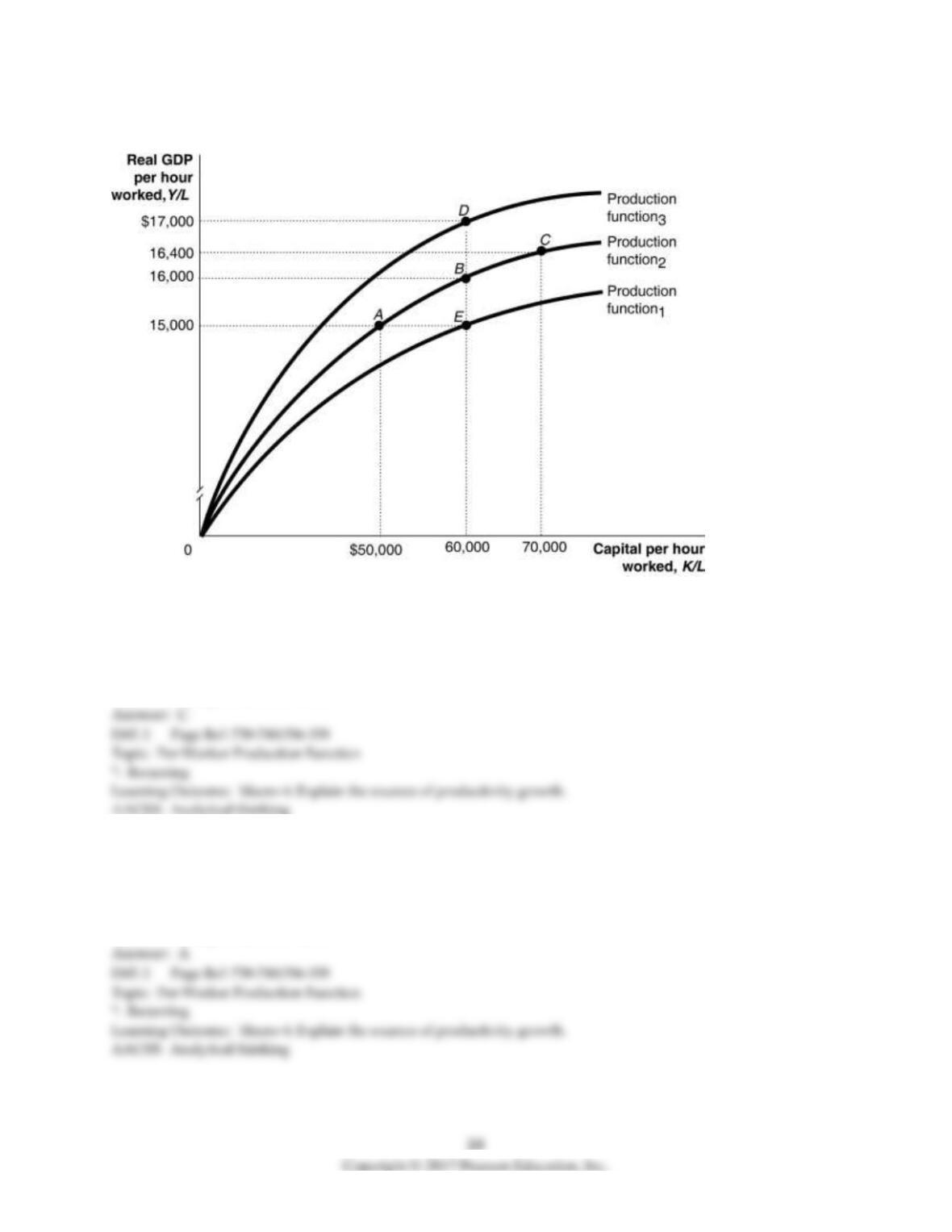
Figure 11-4
63) Refer to Figure 11-4. The movement from A to B to C illustrates
A) an improvement in technology.
B) a decline in capital per worker.
C) diminishing returns to capital.
D) diminishing returns to labor.
64) Refer to Figure 11-4. The movement from E to B to D in the figure above illustrates
A) an improvement in technology.
B) a decline in capital per worker.
C) diminishing returns to capital.
D) diminishing returns to labor.

65) Refer to Figure 11-4. Suppose the economy gains more capital per hour worked and experiences
technological change. This is shown in the figure above by the movement from
A) E to B to D.
B) A to B to C.
C) A to E.
D) A to D.
66) Refer to Figure 11-4. Which of the following combinations of points illustrates changes in the Soviet
Union’s economy from 1950 to 1980?
A) E to B
B) B to D
C) B to E
D) A to B to C
67) Refer to Figure 11-4. Using the per-worker production function in the figure above, the largest
changes in an economy’s standard of living would be achieved by a movement from
A) A to B to C.
B) E to B to D.
C) C to B to A.
D) D to B to E.

68) Refer to Figure 11-4. Suppose the per-worker production function in the figure above represents the
production function for the U.S. economy. If the United States decided to cut its support of university
research in half, this would cause a movement from
A) B to A.
B) B to E.
C) B to C.
D) B to D.
69) Refer to Figure 11-4. Within a country, the impact of wars and revolutions and their subsequent
destruction of capital is reflected in the per-worker production function in the figure above by a
movement from
A) A to C.
B) B to C.
C) B to A.
D) E to B.
70) Refer to Figure 11-4. Many countries in Africa strongly discouraged and prohibited foreign direct
investment in the 1950s and 1960s. By doing so, these countries were essentially preventing a moment
from
A) B to A.
B) E to B.
C) A to E.
D) D to B.

71) New growth theory states that increases in ________ capital will result in ________ at the ________
level.
A) knowledge; increasing returns to scale; firm
B) physical; decreasing returns to scale; firm
C) knowledge; decreasing returns to scale; economy
D) knowledge; increasing returns to scale; economy
72) According to new growth theory, the accumulation of ________ capital is subject to diminishing
returns at the ________ level, but not at the level of the economy as a whole.
A) physical; firm
B) technological; personal
C) knowledge; firm
D) physical; production
73) Because knowledge capital is nonexcludable and nonrival, firms have an incentive to ________ the
research and development of other firms.
A) make bids on
B) not use
C) ignore
D) free ride on
74) When firms benefit from the results of research and development they didn’t pay for, we say firms
A) are litigious.
B) free ride.
C) invest in knowledge capital.
D) maintain a level playing field.

75) For how long does a patent give a firm the exclusive legal right to a product?
A) 10 years
B) 17 years
C) 20 years
D) 50 years
76) A copyright grants the creator of a book, film, or piece of software exclusive legal rights to use the
creation for how long?
A) 10 years
B) 20 years
C) 50 years
D) the creator’s lifetime plus 70 years for the creator’s heirs
77) According to the text, there are three ways the government can help increase the accumulation of
knowledge capital. What are they?
A) protecting intellectual property rights, subsidizing research and development, and subsidizing
education
B) increasing taxes on firms, eliminating patents, and increasing the minimum wage
C) encouraging the use of trade secrets, expanding student loan programs, and increasing the minimum
wage
D) reducing taxes on capital, increasing Social Security payments, and lowering the exchange rate
78) According to Joseph Schumpeter, which of the factors of production is central to economic growth?
A) land
B) labor
C) natural resources
D) the entrepreneur

79) According to Joseph Schumpeter, the theory of creative destruction describes a process by which
A) some new products unleash a gale of destruction that drive other new products out of the market.
B) new products unleash a gale of destruction that drives old products out of the market.
C) new products are created by the destruction of capital.
D) the creation of new products never involves the destruction of old products.
80) The easiest way for a country to obtain access to technology is through
A) subsidizing education and training.
B) promoting foreign direct investment.
C) promoting policies to enhance saving.
D) enacting policies to promote property rights.
81) Human capital refers to the percentage of the working-age population in the labor force.
82) Technological change is the key to sustaining economic growth.
83) One drawback of the patent system is that firms must disclose to the public information about the
product or process.
84) The Soviet Union’s economic growth rate slowed despite rapid increases in capital per hour worked.
85) Technological change allows the economy to produce more output with the same amount of capital
and labor.
86) According to new growth theory, firms accumulate the efficient level of both physical and
knowledge capital.
87) Explain how market economies are generally better able to achieve technological progress than are
centrally planned economies.
88) Is knowledge capital subject to the law of diminishing returns? Explain.