79) Which of the following is NOT an assumption of the classical model?
A) Buyers and sellers react to changes in relative prices.
B) Households want to maximize economic well being.
C) No single buyer or seller of a commodity can affect its price.
D) Wages and prices will move freely in the upward direction but not the downward direction.
80) Given the assumptions of the classical model
A) the economy will often experience recessions and expansions.
B) expansion will be the normal condition, but recessions will often be severe and require
government intervention.
C) the macroeconomy is erratic, and problems will often be increased over time.
D) the market is a self-correcting mechanism.
81) Jacob buys less soda when the price of soda rises 10 percent, while the prices of all other
goods also rise 10 percent. Jacob is
A) suffering from money illusion.
B) worrying too much about a coming recession.
C) behaving in accordance with classical economic theory.
D) paying too much attention to changes in relative prices.
82) Joe’s increase in wages has been identical to the increase in the price level. Joe thinks that he
is better off and has increased his expenditures. Joe’s behavior is consistent with
A) Say’s law.
B) the classical model.
C) a vertical aggregate supply curve.
D) money illusion.
83) Money illusion is
A) a basic condition that all classical economists assume people have.
B) when people think they are better off when their income increases even though prices have
increased by the same amount.
C) when people are motivated by self-interest.
D) could not exist if the economy did not have competitive markets.
84) Saving represents
A) a source of funds for business investment.
B) a normal part of the circular flow of income and output.
C) an injection to the circular flow of income and output.
D) a counter-example to Say’s law that the classical economists never considered.
85) Leakages in the circular flow model are
A) caused by people not acting rational.
B) possible when unemployment exists.
C) reflected in the vertical long-run aggregate supply curve.
D) caused by people saving instead of spending.
86) In an economy with no government and no international trade, consumption expenditures
will be less than the total value of goods and services when
A) investment is zero.
B) saving is zero.
C) people save some of their income.
D) people barter rather than use money in making exchanges.
87) Saving is NOT a problem in the classical model because
A) the classical economists assume that saving was beneficial to people for retirement.
B) saving would be spent by consumers eventually.
C) interest rates are flexible, and savings were channeled into investment.
D) savers and investors are the same people.
88) Which of the following statements is TRUE?
A) There is a direct relationship between investment and the interest rate.
B) There is an inverse relationship between investment and the interest rate.
C) There is no relationship between investment and the interest rate.
D) Investment is always less than savings.
89) At higher rates of interest
A) households save less because it is more expensive to save.
B) households save more because they get a greater return on their savings.
C) businesses demand more investment because future profitability is likely to be greater.
D) businesses demand more investment because there are more funds available to invest.
90) Regarding unemployment, the classical model implies that
A) unemployment always exists.
B) unemployment cannot exist.
C) voluntary unemployment is zero, but involuntary unemployment often is fairly high.
D) only voluntary unemployment exists.
91) In the classical model,
A) unemployment will never exist since workers will be willing to accept lower wages and will
then be able to find work.
B) unemployment will never exist because employers will be willing to pay the wage rate
demanded by the workers.
C) wages will go up but never go down.
D) full employment will never be reached.
92) Higher unemployment tends to be associated with
A) the classical model.
B) higher real GDP.
C) higher nominal GDP.
D) lower real GDP.
93) In the classical model, high unemployment due to a change in aggregate demand
A) can persist for an indefinite period of time.
B) will return to its normal level quickly as wages adjust.
C) will persist if due to a supply shock but not if due to a demand shock.
D) never exists because unemployment can never deviate from its normal level.
94) The aggregate supply curve in the classical model is
A) horizontal.
B) vertical.
C) upward sloping.
D) downward sloping.
95) Which of the following statements is TRUE about the long-run and short-run aggregate
supply curve in the classical model?
A) The long-run aggregate supply curve is vertical, and the short-run curve is horizontal.
B) The long-run aggregate supply curve is not defined, and the short run curve is vertical.
C) The long-run and short-run curves start out horizontal and eventually become vertical.
D) The long-run curve is vertical, and there is no short-run curve since all adjustments occur
quickly.
96) The classical model makes little distinction between the long run and short run because
A) the model has not been fully developed yet.
B) the classical economists knew that we are always operating in the short run.
C) current changes influence the long run, so it is not possible to plan for the future.
D) wages and prices adjust so fast that the economy is quickly moving towards the long run.
97) In the classical model, the aggregate supply curve
A) is horizontal.
B) is positively sloped.
C) is consistent with the natural rate of unemployment.
D) is not related to the employment rate.
98) In the classical model, an increase in aggregate demand will lead to an increase in wage rates
while a decrease in aggregate demand will
A) leave wages unchanged since workers will not take a cut in pay.
B) decrease wages.
C) increase wages since business will be desperate for labor.
D) change the price of capital.
99) Which of the following is NOT an assumption of the classical model?
A) pure competition
B) Wages and prices are flexible.
C) People are motivated by self-interest.
D) wage rigidity
100) In the classical model, a change in aggregate demand
A) causes a change in long-run real GDP but not in the price level.
B) causes a change in the price level but not in the long-run real GDP.
C) causes changes in both the long-run real GDP and in the price level.
D) has no effect on either real GDP or the price level.
101) An economy in long-run equilibrium experiences an increase in aggregate demand.
According to the classical model,
A) the price level will rise first, then real GDP will increase.
B) the price level and real GDP will increase at the same time.
C) the price level will increase, but real GDP will not change.
D) the price level will increase, but real GDP will decrease.
102) In the classical model
A) the level of real GDP per year does not depend on the level of aggregate demand.
B) the level of GDP is demand determined.
C) changes in aggregate supply affect the price level, not real GDP.
D) the level of GDP determines prices independent of demand.
103) In the classical model
A) a decrease in aggregate demand will lead to a decrease in the price level and a decrease in real
GDP.
B) changes in aggregate supply leave real GDP unchanged.
C) a decrease in aggregate demand will lead to an increase in the price level and a decrease in
real GDP.
D) changes in aggregate demand affect only the price level, not real GDP.
104) Which of the following is NOT a key assumption of the classical model?
A) There is a single monopoly seller in many markets for goods and services.
B) People cannot be fooled by money illusion.
C) People are motivated by self-interest.
D) Wages and prices are flexible.
105) Say’s law implies that
A) wages and prices are not flexible.
B) people supply goods and services to the market because they want to consume other goods
and services.
C) government regulation is needed to prevent shortages from becoming a problem.
D) government regulation is needed to prevent surpluses from becoming a problem.
106) In the classical model, the interest rate will adjust to equate
A) consumption spending with real GDP.
B) saving with investment.
C) the economic growth rate with the growth rate of import spending.
D) export spending with import spending.
107) Why is there NO persistent unemployment in the classical model?
A) The wage level adjusts to eliminate unemployment.
B) The interest rate adjusts to eliminate unemployment.
C) The rate of economic growth is always high enough to allow those who want to work at
current wages to find jobs.
D) Unionization creates job security for workers.
108) Which of the following is NOT an assumption of the classical system?
A) Pure competition exists.
B) People are motivated by self interest.
C) Wages and prices are inflexible.
D) There is no money illusion.
109) In the classical model, changes in interest rates will always ensure that
A) consumption equals production.
B) saving equals investment.
C) consumption equals investment.
D) consumption equals income.
110) The concept of Say’s law can be summed up by the phrase,
A) “supply creates its own demand.”
B) “demand creates its own supply.”
C) “supply and demand are equivalent concepts.”
D) “supply and demand are irrelevant concepts.”
111) Full employment in the classical model is maintained by
A) flexible interest rates.
B) flexible wage rates.
C) flexible prices.
D) flexible income.
112) In the classical model, the aggregate supply curve is
A) a horizontal line.
B) an upward sloping line.
C) a vertical line.
D) a combination of horizontal, upward sloping, and vertical lines.
113) In the classical model, a rightward shift in the aggregate demand curve will, in the long run,
A) increase real GDP and the price level.
B) increase real GDP and will not change the price level.
C) decrease real GDP and will not change the price level.
D) not change real GDP and will increase the price level.
114) Why is wage and price flexibility an important assumption of the classical model?
A) Flexible wages and prices guarantee that there will be no scarcity.
B) Flexible wages and prices allow business firms to fool their workers through the money
illusion.
C) Flexible wages and prices allow business firms to fool their customers through the money
illusion.
D) Flexible wages and prices allow markets to reach equilibrium.
115) Which one of the following statements is NOT true?
A) The classical model assumes that people suffer from money illusion.
B) The classical model assumes that people are motivated by self-interest.
C) The classical model assumes that pure competition exists.
D) The classical model assumes that no single seller of a commodity can affect its price.
116) What is TRUE when the credit market is in equilibrium?
A) Desired saving equals desired investment.
B) Desired employment equals the number of jobs available.
C) Desired consumption spending equals the total of saving plus investment.
D) The legal minimum wage equals the actual wage.
117) What is TRUE of the aggregate supply curve in the classical model?
A) The aggregate supply curve is downward sloping.
B) The aggregate supply curve is horizontal.
C) The aggregate supply curve is vertical.
D) The aggregate supply curve is not determined by the level of employment.
118) Long-run aggregate supply curve in the classical model
A) is the level of real GDP corresponding to 100 percent labor force participation.
B) is the level of real GDP corresponding to the natural rate of unemployment.
C) is a downward sloping line.
D) is determined by the capital stock of the economy, not the labor force.
119) In the classical model, what is the result of an increase in aggregate demand?
A) Real GDP increases, and the price level remains constant.
B) Real GDP decreases, and the price level remains constant.
C) The price level increases, and real GDP remains constant.
D) The price level decreases, and real GDP remains constant.
120) Which one of the following is TRUE?
A) The intersection of aggregate demand and aggregate supply identifies an equilibrium interest
rate and an equilibrium wage level.
B) The intersection of aggregate demand and aggregate supply identifies an equilibrium interest
rate and an equilibrium level of exports.
C) The intersection of aggregate demand and aggregate supply identifies an equilibrium level of
employment and an equilibrium level of investment.
D) The intersection of aggregate demand and aggregate supply identifies an equilibrium price
level and an equilibrium level of real GDP.
121) In the classical model, how do shifts in aggregate demand affect real GDP?
A) Real GDP will remain unchanged.
B) Increases in aggregate demand increase real GDP.
C) Increases in aggregate demand decrease real GDP.
D) Decreases in aggregate demand increase real GDP.
122) Which of the following is NOT an assumption of the classical model?
A) Government intervention is necessary for economic stability.
B) No one buyer or seller of a good or service can affect the price of the good or service.
C) People are motivated by self-interest.
D) People are not fooled by the money illusion.
123) According to the classical model, desired saving is
A) a function of real GDP.
B) equal to desired investment.
C) identical to the demand for saving at each level of real GDP.
D) affected by the money illusion at low income levels.
124) According to the classical model, investment
A) is a function of real GDP.
B) is a function of the nominal GDP.
C) is inversely related to the interest rate.
D) is influenced by the money illusion at low income levels.
125) The classical model indicates that at the equilibrium interest rate, saving is
A) equal to investment.
B) greater than investment.
C) unnecessary for investment.
D) less than investment.
126) If your income and the price level both double, and you think you now have more real
income, you are suffering from
A) diminishing marginal expectations.
B) leakages.
C) injections.
D) money illusion.
127) Long-run unemployment in the classical model is considered to be impossible because
A) the government will intervene to aid the unemployed.
B) job placement and training programs are rampant in the United States.
C) flexible prices and wages keep workers fully employed.
D) the labor supply is horizontal.
128) The idea that “supply creates its own demand” is attributed to which of the following
economists?
A) Adam Smith
B) David Ricardo
C) J. B. Say
D) John Maynard Keynes
129) Which of the following is NOT an assumption of the classical model?
A) Absence of money illusion.
B) Wages and prices are flexible.
C) Government spending is necessary to achieve economic stability.
D) People are motivated by self-interest.
130) According to Say’s law
A) supply creates its own demand.
B) demand creates supply.
C) changes in supply create supply-side inflation.
D) changes in demand create demand-side inflation.
131) According to the classical model
A) long-term unemployment is unavoidable.
B) unemployment is a temporary phenomenon.
C) unemployment only exists during periods of war.
D) the natural rate of unemployment is zero.
132) According to the classical model, prices and wages
A) are flexible.
B) must be set by government.
C) move downward easily, but are “sticky” upward.
D) move upward easily, but are “sticky” downward.
133) According to classical economists, the credit market reaches an equilibrium when
A) planned investment equals government expenditures.
B) desired investment equals planned investment.
C) desired investment equals planned changes in aggregate supply.
D) desired investment equals desired saving.
134) According to classical economists, when aggregate demand decreases
A) unemployment is reduced, the price level increases, and equilibrium real GDP is reached.
B) unemployment is reduced, the price level decreases, and equilibrium real GDP is reached.
C) unemployment temporarily increases, the price level increases, and equilibrium real GDP is
reached.
D) unemployment temporarily increases, the price level decreases, and equilibrium real GDP is
reached.
135) A congressman states, “If a government attempts to increase employment through increased
government spending, all we will end up with is a higher price level.” This congressman assumes
that the
A) aggregate demand curve is a horizontal line.
B) aggregate demand curve is a vertical line.
C) aggregate supply curve is a horizontal line.
D) aggregate supply curve is a vertical line.
136) Q: How many economists does it take to screw in a light bulb?
A: None. If the light bulb really needed changing, market forces would have already caused it to
happen.
This joke represents the view of
A) classical economists.
B) Keynesian economists.
C) economists who conclude that money illusion is widespread.
D) economists who conclude that wages and prices are inflexible.
137) Classical economists suggest that unemployment is a short-lived phenomenon because
A) wages adjust quickly to equilibrate quantity of labor demanded with quantity of labor
supplied.
B) wages remain unchanged when the quantity of labor demanded exceeds the quantity of labor
supplied.
C) wages remain unchanged when the quantity of labor supplied exceeds the quantity of labor
demanded.
D) wages tend to rise slowly when the quantity of labor demanded equals the quantity of labor
supplied.
138) Which statement best characterizes the classical economists’ view of saving and
investment?
A) Saving equals investment.
B) Saving exceeds investment.
C) Saving is less than investment.
D) Saving and investment are not related to one another.
139) In the classical view, if desired saving exceeds desired investment
A) government spending must fall.
B) government spending must rise.
C) the interest rate would decline.
D) the interest rate would increase.
140) In the classical view, flexible wage rates would assure
A) low inflation.
B) high rates of unemployment.
C) high secular inflation rates.
D) full employment.
141) In the classical model, what happens to the level of real GDP if aggregate demand
increases?
A) Real GDP increases.
B) Real GDP decreases.
C) Real GDP would increase at first, then decrease.
D) Real GDP would remain the same, at equilibrium.
142) “Supply creates its own demand” implies that
A) the very act of supplying a particular level of goods and services necessarily equals the level
of goods and services demanded.
B) the very act of demanding a particular level of goods and services necessarily equals the level
of goods and services supplied.
C) the government will buy up any surplus of goods and services in a country to avoid economic
problems.
D) the very act of supplying a particular level of goods and services will not necessarily equal
the level of goods and services demanded.
143) What is Say’s law and what does it mean?
144) Saving is a leakage from the circular flow. Why didn’t the classical economists think saving
might cause consumption expenditures to fall short of total output?
145) “In the classical model, the equilibrium level of real Gross Domestic Product (GDP) is
completely supply-determined.” Do you agree or disagree? Why?
146) Why did the classical economists think that large-scale unemployment was not possible in a
market economy?
147) “The level of employment in an economy determines its real GDP, other things held
constant.” Do you agree or disagree? Why? What assumptions are necessary for your conclusion
based on the classical model?
1) According to the Keynesian model, the short-run aggregate supply (SRAS) curve is horizontal
when
A) real Gross Domestic Product (GDP) is at full capacity but prices are not flexible.
B) there are no unemployed resources and wages do not change when prices change.
C) prices react to an aggregate demand shock but real Gross Domestic Product (GDP) does not.
D) there are unemployed resources and prices do not fall when aggregate demand falls.
2) The Keynesian model is basically
A) a long-run theory.
B) a short-run theory.
C) a combination of long- and short-run theories.
D) not a theory about the economy.
3) According to Keynes, involuntary unemployment is possible because of
A) the existence of capital markets.
B) long-term labor contracts.
C) government interference in the market economy.
D) flexible wages.
4) A decrease in aggregate demand will cause
A) prices to fall according to classical economists, and unemployment to increase according to
Keynes.
B) prices to fall and unemployment to increase according to both classical economists and
Keynes.
C) aggregate supply to fall according to classical economists, and prices to fall according to
Keynes.
D) aggregate supply to fall according to Keynes, and unemployment to increase according to
classical economists.
5) Involuntary unemployment
A) occurs when the wage rate is below the equilibrium wage rate.
B) exists when there is an excess quantity of labor supplied.
C) will increase as the wage rate falls.
D) exists when there is a shortage of labor.
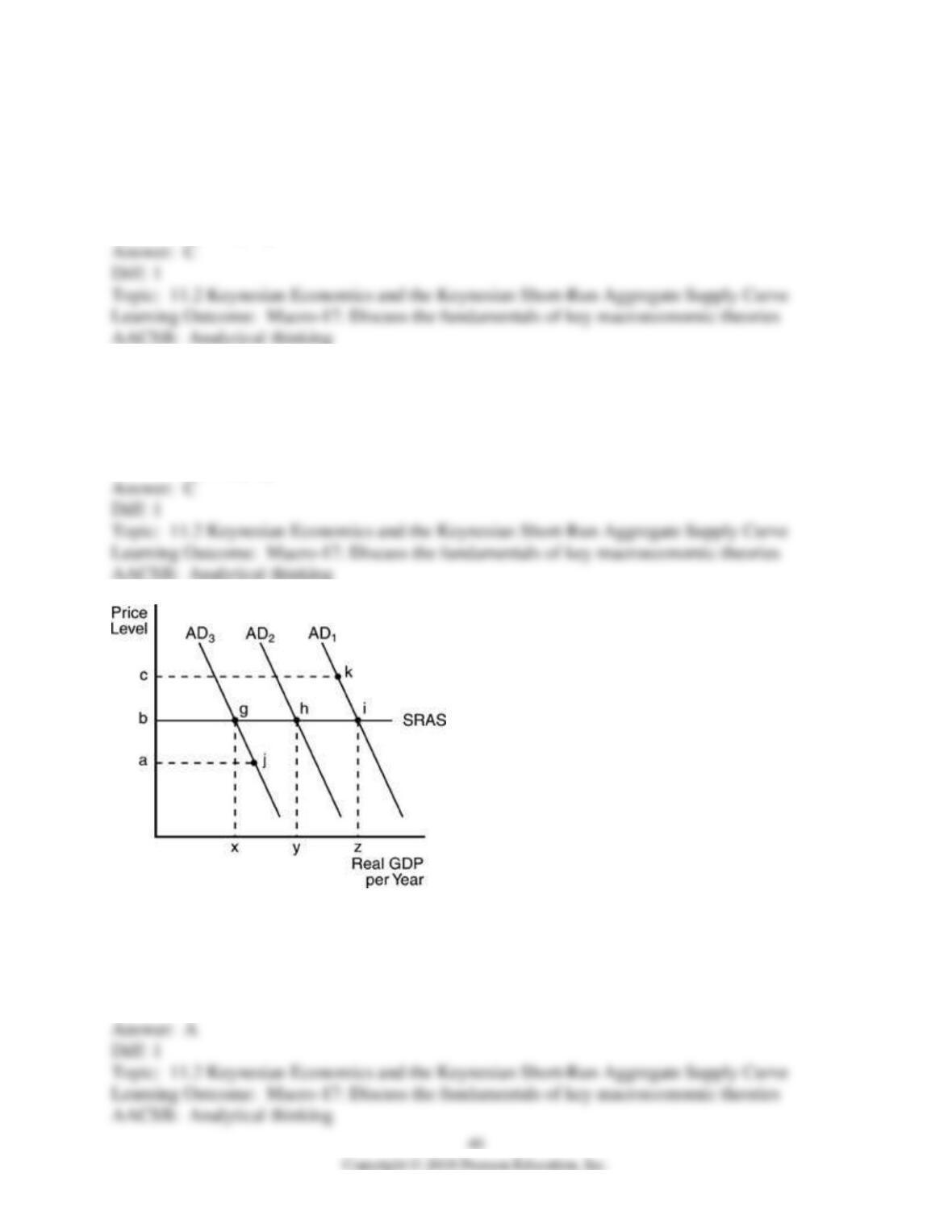
6) If a shift in aggregate demand only affects real Gross Domestic Product (GDP), then the short-
run aggregate supply (SRAS) curve must be
A) vertical.
B) upward sloping.
C) horizontal.
D) downward sloping.
7) The Keynesian short-run aggregate supply (SRAS) curve is
A) upward sloping.
B) vertical.
C) horizontal.
D) downward sloping.
8) The above figure presents the view of the economy according to
A) Keynesian economics.
B) classical economics.
C) microanalysis.
D) Ricardian economics.