Monopoly
Price Discrimination Under Monopoly
174. Discrepancies in profitability tempt rivals to charge the more profitable consumers somewhat lower prices in order to
lure them away from the firm that is “overcharging” them. This practice is referred to as
a.
collusion.
b.
price dealing.
c.
skimming.
d.
market penetration.
c
Moderate
DISC: Monopoly
United States – BPROG: Reflective Thinking – BPROG: Analysis
Monopoly
Price Discrimination Under Monopoly
175. Bargain airline fares in which airlines charge varying rates to passengers for the same flight and service is an
example of
a.
market penetration
b.
transaction pricing.
c.
collusion.
d.
price discrimination.
Moderate
DISC: Monopoly
United States – BPROG: Analytic
Monopoly
Price Discrimination Under Monopoly
176. Firms that engage in price discrimination
a.
will earn less profit than those that do not discriminate.
b.
will earn more profit than those that do not discriminate.
c.
are biased against certain buyers in the market.
d.
will always produce less output than firms that do not discriminate.
Moderate
DISC: Monopoly
United States – BPROG: Analytic
Monopoly
Price Discrimination Under Monopoly
177. A price-discriminating firm will always maximize profit by following the condition that
a.
MR > MC.
b.
MR > P.
c.
MRa = MRb = MC.
d.
MR = ATC.
c
Moderate
DISC: Monopoly
United States – BPROG: Analytic
Monopoly
Price Discrimination Under Monopoly
BLOOMS: Application
178. Price discrimination
a.
may lead to greater output.
b.
always leads to a reduction of output.
c.
leads to lower profits for the firm.
d.
causes firms to operate at a higher cost.
a
Moderate
DISC: Monopoly
United States – BPROG: Analytic
Monopoly
Price Discrimination Under Monopoly
179. The differences between a competitive market and a monopoly include all of these except:
a.
excess profits would be competed away in a competitive market, but persist in a monopolistic market
b.
a competitive market would work toward production of the quantity consumers seek, while a monopolistic
market may restrict output to raise short term prices
c.
a competitive market’s cost curves will shift with the market, while a monopoly’s cost curves will remain
stable
d.
a competitive market would work toward production of the quantity consumers seek, while a monopolistic
market may restrict output to raise long term prices
c
Moderate
DISC: Monopoly
United States – BPROG: Analytic
The Monopolist’s Supply Decision
180. An example of “cream skimming” is when:
a.
a firm charges the same price to all consumers, even though costs for some are higher
b.
a firm offers a reduced price to the best-paying customers of their competitors
c.
a firm offers a reduction in price on a package sale of two items
d.
none of these
Easy
DISC: Monopoly
United States – BPROG: Analytic
Monopoly
The Monopolist’s Supply Decision
Essay
181. Define the following terms and explain their importance to the study of economics.
a.
pure monopoly
b.
barriers to entry
c.
patent
d.
natural monopoly
e.
sunk costs
monopolies are regulated utilities.
investment serves to discourage entry into an industry and promotes monopoly.
Easy
DISC: Monopoly
United States – BPROG: Analytic
Monopoly Defined
182. Give a complete and concise definition of each of the following terms.
a.
deliberately erected entry barriers
b.
inefficiency of monopoly
c.
price discrimination
d.
profit-maximizing equilibrium for a monopolist
output is too little.
DISC: Monopoly
United States – BPROG: Analytic
Monopoly Defined
183. Describe the types of entry barriers which can exist and their importance to the study of monopoly.
various goods or services, or exclusive licenses for local utilities e.g., cable TV.
advertising to secure high customer loyalty.
failure increases when sunk costs increase.
and Microsoft in the software business at present.
become a monopoly.
1
Moderate
DISC: Monopoly
United States – BPROG: Analytic
Monopoly
Monopoly Defined
184. Economists object to monopolies on the grounds of efficiency. Why is this? Explain.
produced. This would maximize societal utility.
1
Easy
DISC: Monopoly
United States – BPROG: Analytic
Monopoly
Monopoly Defined
185. Assume that a firm has measured demand carefully and thinks that the following table accurately displays this. The
total cost has been measured and can be given as TC = 20 + Q + Q2 where Q is the level of output. Complete the table and
determine the profit-maximizing level of output.
Output
Total Revenue
Total Cost
Profit
1
$ 90
_____
_____
2
160
_____
_____
3
210
_____
_____
4
240
_____
_____
5
250
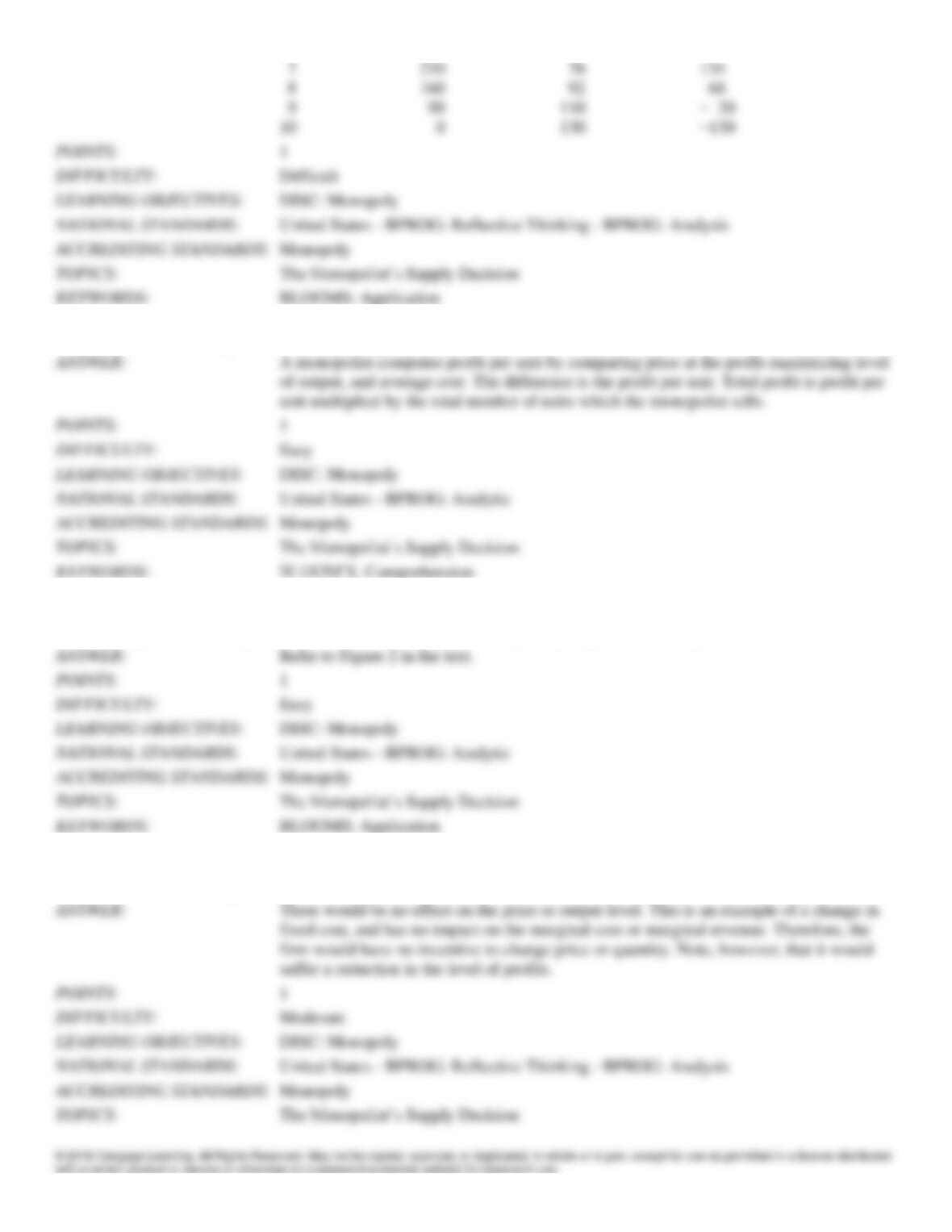
_____
_____
6
240
_____
_____
7
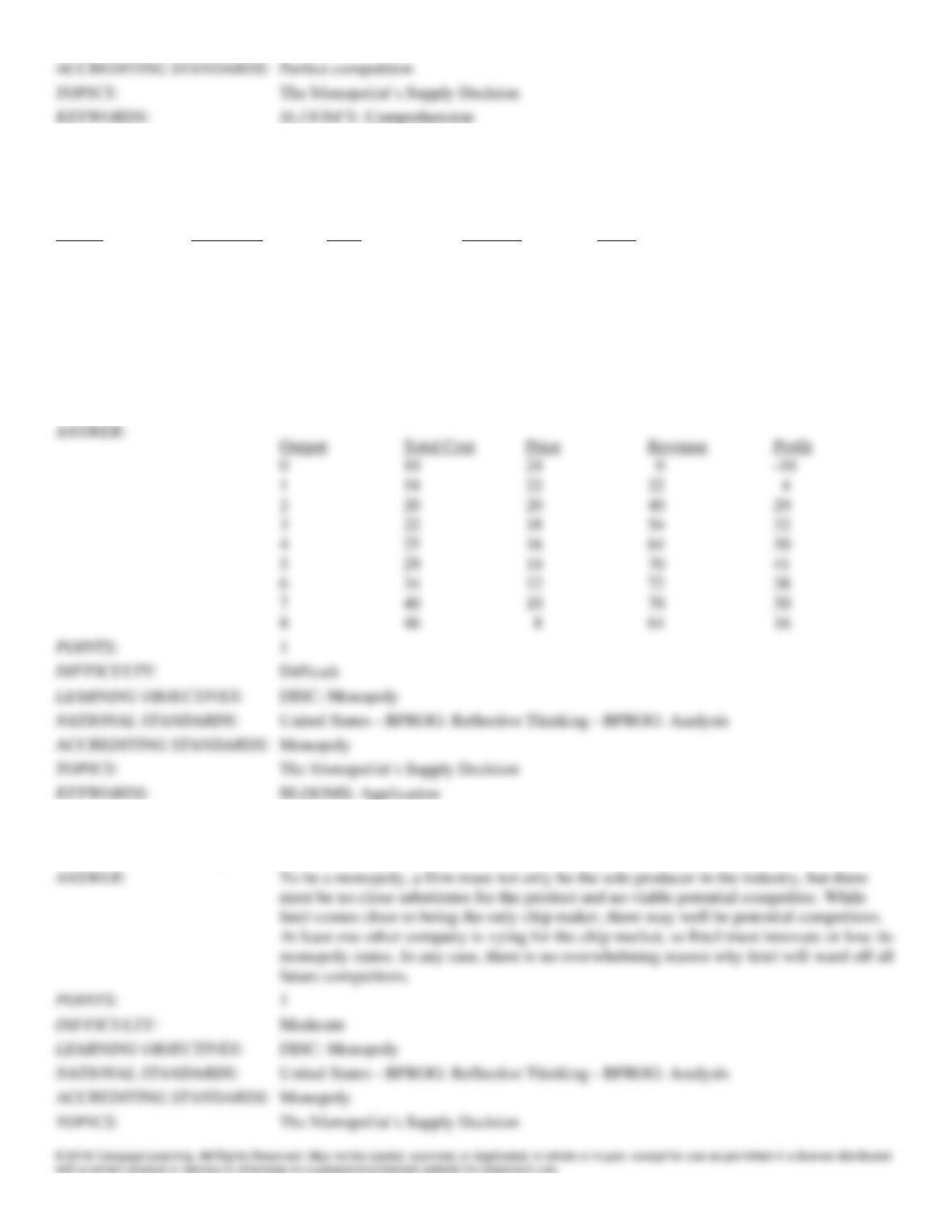
210
_____
_____
8
160
_____
_____
9
90
_____
_____
10
0
_____
_____
Output
Total Revenue
Total Cost
Profit
1
$ 90
$ 22
$ 68
2
160
26
134
3
210
32
178
4
240
40
200
5
250
50
200
6
240
62
178
186. How does the monopolist calculate profit per unit, and total profit?
187. Draw the demand, marginal revenue and marginal cost curve for a monopolist. Show the equilibrium price and
quantity supplied and total profit. Show the equilibrium price and quantity supplied and total profit.
188. If the government charged a tax on monopolists equal to, say, 75 percent of their economic profits, what would
happen to the level of output the firm would produce? What about the price? Explain.
189. Why is the demand curve for a monopolist downward sloping? How does this affect the monopolist’s behavior?
190. One of the conclusions of the model of monopoly is that the firm earns economic profits above the required
opportunity cost of the factors of production. Are these profits lost to society? Do they take spending power from the
economy, and act as a brake on economic growth?
191. In perfect competition, one result of the model was that there were no economic profits in the long run. In a
monopoly, the firm typically earns a positive economic profit. Why is there this difference?
Perfect competition
The Monopolist’s Supply Decision
192. The marketing division of a firm has measured demand for its product and reports that it is 2Q = 24 − P, where Q is
units and P is price per unit in dollars. The cost is given in the table below. Complete the table and determine the profit-
maximizing level of output for this firm.
Output
Total Cost
Price
Revenue
Profit
0
10
_____
_____
_____
1
18
_____
_____
_____
2
20
_____
_____
_____
3
22
_____
_____
_____
4
25
_____
_____
_____
5
29
_____
_____
_____
6
34
_____
_____
_____
7
40
_____
_____
_____
8
48
_____
_____
_____
Output
Total Cost
Price
Revenue
Profit
0
10
24
1
18
22
22
2
20
20
40
20
3
22
18
54
32
4
25
16
64
30
5
29
14
70
41
6
34
12
72
38
7
40
10
70
30
8
48
64
16
1
Difficult
DISC: Monopoly
United States – BPROG: Reflective Thinking – BPROG: Analysis
Monopoly
The Monopolist’s Supply Decision
BLOOMS: Application
193. “Intel Inside” accompanies virtually all IBM-compatible computers. Intel manufactures the Celeron and Pentium
chips that are a key component of personal computers. Does Intel have a monopoly?
1
Moderate
DISC: Monopoly
United States – BPROG: Reflective Thinking – BPROG: Analysis
Monopoly
The Monopolist’s Supply Decision
194. Provide two circumstances where monopoly may offer efficiency advantages over competition.
195. In perfect competition P = MR, but in monopoly P > MR. Why? Substantiate this statement with an example.
196. Explain the source of monopoly power for DeBeers’ Diamond Mine in South Africa, Microsoft (owned by Bill
Gates), the American Medical Association (which licenses doctors), Polaroid’s Instant Picture Cameras, USAir (which
owns virtually all the gates at the airport in Charlotte, North Carolina), and electric utilities.
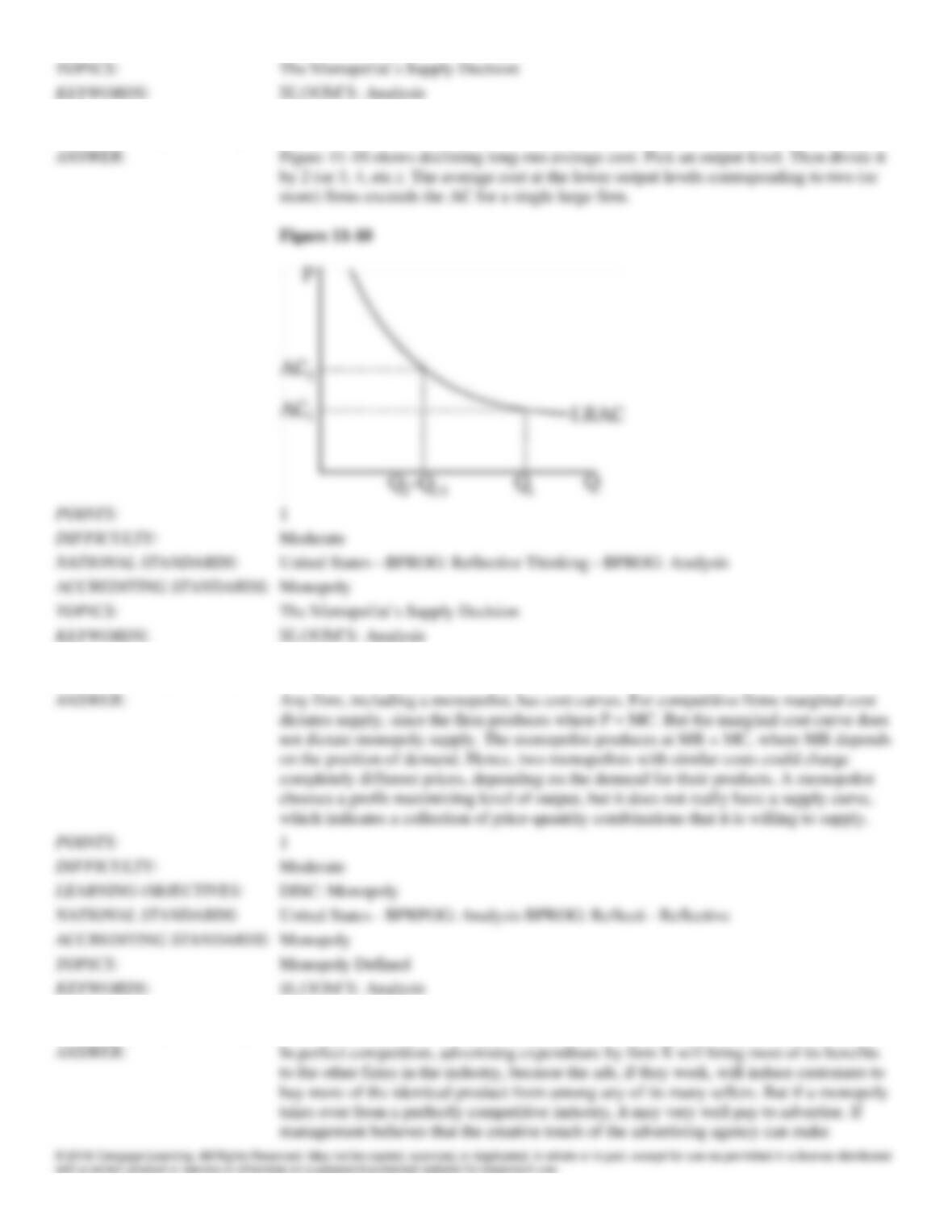
197. Graphically show why one electric company can operate more cheaply than two.
198. Explain why a monopolist does not have a supply curve.
199. Why does perfect competition shun advertising? Does advertising benefit a monopoly?
200. Why is the advent of monopoly likely to shift cost curves?
201. Explain why marginal revenue is less than price for a monopolist.
202. Suppose a monopolist can charge different prices to different customers, such as doctors charging different prices
depending on whether the patient is insured. How will profits and marginal revenue of such a price-discriminating
monopolist compare to profits and MR of an ordinary monopolist who must charge all patients the same fee?
203. What are the reasons for preferring competition to monopoly?
204. What are the reasons for preferring competition to monopoly?
205. Under what conditions might a monopoly be more efficient than a perfectly competitive firm?
206. Explain how each of the following industries practices price discrimination:
a.
movie theaters
b.
airlines
c.
auto dealers
d.
U.S. Postal Service
independent of the age of the audience.
whether it is traveling across town or across the country.
Moderate
DISC: Monopoly
United States – BPROG: Analytic
Monopoly
Price Discrimination under Monopoly
207. What arguments have been advanced in defense of price discrimination?
Moderate
DISC: Monopoly
United States – BPROG: Analytic
Monopoly
Price Discrimination under Monopoly
208. What is the equilibrium condition for price discriminating monopoly firm? Give some examples for price
discrimination.
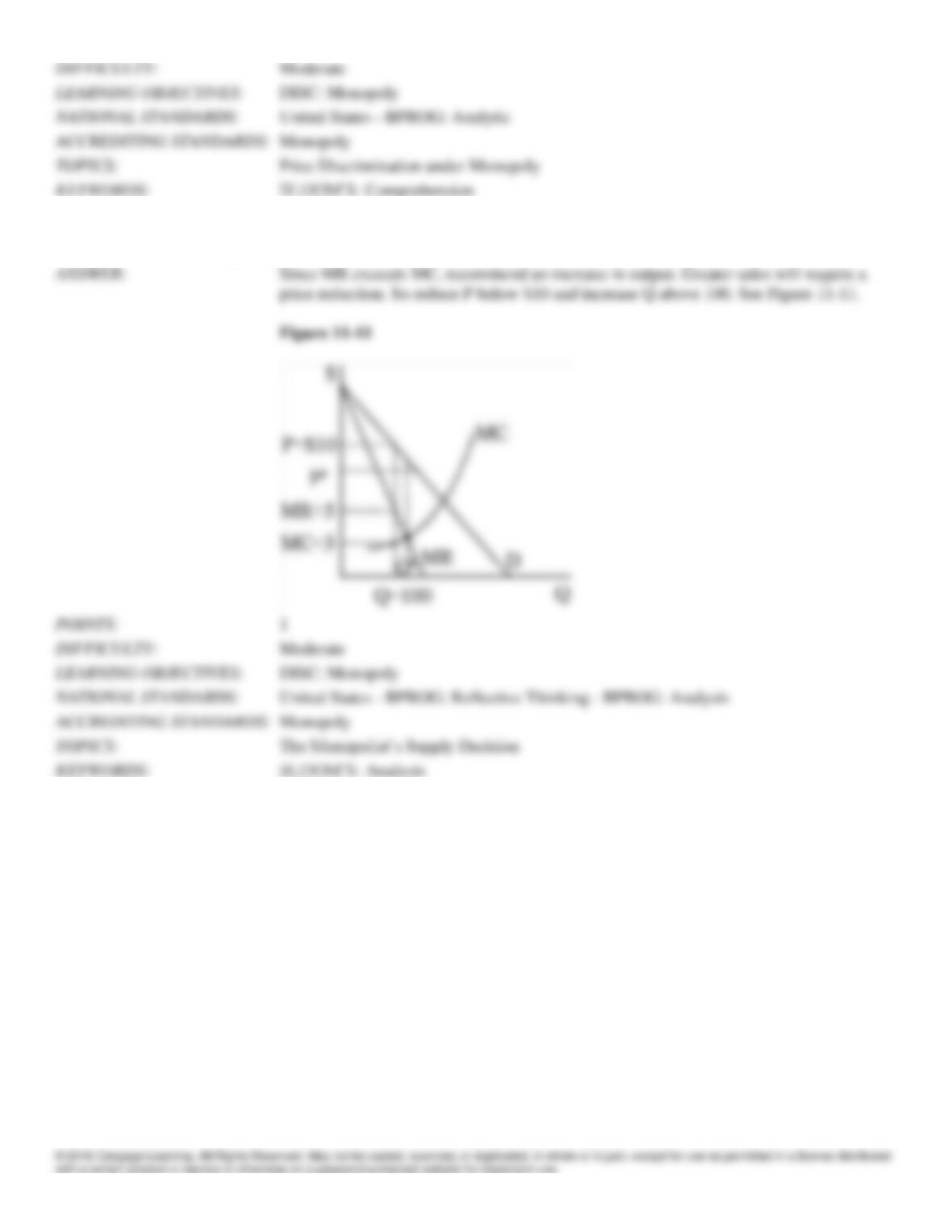
209. A monopolist sets price at $10 and sells 100 units. The corresponding marginal revenue is $5 and marginal cost $3.
What recommendation regarding price and quantity would you give this monopolist? Use a graph if you wish.