Chapter 11: Capital Budgeting and Risk
Year
0
1
2
3
45. The Bull Company, a lawn mower manufacturer, is considering the introduction of a new model. The initial
outlay required is $22 million. Net cash flows over the 4-year life cycle and the corresponding certainty-
equivalents of the new model are as follows:
Year
Net Cash Flow
Certainty-equivalent
1
$15 million
0.90
2
13 million
0.75
3
11 million
0.55
4
9 million
0.30
The firm’s cost of capital is 14% and the risk-free rate is 6%. Bull uses the certainty-equivalent approach in
evaluating above-average risk investments such as this one. What is the project’s certainty-equivalent NPV?
a. $20,083,000
b. $6,628,400
c. $13,905,000
d. $3,019,400
46. DKA uses the certainty equivalent approach to deal with total project risk and is considering a project with the
following:
Year
Expec. NCF
Certainty Equivalent Factor
0
–$60,000
1.0
1
20,000
0.95
2
20,000
0.90
3
25,000
0.80
4
30,000
0.65
What is the certainty equivalent NPV for this project if the risk-free rate is 8% and the required return on the
market portfolio is 15%?
a. $3,233
b. $17,743
c. –$15,243
d. $13,233
Chapter 11: Capital Budgeting and Risk
47. Determine the coefficient of variation for the following annual cash in flows from an investment project:
Cash Flow
($000)
Probability
$2,000
.10
2,500
.20
3,000
.30
3,500
.20
4,000
.20
a. $624.50
b. 125.8
c. 0.201
d. cannot be determined
Chapter 11: Capital Budgeting and Risk
48. Given the following cash flows and certainty equivalent factors for an investment project, determine the
certainty equivalent net present value. The firm’s cost of capital is 14% and the risk-free rate is 6%.
Cash
Certainty-Equivalent
Year
Flow
Factor
0
–$100,000
1.00
1
60,000
0.90
2
60,000
0.75
3
60,000
0.55
a. $32,000
b. $18,692
c. $4,238
d. cannot be determined
49. M-tel is financed entirely with equity and the firm’s stock has a beta of 0.85. M-tel is considering investing in a
project that is expected to have a beta of 1.3. The project requires an initial outlay of $6 million and is expected
to generate after-tax net cash flows of $1.3 million each year for 8 years. Calculate the NPV of the project.
Assume the risk-free rate is 7% and the expected market return is 14%. (Note: Problem requires either
calculator use or interpolation from the tables. The suggested solutions use calculator accuracy.)
a. $249,685
b. –$371,484
c. $238,700
d. –$352,800

Chapter 11: Capital Budgeting and Risk
50. MedChem has a capital structure of 60% equity and 40% debt and a current beta of 1.2. MedChem is
considering an investment project in a new line of business that has an expected internal rate of return of 16%.
The typical firm already in the line of business that MedChem is considering expanding into has a beta of 1.5
and a capital structure that has 55% debt and 45% equity. The marginal tax rate for all these firms, including
MedChem, is 40%. If the current risk-free rate is 7% and the expected market risk premium is 8%, should
MedChem expand into the new line? Assume that MedChem will retain its current capital structure.
a. expand if after-tax cost of debt is 11.5% or less
b. expand if after-tax cost of debt is 15% or less
c. expand if after-tax cost of debt is 10.4% or less
d. do not expand
51. American Biodyne (AB) is considering expanding into a new line of business. The expansion will require an
investment of $500,000 in new equipment. This equipment which will cost another $300,000 to install, will be
depreciated on a straight-line basis over an 8-year period to an estimated salvage value of zero. If the expansion
project is accepted, working capital will increase by $100,000 immediately. Revenues for the first 3 years are
forecasted at $650,000 per year and at $800,000 in years 4-8. Operating costs exclusive of depreciation are
expected to be $310,000 per year for 3 years and increase to $400,000 per year for the following 5 years. AB
has a marginal tax rate of 40% and its required rate of return for the project under consideration is 16%. If AB
assumes that the new equipment will have an actual market value of $50,000 at the end of the 8th year, should
the expansion be undertaken?
a. Yes, NPV = $275,114
b. Yes, NPV = $265,964
c. Yes, NPV = $302,934
d. Yes, NPV = $272,434

Chapter 11: Capital Budgeting and Risk
52. All of the following are correct statements about a project’s total risk EXCEPT:
a. Undiversified investors are concerned about the company’s future outlook.
b. It becomes the relevant risk when the project’s returns are correlated to the returns from the firm as a whole.
c. Total project risk can be measured by calculating standard deviation
d. Total project risk is irrelevant when forecasting a company’s chance of bankruptcy.
53. Many firms combine net present value and payback when analyzing project risk. Which of the following
statements is/are correct?
I. Both payback and net present value consider the frequency of cash flows.
II. Both payback and net present can be adjusted for risk.
a. Only statement I is correct
b. Only statement II is correct
c. Both statements I and II are correct
d. Neither statement I nor II is correct
54. The certainty equivalent approach is a risk evaluation technique. Which of the following statements is/are
correct?
I. Certainty equivalents adjust the cash flows in the numerator of the NPV equation.
II. Using the RADR involves adjustments to the denominator of the NPV equation.
a. Only statement I is correct
b. Only statement II is correct
c. Both statements I and II are correct
d. Neither statement I nor II is correct
Chapter 11: Capital Budgeting and Risk
55. Rolling in Dough Cookie Corporation is trying to determine its certainty equivalent NPV. What is the CNPV if
the risk free rate is 2% and the initial investment is $19,000 (rounded)?
Year
Cash Flows
Certainty
1
$15,000
90%
2
$15,000
60%
3
a. $2,575.25
$8,000
50%
b. $6,655.10
c. $5,261.38
d. $4,215.15
56. Which of the following statements is correct about adjusting for beta risk in capital budgeting?
a. It measures unsystematic risk.
b. It is a guaranteed measure of the success of the project.
c. The beta concept can be used to determine RADR.
d. It evaluates the efficiency of the management team.
57. Portfolio risk is also known as:
a. total project risk
b. beta risk
c. market risk
d. scenario risk

Chapter 11: Capital Budgeting and Risk
58. All of the following techniques are used to measure total project risk EXCEPT:
a. simulation analysis
b. profitability index
c. certainty equivalent approach
d. risk adjusted discount rate
59. A weakness of the net present value/payback method is:
a. It is a complicated calculation
b. It is subjective
c. It is directly related to the variability of returns from a project
d. Because it recognizes the riskiness of various projects, it can develop multiple outcomes.
60. The type of analysis that models some event and requires that estimates be made of the probability distribution
of each cash flow element is:
a. scenario
b. sensitivity
c. simulation
d. net present value/payback approach
61. What item has made sensitivity analysis simple and inexpensive?
a. computer accounting software
b. computer spreadsheet software
c. computer webinars
d. computer video and presentation software
62. All of the following are methods of adjusting a project for total risk EXCEPT:
a. sensitivity analysis
b. carpe diem approach
c. certainty equivalent approach
d. simulation analysis

Chapter 11: Capital Budgeting and Risk
63. The risk of an investment project is defined in terms of the potential of its returns.
a. certainty
b. size
c. variability
d. timing
64. are needed for sensitivity analysis and have made the application simple and inexpensive.
a. risk tolerance tables
b. financial statements
c. financial calculators
d. computer spreadsheets
65. Determine the pure project beta of a project that has 45% debt and 55% equity. The beta for the company is 1.6
and a tax rate of 40%.
a. 1.82
b. 1.82
c. 1.07
d. 2.07
66. Determine the pure project beta of a project that has 30% debt and 70% equity. The beta for the company is 1.4
and a tax rate of 40%.
a. 1.11
b. 1.56
c. 1.83
d. 1.05

Chapter 11: Capital Budgeting and Risk
67. Smart Bumpkins wants to increase production by adding new equipment. The cost of the upgrade is $190,000
and expected cash flows from the new upgrade are expected to be as follows over the next 6 years and the risk
free rate is 5%. Should the company upgrade?
Cash Flows
Certainty Equivalents
$45,000
.85
$45,000
.80
$75,000
.75
$110,000
.70
$110,000
.60
$110,000
.50
a. Yes, the CNPV is $195,196.06
b. Yes, the CNPV is $83,775.16
c. No, the CNPV is –$75,522.84
d. No, the CNPV is –$42,175.93

Chapter 11: Capital Budgeting and Risk
68. Haulin’ It Towing Company is considering adding more tow trucks to its fleet. The cost of the new trucks is
$150,000. The project will utilize the risk adjusted discount, the firm has a beta of 1.3, the risk free rate is 7%
and the return in the market is 15%. Should Haulin’ It add the additional trucks if the expected increased
revenues will be as follows?
Years
Cash Flows
1
$80,000
2
$95,000
3
$110,000
a. No, the NPV of the project is –$15,175.19
b. Yes, the NPV of the project is $75,275.16
c. No, the NPV of the project is –$9,765.12
d. Yes, the NPV of the project is $55,050.92
69. The hurdle rate is best described as:
a. the required rate of return.
b. the risk adjusted discount rate.
c. the net present value.
d. the risk free rate.
70. The hurdle rate approach in determining the acceptability of projects:
a. is an improvement over the risk-adjusted discount rate approach because it provides for an objective basis to
determine risk premiums for individual projects.
b. is a modification of the internal rate of return approach.
c. is inconsistent with the principle of project risk balancing.
d. is a method used with the certainty equivalent approach.
Chapter 11: Capital Budgeting and Risk
71. When is the risk-adjusted discount rate approach considered preferable to the weighted cost of capital approach
in determining the net present value of a project?
a. It is preferable when the projects under consideration differ significantly in the number of cash flows
generated by the projects.
b. It is preferable when the projects under consideration differ significantly in their total return.
c. It is preferable when the projects under consideration differ significantly in their cash inflows.
d. It is preferable when the projects under consideration differ significantly in their risk characteristics.
72. Which of the following is/are a risk associated with projects that must be considered when determining the net
present value?
I. Financial risk
II. Pure project risk
a. Only statement I is correct
b. Only statement II is correct
c. Both statements I and II are correct
d. Neither statement I nor II is correct
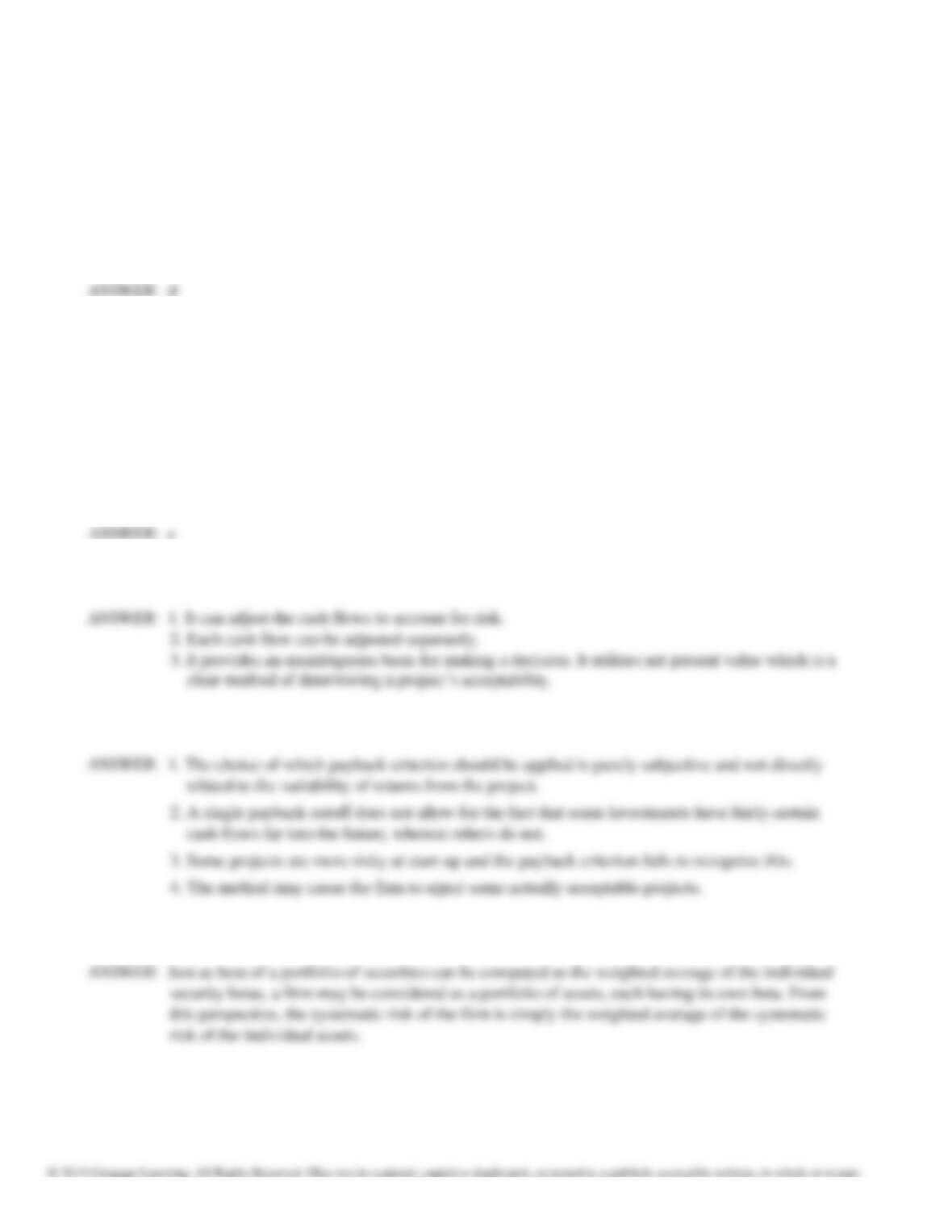
73. What is the reason companies utilize the certainty equivalent approach in evaluating projects?
74. What are the weaknesses of the net present value/payback approach?
75. How can beta, a measure of systematic risk of a portfolio of securities, be used to judge the risk of a firm?
Chapter 11: Capital Budgeting and Risk
76. How and when should firms consider employing additional risk analysis techniques in judging the suitability of
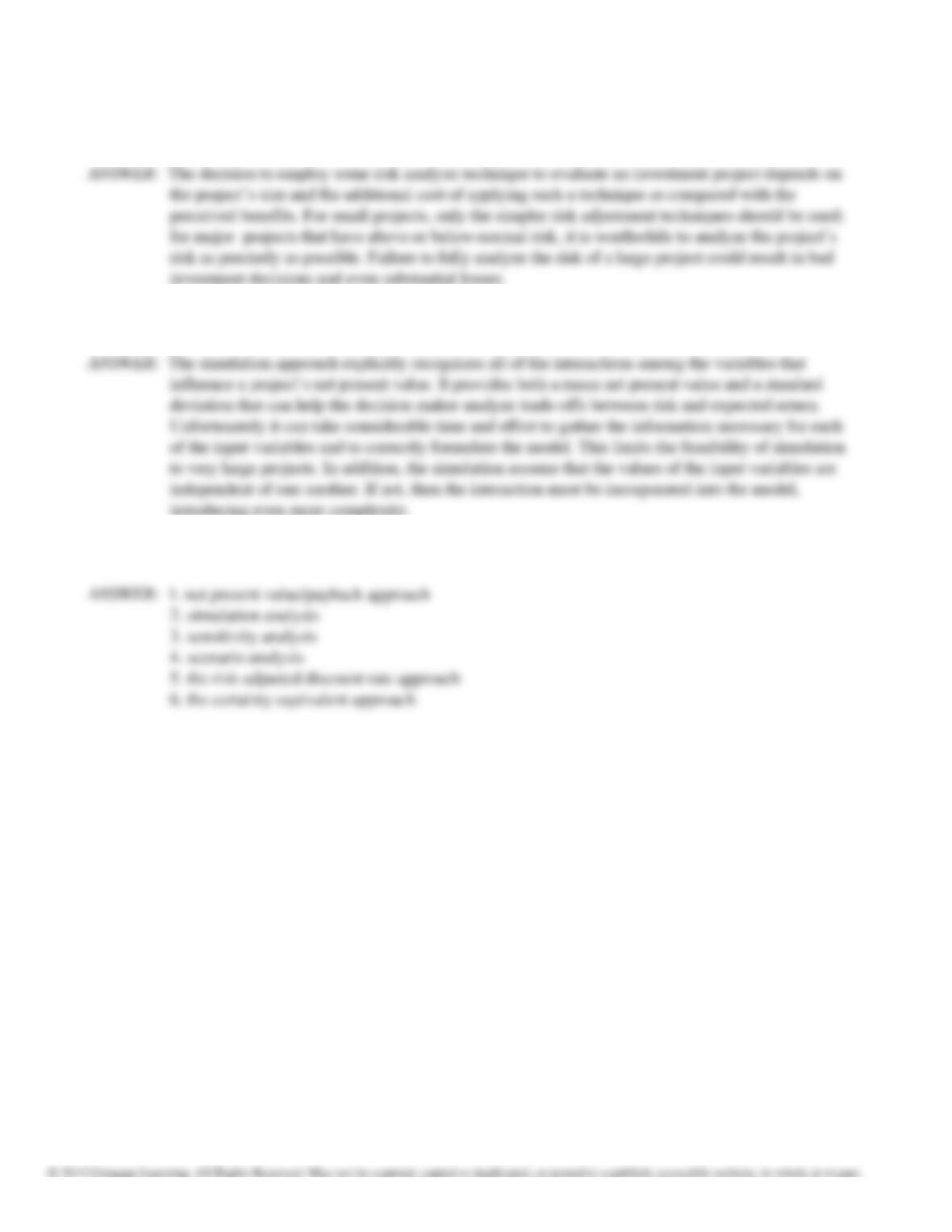
large projects prior to implementation?
77. What are the primary advantages and disadvantages of applying simulation to capital budgeting risk analysis?
78. List the ways that a company’s decision maker can adjust for total project risk in capital budgeting.