68) In the above figure, at point d firms would find themselves with inventories ________ their
target level and so they would ________ production.
A) increasing above; increase
B) increasing above; decrease
C) decreasing below; increase
D) decreasing below; decrease
69) The equilibrium in the above figure is shown at point
A) a.
B) b.
C) c.
D) d.
70) In the above figure, autonomous expenditure is equal to
A) $0.
B) $12 trillion.
C) $14 trillion.
D) $16 trillion.
71) In the above figure, induced expenditure is equal to $2 trillion at point
A) a.
B) b.
C) c.
D) d.
72) In the above figure, the MPC equals
A) 0.10.
B) 0.17.
C) 0.25.
D) 0.50.
73) In the above figure, point b represents the point where planned expenditures are ________
real GDP.
A) less than
B) equal to
C) greater than
D) There is not enough information to answer the question.
74) In the above figure, equilibrium real GDP is equal to
A) $12 trillion.
B) $14 trillion.
C) $16 trillion.
D) $18 trillion.
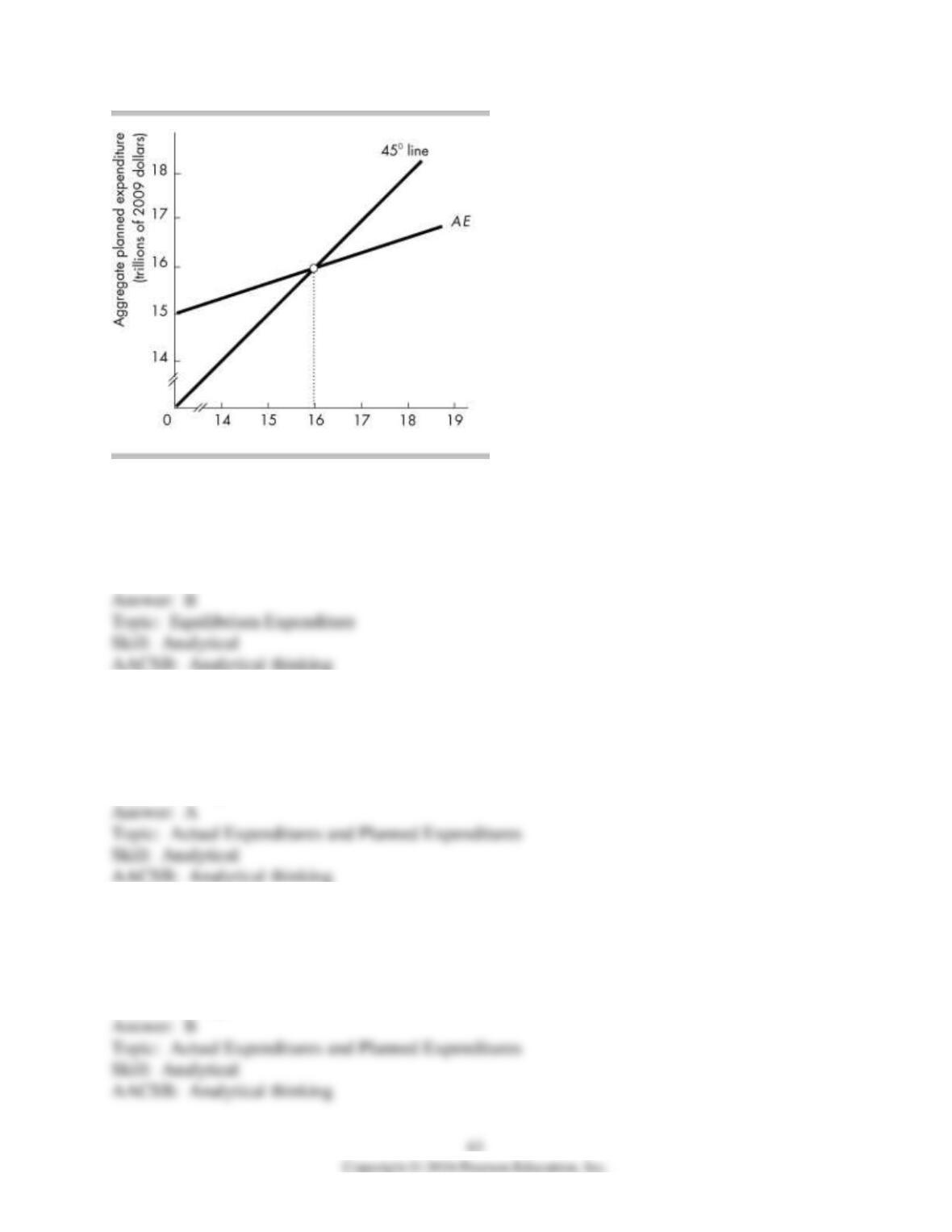
75) In the above figure, equilibrium expenditure is
A) less than $16 trillion.
B) $16 trillion.
C) more than $16 trillion.
D) some amount that cannot be determined without more information.
76) In the above figure, if the level of real GDP is $17 trillion
A) inventories are above the levels planned by firms.
B) inventories are below the levels planned by firms.
C) inventories are equal to the levels planned by firms.
D) planned expenditures are zero.
77) In the above figure, if the level of real GDP is $15 trillion
A) inventories are above the levels planned by firms.
B) inventories are below the levels planned by firms.
C) inventories are equal to the levels planned by firms.
D) planned expenditures are zero.
78) If aggregate planned expenditure is less than real GDP, then in the short run
A) aggregate planned expenditure will increase.
B) exports change to restore equilibrium.
C) the price level will fall.
D) real GDP will decrease.
1) When autonomous expenditure decreases, ________.
A) the AE curve shifts downward
B) there is a movement down along the AE curve
C) the AE curve becomes less steep
D) the AE curve shifts upward
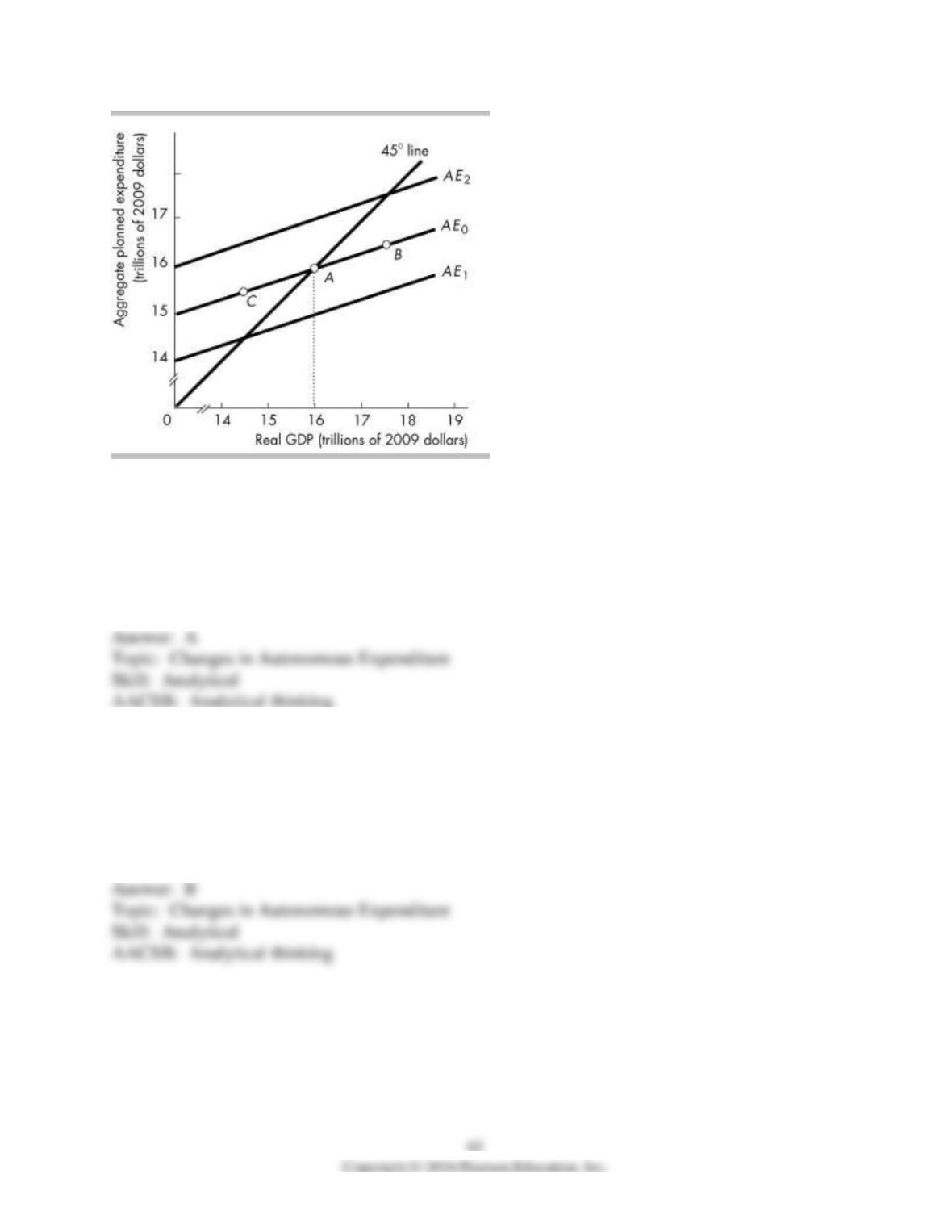
2) In the above figure the economy is initially at point A on the aggregate expenditure curve AE0.
Suppose firms expect profits to increase and decide to increase investment. As a result
A) the AE curve shifts upward to a curve such as AE2.
B) the AE curve shifts downward to a curve such as AE1.
C) there is a movement along AE1 to a point such as B.
D) there is a movement along AE1 to a point such as C.
3) In the above figure the economy is initially at point A on the aggregate expenditure curve AE0.
Suppose investment decreases. As a result
A) the AE curve shifts upward to a curve such as AE2.
B) the AE curve shifts downward to a curve such as AE1.
C) there is a movement along AE1 to a point such as B.
D) there is a movement along AE1 to a point such as C.
4) If prices are fixed, an increase in aggregate expenditures results in an increase in equilibrium
GDP that
A) is greater than the change in aggregate expenditure.
B) is equal to the change in aggregate expenditure.
C) is less than the change in aggregate expenditure.
D) has no necessary relationship to the size of the change in aggregate expenditure.
5) The multiplier effect on real GDP occurs because
A) changes in price levels affect our willingness to invest, consume, import and export.
B) an autonomous change in expenditure causes an induced change in consumption expenditure.
C) of government stabilization policies.
D) of income taxes.
6) The multiplier effect exists because a change in autonomous expenditure
A) leaves the economy in the form of imports.
B) leads to changes in income, which generate further spending.
C) prompts further exports.
D) will undergo its complete effect in one round.
7) The multiplier effect
A) generates instability in autonomous expenditure.
B) promotes stability of the general price level.
C) magnifies small changes in spending into larger changes in real GDP.
D) increases the MPC.
8) When autonomous expenditure increases, equilibrium aggregate expenditure
A) decreases by an equal amount to offset the unplanned portion.
B) increases by an equal amount.
C) decreases by a greater amount due to the multiplier.
D) increases by a greater amount due to the multiplier.
9) In the short run with fixed prices, an increase in investment of $100 billion
A) increases real GDP by $100 billion.
B) increases real GDP by less than $100 billion.
C) increases real GDP by more than $100 billion.
D) decreases real GDP by $100 billion because of the decrease in induced expenditures.
10) The multiplier is the amount by which ________ is multiplied to determine ________.
A) autonomous expenditure; real GDP
B) induced expenditure; real GDP
C) a change in autonomous expenditure; the change in equilibrium expenditure
D) a change in induced expenditure; the change in equilibrium expenditure
11) The multiplier is the ratio of the
A) change in real GDP to the change in autonomous expenditures.
B) equilibrium level of real GDP to the change in induced expenditures.
C) change in induced expenditures to the change in autonomous expenditures.
D) change in autonomous expenditures to the change in real GDP.
12) When prices are fixed and there are no imports or income taxes, the value of the multiplier is
A) less than one.
B) greater than one.
C) equal to one.
D) equal to zero.
13) The multiplier shows that as ________ changes, real GDP changes by a ________ amount.
A) induced expenditure; larger
B) induced expenditure; smaller
C) autonomous expenditure; larger
D) autonomous expenditure; smaller
14) Because of the multiplier, a one-time change in expenditure will
A) have little secondary effect on real GDP.
B) expand real GDP by an infinite amount.
C) generate more additional real GDP than the initial change in expenditure.
D) decrease saving and investment activity and thereby decrease future real GDP.
15) The multiplier is greater than 1 because
A) most households are unable to save.
B) household spending exceeds income.
C) one person’s spending becomes another’s income.
D) corporate spending exceeds corporate income.
16) The multiplier is greater than 1 because the change in autonomous expenditure leads to
________.
A) more investment
B) more saving
C) less consumption expenditure
D) more induced expenditure
17) If a $75 billion increase in autonomous expenditure increases equilibrium expenditure by
$150 billion, then the multiplier must be ________.
A) $225 billion
B) 0.5
C) $75 billion
D) 2
18) If investment increases by $300 and, in response, equilibrium aggregate expenditure
increases by $600, then the multiplier must be
A) 0.2.
B) 0.5.
C) 2.
D) 5.
19) If the multiplier is 6 and exports decrease by $30, what impact will that have on aggregate
expenditure? Aggregate expenditure will
A) increase by $30.
B) increase by $180.
C) decrease by $30.
D) decrease by $180.
20) The multiplier is larger if the
A) marginal propensity to consume is larger.
B) marginal propensity to save is larger.
C) income tax rate is higher.
D) marginal propensity to import is larger.
21) If the MPC increases from 0.75 to 0.80 and there are no income taxes or imports
A) the multiplier becomes larger.
B) the multiplier becomes smaller.
C) the slope of the consumption function becomes smaller.
D) the slope of the savings function becomes larger.
22) An increase in the size of the multiplier can be caused by
A) an increase in the MPS.
B) an increase in the MPC.
C) a decrease in induced expenditures.
D) an increase in the marginal propensity to import.
23) The relationship between the multiplier and the MPC is
A) that as the MPC increases, so does the value of the multiplier.
B) that as the MPC increases, the value of the multiplier decreases.
C) unrelated because the multiplier relates to the MPS, not the MPC.
D) converging at higher incomes.
24) Which of the following makes the multiplier larger?
A) an increase in the marginal propensity to import
B) an increase in the tax rate
C) an increase in the marginal propensity to consume
D) an increase in the marginal propensity to save
25) An increase in the value of the multiplier can be caused by
A) a decrease in the marginal propensity to consume.
B) an increase in the marginal propensity to import.
C) an increase in autonomous consumption expenditure.
D) an increase in the marginal propensity to consume.
26) In an economy with no income taxes or imports, the multiplier equals
A) 1/MPC.
B) 1/MPS.
C) 1/(1 – MPS).
D) 1/(MPC + MPS).
27) The larger the slope of the AE curve, the
A) larger the value of the multiplier.
B) smaller the value of the multiplier.
C) less likely that the multiplier will be affected.
D) more likely that the multiplier will be inconsequential.
28) If the slope of the AE curve increases, the multiplier
A) decreases.
B) increases.
C) stays the same.
D) can either increase or decrease depending on what happens to the MPC.
29) The expenditure multiplier equals
A) APC – APS where APC is the average propensity to consume and APS is the average
propensity to save.
B) 1/(1 – slope of AE curve).
C) MPC – MPS where MPC is the marginal propensity to consume and MPS is the marginal
propensity to consume.
D) 1/(slope of AE curve).
30) If there are no income taxes or imports, the multiplier equals
A) 1/(1 – marginal propensity to consume).
B) 1/(1 – marginal propensity to save).
C) 1/(1 – marginal propensity to import).
D) 1/(1 – marginal propensity to invest).
31) If there are no taxes or imports and MPC = 0.67, the multiplier is
A) 1.5.
B) 3.
C) 6.
D) 0.33.
32) If there are no taxes or imports and MPC = 0.75, the multiplier equals
A) 0.25.
B) 1.33.
C) 4.0.
D) 6.0.
33) If there are no taxes or imports and MPC = 0.5, the multiplier equals
A) 0.5.
B) 5.0.
C) 6.0.
D) 2.0.
34) Assume there are no taxes or imports. The government estimates that between 2012 and
2013 disposable income decreased by $400 billion and consumption expenditure decreased by
$280 billion. Based on these data, the multiplier equals
A) 0.33.
B) 0.7.
C) 1.42.
D) 3.33.
35) If the marginal propensity to consume is 0.8 and there no income taxes or imports, the
multiplier for a change in autonomous expenditure equals
A) 0.8.
B) 1.0
C) 4.0.
D) 5.0.
36) If the MPC is .9 and there are no income taxes or imports, the multiplier for a change in
autonomous expenditure equals
A) 0.1.
B) 9.0.
C) 10.0.
D) 100.0.
37) If the multiplier for a change in autonomous expenditure is 10 and there are no income taxes
or imports, then the MPC is
A) 0.9.
B) 0.1.
C) 1.0.
D) 9.0.
38) If the multiplier is 4 and there are no imports or income taxes, the marginal propensity to
consume is
A) 0.25.
B) 0.50.
C) 0.75.
D) 1.00.
39) If the multiplier is 3.33 and there are no imports or income taxes, then the
A) MPC is 0.7.
B) MPS is 0.3.
C) Both of the above answers are correct.
D) None of the above answers are correct.
40) If the slope of the AE curve is 0.60, the value of the multiplier is
A) 2.5.
B) 0.4.
C) 1.67.
D) 4.0.
41) If the slope of the AE curve is 0.80, the value of the multiplier is
A) 5.
B) 1.25.
C) 2.
D) indeterminate from the information given.
42) Suppose that last year the slope of the AE curve is 0.67 and this year the slope of the AE
curve changes to 0.8. Which of the following best describes what happens to the multiplier?
A) It rises from 3 to 5.
B) It falls from 5 to 3.
C) It rises from 1.25 to 1.49.
D) It falls from 1.49 to 1.25.
43) If the marginal propensity to save is 0.25 in an economy with no imports or taxes, the
multiplier equals
A) 0.25.
B) 0.75.
C) 4.
D) 1.33.
44) In general, the steeper the aggregate expenditure curve, the
A) greater autonomous expenditure.
B) lower the marginal propensity to consume.
C) larger the multiplier.
D) smaller the multiplier.
45) In general, the flatter the aggregate expenditure curve, the
A) greater the autonomous expenditure.
B) larger the marginal propensity to consume.
C) larger the multiplier.
D) smaller the multiplier.
46) The smaller the slope of the AE curve, ________.
A) the greater is the value of the multiplier
B) the smaller is slope of the saving function
C) the steeper is the consumption function
D) the smaller is the value of the multiplier
47) The slope of the aggregate expenditure curve increases when the marginal propensity to
consume ________ or the marginal propensity to import ________.
A) increases; decreases
B) decreases; increases
C) decreases; decreases
D) increases; increases
48) A change in which of the following changes the slope of the aggregate expenditure curve?
A) an increase in autonomous government expenditures
B) an increase in the marginal propensity to consume
C) a decrease in autonomous consumption expenditures
D) All of the above answers are correct because they all change the slope of the aggregate
expenditure curve.
49) Given an MPC of 0.80, if there are no income taxes or imports and prices are constant, then
when investment increases by $50 million and prices are fixed, equilibrium GDP would
A) increase by $50 million.
B) increase by $250 million.
C) increase by $400 million.
D) To answer the question more information on income is needed.
50) In a simple economy in which prices are constant and there are no income taxes or imports,
the marginal propensity to save is 0.2. If exports increase $50, what impact will that have on
aggregate expenditure?
A) increase by $250
B) increase by $100
C) decrease by $250
D) decrease by $100
51) Between 2012 and 2013 the government reports that investment decreased by $400 billion.
The government also estimates that the marginal propensity to save is 0.20. If the entire decrease
in investment is autonomous, then real GDP
A) decreases by $2000 billion.
B) increases by $2000 billion.
C) decreases by $80 billion.
D) decreases by $320 billion
52) Suppose that the slope of the AE curve is 0.80. Then an increase of investment of $10 billion
leads to an increase in equilibrium real GDP equal to
A) $8.0 billion.
B) $10.0 billion.
C) $12.5 billion.
D) $50.0 billion.
53) The slope of the AE curve is 0.9. Investment decreases by $100 million and the price level is
constant. Real GDP
A) decreases by $10 million.
B) increases by $90 million.
C) decreases by $1 billion.
D) increases by $1 billion.
54) If the price level is constant and the slope of the AE curve is 0.75, a decrease in government
expenditures of $100 leads to a decrease in real GDP of
A) $25.
B) $100.
C) $400.
D) $800.
55) An economy has no imports and no taxes. The marginal propensity to save is 0.2. The
multiplier is ________ so a ________ increase in autonomous expenditure increases equilibrium
expenditure by $60 billion.
A) 1.25; $48 billion
B) 5; $12 billion
C) 10; $6 billion
D) None of the above answers are correct.
56) In a simple economy with no income taxes or imports, prices are constant and the slope of
the AE curve is 0.8. In order to increase real GDP by $500 billion, then
A) consumption expenditure needs to increase by $500 billion.
B) saving needs to be reduced by $500 billion
C) investment needs to increase by $200 billion.
D) investment needs to increase by $100 billion
57) Suppose that the slope of the AE curve is 0.75. Then a $100 increase in autonomous
spending means equilibrium expenditure will
A) decrease by $400.
B) increase by $400.
C) decrease by $750.
D) increase by $750.
58) Suppose that the slope of the AE curve is 0.75. Then a $100 decrease in autonomous
spending means equilibrium expenditure will
A) decrease by $400.
B) increase by $400.
C) decrease by $750.
D) increase by $750.
59) Suppose that the slope of the AE curve is 0.67. Then a $100 decrease in autonomous
spending means equilibrium expenditure will
A) decrease by $200.
B) increase by $200.
C) decrease by $300.
D) increase by $300.
60) Suppose that the slope of the AE curve is 0.67. Then a $100 increase in autonomous
spending means equilibrium expenditure will
A) decrease by $200.
B) increase by $200.
C) decrease by $300.
D) increase by $300.
61) Suppose that the slope of the AE curve is 0.80. If prices remain constant and government
expenditure increases by $10 billion, what will be the value of the change in real GDP?
A) $8 billion
B) $2 billion
C) $10 billion
D) $50 billion
62) The government estimates that the fiscal policy multiplier is 2.0. If this estimate is accurate,
then the slope of the AE curve is ________.
A) 0.20
B) 0.80
C) 2.00
D) 0.50
63) The government estimates that the fiscal policy multiplier is 2.0. In this case an increase in
government expenditure of $500 billion increases real GDP by ________ and results in an
increase in induced expenditure of ________.
A) $500 billion; $0
B) $500 billion; $500 billion
C) $1,000 billion; $1,000 billion
D) $1,000 billion; $500 billion