
Macroeconomics 2017 (Hubbard)
Chapter 11 Long-Run Economic Growth: Sources and Policies
11.1 Economic Growth over Time and around the World
1) One of the primary reasons that Mexico has experienced relatively low rates of economic growth is
that for Mexican entrepreneurs,
A) there is a shortage of low-skilled labor to fill manufacturing jobs.
B) the government has a history of nationalizing all successful domestically-owned industries.
C) problems in the banking system have made it difficult to obtain the funding needed to finance
expansion.
D) incentives from its neighboring Central American countries has attracted most of the foreign
investment in the region.
2) The rapid growth of the Chinese economy should
A) benefit U.S. consumers as they have access to less-expensive consumer goods.
B) make it more difficult for citizens of the United States to find jobs.
C) not affect the mix of jobs available to citizens of the United States.
D) A and B
3) The Industrial Revolution began in
A) England around 1750.
B) the United States around 1820.
C) France around 1680.
D) Germany around 1780.

4) Suppose that in 2016, real GDP grew in Estonia by 3% and the population increased by 5%. Therefore,
in 2016, Estonia experienced
A) economic growth, but not an increase in living standards.
B) economic growth and an increase in living standards.
C) no economic growth, but an increase in living standards.
D) no economic growth and no increase in living standards.
5) The period of time from 1,000,000 B.C. to 1300 A.D. was a period of
A) no sustained economic growth.
B) slow and steady economic growth.
C) moderate economic growth.
D) rapid and sustained economic growth.
6) Significant economic growth did not begin in the world until
A) 1000 A.D.
B) 1750 A.D.
C) 1820 A.D.
D) the 20th century A.D.
7) According to Douglass North, the Industrial Revolution occurred in England because
A) the British Parliament took control of the government and could credibly commit to upholding
property rights.
B) the British monarchy took control of the government and pledged not to raise taxes arbitrarily.
C) the British courts became tied to the king and began to refuse to enforce property rights.
D) the British Parliament instituted a command economy structure and implemented a planned
economy.

8) Growth in real GDP per capita for the world economy was greatest during
A) the seventeenth century.
B) the eighteenth century.
C) the nineteenth century.
D) the twentieth century.
9) If real GDP in the United States is growing at an annual rate of 3.2% per capita and Bolivia’s real GDP
per capita is growing at a rate of 1.3%, which of the following would we expect in the long run? Assume
real GDP per capita in the United States begins at a level above that of real GDP per capita in Bolivia.
A) Real GDP per capita in the United States will always be 1.9% higher than real GDP per capita in
Bolivia.
B) The difference between the level of real GDP per capita in the United States and real GDP per capita
in Bolivia will shrink over time.
C) The difference between the level of real GDP per capita in the United States and real GDP per capita
in Bolivia will increase over time.
D) The difference between the level of real GDP per capita in the United States and real GDP per capita
in Bolivia will always be $1.9 trillion.
10) If real GDP per capita in the United States is $8,000, what will real GDP per capita in the United
States be after 5 years if real GDP per capita grows at an annual rate of 3.2%?
A) $8,520
B) $9,280
C) $9,365
D) $10,560

11) If real GDP per capita in Ireland is estimated to be $7,400 in 2016, what will real GDP per capita be
in 2021 if real GDP per capita grows at an annual rate of 2.8%?
A) $7,607
B) $8,496
C) $9,472
D) $20,720
12) If real GDP per capita in the United States is $8,000 in 2016, and if real GDP per capita is $12,000 in
2026, what is the average annual percent change in the growth rate of GDP per capita between 2016 and
2026?
A) 3.33%
B) 5%
C) 33%
D) 50%
13) If real GDP per capita in the United States is $8,000 in 2016, and if real GDP per capita is $12,000 in
2026, what is the total percent change in the growth rate of GDP per capita between 2016 and 2026?
A) 3.33%
B) 5%
C) 33%
D) 50%

14) Increasing the growth rate of GDP per capita and sustaining this growth rate in an economy can
A) increase infant mortality.
B) increase standards of living.
C) increase the level of poverty.
D) lower life expectancy.
15) Over the past 50 years, deaths among children have
A) declined in most high-income countries and have risen in most low-income countries.
B) declined in nearly all countries, including most low-income countries.
C) remained relatively unchanged in most high-income countries and have declined in most low-
income countries.
D) declined in most high-income countries and have remained relatively unchanged in most low-
income countries.
16) Which of the following accurately describes economic growth and standards of living between
1,000,000 B.C. and 1300 A.D.?
A) Standards of living in 1300 A.D. were substantially better than what they were in 1,000,000 B.C.
B) Standards of living substantially declined from 1,000,000 B.C. to 1300 A.D.
C) Significant economic growth took place between 1,000,000 B.C. and 1300 A.D.
D) No sustained economic growth occurred between 1,000,000 B.C. and 1300 A.D.
17) The best measure of a country’s standard of living is
A) GDP per labor hour.
B) GDP per unit of capital.
C) GDP per capita.
D) total nominal GDP.

18) If a country’s real GDP is rising by 3% per year while its population is rising at 5% per year, which of
the following is true?
A) The country’s standard of living is falling.
B) The country’s standard of living is rising.
C) Growth in nominal GDP outweighs growth in the population.
D) Growth in nominal GDP is less than the growth in the population.
Table 11-1
Country
GDP
(billions of
dollars)
Population
(millions of
people)
Sweden
$3.85
9.05
Ireland
2.23
4.21
19) Refer to Table 11-1. Based on the table above, which country has a higher standard of living and
why?
A) Sweden has a higher standard of living because their GDP is higher.
B) Ireland has a higher standard of living because their GDP per capita is higher.
C) Sweden has a higher standard of living because their GDP per capita is higher.
D) Ireland has a higher standard of living because growth in GDP is greater in Ireland than in Sweden.
20) According to the World Bank, in 2006, China’s GDP was approximately $2.7 trillion (or $2,700
billion). That same year, India’s GDP was approximately $906.3 billion. With which of the following
populations would China’s standard of living have been considered higher than India’s that year?
A) China’s population = 1.3 billion; India’s population = 1.1 billion
B) China’s population = 8.3 billion; India’s population = 1.1 billion
C) China’s population = 500 million; India’s population = 125 million
D) China’s population = 3.5 billion; India’s population = 1.1 billion

21) The Industrial Revolution
A) marked the beginning of significant economic growth in the world.
B) started in France around the year 1750.
C) produced goods exclusively using human or animal power.
D) had no impact on standards of living in the world.
22) Which of the following is not a reason why the Industrial Revolution occurred when and where it
did?
A) The British government was committed to upholding private property rights.
B) The British government was able to eliminate arbitrary increases in taxes.
C) The British government was able to more easily seize wealth.
D) Institutional changes by the British government helped protect wealth.
23) During which of the following periods was growth in GDP per capita the strongest?
A) prior to 500 A.D.
B) 500 A.D. to 1800 A.D.
C) 1800-1900 A.D.
D) 1900-2000 A.D.
24) In the long run, ________ differences in economic growth rates result in ________ differences in GDP
per capita.
A) large; small
B) large; no
C) small; large
D) small; no

25) GDP in a country grew from $10 billion to $14 billion over the span of 5 years. The average annual
growth rate of GDP was
A) 4%.
B) 7%.
C) 10%.
D) 40%.
26) GDP in a country grew from $10 billion to $14 billion over the span of 5 years. The percentage
change in GDP was
A) 4%.
B) 7%.
C) 10%.
D) 40%.
27) If GDP per capita rises by 2% between 2015 and 2016, which of the following is necessarily true?
A) Real GDP has risen by more than 2%.
B) The population has decreased.
C) The population has increased, but by less than 2%.
D) None of the above is necessarily true.
28) The key factors in raising standards of living in low-income countries have been increases in
A) capital accumulation and the money supply.
B) technology and knowledge.
C) foreign aid and population.
D) income and government ownership of resources.

29) ________ is considered a high income country, ________ a developing country, and ________ a
newly industrializing country.
A) Japan; Hong Kong; South Korea
B) United States; Somalia; Taiwan
C) Canada; France; Singapore
D) Honduras; New Zealand; South Korea
30) Which of the following countries had the lowest GDP per capita in 2014?
A) France
B) Mexico
C) Central African Republic
D) Argentina
31) Which of the following countries had the highest GDP per capita in 2014?
A) Qatar
B) United States
C) Japan
D) Norway
32) High-income countries are also referred to as
A) developing countries.
B) industrial countries.
C) growing countries.
D) agrarian countries.

33) The small group of East Asian countries that experienced high rates of growth in the 1980s and
1990s are referred to as
A) newly industrializing countries.
B) countries with low standards of living.
C) education-deprived countries.
D) industrial countries.
34) Small differences in economic growth rates result in small differences in living standards.
35) An economy that grows too slowly fails to raise living standards.
36) Most of the countries of Africa are considered newly industrializing countries.
37) According to Nobel laureate Douglass North, one reason why the Industrial Revolution occurred in
England before many other countries was because the king in England consistently maintained control
over the court system and the government.

38) Most economic growth in the world occurred between 1,000,000 B.C. and 1300 A.D.
39) In 2014, South America had a lower average GDP per capita than any other continent.
40) What features made England in the eighteenth century the place where the Industrial Revolution
occurred?
41) What are some of the reasons used to explain improvements in health, education, democracy, and
political stability in many low-income countries?
42) How do economic growth rates affect a nation’s standard of living?

12
Table 11-2
Country
Population
(thousands)
GDP
(measured in
thousands of
U.S. dollars)
Bulgaria
7,200
$ 55,700,000
Indonesia
254,500
888,500,000
South Africa
54,000
349,800,000
Vietnam
90,700
186,200,000
43) Refer to Table 11-2. Calculate the GDP per capita for each country in the table. Which country has
the highest standard of living? Why?

11.2 What Determines How Fast Economies Grow?
1) An economic growth model explains
A) changes in real GDP per capita in the long run.
B) how changes in the money supply affect real interest rates.
C) changes in government tax policies over time.
D) the growth rate of the price level over time.
2) If the Commerce Department adjusts the growth rate of GDP downward for the first quarter of 2016,
and the Bureau of Labor Statistics adjusts the number of hours worked upward for the first quarter of
2016, what will the Bureau of Labor Statistics do in terms of revising the figures on the growth rate of
labor productivity for the first quarter of 2016?
A) The BLS will adjust the growth rate downwards.
B) The BLS will adjust the growth rate upwards.
C) The BLS will not change the growth rate of productivity.
D) The BLS will adjust the level of labor productivity upward and the growth rate downward.
3) Which of the following is not one of the three sources of technological change?
A) additional amounts of existing capital
B) better machinery and equipment
C) increases in human capital
D) better means of organizing and managing production

4) Which of the following would you expect to result in faster economic growth?
A) the invention of new computers that increase labor productivity
B) a decrease in the average level of education in the economy
C) a decrease in the stock of capital per worker
D) a decrease in research and development spending
5) An economy can improve its standard of living by
A) organizing production so that the quantity of goods produced per hour will decrease.
B) reducing the amount of human capital workers have.
C) increasing the amount of capital available per hour worked.
D) all of the above
6) When an economy faces diminishing returns,
A) the slope of the per-worker production function becomes steeper as capital per hour worked
increases.
B) the slope of the per-worker production function becomes flatter as capital per hour worked increases.
C) the per-worker production function shifts to the left.
D) the per-worker production function shifts to the right.
7) When additions of input to a fixed quantity of another input lead to progressively smaller increases
in output, we say we are facing
A) diminishing returns.
B) negative returns.
C) accelerating returns.
D) decreasing production.
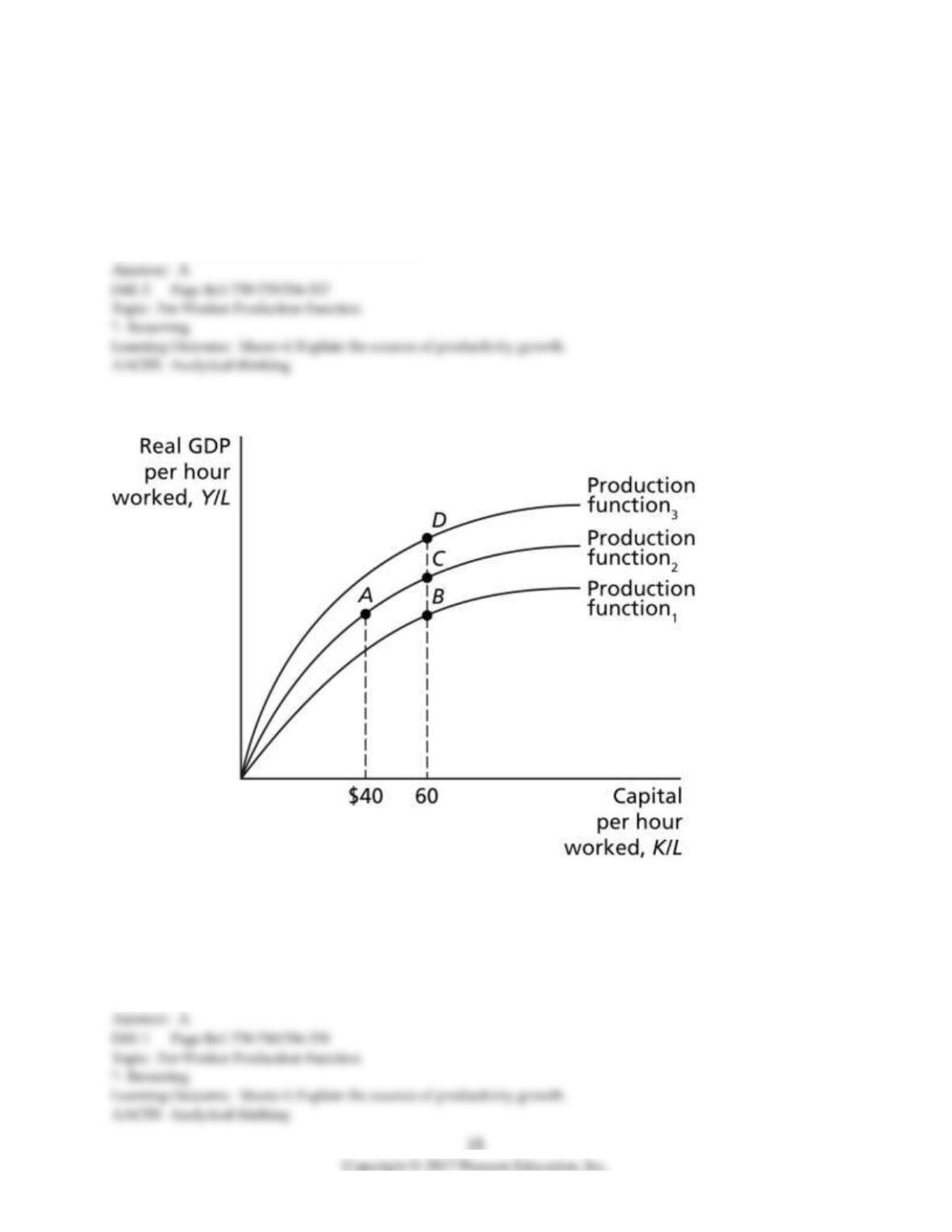
8) Suppose that an increase in capital per hour worked from $15,000 to $20,000 increases real GDP per
hour worked by $500. If capital per hour worked increases further to $25,000, by how much would you
expect real GDP per hour worked to increase if there are diminishing returns?
A) by less than $500
B) by exactly $500
C) by more than $500 but less than $5,000
D) by more than $5,000 but less than $20,000
Figure 11-1
9) Refer to Figure 11-1. Diminishing marginal returns is illustrated in the per-worker production
function in the figure above by a movement from
A) A to C.
B) B to C.
C) C to D.
D) D to C.

10) Refer to Figure 11-1. Technological change is illustrated in the per-worker production function in the
figure above by a movement from
A) A to B.
B) B to C.
C) B to A.
D) D to C.
11) Refer to Figure 11-1. Using the per-worker production function in the figure above, the largest
changes in an economy’s standard of living would be achieved by a movement from
A) A to B to C.
B) B to C to D.
C) C to B to A.
D) D to C to B.
12) Refer to Figure 11-1. Suppose the per-worker production function in the figure above represents the
production function for the U.S. economy. If the United States decided to double its support of
university research, this would cause a movement from
A) A to B.
B) B to C.
C) B to A.
D) D to C.

13) Refer to Figure 11-1. Within a country, the impact of wars and revolutions and their subsequent
destruction of capital is reflected in the per-worker production function in the figure above by a
movement from
A) A to B.
B) B to C.
C) B to A.
D) C to A.
14) Refer to Figure 11-1. Many countries in Africa strongly discouraged and prohibited foreign direct
investment in the 1950s and 1960s. By doing so, these countries were essentially preventing a moment
from
A) A to B.
B) B to C.
C) B to A.
D) D to C.
15) In the early 1900s, Henry Ford revolutionized the automotive manufacturing industry by instituting
the assembly line. What impact did the assembly line method for producing automobiles have on the
per-worker production function for Ford?
A) It became flatter.
B) It shifted up.
C) It shifted down.
D) It became linear.

16) If the per-worker production function shifts down,
A) it now takes more capital per hour worked to get the same amount of real GDP per hour worked.
B) an economy can increase its real GDP per hour worked without changing the level of capital per hour
worked.
C) the per-worker production function becomes steeper.
D) positive technological change has occurred in the economy.
17) Because of diminishing returns, an economy can continue to increase real GDP per hour worked
only if
A) there are decreases in human capital.
B) the per-worker production function shifts downward.
C) there continue to be decreases in capital per hour worked.
D) there is technological change.
18) In a small European country, it is estimated that a $10,000 increase in capital per hour worked will
increase real GDP per hour worked by $300. Based on this information, what is the slope of the per-
worker production function in this range?
A) 0.03
B) 3.3
C) 33.3
D) 333

19) In a small European country, it is estimated that changing the level of capital from $8 million to $10
million will increase real GDP from $2 million to $3 million. If the number of hours worked in the labor
force does not change, what does this information tell you about the slope of the per-worker production
function in this range?
A) The slope is –2.
B) The slope is 1/2.
C) The slope is 2.
D) The slope is 4.
20) In a small European country, it is estimated that changing the level of capital from $8 million to $10
million will increase real GDP from $2 million to $3 million. What level of GDP would you expect the
economy to be able to reach if spending on capital continued to rise to $12 million, assuming no
technological change and no change in the hours of work?
A) GDP would increase further, but by less than $1 million.
B) GDP would increase further by exactly $1 million.
C) GDP would increase further by more than $1 million
D) GDP would increase further by exactly $4 million.
21) If the slope of the per-worker production function is 1/2 in a given range, how will a $10,000 increase
in capital per hour worked affect real GDP per hour worked in the same given range?
A) Real GDP per hour worked will increase by $5,000.
B) Real GDP per hour worked will increase by $20,000.
C) Real GDP per hour worked will increase by $10,000.
D) Real GDP per hour worked will decrease by $20,000.

22) The Soviet Union’s economy grew rapidly in terms of GDP per hour worked in the 1950s, but
eventually this growth slowed. Why did this occur?
A) Capital per hour worked grew rapidly from 1950 to 1980, but technological change occurred very
slowly.
B) Capital per hour worked grew slowly, but technological change grew very rapidly.
C) Increasing implementation of new technologies eventually suffered diminishing marginal returns.
D) The centrally planned economy invested too heavily in technological change.
23) Under the Soviet system of communism,
A) managerial pay was determined by the extent to which managers could lower the per-unit costs of
production.
B) technological progress was slow because managers had little incentive to develop new technologies.
C) competitive pressures in the Soviet Union allowed the country’s technological progress to keep pace
with the rest of the world.
D) the per-worker production function in the Soviet Union shifted up more rapidly than production
functions in other countries.
24) Technological improvements are more likely to occur if
A) the economy is centrally planned.
B) entrepreneurs are compensated with higher profits for taking risks.
C) economic decisions are made by politicians rather than entrepreneurs.
D) companies face little competition in their markets.