5) For the past 15 years the American public has wanted to buy big trucks. The Big Three
automakers delivered, investing billions in plants that build gas guzzlers. Now, when customers
walk into showrooms, gas mileage is on their mind. Retooling the industry will take years. Mike
Quincy says the industry is “like a huge aircraft carrier. It doesn’t stop on a dime. It doesn’t turn
on a dime.” What does Mike mean?
A) The decision time frame to enter into the long run is very long in this industry.
B) The industry has increasing returns to scale.
C) Short run decisions are easily reversed.
D) The industry experiences diminishing marginal returns.
6) Angel Rodriguez pulls up in his 24-foot panel truck in front of Sezz Medi Brick Oven Pizza in
Upper Manhattan. Even though it’s the middle of the summer, he’s delivering— firewood. He
says even though fuel costs have doubled in the past year, it’s still worth the premium he gets
delivering ash and cherry to the captive and growing market in NYC. Which of the following
statements is TRUE about short run costs for Angel?
A) His truck is a fixed cost and gasoline is a variable cost.
B) His truck is a variable cost and gasoline is a fixed cost.
C) Both his truck and gasoline is a variable cost.
D) Neither his truck nor gasoline is a variable cost.
7) Angel Rodriguez pulls up in his 24-foot panel truck in front of Sezz Medi Brick Oven Pizza in
Upper Manhattan. Even though it’s the middle of the summer, he’s delivering— firewood. He
says even though fuel costs have doubled in the past year, it’s still worth the premium he gets
delivering ash and cherry to the captive and growing market in NYC. How would a decrease in
gasoline prices affect Angel’s short run costs?
A) Short run total costs would decrease.
B) Short run variable costs would increase.
C) Short run fixed costs would decrease.
D) Short run average variable costs would increase.
8) Angel Rodriguez pulls up in his 24-foot panel truck in front of Sezz Medi Brick Oven Pizza in
Upper Manhattan. Even though it’s the middle of the summer, he’s delivering— firewood. He
says even though fuel costs have doubled in the past year, it’s still worth the premium he gets
delivering ash and cherry to the captive and growing market in NYC. How does the doubling of
fuel costs affect Angel’s short run costs?
A) Short run variable costs would increase.
B) Short run fixed costs would decrease.
C) Short run total costs would decrease.
D) Short run average fixed costs would increase.
9) Angel Rodriguez pulls up in his 24-foot panel truck in front of Sezz Medi Brick Oven Pizza in
Upper Manhattan. Even though it’s the middle of the summer, he’s delivering— firewood. He
says even though fuel costs have doubled in the past year, it’s still worth the premium he gets
delivering ash and cherry to the captive and growing market in NYC. How would an increase in
Angel’s salary affect short run costs?
A) Short run variable costs would increase.
B) Short run fixed costs would decrease.
C) Short run total costs would decrease.
D) Short run average fixed costs would increase.
10) Minneapolis business Rogue Chocolatier sells specialty chocolate bars with a high cocoa
content. The price of cocoa beans shot up 44 percent in 2008. How did this affect Rogue’s short
run costs?
A) Short run variable costs would increase.
B) Short run fixed costs would decrease.
C) Short run total costs would decrease.
D) Short run average fixed costs would increase.
11) Minneapolis business Rogue Chocolatier sells specialty chocolate bars with a high cocoa
content. If Rogue’s average total cost decreases as the business increases plant size, then Rogue
experiences
A) economies of scale.
B) diseconomies of scale.
C) diminishing marginal returns.
D) constant returns to scale.
12) Minneapolis business Rogue Chocolatier sells specialty chocolate bars with a high cocoa
content. Most chocolate companies use already processed chocolate to craft their sweets. But
Rogue buys raw cocoa beans, and roasts and grinds them until they’re in a liquid state and then
runs the chocolate through a big squat machine with rollers. Which statement is TRUE for
Rogue?
A) Raw cocoa beans are a variable factor of production and the machine is a fixed factor of
production.
B) Both processed chocolate and raw cocoa beans are variable factors of production.
C) Processed chocolate is a variable factor of production and the machine is a fixed factor of
production.
D) Processed chocolate and raw cocoa beans are variable factors of production and the machine
is a fixed factor of production.
13) Minneapolis business Rogue Chocolatier sells specialty chocolate bars with a high cocoa
content. Rogue can produce 15 chocolate bars per day with one employee, 35 with 2, 50 with 3
and 55 with 4 employees. Which statement is TRUE?
A) Rogue’s marginal product curve initially increases and then decreases.
B) Rogue’s marginal product curve decreases continually.
C) Rogue’s total product curve increases at an increasing rate.
D) Rogue’s marginal product curve decreases initially and then increases.
14) Minneapolis business Rogue Chocolatier sells specialty chocolate bars with a high cocoa
content. Rogue can produce 15 chocolate bars per day with one employee, 29 with 2, 35 with 3
and 40 with 4 employees. Which statement is TRUE?
A) Rogue’s marginal product curve decreases continually.
B) Rogue’s marginal product curve initially increases and then decreases.
C) Rogue’s total product curve increases at an increasing rate.
D) Rogue’s marginal product curve decreases initially and then increases.
15) Health care costs rose more than 10 percent in 2011, according to a survey of insurers by
Aon Consulting Worldwide. Which of the following would be a variable cost in a hospital?
A) nurses
B) An MRI machine
C) laboratory equipment
D) gurneys
16) Health care costs rose more than 10 percent in 2011, according to a survey of insurers by
Aon Consulting Worldwide. Which of the following would be a fixed cost in a hospital?
A) an MRI machine
B) bandages
C) nurses
D) syringes
17) Health care costs rose more than 10 percent in 2011, according to a survey of insurers by
Aon Consulting Worldwide. If the increase in costs solely comes from increased wages to nurses
and doctors, then for the health care industry
A) variable costs are increasing.
B) fixed costs are increasing.
C) long run average total cost is decreasing.
D) productivity is increasing.
18) Health care costs rose more than 10 percent in 2011, according to a survey of insurers by
Aon Consulting Worldwide. If the increase in costs solely comes from increased prices for MRI
and X-ray machines, then for the health care industry
A) fixed costs are increasing.
B) long run average total cost is decreasing.
C) productivity is increasing.
D) variable costs are increasing.
1) What is the difference between the short run and the long run?
2) What factors of production can a firm change in the short run? In the long run?
3) What do economists mean when they say that a firm’s plant is fixed?
4) What does a firm’s short-run total product curve show and what is its significance?
5) What is the law of diminishing returns? Why is this proposition called a “law”?
6) “The law of diminishing returns is the same as the decreasing returns to scale.” Do you agree?
Explain.
7) What does the average product of labor equal?
8) “If the marginal product of labor curve slopes downward, then the average product of labor
curve necessarily must slope downward.” Explain whether the previous statement is correct or
incorrect?
9) Describe the relationship between the marginal and average products of labor as the
employment of labor increases in the short run.
10) A student wrote: “When the average product of labor exceeds the marginal product, the
marginal product is increasing.” If you were the instructor, how would you correct this
statement?
11) What are the two components of a firm’s total cost in the short run, and what are their
definitions?
12) Jake is a corn farmer in Nebraska. He rents his land on a long-term lease for $250,000 a year.
He pays his farm hands $28,000 a year. Is his rent a fixed cost or a variable cost? Are the wages
he pays his workers a fixed cost or a variable cost? Briefly explain your answers.
13) “In the short run, even when output is zero, the firm still has some variable costs it must
pay.” Is the statement correct or incorrect? Briefly explain your answer.
14) When plotted against the total output, what does the total fixed cost curve look like?
15) Explain why average total costs initially decrease and then increase as output increases.
16) Downsizing is the practice of laying off workers in an attempt to decrease average total cost.
Can laying off workers decrease average total cost? Is it possible for the firm to downsize and
have its average total cost increase? Explain your answer.
17) How do we calculate average fixed cost and why does average fixed cost fall as output
increases?
18) “Marginal cost is the increase in total cost that results from a one-unit increase in a variable
input.” True or false? Explain.
19) “Marginal cost eventually increases because of the law of diminishing returns.” True or
false? Explain.
20) The average total cost curve is U-shaped. At the quantity of output where average total cost
is at its minimum, is the marginal cost curve above the average total cost curve, below the
average total cost curve, or intersecting the average total cost curve?
21) What is the difference between average total cost and marginal cost and are they ever equal
to each other?
22) Which average cost curves are U-shaped?
23) What is the relationship between the marginal product of labor and the marginal cost?
24) Explain how new technologies, which increase productivity, affect the average variable cost,
average total cost, and marginal cost curves.
25) When the Rent-A-Limo Company negotiates its new labor contract it finds that the wages it
must pay drivers have increased. How does this wage hike affect the Rent-A-Limo Company’s
average fixed cost, average variable cost, average total cost, and marginal cost?
26) How do the marginal and average products of labor affect a firm’s marginal and average
variable costs in the short run?
27) In the long run all costs are variable costs. Why?
28) Which curve shows the lowest average total cost at which it is possible to produce each
output when the firm has time to change both its labor force and plant size?
29) What is the long-run average cost curve? What are the three ranges of output and in what
order do they occur? Briefly define each of the three ranges.
30) What are economies of scale? What is the main source of economies of scale?
31) Explain the difference between increasing marginal returns and economies of scale.
32) What are diseconomies of scale and why might they occur?
33) A firm increases both its plant and its labor force by the same percentage and its average
total costs remain unchanged. Is the firm experiencing increasing returns to scale, constant
returns to scale, or decreasing returns to scale?
34) Are the short-run average total cost curve and the long-run average cost both U-shaped for
the same reasons? If so, carefully explain these reasons. If not, explain why each curve is U-
shaped.
35) What is the difference between diminishing marginal returns and diseconomies of scale?
135
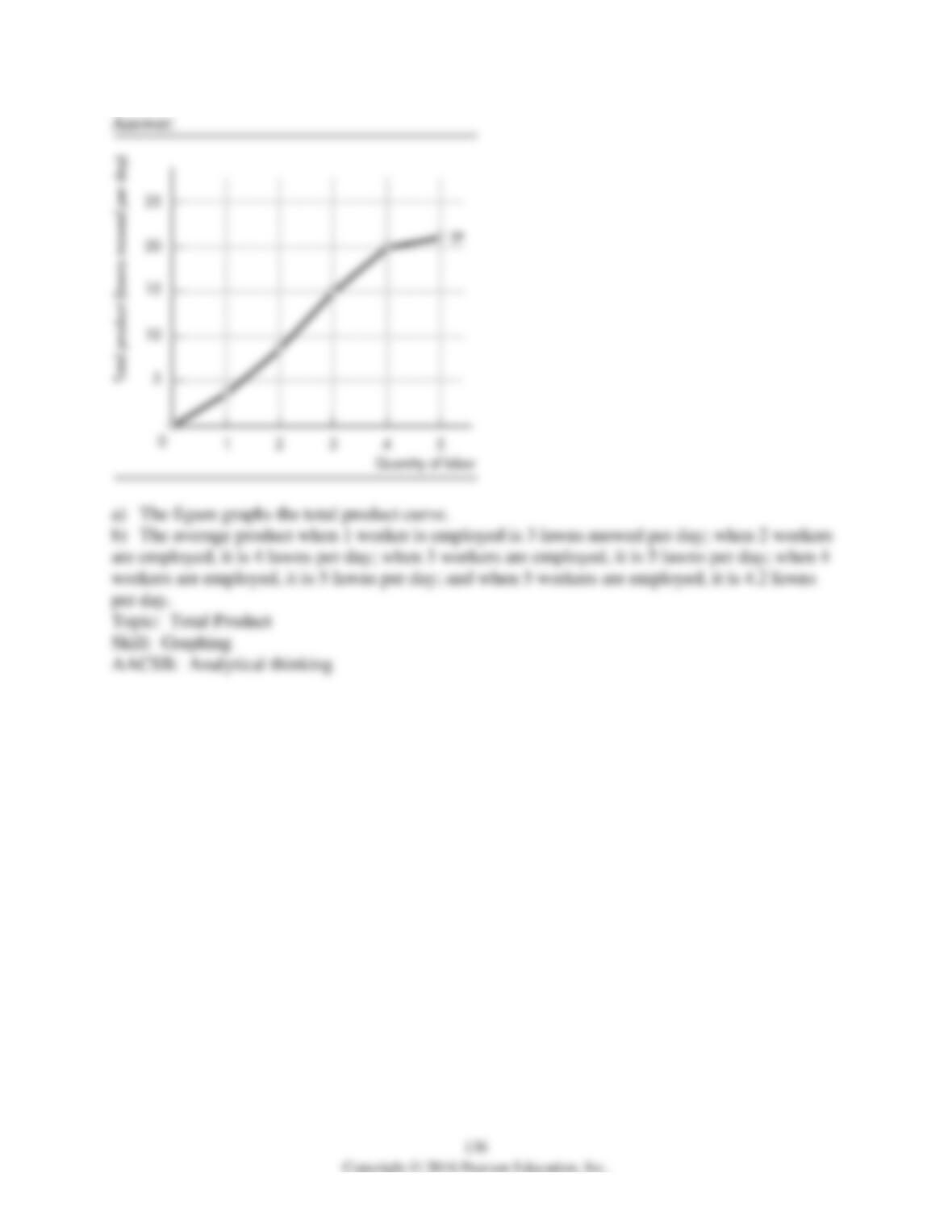
7 Numeric and Graphing Questions
Quantity of labor
(workers)
Total product
(lawns mowed per
day)
0
0
1
3
2
8
3
15
4
20
5
21
1) The above table has the total product schedule for Jesse’s Lawn Service.
a) In the figure, label the axes and then graph the total product curve.
b) Find the average product for the different amounts of employment.
Quantity of
labor
(workers)
Total product
Average
product
Marginal
product
0
0
____
1
24
____
____
2
50
____
____
3
74
____
____
4
94
____
____
5
110
____
____
6
122
____
____
7
130
____
____
8
134
____
____
9
134
____
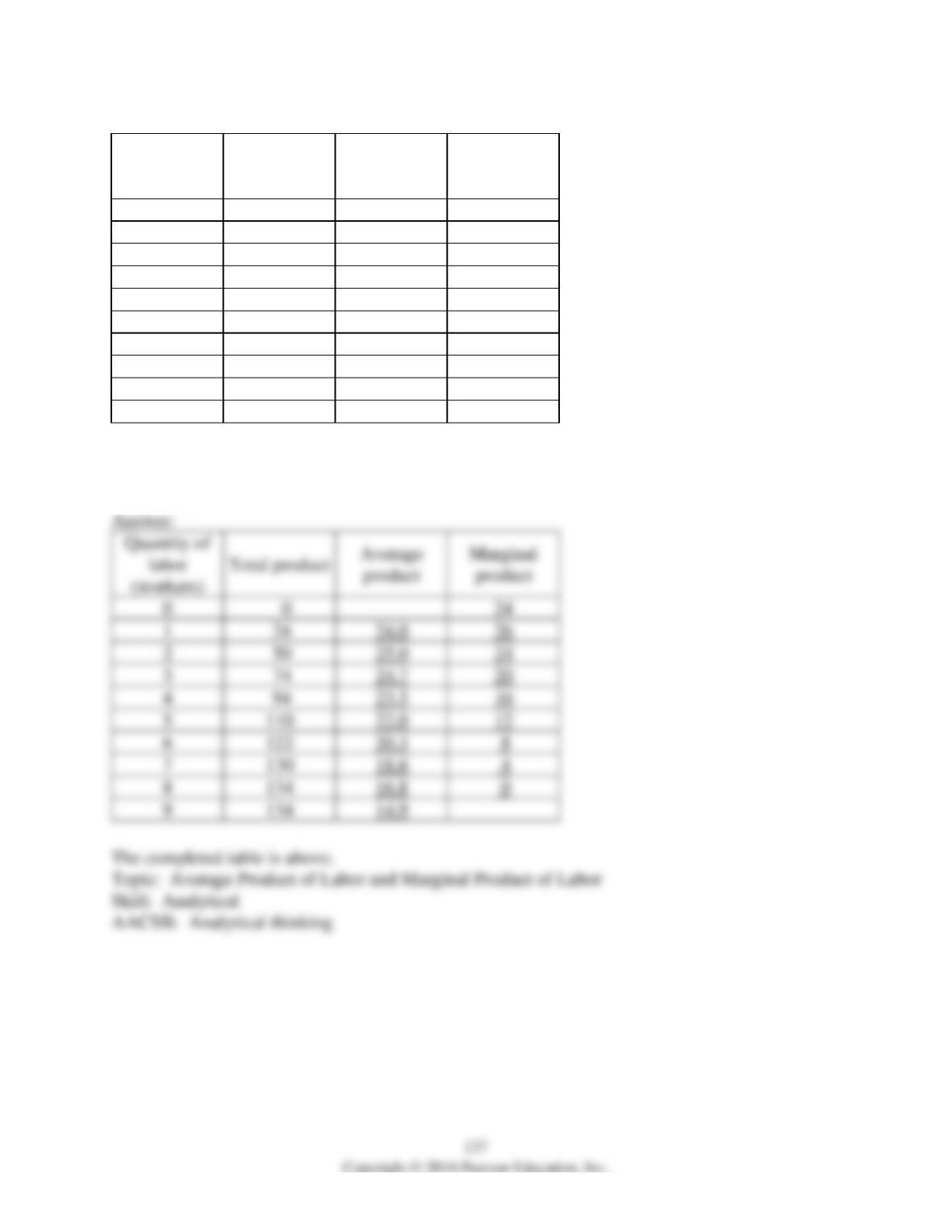
2) Ajax Manufacturing has a fixed scale of plant with the levels of total product given in the
table for different levels of labor. Complete the table by calculating the average product and
marginal product.
Quantity of
labor
(workers)
Total product
Average
product
Marginal
product
0
1
24.0
2
25.0
3
24.7
4
23.5
5
110
22.0
6
122
20.3
7
130
18.6
8
134
16.8
9
134
14.9
Quantity of labor
(workers)
Total product
(hair stylings per day)
0
0
1
10
2
25
3
45
4
60
5
70
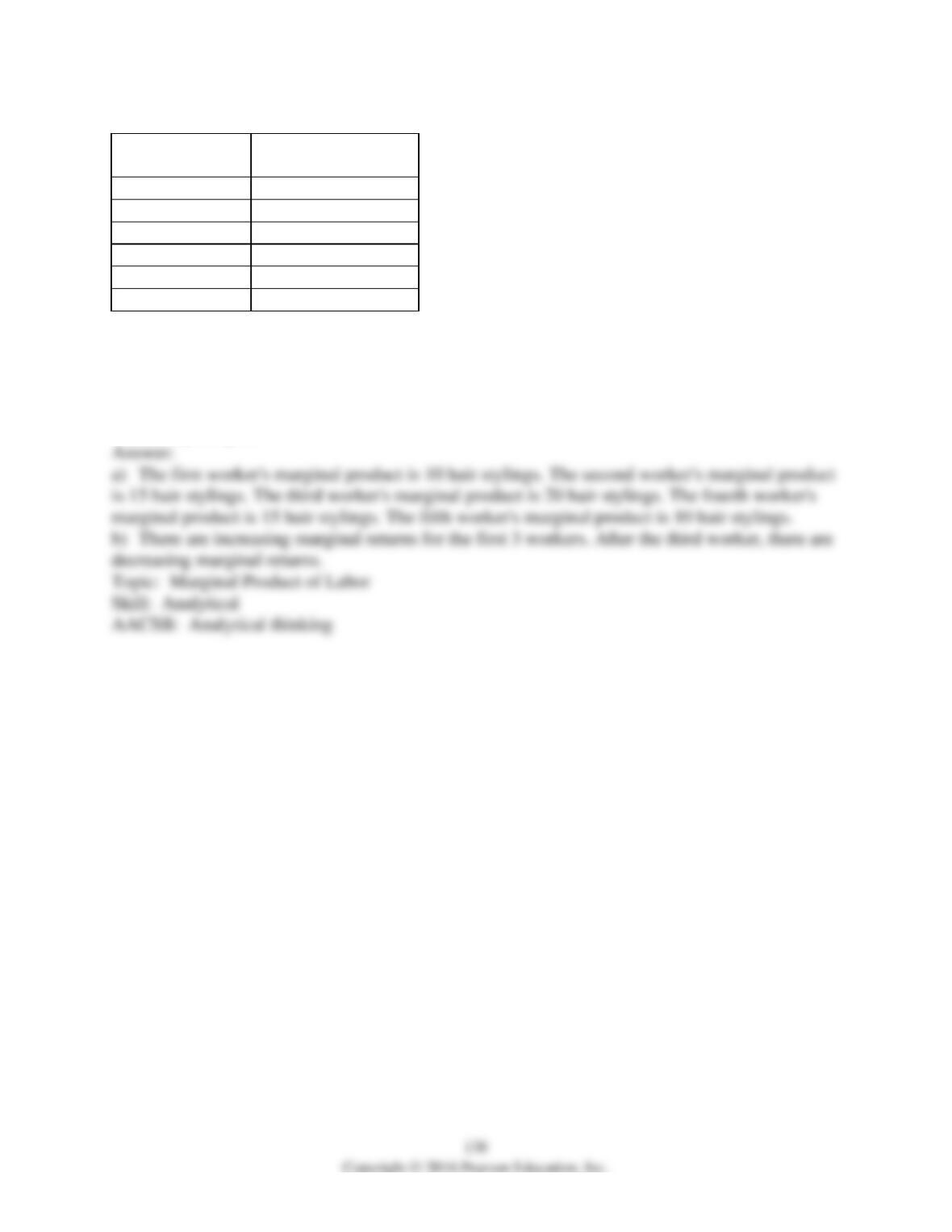
3) The above table shows the total product schedule for Hair Today, a hair styling salon.
a) What is the first worker’s marginal product? The second worker? The third worker? The
fourth worker? The fifth worker?
b) Over what range of workers is there increasing marginal returns? Over what range is there
decreasing marginal returns?
Labor
(workers)
Total product
(shirts per
day)
0
0
1
20
2
36
3
48
4
56
5
60
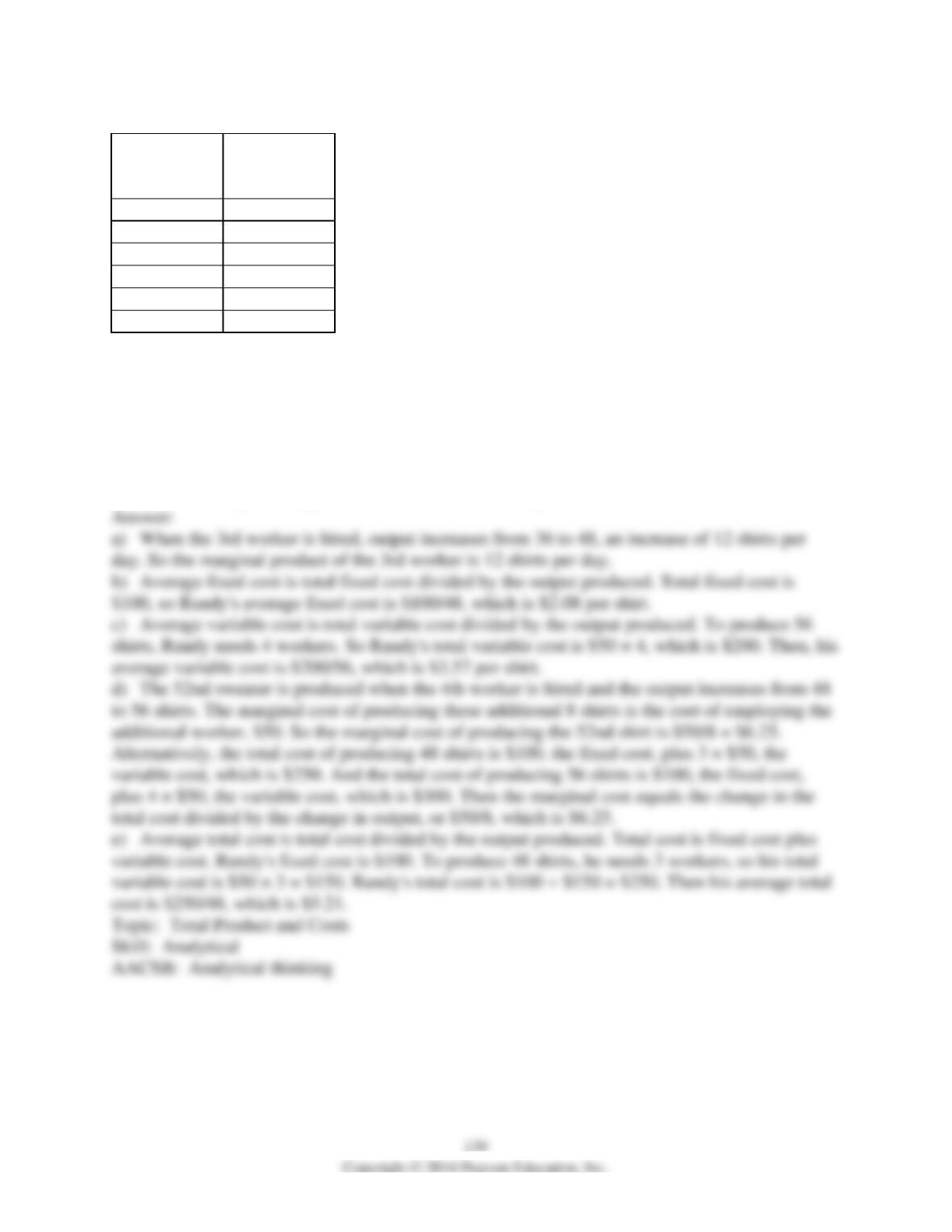
4) The table above shows Randy’s Shirts’ short-run production function. Randy hires workers at a
wage rate of $50 a day and his total fixed cost is $100.
a) What is the marginal product of the 3rd worker?
b) What is Randy’s average fixed cost if 48 shirts are produced?
c) What is Randy’s average variable cost if 56 shirts are produced?
d) What is Randy’s marginal cost of producing the 52nd sweater?
e) What is Randy’s average total cost if 48 sweaters are produced?