15) Silvio’s Pizza is a small pizzeria. The firm’s production function is shown in the table above.
Suppose that Silvio’s costs include only the cost of renting ovens, which is $100 per oven per
week, the labor cost, $280 per worker per week, and the opportunity cost of Silvio’s
entrepreneurship, $1,000 per week. When Silvio’s uses 2 ovens and hires the 3rd worker, the
marginal product of labor is ________ the average product of labor, and therefore the average
product of labor ________.
A) less than; decreases
B) less than; increases
C) greater than; decreases
D) greater than; increases
16) Silvio’s Pizza is a small pizzeria. The firm’s production function is shown in the table above.
Suppose that Silvio’s costs include only the cost of renting ovens, which is $100 per oven per
week, the labor cost, $280 per worker per week, and the opportunity cost of Silvio’s
entrepreneurship, $1,000 per week. Suppose Silvio’s uses Plant 1 and hires 3 workers. What is
the firm’s average fixed cost?
A) $4.33
B) $8.40
C) $19.40
D) $11.00
17) Silvio’s Pizza is a small pizzeria. The firm’s production function is shown in the table above.
Suppose that Silvio’s costs include only the cost of renting ovens, which is $100 per oven per
week, the labor cost, $280 per worker per week, and the opportunity cost of Silvio’s
entrepreneurship, $1,000 per week.
Suppose Silvio’s uses Plant 1 and hires 2 workers. What is the firm’s average variable cost?
A) $7.00
B) $6.40
C) $19.50
D) $8.25

18) Silvio’s Pizza is a small pizzeria. The firm’s production function is shown in the table above.
Suppose that Silvio’s costs include only the cost of renting ovens, which is $100 per oven per
week, the labor cost, $280 per worker per week, and the opportunity cost of Silvio’s
entrepreneurship, $1,000 per week.
Suppose Silvio’s uses Plant 2 and hires 4 workers. What is the firm’s average total cost?
A) $6.00
B) $8.26
C) $10.55
D) $12.40
19) Silvio’s Pizza is a small pizzeria. The firm’s production function is shown in the table above.
Suppose that Silvio’s costs include only the cost of renting ovens, which is $100 per oven per
week, the labor cost, $280 per worker per week, and the opportunity cost of Silvio’s
entrepreneurship, $1,000 per week.
Suppose Silvio’s uses Plant 2. What is the marginal cost of producing the 200th pizza?
A) $5.09
B) $7.00
C) $10.55
D) $4.40
20) Silvio’s Pizza is a small pizzeria. The firm’s production function is shown in the table above.
Suppose that Silvio’s costs include only the cost of renting ovens, which is $100 per oven per
week, the labor cost, $280 per worker per week, and the opportunity cost of Silvio’s
entrepreneurship, $1,000 per week.
Suppose Silvio’s uses Plant 2. The firm’s average total cost is minimized when ________ pizzas
per week are produced.
A) 180
B) 130
C) 220
D) 60
21) Silvio’s Pizza is a small pizzeria. The firm’s production function is shown in the table above.
Suppose that Silvio’s costs include only the cost of renting ovens, which is $100 per oven per
week, the labor cost, $280 per worker per week, and the opportunity cost of Silvio’s
entrepreneurship, $1,000 per week.
What is Silvio’s long-run average cost if the output is 100 pizzas per week?
A) $8.40
B) $11.00
C) $19.40
D) $17.90
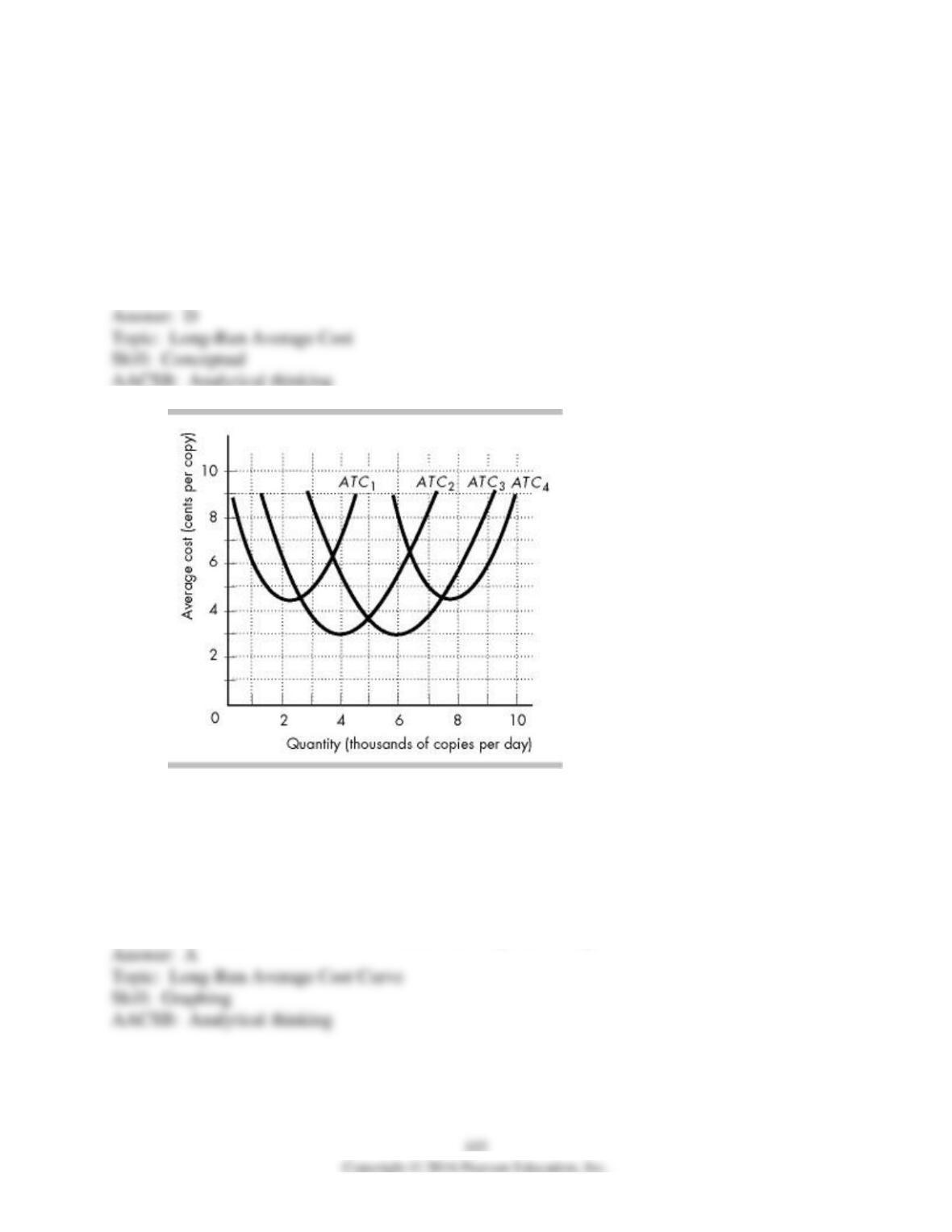
22) Dustin’s copy shop can use four alternative plants. The figure above shows the average total
cost curves for Plant 1 (ATC1), Plant 2 (ATC2), Plant 3 (ATC3), and Plant 4 (ATC4).What is
Dustin’s long-run average cost if the output is 3,000 copies per day?
A) 3.7 cents per copy
B) 5.0 cents per copy
C) 8.5 cents per copy
D) More information is needed to determine the long-run average cost.

23) Dustin’s copy shop can use four alternative plants. The figure above shows the average total
cost curves for Plant 1 (ATC1), Plant 2 (ATC2), Plant 3 (ATC3), and Plant 4 (ATC4). Dustin’s
Plant 2 will be economically efficient if the firm produces
A) 2,000 copies per day.
B) 4,800 copies per day.
C) 5,300 copies per day.
D) 6,000 copies per day.
24) Dustin’s copy shop can use four alternative plants. The figure above shows the average total
cost curves for Plant 1 (ATC1), Plant 2 (ATC2), Plant 3 (ATC3), and Plant 4 (ATC4). Dustin’s
minimum efficient scale is
A) 2,650 copies per day.
B) 6,000 copies per day.
C) 4,000 copies per day.
D) More information is needed to determine the minimum efficient scale.
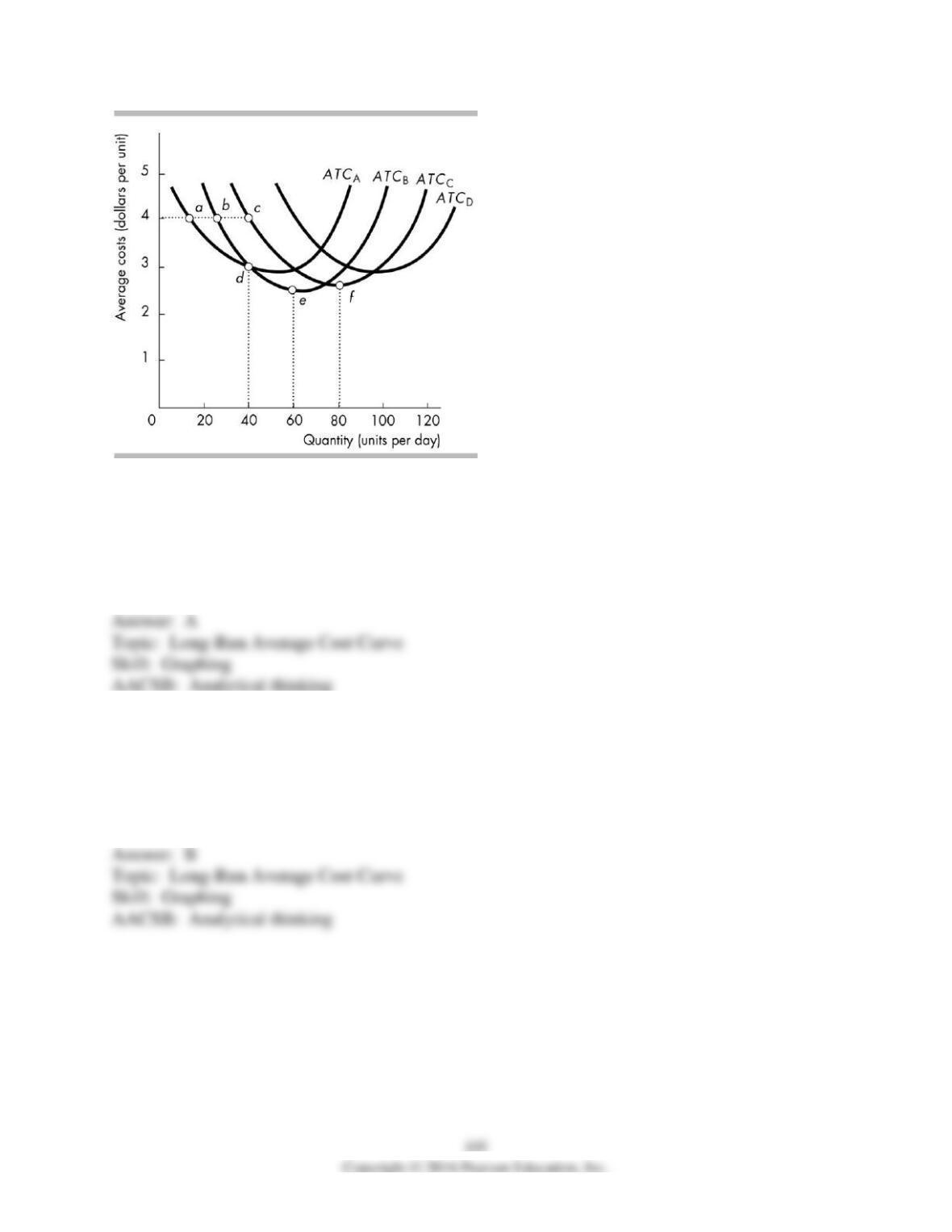
25) The average total cost curves for plants A, B, C and D are shown in the above figure. Which
plant is best to use to produce 20 units per day?
A) plant A
B) plant B
C) plant C
D) plant D
26) The average total cost curves for plants A, B, C and D are shown in the above figure. Which
plant is best to use to produce 60 units per day?
A) plant A
B) plant B
C) plant C
D) plant D
27) The average total cost curves for plants A, B, C and D are shown in the above figure. Which
plant is best to use to produce 80 units per day?
A) plant A
B) plant B
C) plant C
D) plant D
28) The average total cost curves for plants A, B, C, and D are shown in the above figure. The
plant size that is the most economically efficient
A) is plant A.
B) is plant B.
C) is plant C.
D) depends on the desired level of output.
29) The average total cost curves for plants A, B, C, and D are shown in the above figure. It is
possible that the long-run average cost curve runs through points
A) a, b, and c.
B) b, d, and e.
C) d, e, and f.
D) c and d.
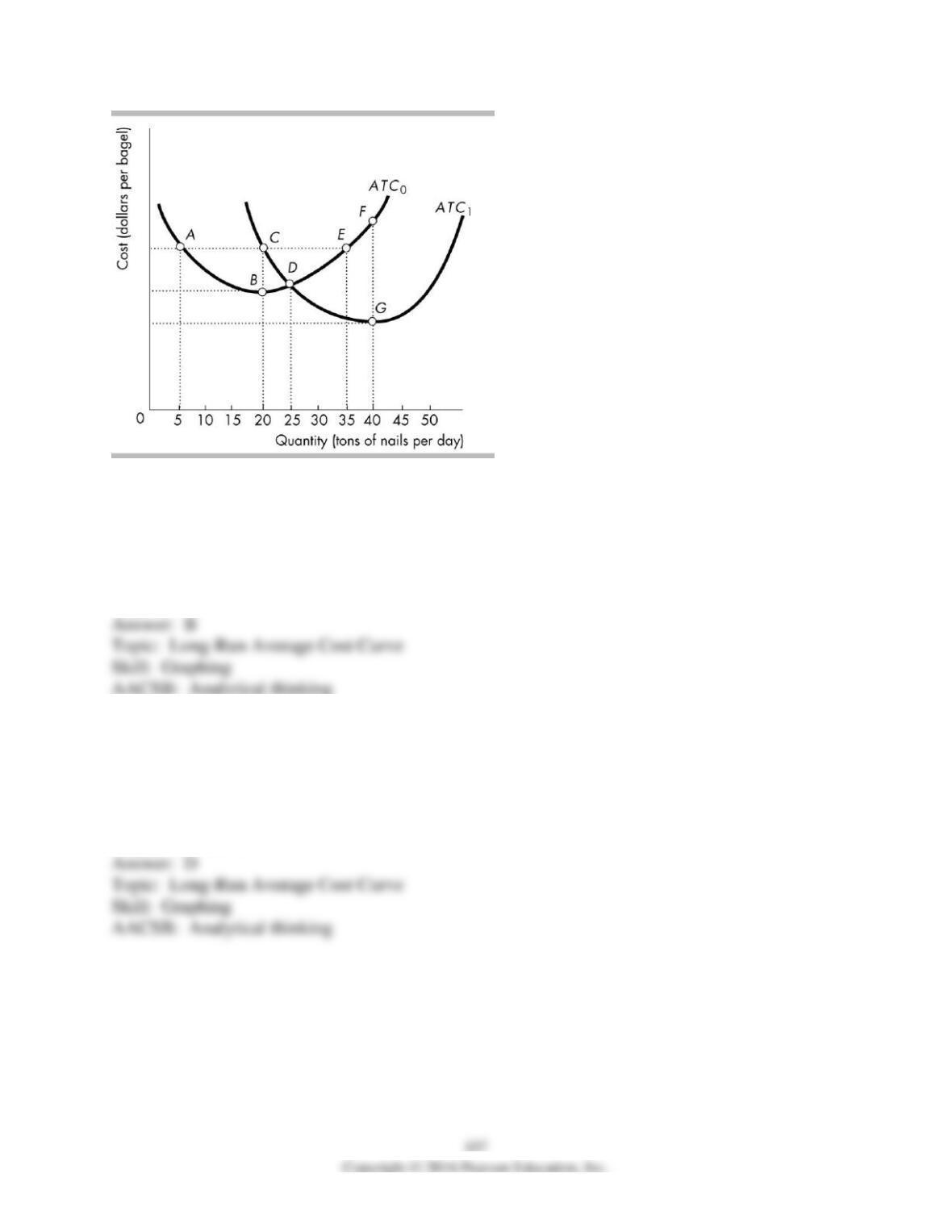
30) The average total cost curves for Plant 1, ATC0, and Plant 2, ATC1, are shown in the figure
above. Over what range of output is it efficient to operate Plant 1?
A) 0-20
B) 0-25
C) 20-25
D) greater than 25
31) The average total cost curves for Plant 1, ATC0, and Plant 2, ATC1, are shown in the figure
above. Over what range of output is it efficient to operate Plant 2?
A) 0-20
B) 0-25
C) 20-25
D) greater than 25
32) The average total cost curves for Plant 1, ATC0, and Plant 2, ATC1, are shown in the figure
above. The long-run average cost curve goes through points
A) C, D, G.
B) A, C, E.
C) A, B, D, G.
D) A, B, D, E, F.
33) A firm is operating in its range of economies of scale and is on both its LRAC curve and its
short-run ATC curve. At that level of output, the slope of its LRAC curve is
A) zero and the slope of its ATC curve is zero.
B) zero and the slope of its ATC curve is negative.
C) negative and the slope of its ATC curve is zero.
D) negative and the slope of its ATC curve is negative.
34) When economies of scale are present, the LRAC curve touches each short-run ATC curve
A) to the left of the ATC curve’s minimum point.
B) to the right of the ATC curve’s minimum point.
C) at the ATC curve’s minimum point.
D) at no points.
35) Economies of scale refer to
A) the point at which marginal cost equals average cost.
B) the fact that in the long run, fixed costs remain constant as output increases.
C) the range of output over which the long-run average cost falls as output increases.
D) a feature of short-run production functions but not long-run production functions.
36) In the short run
A) all inputs are variable.
B) all firms experience increasing returns to scale.
C) some firms experience economies of scale.
D) no firm experiences economies of scale.
37) When long-run average costs decrease as output increases, there are
A) economies of scale.
B) diseconomies of scale.
C) constant returns to scale.
D) constant marginal costs.
38) When a firm experiences economies of scale, its ________ cost curve slopes ________ as
output increases.
A) long-run average; downward
B) short-run average total; downward
C) short-run marginal cost; downward
D) long-run average; upward
39) A firm experiences ________ when its ________ downward as output increases.
A) diseconomies of scale; average total cost curve slopes
B) economies of scale; long-run average cost curve slopes
C) diminishing marginal returns; long-run average cost curve slopes
D) diminishing marginal returns; average total cost curve shifts
40) Economies of scale refer to the range of output over which
A) marginal cost exceeds average cost.
B) the long-run average cost falls as output increases.
C) the marginal product of labor diminishes.
D) the long-run average cost is less than the short-run average total cost.
41) When long-run average cost decreases as output increases, there are definitely
I. increasing marginal returns.
II. economies of scale.
A) only I
B) only II
C) both I and II
D) neither I nor II
42) If Dell Computer Company could produce more computers at lower long-run average cost by
increasing the quantity of all the inputs it uses, Dell definitely would experience
A) decreasing marginal returns.
B) diseconomies of scale.
C) increasing marginal returns.
D) economies of scale.
43) When long-run average cost decreases as output increases there are definitely
A) increasing marginal returns.
B) economies of scale.
C) Both answers A and B are correct.
D) Neither answer A nor B is correct.

44) Electric utility companies have built larger and larger electric generating stations and, as a
result, the long-run average cost of producing each kilowatt hour decreased. This is an example
of
A) constant returns to cost.
B) increasing returns to cost.
C) economies of scale.
D) diseconomies of scale.
45) Electric utility companies have built larger and larger electric generating stations and, as a
result, the long-run average cost of producing each kilowatt hour decreased. This is an example
of
A) increasing marginal returns.
B) diminishing marginal returns.
C) economies of scale.
D) diseconomies of scale.
46) If the average total cost of producing 20 sweaters an hour falls when the firm doubles all its
inputs, then the
A) short-run average total cost curve shifts upward because all inputs have increased.
B) firm moves along its short-run average total cost curve.
C) firm experiences economies of scale.
D) long-run average cost curve shifts downward.
47) If all inputs are increased by 5 percent and output increases by 8 percent, then the
A) firm experiences constant returns to scale.
B) long-run average cost curve slopes downward.
C) long-run average cost curve shifts downward.
D) firm experiences diseconomies of scale.
48) Economies of scale occur when the percentage increase in output
A) exceeds the percentage increase in all inputs.
B) is less than the percentage increase in all inputs.
C) exceeds the percentage decrease in all inputs.
D) is less than the percentage decrease in all inputs.
49) Economies of scale
A) lead to rising long-run average costs as output increases.
B) occur if output more than doubles when all inputs are doubled.
C) occur if output less than doubles when all inputs are doubled.
D) occur when management complexity brings rising average cost.
50) Diminishing marginal returns means that the firm definitely is experiencing
A) diseconomies of scale.
B) constant returns to scale.
C) Both answers A and B are correct.
D) Neither answer A nor B is correct.
51) “Diseconomies of scale” occur in
A) the long run, but not the short run.
B) the short run, but not the long run.
C) both the short run and the long run.
D) neither the short run nor the long run.
52) When long-run average cost increases as output increases there are
A) economies of scale.
B) diseconomies of scale.
C) constant returns to scale.
D) none of the above.
53) When long-run average costs increase as output increases, there are
A) economies of scale.
B) diseconomies of scale.
C) constant returns to scale.
D) constant marginal costs.
54) Diseconomies of scale definitely means that as the firm increases its output, its
A) long-run average total cost increases.
B) long-run average total cost decreases.
C) short-run average total cost increases.
D) short-run average total cost decreases.
55) If diseconomies of scale are present and the firm ________ all its inputs, its output
________.
A) doubles; more than doubles
B) doubles; less than doubles
C) increases; increases by the same percentage
D) halves; doubles
56) One reason for diseconomies of scale is that, at very large scales, management systems can
become
A) more efficient because they can effectively manage more workers.
B) increasingly complex and inefficient.
C) more numerous than the workers they manage.
D) none of the above.
57) A common source of diseconomies of scale is the
A) diminishing marginal returns to capital.
B) diminishing marginal returns to labor.
C) diminishing marginal returns to land.
D) growing complexity of management and organizational structure.
Quantity
Long-run total
cost (dollars)
0
0
20
100
40
160
60
180
80
190
58) The cost data in the above table data show that production is characterized by
A) economies of scale.
B) constant returns to scale.
C) decreasing returns to scale.
D) More information is needed to answer the question.

59) Based on the cost data in the above table, the long-run average cost (LRAC) is lowest when
output is
A) 20.
B) 40.
C) 80.
D) Long-run average cost is constant at all levels of output.
60) When long-run average cost remains constant as output increases there are constant
A) marginal returns.
B) returns to scale.
C) economies of scale.
D) diseconomies of scale.
61) Farmer Seth has a perfectly flat long-run average total cost curve over the range of output
from 10,000 bushels of wheat to 100,000 bushels of wheat. Hence, over this range of output,
Farmer Seth definitely experiences
A) constant marginal returns.
B) constant returns to scale.
C) constant economies of scale.
D) none of the above.
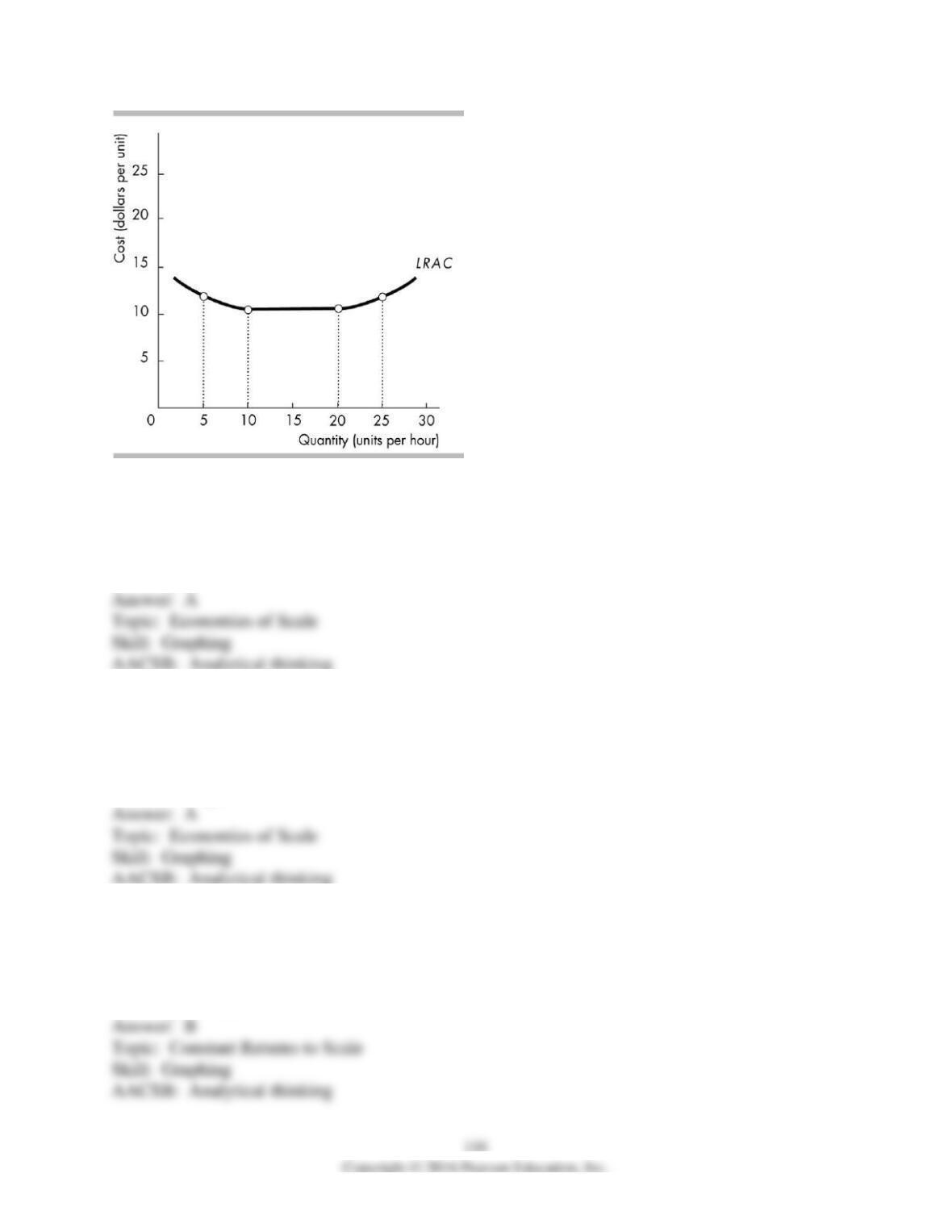
62) In the above figure, the long-run average cost curve exhibits economies of scale
A) between 5 and 10 units per hour.
B) between 10 and 20 units per hour.
C) between 20 and 25 units per hour.
D) along the entire curve.
63) In the above figure, between 5 and 10 units per hour, the firm experiences
A) economies of scale.
B) diseconomies of scale.
C) constant returns to scale.
D) decreasing total fixed costs.
64) In the above figure, the long-run average cost curve exhibits constant returns to scale
A) between 5 and 10 units per hour.
B) between 10 and 20 units per hour.
C) between 20 and 25 units per hour.
D) along the entire curve.
65) In the above figure, the long-run average cost curve exhibits diseconomies of scale
A) between 5 and 10 units per hour.
B) between 10 and 20 units per hour.
C) between 20 and 25 units per hour.
D) along the entire curve.
66) In the above figure, between 20 and 25 units per hour, the firm experiences
A) economies of scale.
B) diseconomies of scale.
C) constant returns to scale.
D) increasing total fixed costs.
67) In the above figure, economies of scale are present up to an output level of
A) 5,000 pounds of coffee.
B) 10,000 pounds of coffee.
C) 13,000 pounds of coffee.
D) 15,000 pounds of coffee.
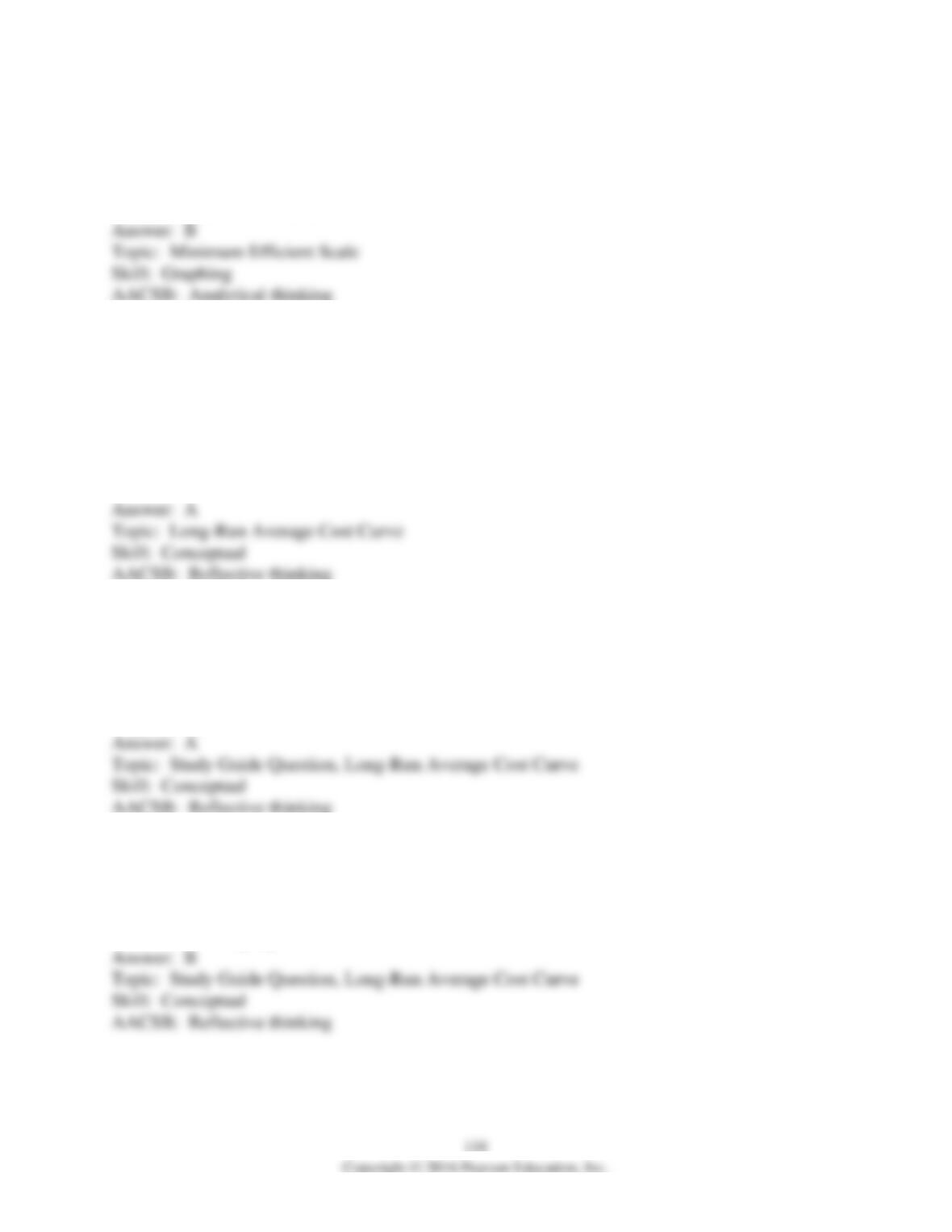
68) In the above figure, the minimum efficient scale of output is
A) 5,000 pounds of coffee.
B) 10,000 pounds of coffee.
C) 13,000 pounds of coffee.
D) 15,000 pounds of coffee.
69) If wages a firm pays it workers increase, then
A) the firm’s long-run average cost curve shifts upward.
B) the firm moves rightward along its long-run average cost curve to where it has diseconomies
of scale.
C) the firm’s long-run average cost curve does not shift and there is no movement along the long–
run average cost curve.
D) the firm moves rightward along its long-run average cost curve but not necessarily to where it
has diseconomies of scale.
70) The LRAC curve
A) is the minimum points on all the short-run ATC curves.
B) shows the lowest possible marginal cost of producing the different levels of output.
C) shows the lowest attainable average total cost for all levels of output when all inputs can be
varied.
D) generally lies above the short-run ATC curves.
71) The LRAC curve generally is
A) shaped as an upside-down U.
B) U-shaped.
C) upward sloping.
D) downward sloping.
72) When a firm is experiencing economies of scale
A) the MP curve slopes upward.
B) the LRAC curve slopes downward.
C) diminishing returns to labor have been suspended.
D) the MC curve slopes downward.
73) Constant returns to scale means that as all inputs are increased
A) total output remains constant.
B) average total cost rises.
C) average total cost rises at the same rate as do the inputs.
D) total output increases in the same proportion as do the inputs.
74) When a firm is experiencing diseconomies of scale
A) the MP curve has a negative slope.
B) the LRAC curve has a positive slope.
C) it must also experience diminishing returns to labor.
D) the MC curve has a negative slope.
5 News Based Questions
1) In 2008, Precision Pattern Interiors, which makes high-end aircraft interiors, began a $1
million renovation of a building at the Hutchinson Air Base Industrial Tract south of Yoder,
Kansas. The company will also add some $400,000 in new equipment and triple its Yoder work
force. Which of Precision Pattern Interiors’ decisions is a short run decision?
A) triple its Yoder work force
B) $1 million renovation of a building at the Hutchinson Air Base Industrial Tract
C) $400,000 in new equipment purchases
D) All of these decisions are short run decisions.

2) In 2008, Precision Pattern Interiors, which makes high-end aircraft interiors, began a $1
million renovation of a building at the Hutchinson Air Base Industrial Tract south of Yoder,
Kansas. The company will also add some $400,000 in new equipment and triple its Yoder work
force. Which of Precision Pattern Interiors’ decisions is a long run decision?
A) $1 million renovation of a building at the Hutchinson Air Base Industrial Tract and $400,000
in new equipment purchases
B) $1 million renovation of a building at the Hutchinson Air Base Industrial Tract
C) $400,000 in new equipment purchases
D) triple its Yoder work force
3) In 2008, Precision Pattern Interiors, which makes high-end aircraft interiors, began a $1
million renovation of a building at the Hutchinson Air Base Industrial Tract south of Yoder,
Kansas. The company will also add some $400,000 in new equipment and triple its Yoder work
force. Why would the long run decisions be riskier than the short run decisions?
A) because the firm has to live with the long run decisions for a long time
B) because it is easier to sell the equipment than it is to lay off employees
C) because the firm has to raise prices to purchase equipment
D) because employees will be upset
4) For the past 15 years the American public has wanted to buy big trucks. The Big Three
automakers delivered, investing billions in plants that build gas guzzlers. Now, when customers
walk into showrooms, gas mileage is on their mind. Retooling the industry will take years, so in
the meantime GM, Ford and Chrysler are tweaking their existing models. They’re changing tires,
adjusting transmissions and exhaust valves in hopes of getting one or maybe two more miles per
gallon. Which of the decisions by the Big Three to gain gas mileage is a short run decision?
A) adjusting exhaust valves
B) adjusting transmissions
C) changing tires
D) All of these decisions are short run decisions.