130) In the above figure, the average total cost curve is curve
A) A.
B) B.
C) C.
D) D.
131) In the above figure, as output increases, the distance between curves B and C decreases
because
A) total cost decreases as output increases.
B) average fixed cost decreases as output increases.
C) there are diminishing returns to average total cost.
D) there are increasing marginal costs as output increases.
132) In the above figure, curve D slopes downward because
A) average fixed costs decrease as output increases.
B) all costs decrease as output increases.
C) there are diminishing returns.
D) there are decreasing marginal costs.
133) In the above figure, the intersection of curves A and C is the point at which
A) average total cost is minimized.
B) average variable cost is minimized.
C) average fixed cost is minimized.
D) total product is maximized.
134) In the above figure, the intersection of curves A and B is the point at which
A) average total cost is minimized.
B) average variable cost is minimized.
C) average fixed cost is minimized.
D) total product is maximized.
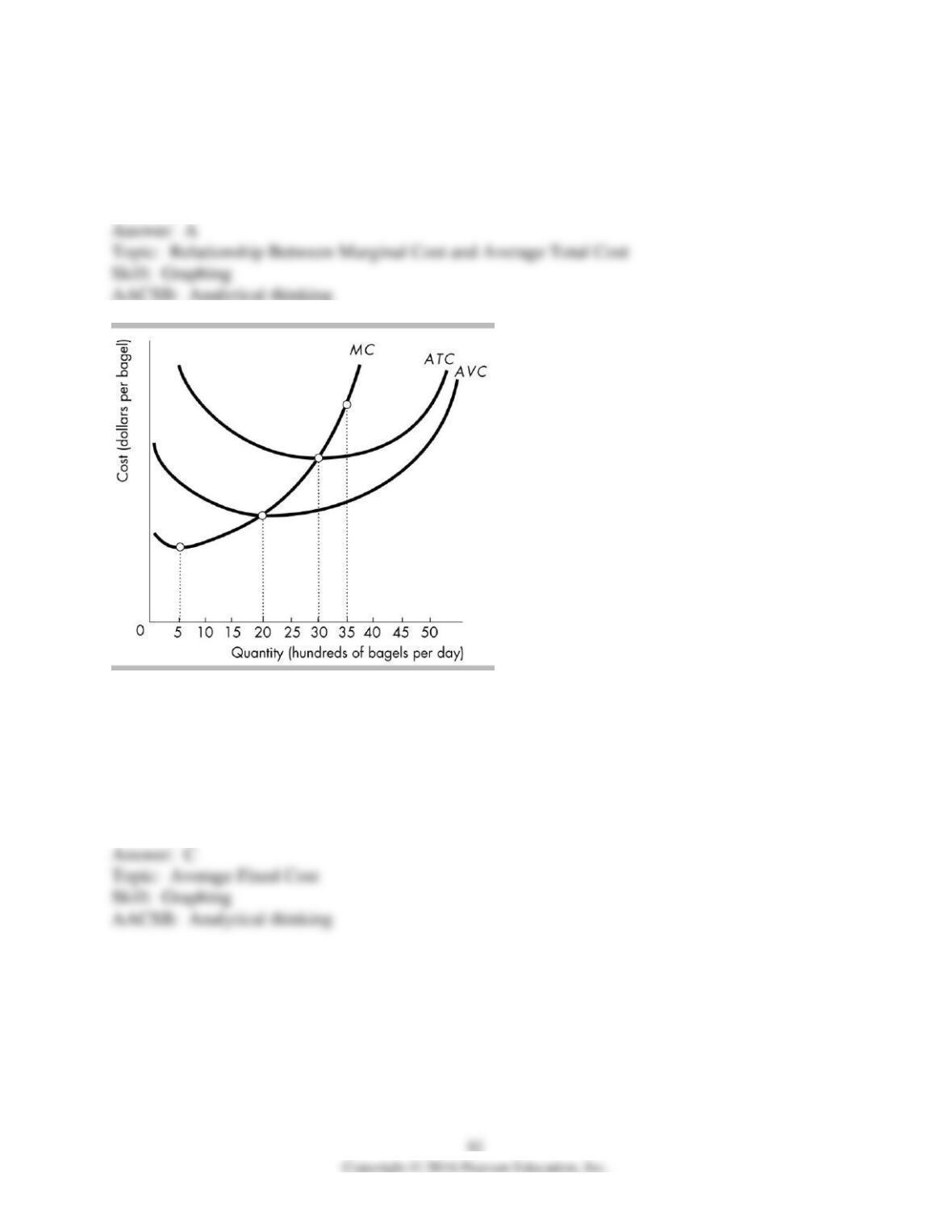
135) The above figure shows the costs at Barney’s Bagel Bakery. At which of the following
amounts of output is the AFC be the lowest?
A) at 2000 bagels
B) at 3000 bagels
C) at 3500 bagels
D) None of the above because the AFC is constant regardless of how many bagels are produced
each day.
136) The above figure shows the costs at Barney’s Bagel Bakery. As the amount of output
increases, the AVC curve approaches the ATC curve because the
A) TFC curve (not shown) slopes down.
B) AFC curve (not shown) slopes down.
C) MC curve is rising.
D) AVC curve is rising.
137) The above figure shows the costs at Barney’s Bagel Bakery. After 3000 bagels are produced
each day, the ATC curve starts to slope upward because the
A) MC curve slopes upward.
B) MC exceeds the ATC.
C) AFC curve (not shown) starts to slope upward.
D) None of the above answers is correct.
138) The above figure shows the costs at Barney’s Bagel Bakery. Up to which level of output
will increasing marginal returns in production be experienced at Barney’s Bagel Bakery?
A) up to 500 bagels
B) up to 2000 bagels
C) up to 3000 bagels
D) up to 3500 bagels
139) Based on the above figure of the costs at Barney’s Bagel Bakery, at which level of output
will diminishing marginal returns first occur?
A) at 1 bagel
B) at 500 bagels
C) at 2000 bagels
D) at 3000 bagels
140) Based on the above figure of the costs at Barney’s Bagel Bakery, at which of the following
levels of output does the marginal product of labor equal the average product of labor?
A) at 500 bagels
B) at 2000 bagels
C) at 3000 bagels
D) None of the above because the marginal and average products of labor can never be equal.
141) The above figure shows the costs at Barney’s Bagel Bakery. For which of the following
levels of output does the marginal product of labor exceed the average product of labor?
A) at 1000 bagels daily
B) at 2000 bagels daily
C) at 3000 bagels daily
D) all of the above
142) The above figure shows the costs at Barney’s Bagel Bakery. For which of the following
levels of output does the average product of labor exceed the marginal product of labor?
A) at 1000 bagels daily
B) at 2000 bagels daily
C) at 3000 bagels daily
D) all of the above
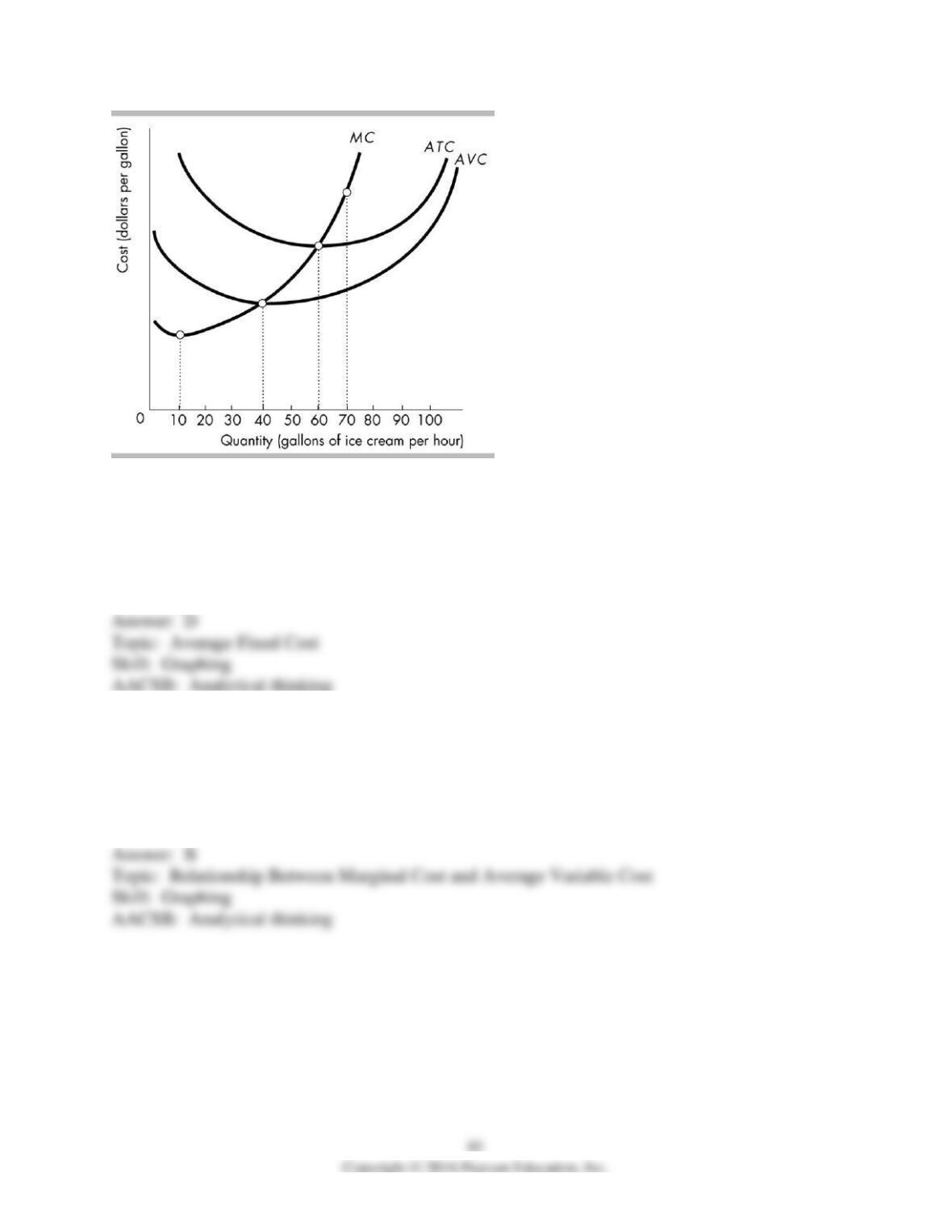
143) Some of the cost curves for Ike’s Ice Cream Kitchen are given in the above figure. At which
of the following levels of output will AFC be the lowest?
A) at 0 gallons
B) at 10 gallons
C) at 40 gallons
D) at 70 gallons
144) As illustrated in the above figure, after 40 gallons are produced each hour at Ike’s Ice Cream
Kitchen, the AVC curve starts to slope upward. The AVC starts to slope upward because the
A) MC curve slopes upward.
B) MC exceeds the AVC.
C) ATC curve has not yet reached its minimum.
D) None of the above answers is correct.
145) As illustrated in the above figure, after 60 gallons are produced each hour at Ike’s Ice Cream
Kitchen, the ATC curve starts to slope upward. The ATC starts to slope upward because the
A) MC curve slopes upward.
B) MC exceeds the ATC.
C) distance between the ATC and the AVC curve is shrinking.
D) None of the above answers is correct.
146) Based on the above figure, up to which level of output will Ike’s Ice Cream Kitchen have
increasing marginal returns?
A) only at 0 gallons
B) up to 10 gallons
C) up to 40 gallons
D) up to 60 gallons
147) Based on the above figure, at which level of output does diminishing marginal returns first
occur at Ike’s Ice Cream Kitchen?
A) at 0 gallons
B) at 10 gallons
C) at 40 gallons
D) at 60 gallons
148) Some of the cost curves for Ike’s Ice Cream Kitchen are given in the above figure. At which
of the following levels of output does the marginal product of labor equal the average product of
labor?
A) at 0 gallons
B) at 10 gallons
C) at 40 gallons
D) at 60 gallons
149) Based on the above figure, for which of the following levels of output at Ike’s Ice Cream
Kitchen does the marginal product of labor exceed the average product of labor?
A) at 10 gallons
B) at 40 gallons
C) at 70 gallons
D) all of the above
150) Based on the above figure, for which of the following amounts of output at Ike’s Ice Cream
Kitchen does the average product of labor exceed the marginal product of labor?
A) at 10 gallons
B) at 40 gallons
C) at 70 gallons
D) all of the above
151) The marginal cost (MC) curve intersects the
A) ATC, AVC, and AFC curves at their minimum points.
B) ATC and AFC curves at their minimum points.
C) AVC and AFC curves at their minimum points.
D) ATC and AVC curves at their minimum points.
152) If average variable cost is decreasing as output increases, then marginal cost is definitely
A) decreasing as output increases.
B) increasing as output increases.
C) less than average variable cost.
D) greater than average variable cost.
153) When marginal cost is greater than average total cost, the
A) marginal cost decreases as output increases.
B) marginal cost does not change as output increases.
C) average total cost increases as output increases.
D) average total cost decreases as output increases.
154) If marginal cost is less than average variable cost and output increases, average total cost
________ and average variable cost ________.
A) increases; increases
B) decreases; decreases
C) decreases; increases
D) increases; decreases
155) If marginal cost exceeds average variable cost but is less than average total cost, then as
output increases average total cost ________ and average variable cost ________.
A) increases; decreases
B) decreases; decreases
C) increases; increases
D) decreases; increases
156) If marginal cost is less than average total cost, then ________ is ________.
A) average total cost; falling
B) average variable cost; falling
C) marginal cost; falling
D) marginal cost; rising
157) The marginal cost curve passes through the ________ points of the ________ cost curve
and the ________ cost curve.
A) minimum; average total; average variable
B) minimum; average total; average fixed
C) maximum; total cost; total variable
D) minimum; average variable; average fixed
158) If marginal cost exceeds average variable cost, then ________ cost is ________ as output
increases.
A) average total; at a maximum
B) average total; falling
C) average variable; rising
D) average fixed; at a maximum
159) Average variable cost is at a minimum at the same amount of output at which
A) average product is at a maximum.
B) marginal product is at a maximum.
C) average product is at a minimum.
D) marginal product is at a minimum.
160) The range of output over which a firm’s average variable cost is decreasing is the same as
the range over which its
A) marginal cost is increasing.
B) average fixed cost is decreasing.
C) average product is increasing.
D) average product is decreasing.
161) If as output increases average product increases, then ________.
A) average total cost decreases
B) average fixed cost decreases
C) marginal cost decreases
D) average variable cost decreases
162) The output at which average product is a maximum is the same output at which ________
is a minimum.
A) average fixed cost
B) average variable cost
C) average total cost
D) marginal cost
163) Increasing marginal returns means that as the firm expands its output, its
A) long-run average total cost increases.
B) long-run average total cost decreases.
C) short-run average total cost increases.
D) short-run average total cost decreases.
164) Marginal cost eventually increases because
A) of the law of diminishing returns.
B) eventually each additional worker produces a successively smaller addition to output.
C) the marginal product of the variable input eventually falls.
D) All of the above answers are correct.
165) A technological change that increases productivity ________ marginal product and
________ marginal cost.
A) increases; increases
B) increases; decreases
C) decreases; increases
D) decreases; decreases
166) Which of the following shifts the ATC curve upward at the XYZ Co.?
A) an increase in the hourly wage that XYZ pays its workers
B) a decrease in the hourly wage that XYZ pays its workers
C) an increase in the fixed amount of liability insurance premiums that XYZ pays for its business
D) Both answers A and C are correct.
167) Which of the following shifts the AVC curve upward at Barney’s Bagel Bakery?
A) an increase in the hourly wage that Barney pays his workers
B) a decrease in the hourly wage that Barney pays his workers
C) an increase in the fixed amount of liability insurance premiums that Barney pays for his
business
D) Both answers A and C are correct.
168) Which of the following shifts the AVC curve upward at Barney’s Bagel Bakery?
A) an increase in the hourly wage that Barney pays his workers
B) an increase in Barney’s daily output from hiring more workers
C) an increase in the fixed amount of local property tax that Barney pays on the building he owns
and uses
D) all of the above
169) A change in technology that shifts the firm’s total product curve upward without changing
the quantity of capital used
A) shifts the average total cost curve upward.
B) shifts the average total cost curve downward.
C) does not change the cost curves.
D) shifts the marginal cost curve upward.
170) The a firm’s short-run cost curves shifts when there is a change in
A) technology
B) the prices of factors of production
C) the quantity of outputs
D) Both answers A and B are correct.
171) Which cost always increases as output increases?
A) total cost
B) marginal cost
C) average total cost
D) average fixed cost
172) Pat’s Catering finds that when it caters 20 meals a week, its total cost is $6,000. If Pat has
total variable cost of $5,000, what is Pat’s total fixed cost?
A) $50
B) $250
C) $1,000
D) $6,000
173) The change in total cost from producing another unit of output equals the
A) average total cost.
B) variable cost.
C) average variable cost.
D) marginal cost.
174) A farmer discovers that the total cost of growing 50 acres of eggplant is $50,000 and that
the total cost of growing 51 acres of eggplant is $52,000. The marginal cost of the 51st acre of
eggplant is
A) $52,000.
B) $50,000.
C) $2,000.
D) $1,000.
175) Which curve intersects the AVC curve at its minimum point?
A) the MC curve
B) the ATC curve
C) the AFC curve
D) the MP curve
176) If the ATC curve has a positive slope, then the MC curve must be
A) horizontal.
B) vertical.
C) above the ATC curve.
D) below the ATC curve.
177) The average variable cost curve shifts downward if
A) there is a decrease in fixed costs.
B) there is a technological advance.
C) the cost of a variable input increases.
D) the price of output decreases.
178) The cost of a variable input, such as the wage paid to workers, decreases. This decrease
shifts the
A) total fixed cost curve downward.
B) marginal product of labor curve downward.
C) average variable cost curve downward.
D) marginal product of labor curve upward.
Labor
(workers)
Output
(units)
Total fixed
cost, TFC
(dollars)
Total variable
cost, TVC
(dollars)
Total cost, TC
(dollars)
0
0
20
0
20
1
4
20
25
45
2
9
20
50
70
3
13
20
75
95
4
16
20
100
120
5
18
20
125
145
179) Using the data in the above table, the average fixed cost of producing 16 units is
A) $1.11 a unit.
B) $1.25 a unit.
C) $1.54 a unit.
D) $2.22 a unit.
180) Using the data in the above table, when the firm increases its output from 4 to 9 units, the
marginal cost of a unit is
A) $4.00 a unit.
B) $5.00 a unit.
C) $6.00 a unit.
D) $7.00 a unit.
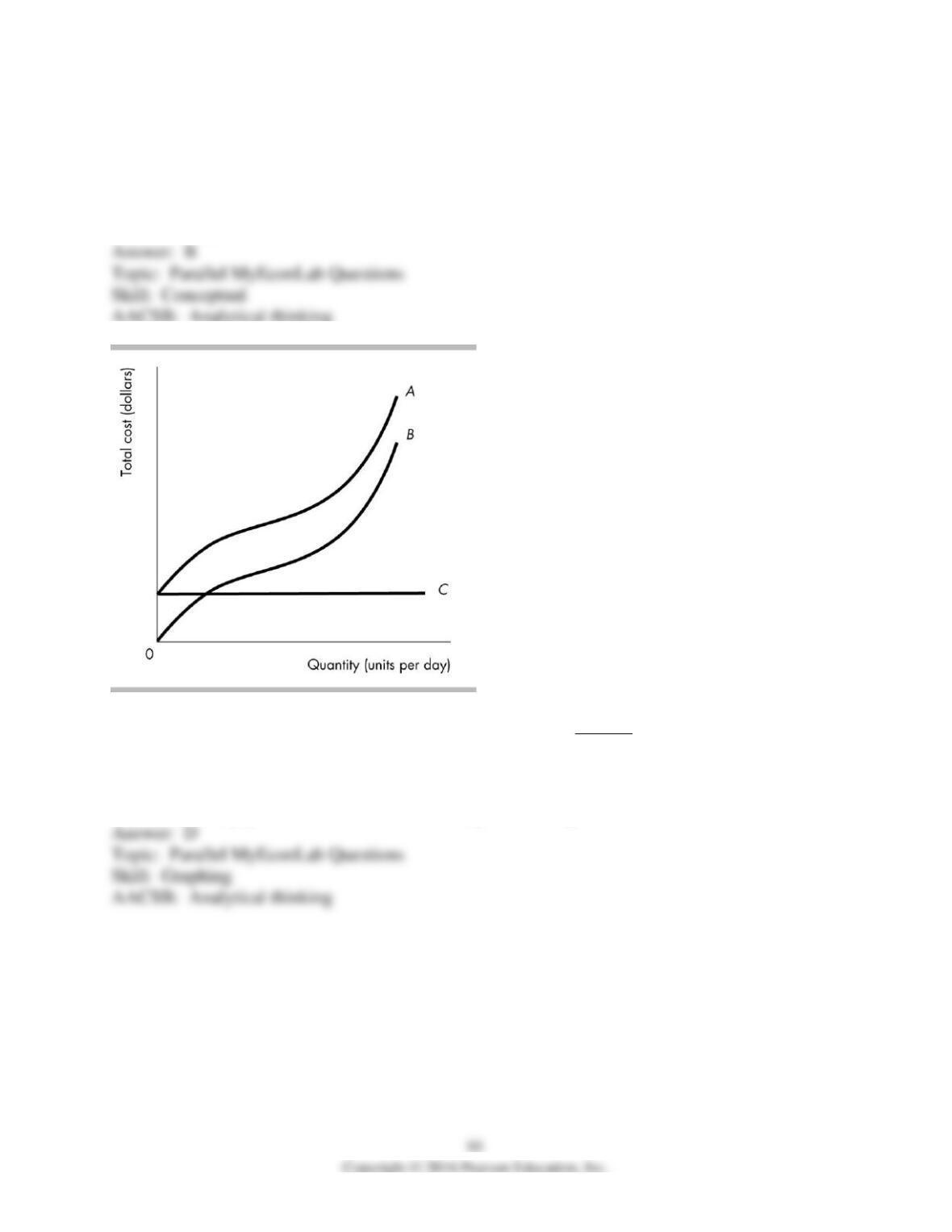
181) In the above figure, which of the following statements is FALSE?
A) The total fixed cost curve is curve C.
B) Total variable cost and total cost both increase as output increases.
C) Marginal cost is equal to the slope of curve A.
D) The vertical gap between curves A and B is equal to average fixed cost.
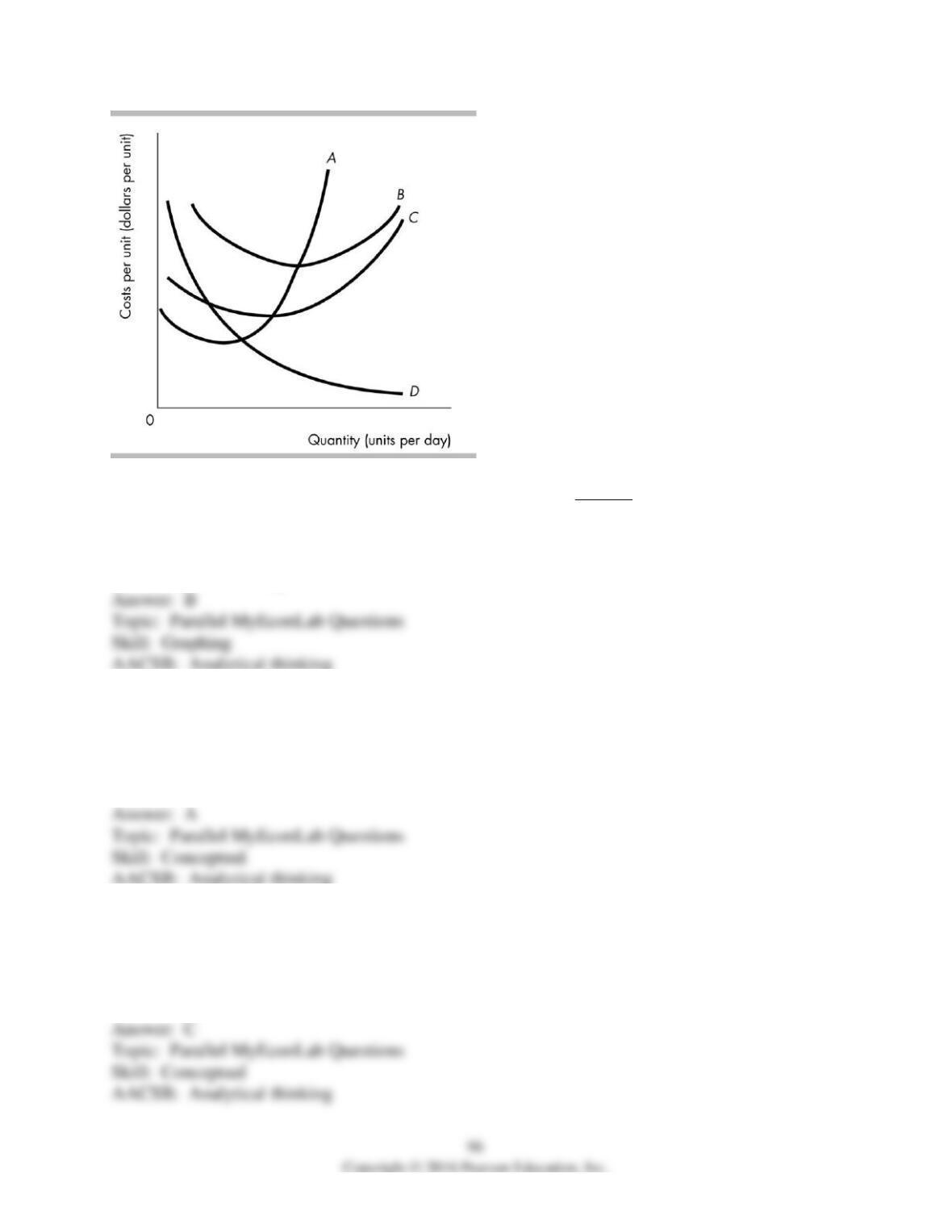
182) In the above figure, which of the following statements is FALSE?
A) Average fixed cost decreases as output decreases.
B) The vertical gap between curves B and C equals marginal fixed cost.
C) The vertical gap between curves B and C gets smaller as AFC decreases.
D) Curve A is the marginal cost curve.
183) Poppy Lipstick is a lipstick producer. A decrease in the rent paid by Poppy Lipstick
A) shifts its TFC curve downward but not its TVC curve.
B) shifts both its TFC curve and its TVC curve downward.
C) does not shift its TFC curve but shifts its TVC curve upward.
D) does not shift its TFC curve but shifts its TVC curve downward.
184) Sticky Cakes is a bakery. A decrease in the wage rate that Sticky Cakes pays its workers
A) does not shift its MC curve or its ATC curve.
B) shifts its MC curve downward but not its ATC curve.
C) shifts both its MC curve and its ATC curve downward.
D) does not shift its MC curve but shifts its ATC curve downward.
4 Long-Run Cost
1) Which of the following statements is TRUE?
A) In the long run, the average cost curve is always downward sloping.
B) In the long run, the quantities of all inputs are fixed.
C) In the long run, the firms’ fixed costs are greater than its variable costs.
D) In the long run, all costs are variable costs.
2) Which of the following is FALSE?
A) Long-run average variable costs equal long-run average total costs.
B) Fixed costs increase in the long run.
C) As a firm produces more output, eventually it experiences diseconomies of scale.
D) In the long run, both the amount of capital and labor used by the firm can be changed.
3) In the long run
A) all inputs can be varied.
B) all inputs are fixed.
C) some inputs are variable and other inputs are fixed.
D) output is fixed.
4) The firm’s production function is the relationship between the ________ and ________.
A) output produced; the quantities of all inputs
B) maximum output attainable; the quantity of variable inputs
C) possible range of maximum output; the quantity of variable inputs
D) maximum output attainable; the quantities of both labor and capital
5) A firm’s long run cost is the cost of production when the firm
A) calculates its cost at least one year into the future.
B) adds together all of its short run costs.
C) uses the economically efficient quantities for its plant and its labor.
D) can vary the amount of output it produces.
6) A firm’s long-run average cost curve
A) shows the lowest attainable average total cost of producing any level of output when the plant
and labor are fixed.
B) is the sum of all of its short-run average cost curves.
C) tells the firm which plant size to use and which quantity of labor to use to minimize the cost
of producing any level of output.
D) all of the above
7) The long-run average cost curve is the
A) change in total product divided by the change in capital when the quantity of labor is
constant.
B) change in output resulting from a one-unit increase in the quantity of capital.
C) relationship between the lowest attainable average total cost and output when both the plant
size and labor are varied.
D) relationship between the lowest attainable average total cost and output when both the plant
size and labor are fixed.
8) A firm’s long-run average cost curve
A) shows the lowest attainable average total cost of producing any level of output when the plant
and labor are variable.
B) is U-shaped.
C) tells the firm which plant size to use and which quantity of labor to use to minimize the cost
of producing any level of output.
D) all of the above
9) Which of the following is CORRECT?
A) A firm’s short-run average cost curve is derived from a series of long-run average cost curves.
B) A firm’s long-run average cost curve is derived from a series of short-run average cost curves.
C) A firm’s long-run total cost is the difference between its long-run fixed cost and long-run
variable cost.
D) Both answers A and C are correct.
10) For each short-run average total cost curve, the ________ the plant, the ________ is the
output at which average total cost is at a ________.
A) larger; greater; maximum
B) larger; greater; minimum
C) larger; smaller; minimum
D) smaller; smaller; minimum
Labor
(workers per week)
Output with Plant 1 (1 oven)
(pizzas per week)
Output with Plant 2 (2 ovens)
(pizzas per week)
1
50
60
2
80
130
3
100
180
4
110
220
5
115
240
11) Silvio’s Pizza is a small pizzeria. The firm’s production function is shown in the table above.
Suppose that Silvio’s costs include only the cost of renting ovens, which is $100 per oven per
week, the labor cost, $280 per worker per week, and the opportunity cost of Silvio’s
entrepreneurship, $1,000 per week.
Suppose Silvio’s kitchen currently has enough room for only one oven. If Silvio employs 3
workers, producing 200 pizzas per week is ________ in the short run and ________ in the long
run.
A) impossible; impossible
B) impossible; possible
C) possible; impossible
D) possible; possible
12) Silvio’s Pizza is a small pizzeria. The firm’s production function is shown in the table above.
Suppose that Silvio’s costs include only the cost of renting ovens, which is $100 per oven per
week, the labor cost, $280 per worker per week, and the opportunity cost of Silvio’s
entrepreneurship, $1,000 per week.
If Silvio’s uses Plant 1, the marginal product of the 3rd worker is ________ pizzas per week.
A) 33
B) 100
C) 20
D) 80
13) Silvio’s Pizza is a small pizzeria. The firm’s production function is shown in the table above.
Suppose that Silvio’s costs include only the cost of renting ovens, which is $100 per oven per
week, the labor cost, $280 per worker per week, and the opportunity cost of Silvio’s
entrepreneurship, $1,000 per week.
With Plant 2, Silvio’s average product per worker is highest if ________ workers per week are
employed.
A) 3
B) 4
C) 5
D) 2
14) Silvio’s Pizza is a small pizzeria. The firm’s production function is shown in the table above.
Suppose that Silvio’s costs include only the cost of renting ovens, which is $100 per oven per
week, the labor cost, $280 per worker per week, and the opportunity cost of Silvio’s
entrepreneurship, $1,000 per week. Suppose Silvio’s uses Plant 2. If Silvio hires the 4th worker,
the firm will experience ________ marginal returns.
A) diminishing
B) increasing
C) constant
D) zero