Chapter 11: The Basics of Capital Budgeting
0
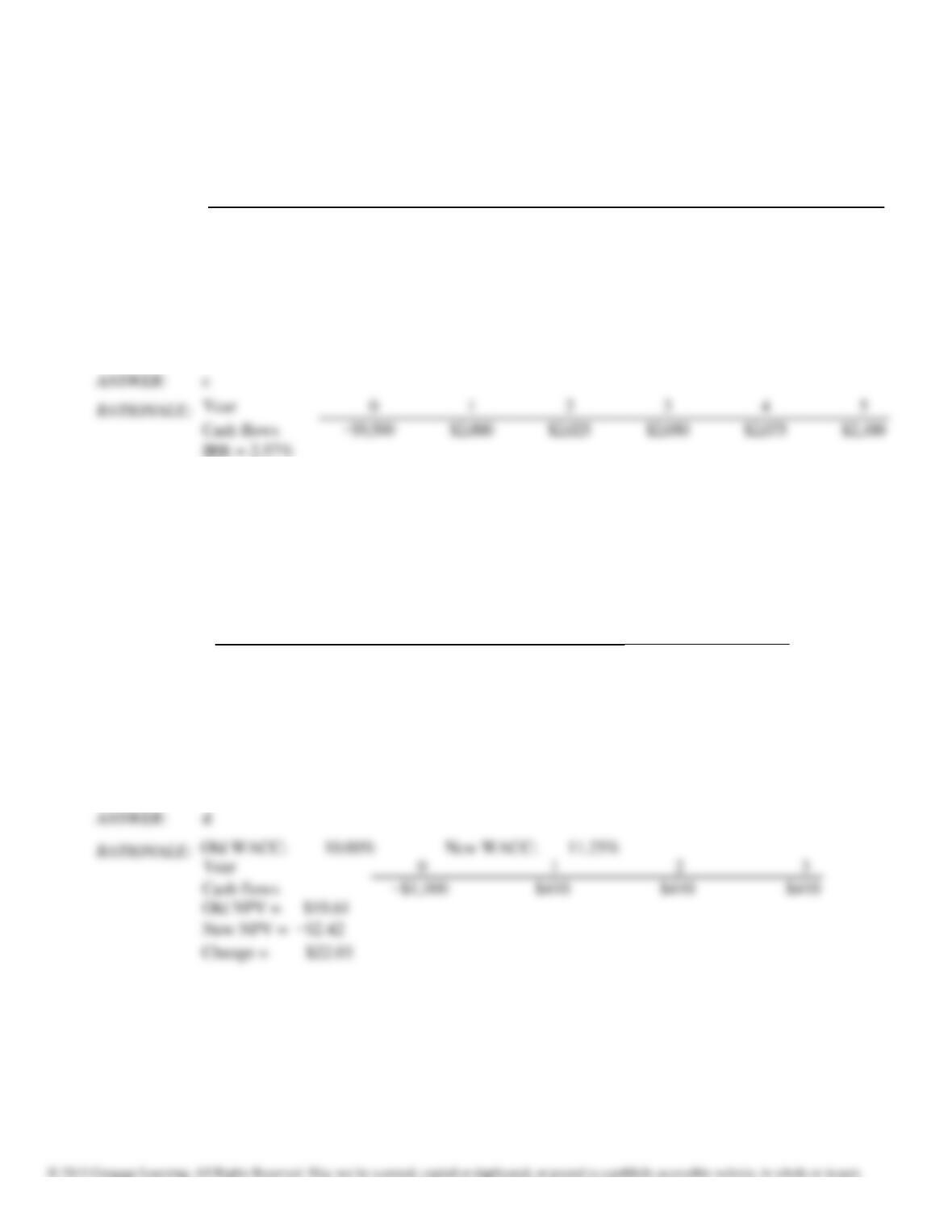
91.
Maxwell Feed & Seed is considering a project that has the following cash flow data. What is the project’s
IRR?
Note that a project’s projected IRR can be less than the WACC (and even negative), in which case it
will be
rejected.
Year
0
1
2
3
4
5
Cash flows
a. 2.08%
−$9,500
$2,000
$2,025
$2,050
$2,075
$2,100
b. 2.31%
c. 2.57%
d. 2.82%
e. 3.10%
92.
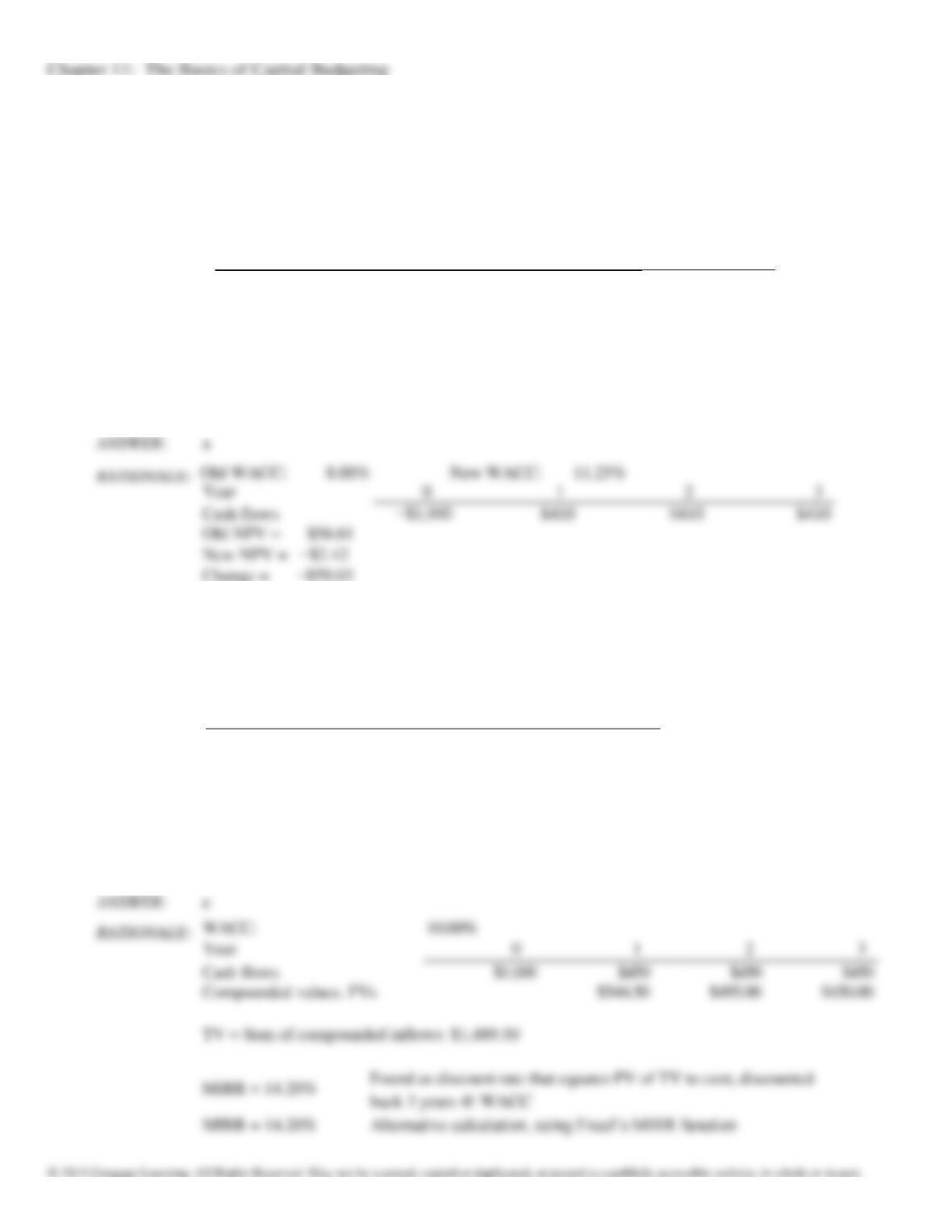
Last month, Lloyd’s Systems analyzed the project whose cash flows are shown below. However, before the
decision to accept or reject the project, the Federal Reserve took actions that changed interest rates and
therefore
the firm’s WACC. The Fed’s action did not affect the forecasted cash flows. By how much did the
change in the
WACC affect the project’s forecasted NPV? Note that a project’s projected NPV can be
negative, in which case it
should be rejected.
Old WACC:
Year
10.00%
0
New WACC: 11.25%
1
2
3
Cash flows
−$1,00
$41
$410
$410
a. −$18.89
b. −$19.88
c. −$20.93
d. −$22.03
e. −$23.13
WACC:
10.00%
93.
Lasik Vision Inc. recently analyzed the project whose cash flows are shown below. However, before Lasik
decided to accept or reject the project, the Federal Reserve took actions that changed interest rates and
therefore
the firm’s WACC. The Fed’s action did not affect the forecasted cash flows. By how much did the
change in the
WACC affect the project’s forecasted NPV? Note that a project’s projected NPV can be
negative, in which case it
should be rejected.
Old WACC:
Year
8.00%
0
New WACC: 11.25%
1
2
3
Cash flows
−$1,00
$41
$410
$410
a. −$59.03
b. −$56.08
c. −$53.27
d. −$50.61
e. −$48.08
94.
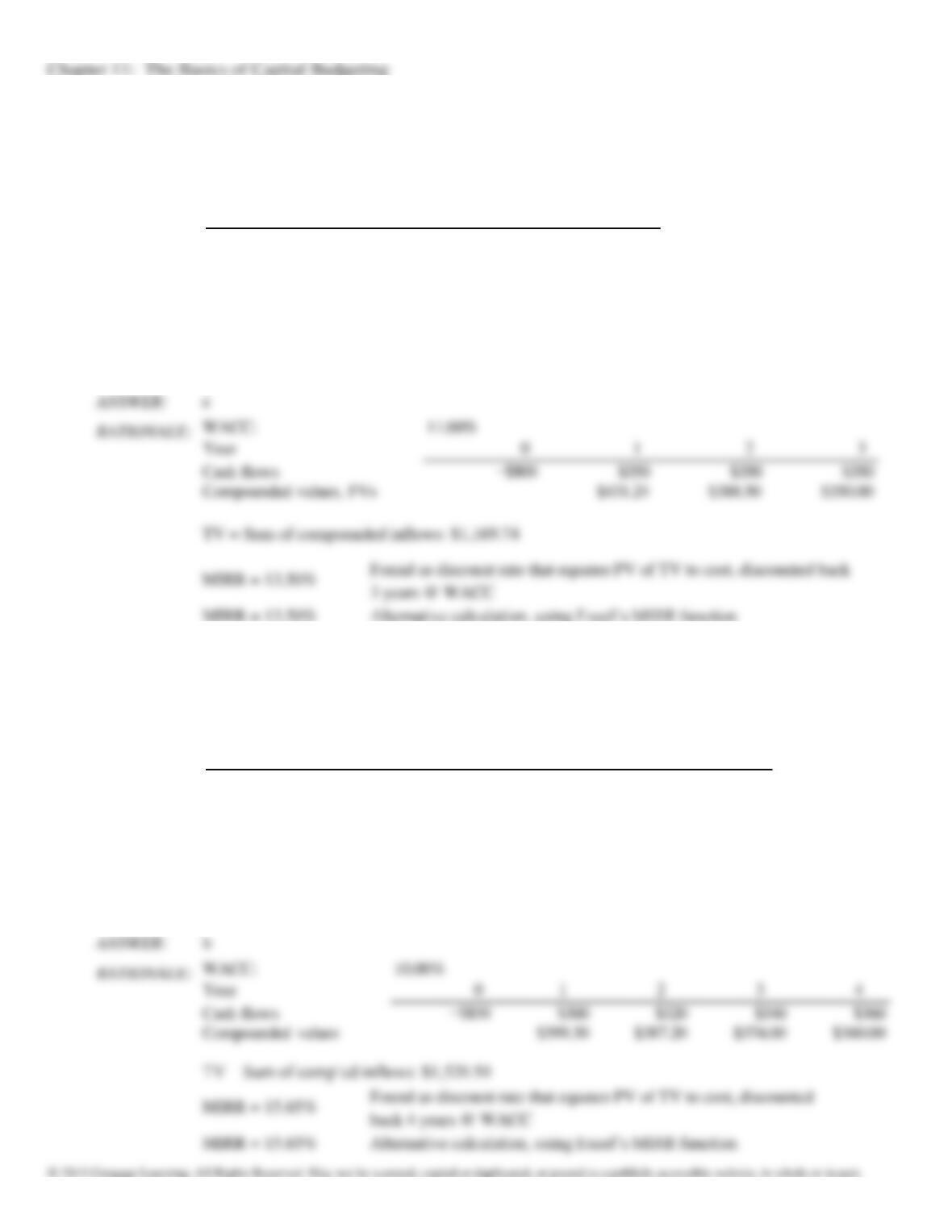
Ehrmann Data Systems is considering a project that has the following cash flow and WACC data. What is the
project’s MIRR? Note that a project’s projected MIRR can be less than the WACC (and even negative), in
which
case it will be rejected.
WACC:
Year
10.00%
0
1
2
3
Cash flows
a. 9.32%
−$1,000
$450
$450
$450
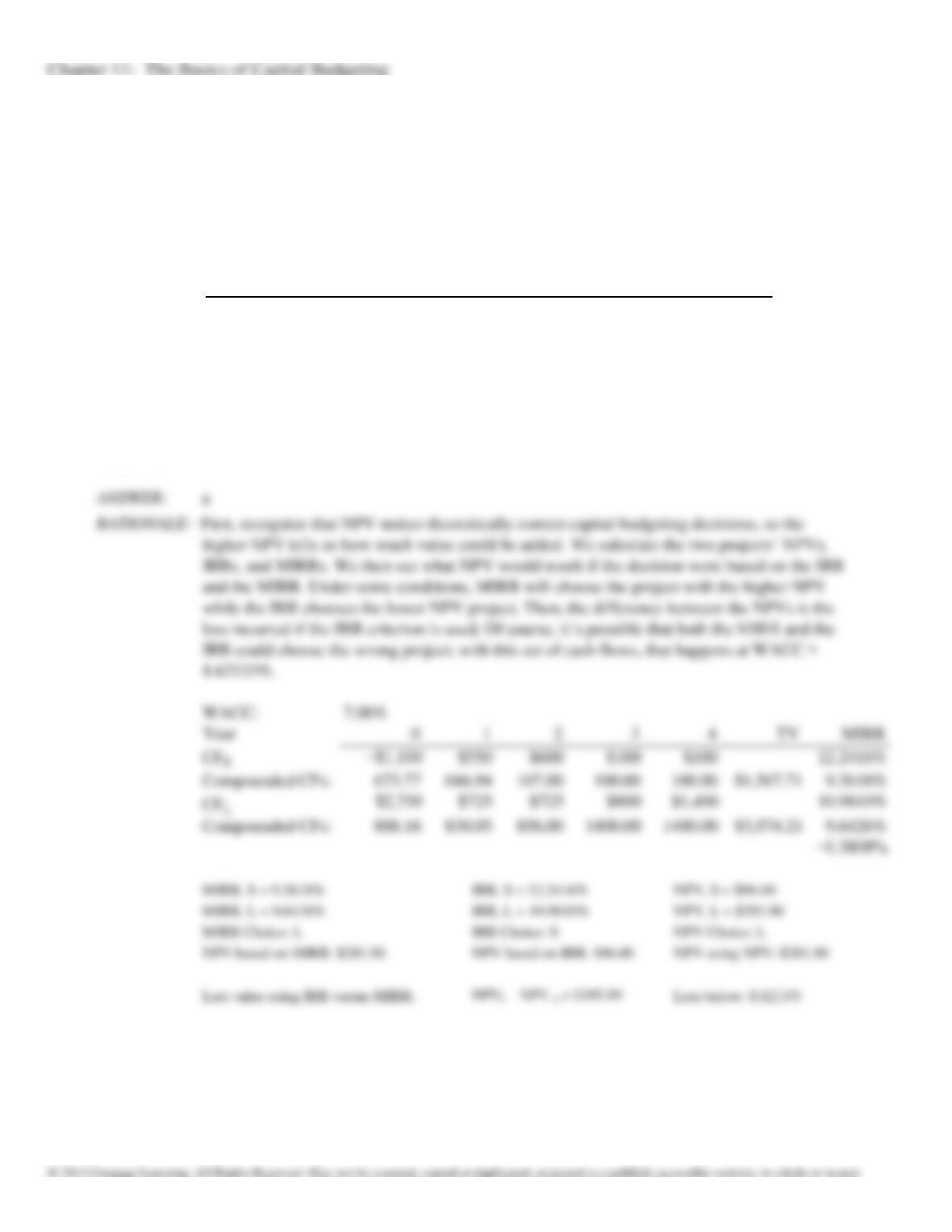
b. 10.35%
c. 11.50%
d. 12.78%
e. 14.20%
WACC:
11.00%
0
Compounded values, FVs
95.
Ingram Electric Products is considering a project that has the following cash flow and WACC data. What is
the
project’s MIRR? Note that a project’s projected MIRR can be less than the WACC (and even negative), in
which
case it will be rejected.
WACC:
Year
11.00%
0
1
2
3
Cash flows
a. 8.86%
−$800
$350
$350
$350
b. 9.84%
c. 10.94%
d. 12.15%
e. 13.50%
96.
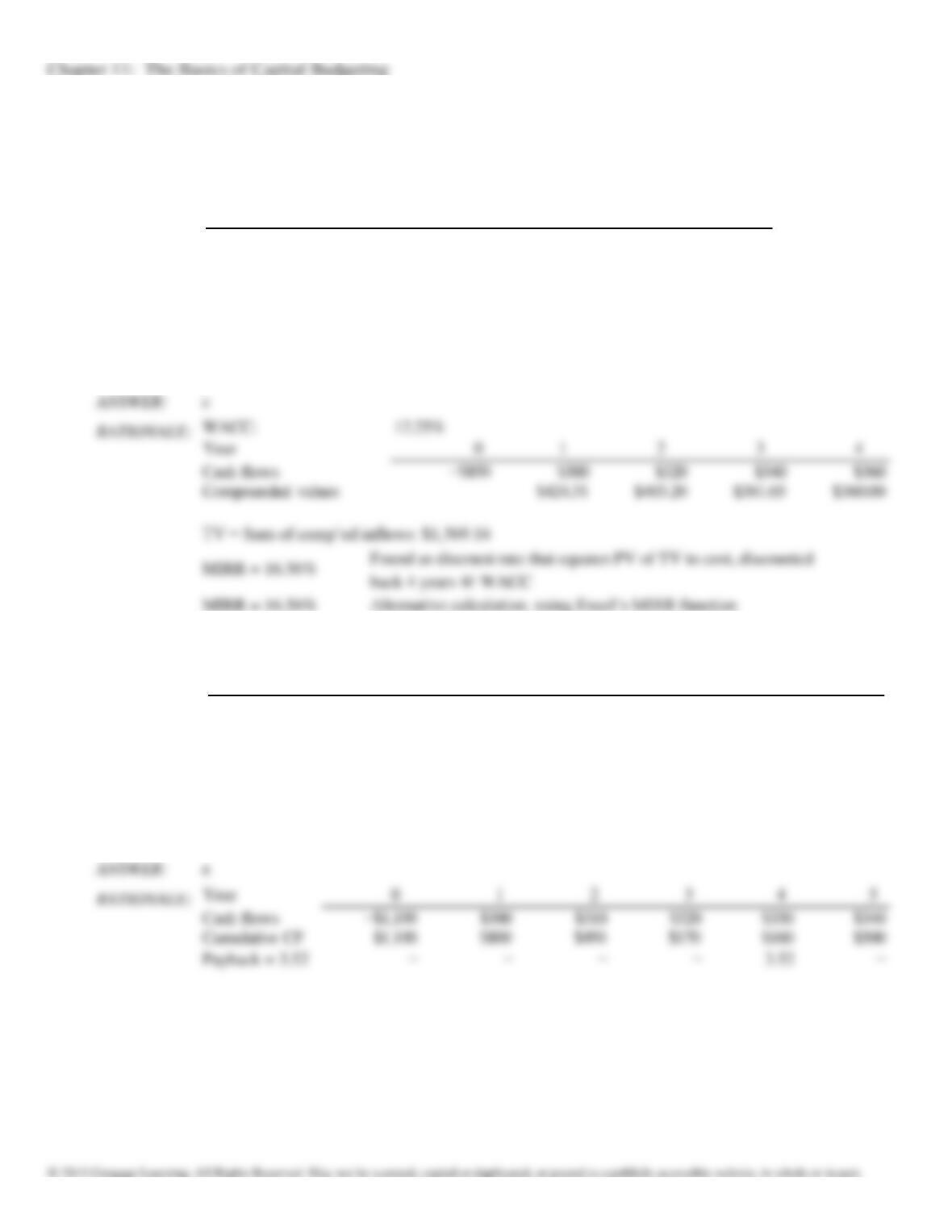
Malholtra Inc. is considering a project that has the following cash flow and WACC data. What is the project’s
MIRR? Note that a project’s projected MIRR can be less than the WACC (and even negative), in which case
it
will be rejected.
WACC:
Year
10.00%
0
1
2
3
4
Cash flows
a. 14.08%
−$850
$300
$320
$340
$360
b. 15.65%
c. 17.21%
d. 18.94%
e. 20.83%
Compounded values
97.
Hindelang Inc. is considering a project that has the following cash flow and WACC data. What is the
project’s
MIRR? Note that a project’s projected MIRR can be less than the WACC (and even negative), in
which case it
will be rejected.
WACC:
Year
12.25%
0
1
2
3
4
Cash flows
a. 13.42%
−$850
$300
$320
$340
$360
b. 14.91%
c. 16.56%
d. 18.22%
e. 20.04%
98.
Stern Associates is considering a project that has the following cash flow data. What is the project’s payback?
Year
0
1
2
3
4
5
Cash flows
a. 2.31 years
−$1,100
$300
$310
$320
$330
$340
b. 2.56 years
c. 2.85 years
d. 3.16 years
e. 3.52 years
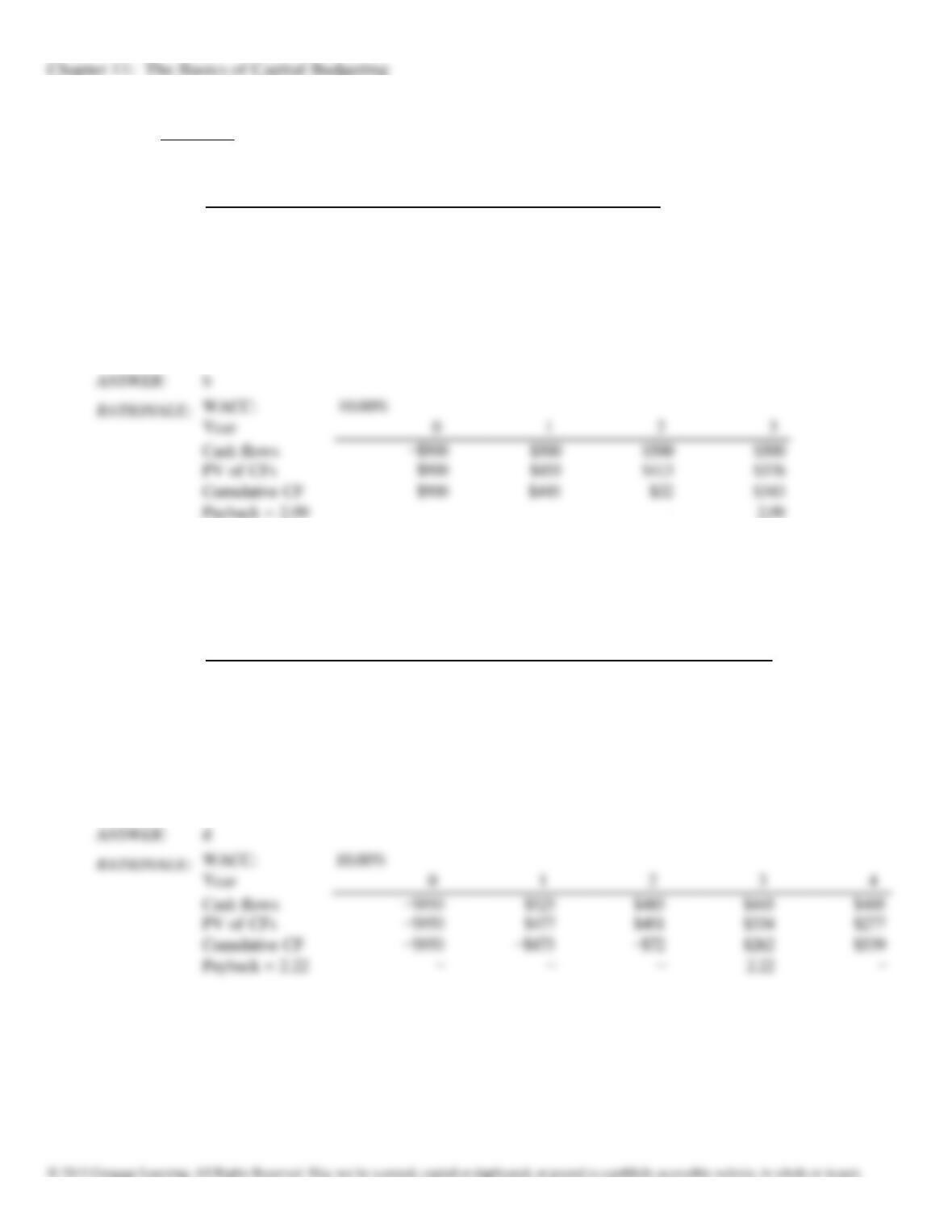
Payback = 2.22
99.
Fernando Designs is considering a project that has the following cash flow and WACC data. What is the
project’s
discounted payback?
WACC:
Year
10.00%
0
1
2
3
Cash flows
a. 1.88 years
−$900
$500
$500
$500
b. 2.09 years
c. 2.29 years
d. 2.52 years
e. 2.78 years
100.
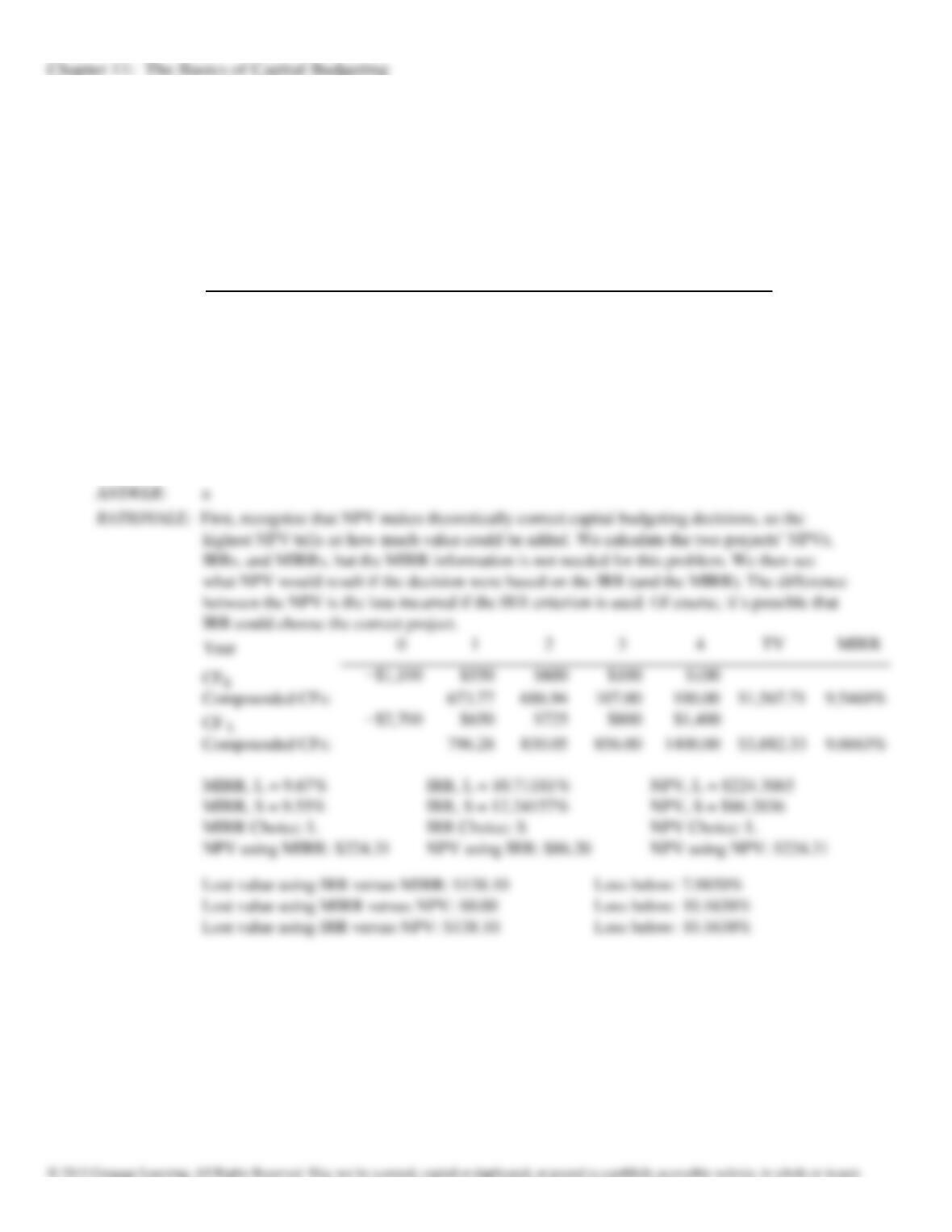
Masulis Inc. is considering a project that has the following cash flow and WACC data. What is the project’s
discounted payback?
WACC:
Year
10.00%
0
1
2
3
4
Cash flows
a. 1.61 years
−$950
$525
$485
$445
$405
b. 1.79 years
c. 1.99 years
d. 2.22 years
e. 2.44 years
101.
Tesar Chemicals is considering Projects S and L, whose cash flows are shown below. These projects are
mutually
exclusive, equally risky, and not repeatable. The CEO believes the IRR is the best selection
criterion, while the
CFO advocates the NPV. If the decision is made by choosing the project with the higher
IRR rather than the one
with the higher NPV, how much, if any, value will be forgone, i.e., what’s the chosen
NPV versus the maximum
possible NPV? Note that (1) “true value” is measured by NPV, and (2) under some
conditions the choice of IRR
vs. NPV will have no effect on the value gained or lost.
WACC:
Year
7.50%
0
1
2
3
4
CFS
−$1,100
$550
$600
$100
$100
CFL
−$2,700
$650
$725
$800
$1,400
a. $138.10
b. $149.21
c. $160.31
d. $171.42
e. $182.52
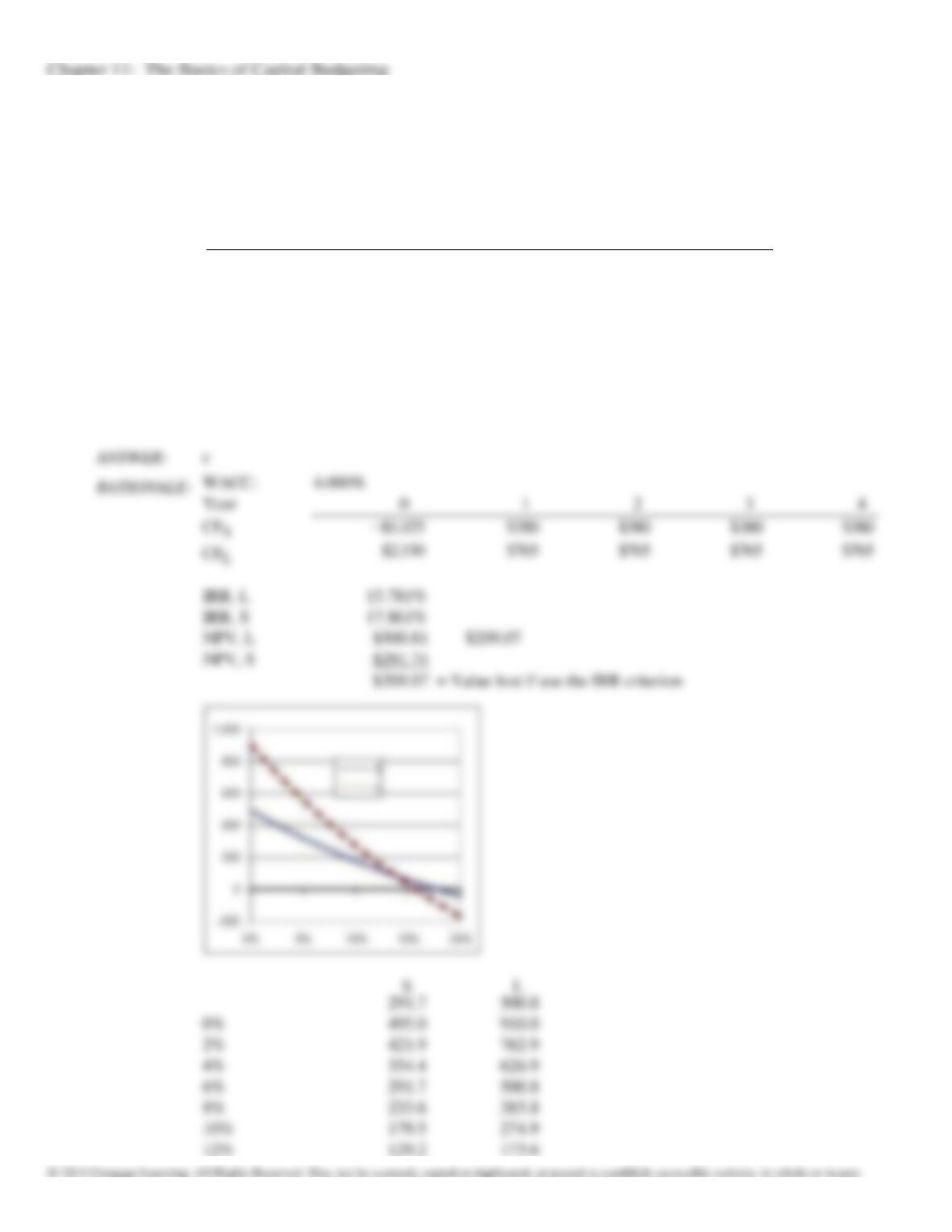
c
102.
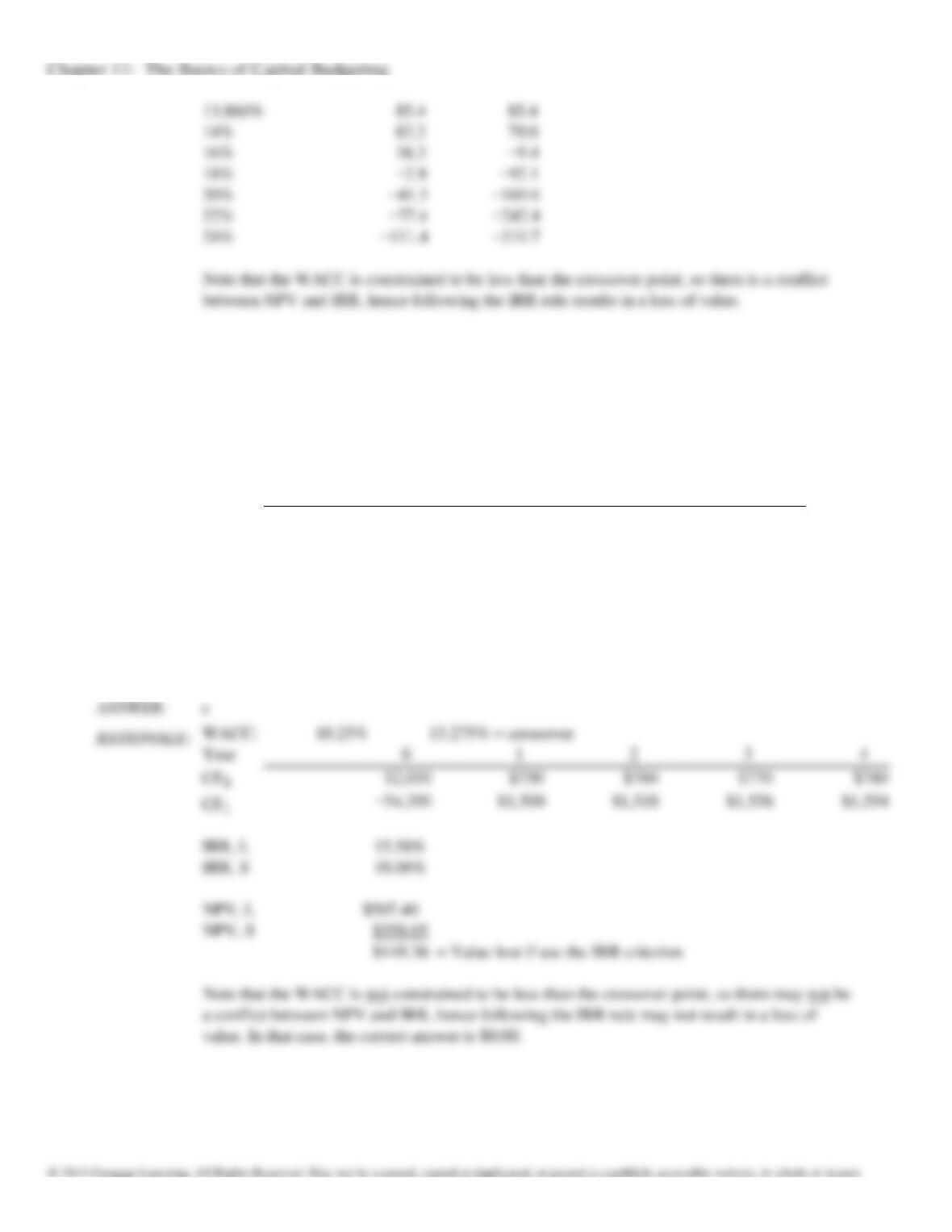
A firm is considering Projects S and L, whose cash flows are shown below. These projects are mutually
exclusive,
equally risky, and not repeatable. The CEO wants to use the IRR criterion, while the CFO favors
the NPV method.
You were hired to advise the firm on the best procedure. If the wrong decision criterion is
used, how much
potential value would the firm lose?
WACC:
Year
6.00%
0
1
2
3
4
CFS
−$1,025
$380
$380
$380
$380
CFL
−$2,150
$765
$765
$765
$765
a. $188.68
b. $198.61
c. $209.07
d. $219.52
e. $230.49
103.
Sexton Inc. is considering Projects S and L, whose cash flows are shown below. These projects are mutually
exclusive, equally risky, and not repeatable. If the decision is made by choosing the project with the higher
IRR,
how much value will be forgone? Note that under certain conditions choosing projects on the basis of
the IRR will
not cause any value to be lost because the one with the higher IRR will also have the higher
NPV, so no value will
be lost if the IRR method is used.
WACC:
Year
10.25%
0
1
2
3
4
CFS
−$2,050
$750
$760
$770
$780
CFL
−$4,300
$1,500
$1,518
$1,536
$1,554
a. $134.79
b. $141.89
c. $149.36
d. $164.29
e. $205.36
2
4
CFS
$760
$780
104.
Moerdyk & Co. is considering Projects S and L, whose cash flows are shown below. These projects are
mutually
exclusive, equally risky, and not repeatable. If the decision is made by choosing the project with the
higher IRR,
how much value will be forgone? Note that under certain conditions choosing projects on the
basis of the IRR will
not cause any value to be lost because the one with the higher IRR will also have the
higher NPV, i.e., no conflict
will exist.
WACC:
Year
10.00%
0
1
2
3
4
CFS
−$1,025
$650
$450
$250
$50
CFL
−$1,025
$100
$300
$500
$700
a. $5.47
b. $6.02
c. $6.62
d. $7.29
e. $7.82
CFS
105.
Kosovski Company is considering Projects S and L, whose cash flows are shown below. These projects are
mutually exclusive, equally risky, and are not repeatable. If the decision is made by choosing the project with
the
higher IRR, how much value will be forgone? Note that under some conditions choosing projects on the
basis of the
IRR will cause $0.00 value to be lost.
WACC: 7.75%
Year
0
1
2
3
4
CFS −$1,050 $675 $650
CFL −$1,050 $360 $360 $360 $360
a. $11.45
b. $12.72
c. $14.63
d. $16.82
e. $19.35
106.
Nast Inc. is considering Projects S and L, whose cash flows are shown below. These projects are mutually
exclusive, equally risky, and not repeatable. If the decision is made by choosing the project with the higher
MIRR
rather than the one with the higher NPV, how much value will be forgone? Note that under some
conditions
choosing projects on the basis of the MIRR will cause $0.00 value to be lost.
WACC: 8.75%
Year
0
1
2
3
4
CFS −$1,100 $375 $375 $375 $375
CFL −$2,200 $725 $725 $725 $725
a. $32.12
b. $35.33
c. $38.87
d. $40.15
e. $42.16
107.
Yonan Inc. is considering Projects S and L, whose cash flows are shown below. These projects are mutually
exclusive, equally risky, and not repeatable. If the decision is made by choosing the project with the shorter
payback, some value may be forgone. How much value will be lost in this instance? Note that under some
conditions choosing projects on the basis of the shorter payback will not cause value to be lost.
WACC:
Year
10.25%
0
1
2
3
4
CFS
−$950
$500
$800
$0
$0
CFL
−$2,100
$400
$800
$800
$1,000
a. $24.14
b. $26.82
c. $29.80
d. $33.11
e. $36.42
CFS
$0
108.
Noe Drilling Inc. is considering Projects S and L, whose cash flows are shown below. These projects are
mutually
exclusive, equally risky, and not repeatable. The CEO believes the IRR is the best selection
criterion, while the
CFO advocates the MIRR. If the decision is made by choosing the project with the higher
IRR rather than the one
with the higher MIRR, how much, if any, value will be forgone, i.e., what’s the NPV
of the chosen project versus
the maximum possible NPV? Note that (1) “true value” is measured by NPV, and
(2) under some conditions the
choice of IRR vs. MIRR will have no effect on the value lost.
WACC:
Year
7.00%
0
1
2
3
4
CFS
−$1,100
$550
$600
$100
$100
CFL
−$2,750
$725
$725
$800
$1,400
a. $185.90
b. $197.01
c. $208.11
d. $219.22
e. $230.32
CFS