114) When the marginal product of labor exceeds the average product of labor
A) the average product of labor is increasing.
B) the average product of labor is decreasing.
C) the total product curve is negatively sloped.
D) the firm is experiencing decreasing returns to scale.
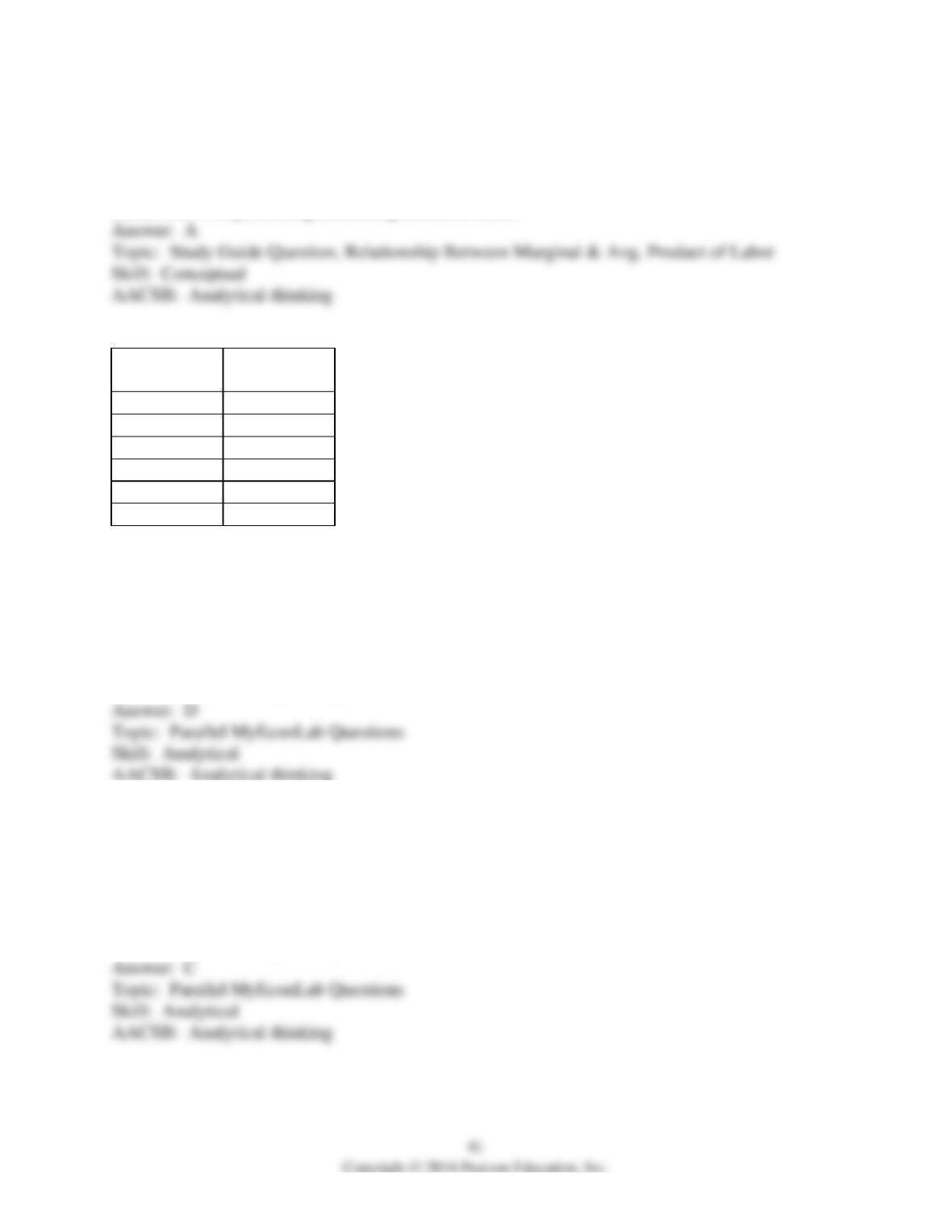
Labor
(workers)
Total product
(units per day)
0
0
1
3
2
12
3
19
4
23
5
25
115) Using the data in the above table, if the firm employs 3 workers, total product (measured in
units per day) and average product and marginal product of the third worker (measured in units
per worker) are
A) 19, 6 1/3, and 9 respectively.
B) 3, 19, and 6 1/3 respectively.
C) 19, 3, and 9 respectively.
D) 19, 6 1/3, and 7 respectively.
116) Using the data in the above table, if the firm employs 5 workers, total product (measured in
units per day) and average product and marginal product of the fifth worker (measured in units
per worker) are
A) 23, 5.00, and 4 respectively.
B) 23, 5.75, and 4 respectively.
C) 25, 5.00, and 2 respectively.
D) 25, 5.75, and 4 respectively.
3 Short-Run Cost
1) A firm’s total cost (TC) equals the sum of its fixed cost plus its
A) marginal cost.
B) variable cost.
C) variable cost plus its marginal cost.
D) sunk cost plus its variable cost plus its marginal cost.
2) Total cost is equal to the
A) sum of the total fixed cost and the total variable cost.
B) sum of the average fixed cost and the average variable cost.
C) difference between the average variable cost and the average fixed cost.
D) product of the marginal cost multiplied by the average total cost.
3) Which of the following statements is CORRECT?
A) As output increases, total cost and total fixed cost increase by the same amount.
B) As output increases, total cost and total fixed cost increase but not necessarily by the same
amount.
C) As output increases, total cost increases and total fixed cost decreases.
D) Total fixed cost plus total variable cost equals total cost.
4) A firm has fixed costs
A) in the short run and in the long run.
B) in the short run but not in the long run.
C) in the long run but not in the short run.
D) neither in the long run nor in the short run.
5) Total fixed cost is the sum of all
A) costs of the firm’s fixed factors of production.
B) costs associated with the production of goods.
C) costs that rise as output increases.
D) the marginal costs of the different factors of production.
6) A firm’s total fixed cost (TFC) is a cost
A) it is certain (“fixed”) that the firm must pay.
B) that does not change as output changes.
C) that is dependent on marginal cost.
D) that is paid in only the long run.
7) Total fixed cost
A) increases as output increases.
B) does not change as output changes.
C) decreases as output increases.
D) initially decreases and then increases as output increases.
8) Which type of cost is does not change as the quantity of output produced changes?
A) total cost
B) average cost
C) fixed cost
D) marginal cost
9) Which of the following would be classified as a fixed cost for the local supermarket?
A) The cost of the boxes of cereal sold in the store.
B) The salary and any overtime paid the store’s manager.
C) The rent from the six-year lease for the building the store uses.
D) The Social Security tax the store pays the federal government on the workers’ income.
10) Which of the following would be classified as a fixed cost for the proprietor who owns and
operates the local Texaco station?
A) the federal excise tax paid on each gallon of Texaco gasoline sold
B) the state income tax on the profit earned
C) the rent paid on the 10 year lease for the property on which the station is located
D) the Social Security tax the owner pays the federal government on the owner’s income
11) Total variable cost is the sum of all
A) costs of the firm’s fixed factors of production.
B) costs associated with the production of goods.
C) costs that rise as output increases.
D) implicit costs.
12) A firm’s total variable cost (TVC) is defined as a cost that
A) does not change (is not “variable”) as the firm changes its output.
B) changes as the firm changes its output.
C) falls as the firm increases its output.
D) varies only when the firm reaches the long run.
13) Total variable cost
A) increases as output increases.
B) does not change as output changes.
C) decreases as output increases.
D) initially decreases and then increases as output increases.
14) Ernie’s Earmuffs produces 200 earmuffs per year at a total cost of $2,000 and $400 of this
cost is fixed. What is Ernie’s total variable cost?
A) $2,400
B) $2,000
C) $1,600
D) $800
15) Which of the following would be classified as a variable cost for the local Texaco station?
A) interest payments to a local bank for a 5-year loan
B) the total wages paid to the workers who are all paid $16.00 per hour, no matter how many
hours they work each week
C) the premiums paid for liability insurance, which are constant throughout the life of the
contract
D) the opportunity cost of money used to finance the installation of some new pumps
16) In a diagram with the total cost curve and the total variable cost curve, as output increases,
the vertical distance between these two curves
A) is constant.
B) decreases.
C) increases.
D) gets smaller and then bigger again.
17) Ernie’s Earmuffs produces 200 earmuffs per year at a total cost of $2,000 and $400 of this
cost is fixed. What is Ernie’s average total cost?
A) $12
B) $10
C) $8
D) $2
Labor
(workers)
Output (bikes)
Total fixed
costs (dollars)
Total variable
cost (dollars)
Total cost
(dollars)
0
0
200
1
20
100
2
50
3
60
4
64
18) The table above gives costs at Jan’s Bike Shop. Unfortunately, Jan’s record keeping has been
spotty. Each worker is paid $100 a day. Labor costs are the only variable costs of production.
What is the total cost of producing 50 bikes?
A) $100
B) $200
C) $300
D) $400
19) The table above gives costs at Jan’s Bike Shop. Unfortunately, Jan’s record keeping has been
spotty. Each worker is paid $100 a day. Labor costs are the only variable costs of production.
What is the total fixed cost of producing 64 bikes?
A) $200
B) $300
C) $400
D) $500
20) The table above gives costs at Jan’s Bike Shop. Unfortunately, Jan’s record keeping has been
spotty. Each worker is paid $100 a day. Labor costs are the only variable costs of production.
What is the total variable cost of producing 60 bikes?
A) $200
B) $300
C) $400
D) $500
21) A firm’s marginal cost is the increase in its total cost divided by the increase in its
A) quantity of labor.
B) average cost.
C) output.
D) average revenue.
22) Marginal cost is equal to
A) total cost divided by output.
B) output divided by total cost.
C) the change in total cost divided by the change in total revenue.
D) the change in total cost divided by the change in output.
23) Marginal cost is the increase in total ________ that results from a one-unit increase in
________.
A) fixed cost; the fixed input
B) cost; output
C) variable cost; the variable input
D) fixed cost; output
24) Marginal cost is
A) all the costs of the fixed inputs.
B) all the costs of production of goods.
C) all the costs that vary with output.
D) the change in the total cost resulting from a one-unit change in output.
25) Marginal cost is calculated as
A) total cost divided by output.
B) the increase in total cost divided by the increase in output.
C) the increase in total cost divided by the increase in labor, given the amount of capital.
D) total cost minus total fixed cost.
26) Marginal cost ________ as the quantity produced is increased.
A) first increases and then decreases
B) first decreases and then increases
C) always increases
D) always decreases
27) A decrease in the price of a fixed factor of production decreases total cost and
A) increases marginal cost.
B) leaves marginal cost unchanged.
C) decreases marginal cost.
D) increases variable cost.
28) Ernie’s Earmuffs produces 200 earmuffs per year at a total cost of $2,000 and $400 of this
cost is fixed. If he increases output to 220 earmuffs, his total cost increases to $2100, and his
fixed cost remains $400. What is Ernie’s marginal cost per earmuff?
A) $105
B) $35
C) $9.55
D) $5
29) A company could produce 99 units of a good for $316 or produce 100 units of the same good
for $320. The marginal cost of the 100th unit
A) is $3.20.
B) is $4.00.
C) is $320.
D) cannot be calculated with this information.
30) A company could produce 100 units of a good for $320 or produce 101 units of the same
good for $324. The $4 difference in costs is
A) the marginal benefit of producing the 101st unit.
B) the marginal cost of producing the 101st unit.
C) both the marginal benefit and the marginal cost of producing the 101st unit.
D) neither the marginal benefit nor the marginal cost of producing the 101st unit.
31) As output increases, marginal cost will eventually
A) increase because of the law of increasing returns.
B) increase because of the law of diminishing returns.
C) decrease because of the law of diminishing returns.
D) decrease because of the law of increasing returns.
32) Which of the following statements is TRUE?
A) Average fixed cost equals average total cost plus average variable cost.
B) Average variable cost is always greater than average fixed cost.
C) Average fixed cost equals total fixed cost divided by total output.
D) Average total cost always falls as output increases.
33) As output increases, average fixed cost
A) always decreases.
B) increases, then decreases.
C) decreases, then increases.
D) remains constant.
34) By using more labor to produce more output, a firm can always reduce its
A) marginal cost.
B) average variable cost.
C) average total cost.
D) average fixed cost.
35) Average total cost minus average variable cost ________ as output increases because
________ as output increases.
A) decreases and then increases; marginal cost initially decreases and then increases
B) decreases; average fixed cost decreases
C) decreases; marginal returns diminish
D) decreases; economies of scale are present
36) As output increases, AVC approaches ATC because of
A) diseconomies of scale.
B) diminishing marginal returns.
C) decreasing average fixed cost.
D) increasing marginal cost.
37) Average variable cost is equal to
A) average total cost minus average fixed cost.
B) average total cost multiplied by output.
C) total cost divided by output.
D) the change in total cost divided by the change in output.
38) The average total cost curve eventually slopes upwards because of the
A) law of diminishing returns.
B) reductions in average fixed costs.
C) increase in capital costs.
D) decrease in labor costs.
39) The average total cost curve
A) is U-shaped.
B) diminishes initially because average fixed costs diminish.
C) increases eventually because of diminishing returns.
D) All of the above answers are correct.
40) Average total costs are total costs divided by
A) total output.
B) total fixed costs.
C) total variable costs.
D) the total number of workers employed.
41) Average total costs are
A) total costs divided by total output.
B) total output divided by total costs.
C) the change in total costs divided by the change in output.
D) the change in output divided by the change in total costs.
42) A firm’s average total cost is $60, its average variable cost is $30, and its total fixed cost is
$600. Its output is
A) 20 units.
B) 30 units.
C) 40 units.
D) 50 units.
Labor
(workers per day)
Output
(units per day)
0
0
1
13
2
18
3
22
4
24
5
25
43) Sandra’s Sweaters’ production function is shown in the above table. Sandra rents three
knitting machines for $30 a day each and hires workers at a wage rate of $40 a day. If Sandra
produces 18 sweaters per day, what is her average total cost?
A) $5.00
B) $6.67
C) $9.44
D) $10.00
44) Sandra’s Sweaters’ production function is shown in the above table. Sandra rents three
knitting machines for $30 a day each and hires workers at a wage rate of $40 a day. If the rental
rate of capital rises to $50 per machine a day, Sandra’s ________ curve shifts upward.
A) average variable cost
B) total variable cost
C) average fixed cost
D) marginal cost
Labor
(workers)
Output
(frijoles)
Total cost
(dollars)
0
0
1,000
5
1000
3,000
10
3000
5,000
15
4000
7,000
20
4500
9,000
45) The above table gives some production and cost information for Flaming Fernando’s, a
restaurant that sells Fiery Frijoles. What is the total fixed cost of producing 4,500 frijoles?
A) $1000
B) $8000
C) $9000
D) More information is needed to determine the answer.
46) The above table gives some production and cost information for Flaming Fernando’s, a
restaurant that sells Fiery Frijoles. Between what two levels of output does the marginal cost of
producing Fiery Frijoles first begin to rise?
A) 0 and 1000
B) 1000 and 3000
C) 3000 and 4000
D) 4000 and 4500
47) The above table gives some production and cost information for Flaming Fernando’s, a
restaurant that sells Fiery Frijoles. What is the average variable cost of producing 1,000 frijoles?
A) $1
B) $2
C) $3
D) More information is needed to determine the answer.
48) The above table gives some production and cost information for Flaming Fernando’s, a
restaurant that sells Fiery Frijoles. What is the average total cost of producing 4,500 frijoles?
A) $2
B) $225
C) $9000
D) More information is needed to determine the answer.
49) The production and cost information provided in the table above for Flaming Fernando’s, a
restaurant that sells Fiery Frijoles, is for the
A) short run because there are no variable costs.
B) short run because there is a fixed cost.
C) long run because there are no variable costs.
D) long run because there are no fixed costs.
50) As output increases, total cost ________, total fixed cost ________, and total variable cost
________.
A) increases; increases; increases
B) increases; increases; does not change
C) increases; does not change; increases
D) does not change; increases; increases
51) The vertical distance between the total variable cost curve and the total cost curve ________
as output increases; the vertical distance between the average variable cost curve and the average
total cost curve ________ as output increases.
A) decreases; remains the same
B) is constant; becomes smaller
C) increases; becomes smaller at first but then increases
D) increases; remains the same
52) If total fixed cost increases, then the average total cost curve ________ and the marginal cost
curve ________.
A) does not shift; shifts upward
B) shifts upward; shifts upward
C) does not shift; does not shift
D) shifts upward; does not shift
Labor
(workers per
week)
Output
(units per week)
0
0
1
20
2
50
3
70
4
85
5
95
6
100
53) In the table above, the marginal product of the 5th worker is ________ units per week.
A) 2
B) 5
C) 10
D) 19
54) The table above gives a firm’s total product schedule. Suppose labor is the only variable
factor of production. The price of labor is $500 per week and total fixed costs are $600 per week.
What is the total cost of producing 70 units?
A) $1,700
B) $1,900
C) $2,100
D) $2,300
55) The table above gives a firm’s total product schedule. Suppose labor is the only variable
factor of production. The price of labor is $500 per week and total fixed costs are $600 per week.
If 95 units are produced, the average total cost is
A) $6.31.
B) $17.45.
C) $26.32.
D) $32.63.
56) The table above gives a firm’s total product schedule. Suppose labor is the only variable
factor of production. The price of labor is $500 per week and total fixed costs are $600 per week.
What is the marginal cost of producing the 90th unit?
A) $10.00
B) $24.92
C) $31.61
D) $50.00
Decent Donuts
Labor
(workers)
Total product (dozens
of donuts per day)
0
0
1
12
2
26
3
44
4
64
5
86
6
110
7
122
8
125
9
127
10
128
57) Use the data in the table above and suppose that labor is the only variable factor of
production. If each worker is paid $42.00 per day, what is the average variable cost to Decent
Donuts of producing 122 dozen donuts per day?
A) $1.91
B) $2.16
C) $2.41
D) $3.06
58) Use the data in the table above and suppose that labor is the only variable factor of
production. When 122 dozen donuts are produced at Decent Donuts, the MC curve
A) has a positive slope.
B) shows the effect of increasing marginal returns.
C) Both answers A and B are correct.
D) Neither answer A nor B is correct.
59) Use the data in the table above and suppose that labor is the only variable factor of
production. When 122 dozen donuts are produced at Decent Donuts, the AVC curve
A) has a negative slope.
B) has a positive slope.
C) is at its minimum point.
D) is at its maximum point.
60) Use the data in the above table and suppose that labor is the only variable factor of
production. At what level of output does the marginal cost start to rise at Decent Donuts?
A) 0 dozen donuts
B) 111 dozen donuts
C) 128 dozen donuts
D) There is not enough information given to determine when the marginal cost starts to increase.
Labor
(workers per day)
Output
(units per day)
0
0
1
10
2
15
3
18
4
20
5
21
61) Cindy’s Sweaters’ production function is shown in the above table. What is the marginal
product of labor when the 4th worker is hired?
A) 4 sweaters per day
B) 2 sweaters per day
C) 20 sweaters per day
D) 5 sweaters per day
62) Cindy’s Sweaters’ production function is shown in the above table. Cindy rents two knitting
machines for $30 a day each and hires workers at a wage rate of $40 a day. If Cindy produces 18
sweaters per day, what is her total cost?
A) $120
B) $140
C) $180
D) $60
63) Cindy’s Sweaters’ production function is shown in the above table. Cindy rents two knitting
machines for $30 a day each and hires workers at a wage rate of $40 a day. If Cindy produces 20
sweaters per day, what is her average fixed cost of production?
A) $3.00
B) $3.33
C) $8.00
D) $11.00
64) Cindy’s Sweaters’ production function is shown in the above table. Cindy rents two knitting
machines for $30 a day each and hires workers at a wage rate of $40 a day. What is the marginal
cost of the 19th sweater?
A) $40.00
B) $20.00
C) $10.00
D) $8.00
65) Cindy’s Sweaters’ production function is shown in the above table. Cindy rents two knitting
machines for $30 a day each and hires workers at a wage rate of $40 a day. If Cindy produces 18
sweaters per day, what is her average total cost?
A) $6.67
B) $10.00
C) $11.00
D) $13.33