33) Why is the monopoly total welfare lower than the competitive total welfare?
34) Consider a monopolist with linear (inverse) demand p = a – bQ and constant average and marginal
cost, c. Derive the monopolist’s profit and the deadweight loss generated. Show that in such cases of
linear demand and constant average and marginal cost, the deadweight loss is 50% of the monopolist’s
profits.
11.3 Taxes and Monopoly
1) If the government desires to raise a certain amount of revenue by taxing a monopoly, an ad valorem tax
will
A) generate the same loss of consumer surplus as a specific tax.
B) generate a greater loss of consumer surplus than a specific tax.
C) generate a smaller loss of consumer surplus than a specific tax.
D) generate no loss of consumer surplus.
2) The government prefers an ad valorem tax to a specific tax that reduces the monopoly output by the
same amount because
A) consumers are not harmed by the ad valorem tax.
B) the monopoly prefers the ad valorem tax.
C) consumers prefer the ad valorem tax.
D) the ad valorem tax transfers more revenue from the monopoly to the government.
3) If the government imposes a specific tax on a monopoly, the consumer‘s tax incidence
A) can exceed 100%.
B) will always be between 0-100%.
C) may be negative.
D) will be the same as when the tax is imposed on a perfectly competitive firm.
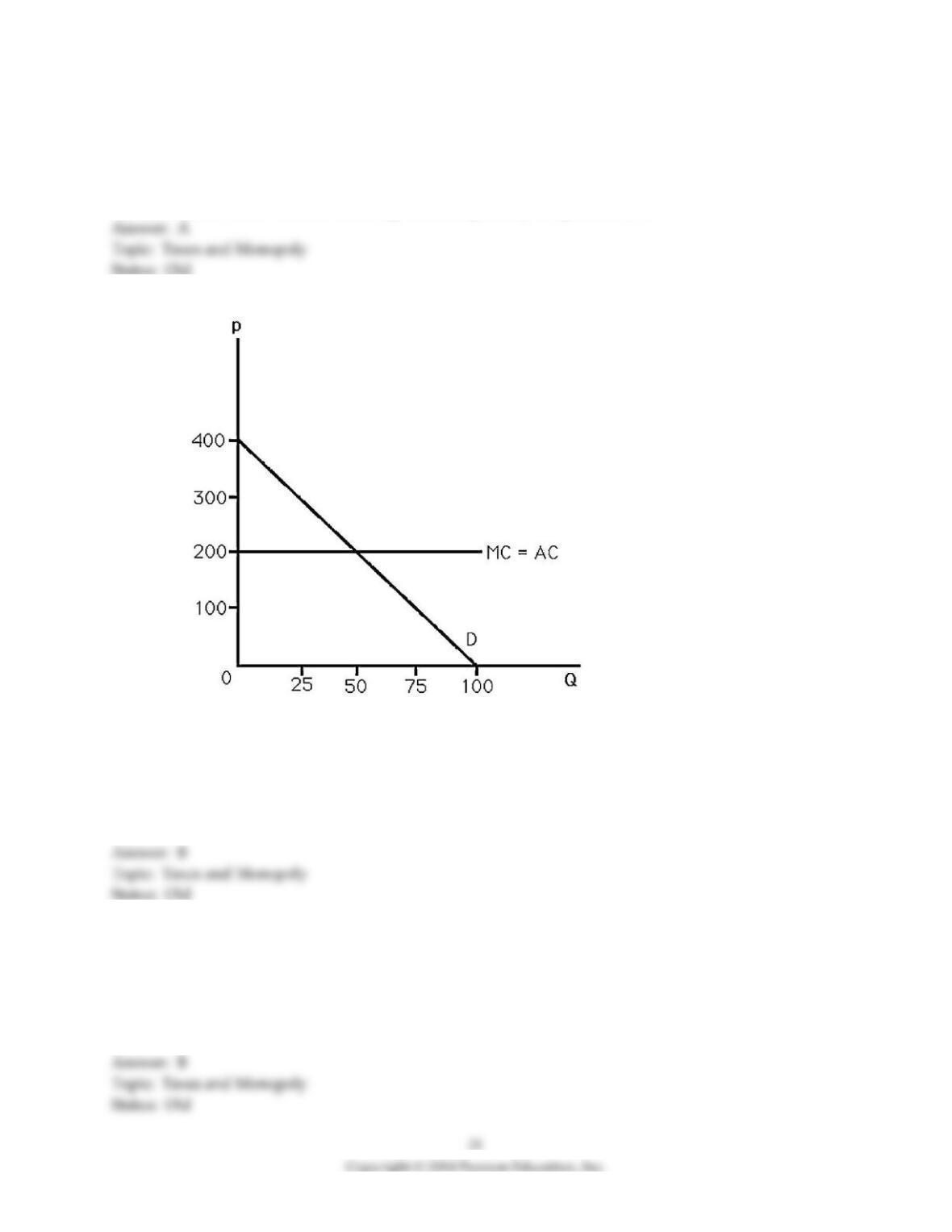
4) The above figure shows the demand and cost curves facing a monopoly. A $100 per unit tax would
raise price by
A) $100.
B) $50.
C) $25.
D) $0.
5) The above figure shows the demand and cost curves facing a monopoly. If a $100 per unit tax is
charged, what is the incidence of the tax on consumers?
A) 100%
B) 50%
C) 25%
D) 0%
6) The above figure shows the demand and cost curves facing a monopoly. If a $100 per unit tax is
charged, the loss in welfare resulting from the tax is
A) $250.
B) $312.50.
C) $1,250.
D) $1,562.50.
For the following, please answer “True” or “False” and explain why.
7) If the government’s goal is to generate a certain amount of tax revenue, a specific tax and an ad valorem
tax on a monopoly have the same impact on social welfare.
8) A specific tax imposed on a monopolist may increase the price by more than the tax.
9) An ad valorem tax imposed on a monopolist will reduce the deadweight loss generated by the
monopolist.
10) What is the advantage of the government imposing an ad valorem tax over a specific tax when facing a
monopoly?
11) If the government sets a specific tax and an ad valorem tax so that they raise the same amount of tax
revenue, why does the ad valorem tax reduce output less than the specific tax?
12) Show that for a monopolist with a constant marginal cost and facing a linear demand curve, if a
specific tax is imposed on the monopolist, the tax burden is shared equally between the monopolist and
the consumers.
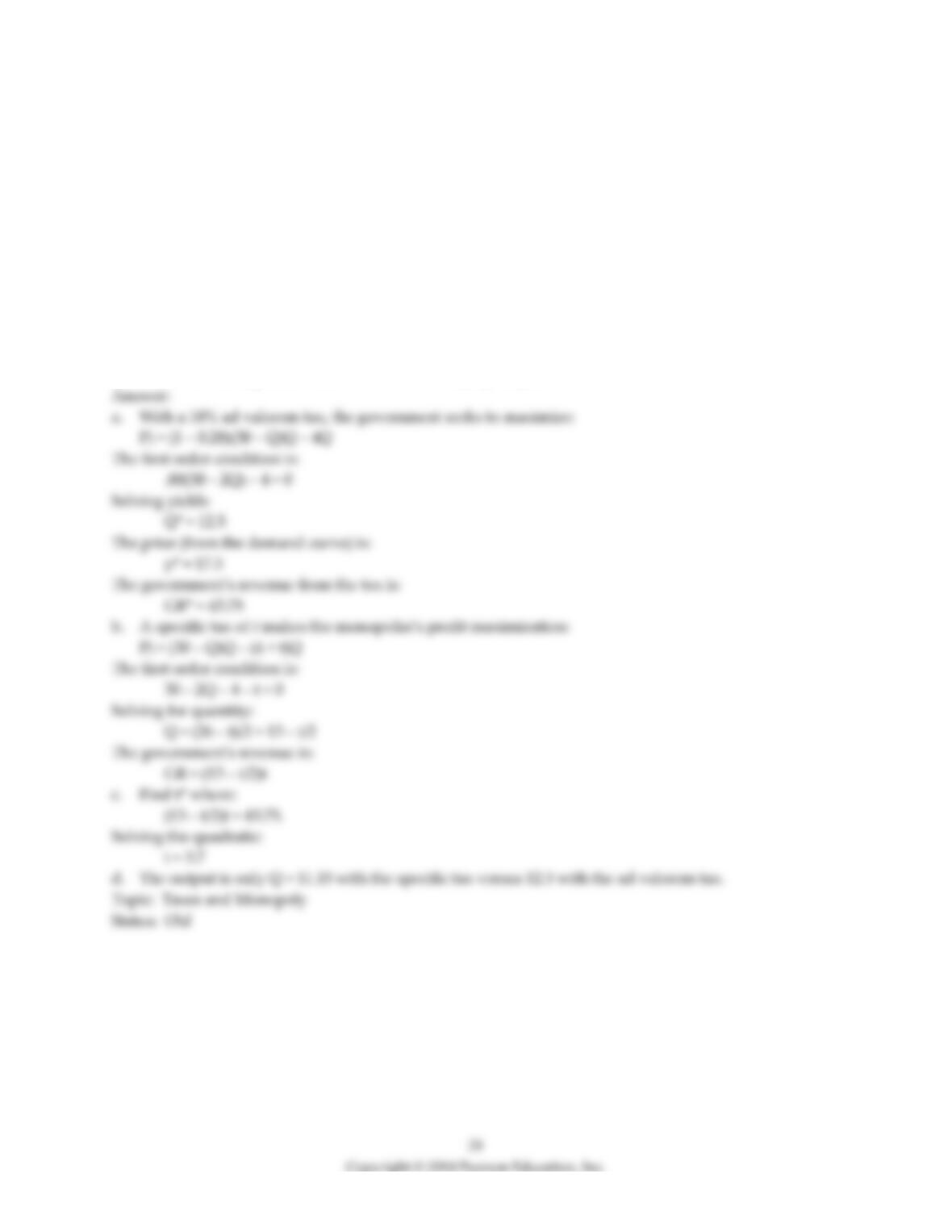
13) A monopolist faces the inverse demand for its output:
p = 30 – Q
The monopolist also has a constant marginal and average cost of $4/unit. The government is seeking
ways to collect tax revenue from the monopolist and faces two proposals:
i. Impose a specific tax of t on the monopolist.
ii. Impose an ad valorem tax of a on the monopolist.
a. Suppose the government imposes a 20% ad valorem tax on the monopolist. What price and quantity
does the monopolist choose and how much revenue does the government generate from the tax?
b. Rather than an ad valorem tax, what is the government’s revenue from a specific tax of t imposed on
the monopolist? Your answer should be in terms of t.
c. Show that a specific tax of $3.70/unit generates the same revenue as a 20% ad valorem tax
(approximately).
d. Which tax has a greater distortion on the monopoly output?
11.4 Causes of Monopolies
1) A flour mill holding exclusive contracts to 95% of the wheat in a large geographic area may operate as
a flour producing monopoly locally because
A) the mill has a very inelastic supply curve.
B) the mill is a natural monopoly.
C) the mill controls a key input.
D) the government will declare it a monopoly.
2) Which of the following total cost functions suggests the presence of a natural monopoly?
A) TC = 2Q
B) TC = 100 + 2Q
C) TC = 100 + 2Q2
D) All of the above.
3) Which of the following average cost functions suggests the presence of a natural monopoly?
A) AC = 2
B) AC = 100/Q + 2
C) TC = 100/Q + 2Q
D) All of the above.
4) The situation in which one firm can produce the total output of the market at lower cost than several
firms is called
A) natural monopoly.
B) pure monopoly.
C) ruling monopoly.
D) cost monopoly.
5) Empirical evidence from electric-power-producing firms suggests that
A) all electric-power-producing firms are natural monopolies.
B) no electric-power-producing firms are natural monopolies.
C) the largest electric-power-producing firms are natural monopolies.
D) the smallest electric-power-producing firms are natural monopolies.
6) Empirical evidence from electric-power-producing firms suggests that the largest electric-power-
producing firms are not natural monopolies because
A) the average cost curve for these firms is U-shaped.
B) no electric-power-producing firms are natural monopolies.
C) the largest firms enjoy economies of scale.
D) the designation of natural monopoly can only be bestowed by the government.
7) Limited government licenses that create a monopoly do so because
A) the license generates a marginal cost advantage.
B) the monopoly will become a natural monopoly.
C) a barrier to enter the market exists.
D) All of the above.
8) An exclusive right to sell a new and useful product, process, substance, or design for a fixed period of
time is called a
A) patent.
B) barrier to entry.
C) monopoly.
D) research disincentive.
9) A justification for patents is that without patents consumer surplus would be
A) larger than with the patent.
B) zero since the product would not be invented.
C) only slightly smaller than with the patent.
D) zero since the monopoly would be a revenue maximizer.
10) Patents
A) will create a profit incentive to do research.
B) might be welfare reducing if granted for too long a period.
C) serve as a barrier to entry.
D) All of the above.
11) Why do patents stimulate research?
A) Patents give firms time to do research.
B) Patents give firms the opportunity to recover research costs and thus a profit motive.
C) Firms would research as much even without patents.
D) Patents don’t stimulate research.
12) Government actions that create monopolies
A) spur product innovation by the monopoly.
B) create deadweight loss.
C) result in lower average costs of production.
D) ensure that firms price at marginal cost.
For the following, please answer “True” or “False” and explain why.
13) If a firm in an industry experiences very high fixed costs and constant marginal cost, it is a good
candidate for a natural monopoly.
14) The optimal patent length is equal to 20 years.
15) The average cost for a typical electric-power-production firm is AC = 100 – 10Q + Q2 where Q is
measured in billion kilowatt hours per day. At the current regulated price, consumers demand 4 billion
kilowatt hours per day. Is this market a natural monopoly? If demand increases to 10 billion kilowatt
hours, is this market a natural monopoly? Explain.
16) If the average cost curve for an individual firm is decreasing when it intersects the market demand
curve, why is a natural monopoly likely to develop in this market? Explain.
17) The SSS Co. has a patent on a particular medication. The medication sells for $1 per daily dose and
marginal cost is estimated to be a constant at 20¢. Assuming linear demand and marginal cost curves, use
this information to estimate the deadweight loss from monopoly pricing if the firm currently sells 1,000
doses per day. Can this loss be justified?
18) The “Sonny Bono” Copyright Term Extension Act extended the copyright terms in the U.S. by 20
years. In addition, the act was applied to already existing copyrights.
a. Discuss the advantages and/or disadvantages in terms of efficiency and monopoly power from the
extension of the lifespan of new copyrights. In theory, what determines the optimal term of a copyright?
b. Discuss the advantages and/or disadvantages in terms of efficiency and monopoly power from the
extension of the lifespan of existing copyrights.
11.5 Government Actions that Reduce Market Power
1) Optimal price regulation sets price equal to
A) marginal cost.
B) average variable cost.
C) average cost.
D) minimum average cost.
2) If the government regulates the price a monopoly can charge, and the price ceiling is set below what
the competitive market price would be, then
A) a shortage will exist.
B) a surplus will exist.
C) producer surplus is maximized.
D) consumer surplus is maximized.
3) The government forcing a monopoly telecommunications company to allow other firms to use its
cables is an attempt to
A) regulate prices.
B) decrease the monopoly market power by eliminating a natural monopoly.
C) decrease the monopoly market power by increasing competition.
D) None of the above.
4) When attempting price regulation, a government faces what problem(s)?
A) limited information
B) bribes
C) uncooperative firms
D) All of the above
5) If the government attempts to force a natural monopoly to charge a price equal to marginal cost,
A) the natural monopoly will shut down.
B) the natural monopoly will still make high profits.
C) the natural monopoly’s marginal cost curve will shift up.
D) total welfare is maximized.
6) If the government wants to regulate a natural monopoly, it will force the firm to set price equal to
A) average cost.
B) marginal cost.
C) marginal revenue.
D) None of the above.
7) A dominant-firm‘s residual demand curve is
A) the horizontal difference between the market demand curve and the supply curve of the fringe firms.
B) the vertical difference between the market demand curve and the supply curve of the fringe firms.
C) the demand curve left for the fringe firms after the dominant firm has determined an output level.
D) None of the above.
8) Which of the following measures are government regulations to increase competition?
A) Government ends the ban on steel imports.
B) Government shortens the term of the patent for a drug.
C) Government subsidizes firms to enter energy market.
D) All of above.
For the following, please answer “True” or “False” and explain why.
9) Forcing a natural monopoly to charge P = MC will not work.
10) A monopoly faces an inverse demand curve of P = 100 – 2Q. The marginal cost curve is MC = .5Q.
What government price ceiling would represent optimal price regulation?
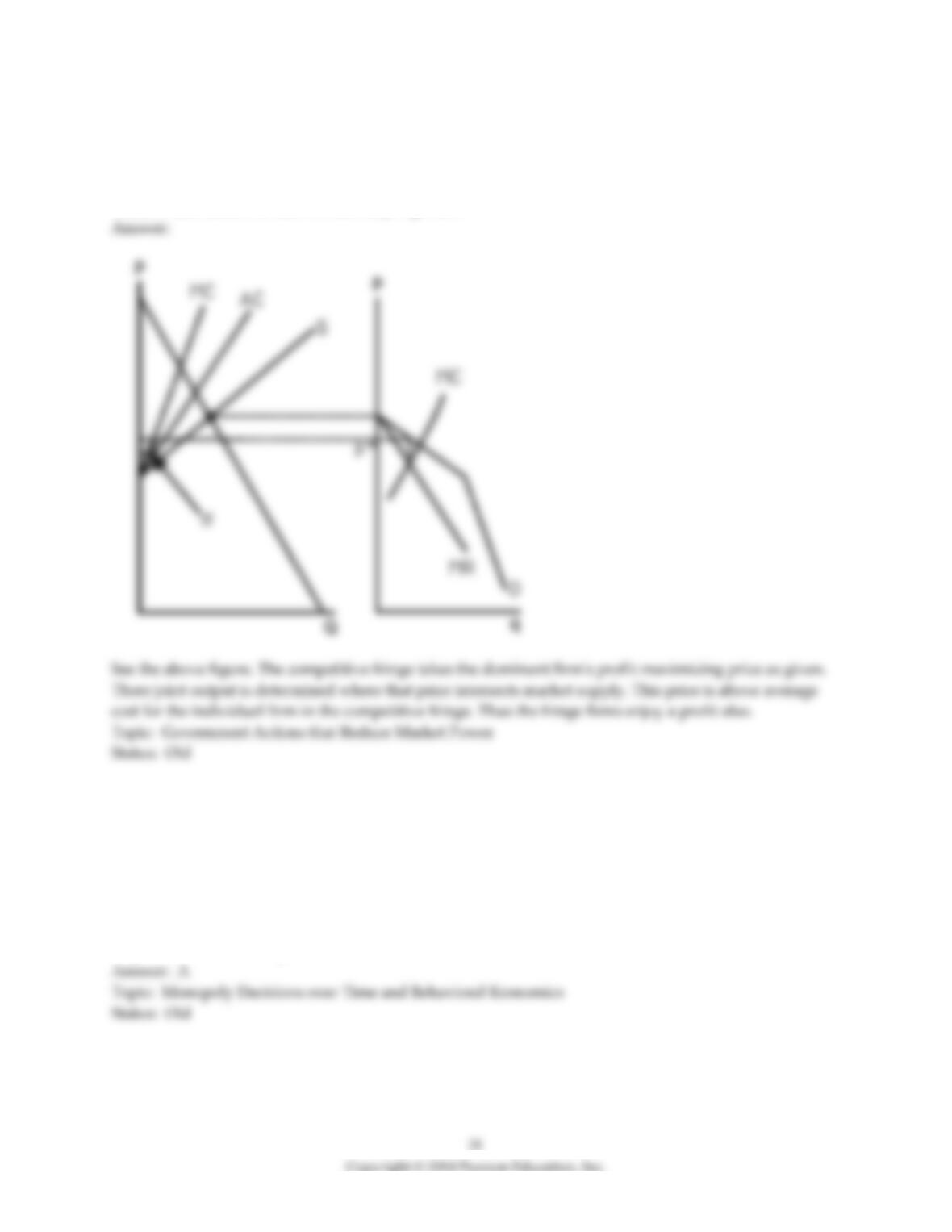
11) In the early 1900s, U.S. Steel acted as a dominant firm with over sixty percent (60%) of the market.
Many, including the Supreme Court in 1920, viewed U.S. Steel as a “good” monopolist since competitive
fringe firms prospered under this arrangement. Graph the market for steel as it might have existed at this
time showing that being a member of the competitive fringe can be profitable. Assume a linear market
demand and linear MC and AC that slope upward.
11.6 Monopoly Decisions over Time and Behavioral Economics
1) The situation where one person’s demand for a good depends on the consumption of the good by
others is called a
A) network externality.
B) network internality.
C) consumption externality.
D) production externality.
2) The situation in which a person places greater value on a good as more and more people possess it is
called
A) Bandwagon Effect.
B) Greater Value Effect.
C) Snob Effect.
D) Behavioral Effect.
3) The situation in which a person places greater value on a good as fewer and fewer people possess it is
called
A) Bandwagon Effect.
B) Greater Value Effect.
C) Snob Effect.
D) Behavioral Effect.
4) Which of the following is an example of the bandwagon effect?
A) A larger cellphone consumer group makes a cellphone service more attractive.
B) The more people use Facebook, the more attractive it is to consumers.
C) With more broadband services, more high-definition webpages become available.
D) All of the above.
5) Which of the following is an example of the snob effect?
A) The fewer consumers that buy the operating system, the fewer the applications that will be available.
B) The more people that buy a luxury watch, the less value consumers put on the watch.
C) The fewer ATMs available in the city, the fewer consumers want to join the network.
D) None of the above.
For the following, please answer “True” or “False” and explain why.
6) The telephone is an example of a product with network externalities.
7) Explain Microsoft Windows’ monopoly positions in terms of network externalities.
11.7 Monopsony
1) For a monopsonist, the labor supply curve is upward sloping because
A) the monopsonist must compete with other industries for that labor.
B) the monopsonist requires that the laborers are highly skilled.
C) the monopsonist is the only buyer in that labor market.
D) the monopsonist restricts the supply of labor.
2) Because the labor supply curve for a monopsonist is upward sloping, the monopsonist
A) hires zero units of labor.
B) chooses the perfectly competitive quantity of labor.
C) must increase the wage to attract more units of labor.
D) must take the wage as given by the market.
3) Under monopsony, the wage rate
A) equals the marginal product of labor.
B) equals the marginal revenue product of labor.
C) is less than the marginal revenue product of labor.
D) is greater than it would be under perfect competition.
4) If a firm buys some labor in a competitive market and some labor as a monopsonist, the firm is most
likely to
A) pay the same wage to both types of labor.
B) pay a lower wage to the labor purchased in the competitive market.
C) pay a higher wage to the labor purchased in the competitive market.
D) not exercise any of its monopsony power.
5) For the monopsonist, marginal expenditure is greater than the wage rate because the monopsonist
A) pays a wage higher than that paid in a competitive market.
B) chooses the perfectly competitive quantity of labor.
C) must increase the wage to all units of labor to attract more units of labor.
D) must take the wage as given by the market.
6) A monopsonist faces an upward-sloping labor supply curve. This means that his marginal
expenditures on labor are
A) greater than the wage.
B) equal to the wage plus the the increase in the wage resulting from hiring one more unit of labor hired.
C) greater than the wage because hiring more workers requires to pay all workers more.
D) All of the above.
7) The steeper the labor supply curve,
A) the higher the wage the monopsonist pays.
B) the lower the wage the monopsonist pays.
C) the smaller the difference between the wage and the marginal expenditure on labor.
D) the better off workers are.
8) If a firm takes the wage as given, then the supply curve of labor to that firm is
A) horizontal.
B) vertical.
C) upward sloping.
D) downward sloping.
9) If a firm takes the wage as given, then the firm’s marginal expenditure on labor curve is
A) above the labor supply curve.
B) below the labor supply curve.
C) the same as the labor supply curve.
D) upward sloping.
10) If the supply of labor to a monopsonist is everywhere unit elastic, then the wage will equal
A) the marginal expenditure.
B) one-half of the marginal expenditure.
C) the marginal revenue product of labor.
D) one.
11) If the supply of labor to a monopsonist is everywhere unit elastic, and the marginal expenditure
equals $1, then the wage will equal
A) 50¢.
B) 75¢.
C) $1.
D) $2.
12) Which of the following would be most able to act like a monopsonist?
A) a hospital in a small isolated town
B) a hospital in a very big city
C) a law firm in Washington, D.C.
D) a computer software firm in Silicon Valley
13) Universities are able to act as monopsonists in the market for professors because
A) a university usually does not consider hiring faculty members from another institution.
B) faculty members usually have to move to a different city when changing universities.
C) students like all of their professors.
D) senior faculty members are willing to move to a new university at any cost.
14) Relative to a competitive labor market, monopsony
A) is also efficient.
B) creates a deadweight loss because it pays an excessive wage.
C) creates a deadweight loss because the wage is below the marginal revenue product of labor.
D) creates a deadweight loss because the wage is above the marginal revenue product of labor.
15) The gap between the value a monopsony places on the last worker hired and the wage paid will
increase when
A) the supply curve becomes more elastic at the optimum.
B) the supply curve becomes less elastic at the optimum.
C) the supply curve becomes horizontal.
D) the value of the last unit of labor hired is greater than the cost.
16) A monopsonist purchaser of labor that could negotiate a different wage for each worker could
A) purchase less labor than a regular monopsonist.
B) purchase more labor than a regular monopsonist.
C) rotate the marginal expenditure curve to the left.
D) shift the marginal expenditure curve to the left.
17) The difference between the marginal expenditure and the wage is greater when the supply curve of
labor is
A) less elastic at the monopsony optimum.
B) more elastic at the monopsony optimum.
C) more elastic than the demand curve.
D) The difference does not depend on any elasticity.
For the following, please answer “True” or “False” and explain why.
18) Because of market power, wages are higher under monopsony than under competitive conditions.
19) Why does a monopsonist’s marginal expenditure curve lie above the labor supply curve?
20) Suppose a monopoly producer is also a monopsonist in the labor market. Demand for the output is
p = 100 – Q. The production function is Q = L, and the labor supply curve is w = 10 + L. How much labor
does the firm hire? What wage is paid?
21) Suppose that a mining company employs 80% of the available laborers in a town. Explain what will
happen to the number of laborers hired and the wage rate paid by the mine if a minimum wage is set at
the competitive level.
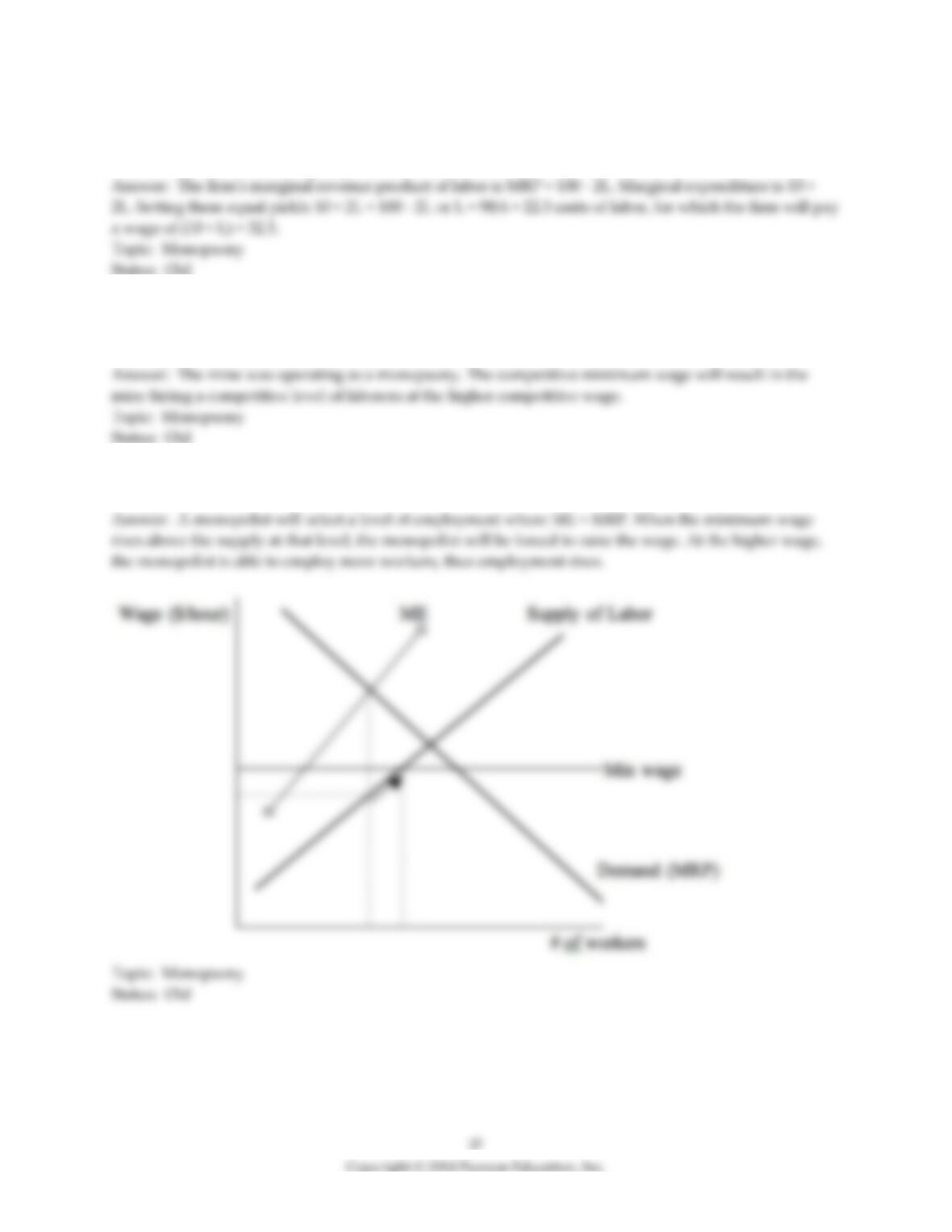
22) Show with a graph that an increase in the minimum wage can increase the level of employment in a
monopsony market.