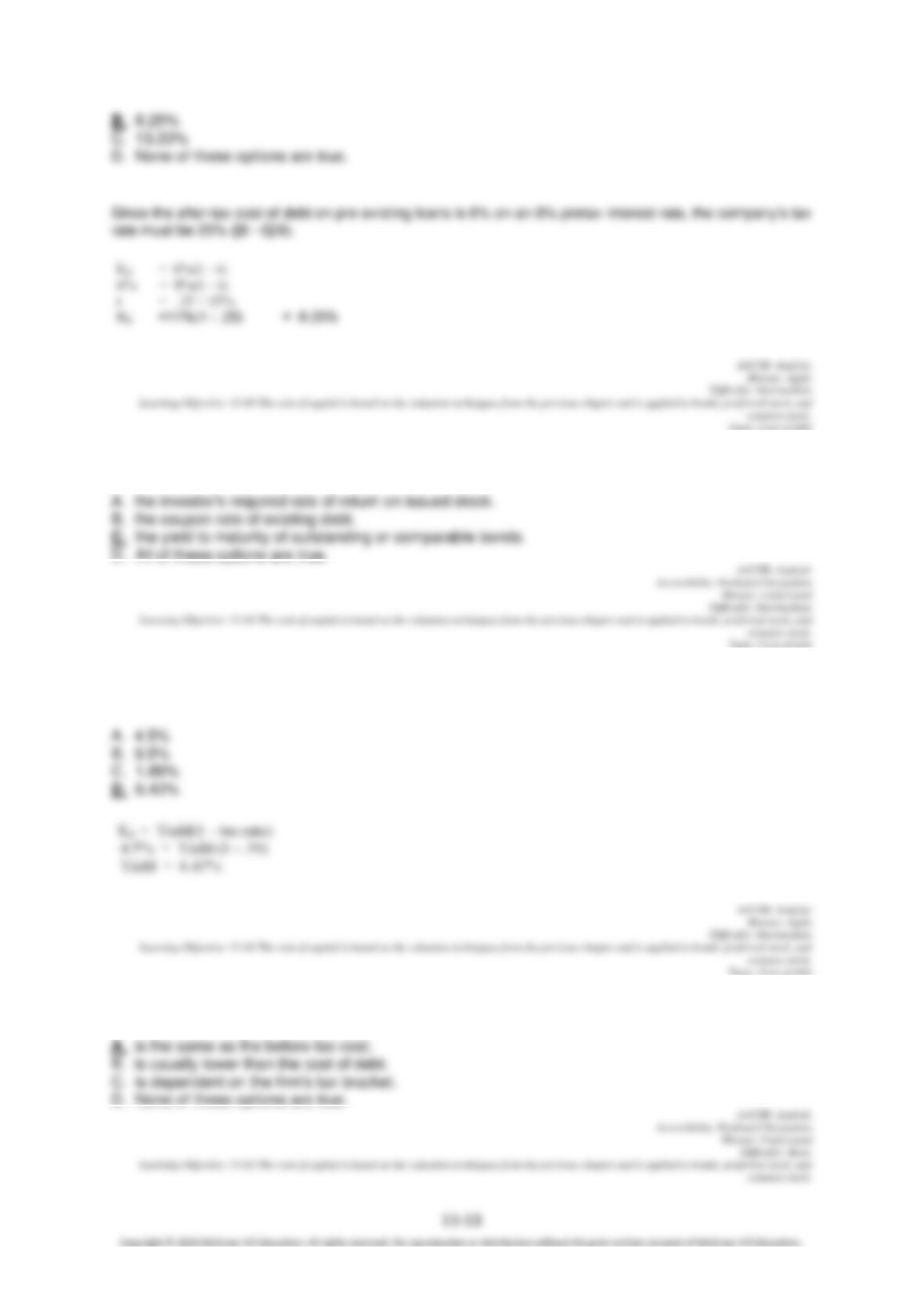
63. The pre-tax cost of debt for a new issue of debt is determined by
64. Lewis, Schultz, and Nobel Development Corp. has an after-tax cost of debt of 4.5%. With a tax rate of
30%, what is the yield on the debt?
65. The after-tax cost of preferred stock to the issuing corporation
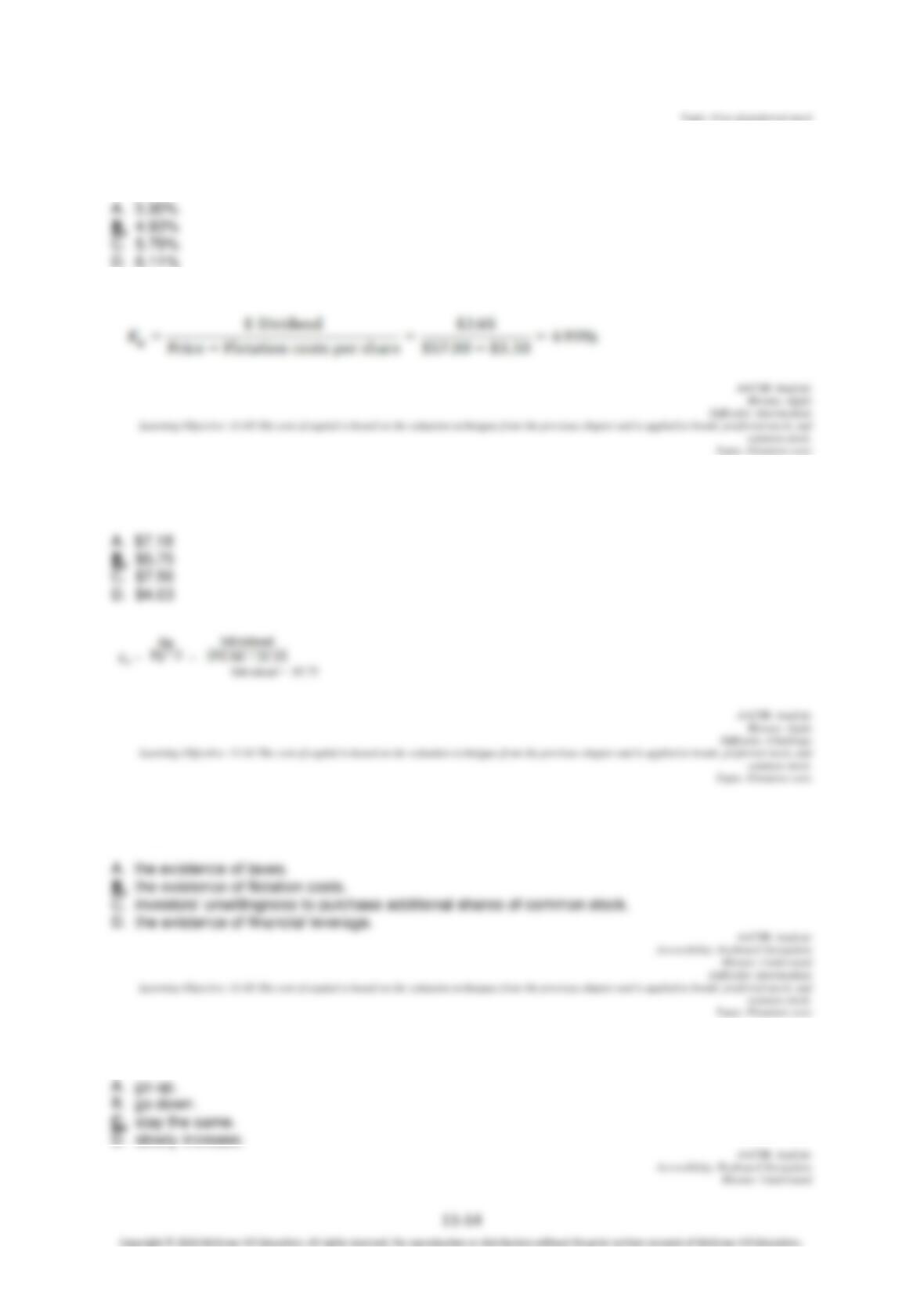
66. A firm is paying an annual dividend of $2.65 for its preferred stock that is selling for $57.00. There is a
selling cost of $3.30. What is the after-tax cost of preferred stock if the firm’s tax rate is 33%?
67. Firm X has a tax rate of 30%. The price of its new preferred stock is $75 and its flotation cost is $3.15.
The cost of new preferred stock is 8%. What is the firm’s dividend?
68. The cost of equity capital in the form of new common stock will be higher than the cost of retained
earnings because of
69. If the flotation cost goes up, the cost of retained earnings will
11–15
70. Flotation cost is the
71. Why is the cost of debt normally lower than the cost of preferred stock?
72. If flotation costs go down, the cost of new preferred stock will
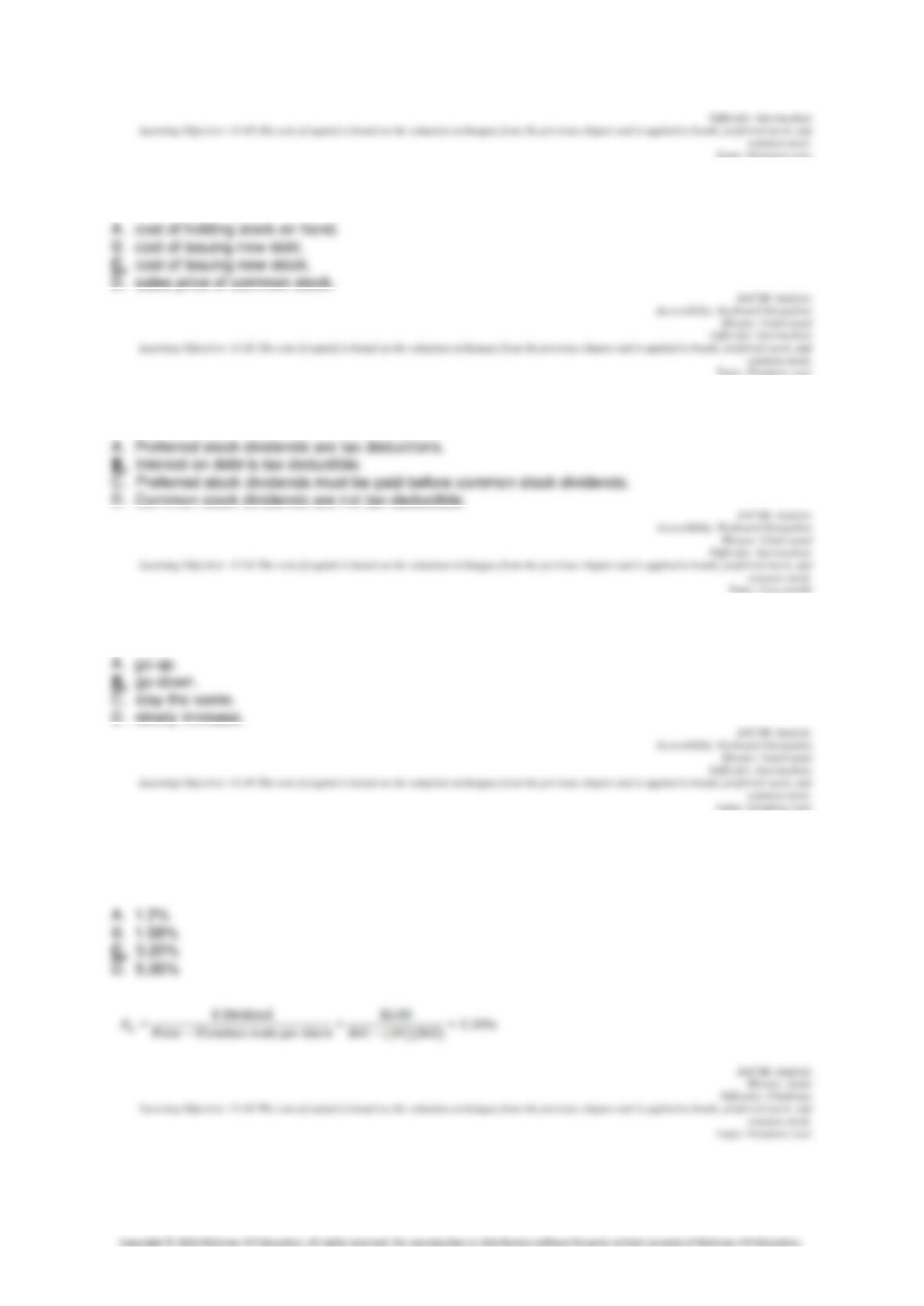
73. A firm’s preferred stock pays an annual dividend of $2, and the stock sells for $65. Flotation costs for
new issuances of preferred stock are 5% of the stock value. What is the after-tax cost of preferred stock if
the firm’s tax rate is 30%?
11–16
74. Ten years ago, Stigler Company issued $100 par value preferred stock yielding 6%. The preferred
stock is now selling for $102 per share. What is the approximate current yield or cost of the preferred
stock? (Disregard flotation costs.)
75. A firm’s debt-to-equity ratio varies at times because
76. Using the constant dividend growth model for common stock, if the market price of stock (P0) goes up,
77. New common stock is more expensive than required rate of return (Ke)because new common stock has
to
78. In computing the cost of common equity, if the dividend (D1) goes downward and market price (P0) goes
up, required rate of return (Ke) will
79. In determining the cost of retained earnings
80. Within the capital asset pricing model
81. Using the constant growth model, a firm’s expected dividend yield (D1) is 4% of the stock price, and its
growth rate is 5%. If the tax rate is 35%, what is the firm’s cost of equity?
82. Expected cash dividends are $3.00, the dividend yield is 4%, flotation costs are 4% of price, and the
growth rate is 3%. Compute the approximate cost of new common stock.
11–18
83. A firm’s stock is selling for $65. The dividend yield is 6%. A 7% growth rate is expected for the common
stock. The firm’s tax rate is 40%. What is the firm’s cost of retained earnings?
84. A firm’s stock is selling for $62. The next annual dividend is expected to be $3.00. The growth rate is
9%. The flotation cost is $5.00. What is the cost of retained earnings?
85. For many firms, the cheapest and most important source of equity capital is in the form of
86. Retained earnings has a cost associated with it because
87. There may be a change in the marginal cost of capital curve when
88. The after-tax cost of debt will almost always be below
89. The optimal capital structure for firms in cyclical industries should contain ________________ than
firms in stable industries.
90. The component parts of the cost of capital should be weighted by their proportion in the firm’s
11–20
91. Which of the following is NOT true about debt financing and the weighted average cost of capital?
92. A firm in a stable industry should use
93. Although debt financing is usually the cheapest component of capital, it cannot be used in excess
because
94. A firm in a cyclical industry should use
95. Most firms are able to use ______% debt in their capital structure without exceeding norms acceptable
to creditors and investors.
96. Marginal cost of capital
97. The weighted average cost of capital is used as a discount rate because
98. Use of the marginal cost of capital
99. The general rule for using the weighted average cost of capital (WACC) in capital budgeting decisions
is to accept all projects with
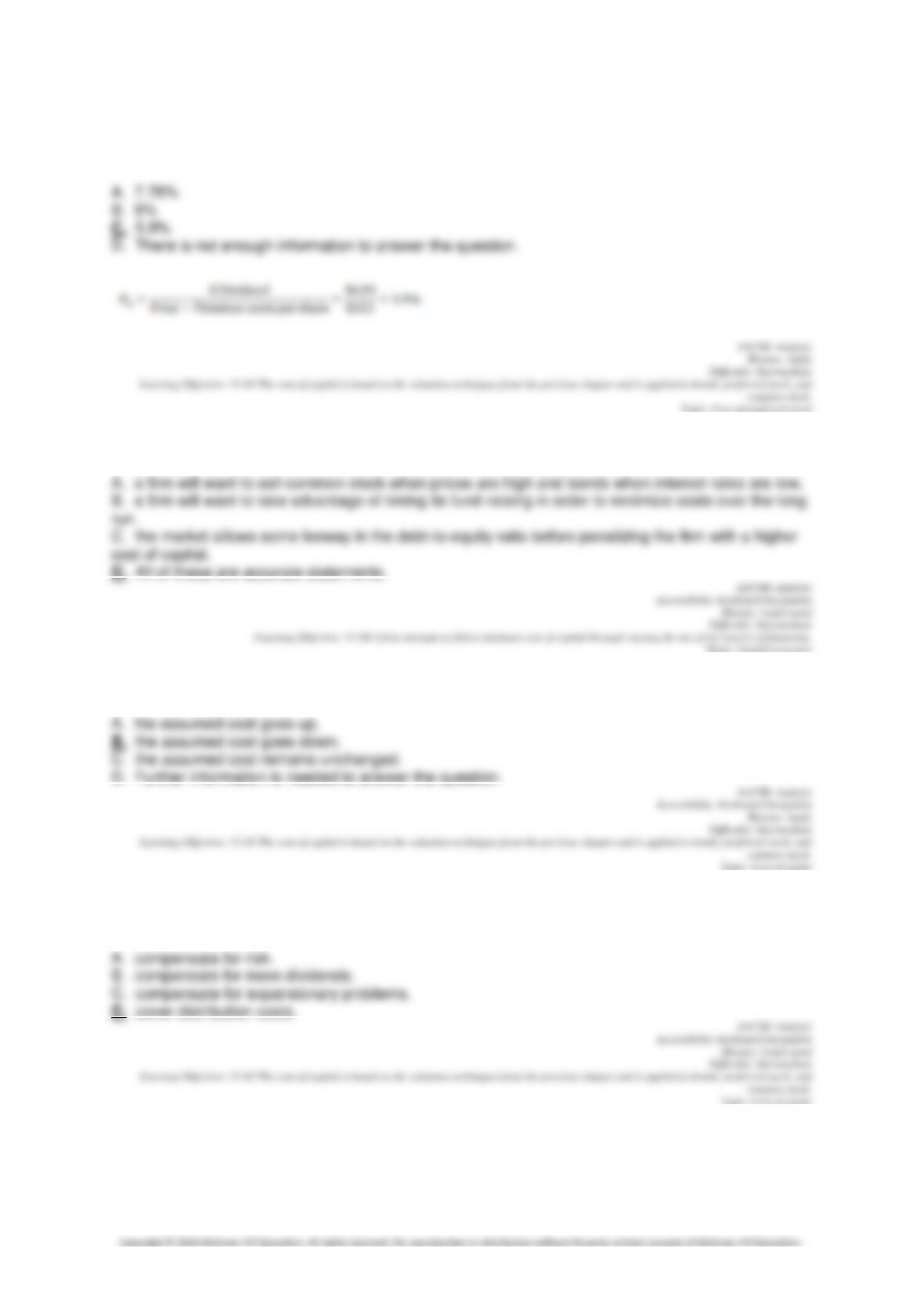
100. Oak Enterprises has a beta of 1.2, the market return is 8%, and the T-bill rate is 4%. Its tax rate is
40%. What is its expected required return of common equity?
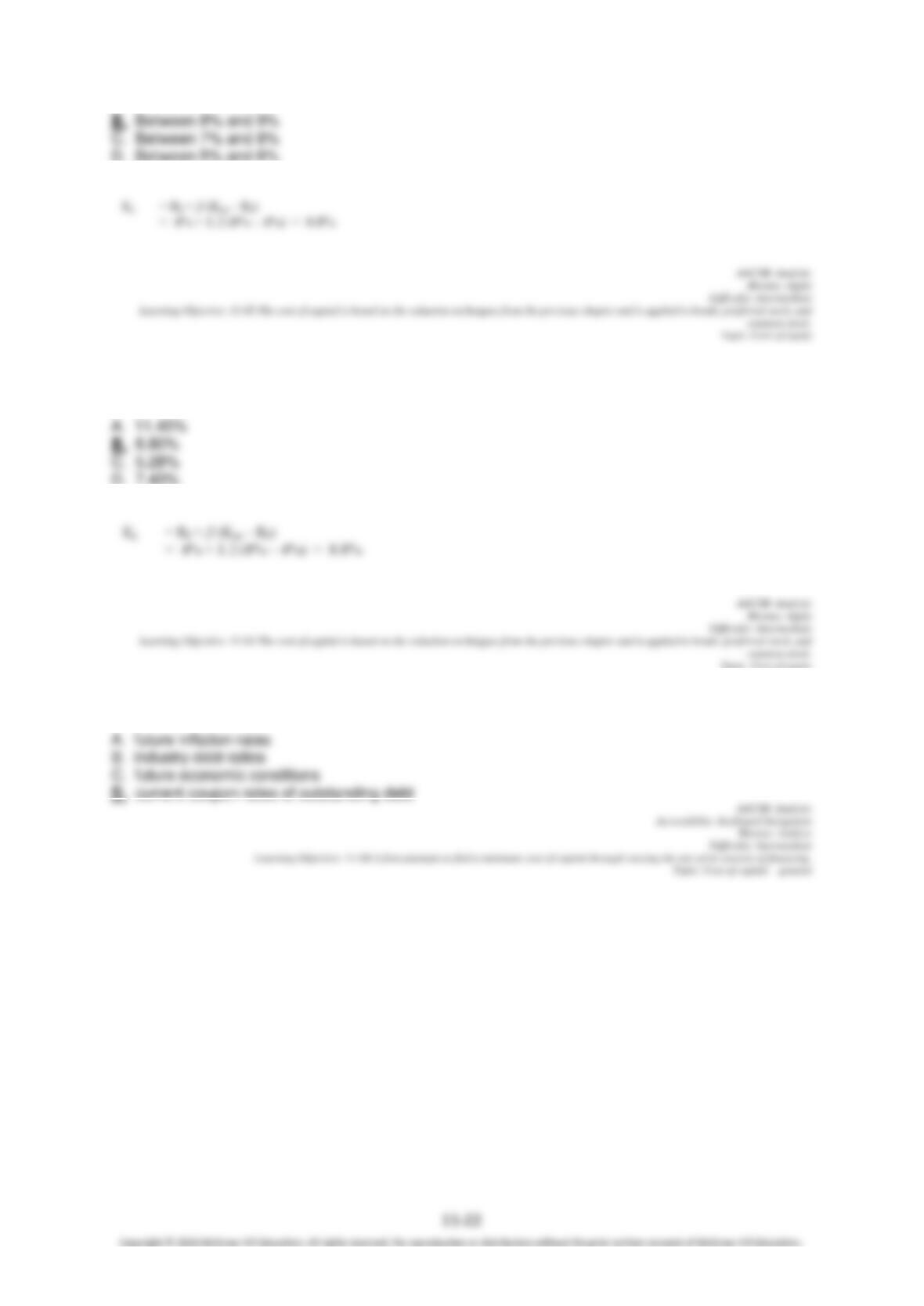
101. Oak Enterprises has a beta of 1.2, the market return is 8%, and the T-bill rate is 4%. Its tax rate is
40%. What is its expected required return of common equity?
102. All of the following are important considerations for minimizing the cost of capital EXCEPT:

11–23
Chapter 11 Test Bank – Static Summary
Category
# of Questions
AACSB: Analytic
94
AACSB: Reflective Thinking
8
Accessibility: Keyboard Navigation
84
Blooms: Analyze
1
Blooms: Apply
20
Blooms: Evaluate
3
Blooms: Remember
8
Blooms: Understand
70
Difficulty: Basic
16
Difficulty: Challenge
10
Difficulty: Intermediate
76
Learning Objective: 11-01 The cost of capital represents the weighted average cost of the
source of financing to the firm.
11
Learning Objective: 11-02 The cost of capital is normally the discount rate to use in
analyzing an investment.
7
Learning Objective: 11-03 The cost of capital is based on the valuation techniques from the
previous chapter and is applied to bonds, preferred stock, and common stock.
56
Learning Objective: 11-04 A firm attempts to find a minimum cost of capital through varying
the mix of its sources of financing.
25
Learning Objective: 11-05 The cost of capital may eventually increase as larger amounts of
financing are utilized.
6
Topic: Capital asset pricing model
4
Topic: Capital structure
6
Topic: Capital structure observations
2
Topic: Capital structure weights
4
Topic: Cost of capital – general
24
Topic: Cost of debt
14
Topic: Cost of equity
20
Topic: Cost of preferred stock
5
Topic: Divisional and project costs of capital
2
Topic: Flotation costs
9
Topic: Liquidity
1
Topic: Security market line
1
Topic: Weighted average cost of capital
10