39. Regulation Costs. Kingston Components, Inc., produces electronic components for cable TV systems.
Given vigorous import competition, prices are stable at $4,500 per unit in this dynamic and very competitive
market. Kingston’s annual total cost (TC) and marginal cost (MC) relations are:
TC = $7,000,000 + $500Q + $0.5Q2
MC = TC/ Q = $500 + $1Q
where Q is output.
Suppose the Occupational Health and Safety Administration (OSHA) has recently ruled that the company must install expensive new shielding
equipment to guard against worker injuries. This will increase the marginal cost of manufacturing by $100 per unit. Kingston’s fixed expenses, which
include a required return on investment, will be unaffected.
A.
Calculate Kingston’s profit-maximizing price/output combination and economic profits before installation of the OSHA-mandated
shielding equipment.
B.
Calculate the profit-maximizing price/output combination and economic profits after Kingston has met OSHA guidelines.
C.
Compare your answers to parts A and B. Who pays the economic burden of meeting OSHA guidelines?
0.5P
= 5 + QS
P
= $10 + $2QS
= $10 + $2(25)
= $60
= 25($60)
= $1,500(000)
The effect of a 25% of revenues franchise fee is to shift the supply curve upward. With the franchise fee:
P
= 1.25($10 + $2QS)
= $12.5 + $2.5(25)
= $75 (including taxes of $15)
= 25($60)
= $1,500(000)
40. Compulsory Benefit Costs. Columbia Federal Savings & Loan, Inc. offers low-cost home mortgage
refinancing services on the Internet. Each refinancing brings the company $250 in fees, and these fees are stable
given the competitive nature of Internet marketing. Columbia’s relies upon independent contractors (sales
associates) who work on a commission-only basis. Weekly total cost (TC) and marginal cost (MC) relations are:
TC = $200,000 + $50Q + $0.05Q2
MC = TC/ Q = $50 + $0.1Q
= MC
$4,500
= $500 + $1Q
Q
= 4,000
Economic Profits
= PQ – TC
= $4,500(4,000) – [$7,000,000 + $500(4,000) + $0.5(4,0002)]
= $1,000,000
After the OSHA-mandated increase in costs of $100, Kingston’s optimal activity level changes as follows:
= MC + $100
$4,500
= $600 + $1Q
Q
= 3,900
Economic Profits
= PQ – TC
= $4,500(3,900) – [$7,000,000 + $600(3,900) + $0.5(3,9002)]
= $605,000
where Q is thousands of refinancing applications processed.
Suppose the US Department of Labor recently ruled that Columbia’s sales associates must be considered employees entitled to benefits under the
Employee Retirement Income Security Act (ERISA). As a result, Columbia’s marginal cost of doing business will rise by $25 per unit. Columbia’s
fixed expenses, which include a required return on investment, will be unaffected.
A.
Calculate Columbia’s profit-maximizing price/output combination and economic profits before meeting DOL guidelines.
B.
Calculate the profit-maximizing price/output combination and economic profits after Columbia has met DOL guidelines.
C.
Compare your answers to parts A and B. Who pays the economic burden of meeting DOL guidelines?
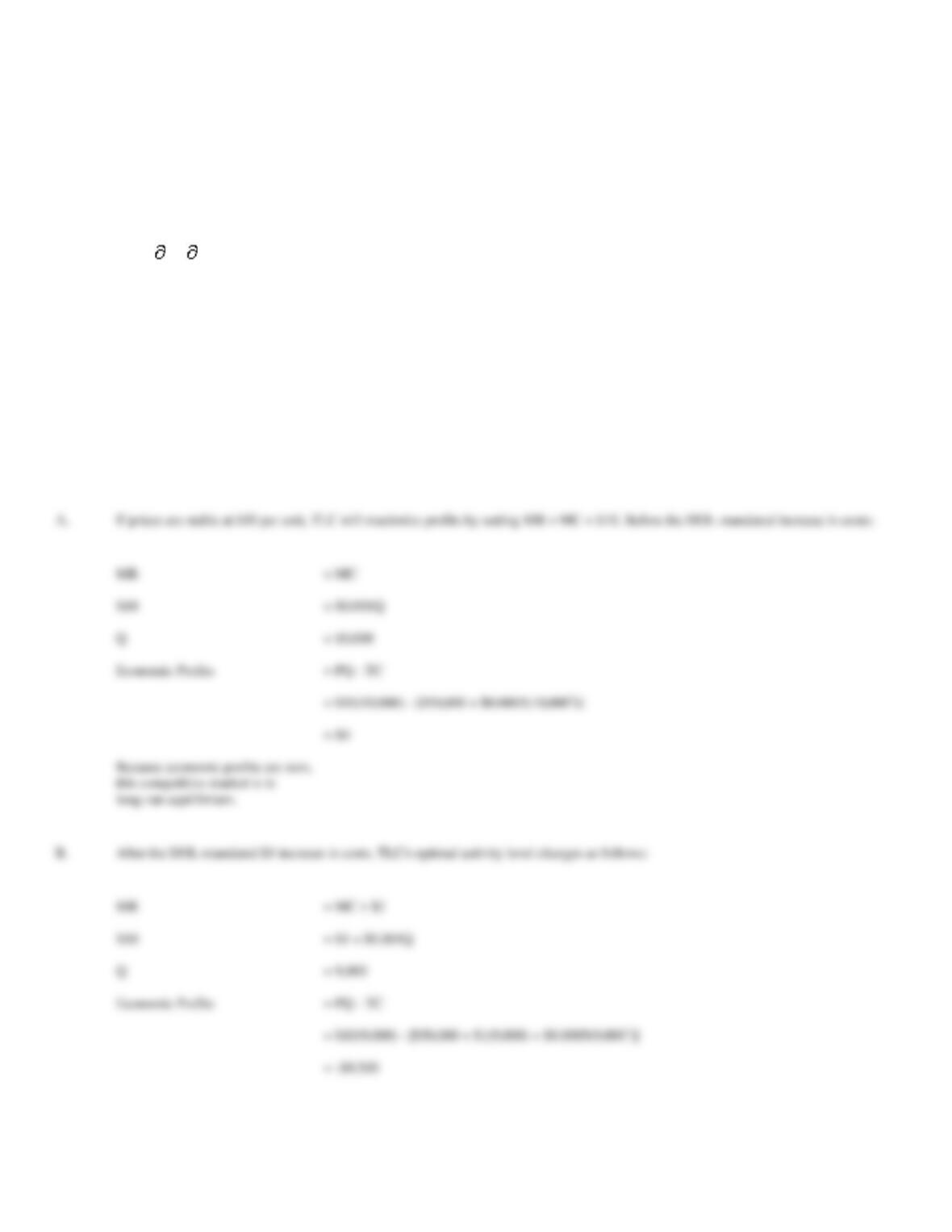
= MC
$250
= $50 + $0.1Q
Q
= 2,000
Economic Profits
= PQ – TC
= $0
B.
After the DOL-mandated increase in costs of $25, MC = $75 + $0.1Q. Therefore, Columbia’s optimal activity level changes as follows:
$250
= $75 + $0.1Q
Economic Profits
= PQ – TC
41. Compulsory Benefit Costs. The Telemarketing Louisianan Company generates leads for a major credit
card company using over-the-phone solicitations. Each lead generated brings TLC $10 in fees, and these fees
are stable given the competitive nature of the telemarketing business. TLC’s relies upon independent contractors
(sales associates) who work on a commission-only basis. Weekly total cost (TC) and marginal cost (MC)
relations are:
TC = $50,000 + $0.0005Q2
MC = TC/ Q = $0.001Q
where Q is thousands of refinancing applications processed.
Suppose the US Department of Labor recently ruled that TLC’s sales associates must be considered employees entitled to benefits under the
Employee Retirement Income Security Act (ERISA). As a result, TLC’s marginal cost of doing business will rise by $1 per unit. TLC’s fixed
expenses, which include a required return on investment, will be unaffected.
A.
Calculate TLC’s profit-maximizing price/output combination and economic profits before meeting DOL guidelines.
B.
Calculate the profit-maximizing price/output combination and economic profits after TLC has met DOL guidelines.
C.
Compare your answers to parts A and B. Who pays the economic burden of meeting DOL guidelines?
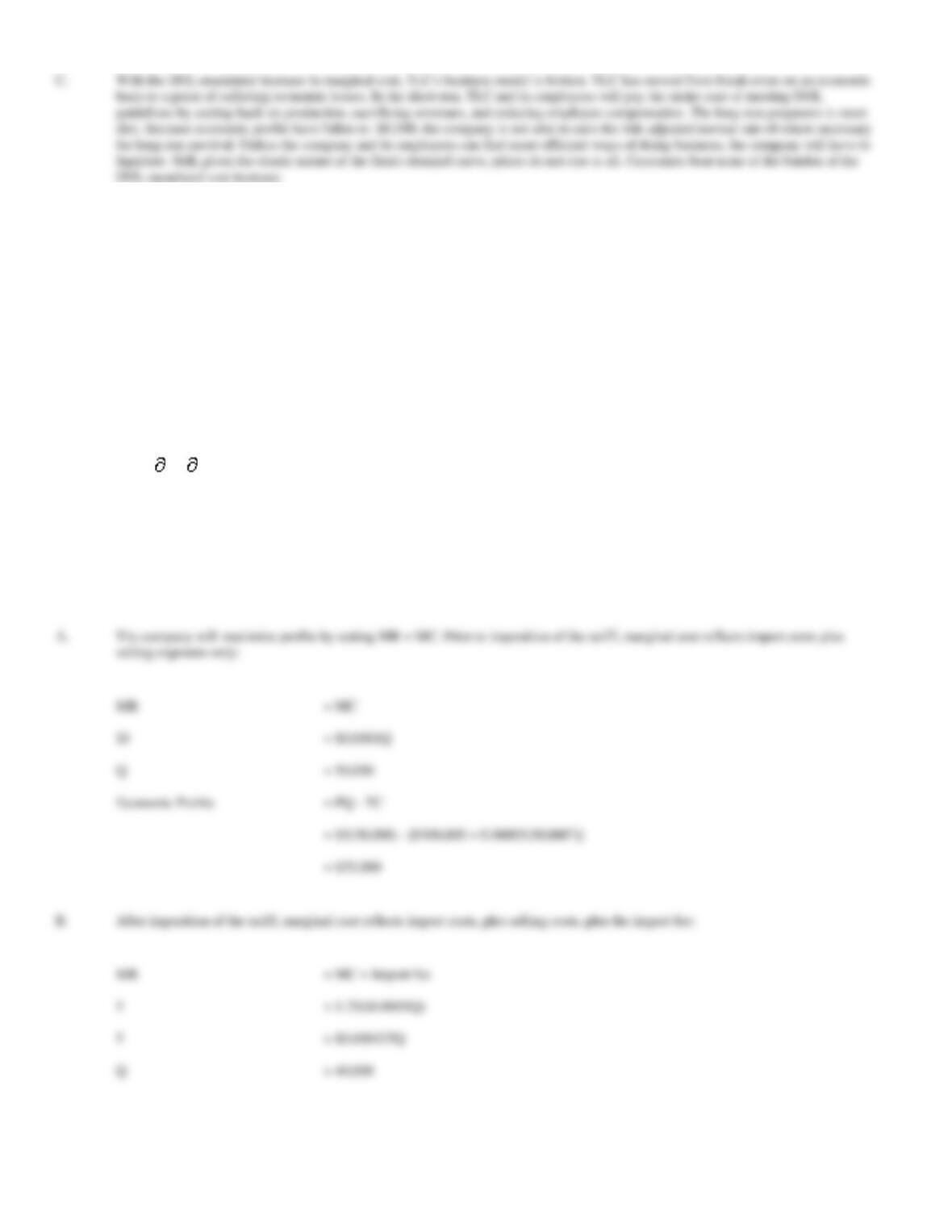
= MC
= $0.001Q
Q
= 10,000
Economic Profits
= PQ – TC
= $10(10,000) – [$50,000 + $0.0005(10,0002)]
= $0
B.
After the DOL-mandated $1 increase in costs, TLC’s optimal activity level changes as follows:
= $1 + $0.001Q
Q
= 9,000
Economic Profits
= PQ – TC
= $10(9,000) – [$50,000 + $1(9,000) + $0.0005(9,0002)]
42. Tariffs. The Manchester Shoe Corporation is an importer and distributor of foreign-made footwear that is
sold at popular prices in leading discount retailers. The U.S. Commerce Department recently informed the
company that it will be subject to a new 25% tariff on the import cost of rubberized footwear originating from
China. The company is concerned that the tariff will slow its sales growth, given the highly competitive nature
of the footwear market where wholesale prices are stable at $5 per unit. Relevant total cost (TC) and marginal
cost (MC) relations for this product are:
TC = $100,000 + $0.00005Q2
MC = TC/ Q = $0.0001Q
A.
Calculate the optimal price/output combination and economic profit prior to imposition of the tariff.
B.
Calculate the optimal price/output combination and economic profit after imposition of the tariff.
C.
Compare your answers to Parts A and B. Who pays the economic burden of the import tariff?
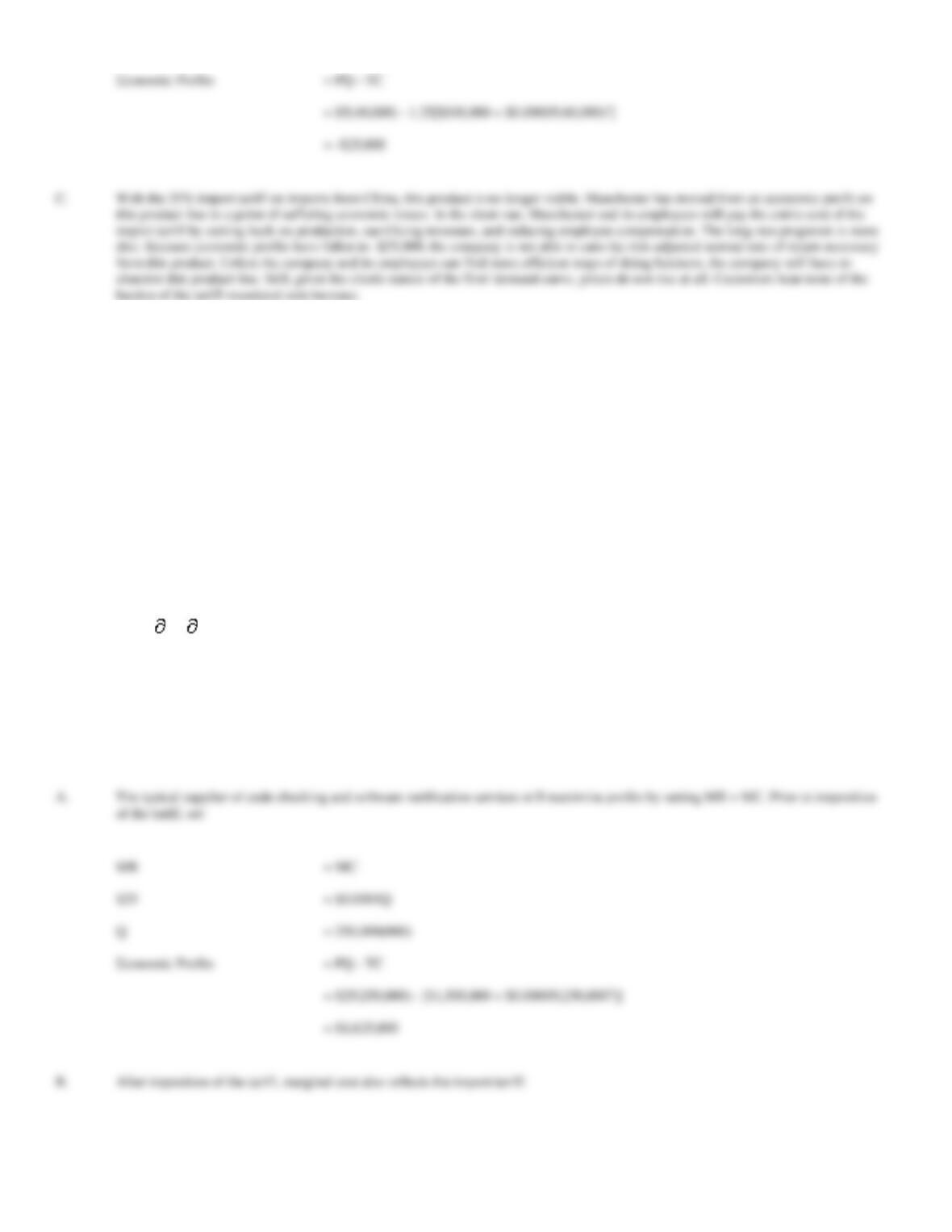
= MC
= $0.0001Q
Q
= 50,000
Economic Profits
= PQ – TC
= $5(50,000) – [$100,000 + 0.00005(50,0002)]
= $25,000
B.
After imposition of the tariff, marginal cost reflects import costs, plus selling costs, plus the import fee:
= MC + Import fee
5
= 1.25($0.0001Q)
5
= $0.000125Q
43. Outsourcing Tariffs. The Seattle Software Company develops, manufactures, licenses, and supports a wide
range of software products. Its software products include operating systems for servers, personal computers
(PC), and intelligent devices; and server applications for distributed computing environments. To cut costs, the
company has begun to outsource to various Asian markets a significant amount of code checking and software
verification. The global code checking and software verification service market is fiercely price competitive
with prices stable at $25 per hour for services provided by trained and experienced software engineers. Relevant
total cost (TC) and marginal cost (MC) relations for a typical foreign supplier of code checking and software
verification services (Q) are:
TC = $1,500,000 + $0.00005Q2
MC = TC/ Q = $0.0001Q
A.
Calculate the optimal price/output combination and economic profit for a typical foreign supplier prior to imposition of the tariff.
B.
Calculate the optimal price/output combination and economic profit for a typical foreign supplier after imposition of the tariff.
C.
Compare your answers to parts A and B. Who pays the economic burden of the import tariff?
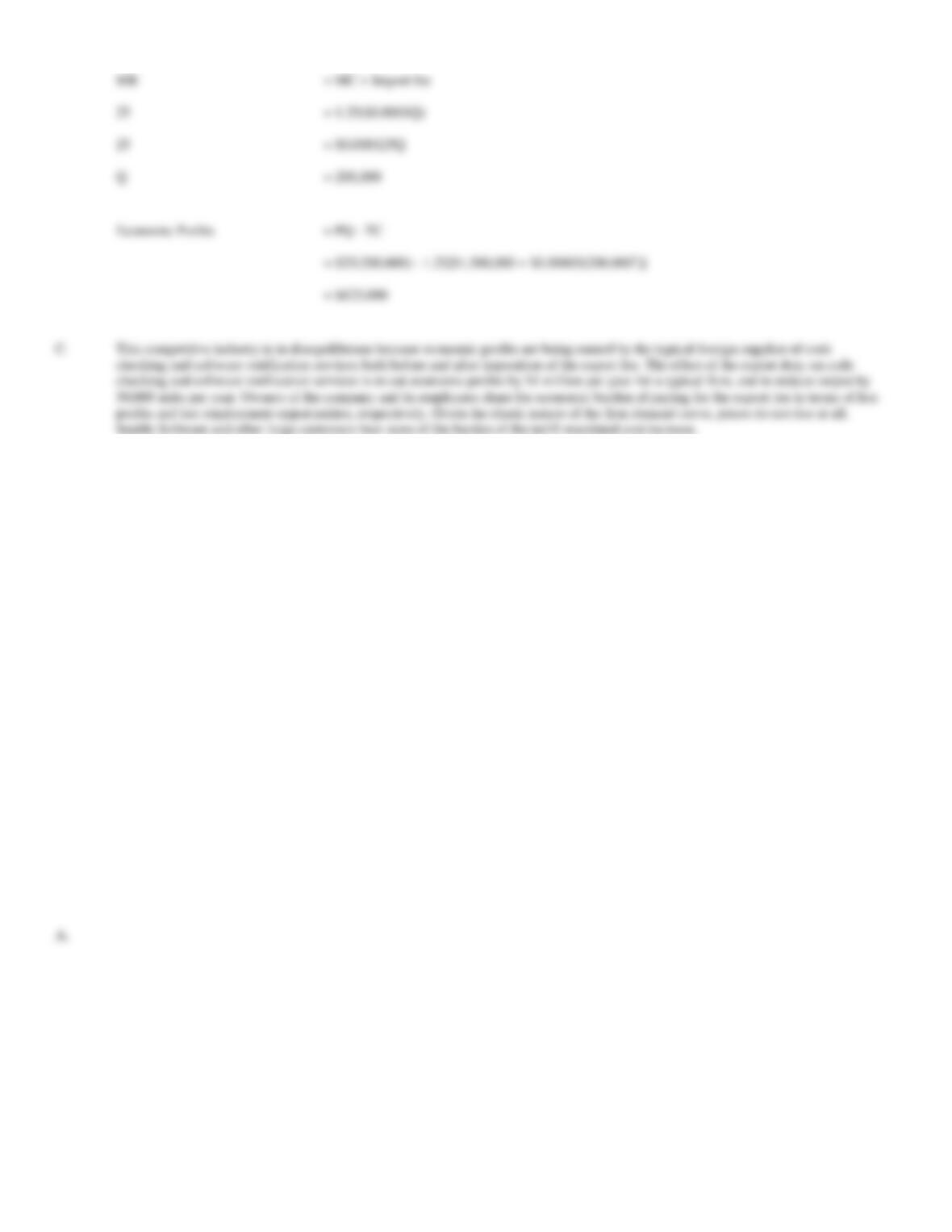
= MC
= $0.0001Q
Q
= 250,000(000)
Economic Profits
= PQ – TC
= $1,625,000
Economic Profits
= PQ – TC
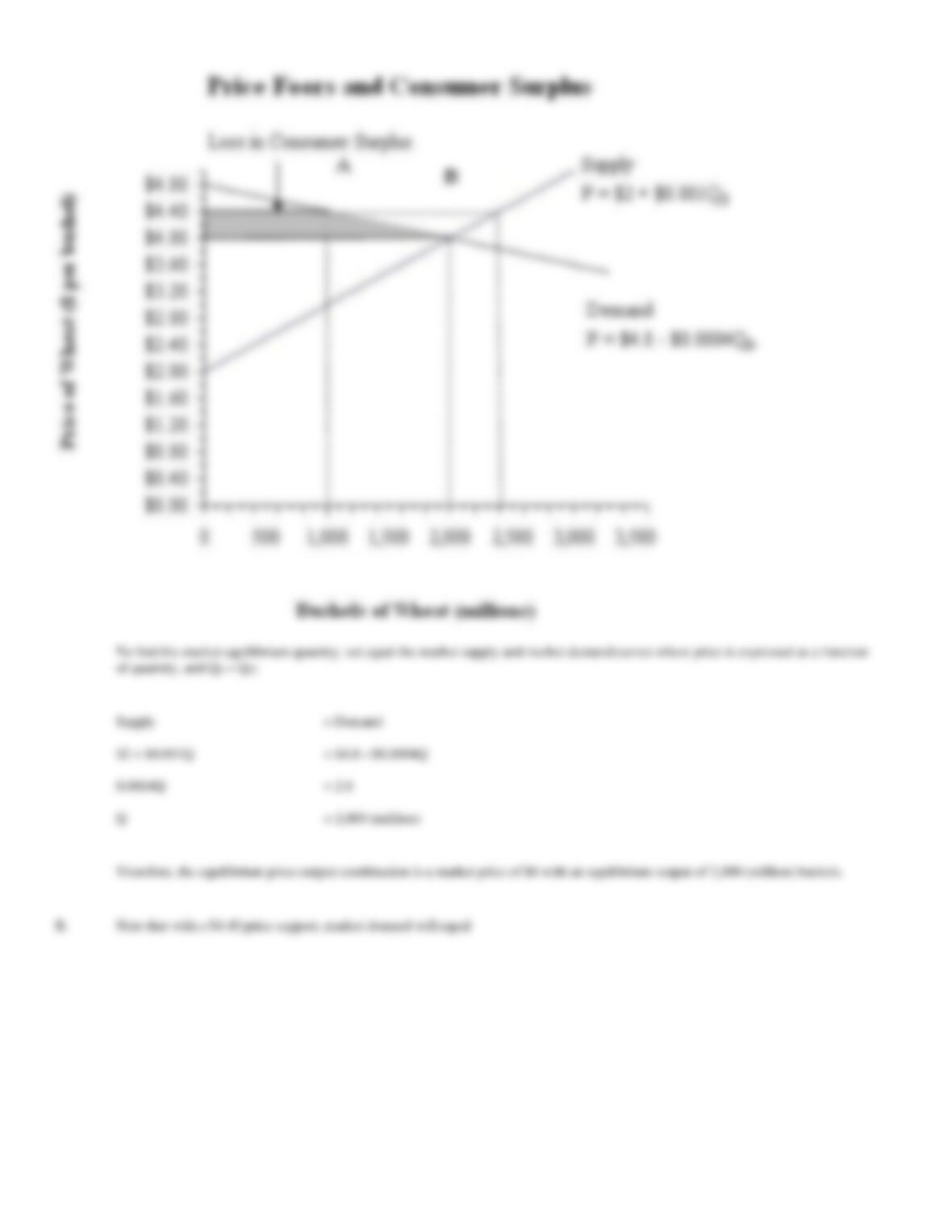
44. Price Floors and Consumer Surplus. The U. S. wheat crop averages about 2 billion bushels per year, and
is about 10 percent of the 20 billion-bushel foreign wheat crop. Typically, the market has a relatively good
estimate of the wheat crop from the United States and Canada, but wheat crops from the Southern Hemisphere
are much harder to predict. Argentina’s wheat acreage varies dramatically from one year to another, for
example, and Australia has hard-to-predict rainfall in key wheat production areas. To illustrate some of the cost
in social welfare from agricultural price supports, assume the following market supply and demand conditions
for wheat:
P
= $2 + 0.001QS
(Market Supply)
P
= $4,80 – $0.0004QD
(Market Demand)
where Q is output in bushels of wheat (in millions), and P is the market price per bushel.
A.
Graph and calculate the equilibrium price/output solution.
B.
Use this graph to help you algebraically determine the loss in consumer surplus due imposition of a $4.40 per bushel price support
program. Explain.
A.
= MC + Import fee
= 1.25($0.0001Q)
= $0.000125Q
Q
= 200,000
Economic Profits
= PQ – TC
= $625,000
profits and lost employment opportunities, respectively. Given the elastic nature of the firm demand curve, prices do not rise at all.
Seattle Software and other large customers bear none of the burden of the tariff-mandated cost increase.
45. Price Floors and Producer Surplus. The U. S. wheat crop averages about 2 billion bushels per year, and is
about 10 percent of the 20 billion-bushel foreign wheat crop. Typically, the market has a relatively good
estimate of the wheat crop from the United States and Canada, but wheat crops from the Southern Hemisphere
are much harder to predict. Argentina’s wheat acreage varies dramatically from one year to another, for
example, and Australia has hard-to-predict rainfall in key wheat production areas. To illustrate some of the cost
in social welfare from agricultural price supports, assume the following market supply and demand conditions
for wheat:
QS
= -2,000 + 1,000P
(Market Supply)
QD
= 12,000 – 2,500P
(Market Demand)
= 12,000 – 2,500P
= 12,000 – 2,500(4.40)
= 1,000 (million)
equals:
= $200 (million)
= $800 (million)
Loss in Consumer Surplus
= Consumer SurplusFM – Consumer SurplusPS
= $800 – $200
= $600 (million)
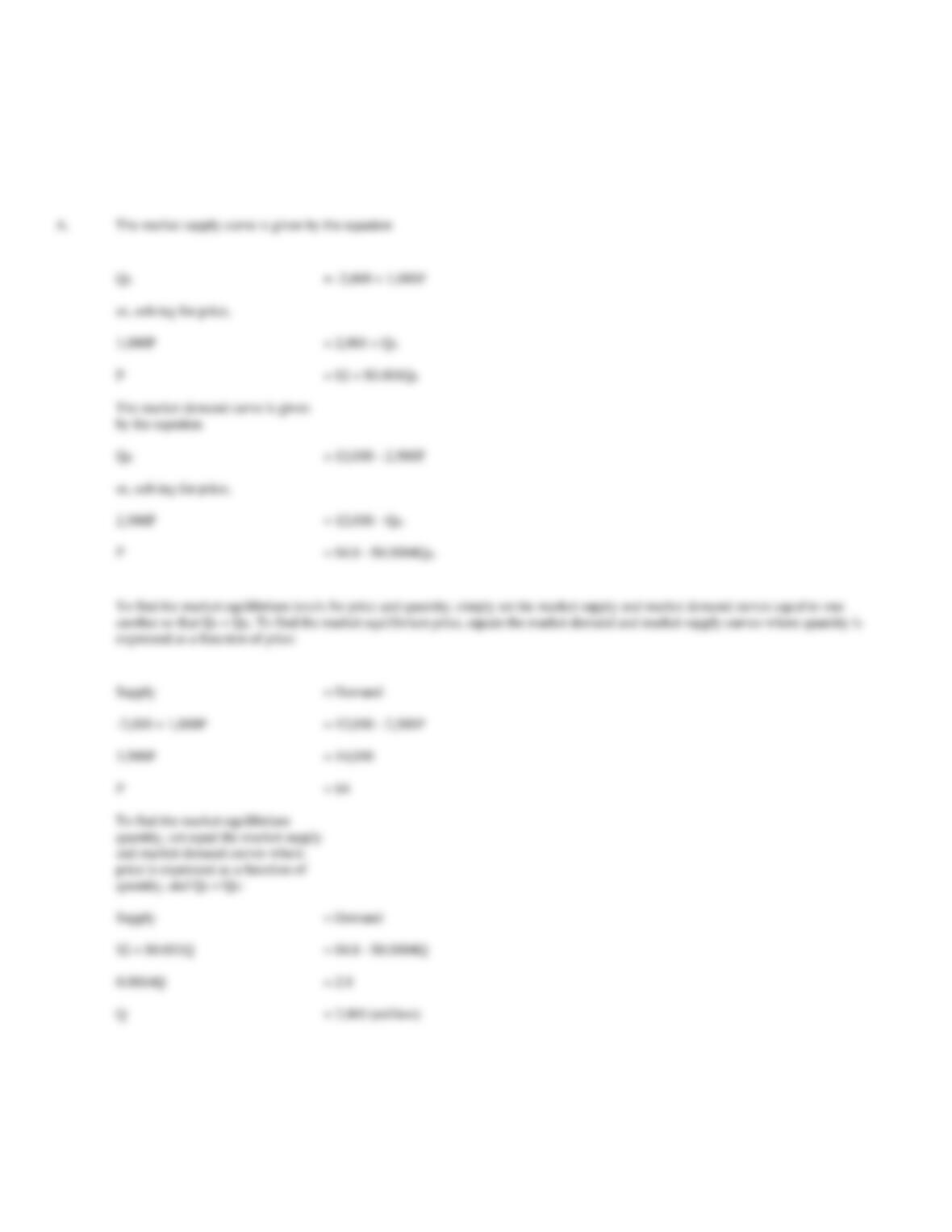
where Q is output in bushels of wheat (in millions), and P is the market price per bushel.
A.
Graph and calculate the equilibrium price/output solution. Use this graph to help you algebraically determine the amount of surplus
production the government will be forced to buy if it imposes a support price of $4.40 per bushel.
B.
Use this graph to help you algebraically determine the gain in producer surplus due to the price support program. Explain.
1,000P
= 2,000 + QS
= 12,000 – 2,500P
or, solving for price,
2,500P
= 12,000 – QD
P
= $4.8 – $0.0004QD
expressed as a function of price:
-2,000 + 1,000P
= 12,000 – 2,500P
P
= $4
Supply
= Demand
0.0014Q
= 2.8
46. Regulation Costs. Finlandia, Inc., manufacturers molded plastic products used to improve industrial
productivity. Suppose the Occupation Health and Safety Administration (OSHA) has required the firm to
enhance the durability of its popular safety helmet at a cost of $10 per unit. Prior to these costs, Finlandia’s
annual manufacturing costs of this item are:
TC = $225,000 + $20Q + $0.001Q2
MC = ¶TC/ ¶Q = $20 + $0.002Q
where Q is units produced per year and TC includes a normal rate of return on investment.
A.
Calculate Finlandia’s profit at the profit-maximizing activity level if prices in the industry are stable at $50 per unit, and therefore P =
MR = $50.
B.
Calculate Finlandia’s optimal price, output, and profit levels if the OSHA mandated cost increase can be fully passed onto customers.
C.
Determine the effect on output and profit if Finlandia is not able to pass onto consumers any of the projected cost increase, and must
instead absorb it.
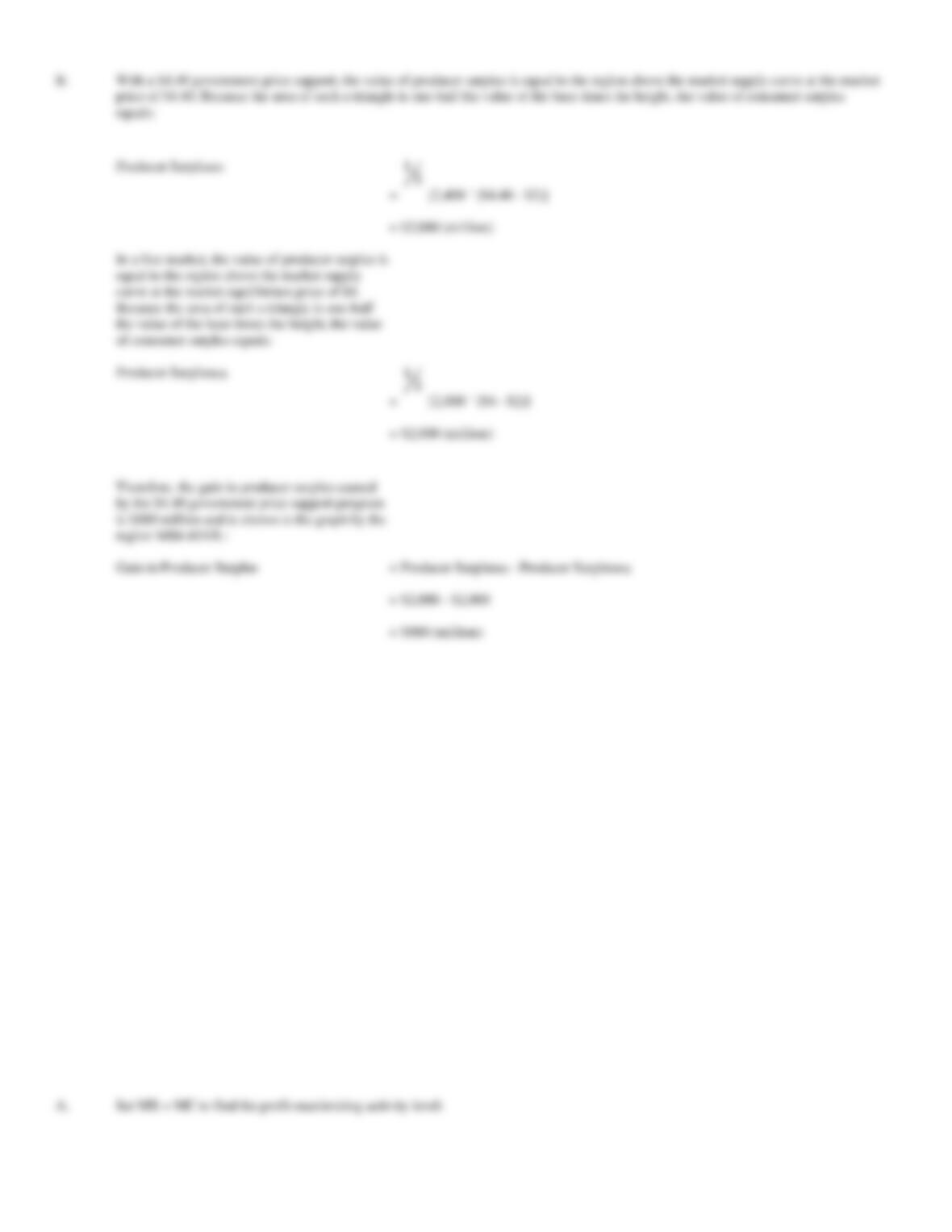
= $2,880 (million)
= $2,000 (million)
region $4$4.40AB.:
Gain in Producer Surplus
= Producer SurplusPS – Producer SurplusFM
= $2,880 – $2,000
= $880 (million)
47. Regulation Costs. Ottawa Construction, Ltd., is a medium-sized housing contractor located in eastern
Ontario. The company is adversely affected by new local regulations requiring it to pay $10,000 to cover sewer
and water hook-up charges for each new apartment Ottawa builds. Before such expenses, Ottawa’s construction
costs are described as:
TC = $100,000 + $50,000Q + $2,500Q2
MC = ¶TC/ ¶Q = $50,000 + $5,000Q
where Q is the number of apartment units built per year and TC includes a normal rate of return on investment.
A.
Calculate Ottawa’s profit at the profit-maximizing activity level if prices in the industry are stable at $100,000 per unit, and therefore
P = MR = $100,000.
B.
Calculate Ottawa’s optimal price, output, and profit levels if the new regulation-induced cost increase can be fully passed onto
customers.
C.
Determine the effect on output and profit if Ottawa is not able to pass onto consumers any of the projected cost increase.
Set MR = MC to find the profit-maximizing activity level:
= MC
$100,000
= $50,000 + $5,000Q
5,000Q
= 50,000
Q
= 10
p
= TR – TC
= $150,000
If the $10,000 regulation-induced cost increase can be fully passed onto customers, then MR = $110,000 = $100,000 + $10,000.
MR + $10,000
= MC + $10,000
$110,000
= $60,000 + $5,000Q
5,000Q
= 50,000
Q
= 10
p
= TR – TC
= $150,000
48. Costs of Regulation. The Appalachian Coal Company sells coal to electric utilities in the southeast.
Unfortunately, Appalachian’s coal has high particulate content and, therefore, the company is adversely affected
by state and local regulations governing smoke and dust emissions at its customer’s electricity-generating plants.
Appalachian’s total cost and marginal cost relations are:
TC = $250,000 + $5Q + $0.0002Q2
MC = ¶TC/ ¶Q = $5 + $0.0004Q
where Q is tons of coal produced per month and TC includes a normal rate of return on investment.
A.
Calculate Appalachian’s profit at the profit-maximizing activity level if prices in the industry are stable at $25 per ton, and therefore
P = MR = $25.
B.
Calculate Appalachian’s optimal price, output, and profit levels if a new state regulation results in a $300,000 fixed cost increase that
cannot be passed onto customers.
Set MR = MC to find the profit-maximizing activity level:
= MC
= $5 + $0.0004Q
0.0004Q
= 20
Q
= 50,000
p
= TR – TC
= $250,0000
= MC + $10,000
$100,000
= $60,000 + $5,000Q
5,000Q
= 40,000
Q
= 8
p
= TR – TC
= $60,000
continue to operate in the long-run.
49. Competitive Strategy. Carry Underwood runs Tax Preparation Services, Inc., a small firm that offers
timely tax preparation services in Oklahoma City. Given the large number of competitors, the fact that tax
preparers rely heavily upon standard tax-preparation software, and the lack of entry barriers, it is reasonable to
assume that the tax form preparation market is perfectly competitive and that the average $150 price equals
marginal revenue, P = MR = $150. Assume that TPS’s annual operating expenses are typical of several such
firms operating in the local market, and can be expressed by the following total and marginal cost functions:
TC = $830,000 + $10Q + $0.005Q2
MC = $10 + $0.01Q
where TC is total cost per year, MC is marginal cost, and Q is the number of clients served. Total costs include a normal profit and allow for
Underwood’s employment opportunity costs.
A.
Calculate TPS’s profit-maximizing output level.
B.
Calculate TPS’s economic profits at this activity level. Is this activity level sustainable in the long run?
The optimal output level can be determined by setting marginal revenue equal to marginal cost and solving for Q:
= MC
$150
= $10 + $0.01Q
0.01Q
= 140
Q
= 14,000 tax forms per year
= MC
= $5 + $0.0004Q
0.0004Q
= 20
Q
= 50,000
However, profit is affected because:
p
= TR – TC
forced out of business.
50. Competitive Strategy. Bob Ice owns and operates Bob’s Music Center, Ltd., a small firm that offers music
lessons in Huntsville, Alabama. Given the large number of competitors and the lack of entry barriers, it is
reasonable to assume that the market for music lessons is perfectly competitive and that the average $60 per
hour price equals marginal revenue, P = MR = $60. Assume that Bob’s annual operating expenses are typical of
several such firms and individuals operating in the local market, and can be expressed by the following total and
marginal cost functions:
TC = $100,000 + $10Q + $0.005Q2
MC = $10 + $0.01Q
where TC is total cost per year, MC is marginal cost, and Q is the number lessons given. Total costs include a normal profit and allow for Bob’s
employment opportunity costs.
A.
Calculate Bob’s profit-maximizing output level.
B.
Calculate Bob’s economic profits at this activity level. Is this activity level sustainable in the long run?
A.
The optimal output level can be determined by setting marginal revenue equal to marginal cost and solving for Q:
= MC
= $10 + $0.01Q
Q
= 5,000 lessons per year
p
= TR – TC
= $150Q – [$830,000 + $10Q + $0.005Q2]
= $150(14,000) – [$830,000 + $10(14,000) + $0.005(14,0002)]
= $150,000