Chapter 11W – Technology, R&D, and Efficiency
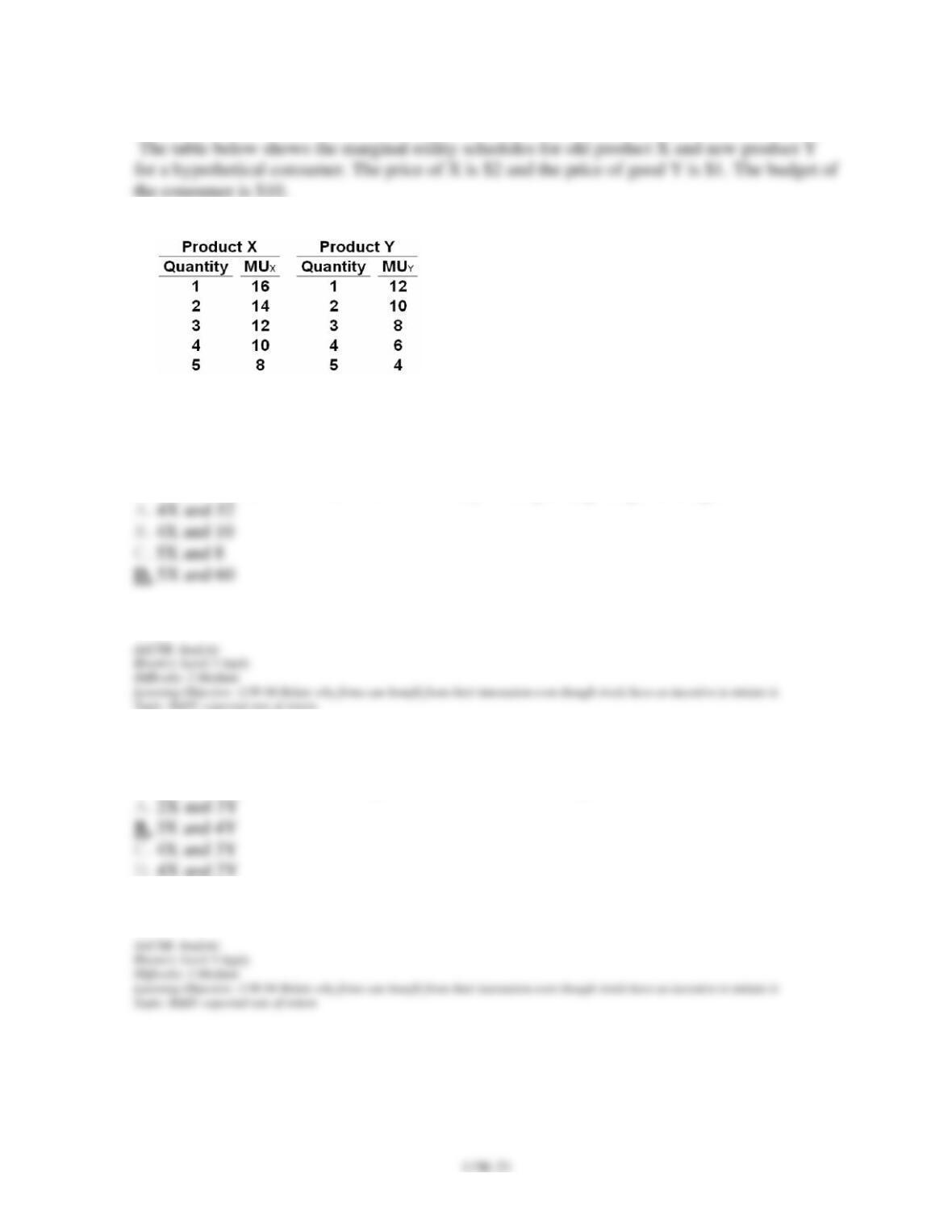
56. Refer to the above table. If the consumer can only buy old product X, how much will the
consumer buy and what will be the total utility from spending the given budget?
57. Refer to the above table. If the consumer buys both old product X and new product Y,
how much will the consumer buy of each to maximize utility?
Chapter 11W – Technology, R&D, and Efficiency
58. Refer to the above table. When the consumer purchases the utility-maximizing
combination of old product X and new product Y, total utility will be:
59. Refer to the above table. The consumer was originally limited to purchasing old product X
but now can also purchase new product Y. What is the increase in total utility from the
original situation when the consumer purchases the utility-maximizing combination of both X
and Y?
60. Consumer acceptance of a new product depends on:
Chapter 11W – Technology, R&D, and Efficiency
61. Which would be a good example of a successful introduction of a new product?
62. Henry Ford’s development of an assembly method for building cars and trucks would be
an example of:
63. Process innovation will shift a firm’s:
Chapter 11W – Technology, R&D, and Efficiency
64. If a firm improves its production method, this change will shift the firm’s:
65. If a firm develops better methods of producing a product, then this process innovation can
be expected to result in a(n):
66. Refer to the above information. If the firm can produce 2,000 units of output by
combining its fixed capital with 200 units of labor and 500 units of raw materials, what are
the total cost (TC) and average total cost (ATC) of producing the 2,000 units of output?
Chapter 11W – Technology, R&D, and Efficiency
67. Refer to the above information. A firm improves its production process so that it can
produce 3,000 units of output by combining its fixed capital with 100 units of labor and 500
units of raw materials. What are the total cost and average cost of producing the 3,000 units of
output?
68. Refer to the above information. Originally the firm produced 2,000 units of output by
combining its fixed capital with 200 units of labor and 500 units of raw materials. Now the
firm improves its production process so that it can produce 3,000 units of output by
combining its fixed capital with 100 units of labor and 500 units of raw materials. What
happened to total cost?
Chapter 11W – Technology, R&D, and Efficiency
69. Refer to the above information. Originally the firm produced 2,000 units of output by
combining its fixed capital with 200 units of labor and 500 units of raw materials. Now the
firm changes its production process so that it can produce 3,000 units of output by combining
its fixed capital with 100 units of labor and 500 units of raw materials. What happened to
average total cost?
70. Refer to the above information. Originally the firm produced 2,000 units of output by
combining its fixed capital with 200 units of labor and 500 units of raw materials. Now the
firm changes its production process so that it can produce 3,000 units of output by combining
its fixed capital with 100 units of labor and 500 units of raw materials. What valid conclusion
can be drawn about the effect and reasons for the change?
Chapter 11W – Technology, R&D, and Efficiency
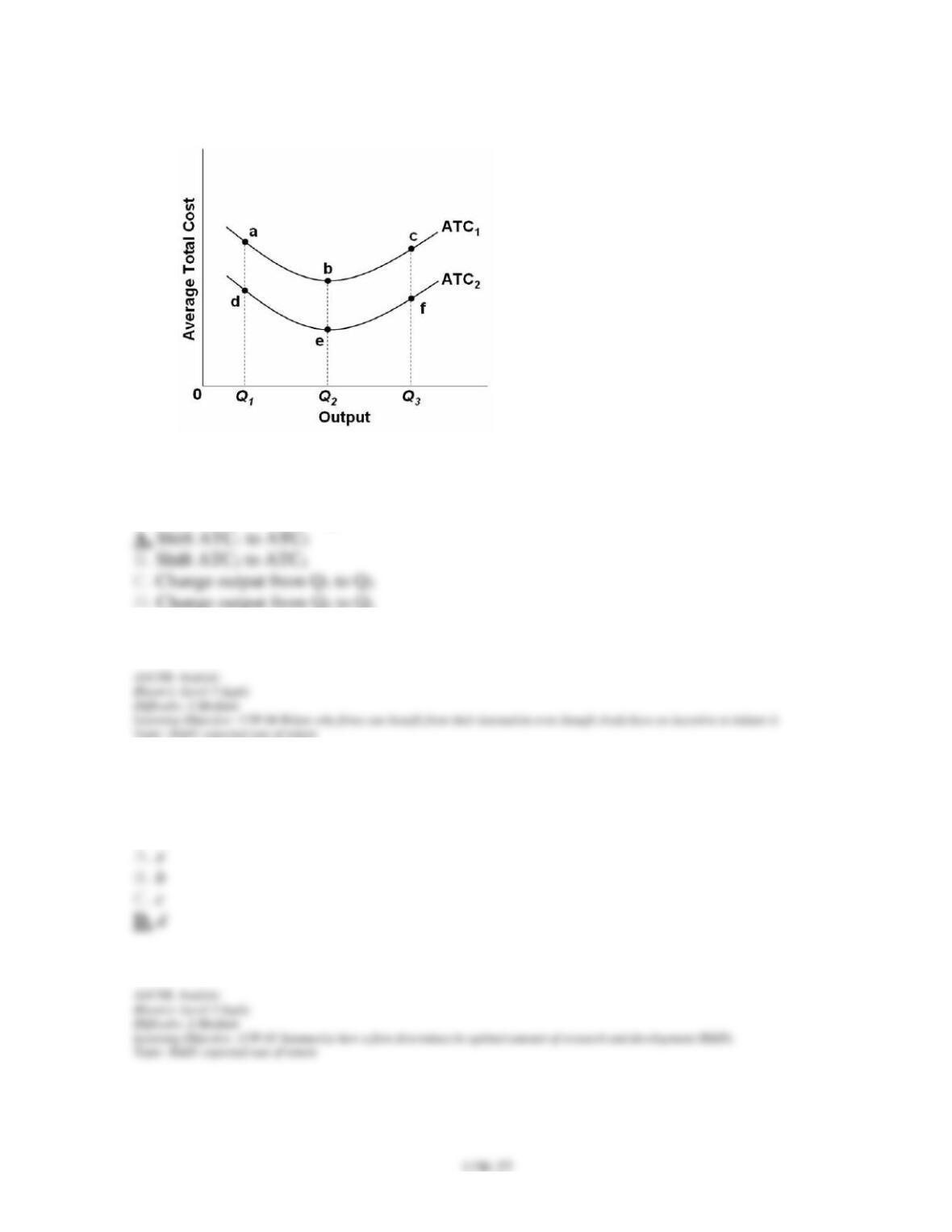
71. Refer to the above diagram. Process innovation will tend to:
72. Refer to the above diagram. Assume the firm is currently producing at Q1 with average
cost associated with point a. A process innovation will reduce average costs from point a to
point:
Chapter 11W – Technology, R&D, and Efficiency
73. The following statements apply when a firm’s rivals imitate its innovation, except:
74. A “fast-second strategy” means that a dominant firm in an industry:
75. When a dominant firm quickly copies the new product innovation of a smaller firm so that
it is the next firm to make the innovation, it is following a:

Chapter 11W – Technology, R&D, and Efficiency
76. The legal protection for publishers of books, computer software, movies, videos, and
musical compositions from having their works used or copied by others without their
permission is a:
77. The legal protection that gives the original innovators of products the exclusive right to
use a particular product name is a:
78. A legal protection for taking the lead in innovation is:
Chapter 11W – Technology, R&D, and Efficiency
79. One of the major advantages of being the first to develop a product is:
80. Which market structure has a strong incentive for product development and
differentiation?
81. Under which market structure are profit rewards most likely to be quickly taken away by
existing firms or new firms entering the industry?
Chapter 11W – Technology, R&D, and Efficiency
82. Which market structure is most likely to have the means and some incentive to innovate?
83. Which two market structures have a strong need to innovate but have low expected returns
on R&D expenditures?
84. Which market structure offers little incentive to engage in R&D?