Chapter 11 – Monopolistic Competition and Oligopoly (+ Appendix)
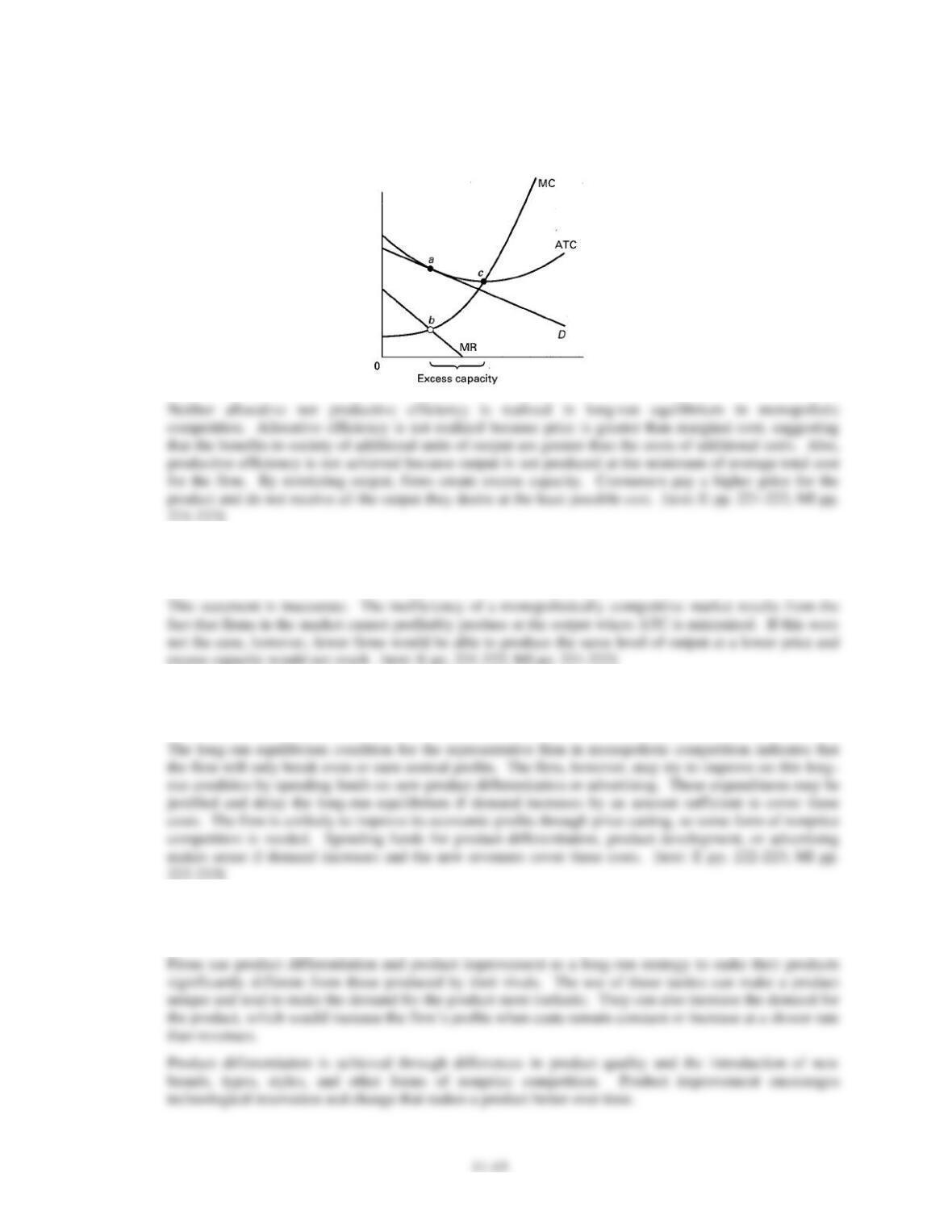
20. Draw a graph of the cost curves for a monopolistically competitive firm that clearly illustrates the excess
capacity that arises in the long run. Explain why this excess capacity arises.
21. Evaluate this statement: “A monopolistically competitive industry would be more efficient if there were
fewer firms.”
22. Why do monopolistically competitive firms spend funds for product differentiation and advertising when
this practice only adds to the firm’s costs?
23. Explain how monopolistically competitive producers try to improve on the condition of just breaking even
in the long run. Is this improvement a benefit for consumers?
Chapter 11 – Monopolistic Competition and Oligopoly (+ Appendix)
11–16
24. Explain why the economic analysis of monopolistic competition is so complex.
25. What are the basic characteristics of oligopoly? How does oligopoly compare with the other market
structures?
26. Evaluate the statement: “A market that produces an identical product cannot be become an oligopoly.”
224; MI p. 224]
Chapter 11 – Monopolistic Competition and Oligopoly (+ Appendix)
11–17
27. (Consider This) How is strategic behavior illustrated by the competition among three sellers of native arts and
crafts near a national park?
28. What are the shortcomings or limitations of the “four–firm” concentration ratios?
29. The market shares of firms in three different industries are listed in the table below. Use this information to
calculate the Herfindahl index for each industry.
Firms Industry 1 Industry 2 Industry 3
1 65 70 35
2 15 15 35
3 10 10 30
4 5 5 –
5 5 – –
Herfindahl Index _____ _____ _____
(a) Which industry is has the greatest market power? The least?
(b) Based on your findings, is the number of firms in the industry a good predictor of the competitiveness
of an industry? Why or why not?
Chapter 11 – Monopolistic Competition and Oligopoly (+ Appendix)
11–18
30. What conclusions can be drawn from the game theory view of oligopoly?
31. Consider the following payoff matrix in which the numbers indicate the profit in millions of dollars for a
duopoly based either on a high-price or a low-price strategy.
Firm A
High-price Low-price
High-price A = $500
B = $500 A = $650
B = $300
Firm B
Low-price A = $300
B = $650 A = $400
B = $400
(a) What will be the result when each firm chooses a high-price strategy?
(b) What will be the result when Firm A chooses a low-price strategy while Firm B maintains a high-price
strategy?
(c) What will be the result when Firm B chooses a low-price strategy while Firm A maintains a high-price
strategy?
(d) What will be the result when each firm chooses a low-price strategy?
(e) What two conclusions can you draw about collusion?
Chapter 11 – Monopolistic Competition and Oligopoly (+ Appendix)
11–19
32. Consider the following payoff matrix in which the numbers indicate the profit in millions of dollars for a
duopoly based either on a high-price or a low-price strategy.
Firm A
High-price Low-price
High-price A = $150
B = $150 A = $200
B = $ 90
Firm B
Low-price A = $ 90
B = $200 A = $100
B = $100
(a) What will be the result when each firm chooses a high-price strategy?
(b) What will be the result when Firm A chooses a low-price strategy while Firm B maintains a high-price
strategy?
(c) What will be the result when Firm B chooses a low-price strategy while Firm A maintains a high-price
strategy?
(d) What will be the result when each firm chooses a low-price strategy?
(e) What two conclusions can you draw about collusion?
33. (Consider This) What is the Prisoner’s Dilemma? How is this dilemma similar to the one for two firms
competing for market share as described in the text?
Chapter 11 – Monopolistic Competition and Oligopoly (+ Appendix)
11–20
34. Why is the economic analysis of oligopoly so difficult? What two generalizations can be made about the
pricing behavior of oligopolists?
35. Describe the essential features of the kinked-demand model of oligopoly pricing.
36. The kinked-demand schedule that an oligopolist believes confronts the firm is given in the table below.
Compute the oligopolist’s total revenue at each of the nine prices, and enter these figures in the table. Also
compute marginal revenue for each unit between the nine prices and enter these figures in the table.
Price Quantity demanded Total revenue Marginal revenue per unit
$5.80 50 $_____
5.60 100 _____ $_____
5.40 150 _____ _____
5.20 200 _____ _____
5.00 250 _____ _____
4.80 264 _____ _____
4.60 279 _____ _____
4.40 288 _____ _____
4.20 300 _____ _____
(a) Where is the “kink” in the demand curve? What is the current selling price at that kink and how much
output will be demanded?
(b) What is the range of marginal cost that will keep the price set at the kink?
Chapter 11 – Monopolistic Competition and Oligopoly (+ Appendix)
11–21
37. The kinked-demand schedule that an oligopolist believes confronts the firm is given in the table below.
Compute the oligopolist’s total revenue at each of the nine prices, and enter these figures in the table. Also
compute marginal revenue for each unit between the nine prices and enter these figures in the table.
Price Quantity demanded Total revenue Marginal revenue per unit
$17.40 150 $_____
16.80 300 _____ $_____
16.20 450 _____ _____
15.60 600 _____ _____
15.00 750 _____ _____
14.40 792 _____ _____
13.80 837 _____ _____
13.20 864 _____ _____
12.60 900 _____ _____
(a) Where is the “kink” in the demand curve? What is the current selling price at that kink and how much
output will be demanded?
(b) What is the range of marginal cost that will keep the price set at the kink?
38. Explain in nontechnical terms why oligopolistic prices may tend to be inflexible.
39. Explain the collusive pricing model of oligopoly behavior.
Chapter 11 – Monopolistic Competition and Oligopoly (+ Appendix)
11–22
40. An oligopoly producing a homogeneous product is composed of three firms that act like a cartel. Assume
that these three firms have identical cost schedules. Assume also that if any one of these firms sets a price
for the product, the other two firms charge the same price. As long as they all charge the same price they
will share the market equally; and the quantity demanded of each will be the same.
Below are the total-cost schedule of one of these firms and the demand schedule that confronts it when the
other firms charge the same price as this firm. Complete the marginal-cost and marginal-revenue schedules
facing the firm.
Output Total cost Marginal cost
Price Quantity demanded Marginal revenue
0 $ 0
1 60 $_____ $260 1 $_____
2 100 _____ 240 2 _____
3 160 _____ 220 3 _____
4 240 _____ 200 4 _____
5 340 _____ 180 5 _____
6 460 _____ 160 6 _____
7 600 _____ 140 7 _____
8 760 _____ 120 8 _____
(a) What price would be charged, what output would be produced, and what profit would be made by this
firm?
(b) If the firms collude to maximize joint profits, what would be the industry price, output, and profit?
41. An oligopoly producing a homogeneous product is comprised of three firms that act like a cartel. Assume
that these three firms have identical cost schedules. Assume also that if any one of these firms sets a price
for the product, the other two firms charge the same price. As long as they all charge the same price they
will share the market equally; and the quantity demanded of each will be the same.
Below are the total-cost schedule of one of these firms and the demand schedule that confronts it when the
other firms charge the same price as this firm. Complete the marginal-cost and marginal-revenue schedules
facing the firm.
Output Total cost Marginal cost
Price Quantity demanded Marginal revenue
0 $ 0
Chapter 11 – Monopolistic Competition and Oligopoly (+ Appendix)
1 180 $_____ $780 1 $_____
2 300 _____ 720 2 _____
3 180 _____ 660 3 _____
4 720 _____ 600 4 _____
5 1020 _____ 540 5 _____
6 1380 _____ 480 6 _____
7 1800 _____ 420 7 _____
8 2280 _____ 360 8 _____
(a) What price would be charged, what output would be produced, and what profit would be made by this
firm?
(b) If the firms collude to maximize joint profits, what would be the industry price, output, and profit?
42. What obstacles might a group of oligopolists encounter in forming a cartel or an informal understanding?
43. Explain why there is an incentive to cheat in collusive oligopoly. How does such behavior threaten
collusive oligopoly over time?
44. What is the price leadership model of oligopoly pricing and what are its tactics?
Chapter 11 – Monopolistic Competition and Oligopoly (+ Appendix)
45. Why is there emphasis on nonprice competition in oligopoly?
46. Describe the positive and negative views of the economics of advertising.
47. “Purely competitive firms sell their product at the same price. This is also true in some oligopolistic
markets with standardized products. Therefore, these oligopolies are actually highly competitive.”
Evaluate critically.
48. What are three qualifications to the view that allocative and productive efficiency are not realized in
oligopoly?
Chapter 11 – Monopolistic Competition and Oligopoly (+ Appendix)
49. Compare pure competition, pure monopoly, monopolistic competition, and oligopoly on each of the
following points:
(a) Ability to manipulate price.
(b) Flexibility of prices.
(c) Expenditures on advertising and sales promotion.
(d) Efficiency in allocation of resources.
50. (Last Word) Describe the major demand and supply factors that have turned the beer industry into an
oligopoly over the years.
Chapter 11 – Monopolistic Competition and Oligopoly (+ Appendix)
11–26
C. Appendix Questions
51. Define a simultaneous one-time game.
52. What are the differences among positive-sum, negative-sum, and zero-sum games?
53. Describe and give an example of a dominant strategy.
54. Is a Nash equilibrium stable? Explain.
55. How does the use of credible threats or empty threats by firms affect outcomes and the Nash equilibrium in
one-period games?
56. Answer the following questions based on the payoff matrix for a single-period, two-firm game for firms,
Capoc and Caroc. The numbers in the matrix indicate the profit in billions of dollars for a national of
regional strategy. The profit outcome cells are A, B, C, and D.
Capoc Strategy
(a) Which strategies are the dominate ones for Capoc and Caroc?
(b) What is the Nash Equilibrium?
(c) What will be the total amount of profits for both firms if both firms decide their strategy
simultaneously?
(d) If Capoc makes a credible threat that determines the strategy for Caroc, which combination of
strategies will be selected and what will be the total amount of profits for both firms?
57. What are the effects of a reciprocity strategy on game outcomes?
58. Define a sequential game.
59. Determine whether the following statement is true or false and provide an explanation for your answer: A
first-mover firm may be able to preempt the market entry of other firms.
Caroc Strategy
NationalRegional
National Caroc = $12
Capoc = $12 Caroc = $6
Capoc = $21
Regional Caroc = $21
Capoc = $6 Caroc = $18
Capoc = $18
A
B
C
D
Chapter 11 – Monopolistic Competition and Oligopoly (+ Appendix)
11–27
D. Answers to Appendix Questions
51. Define a simultaneous one-time game.
52. What are the differences among positive-sum, negative-sum, and zero-sum games?
53. Describe and give an example of a dominant strategy.
54. Is a Nash equilibrium stable? Explain.
55. How does the use of credible threats or empty threats by firms affect outcomes and the Nash equilibrium in
one-period games?
56. Answer the following questions based on the payoff matrix for a single-period, two-firm game for firms,
Capoc and Caroc. The numbers in the matrix indicate the profit in billions of dollars for a national of
regional strategy. The profit outcome cells are A, B, C, and D.
Capoc Strategy
Caroc Strategy
NationalRegional
National Caroc = $12
Capoc = $12 Caroc = $6
Capoc = $21
Regional Caroc = $21
Capoc = $6 Caroc = $18
Capoc = $18
A
B
C
D
Chapter 11 – Monopolistic Competition and Oligopoly (+ Appendix)
11–28
(a) Which strategies are the dominate ones for Capoc and Caroc?
(b) What is the Nash Equilibrium?
(c) What will be the total amount of profits for both firms if both firms decide their strategy
simultaneously?
(d) If Capoc makes a credible threat that determines the strategy for Caroc, which combination of
strategies will be selected and what will be the total amount of profits for both firms?
57. What are the effects of a reciprocity strategy on game outcomes?
58. Define a sequential game.
59. Determine whether the following statement is true or false and provide an explanation for your answer: A
first-mover firm may be able to preempt the market entry of other firms.