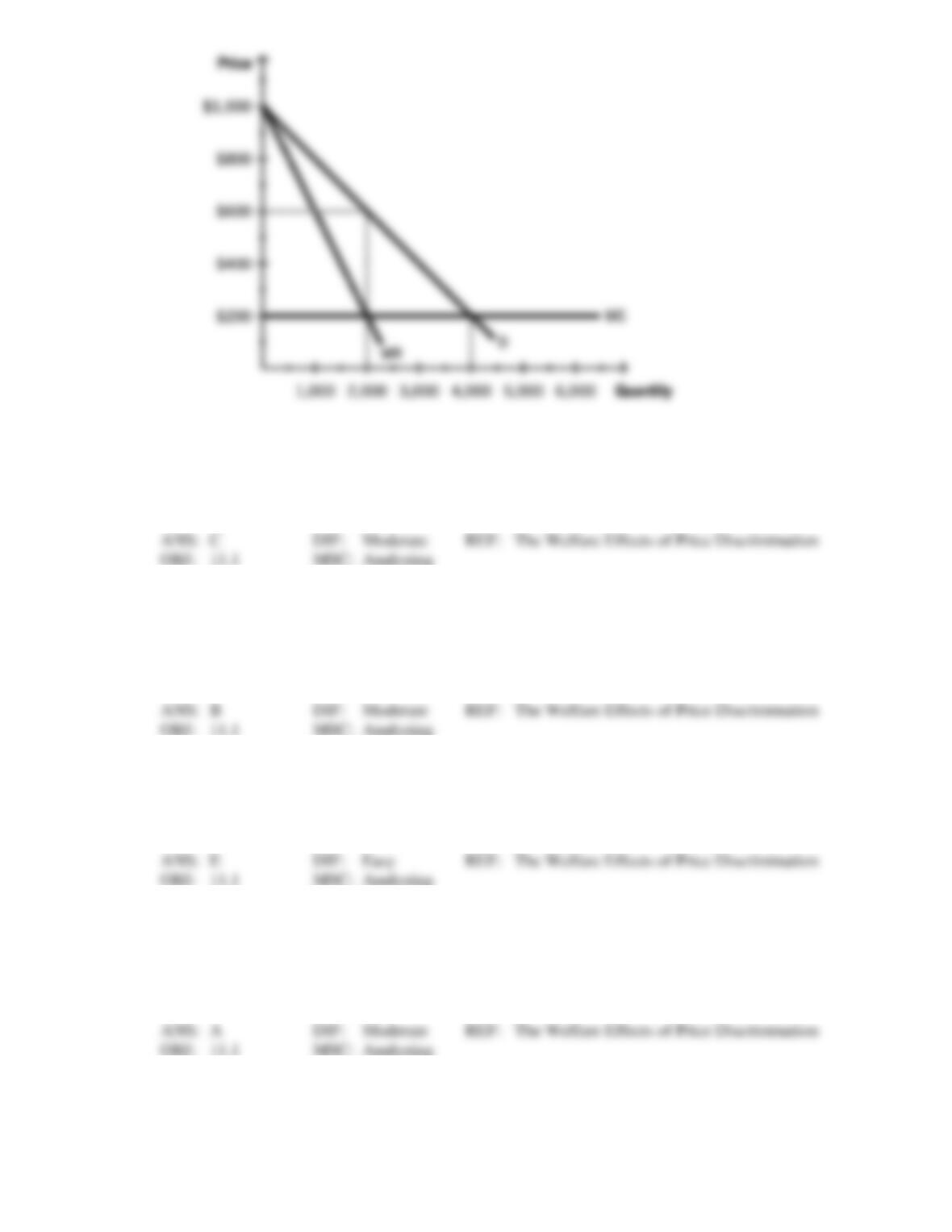
87. If Carnival Cruise Lines moves from a monopolist model that charges a single price to a perfect
price-discrimination model, there would be a ________ in total welfare.
a. gain of $800,000 d. loss of $1.2 million
b. loss of $400,000 e. gain of $1.2 million
c. gain of $400,000
88. If Carnival Cruise Lines moves from a perfect price-discrimination model to a monopolist model
that charges a single price, there would be a ________ in total welfare.
a. gain of $800,000 d. loss of $1.2 million
b. loss of $400,000 e. gain of $1.2 million
c. gain of $400,000
89. If this cruise line faces a perfectly competitive market, its consumer surplus would be
a. $400,000. d. $1.2 million.
b. $600,000. e. $1.6 million.
c. $800,000.
90. If this cruise line is a monopoly that charges a single price of $600 per passenger, what is the
amount of consumer surplus?
a. $400,000 d. $1.2 million
b. $600,000 e. $1.6 million
c. $800,000
91. In the movie Legally Blonde, a sales associate at an exclusive boutique store attempts to convince
the main character to pay full price for a dress that was on the clearance rack because the
salesperson incorrectly believes that the buyer is uninformed about the quality of the product and
has an inelastic demand (she has a function to attend that same evening). In this case, the
salesperson is attempting to practice perfect
a. sales tactics. d. price discrimination.
b. competition. e. producer surplus.
c. product management.
92. An outlet mall tends to be more attractive to shoppers who have
a. inelastic supply. d. elastic supply.
b. elastic demand. e. unit-elastic demand.
c. inelastic demand.
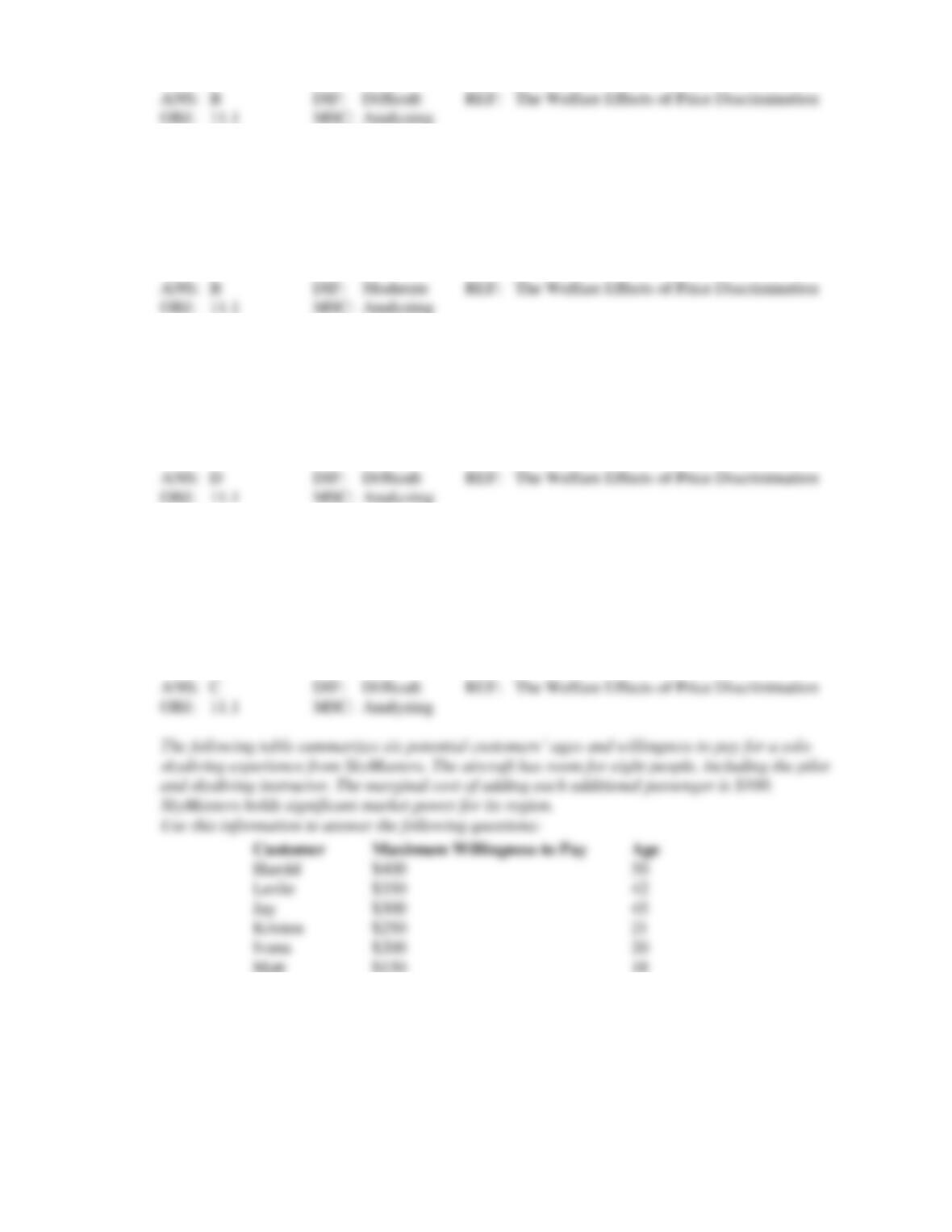
93. If a company is a profit-maximizing firm and can charge a single price in both cities, how much
would its profit be?
a. $6 d. $60
b. $20 e. $64
c. $25
94. Because both cities are located quite far from each other, a company can charge different prices in
each without fear of reselling. What prices would it charge in each city?
a. $8 in City A and $11 in City R d. $10 in City A and $11 in City R
b. $12 in City A and $13 in City R e. $4 in City A and $6 in City R
c. $7 in City A and $7 in City R
95. Because both cities are located quite far from each other, a company can charge different prices in
each without fear of reselling. How much more would it earn in profit by charging two different
prices compared to charging everyone only one price?
a. $4 d. $1
b. $3 e. $0
c. $2
96. It is very hot today, and the ice cream sandwiches melt quickly after Chanel takes them out of the
cooler. This gives her the advantage of being able to sell each ice cream at a different price for
each person in both cities. How many ice cream sandwiches would Chanel sell in both cities?
a. 10 d. 5
b. 8 e. 4
c. 7
97. If an individual could charge a different price to each consumer in both cities (perfect price
discrimination), how much more would this person earn compared to when he or she can charge a
single price to everyone (monopoly)?
a. $40 d. $18
b. $39 e. $10
c. $35
98. Which consumers would not purchase any ice cream sandwiches if the firm decides to price
discriminate and charge a different price in each city?
a. Alvin, Albert, and Roger
b. Albus and Reginald
c. Alvin, Albert, Albus, Roger, and Reginald
d. Robert and Reginald
e. Robert and Albus
99. Assume that SkyMasters follows the profit-maximizing rule and that the company can charge only
one price. What should that price be?
a. $400 d. $250
b. $350 e. $200
c. $325
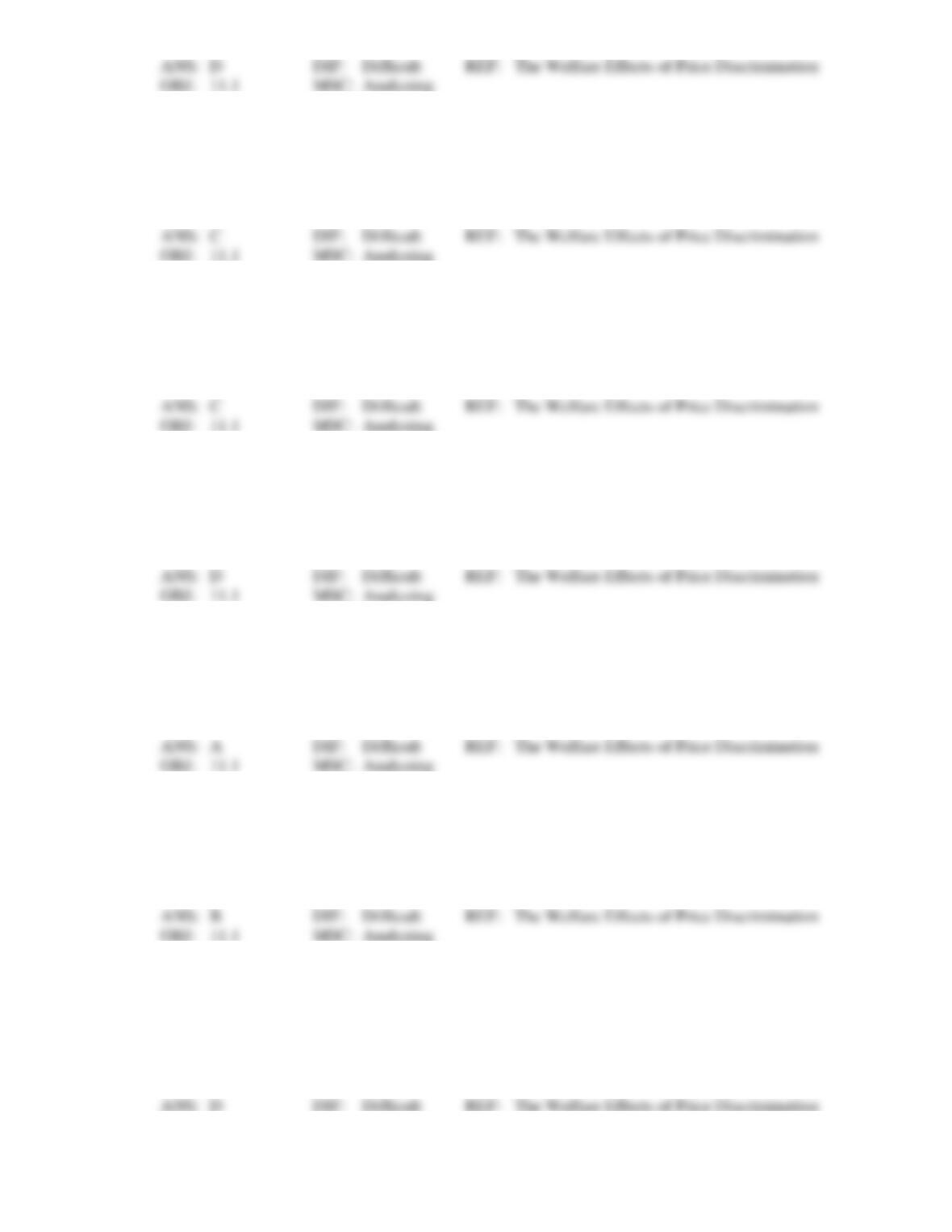
100. Assume that SkyMasters follows the profit-maximizing rule and that the company charges a single
price for skydiving. Which potential customer(s) will not purchase a skydiving experience?
a. Harold and Leslie d. Harold
b. Kristen and Jay e. Matt
c. Matt and Ivana
101. Assume that SkyMasters follows the profit-maximizing rule and that the company charges a single
price for skydiving. What would the company’s total revenue be?
a. $1,650 d. $900
b. $1,500 e. $600
c. $1,000
102. Assume that SkyMasters follows the profit-maximizing rule and the company charges a single
price for skydiving. What would the company’s profit be?
a. $1,050 d. $600
b. $1,000 e. $550
c. $700
103. If SkyMasters could charge two different prices based on the age of the customer, what would
those prices be?
a. $300 and $200 d. $400 and $200
b. $350 and $200 e. $250 and $100
c. $400 and $150
104. SkyMasters has decided to charge two different prices, a high price and a low price, based on age.
Customers ________ would pay the higher price.
a. over the age of 50 d. under the age of 21
b. age 40 and over e. over the age of 16
c. age 21 and over
105. SkyMasters has decided to charge two different prices, a high price and low price, based on age.
What would be the increase in total revenue the company gains from its practice of price
discrimination versus what it would earn if it charged a single price to all customers?
a. $1,300 d. $300
b. $1,200 e. $100
c. $650
106. If SkyMasters decides to price discriminate based on age, which customer(s) will not skydive
based on the price that should be offered to that particular age group?
a. Jay d. Matt
b. Harold and Jay e. Ivana
c. Kristen and Harold
107. An example of price discrimination is when
a. movie theaters do not allow children into R-rated movies without a parent or guardian.
b. you can purchase a new PC for half the price of a new Mac, even though they are both
computers.
c. Procter & Gamble charges $9 for a bottle of Tide laundry detergent, while the store brand costs
the consumer significantly less, despite being somewhat similar products.
d. out-of-state students pay more for the same education as in-state students.
e. a grocery store charges $3.00 for a box of Froot Loops on Tuesday, but charges $2.80 for a
box of Froot Loops on Wednesday.
108. When a nightclub advertises “ladies night” and allows women to enter the club without a cover
charge (whereas men are still required to pay an entrance fee), the club is charging different prices
in an attempt to
a. attract the best clientele and build a reputation as an exclusive club.
b. discriminate between those who are willing to pay for entry and those who have an inelastic
demand for an active nightlife.
c. appeal to different segments of its customer base by allowing certain groups to sometimes gain
free entry.
d. offset the surplus of single men who tend to discriminate between nightclubs based on price.
e. price discriminate, which maximizes the amount of money the club can receive from its
customers.
109. Many electronic brands such as Apple, Hewlett-Packard, and Epson typically offer refurbished
products at lower prices. In this case, these companies are
a. not discriminating prices because the refurbished products are different from the new products.
b. price discriminating because they offer a similar product at a lower price.
c. price discriminating because they offer those discounts only online.
d. not discriminating because people can buy the same products in retail stores.
e. not discriminating because they are price takers, not price makers.
110. Evening showtimes are more popular with moviegoers. Movie theaters discount afternoon ticket
prices in order to sell more tickets during the daytime hours. Unlike the customers who go to the
movies in the evenings, the afternoon customers tend to be
a. retirees who have already paid for many movies over their lifetimes.
b. stay-at-home parents who have relatively inelastic demand compared to the rest of the
moviegoing population.
c. movie theater employees who could sneak in and see the movie for free; the low price deters
such deceptive behavior.
d. retirees, people on vacation, and those who do not work during the day and who tend to have
more price-elastic demands.
e. people who work or attend school and must be presented with a low price to offset their high
opportunity cost of calling in sick for work or school.
111. Concession pricing in movie theaters separates moviegoers into what distinct groups?
a. those who want to eat while watching movies and those who do not
b. moviegoers who value snacks over being caught engaging in the illegal activity of smuggling
in snacks
c. free-riders who would rather eat their friend’s popcorn instead of buying their own
d. revenue-building nonsnackers who attend more movies on average than those who purchase
concessions
e. a price-inelastic group of nonsnackers and snack smugglers and a price-elastic group of
concession area snackers
112. Senior citizens typically receive many discounts in movie theaters, among other places, because
they
a. have very elastic demands.
b. are poorer than the average population.
c. have very inelastic demands.
d. can be distinguished easily from other types of consumers.
e. are retired and don’t work anymore.
113. In the research paper “Personalized Dynamic Pricing of Limited Inventories” by Aydin and Ziya
(2007), the authors note that
[I]mplementing personalization [with regard to pricing] to such a full extent may be impractical.
Instead, a seller may want to use a personalization strategy where there is an announced price and
single discount level that can possibly be offered to a customer depending on the signal from the
customer.
Source: G. Aydin and S. Ziya, “Personalized Dynamic Pricing of Limited Inventories,” Operations Research 57, no. 6
(November/December 2009): 1523–1531.
An everyday example of this would be a discount on
a. movie tickets when the customer signals that he or she is single.
b. movie tickets when the customer signals that he or she is a student.
c. Twilight movie tickets when the customer signals that he or she is a Twilight fan.
d. Avengers movie tickets when the customer signals that he or she is a silent-film fan.
e. concessions when the customer signals that he or she is on a diet.
114. A campus financial aid office uses what tool to separate students into distinct groups based on
family income?
a. National Aid for Federal Teaching Assistance (NAFTA)
b. College Student Aid Federal Fund (CSAFF)
c. Free Application for Federal Student Aid (FAFSA)
d. Federal Aid to Student Organization (FATSO)
e. Federal Stafford Loan Program Report (FSLPR)
115. Selective private colleges advertise high tuition rates, but have the flexibility to discount the tuition
for each student on an individual basis. This type of near-perfect price discrimination practiced in
the real world is most similar to that which occurs in a
a. movie theater. d. nightclub.
b. restaurant chain. e. retail store.
c. jewelry store.
116. If the “smart vending machine” described in the excerpt were available today on a 100-degree day
in Atlanta, Georgia, Coca-Cola would be purchased by the
a. person with the most price-inelastic demand for cola.
b. person with the most elastic demand for cola.
c. firm with the most inelastic supply of cola.
d. firm with the most elastic supply of cola.
e. person with a low reservation price.
117. If a “smart vending machine” were placed outside a classroom and it took other factors in addition
to temperature into account when setting its price, what would likely happen to prices for
caffeinated beverages during spring semester’s exam week?
a. Most students elect to attend class during exam week, so we would expect lower demand for
cola.
b. Students tend to run out of funds near the end of the academic year, so we would expect them
to be very insensitive to changes in price.
c. Demand for chemical alertness would likely be higher during this time and the weather would
be warmer, so we would expect the price of cola to be higher.
d. This is an area that students visit on a regular basis, so we would expect them to notice the
fluctuating prices and make alternative plans if they have price-inelastic demand.
e. The supply of cola is consistent from week to week, so we would expect the demand for cola
to remain unchanged.
118. In a price-discrimination setting, who pays the higher price for the same good?
a. Consumers with the most inelastic demand pay the highest price.
b. Consumers with the most elastic demand pay the highest price.
c. All consumers pay the same high price.
d. It is unknown which consumers would pay the higher price.
e. The consumers with the most inelastic supply pay the highest price.
119. In a price-discrimination setting, people with the most inelastic demand
a. pay the lowest price for the same good.
b. pay the same price as everybody else.
c. pay the highest price for the same good.
d. pay either a higher or a lower price.
e. do not buy the good.
120. Second degree discrimination, represented by the $5 foot-long sandwich available from Subway,
occurs when the price per unit
a. is consistent over time.
b. varies from month to month.
c. varies with the quantity sold.
d. varies from producer to producer.
e. is determined by the consumer’s willingness to pay.
121. At the Kickin’ Chicken Family Restaurant, which of the following menu items represents the
company’s attempt to price discriminate?
a. A large soft drink costs $2.99, whereas a small soft drink costs $1.99.
b. The “chicken little tenders with fries” menu name sells as an entrée at $8.99, while a “kickin’
chicken tender basket with fries” menu name sells as an appetizer at $6.99; both have the same
amount of tenders and fries.
c. Takeout orders of dark meat buckets of chicken are $5.00 per bucket, while an order of white
meat chicken costs $6.00 per bucket.
d. The small-size potato salad is $1.49, while the large potato salad is $1.99.
e. The “bawk–buck” menu highlights restaurant items that are available for $1.00 or less every
day.
122. The local coffee shop, Latté Café, has a frequent-buyer program that offers a 5 percent discount to
customers who “like” its business page on Facebook. This allows the firm to price discriminate
because
a. everyone will now know where to go for the best coffee in town.
b. increasing its customer base lowers prices for all consumers.
c. customers who are sensitive to price will take the time to go to the website.
d. only java-obsessed customers are eligible for the discount.
e. price-conscious customers are usually unwilling to sign up for discounts.
123. Which of the following situations is considered price discrimination?
a. McDonald’s is offering food products for $1 if you order from the dollar menu.
b. Barnes & Noble offers books at a lower-than-market price to members, who must pay an
annual fee.
c. Karen uses TripAdvisor.com to research hotel recommendations online.
d. Best Buy is offering a discount on older model television sets.
e. QT, a chain of gas stations, typically supplies gasoline at lower prices to fleet vehicles.
124. Teryn booked a flight to Boston for her little sister’s wedding. When she boarded the plane, she
found out that Frugal Fred, in the seat beside her, paid $100 less for his ticket. Teryn paid a higher
price for her flight since she is more
a. price-elastic because she is the maid of honor at her sister’s wedding.
b. price-inelastic because she would not dream of missing her sister’s wedding.
c. price-sensitive because she does not like it when people get better deals than she does.
d. price-insensitive because she would have been just as happy to go to Boston any other
weekend.
e. price-static because she always has the same demand for trips to Boston, regardless of the
event.
125. Post-Thanksgiving consumers are already separated into distinct groups: those who shop on Black
Friday and those who do not shop on Black Friday:
A carnival of capitalism, Black Friday is the day after Thanksgiving, when retailers across the
country dangle deep discounts to lure customers out of bed. Black Friday is also the official
beginning of the holiday-buying frenzy. As retailers battled to draw customers into their stores on
Black Friday, online merchants were plotting a cunning ambush—offering an arsenal of
mobile-only deals intended to pick off shoppers as they wait in line. In 2011, with a
record-breaking Black Friday—shoppers spent $816 million online, 26 percent more than in 2010.
Cyber Monday, the Monday after Thanksgiving, might have started as a made-up occasion to give
underdog e-commerce sites a day of their own, but it has become an undeniably real
thing—surprising even to the people who invented it.
Source: “Times Topics: Black Friday,” New York Times, November 28, 2011,
http://topics.nytimes.com/top/reference/timestopics/subjects/r/retail_stores_and_trade/black_friday/index.html.
The excerpt indicates that Cyber Monday and online sales
a. discourage the violent Black Friday behavior that has become more prevalent in recent years.
b. encourage shopper loyalty to brand leaders who can offer lower prices than their in-store
rivals.
c. split shoppers into two groups: those who like to shop on Fridays and those who like to shop
on Mondays.
d. further separate Black Friday shoppers into two distinct groups: those who like to find deals in
person and those willing to get better deals online.
e. sort shoppers into groups who like to shop during work hours and those who like to shop
during the holiday atmosphere provided by Black Friday.
126. A local discount store offers customers three options for printing their photos: a self-printing kiosk,
one-hour photos, and next-day prints. The most likely reason this type of firm bothers to offer so
many different options to its bargain-hunting consumers is because
a. offering alternatives to customers leads to greater consumer satisfaction.
b. some photos take longer to print than others, which allows firms to lower costs.
c. the variance in impatience on the part of the consumer allows the firm to maximize profit.
d. the different alternatives help consumers realize which service offers the best price.
e. the competing stores also offer these same options, so it allows the discount store to remain
competitive.
127. How does coupon clipping allow for price discrimination?
a. Coupon mailers are sent out only to economically disadvantaged households.
b. Businesses are able to reward those customers who truly want their product by offering them a
better deal than the casual consumer.
c. Because coupon users are less price-sensitive, they require large differences in price to be
apparent before they will be convinced to make a purchase.
d. One price is charged to people who put forth the effort to use the coupon, while another price
is charged to consumers for whom the marginal cost of finding and using the coupon is greater
than the marginal benefit of a lowered price.
e. It allows for price discrimination only if the consumer engages in extreme couponing, where
the risks outweigh the rewards.
128. What is the primary benefit of price discrimination?
a. There is no benefit; discrimination of any kind is wrong.
b. Charging multiple prices generates more profit for firms and matches more buyers and sellers
in the marketplace.
c. It converts firms that were price makers into price takers.
d. All surplus is transferred from the producer to the consumer.
e. It takes a market with varying demand elasticities and makes them more inelastic.
129. When we say that firms must be price makers in order to practice price discrimination, it means
that this activity cannot occur with
a. competitive firms.
b. monopolists.
c. monopolistic competitors.
d. relatively elastic demand.
e. indistinguishable buyers.
130. A potential complication for successful price discrimination is
a. multiple demand elasticities among consumers.
b. the presence of a price maker in a market full of price takers.
c. a product or service for which consumers value differently.
d. other industry firms also practicing price discrimination.
e. the potential for consumers to resell a product or service.
131. Many food retailers offer loyalty cards that track purchases and offer free items to customers after
a certain threshold of purchases. Is this an example of price discrimination?
a. Yes. The store is separating its customers based on how much they spend, and the free items
represent a value to the customer that differs from that which is received by other types of patrons.
b. Yes. Since the store is tracking purchases, it can offer individual customers discounted prices
on items that are purchased most frequently.
c. No. Since every customer has the option to receive a loyalty card, there is no differentiation in
benefits received by customers.
d. No. Since the rewards aren’t a discount in price, it wouldn’t qualify as price discrimination.
e. No. Because the retailer might discontinue the card at any time, the customer may never
receive the earned free items.
132. Dine-in restaurants typically have their lowest business volume on Monday and Tuesday nights.
Besides appealing to consumers on a budget, how might a restaurant benefit from charging
discounted prices on these nights?
a. Demand on these nights will increase to the point where the restaurant can remove the price
discounts.
b. Profits on these nights will surge, allowing the restaurant to close during other nights of the
week.
c. By creating an incentive for consumers, a restaurant is able to capture revenue that it wouldn’t
otherwise.
d. Price discrimination is always successful, so a restaurant can turn an unprofitable situation into
a profitable one.
e. Customers on a budget tend to tip their servers better, increasing the supply of staff willing to
work on these nights.
133. Bakeries will often offer a discount on items that were made the day before but did not sell. How is
this an example of price discrimination?
a. Discounting the items, as opposed to giving them away, prevents customers from attempting to
resell them.
b. Making items of high enough quality to sell the following day means that a bakery has a
certain degree of market power.