Chapter 11: The Basics of Capital Budgeting
67.
You are on the staff of Camden Inc. The CFO believes project acceptance should be based on the NPV, but
Steve Camden, the president, insists that no project should be accepted unless its IRR exceeds the project’s
risk-adjusted WACC. Now you must make a recommendation on a project that has a cost of $15,000 and two
cash flows: $110,000 at the end of Year 1 and −$100,000 at the end of Year 2. The president and the CFO
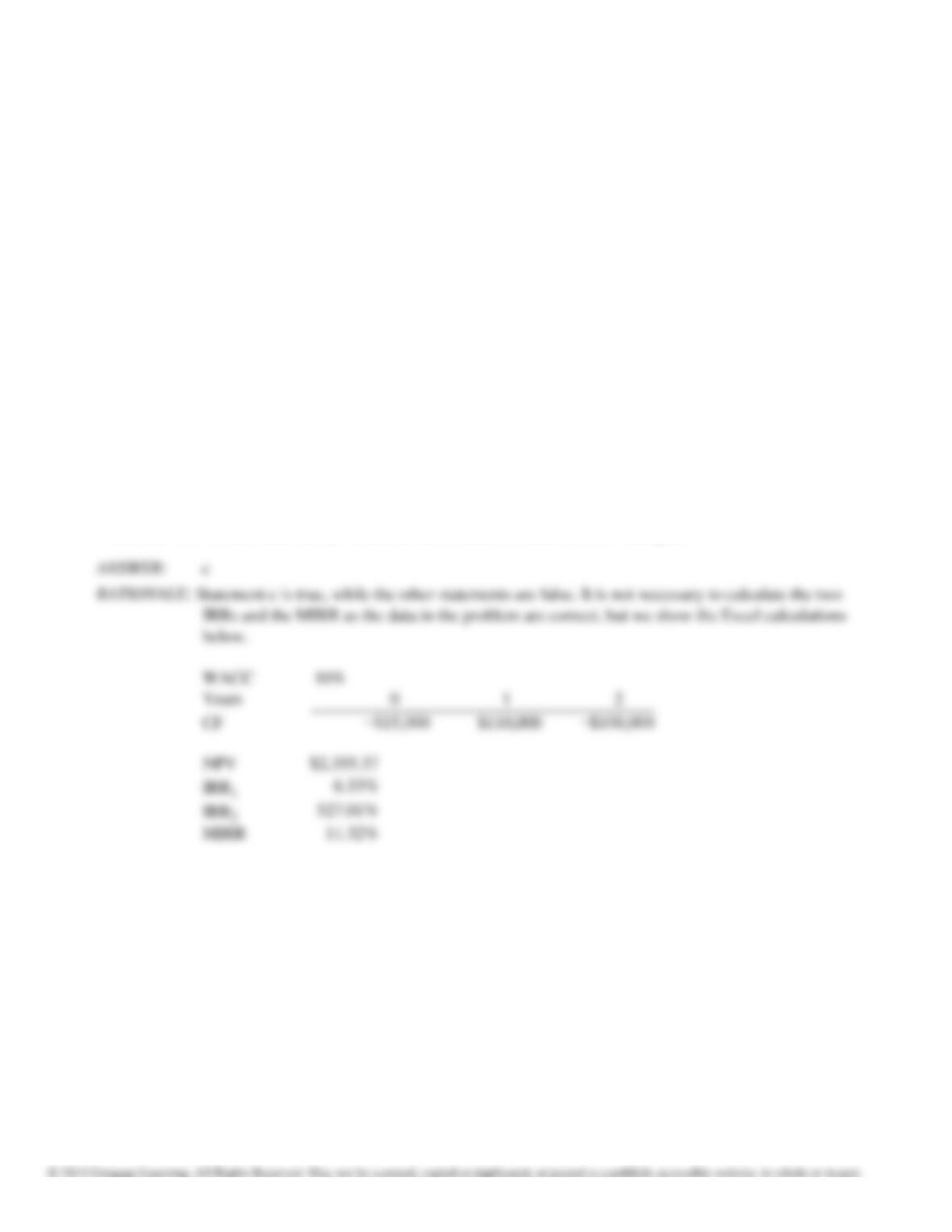
both agree that the appropriate WACC for this project is 10%. At 10%, the NPV is $2,355.37, but you find
two IRRs, one at 6.33% and one at 527%, and a MIRR of 11.32%. Which of the following statements best
describes your optimal recommendation, i.e., the analysis and recommendation that is best for the company
and least likely to get you in trouble with either the CFO or the president?
a.
You should recommend that the project be rejected because its NPV is negative and its IRR is less than the
WACC.
b.
You should recommend that the project be rejected because, although its NPV is positive, it has an IRR that
is less than the WACC.
c.
You should recommend that the project be accepted because (1) its NPV is positive and (2) although it has
two IRRs, in this case it would be better to focus on the MIRR, which exceeds the WACC. You should
explain this to the president and tell him that that the firm’s value will increase if the project is accepted.
d.
You should recommend that the project be rejected because (1) its NPV is positive and (2) it has two IRRs,
one of which is less than the WACC, which indicates that the firm’s value will decline if the project is
accepted.
e.
You should recommend that the project be rejected because, although its NPV is positive, its MIRR is less
than the WACC, and that indicates that the firm’s value will decline if it is accepted.
68.
Which of the following statements is CORRECT? Assume that the project being considered has normal cash
flows,
with one cash outflow at t = 0 followed by a series of positive cash flows.
a.
A project’s MIRR is always greater than its regular IRR.
b.
A project’s MIRR is always less than its regular IRR.
c.
If a project’s IRR is greater than its WACC, then its MIRR will be greater than the IRR.
d.
To find a project’s MIRR, we compound cash inflows at the regular IRR and then find the discount rate
that
causes the PV of the terminal value to equal the initial cost.
e.
To find a project’s MIRR, the textbook procedure compounds cash inflows at the WACC and then finds the
discount rate that causes the PV of the terminal value to equal the initial cost.
69.
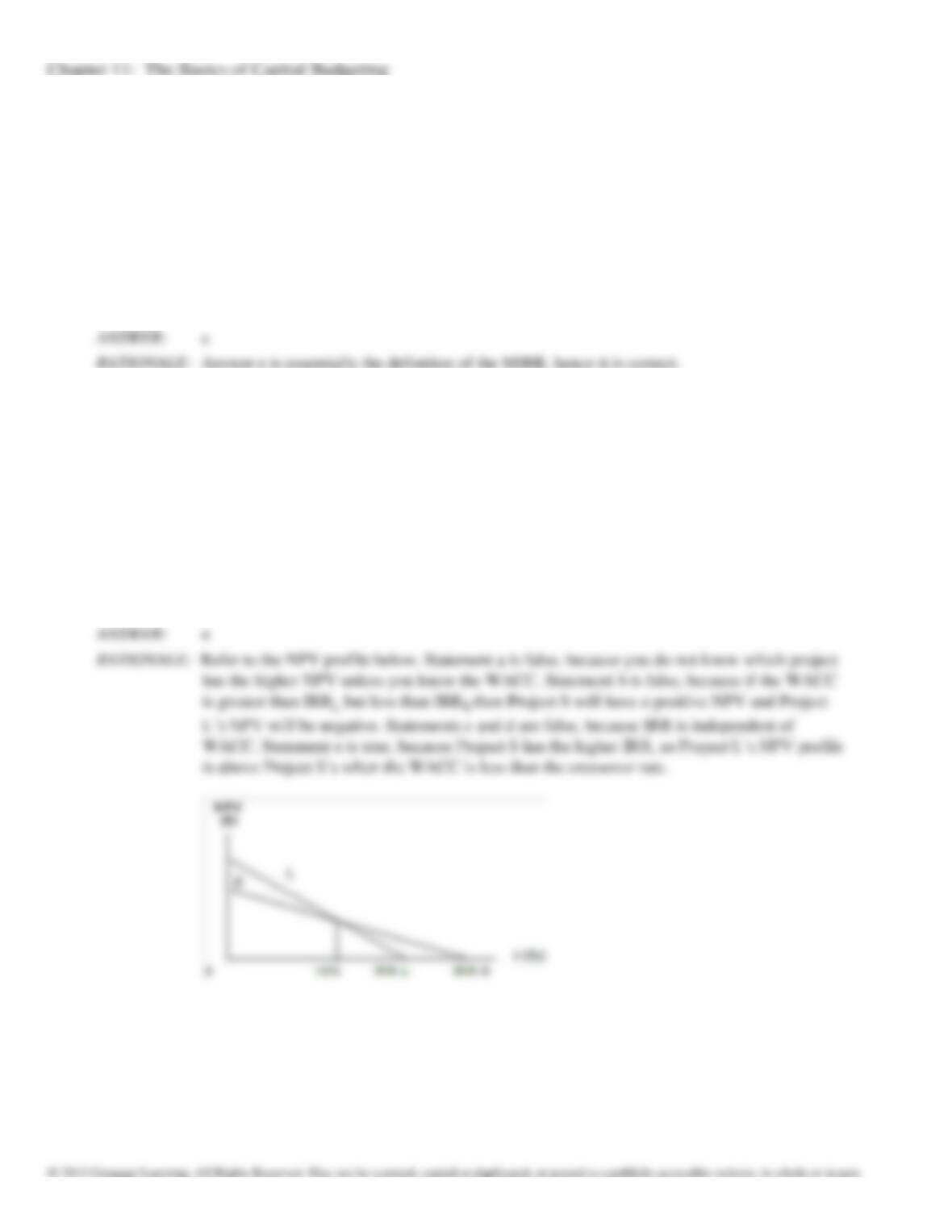
Projects S and L both have normal cash flows, and the projects have the same risk, hence both are evaluated
with
the same WACC, 10%. However, S has a higher IRR than L. Which of the following statements is
CORRECT?
a.
Project S must have a higher NPV than Project L.
b.
If Project S has a positive NPV, Project L must also have a positive NPV.
c.
If the WACC falls, each project’s IRR will increase.
d.
If the WACC increases, each project’s IRR will decrease.
e.
If Projects S and L have the same NPV at the current WACC, 10%, then Project L, the one with the lower
IRR, would have a higher NPV if the WACC used to evaluate the projects declined.
70.
Which of the following statements is CORRECT? Assume that all projects being considered have normal
cash
flows and are equally risky.
a.
If a project’s IRR is equal to its WACC, then, under all reasonable conditions, the project’s NPV must be
negative.
b.
If a project’s IRR is equal to its WACC, then under all reasonable conditions, the project’s IRR must be
negative.
c.
If a project’s IRR is equal to its WACC, then under all reasonable conditions the project’s NPV must be
zero.
d.
There is no necessary relationship between a project’s IRR, its WACC, and its NPV.
e.
When evaluating mutually exclusive projects, those projects with relatively long lives will tend to have
relatively high NPVs when the cost of capital is relatively high.
71.
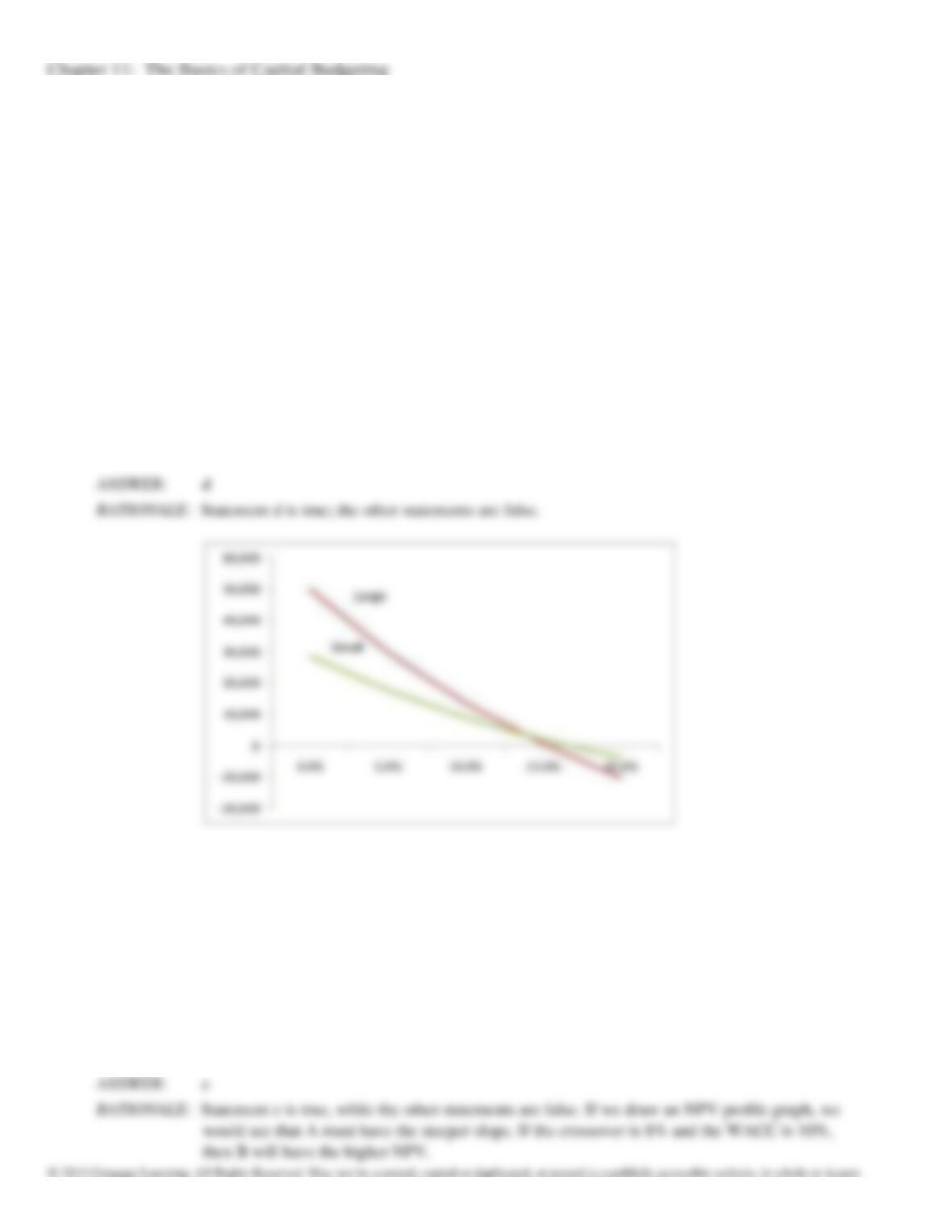
A company is choosing between two projects. The larger project has an initial cost of $100,000, annual cash
flows
of $30,000 for 5 years, and an IRR of 15.24%. The smaller project has an initial cost of $51,600, annual
cash flows
of $16,000 for 5 years, and an IRR of 16.65%. The projects are equally risky. Which of the
following statements is
CORRECT?
a.
Since the smaller project has the higher IRR, the two projects’ NPV profiles cannot cross, and the smaller
project’s NPV will be higher at all positive values of WACC.
b.
Since the smaller project has the higher IRR, the two projects’ NPV profiles will cross, and the larger
project
will look better based on the NPV at all positive values of WACC.
c.
If the company uses the NPV method, it will tend to favor smaller, shorter-term projects over larger,
longer-
term projects, regardless of how high or low the WACC is.
d.
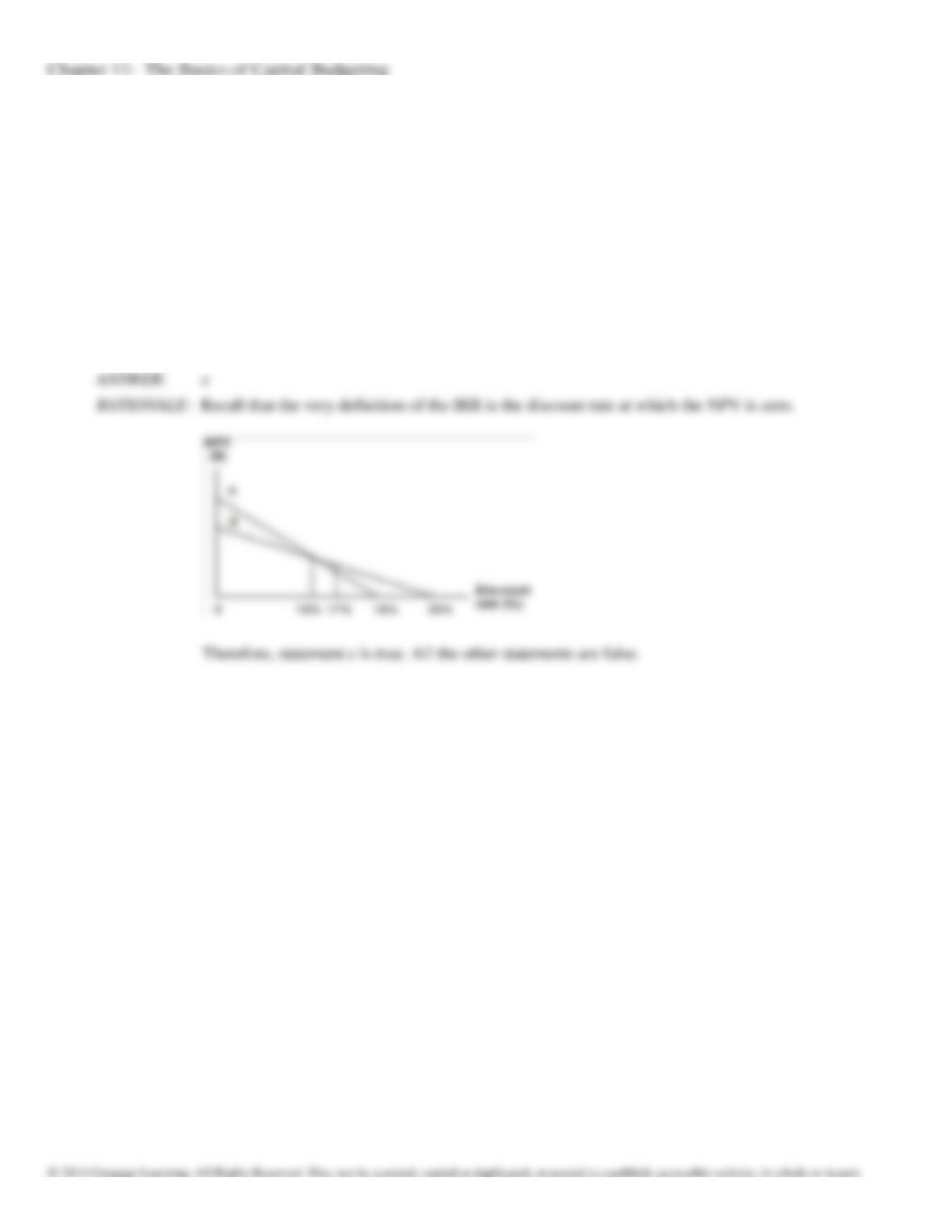
Since the smaller project has the higher IRR but the larger project has the higher NPV at a zero discount
rate, the two projects’ NPV profiles will cross, and the larger project will have the higher NPV if the
WACC
is less than the crossover rate.
e.
Since the smaller project has the higher IRR and the larger NPV at a zero discount rate, the two projects’
NPV profiles will cross, and the smaller project will look better if the WACC is less than the crossover
rate.
72.
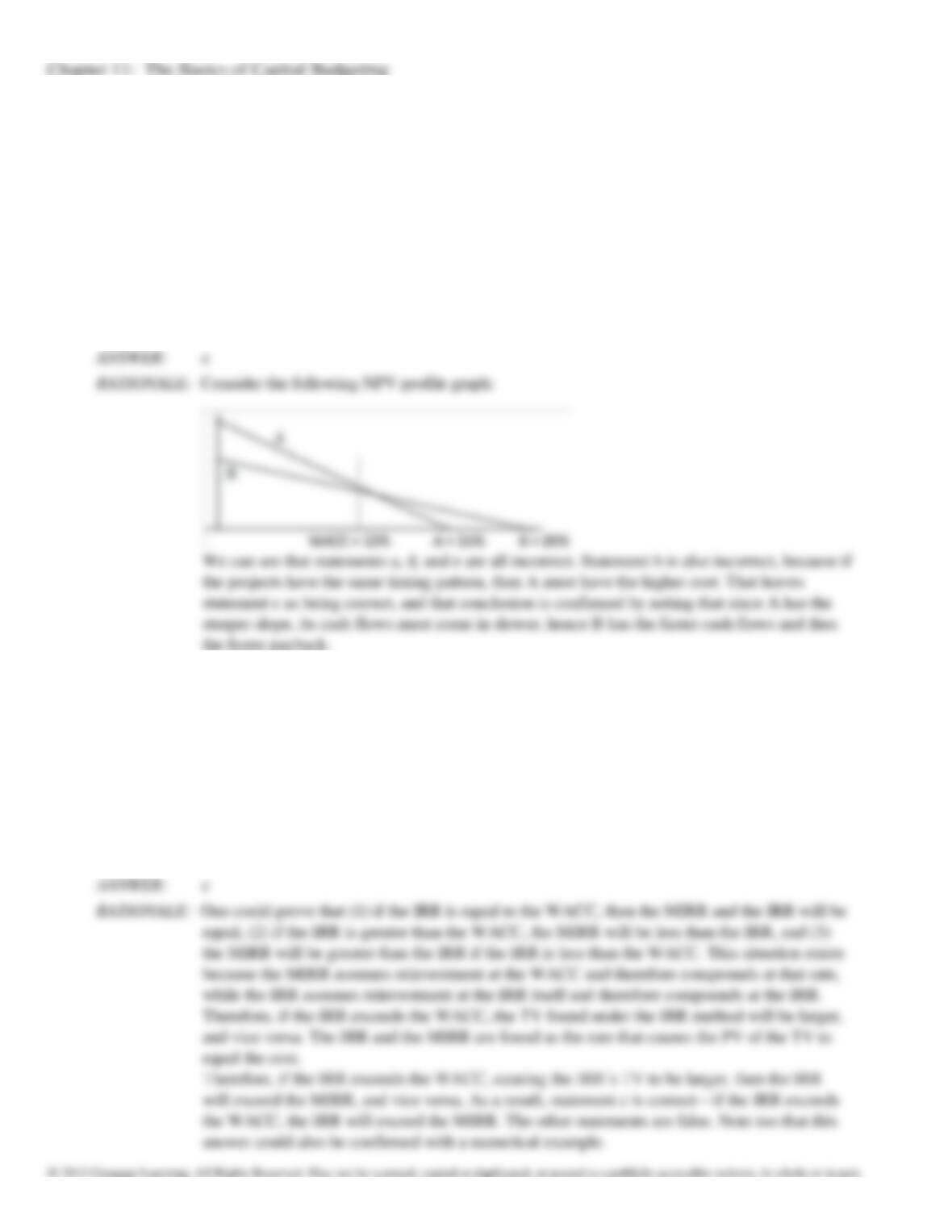
McCall Manufacturing has a WACC of 10%. The firm is considering two normal, equally risky, mutually
exclusive,
but not repeatable projects. The two projects have the same investment costs, but Project A has an
IRR of 15%,
while Project B has an IRR of 20%. Assuming the projects’ NPV profiles cross in the upper
right quadrant, which
of the following statements is CORRECT?
a.
Each project must have a negative NPV.
b.
Since the projects are mutually exclusive, the firm should always select Project B.
c.
If the crossover rate is 8%, Project B will have the higher NPV.
d.
Only one project has a positive NPV.
e.
If the crossover rate is 8%, Project A will have the higher NPV.
73.
Projects A and B are mutually exclusive and have normal cash flows. Project A has an IRR of 15% and B’s
IRR is
20%. The company’s WACC is 12%, and at that rate Project A has the higher NPV. Which of the
following
statements is CORRECT?
a.
The crossover rate for the two projects must be less than 12%.
b.
Assuming the timing pattern of the two projects’ cash flows is the same, Project B probably has a higher
cost
(and larger scale).
c.
Assuming the two projects have the same scale, Project B probably has a faster payback than Project A.
d.
The crossover rate for the two projects must be 12%.
e.
Since B has the higher IRR, then it must also have the higher NPV if the crossover rate is less than the
WACC of 12%.
74.
Which of the following statements is CORRECT? Assume that the project being considered has normal cash
flows,
with one outflow followed by a series of inflows.
a.
A project’s MIRR is always greater than its regular IRR.
b.
A project’s MIRR is always less than its regular IRR.
c.
If a project’s IRR is greater than its WACC, then the MIRR will be less than the IRR.
d.
If a project’s IRR is greater than its WACC, then the MIRR will be greater than the IRR.
e.
To find a project’s MIRR, we compound cash inflows at the IRR and then discount the terminal value back
to t = 0 at the WACC.
WACC:
WACC:
11.00%
75.
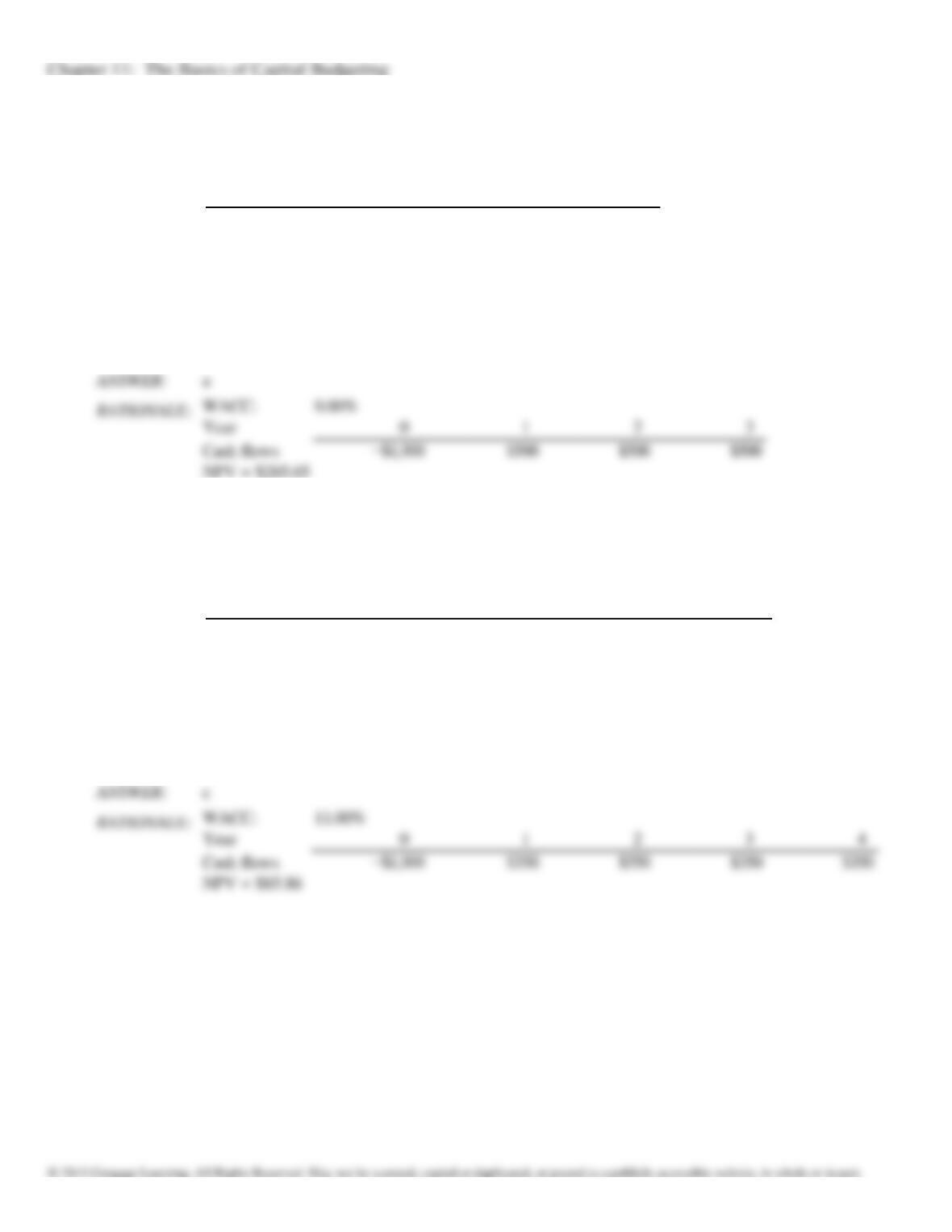
Anderson Systems is considering a project that has the following cash flow and WACC data. What is the
project’s
NPV? Note that if a project’s projected NPV is negative, it should be rejected.
WACC:
Year
9.00%
0
1
2
3
Cash flows
a. $265.65
−$1,000
$500
$500
$500
b. $278.93
c. $292.88
d. $307.52
e. $322.90
76.
Tuttle Enterprises is considering a project that has the following cash flow and WACC data. What is the
project’s
NPV? Note that if a project’s projected NPV is negative, it should be rejected.
WACC:
Year
11.00%
0
1
2
3
4
Cash flows
a. $77.49
−$1,000
$350
$350
$350
$350
b. $81.56
c. $85.86
d. $90.15
e. $94.66
WACC:
0
1
2
3
77.
Harry’s Inc. is considering a project that has the following cash flow and WACC data. What is the project’s
NPV?
Note that if a project’s projected NPV is negative, it should be rejected.
WACC:
Year
10.25%
0
1
2
3
4
5
Cash flows
a. $105.89
−$1,000
$300
$300
$300
$300
$300
b. $111.47
c. $117.33
d. $123.51
e. $130.01
78.
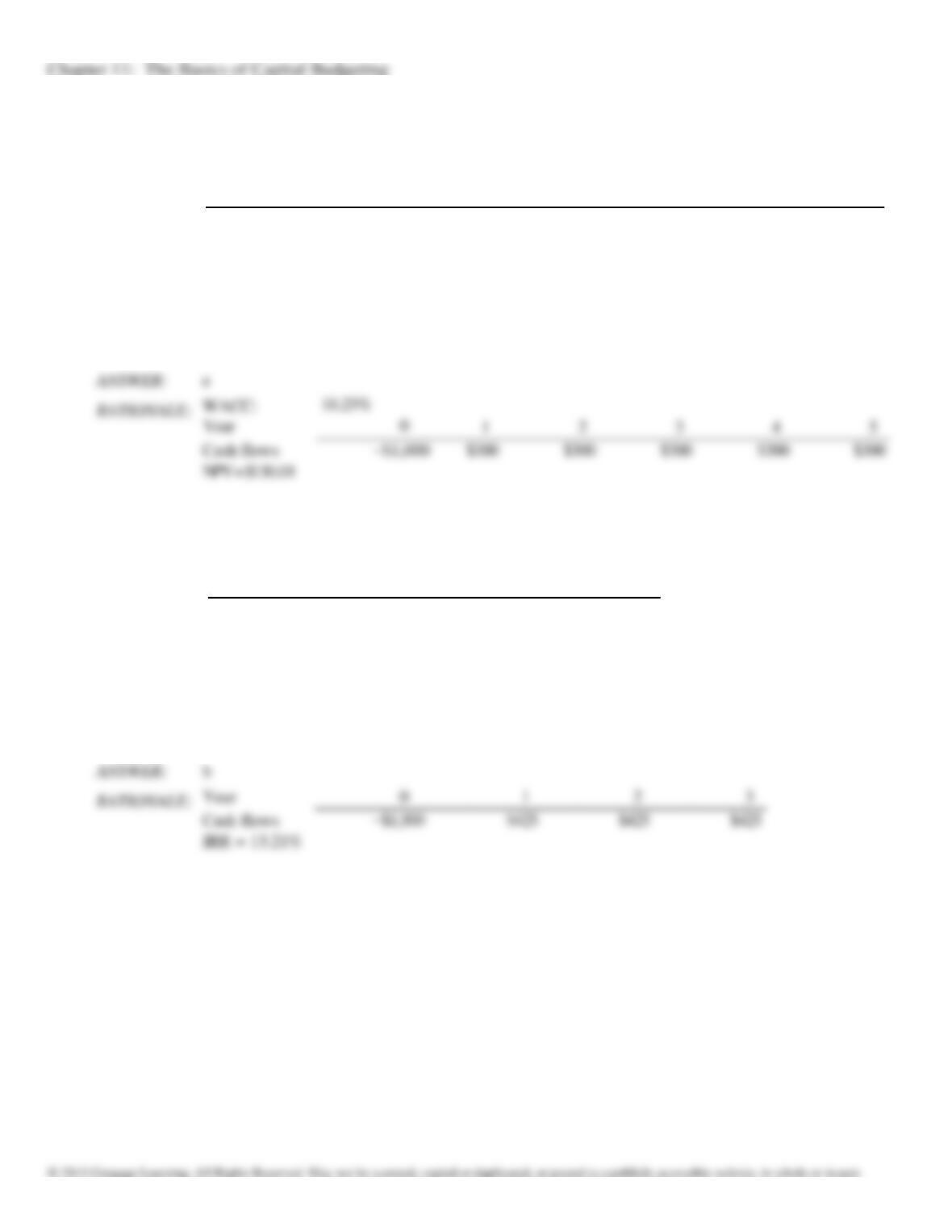
Simms Corp. is considering a project that has the following cash flow data. What is the project’s IRR? Note
that a
project’s projected IRR can be less than the WACC or negative, in both cases it will be rejected.
Year
0
1
2
3
Cash flows
a. 12.55%
−$1,000
$425
$425
$425
b. 13.21%
c. 13.87%
d. 14.56%
e. 15.29%
0
1
2
3
4
79.
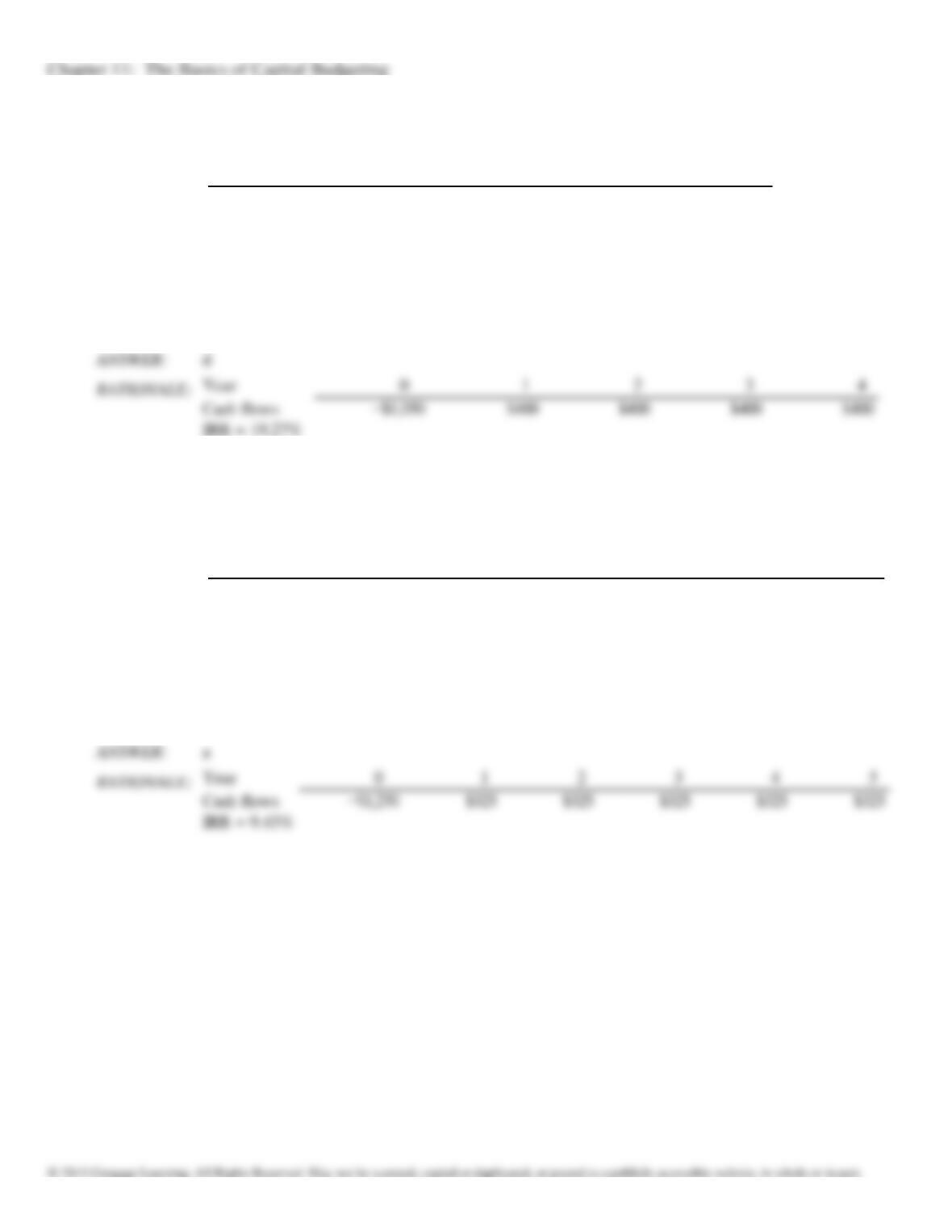
Warr Company is considering a project that has the following cash flow data. What is the project’s IRR? Note
that
a project’s projected IRR can be less than the WACC or negative, in both cases it will be rejected.
Year
0
1
2
3
4
Cash flows
a. 14.05%
−$1,050
$400
$400
$400
$400
b. 15.61%
c. 17.34%
d. 19.27%
e. 21.20%
80.
Thorley Inc. is considering a project that has the following cash flow data. What is the project’s IRR? Note
that a
project’s projected IRR can be less than the WACC or negative, in both cases it will be rejected.
Year
0
1
2
3
4
5
Cash flows
a. 9.43%
−$1,250
$325
$325
$325
$325
$325
b. 9.91%
c. 10.40%
d. 10.92%
e. 11.47%
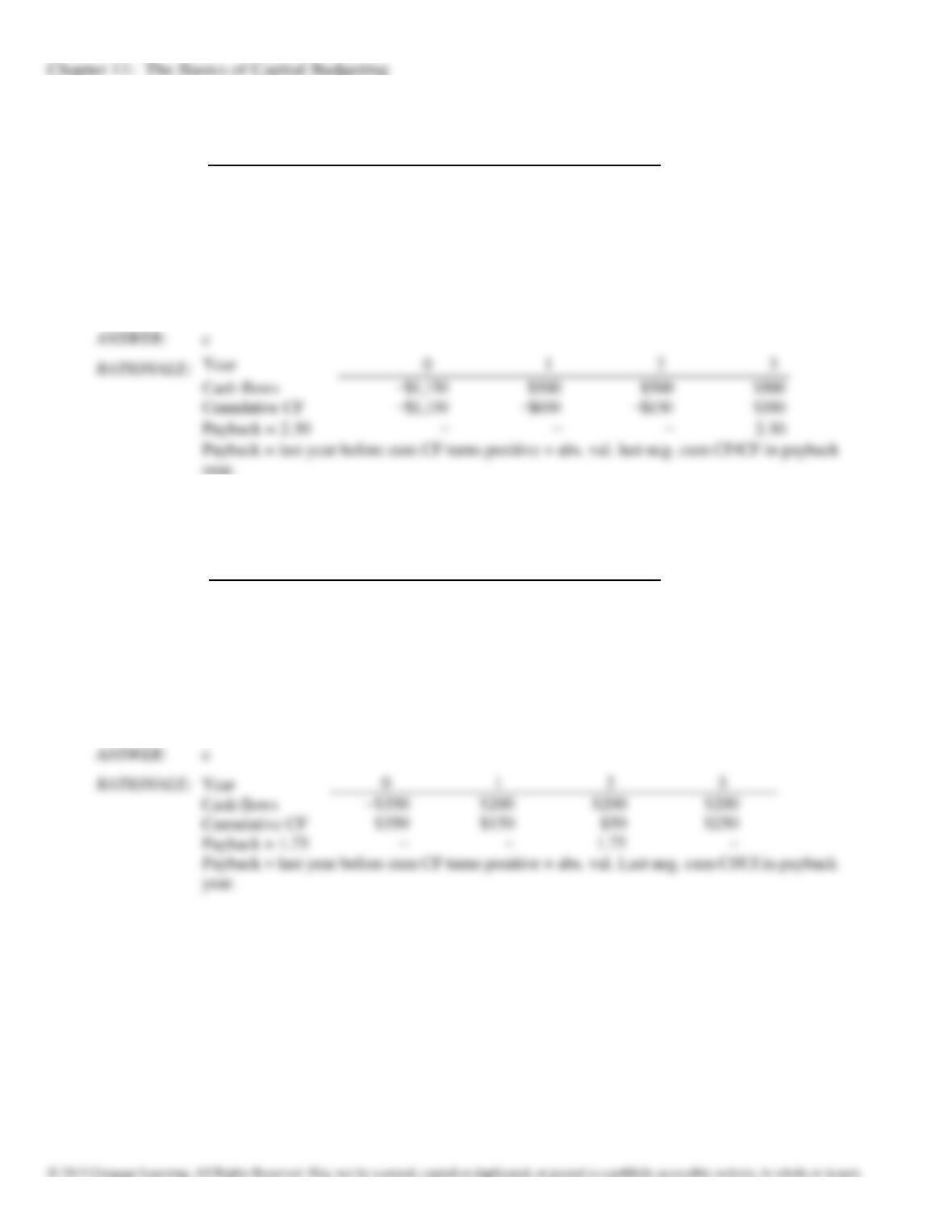
Year
0
1
2
3
Cash flows
a. 1.42 years
−$350
$200
$200
$200
b. 1.58 years
c. 1.75 years
d. 1.93 years
e. 2.12 years
81.
Taggart Inc. is considering a project that has the following cash flow data. What is the project’s payback?
Year
0
1
2
3
Cash flows
a. 1.86 years
−$1,150
$500
$500
$500
b. 2.07 years
c. 2.30 years
d. 2.53 years
e. 2.78 years
82.
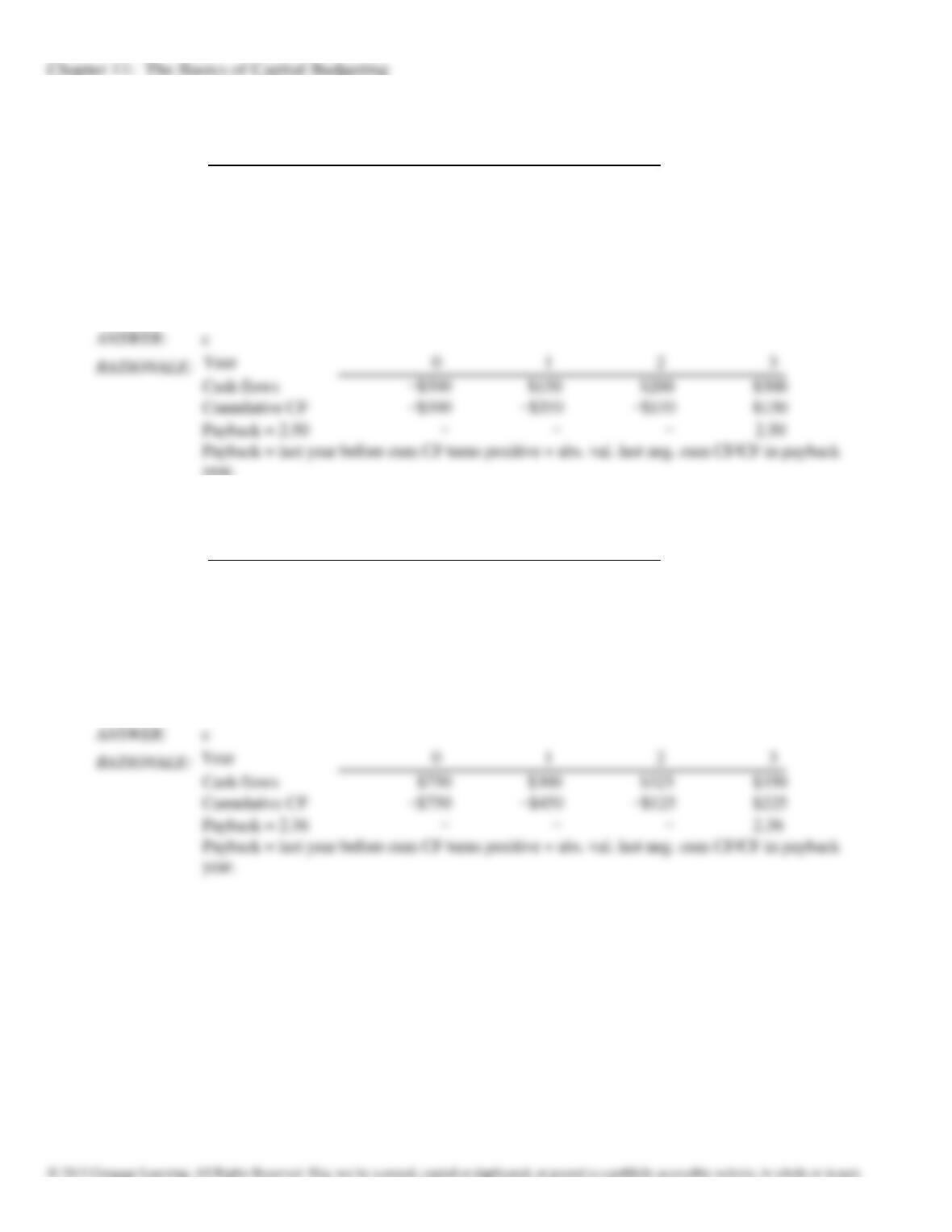
Resnick Inc. is considering a project that has the following cash flow data. What is the project’s payback?
83.
Susmel Inc. is considering a project that has the following cash flow data. What is the project’s payback?
Year
0
1
2
3
Cash flows
a. 2.03 years
−$500
$150
$200
$300
b. 2.25 years
c. 2.50 years
d. 2.75 years
e. 3.03 years
84.
Mansi Inc. is considering a project that has the following cash flow data. What is the project’s payback?
Year
0
1
2
3
Cash flows
a. 1.91 years
−$750
$300
$325
$350
b. 2.12 years
c. 2.36 years
d. 2.59 years
e. 2.85 years
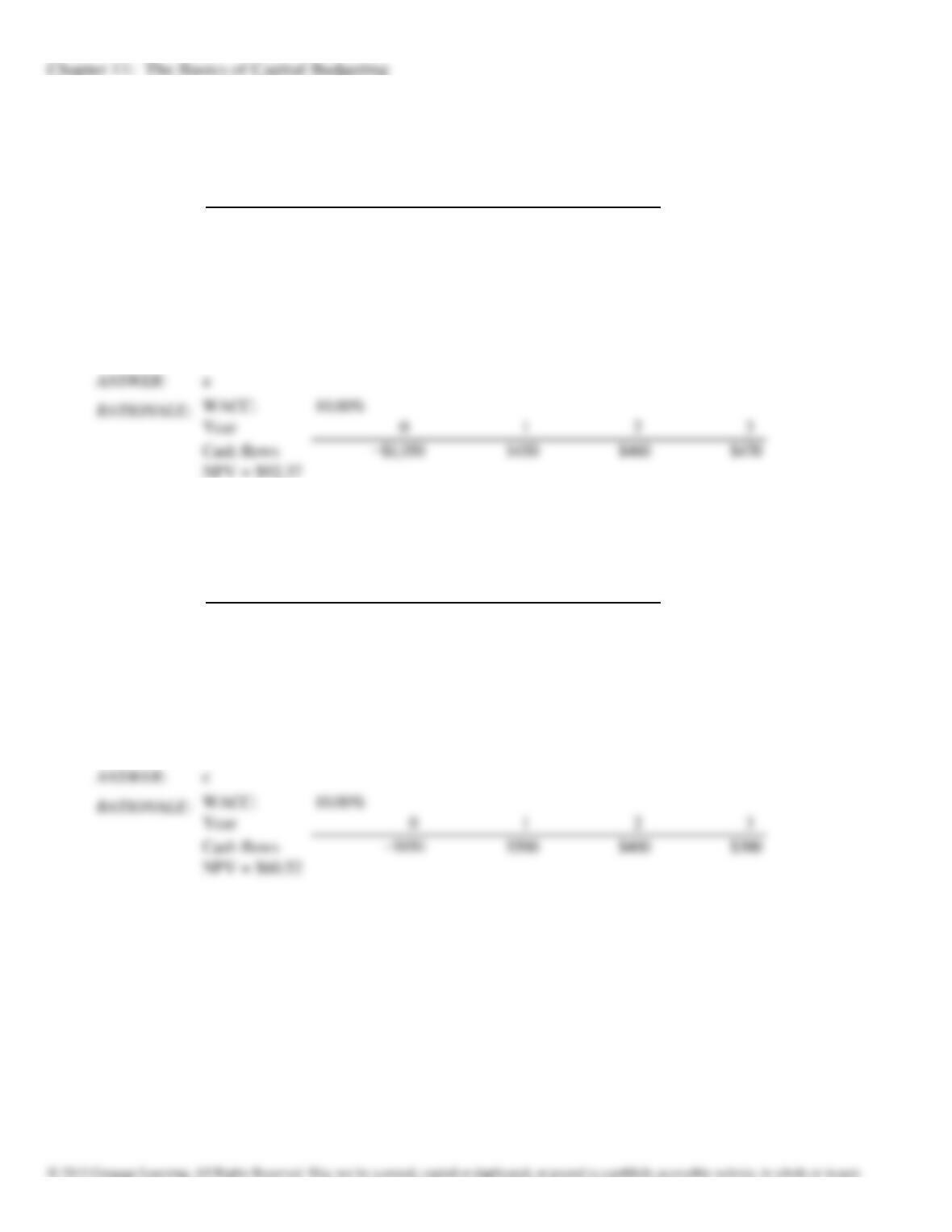
WACC:
10.00%
WACC:
10.00%
85.
Cornell Enterprises is considering a project that has the following cash flow and WACC data. What is the
project’s
NPV? Note that a project’s projected NPV can be negative, in which case it will be rejected.
WACC:
Year
10.00%
0
1
2
3
Cash flows
a. $ 92.37
−$1,050
$450
$460
$470
b. $ 96.99
c. $101.84
d. $106.93
e. $112.28
86.
Warnock Inc. is considering a project that has the following cash flow and WACC data. What is the project’s
NPV? Note that a project’s projected NPV can be negative, in which case it will be rejected.
WACC:
Year
10.00%
0
1
2
3
Cash flows
a. $54.62
−$950
$500
$400
$300
b. $57.49
c. $60.52
d. $63.54
e. $66.72
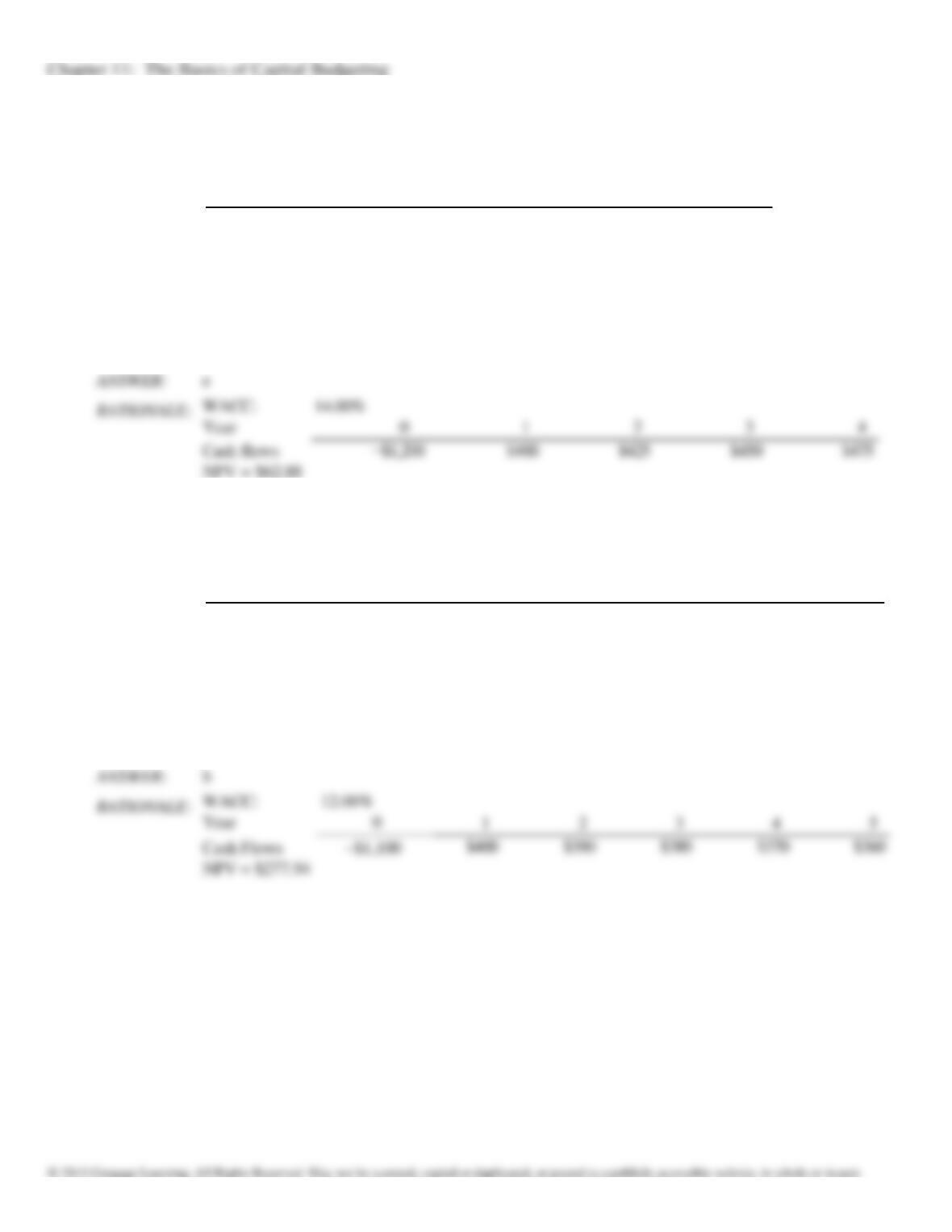
WACC:
14.00%
87.
Jazz World Inc. is considering a project that has the following cash flow and WACC data. What is the
project’s
NPV? Note that a project’s projected NPV can be negative, in which case it will be rejected.
WACC:
Year
14.00%
0
1
2
3
4
Cash flows
a. $41.25
−$1,200
$400
$425
$450
$475
b. $45.84
c. $50.93
d. $56.59
e. $62.88
88.
Barry Company is considering a project that has the following cash flow and WACC data. What is the
project’s
NPV? Note that a project’s projected NPV can be negative, in which case it will be rejected.
WACC:
Year
12.00%
0
1
2
3
4
5
Cash flows
a. $250.15
−$1,100
$400
$390
$380
$370
$360
b. $277.94
c. $305.73
d. $336.31
e. $369.94
0
1
2
3
89.
Datta Computer Systems is considering a project that has the following cash flow data. What is the project’s
IRR?
Note that a project’s projected IRR can be less than the WACC (and even negative), in which case it
will be
rejected.
Year
0
1
2
3
Cash flows
a. 9.70%
−$1,100
$450
$470
$490
b. 10.78%
c. 11.98%
d. 13.31%
e. 14.64%
90.
Simkins Renovations Inc. is considering a project that has the following cash flow data. What is the project’s
IRR?
Note that a project’s projected IRR can be less than the WACC (and even negative), in which case it
will be
rejected.
Year
0
1
2
3
4
Cash flows
a. 13.13%
−$850
$300
$290
$280
$270
b. 14.44%
c. 15.89%
d. 17.48%
e. 19.22%