Microeconomics, 12e (Parkin)
Chapter 11 Output and Costs
1 Decision Time Frames
1) All the decisions made by people who operate firms have one overriding objective, which is to
________.
A) make maximum attainable profit
B) maximize the firm’s total revenue
C) maximize the firm’s market share
D) maximize the quantity that the firm sells
2) The short run is a period of time in which
A) the quantity of at least one factor of production is fixed.
B) the amount of output is fixed.
C) prices and wages are fixed.
D) nothing the firm does can be altered.
3) The short run is a period of time in which
A) the quantity used of at least one factor of production is fixed.
B) the quantities used of all factors of production are fixed.
C) output prices are fixed.
D) factor of production prices are fixed.
4) A period of time in which the quantity of at least one factor of production used by a firm is
fixed is called the
A) market period.
B) intermediate run.
C) short run.
D) long run.
5) Economists define the short run as a period of time so short that
A) the amount of output cannot be changed except under diminishing marginal returns.
B) the amount of output cannot be changed at all.
C) only one factor of production can be varied.
D) at least one factor of production cannot be varied.
6) The short run is a time frame in which
A) at least one factor of production is fixed.
B) all factors of production can be varied.
C) all factors of production are fixed.
D) at least one factor of production can be varied.
7) In the short run
A) all factors of production are fixed.
B) at least one factor of production is fixed.
C) all factors of production are variable.
D) there are no variable costs.
8) In the short run
A) all factors of production are fixed.
B) labor usage must remain fixed.
C) a firm’s plant is fixed.
D) no factors of production are fixed.
9) The short run is a time period during which
A) a firm can earn a normal profit.
B) all factors of production are variable.
C) at least one factor of production is fixed.
D) all factors of production are fixed.
10) The short run is a time frame in which
A) the quantities of some factors of production are fixed and the quantities of other factors of
production can be varied.
B) the quantities of all factors of production can be varied.
C) the quantities of all factors of production are fixed.
D) all costs are sunk costs.
11) An example of a variable factor of production in the short run is
A) a building.
B) capital equipment.
C) an employee.
D) land.
12) When the demand for electricity peaks during the hottest days of summer, Florida Power and
Light Company can generate more electricity by using more fuel and increasing the working
hours of many of its employees. The company cannot, however, increase electric power
production by building additional generating capacity. This means that the company is in the
A) market run.
B) short run.
C) intermediate run.
D) long run.
13) An example of a short-run fixed factor of production is
A) capital equipment.
B) labor.
C) electricity.
D) postage for mailing.
14) A cost that has already been made and cannot be recovered is called a
A) variable cost.
B) fixed cost.
C) sunk cost.
D) marginal cost.
15) After constructing a new factory, the cost of building the factory is a
A) past cost.
B) sunk cost.
C) variable cost.
D) None of the above answers are correct.
16) The long run is a time frame in which
A) the quantities of some factors of production are fixed and the quantities of other factors of
production can be varied.
B) the quantities of all factors of production can be varied.
C) the quantities of all factors of production are fixed.
D) all costs are sunk costs.
17) A period of time in which the quantity of all factors of production used by a firm can be
varied is called the
A) market period.
B) variable run.
C) short run.
D) long run.
18) In the long run, a firm has
A) no factors of production that are fixed.
B) no factors of production that are variable.
C) no factors of production that are either fixed or variable.
D) fixed factors of production but no variable resources.
19) The long run
A) means a long period of time, always longer than a year.
B) is a period of time in which all factors of production can be varied.
C) is different for different firms.
D) Both answers B and C are correct.
20) The long run is a period of time in which
A) all factors of production are variable.
B) all factors of production are fixed.
C) some but not all factors of production are fixed.
D) some but not all factors of production are variable.
21) Which of the following factors is fixed in the long run?
A) capital
B) land
C) entrepreneurship
D) none of the above because all factors are variable in the long run
22) In the long run, a firm can vary
A) its capital but not its labor.
B) its labor but not its capital.
C) both its labor and its capital.
D) neither its labor nor its capital.
23) The long run is distinguished from the short run because only in the long run
A) output prices can vary.
B) factor of production prices can vary.
C) the quantities of all factors of production can be varied.
D) the firm no longer maximizes its profit.
24) In economics, the short run is the time frame in which the quantities of ________ and the
long run is the period of time in which ________.
A) some factors of production are variable; the quantities of all factors of production are fixed
B) all factors of production are variable but technology is fixed; technology is variable
C) all factors of production are fixed; the quantities of all factors of production can be varied
D) some factors of production are fixed; the quantities of all factors of production can be varied
25) In the short run
A) the size of the plant is fixed.
B) all factors of production are variable.
C) all factors of production are fixed.
D) some firms experience increasing returns to scale.
26) The long run is a time period in which
A) one year or less elapses.
B) all factors of production are variable.
C) all factors of production are fixed.
D) there is at least one fixed factor of production and at least one variable factor of production.
27) Which of the following statements is CORRECT?
A) A firm does not need to take into account its sunk cost when making current decisions.
B) Long-run decisions are easily reversed.
C) Short-run decisions are not easily reversed.
D) In the long run, a firm can change its plant but not the quantity of its labor.
2 Short-Run Technology Constraint
1) Total product is
A) the increase in output that results from a one-unit increase in the quantity of labor employed
with all other inputs remaining the same.
B) maximum output that a given quantity of labor can produce.
C) maximum amount of output produced by a given quantity of labor divided by the given
quantity of labor employed.
D) maximum amount of amount of output produced by a given quantity of labor divided by price
of the output.
2) Points below a firm’s total product curve are
A) both attainable and technologically efficient.
B) neither attainable nor technologically efficient.
C) attainable but not technologically efficient.
D) technologically efficient but not attainable.
3) Points on a firm’s total product curve are
A) both attainable and technologically efficient.
B) neither attainable nor technologically efficient.
C) attainable but not technologically efficient.
D) technologically efficient but not attainable.
4) When the total product curve is drawn in a figure that measures employment along the
horizontal axis, it is a graph that shows the
A) minimum cost of producing a given amount of output using different techniques.
B) maximum profit attainable for each unit of output sold per unit of labor employed.
C) maximum output attainable for each quantity of labor employed.
D) minimum output attainable for each quantity of labor employed.
5) All the production points that lie ________ the total product curve are attainable and
________.
A) above; efficient
B) above; inefficient
C) below; efficient
D) below; inefficient
6) A firm’s total product curve shows
A) that inefficiency is not possible.
B) how the cost of the fixed resources change when output changes.
C) how the amount of output changes when the quantity of labor changes.
D) that in the long run the firm must adjust the quantity of all the resources it employs.
7) Most total product curves have
A) first increasing and then decreasing marginal returns to labor.
B) output first increasing and then decreasing as labor is added.
C) first decreasing and then increasing marginal returns to labor.
D) output increasing at an increasing rate as labor is added.
8) The marginal product of labor is equal to the
A) total product divided by the total number of workers hired.
B) increase in the total product that results from hiring one more worker with all other inputs
remaining the same.
C) slope of the marginal product of labor curve.
D) None of the above answers are correct.
9) Marginal product is
A) the increase in output that results from a one-unit increase in the quantity of labor employed
with all other inputs remaining the same.
B) total amount of output produced.
C) total amount of output produced divided by the quantity of labor employed.
D) total amount of output produced divided by price of the output.
10) The marginal product of labor is the increase in total product from a
A) one unit increase in the quantity of labor, while holding the quantity of other inputs constant.
B) one unit increase in the quantity of labor, while also increasing the quantity of other inputs by
one unit.
C) one dollar increase in the wage rate, while holding the price of other inputs constant.
D) one percent increase in the wage rate, while also increasing the price of other inputs by one
percent.
11) The marginal product of labor is the change in total product from a one-unit increase in
A) the quantity of labor employed, holding the quantity of other inputs constant.
B) the quantity of capital employed, holding the quantity of labor constant.
C) both the quantity of labor and the quantity of other inputs employed.
D) the wage rate.
12) The marginal product of labor is the
A) change in output resulting from a one-unit increase in labor with all other inputs remaining
the same.
B) maximum output attainable with fixed factors of production when labor is the only variable
factor of production.
C) output level above which the slope of the total product curve falls.
D) output level above which the rate of total product per unit of labor falls.
13) The total output produced with any quantity of labor is equal to the sum of the
A) marginal products of each of the workers hired.
B) average products of each of the workers hired.
C) total wages the firm pays its workers.
D) Both answers A and B are correct.
14) The average product of labor is equal to the
A) total product divided by the total number of workers hired.
B) total number of workers hired divided by the total product.
C) slope of the marginal product of labor curve.
D) Both answers B and C are correct.
15) Average product equals the
A) increase in output that results from a one-unit increase in the quantity of labor employed with
all other inputs remaining the same.
B) total amount of output produced.
C) total amount of output produced divided by the quantity of labor employed.
D) total amount of output produced divided by price of the output.
16) Average product of labor is equal to ________.
A) total product multiplied by the quantity of labor employed.
B) the total product produced
C) the quantity of labor employed divided by total product
D) total product divided by the quantity of labor employed
17) The average product of labor is
A) the inverse of the average product of capital.
B) the slope of the curve showing the marginal product of labor.
C) the slope of the curve showing the total product of labor.
D) total product divided by the total quantity of labor employed.
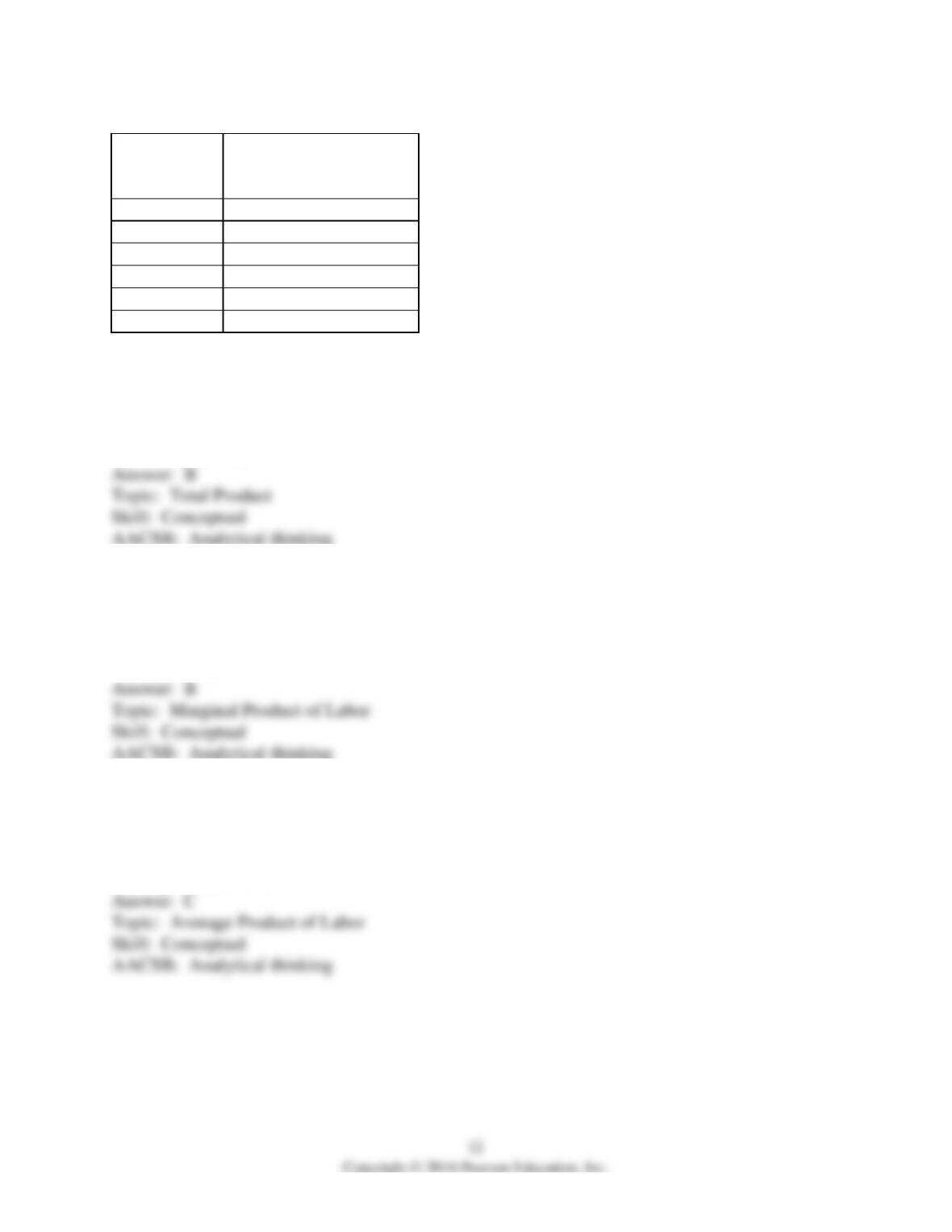
Pizza Hut
Labor
(workers)
Total product
(pizzas produced per
hour)
0
0
1
5
2
9
3
12
4
14
5
15
18) Using the data in the above table, what is the marginal product of the second worker?
A) 4.5 pizzas per hour
B) 4 pizzas per hour
C) 5 pizzas per hour
D) The marginal product is undefined.
19) Using the data in the above table, what is the marginal product of the third employee?
A) 2 pizzas per hour
B) 3 pizzas per hour
C) 4 pizzas per hour
D) 12 pizzas per hour
20) Using the data in the above table, what is the average product of three employees?
A) 2 pizzas per hour
B) 3 pizzas per hour
C) 4 pizzas per hour
D) 12 pizzas per hour
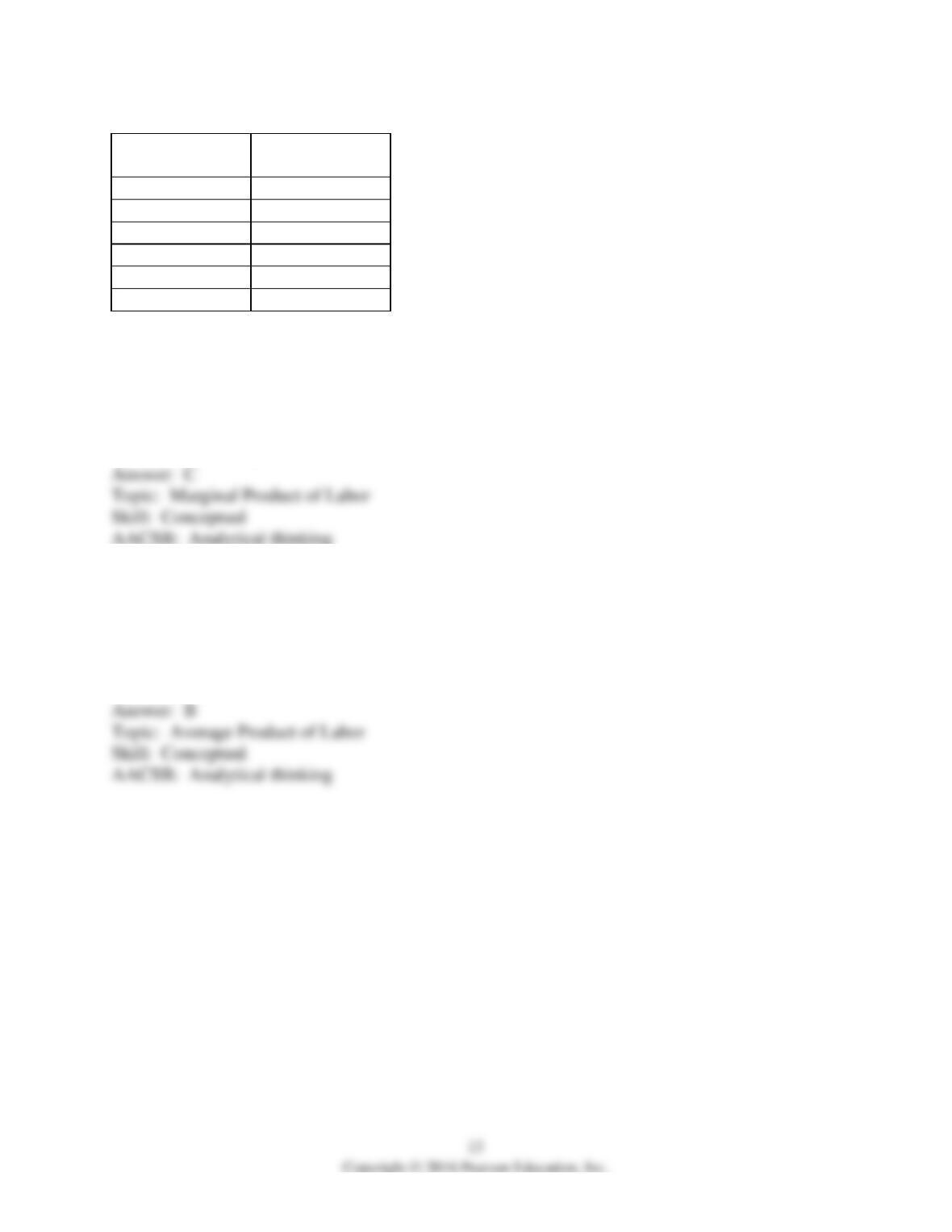
Labor
(workers per day)
Total product
(hats per day)
0
0
1
4
2
10
3
18
4
25
5
30
21) The above table shows the total product of producing baseball hats. The marginal product of
the 4th worker is equal to
A) 25 baseball hats.
B) 21 baseball hats.
C) 7 baseball hats.
D) 6.25 baseball hats.
22) The above table shows the total product of producing baseball hats. The average product of 3
workers is equal to
A) 1.67 baseball hats.
B) 6.00 baseball hats.
C) 12.78 baseball hats.
D) 18.00 baseball hats.
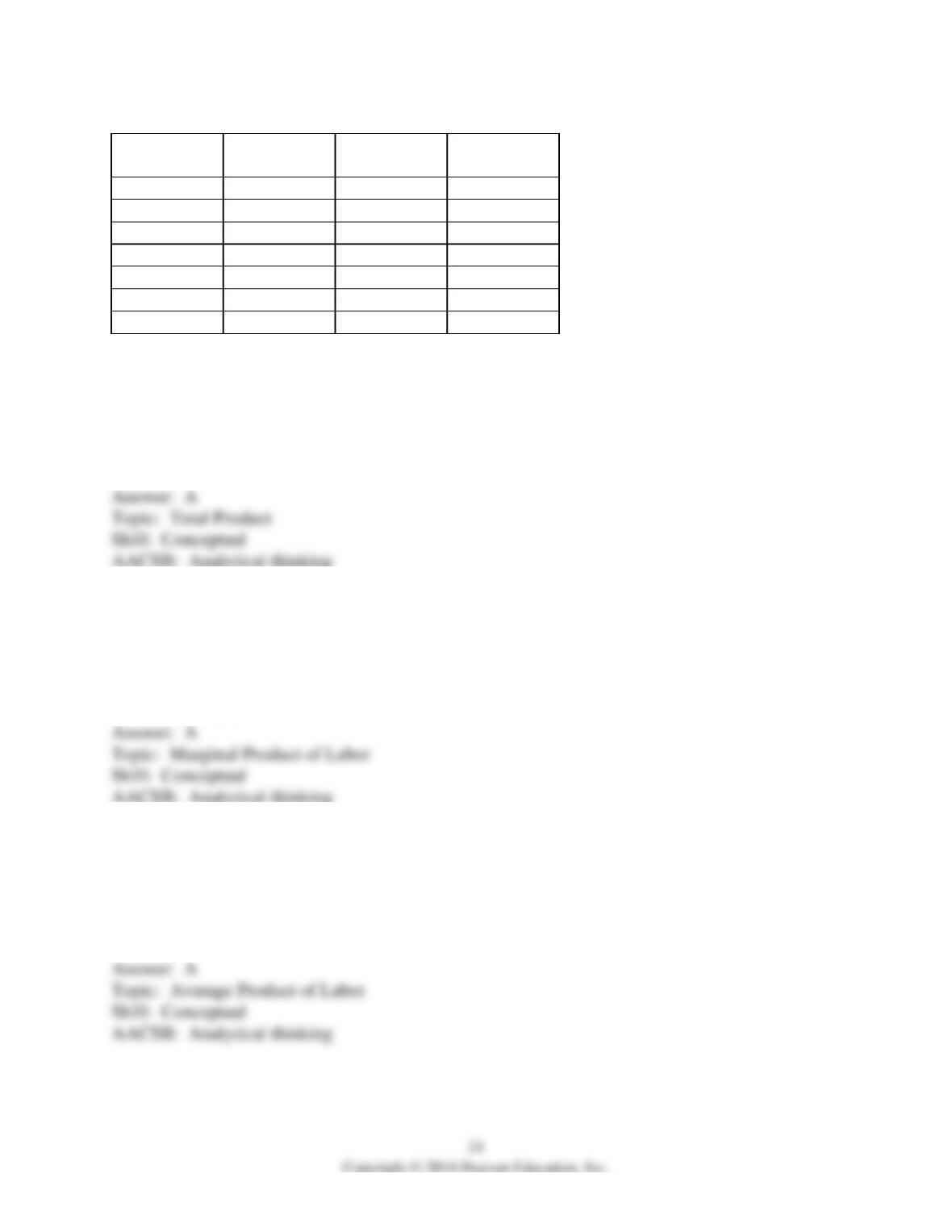
Labor
(workers)
Total product
(units)
Marginal
product
Average
product
0
0
1
3
2
4.5
3
14
4
3
5
19
6
1
23) The above (incomplete) table provides information about the relationships between labor and
various product measures. The total product that can be produced with 6 units of labor is
A) 20.
B) 19.
C) More information is needed to answer the question.
D) None of the above answers is correct.
24) The above (incomplete) table provides information about the relationships between labor and
various product measures. The amount of labor that maximizes the marginal product of labor is
A) 2 units of labor.
B) 3 units of labor.
C) 4 units of labor.
D) 5 units of labor.
25) The above (incomplete) table provides information about the relationships between labor and
various product measures. The average product of the fourth unit of labor
A) exceeds the marginal product of the fourth unit of labor.
B) is less than the marginal product of the fourth unit of labor.
C) is equal to the marginal product of the fourth unit of labor.
D) is equal to 4.0.
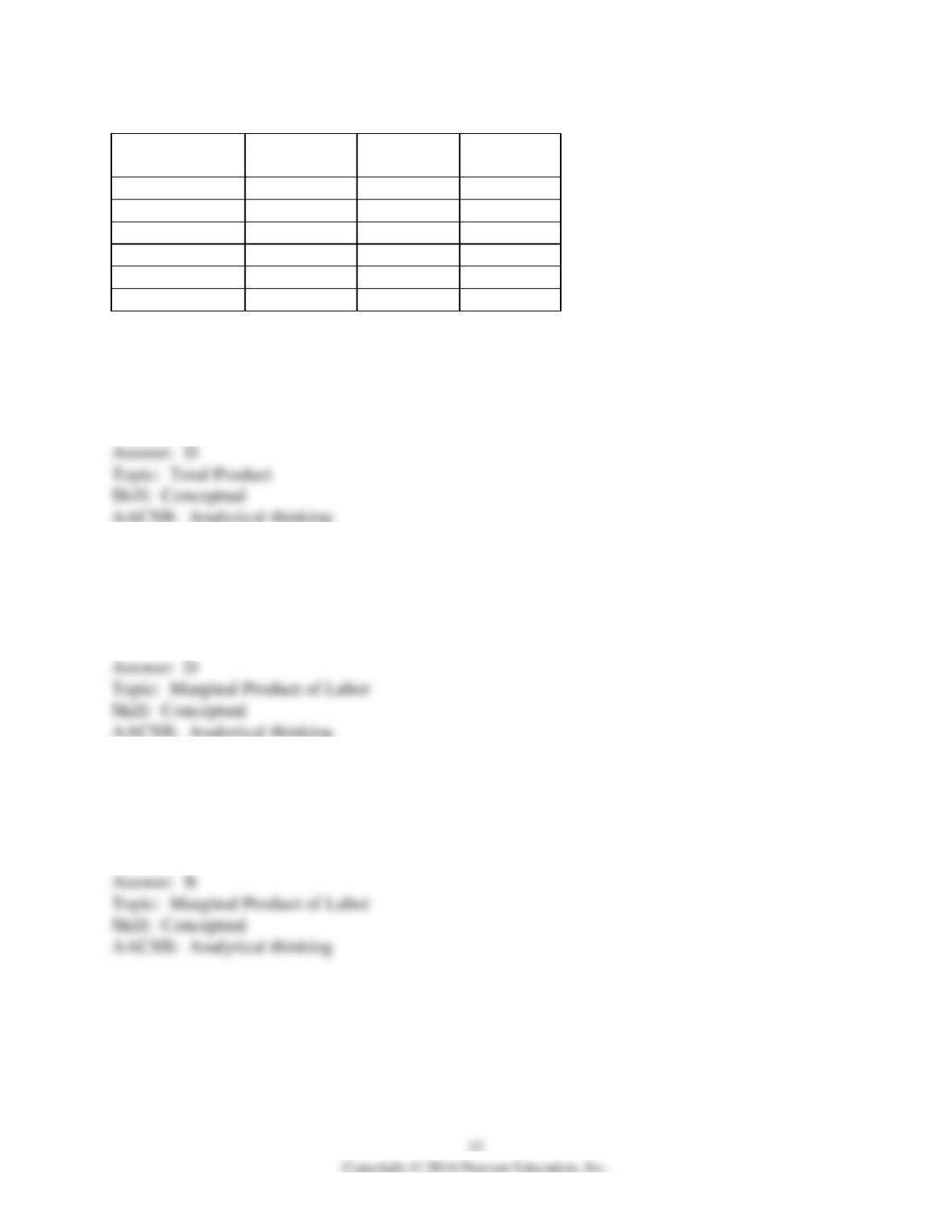
Total Product, Marginal Product, Average Product
Labor
(workers per day)
Total product
(units per day)
Marginal
product
Average
product
0
0
0
0
1
2
2
2
2
8
3
12
4
15
5
16
1
26) In the above table, the marginal product of the second worker is
A) 1.
B) 2.
C) 3.
D) 4.
27) In the above table, the marginal product of the third worker is
A) 1.
B) 2.
C) 3.
D) 4.
28) In the above table, the marginal product of the fourth worker is
A) 1.
B) 3.
C) 4.
D) 6.
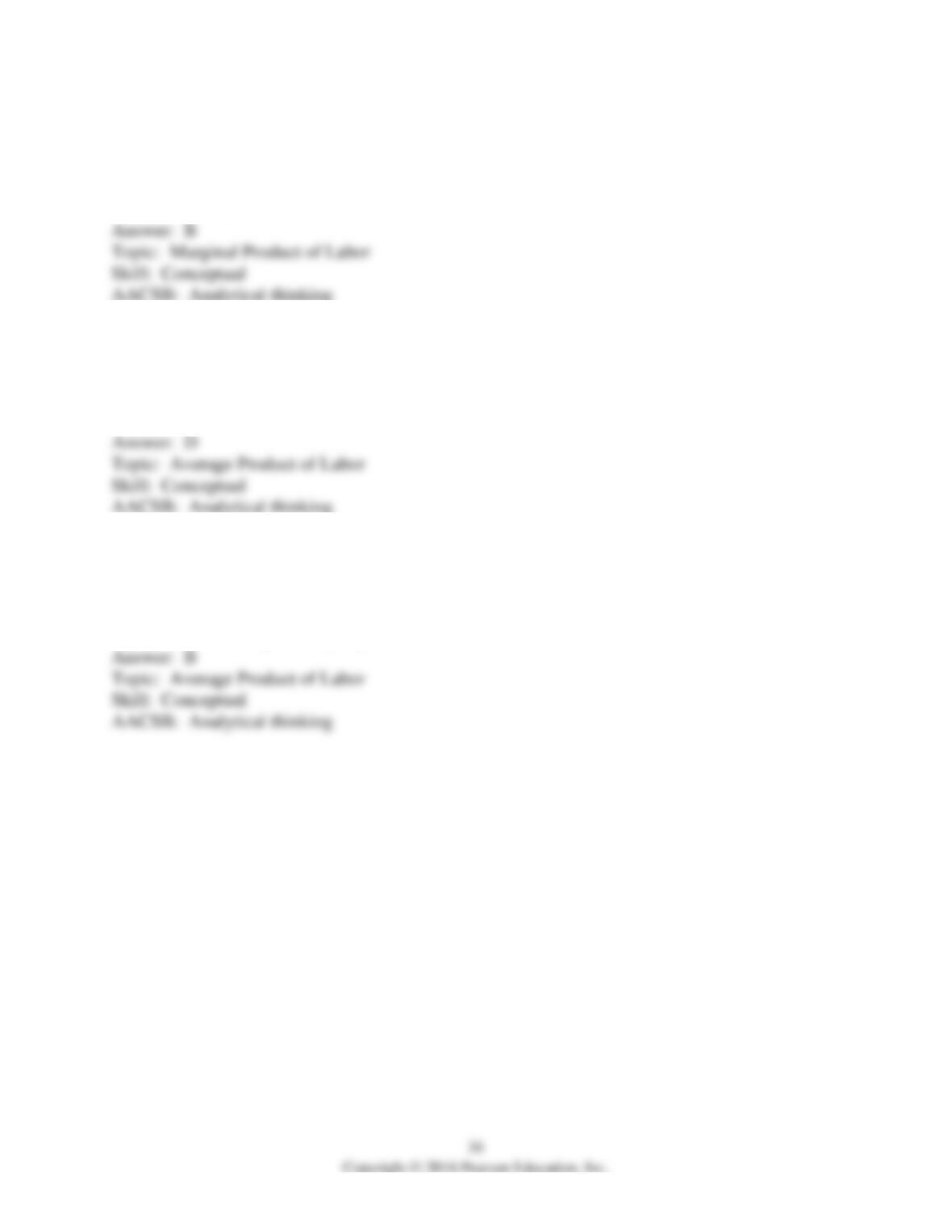
29) In the above table, the marginal product is greatest when the
A) first worker is hired.
B) second worker is hired.
C) third worker is hired.
D) fourth worker is hired.
30) In the above table, the average product of three workers is
A) 1.
B) 2.
C) 3.
D) 4.
31) In the above table, the average product is less than the marginal product
A) when the first worker is hired.
B) when the second worker is hired.
C) when the third worker is hired.
D) for the entire range of output given.
Labor
(workers per day)
Quantity
(T shirts per day)
0
0
1
10
2
22
3
30
4
34
5
35
32) The table shows some data that describes Tom’s T-Shirts’ total product when Tom’s has 1
sewing machine. When 4 workers are employed, ________.
A) average product of labor is a maximum
B) marginal product of labor is less than average product of labor
C) marginal product of labor exceeds average product of labor
D) marginal product of labor equals average product of labor
Labor
(workers per day)
Total product
(pizzas per day)
0
0
1
10
2
25
3
37
4
45
5
50
33) Based on the production data for Pat’s Pizza Parlor in the above table, the marginal product
of the 4th worker is ________ pizzas.
A) 5
B) 8
C) 10
D) 45
34) Based on the production data for Pat’s Pizza Parlor in the above table, which worker has the
largest marginal product?
A) Worker 1
B) Worker 2
C) Worker 3
D) Worker 4
35) Based on the above production data table for Ken’s Pizza Parlor, we know that the average
product of labor curve begins to decrease after hiring worker ________.
A) 1
B) 2
C) 3
D) 4
36) Based on the production data for Pat’s Pizza Parlor in the above table, the average product of
labor when 4 workers are hired is ________ pizzas.
A) 8
B) 10
C) 11.25
D) 45
37) Based on the production data for Pat’s Pizza Parlor in the above table, which of the following
pair of workers have the same average product?
A) 1 and 2
B) 2 and 4
C) 1 and 5
D) 2 and 5
38) In the figure above, the marginal product of the second worker is
A) 10 units.
B) 5 units.
C) 2 units.
D) 1 units.
39) In the above figure, after the second worker is hired, the marginal product of labor is
A) increasing.
B) diminishing.
C) constant.
D) zero.
40) At point d in the above figure, the average product of labor equals
A) 15.
B) 4.
C) 3.75.
D) approximately 1.
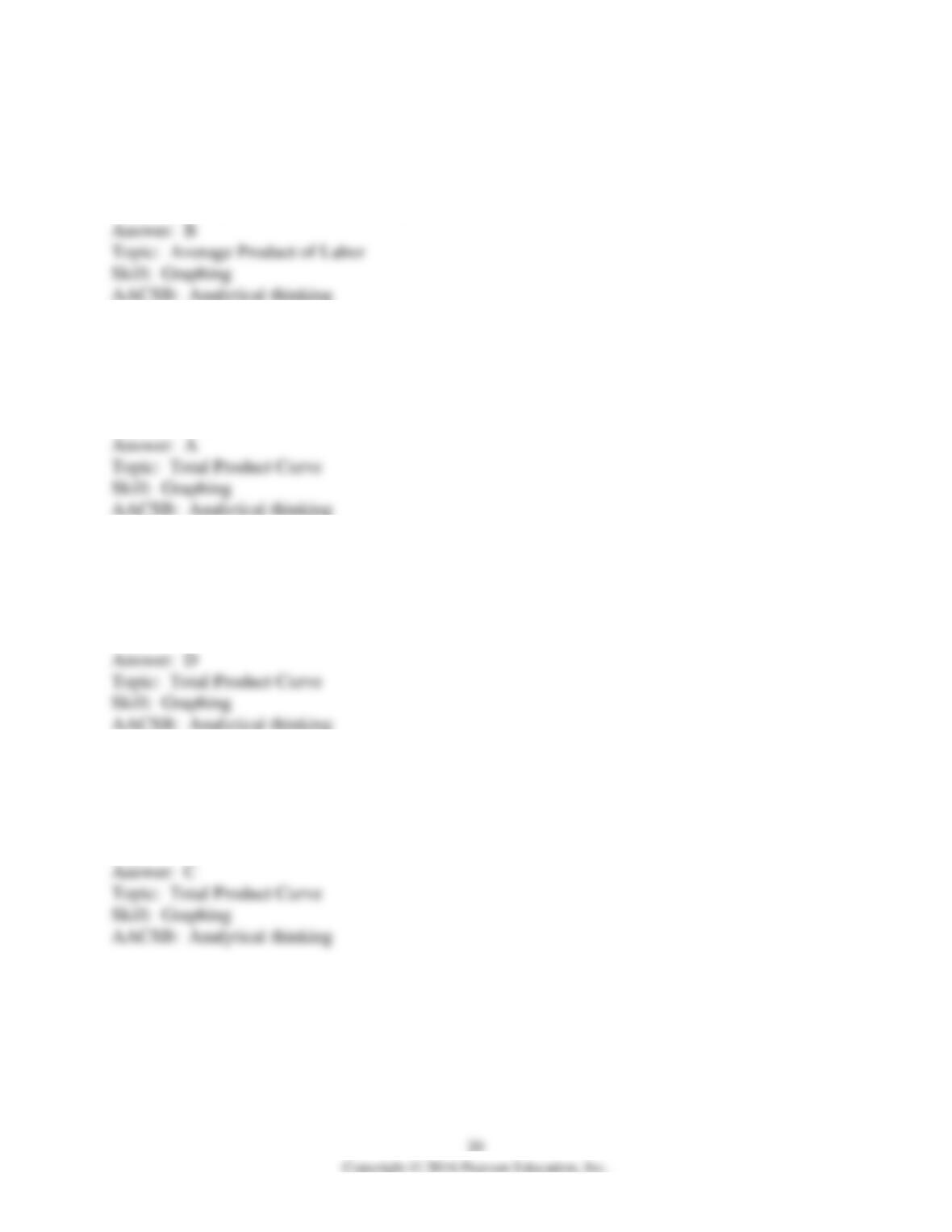
41) In the above figure, the average product of labor at point c is
A) 10.
B) 5.
C) 2.
D) None of the above answers is correct.
42) In the figure above, ________ is a technologically efficient point.
A) d
B) f
C) g
D) None of the selections is correct.
43) In the above figure, a technologically inefficient point is
A) a.
B) e.
C) g.
D) f.
44) In the above figure, an unattainable point is
A) a.
B) e.
C) g.
D) f.