Microeconomics: Theory and Applications with Calculus, 3e (Perloff)
Chapter 11 Monopoly and Monopsony
11.1 Monopoly Profit Maximization
1) For a monopoly, marginal revenue is less than price because
A) the firm is a price taker.
B) the firm must lower price if it wishes to sell more output.
C) the firm can sell all of its output at any price.
D) the demand for the firm’s output is perfectly elastic.
2) For a monopoly, marginal revenue is less than price because
A) the demand for the firm’s output is downward sloping.
B) the firm has no supply curve.
C) the firm can sell all of its output at any price.
D) the demand for the firm’s output is perfectly elastic.
3) Marginal Revenue is
A) the increase in total revenue from selling one more unit of output.
B) equal to P(1 + 1/e).
C) equal to P when the price elasticity of demand is infinite.
D) All of the above.
4) At the current level of output, a firm’s marginal cost equals 16 and marginal revenue equals 10. The
firm
A) is producing the profit-maximizing amount.
B) should produce more.
C) should produce less.
D) Not enough information.
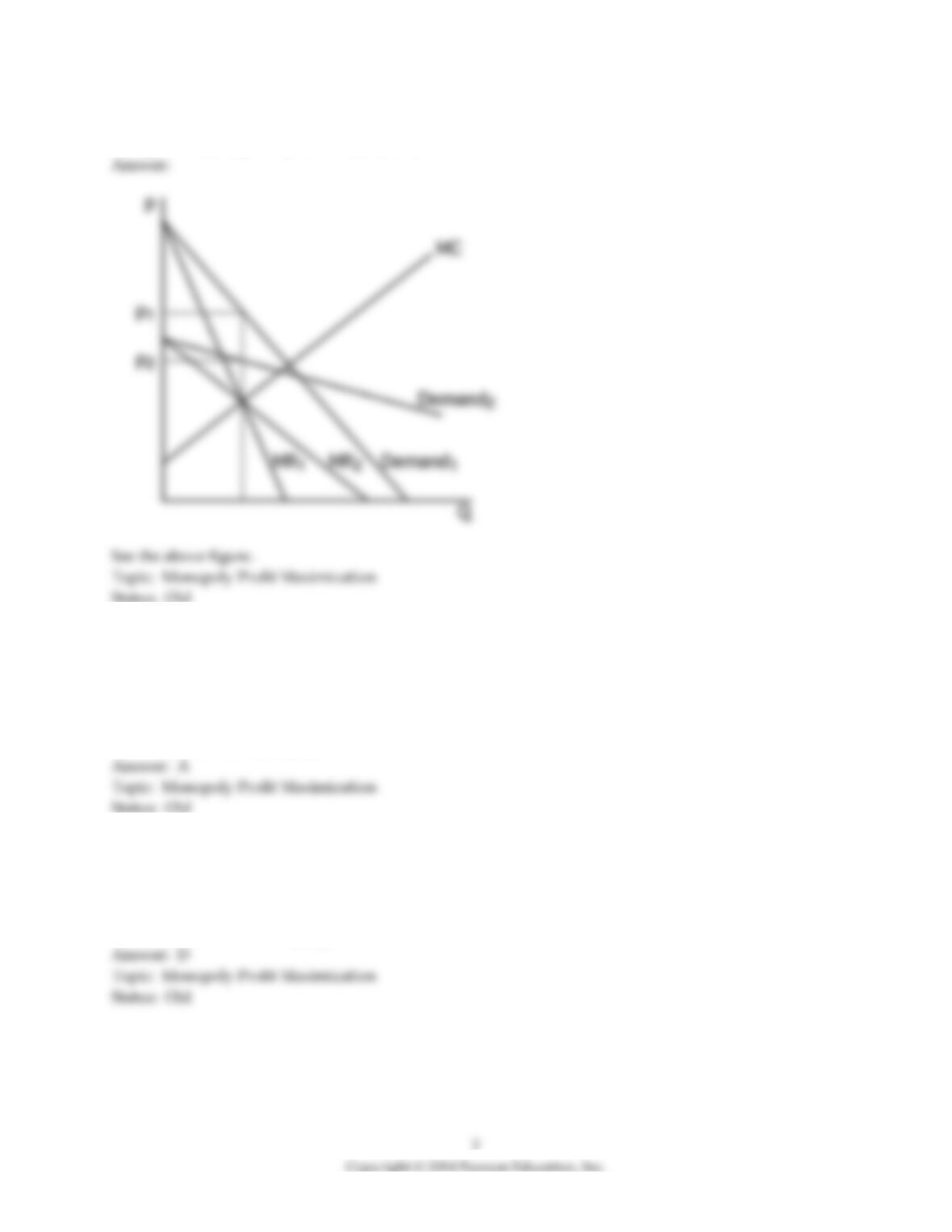
5) Draw a graph that shows a shift in the demand curve that causes the optimal monopoly price to
change, while the quantity remains the same.
6) At an output level of 100, a monopolist faces MC = 15 and MR = 17. At output level q = 101, the
monopolist faces MC = 16 and MR = 15. To maximize profits, the firm
A) should produce 100 units.
B) should produce 101 units.
C) The firm cannot maximize profits.
D) The firm is not a monopoly.
7) If a firm is able to set price,
A) it is a monopoly.
B) its marginal revenue is constant.
C) it sells its output at a constant price.
D) it faces a downward-sloping demand curve.
8) One difference between a monopoly and a competitive firm is that
A) only a monopoly is a price taker.
B) only a monopoly maximizes profit by setting marginal revenue equal to marginal cost.
C) only a monopoly faces a downward-sloping demand curve.
D) None of the above.
9) If the inverse demand function for a monopoly’s product is p = a – bQ, then the firm’s marginal revenue
function is
A) a.
B) a – (1/2)bQ.
C) a – bQ.
D) a – 2bQ.
10) If the inverse demand function for a monopoly’s product is p = 100 – 2Q, then the firm’s marginal
revenue function is
A) –2.
B) 100 – 4Q.
C) 200 – 4Q.
D) 200 – 2Q.
11) If the inverse demand curve a monopoly faces is p = 100 – 2Q, then profit maximization
A) is achieved when 25 units are produced.
B) is achieved by setting price equal to 25.
C) is achieved only by shutting down in the short run.
D) cannot be determined solely from the information provided.
12) If the inverse demand curve a monopoly faces is p = 100 – 2Q, and MC is constant at 16, then profit
maximization
A) is achieved when 21 units are produced.
B) is achieved by setting price equal to 21.
C) is achieved only by shutting down in the short run.
D) cannot be determined solely from the information provided.
13) If the inverse demand curve a monopoly faces is p = 100 – 2Q, and MC is constant at 16, then profit
maximization is achieved when the monopoly sets price equal to
A) 16.
B) 21.
C) 25.
D) 58.
14) If the inverse demand curve a monopoly faces is p = 100 – 2Q, and MC is constant at 16, then
maximum profit
A) equals $336.
B) equals $882.
C) equals $1,218.
D) cannot be determined solely from the information provided.
15) The monopoly maximizes profit by setting
A) price equal to marginal cost.
B) price equal to marginal revenue.
C) marginal revenue equal to marginal cost.
D) marginal revenue equal to zero.
16) When a monopoly is maximizing its profits,
A) MR > MC
B) MR < MC
C) dMR/dQ > dMC/dQ
D) dMR/dQ < dMC/dQ
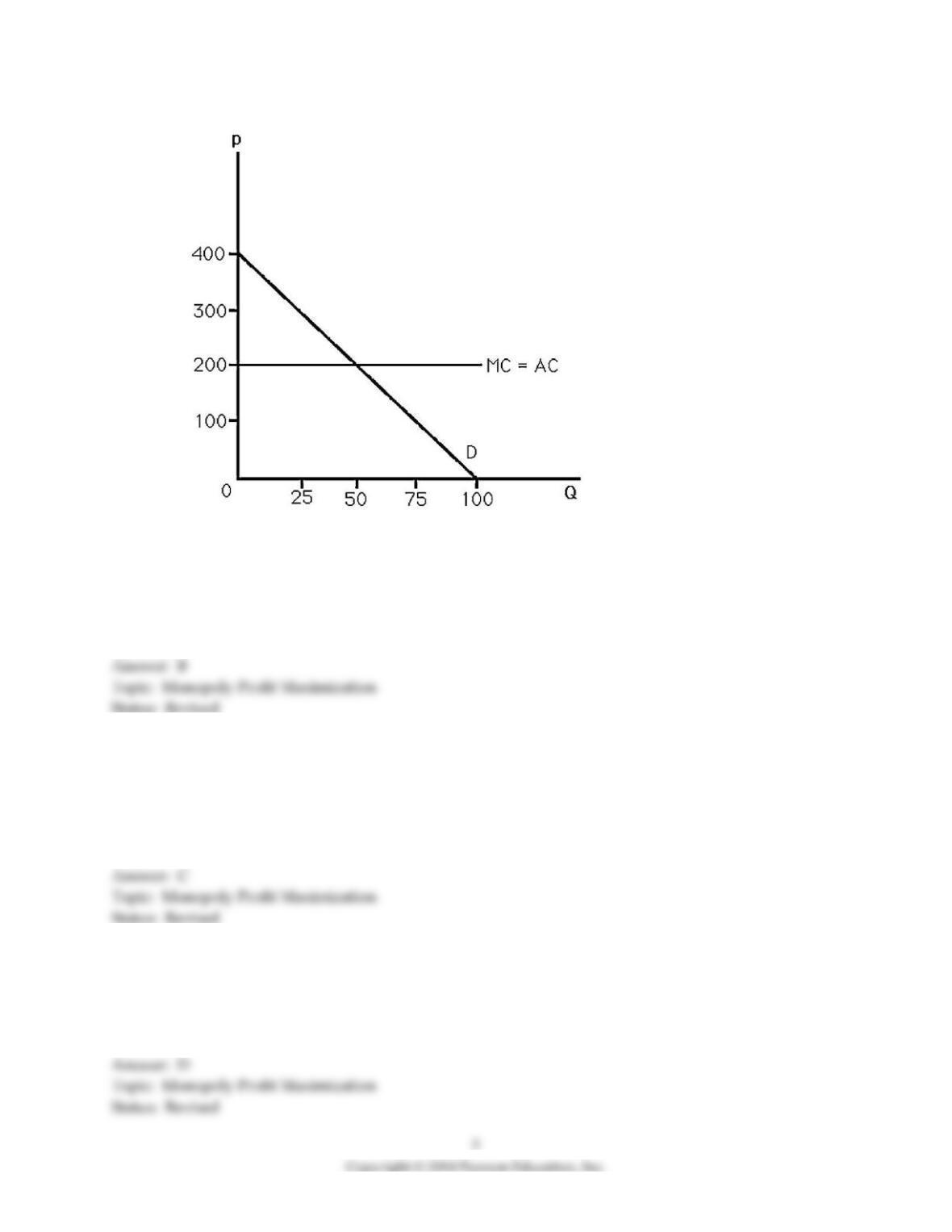
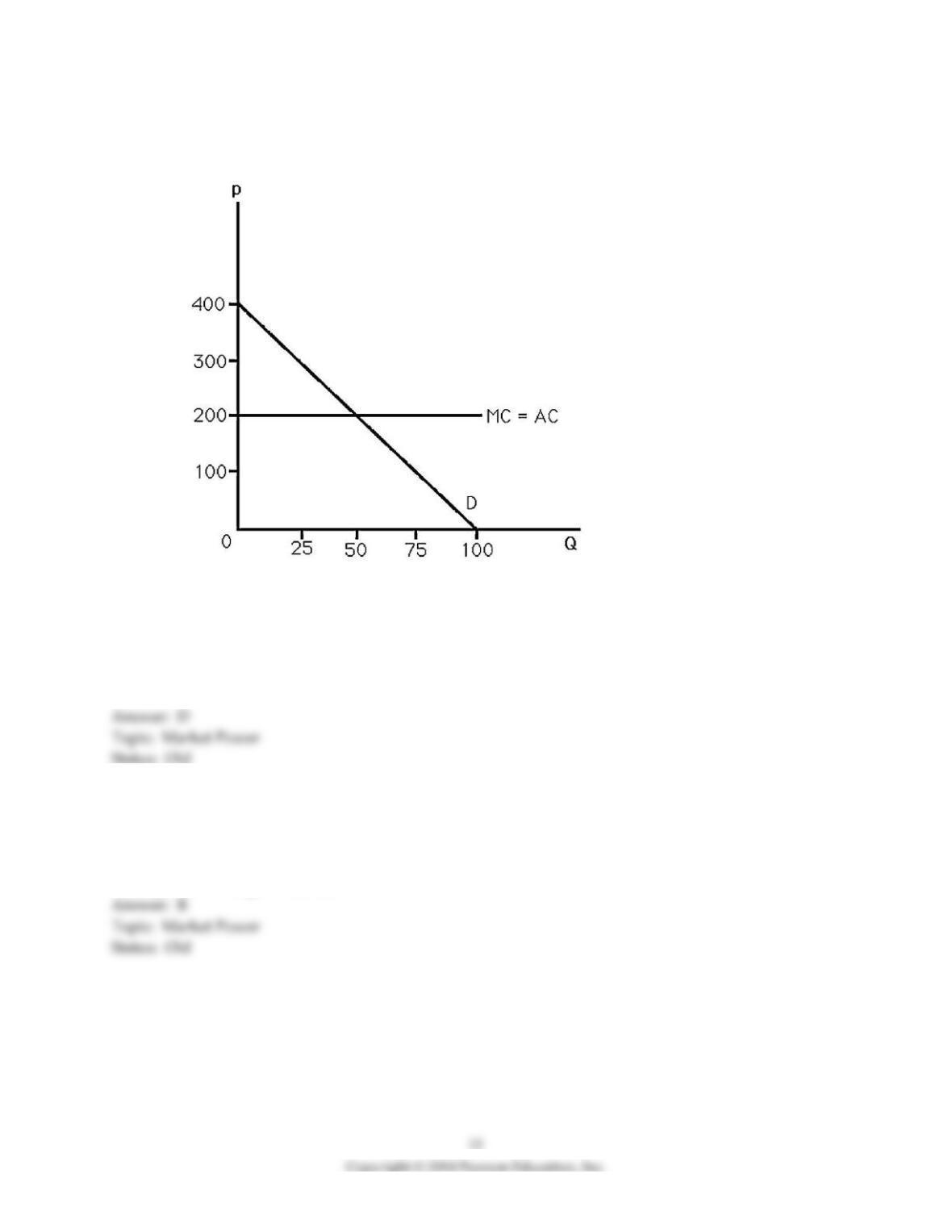
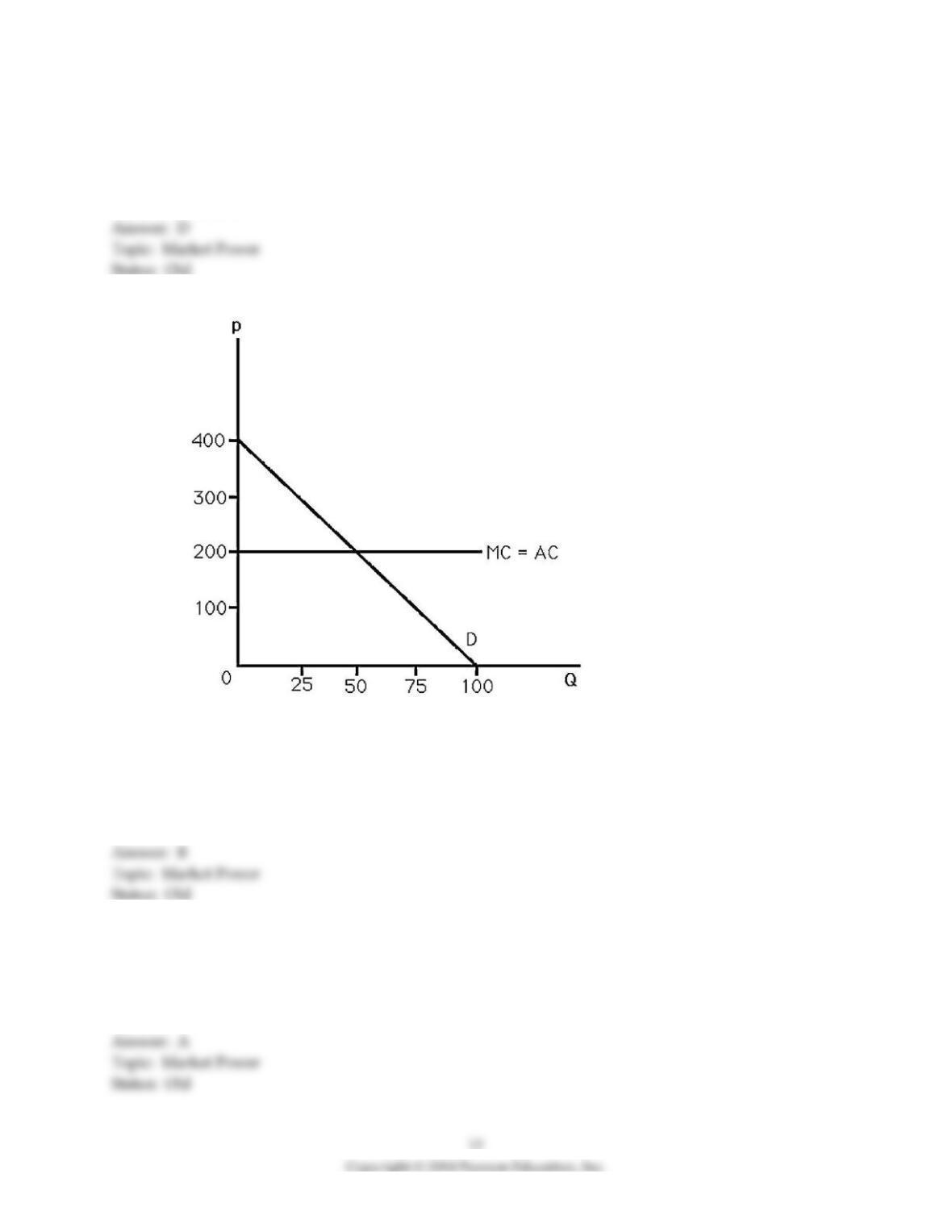
17) The above figure shows the demand and cost curves facing a monopoly. The monopoly maximizes
profit by selling
A) 0 units.
B) 25 units.
C) 50 units.
D) 75 units.
18) The above figure shows the demand and cost curves facing a monopoly. The monopoly maximizes
profit by setting price equal to
A) $100.
B) $200.
C) $300.
D) $400.
19) The above figure shows the demand and cost curves facing a monopoly. Maximum profit equals
A) $0.
B) $100.
C) $1,000.
D) $2,500.
20) A profit-maximizing monopolist will never operate in the portion of the demand curve with price
elasticity equal to
A) –3.
B) –1.
C) -1/3.
D) None of the above—the price elasticity does not matter.
21) A profit-maximizing monopoly will never operate in the portion of the demand curve with MR equal
to
A) 3.
B) 2.
C) 1.
D) –1.
22) If a monopoly is operating on the demand curve where price elasticity is equal to -3, and price equals
3, then MR is equal to
A) –1.
B) 1.
C) –2.
D) 2.
23) If a monopoly is operating on the demand curve where price elasticity is equal to -3, and MR equals 2,
then price is equal to
A) 3.
B) 2.
C) 1.
D) 0.
24) If the demand shifts, then for a profit maximizing monopolist,
A) price will change while quantity will remain constant.
B) price will change and quantity will change.
C) Both A and B.
D) Neither A nor B.
For the following, please answer “True” or “False” and explain why.
25) If the monopoly’s demand curve intersects the AVC curve at minimum AVC, the firm will shut down.
26) Since there are no close substitutes for the monopoly’s product, the monopoly can charge any price it
wishes.
27) Since a monopoly can set any price it wants, it always makes a profit.
28) A monopoly always operates in the inelastic portion of its demand curve.
29) In a recent court case, an expert witness defined a monopoly as a firm that can “raise price without
reducing its total revenue.” What does this imply about the elasticity of demand? Would this definition
hold for a profit-maximizing monopoly? Explain.
8
31) Consider a monopolist facing a linear (inverse) demand curve given by:
p = a – bQ
Show with calculus that the marginal revenue in fact has the same price–axis intercept but twice the slope
as the inverse demand curve above.
32) Suppose a monopolist faces the constant price elasticity demand curve:
p = Qε
where ε < 0. The monopolist has a constant marginal cost of c.
a. If ε < -1, can you determine what price and quantity will the monopolist set? Explain.
b. If 0 > ε > -1, what is the price and quantity the monopolist will set?
33) A monopolist faces a demand curve Q = 120 – 2p and has costs given by C(Q) = 20Q + 100.
a. Write the monopolist’s profits in terms of the price it charges.
b. Use the derivative (w.r.t. price) to determine the monopolist’s profit-maximizing price.
c. Now, derive the monopolist’s inverse demand based on the demand equation above. Write out the
monopolist’s profits in terms of quantity.
d. Use the derivative w.r.t. Q to determine the monopolist’s optimal quantity. What price does the
monopoly charge?
9
34) A monopolist faces the (inverse) demand for its product: p = a – bQ. The monopolist has a marginal
cost given by c and a fixed cost given by F.
a. Assume that F is sufficiently small such that the monopolist produces a strictly positive level of output.
What is the profit-maximizing price and quantity?
b. Compute the maximum profit for the monopolist.
c. For what values of F will the monopolist earn negative profit?
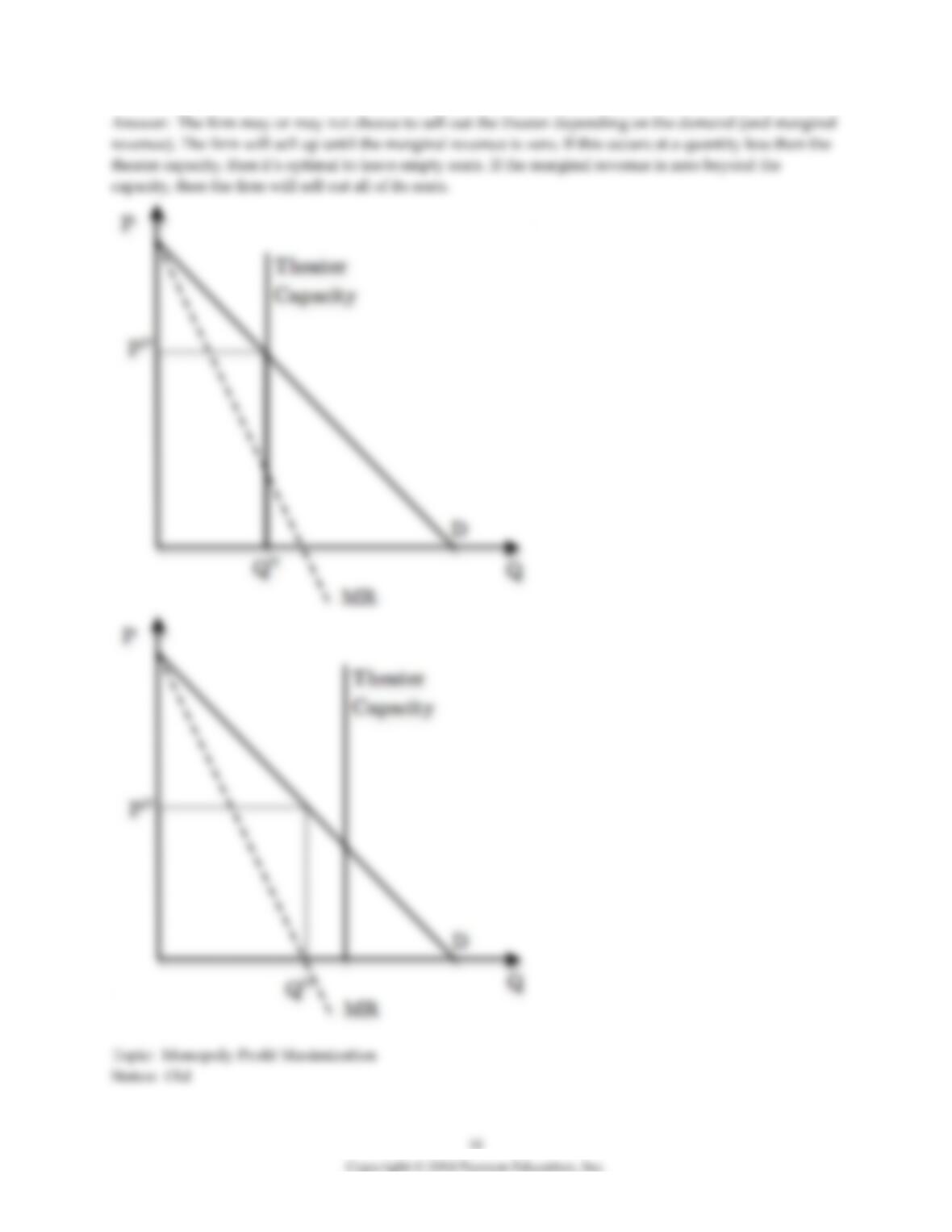
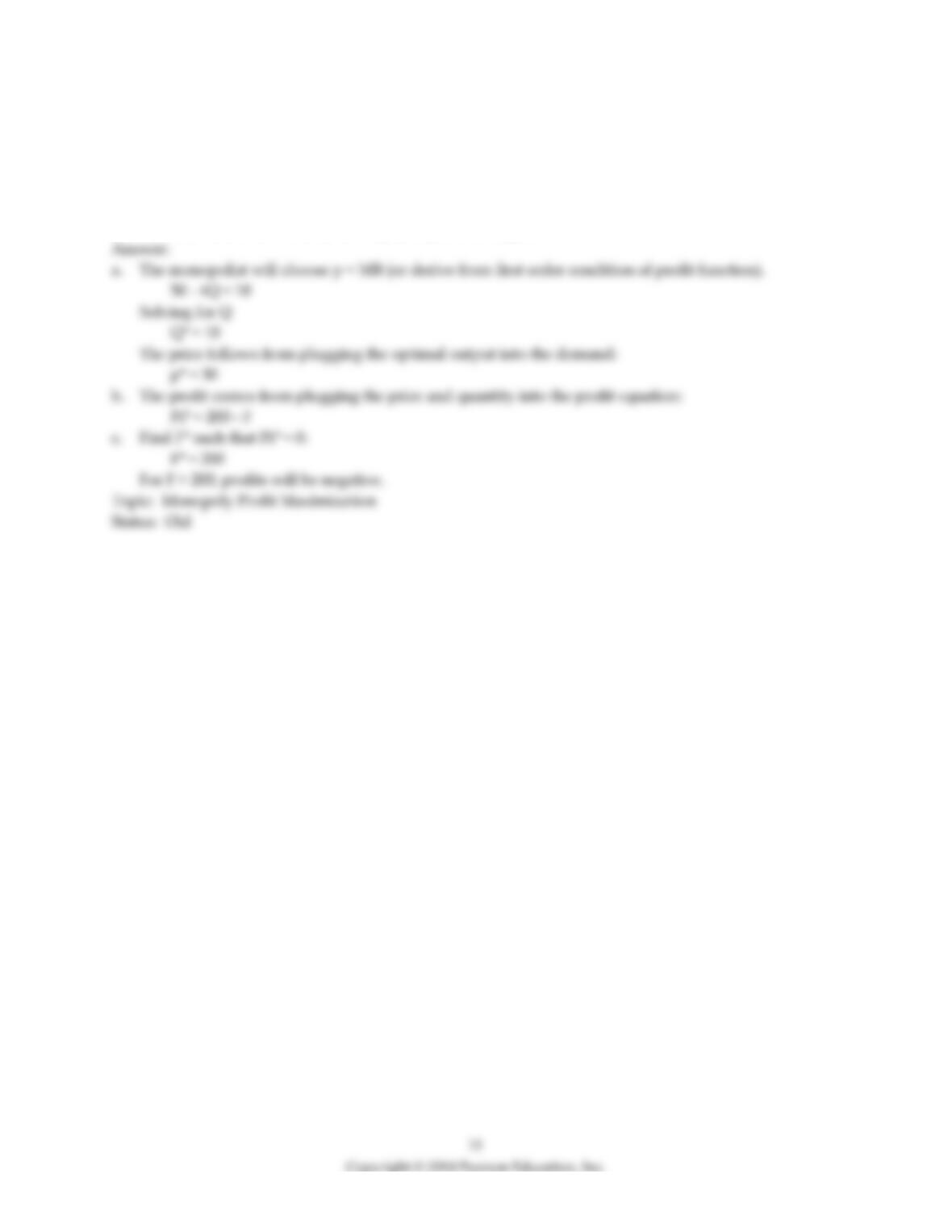
35) Consider a town with a single movie theater, and that movie theater faces a downward sloping
demand curve for its tickets. The movie theater has a fixed number of seats available for each show but
the marginal cost of filling a seat is zero. Why might it be in the movie theater’s interest to not to sell out
every show even though the marginal cost of selling additional seats is virtually zero? (A graph will help
your answer).
36) A monopolist faces the (inverse) demand for its product: p = 50 – 2Q. The monopolist has a marginal
cost of 10/unit and a fixed cost given by F.
a. Assume that F is sufficiently small such that the monopolist produces a strictly positive level of
output. What is the profit-maximizing price and quantity?
b. Compute the maximum profit for the monopolist in terms of F.
c. For what values of F will the monopolists profit be negative?
11.2 Market Power and Welfare
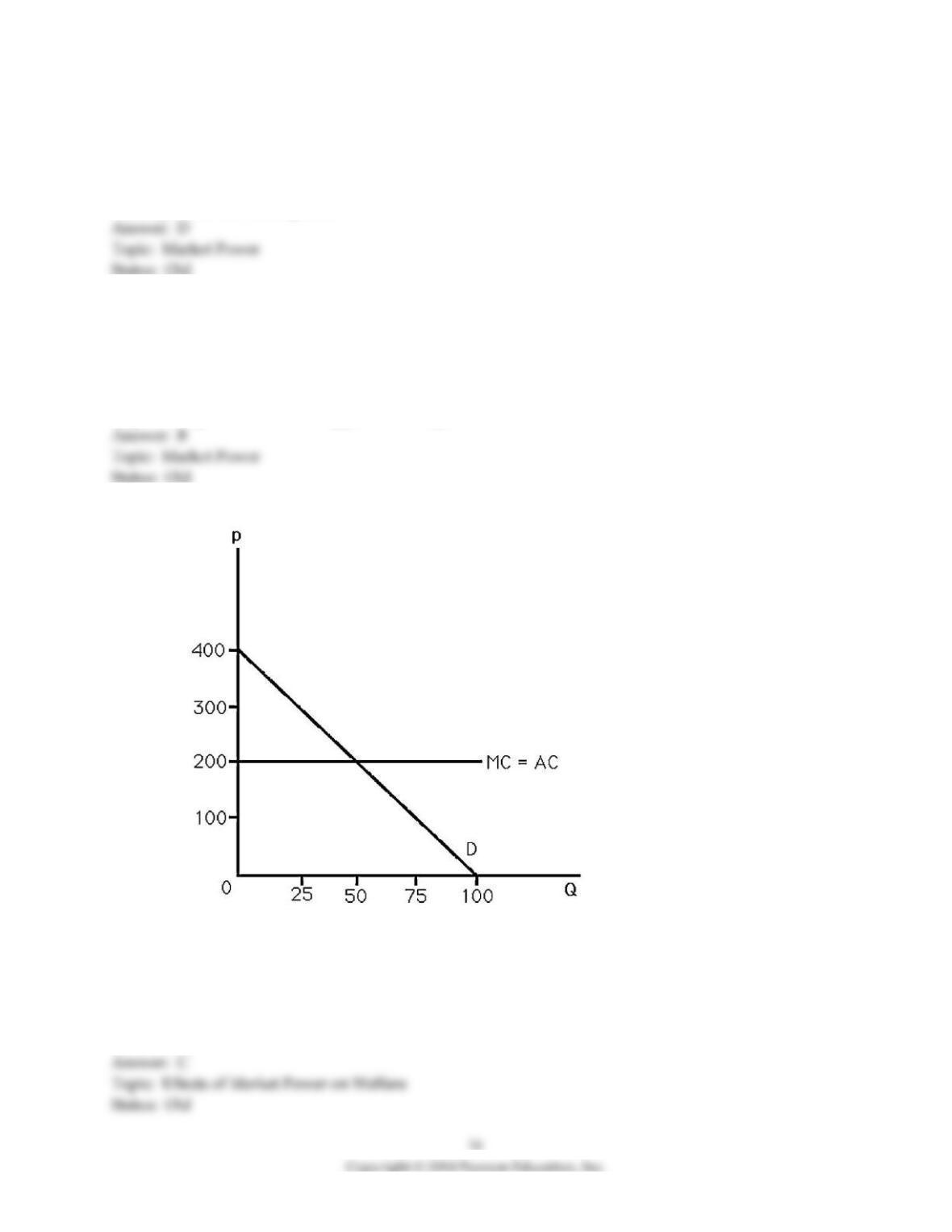
1) The above figure shows the demand and cost curves facing a monopoly. At the profit–maximizing
price, the elasticity of demand equals
A) –1.
B) zero.
C) infinity.
D) –3.
2) The ability of a monopoly to charge a price that exceeds marginal cost depends on
A) the price elasticity of supply.
B) price elasticity of demand.
C) slope of the demand curve.
D) shape of the marginal cost curve.
3) The Lerner Index is
A) the ratio of the difference between price and marginal to price.
B) equal to (Price – MC)/Price.
C) a measure of market power.
D) All of the above.
4) The above figure shows the demand and cost curves facing a monopoly. If the firm is a profit
maximizer, its Lerner Index will equal
A) 1.
B) 1/3.
C) 1.5.
D) 3.
5) If the demand for a firm’s output is perfectly elastic, then the firm’s Lerner Index equals
A) zero.
B) one.
C) infinity.
D) one-half.
6) If the demand curve a monopolist faces is perfectly elastic, then the ratio of the firm’s price to the
marginal cost is
A) 0.
B) 1.
C) 2.
D) None of the above—the answer cannot be determined.
7) The more elastic the demand curve, a monopoly
A) will have a larger Lerner Index.
B) will face a lower marginal cost.
C) will earn more profit.
D) will lose more sales as it raises its price.
8) The introduction of satellite television systems would cause the Lerner Index for cable television to
A) become smaller.
B) increase.
C) change in accordance to the increase in market power of cable TV providers.
D) be unchanged.
9) If the inverse demand curve a monopoly faces is p = 100 – 2Q, and MC is constant at 16, then the firm’s
Lerner Index equals
A) 58/16.
B) 16/42.
C) 58/42.
D) 42/58.
10) The introduction of satellite television systems would cause the demand curve for cable television to
be
A) more elastic.
B) less elastic.
C) perfectly inelastic.
D) unchanged.
11) Humana Hospital’s price/marginal cost ratio of 2.3 is most likely to decline if
A) the number of nearby hospitals increases.
B) the number of nearby hospitals decreases.
C) the demand curve for hospital services shifts rightward.
D) the demand curve for hospital services becomes steeper.
12) As other firms enter a monopoly’s market, the monopoly’s market power
A) is unaffected.
B) declines.
C) increases.
D) increases according to the Lerner Index but decreases according to the price/marginal cost ratio.
13) If a monopoly can produce a good at zero marginal cost, then its Lerner Index is
A) zero.
B) one.
C) infinity.
D) undetermined.
14) A monopoly sets a price of $50 per unit for an item that has a marginal cost of $10. Assuming profit
maximization, the implicit demand elasticity is
A) -0.2.
B) -0.8.
C) -1.25.
D) -5.0.
15) A monopoly incurs a marginal cost of $1 for each unit produced. If the price elasticity of demand
equals -2.0, the monopoly maximizes profit by charging a price of
A) $1.
B) $1.50.
C) $2.
D) $3.
16) If a monopoly’s Lerner Index exceeds 1, then
A) it is earning maximum profit.
B) it has ultimate market power.
C) it must be pricing below marginal cost.
D) marginal revenue is negative.
17) If a monopoly discovers that the demand for its output has become more elastic at the original output
level, then it will respond by
A) producing more and setting a higher price.
B) setting a lower price.
C) setting a higher price.
D) producing more while leaving price unchanged.
18) The above figure shows the demand and cost curves facing a monopoly. The deadweight loss of this
monopoly is
A) $100.
B) $250.
C) $1,250.
D) $2,500.
19) The loss associated with the fact that at the profit-maximizing quantity consumers value the goods
more than it cost to produce them is called
A) deadweight loss.
B) comparative loss.
C) Lerner Loss.
D) Consumer Value Loss.
20) The above figure shows the demand and marginal cost curves for a monopoly. The deadweight loss
of this monopoly equals
A) h.
B) c.
C) c + f.
D) c + d + e + f.
21) The above figure shows the demand and marginal cost curves for a monopoly. Under monopoly,
consumer surplus equals
A) a + b.
B) a + b + c.
C) a + b + c + d + e + f.
D) None of the above.
22) The existence of a deadweight loss associated with a monopoly can be seen because
A) consumers are willing to pay more for the last unit of output than it cost to produce.
B) the cost of the last unit produced is more than consumers are willing to pay for it.
C) the producer surplus is larger than in a competitive market.
D) None of the above.
23) If the inverse demand curve a monopoly faces is p = 100 – 2Q, and MC is constant at 16, then the
deadweight loss from monopoly equals
A) $21.
B) $441.
C) $882.
D) $1,764.
24) For a profit maximizing monopolist, if the MC = 10 and price is set to be 20, then the elasticity at this
price is
A) –2.
B) –1.
C) -0.5.
D) 0.
25) For a monopoly market, if the Lerner Index is 2, then
A) the monopoly is maximizing its profit.
B) the price elasticity of demand is –2.
C) the price elasticity of demand is -0.5.
D) None of the above.
For the following, please answer “True” or “False” and explain why.
26) The less elastic is the demand for a firm’s product, the greater is that firm’s market power.
27) The Lerner Index is derived from the profit-maximizing condition of a firm.
28) The deadweight loss represent the sum of added consumer and producer surplus if the firm would
produce the quantity where P = MC.
29) When would a profit-maximizing monopolist that operates with no government intervention choose
to produce the competitive level of output?
30) It is a conventional practice among apparel retailers to set the retail price of clothing at twice the cost
paid to the manufacturer. For example, if the retailer pays $7 for a pair of jeans, the jeans will retail for
$14. What must the price elasticity of demand be for this practice to be profit maximizing?
31) For profit-maximizing monopolies, explain why the boundaries on the Lerner Index are 0 and 1.
32) Suppose that market demand for a good is Q = 480 – 2p. The marginal cost is MC = 2Q. Calculate the
deadweight loss resulting from a monopoly in this market.