
Chapter 11: The Basics of Capital Budgeting
1.
A firm should never accept a project if its acceptance would lead to an increase in the firm’s cost of capital
(its
WACC).
a.
True
b.
False
2.
Because “present value” refers to the value of cash flows that occur at different points in time, a series of
present
values of cash flows should not be summed to determine the value of a capital budgeting project.
a.
True
b.
False
3.
Assuming that their NPVs based on the firm’s cost of capital are equal, the NPV of a project whose cash
flows
accrue relatively rapidly will be more sensitive to changes in the discount rate than the NPV of a project
whose
cash flows come in later in its life.
a.
True
b.
False
4.
A basic rule in capital budgeting is that if a project’s NPV exceeds its IRR, then the project should be
accepted.
a.
True
b.
False
5.
Conflicts between two mutually exclusive projects occasionally occur, where the NPV method ranks one
project
higher but the IRR method puts the other one first. In theory, such conflicts should be resolved in
favor of the
project with the higher NPV.
a.
True
b.
False
6.
Conflicts between two mutually exclusive projects occasionally occur, where the NPV method ranks one
project
higher but the IRR method puts the other one first. In theory, such conflicts should be resolved in
favor of the
project with the higher IRR.
a.
True
b.
False

7.
The internal rate of return is that discount rate that equates the present value of the cash outflows (or costs)
with
the present value of the cash inflows.
a.
True
b.
False
8.
Other things held constant, an increase in the cost of capital will result in a decrease in a project’s IRR.
a.
True
b.
False
9.
Under certain conditions, a project may have more than one IRR. One such condition is when, in addition to
the
initial investment at time = 0, a negative cash flow (or cost) occurs at the end of the project’s life.
a.
True
b.
False
10.
The phenomenon called “multiple internal rates of return” arises when two or more mutually exclusive
projects that
have different lives are being compared.
a.
True
b.
False
11.
The NPV method is based on the assumption that projects’ cash flows are reinvested at the project’s risk–
adjusted
cost of capital.
a.
True
b.
False
12.
The IRR method is based on the assumption that projects’ cash flows are reinvested at the project’s risk–
adjusted
cost of capital.
a.
True
b.
False
13.
The NPV method’s assumption that cash inflows are reinvested at the cost of capital is generally more
reasonable
than the IRR’s assumption that cash flows are reinvested at the IRR. This is an important reason
why the NPV
method is generally preferred over the IRR method.
a.
True
b.
False

14.
For a project with one initial cash outflow followed by a series of positive cash inflows, the modified IRR
(MIRR)
method involves compounding the cash inflows out to the end of the project’s life, summing those
compounded cash
flows to form a terminal value (TV), and then finding the discount rate that causes the PV
of the TV to equal the
project’s cost.
a.
True
b.
False
15.
Both the regular and the modified IRR (MIRR) methods have wide appeal to professors, but most business
executives prefer the NPV method to either of the IRR methods.
a.
True
b.
False
16.
When evaluating mutually exclusive projects, the modified IRR (MIRR) always leads to the same capital
budgeting
decisions as the NPV method, regardless of the relative lives or sizes of the projects being
evaluated.
a.
True
b.
False
17.
One advantage of the payback method for evaluating potential investments is that it provides information
about a
project’s liquidity and risk.
a.
True
b.
False
18.
When considering two mutually exclusive projects, the firm should always select the project whose internal
rate of
return is the highest, provided the projects have the same initial cost. This statement is true regardless
of whether
the projects can be repeated or not.
a.
True
b.
False

19.
The primary reason that the NPV method is conceptually superior to the IRR method for evaluating mutually
exclusive investments is that multiple IRRs may exist, and when that happens, we don’t know which IRR is
relevant.
a.
True
b.
False
20.
The NPV and IRR methods, when used to evaluate two independent and equally risky projects, will lead to
different accept/reject decisions and thus capital budgets if the projects’ IRRs are greater than their costs of
capital.
a.
True
b.
False
21.
The NPV and IRR methods, when used to evaluate two equally risky but mutually exclusive projects, will
lead to
different accept/reject decisions and thus capital budgets if the cost of capital at which the projects’
NPV profiles
cross is greater than the crossover rate.
a.
True
b.
False
22.
A conflict will exist between the NPV and IRR methods, when used to evaluate two equally risky but
mutually
exclusive projects, if the projects’ cost of capital is less than the rate at which the projects’ NPV
profiles cross.
a.
True
b.
False
23.
Project S has a pattern of high cash flows in its early life, while Project L has a longer life, with large cash
flows
late in its life. Neither has negative cash flows after Year 0, and at the current cost of capital, the two
projects have
identical NPVs. Now suppose interest rates and money costs decline. Other things held
constant, this change will
cause L to become preferred to S.
a.
True
b.
False
24.
The regular payback method is deficient in that it does not take account of cash flows beyond the payback
period.
The discounted payback method corrects this fault.
a.
True
b.
False

25.
In theory, capital budgeting decisions should depend solely on forecasted cash flows and the opportunity cost
of
capital. The decision criterion should not be affected by managers’ tastes, choice of accounting method, or
the
profitability of other independent projects.
a.
True
b.
False
26.
If you were evaluating two mutually exclusive projects for a firm with a zero cost of capital, the payback
method
and NPV method would always lead to the same decision on which project to undertake.
a.
True
b.
False
27.
Small businesses make less use of DCF capital budgeting techniques than large businesses. This may reflect a
lack
of knowledge on the part of small firms’ managers, but it may also reflect a rational conclusion that the
costs of
using DCF analysis outweigh the benefits of these methods for very small firms.
a.
True
b.
False
28.
An increase in the firm’s WACC will decrease projects’ NPVs, which could change the accept/reject decision
for
any potential project. However, such a change would have no impact on projects’ IRRs. Therefore, the
accept/reject decision under the IRR method is independent of the cost of capital.
a.
True
b.
False
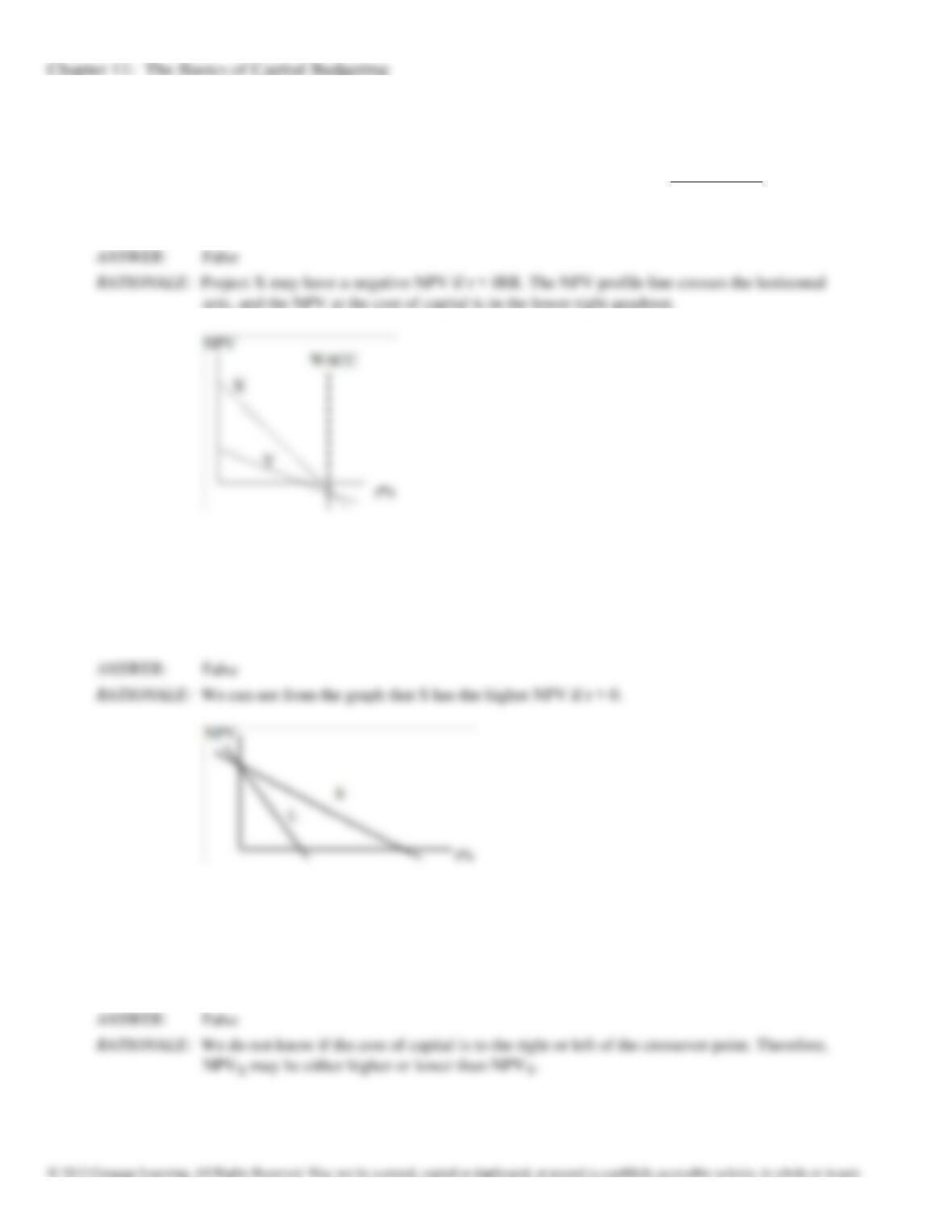
29.
The IRR of normal Project X is greater than the IRR of normal Project Y, and both IRRs are greater than zero.
Also, the NPV of X is greater than the NPV of Y at the cost of capital. If the two projects are mutually
exclusive,
Project X should definitely be selected, and the investment made, provided we have confidence in
the data. Put
another way, it is impossible to draw NPV profiles that would suggest not accepting Project X.
a.
True
b.
False
30.
Normal Projects S and L have the same NPV when the discount rate is zero. However, Project S’s cash flows
come in faster than those of L. Therefore, we know that at any discount rate greater than zero, L will have the
higher NPV.
a.
True
b.
False
31.
If the IRR of normal Project X is greater than the IRR of mutually exclusive (and also normal) Project Y, we
can
conclude that the firm should always select X rather than Y if X has NPV > 0.
a.
True
b.
False

32.
Which of the following statements is CORRECT? Assume that the project being considered has normal cash
flows,
with one outflow followed by a series of inflows.
a.
A project’s NPV is found by compounding the cash inflows at the IRR to find the terminal value (TV), then
discounting the TV at the WACC.
b.
The lower the WACC used to calculate it, the lower the calculated NPV will be.
c.
If a project’s NPV is less than zero, then its IRR must be less than the WACC.
d.
If a project’s NPV is greater than zero, then its IRR must be less than zero.
e.
The NPV of a relatively low-risk project should be found using a relatively high WACC.
33.
Which of the following statements is CORRECT?
a.
One defect of the IRR method is that it does not take account of cash flows over a project’s full life.
b.
One defect of the IRR method is that it does not take account of the time value of money.
c.
One defect of the IRR method is that it does not take account of the cost of capital.
d.
One defect of the IRR method is that it values a dollar received today the same as a dollar that will not be
received until sometime in the future.
e.
One defect of the IRR method is that it assumes that the cash flows to be received from a project can be
reinvested at the IRR itself, and that assumption is often not valid.
34.
Which of the following statements is CORRECT?
a.
One defect of the IRR method versus the NPV is that the IRR does not take account of cash flows over a
project’s full life.
b.
One defect of the IRR method versus the NPV is that the IRR does not take account of the time value of
money.
c.
One defect of the IRR method versus the NPV is that the IRR does not take account of the cost of capital.
d.
One defect of the IRR method versus the NPV is that the IRR values a dollar received today the same as a
dollar that will not be received until sometime in the future.
e.
One defect of the IRR method versus the NPV is that the IRR does not take proper account of differences
in the sizes of projects.

35.
Which of the following statements is CORRECT? Assume that the project being considered has normal cash
flows,
with one outflow followed by a series of inflows.
a.
A project’s regular IRR is found by compounding the cash inflows at the WACC to find the terminal value
(TV), then discounting this TV at the WACC.
b.
A project’s regular IRR is found by discounting the cash inflows at the WACC to find the present value
(PV), then compounding this PV to find the IRR.
c.
If a project’s IRR is greater than the WACC, then its NPV must be negative.
d.
To find a project’s IRR, we must solve for the discount rate that causes the PV of the inflows to equal the
PV of the project’s costs.
e.
To find a project’s IRR, we must find a discount rate that is equal to the WACC.
36.
Which of the following statements is CORRECT? Assume that the project being considered has normal cash
flows,
with one outflow followed by a series of inflows.
a.
A project’s regular IRR is found by compounding the initial cost at the WACC to find the terminal value
(TV), then discounting the TV at the WACC.
b.
A project’s regular IRR is found by compounding the cash inflows at the WACC to find the present value
(PV), then discounting the TV to find the IRR.
c.
If a project’s IRR is smaller than the WACC, then its NPV will be positive.
d.
A project’s IRR is the discount rate that causes the PV of the inflows to equal the project’s cost.
e.
If a project’s IRR is positive, then its NPV must also be positive.
37.
Which of the following statements is CORRECT?
a.
If a project has “normal” cash flows, then its IRR must be positive.
b.
If a project has “normal” cash flows, then its MIRR must be positive.
c.
If a project has “normal” cash flows, then it will have exactly two real IRRs.
d.
The definition of “normal” cash flows is that the cash flow stream has one or more negative cash flows
followed by a stream of positive cash flows and then one negative cash flow at the end of the project’s life.
e.
If a project has “normal” cash flows, then it can have only one real IRR, whereas a project with
“nonnormal”
cash flows might have more than one real IRR.
38.
Which of the following statements is CORRECT?
a.
Projects with “normal” cash flows can have only one real IRR.
b.
Projects with “normal” cash flows can have two or more real IRRs.
c.
Projects with “normal” cash flows must have two changes in the sign of the cash flows, e.g., from negative
to positive to negative. If there are more than two sign changes, then the cash flow stream is “nonnormal.”
d.
The “multiple IRR problem” can arise if a project’s cash flows are “normal.”
e.
Projects with “nonnormal” cash flows are almost never encountered in the real world.

39.
Which of the following statements is CORRECT?
a.
The regular payback method recognizes all cash flows over a project’s life.
b.
The discounted payback method recognizes all cash flows over a project’s life, and it also adjusts these
cash
flows to account for the time value of money.
c.
The regular payback method was, years ago, widely used, but virtually no companies even calculate the
payback today.
d.
The regular payback is useful as an indicator of a project’s liquidity because it gives managers an idea of
how long it will take to recover the funds invested in a project.
e.
The regular payback does not consider cash flows beyond the payback year, but the discounted payback
overcomes this defect.
40.
Which of the following statements is CORRECT? Assume that the project being considered has normal cash
flows,
with one outflow followed by a series of inflows.
a.
The longer a project’s payback period, the more desirable the project is normally considered to be by this
criterion.
b.
One drawback of the payback criterion for evaluating projects is that this method does not properly account
for the time value of money.
c.
If a project’s payback is positive, then the project should be rejected because it must have a negative NPV.
d.
The regular payback ignores cash flows beyond the payback period, but the discounted payback method
overcomes this problem.
e.
If a company uses the same payback requirement to evaluate all projects, say it requires a payback of 4
years or less, then the company will tend to reject projects with relatively short lives and accept long-lived
projects, and this will cause its risk to increase over time.
41.
Which of the following statements is CORRECT?
a.
The shorter a project’s payback period, the less desirable the project is normally considered to be by this
criterion.
b.
One drawback of the payback criterion is that this method does not take account of cash flows beyond the
payback period.
c.
If a project’s payback is positive, then the project should be accepted because it must have a positive NPV.
d.
The regular payback ignores cash flows beyond the payback period, but the discounted payback method
overcomes this problem.
e.
One drawback of the discounted payback is that this method does not consider the time value of money,
while the regular payback overcomes this drawback.

42.
Assume a project has normal cash flows. All else equal, which of the following statements is CORRECT?
a.
A project’s IRR increases as the WACC declines.
b.
A project’s NPV increases as the WACC declines.
c.
A project’s MIRR is unaffected by changes in the WACC.
d.
A project’s regular payback increases as the WACC declines.
e.
A project’s discounted payback increases as the WACC declines.
43.
Which of the following statements is CORRECT?
a.
The internal rate of return method (IRR) is generally regarded by academics as being the best single
method
for evaluating capital budgeting projects.
b.
The payback method is generally regarded by academics as being the best single method for evaluating
capital budgeting projects.
c.
The discounted payback method is generally regarded by academics as being the best single method for
evaluating capital budgeting projects.
d.
The net present value method (NPV) is generally regarded by academics as being the best single method
for
evaluating capital budgeting projects.
e.
The modified internal rate of return method (MIRR) is generally regarded by academics as being the best
single method for evaluating capital budgeting projects.
44.
Which of the following statements is CORRECT?
a.
An NPV profile graph shows how a project’s payback varies as the cost of capital changes.
b.
The NPV profile graph for a normal project will generally have a positive (upward) slope as the life of the
project increases.
c.
An NPV profile graph is designed to give decision makers an idea about how a project’s risk varies with its
life.
d.
An NPV profile graph is designed to give decision makers an idea about how a project’s contribution to the
firm’s value varies with the cost of capital.
e.
We cannot draw a project’s NPV profile unless we know the appropriate WACC for use in evaluating the
project’s NPV.
45.
Which of the following statements is CORRECT? Assume that the project being considered has normal cash
flows,
with one outflow followed by a series of inflows.
a.
A project’s NPV is generally found by compounding the cash inflows at the WACC to find the terminal
value (TV), then discounting the TV at the IRR to find its PV.
b.
The higher the WACC used to calculate the NPV, the lower the calculated NPV will be.
c.
If a project’s NPV is greater than zero, then its IRR must be less than the WACC.
d.
If a project’s NPV is greater than zero, then its IRR must be less than zero.
e.
The NPVs of relatively risky projects should be found using relatively low WACCs.

46.
Which of the following statements is CORRECT?
a.
For a project to have more than one IRR, then both IRRs must be greater than the WACC.
b.
If two projects are mutually exclusive, then they are likely to have multiple IRRs.
c.
If a project is independent, then it cannot have multiple IRRs.
d.
Multiple IRRs can only occur if the signs of the cash flows change more than once.
e.
If a project has two IRRs, then the smaller one is the one that is most relevant, and it should be accepted
and
relied upon.
47.
Which of the following statements is CORRECT?
a.
The NPV method assumes that cash flows will be reinvested at the WACC, while the IRR method assumes
reinvestment at the IRR.
b.
The NPV method assumes that cash flows will be reinvested at the risk-free rate, while the IRR method
assumes reinvestment at the IRR.
c.
The NPV method assumes that cash flows will be reinvested at the WACC, while the IRR method assumes
reinvestment at the risk-free rate.
d.
The NPV method does not consider all relevant cash flows, particularly cash flows beyond the payback
period.
e.
The IRR method does not consider all relevant cash flows, particularly cash flows beyond the payback
period.
48.
Which of the following statements is CORRECT? Assume that the project being considered has normal cash
flows,
with one outflow followed by a series of inflows.
a.
If Project A has a higher IRR than Project B, then Project A must have the lower NPV.
b.
If Project A has a higher IRR than Project B, then Project A must also have a higher NPV.
c.
The IRR calculation implicitly assumes that all cash flows are reinvested at the WACC.
d.
The IRR calculation implicitly assumes that cash flows are withdrawn from the business rather than being
reinvested in the business.
e.
If a project has normal cash flows and its IRR exceeds its WACC, then the project’s NPV must be positive.

49.
Assume that the economy is in a mild recession, and as a result interest rates and money costs generally are
relatively low. The WACC for two mutually exclusive projects that are being considered is 8%. Project S has
an
IRR of 20% while Project L’s IRR is 15%. The projects have the same NPV at the 8% current WACC.
However,
you believe that the economy is about to recover, and money costs and thus your WACC will also
increase. You
also think that the projects will not be funded until the WACC has increased, and their cash
flows will not be
affected by the change in economic conditions. Under these conditions, which of the
following statements is
CORRECT?
a.
You should reject both projects because they will both have negative NPVs under the new conditions.
b.
You should delay a decision until you have more information on the projects, even if this means that a
competitor might come in and capture this market.
c.
You should recommend Project L, because at the new WACC it will have the higher NPV.
d.
You should recommend Project S, because at the new WACC it will have the higher NPV.
e.
You should recommend Project L because it will have the higher IRR at the new WACC.
50.
Assume that the economy is enjoying a strong boom, and as a result interest rates and money costs generally
are
relatively high. The WACC for two mutually exclusive projects that are being considered is 12%. Project
S has an
IRR of 20% while Project L’s IRR is 15%. The projects have the same NPV at the 12% current
WACC.
However, you believe that the economy will soon fall into a mild recession, and money costs and
thus your WACC
will soon decline. You also think that the projects will not be funded until the WACC has
decreased, and their cash
flows will not be affected by the change in economic conditions. Under these
conditions, which of the following
statements is CORRECT?
a.
You should reject both projects because they will both have negative NPVs under the new conditions.
b.
You should delay a decision until you have more information on the projects, even if this means that a
competitor might come in and capture this market.
c.
You should recommend Project L, because at the new WACC it will have the higher NPV.
d.
You should recommend Project S, because at the new WACC it will have the higher NPV.
e.
You should recommend Project L because it will have both a higher IRR and a higher NPV under the new
conditions.

51.
Which of the following statements is CORRECT?
a.
The NPV method was once the favorite of academics and business executives, but today most authorities
regard the MIRR as being the best indicator of a project’s profitability.
b.
If the cost of capital declines, this lowers a project’s NPV.
c.
The NPV method is regarded by most academics as being the best indicator of a project’s profitability,
hence
most academics recommend that firms use only this one method and disregard other methods.
d.
A project’s NPV depends on the total amount of cash flows the project produces, but because the cash
flows are discounted at the WACC, it does not matter if the cash flows occur early or late in the project’s
life.
e.
The NPV and IRR methods may give different recommendations regarding which of two mutually
exclusive
projects should be accepted, but they always give the same recommendation regarding the
acceptability of a
normal, independent project.
52.
Projects A and B have identical expected lives and identical initial cash outflows (costs). However, most of
one
project’s cash flows come in the early years, while most of the other project’s cash flows occur in the
later years.
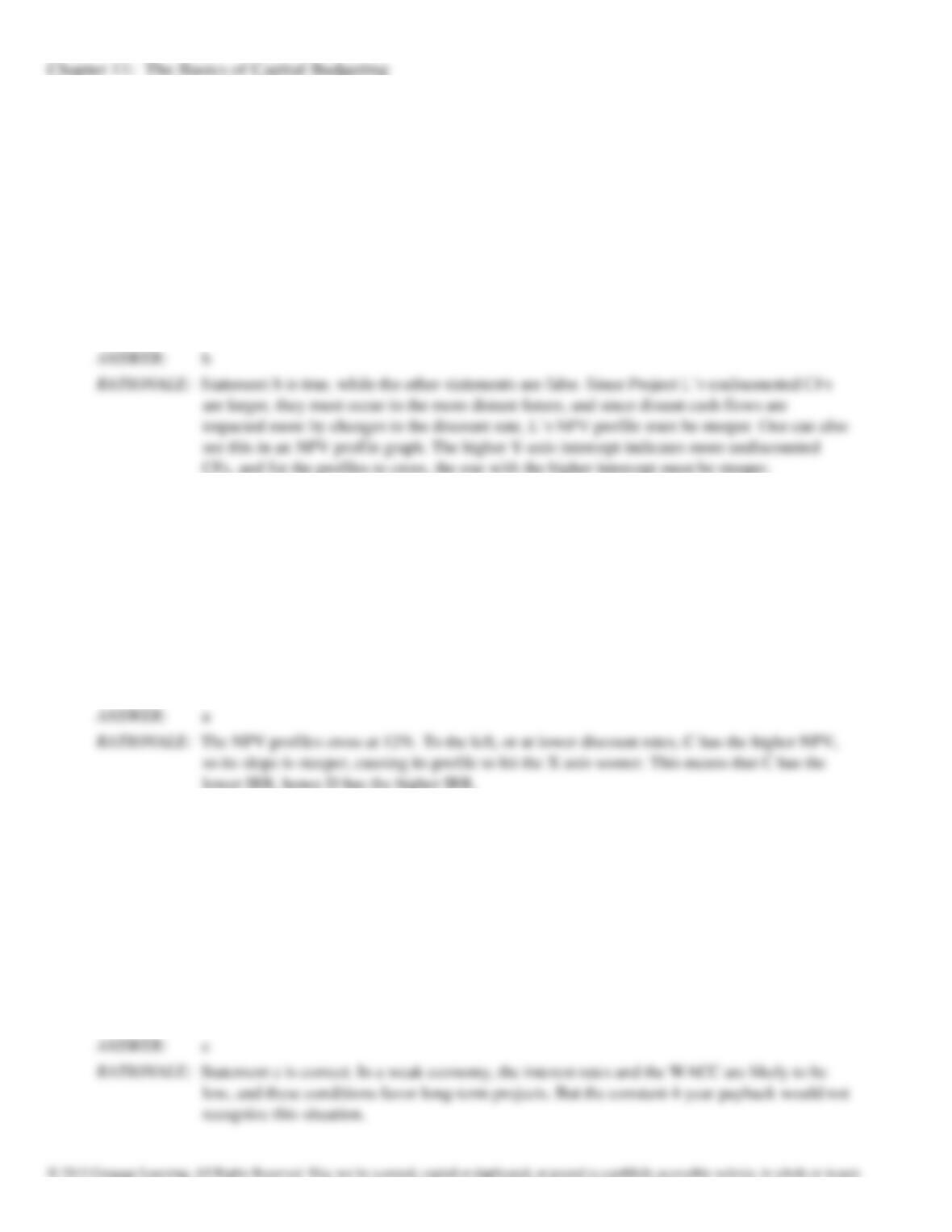
The two NPV profiles are given below:
Which of the following statements is CORRECT?
a.
More of Project A’s cash flows occur in the later years.
b.
More of Project B’s cash flows occur in the later years.
c.
We must have information on the cost of capital in order to determine which project has the larger early
cash
flows.
d.
The NPV profile graph is inconsistent with the statement made in the problem.
e.
The crossover rate, i.e., the rate at which Projects A and B have the same NPV, is greater than either
project’s IRR.
53.
Projects S and L both have an initial cost of $10,000, followed by a series of positive cash inflows. Project S’s
undiscounted net cash flows total $20,000, while L’s total undiscounted flows are $30,000. At a WACC of
10%, the
two projects have identical NPVs. Which project’s NPV is more sensitive to changes in the WACC?
a.
Project S.
b.
Project L.
c.
Both projects are equally sensitive to changes in the WACC since their NPVs are equal at all costs of
capital.
d.
Neither project is sensitive to changes in the discount rate, since both have NPV profiles that are horizontal.
e.
The solution cannot be determined because the problem gives us no information that can be used to
determine the projects’ relative IRRs.
54.
Projects C and D are mutually exclusive and have normal cash flows. Project C has a higher NPV if the
WACC is
less than 12%, whereas Project D has a higher NPV if the WACC exceeds 12%. Which of the
following
statements is CORRECT?
a.
Project D probably has a higher IRR.
b.
Project D is probably larger in scale than Project C.
c.
Project C probably has a faster payback.
d.
Project C probably has a higher IRR.
e.
The crossover rate between the two projects is below 12%.
55.
Suppose a firm relies exclusively on the payback method when making capital budgeting decisions, and it sets
a 4-year payback regardless of economic conditions. Other things held constant, which of the following
statements is
most likely to be true?
a.
It will accept too many short-term projects and reject too many long-term projects (as judged by the NPV).
b.
It will accept too many long-term projects and reject too many short-term projects (as judged by the NPV).
c.
The firm will accept too many projects in all economic states because a 4-year payback is too low.
d.
The firm will accept too few projects in all economic states because a 4-year payback is too high.
e.
If the 4-year payback results in accepting just the right set of projects under average economic conditions,
then this payback will result in too few long-term projects when the economy is weak.

56.
Four of the following statements are truly disadvantages of the regular payback method, but one is not a
disadvantage of this method. Which one is NOT a disadvantage of the payback method?
a.
Lacks an objective, market-determined benchmark for making decisions.
b.
Ignores cash flows beyond the payback period.
c.
Does not directly account for the time value of money.
d.
Does not provide any indication regarding a project’s liquidity or risk.
e.
Does not take account of differences in size among projects.
57.
Which of the following statements is CORRECT?
a.
If a project with normal cash flows has an IRR greater than the WACC, the project must also have a
positive NPV.
b.
If Project A’s IRR exceeds Project B’s, then A must have the higher NPV.
c.
A project’s MIRR can never exceed its IRR.
d.
If a project with normal cash flows has an IRR less than the WACC, the project must have a positive NPV.
e.
If the NPV is negative, the IRR must also be negative.
58.
Which of the following statements is CORRECT?
a.
The MIRR and NPV decision criteria can never conflict.
b.
The IRR method can never be subject to the multiple IRR problem, while the MIRR method can be.
c.
One reason some people prefer the MIRR to the regular IRR is that the MIRR is based on a generally more
reasonable reinvestment rate assumption.
d.
The higher the WACC, the shorter the discounted payback period.
e.
The MIRR method assumes that cash flows are reinvested at the crossover rate.
59.
Which of the following statements is CORRECT?
a.
The NPV, IRR, MIRR, and discounted payback (using a payback requirement of 3 years or less) methods
always lead to the same accept/reject decisions for independent projects.
b.
For mutually exclusive projects with normal cash flows, the NPV and MIRR methods can never conflict,
but
their results could conflict with the discounted payback and the regular IRR methods.
c.
Multiple IRRs can exist, but not multiple MIRRs. This is one reason some people favor the MIRR over the
regular IRR.
d.
If a firm uses the discounted payback method with a required payback of 4 years, then it will accept more
projects than if it used a regular payback of 4 years.
e.
The percentage difference between the MIRR and the IRR is equal to the project’s WACC.

60.
Which of the following statements is CORRECT?
a.
For a project with normal cash flows, any change in the WACC will change both the NPV and the IRR.
b.
To find the MIRR, we first compound cash flows at the regular IRR to find the TV, and then we discount
the TV at the WACC to find the PV.
c.
The NPV and IRR methods both assume that cash flows can be reinvested at the WACC. However, the
MIRR method assumes reinvestment at the MIRR itself.
d.
If two projects have the same cost, and if their NPV profiles cross in the upper right quadrant, then the
project with the higher IRR probably has more of its cash flows coming in the later years.
e.
If two projects have the same cost, and if their NPV profiles cross in the upper right quadrant, then the
project with the lower IRR probably has more of its cash flows coming in the later years.
61.
Which of the following statements is CORRECT?
a.
One advantage of the NPV over the IRR is that NPV takes account of cash flows over a project’s full life
whereas IRR does not.
b.
One advantage of the NPV over the IRR is that NPV assumes that cash flows will be reinvested at the
WACC, whereas IRR assumes that cash flows are reinvested at the IRR. The NPV assumption is generally
more appropriate.
c.
One advantage of the NPV over the MIRR method is that NPV takes account of cash flows over a
project’s
full life whereas MIRR does not.
d.
One advantage of the NPV over the MIRR method is that NPV discounts cash flows whereas the MIRR is
based on undiscounted cash flows.
e.
Since cash flows under the IRR and MIRR are both discounted at the same rate (the WACC), these two
methods always rank mutually exclusive projects in the same order.
62.
Which of the following statements is CORRECT?
a.
The IRR method appeals to some managers because it gives an estimate of the rate of return on projects
rather than a dollar amount, which the NPV method provides.
b.
The discounted payback method eliminates all of the problems associated with the payback method.
c.
When evaluating independent projects, the NPV and IRR methods often yield conflicting results regarding
a
project’s acceptability.
d.
To find the MIRR, we discount the TV at the IRR.
e.
A project’s NPV profile must intersect the X–axis at the project’s WACC.
63.
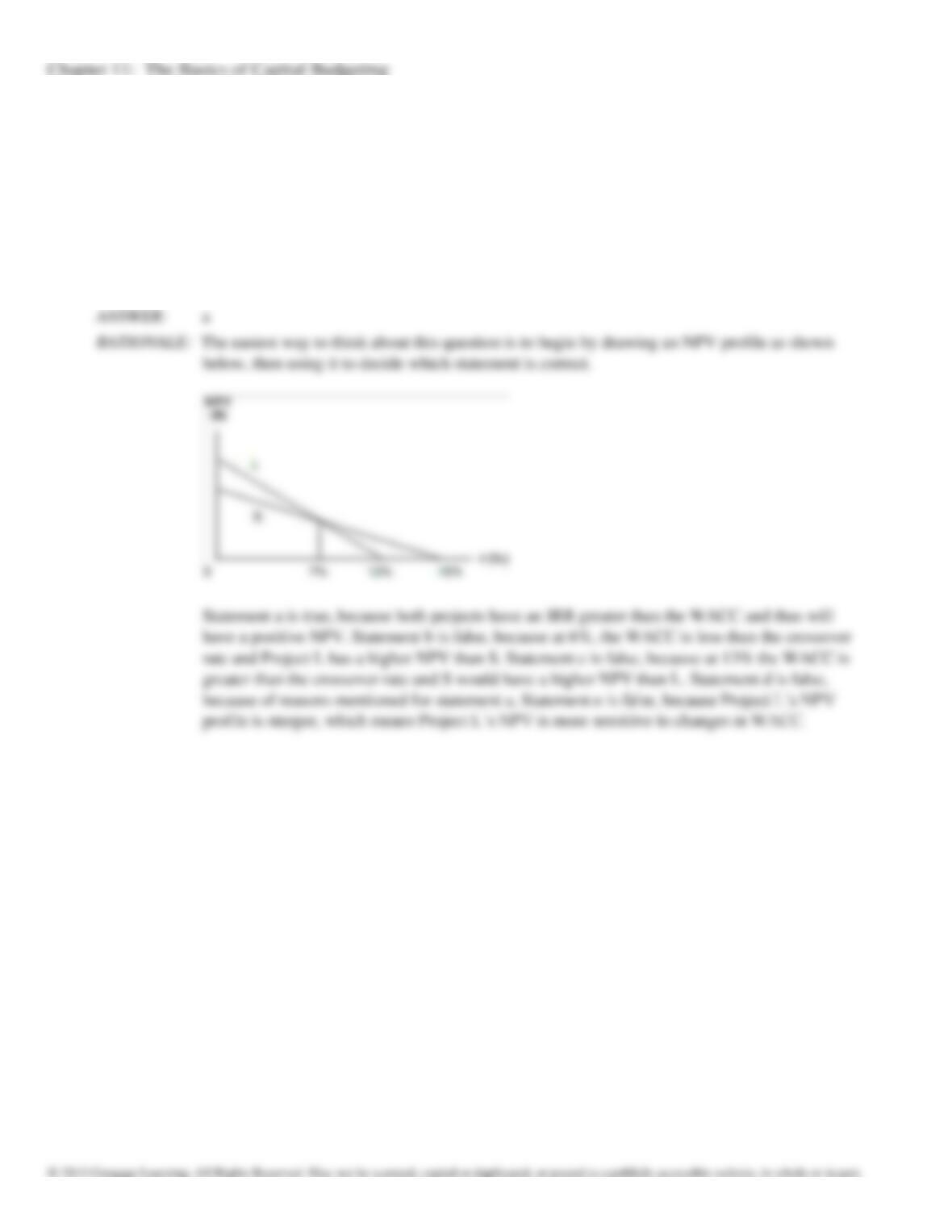
Projects S and L are equally risky, mutually exclusive, and have normal cash flows. Project S has an IRR of
15%,
while Project L’s IRR is 12%. The two projects have the same NPV when the WACC is 7%. Which of
the
following statements is CORRECT?
a.
If the WACC is 10%, both projects will have positive NPVs.
b.
If the WACC is 6%, Project S will have the higher NPV.
c.
If the WACC is 13%, Project S will have the lower NPV.
d.
If the WACC is 10%, both projects will have a negative NPV.
e.
Project S’s NPV is more sensitive to changes in WACC than Project L’s.
64.
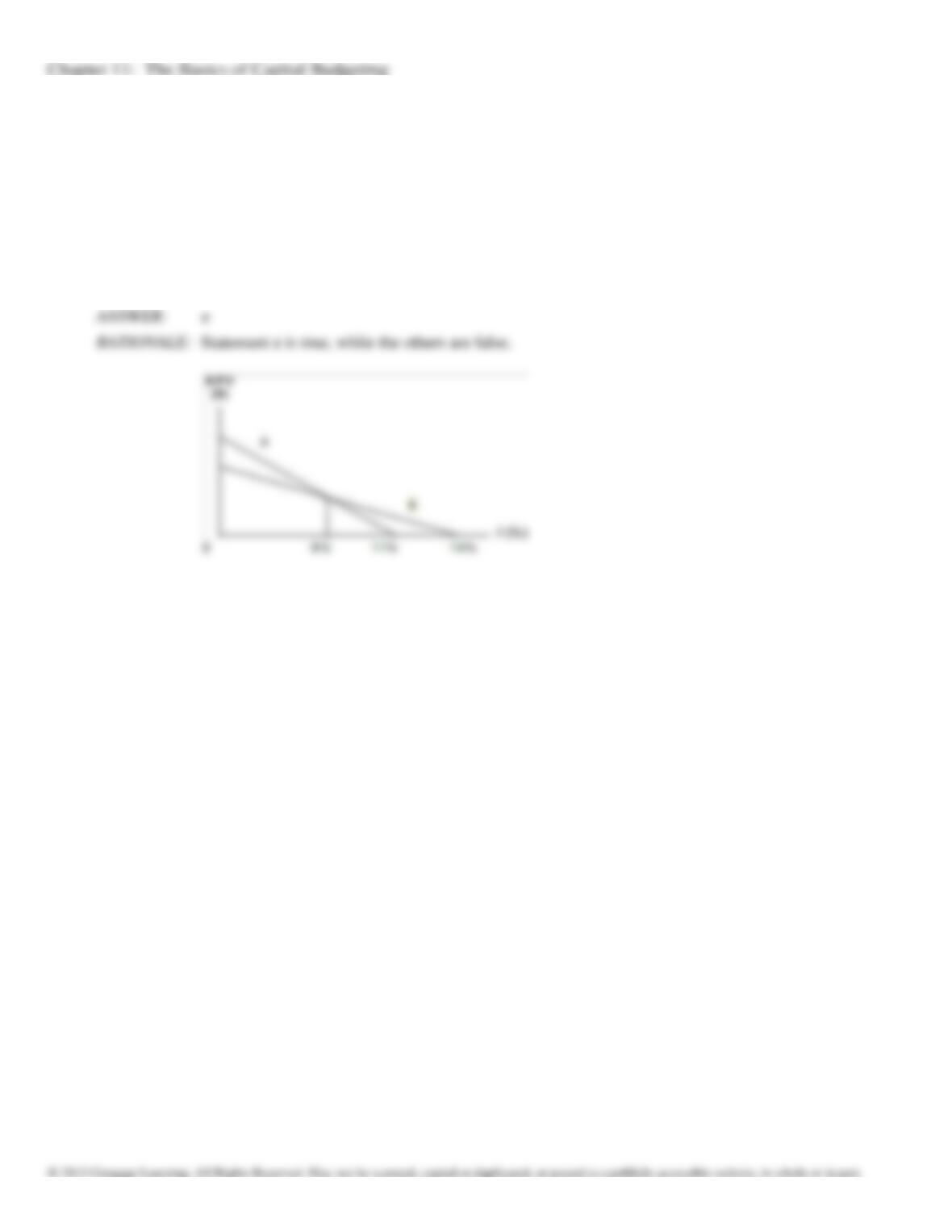
Westchester Corp. is considering two equally risky, mutually exclusive projects, both of which have normal
cash
flows. Project A has an IRR of 11%, while Project B’s IRR is 14%. When the WACC is 8%, the projects
have the
same NPV. Given this information, which of the following statements is CORRECT?
a.
If the WACC is 13%, Project A’s NPV will be higher than Project B’s.
b.
If the WACC is 9%, Project A’s NPV will be higher than Project B’s.
c.
If the WACC is 6%, Project B’s NPV will be higher than Project A’s.
d.
If the WACC is greater than 14%, Project A’s IRR will exceed Project B’s.
e.
If the WACC is 9%, Project B’s NPV will be higher than Project A’s.
65.
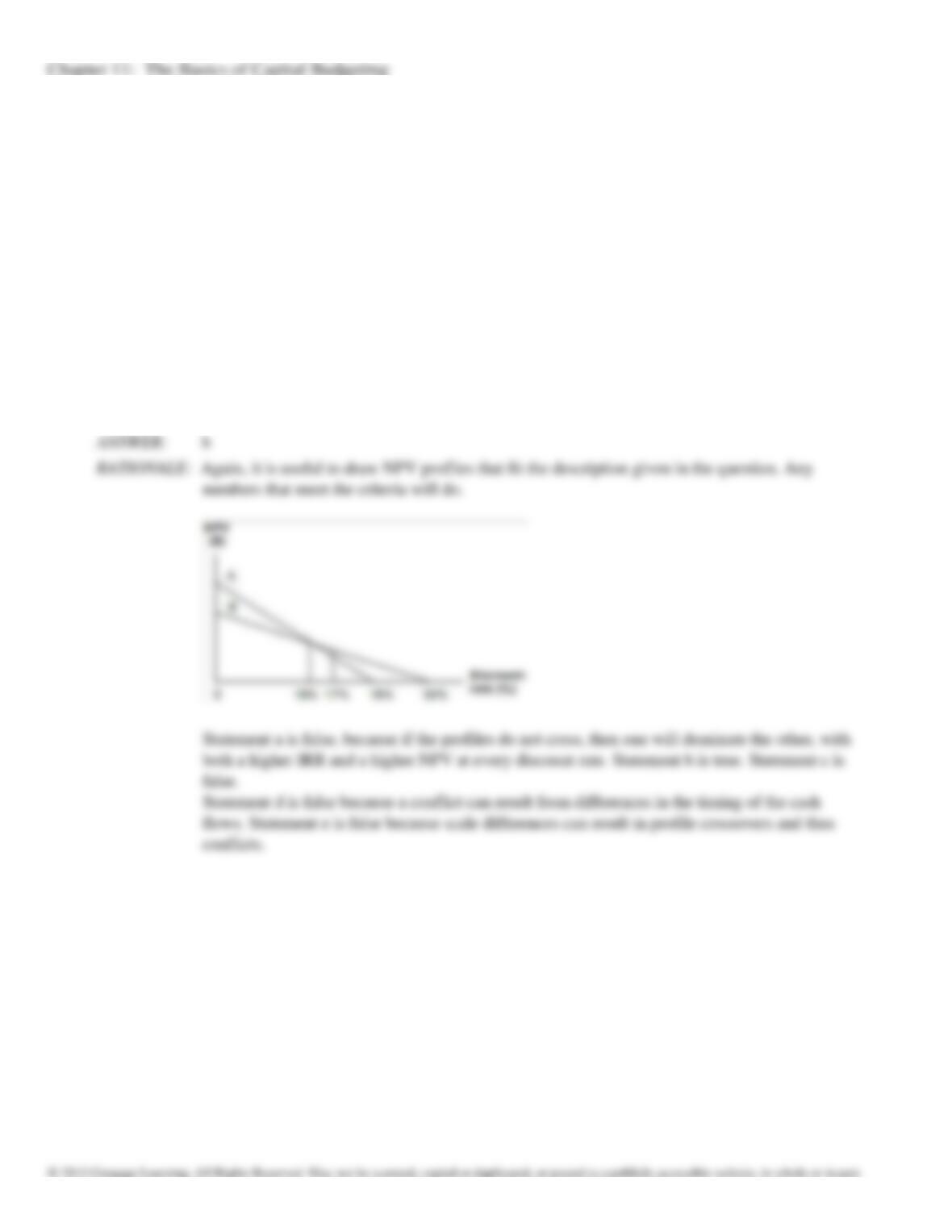
You are considering two mutually exclusive, equally risky, projects. Both have IRRs that exceed the WACC.
Which of the following statements is CORRECT? Assume that the projects have normal cash flows, with one
outflow followed by a series of inflows.
a.
If the two projects’ NPV profiles do not cross, then there will be a sharp conflict as to which one should be
selected.
b.
If the cost of capital is greater than the crossover rate, then the IRR and the NPV criteria will not result in a
conflict between the projects. One project will rank higher by both criteria.
c.
If the cost of capital is less than the crossover rate, then the IRR and the NPV criteria will not result in a
conflict between the projects. One project will rank higher by both criteria.
d.
For a conflict to exist between NPV and IRR, the initial investment cost of one project must exceed the cost
of the other.
e.
For a conflict to exist between NPV and IRR, one project must have an increasing stream of cash flows
over time while the other has a decreasing stream. If both sets of cash flows are increasing or decreasing,
then it would be impossible for a conflict to exist, even if one project is larger than the other.
66.
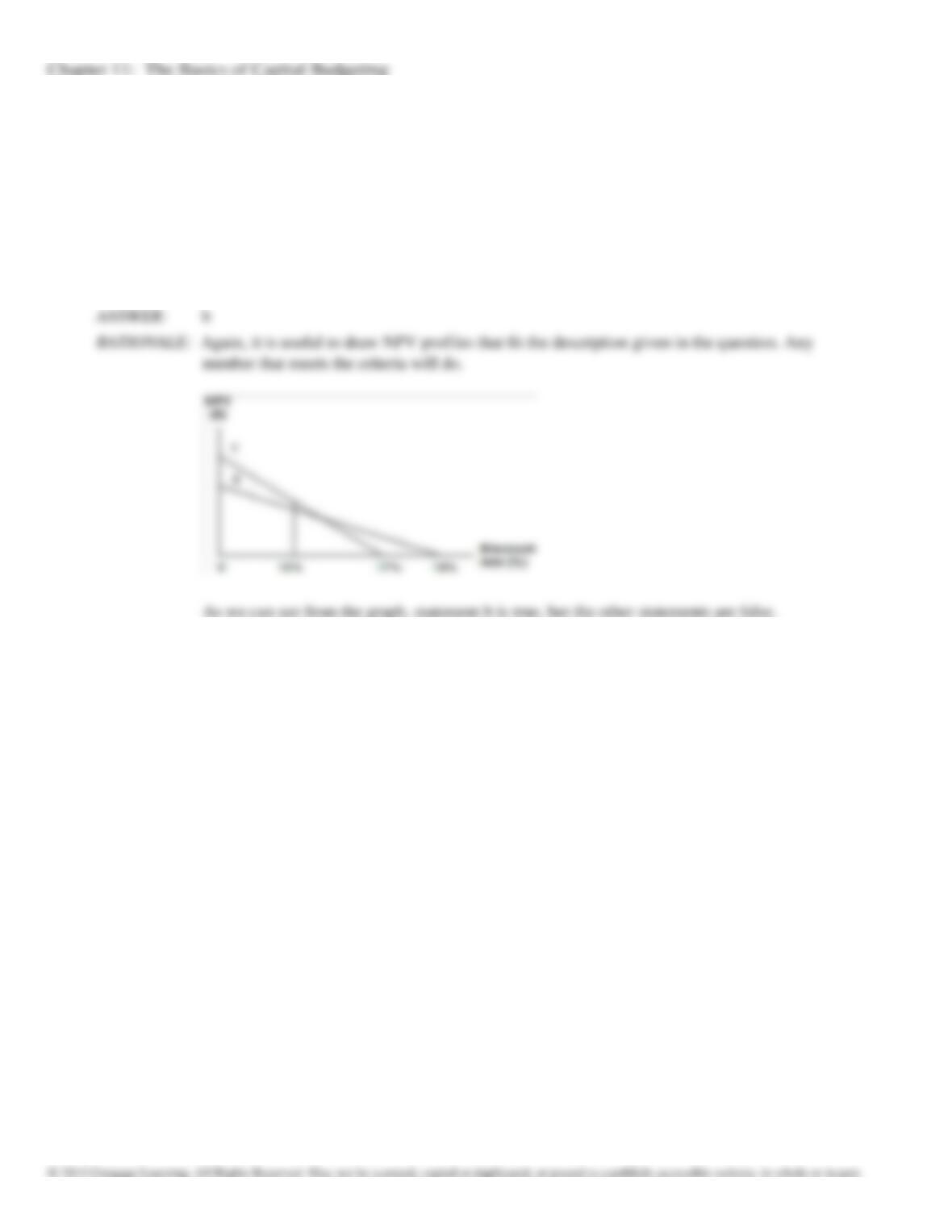
Project X’s IRR is 19% and Project Y’s IRR is 17%. The projects have the same risk and the same lives, and
each
has constant cash flows during each year of their lives. If the WACC is 10%, Project Y has a higher
NPV than X.
Given this information, which of the following statements is CORRECT?
a.
The crossover rate must be less than 10%.
b.
The crossover rate must be greater than 10%.
c.
If the WACC is 8%, Project X will have the higher NPV.
d.
If the WACC is 18%, Project Y will have the higher NPV.
e.
Project X is larger in the sense that it has the higher initial cost.