Chapter 11W – Technology, R&D, and Efficiency
1. Which term would be most closely associated with the idea of “new and better goods and
services and new and better ways of producing and distributing them”?
2. In analyzing a market, the time horizon where technology can change and firms can offer
new products is referred to as the:
Chapter 11W – Technology, R&D, and Efficiency
3. Technological advance is a three-step process of:
4. The discovery of a product or process through the use of imagination, ingenious thinking,
and experimentation is:
5. The first working prototype of a microcomputer chip would be an example of:
Chapter 11W – Technology, R&D, and Efficiency
6. A common way by which governments encourage invention is by providing the inventor
with a:
7. The worldwide duration of patents that begins at the time of application is:
8. Which of the following does not aptly describe innovation?
Chapter 11W – Technology, R&D, and Efficiency
9. The reason that innovation promotes competition is because:
10. The following are examples of innovative products, except:
11. What idea is best illustrated by the example of Alamo auto rentals offering unlimited
mileage to drivers and the practice being adopted by other auto rental firms?
Chapter 11W – Technology, R&D, and Efficiency
12. In 2007, which of the following nations ranked highest in total R&D expenditures as a
percent of GDP?
13. About what percentage of research and development spending by businesses in the United
States in 2008 went to development (innovation and imitation) and about what percentage
went to basic research and invention, respectively?
14. What activity receives the smallest amount from business spending on research and
development?
Chapter 11W – Technology, R&D, and Efficiency
15. What activity receives the largest amount from business spending on research and
development?
16. The modern view of technological advance is that it:
17. The traditional view of technological advance was that it:
Chapter 11W – Technology, R&D, and Efficiency
18. Entrepreneurs differ from other innovators because they:
19. Entrepreneurs and innovative firms with past successes in developing products:
20. Which would be an example of innovation within an existing business firm?
Chapter 11W – Technology, R&D, and Efficiency
21. Which of the following would be the best example of entrepreneurship?
22. Which of the following are aptly considered entrepreneurs?
23. Why is the percentage of business research and development spending for basic research
so small?
Chapter 11W – Technology, R&D, and Efficiency
24. Which of the following is not a start-up?
25. What is an example of a technological breakthrough that came out of a government or
university laboratory?
26. The following are examples of technological breakthroughs that came out of a
government or university laboratory, except:
Chapter 11W – Technology, R&D, and Efficiency
The question is based on the following table showing the expected rate of return, R&D
spending, and interest-rate cost-of-funds for a hypothetical firm.
27. Refer to the above data. In a graph for determining the optimal R&D expenditure, the
interest-cost of funds curve would be a(n):
28. Refer to the above data. The optimal amount of R&D expenditure of the firm would be:
Chapter 11W – Technology, R&D, and Efficiency
29. Refer the above data. If interest-rate cost-of-funds rose to 11 percent, the optimal amount
of R&D spending would be:
30. Refer the above data. If interest-rate cost-of-funds fell to 5 percent, the optimal amount of
R&D spending would be:
31. Refer to the above data. If the expected rate of return fell by 2 percentage points at each
level, the optimal amount of R&D spending would be:
Chapter 11W – Technology, R&D, and Efficiency
32. A firm’s marginal benefit from its R&D expenditures is the:
33. A firm decides to make a $20 million expenditure on research and development that will
create a new product. This product is expected to increase the firm’s revenues by a total of $24
million in the next year. The firm also estimates that the production cost of the new product
will be $22 million. What is the expected rate of return on this research and development
expenditure?
34. A firm decides to make a $20 million expenditure on research and development that will
create a new product. This product is expected to increase the firm’s revenues by a total of $24
million in the next year. The firm also estimates that the production cost of the new product
will be $22 million. If the firm has to take out a loan to finance the project, what is the highest
interest rate it will pay and still do the project among the choices given?
Chapter 11W – Technology, R&D, and Efficiency
11W–13
35. The expected-rate-of-return curve for R&D expenditures of a firm slopes downward
because of:
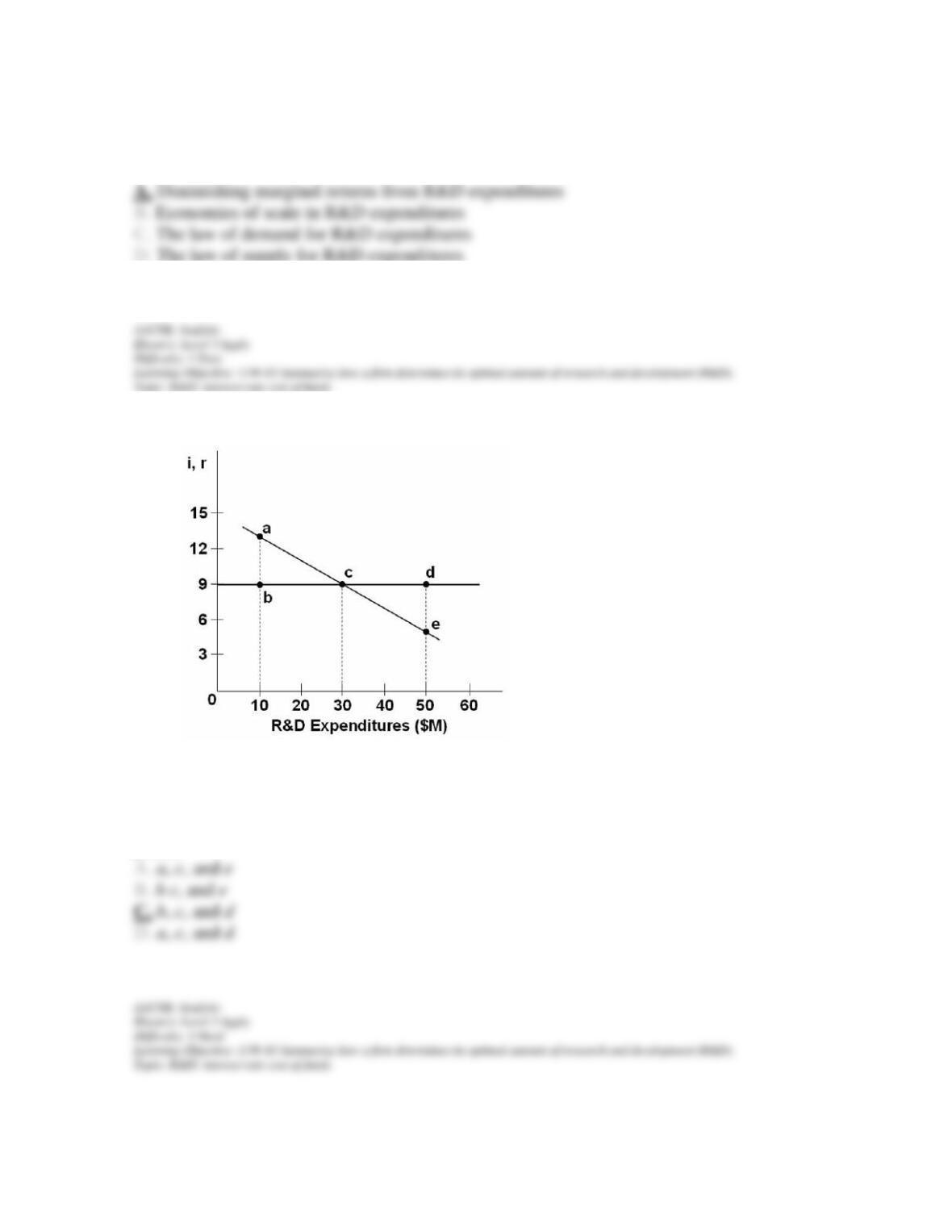
36. In the above graph, the interest-rate cost-of-funds curve would be the line connecting
points:
Chapter 11W – Technology, R&D, and Efficiency
37. In the above graph, the expected-rate-of-return curve would be the line connecting points:
38. In the above graph, the optimal amount of R&D spending and the interest-rate cost-of–
funds at that optimal level would be, respectively:
39. In the above graph, the difference between points a and b indicates that at that level of
R&D spending, the:
Chapter 11W – Technology, R&D, and Efficiency
40. In the above graph, the difference between points d and e indicate that at that level of
R&D spending, the:
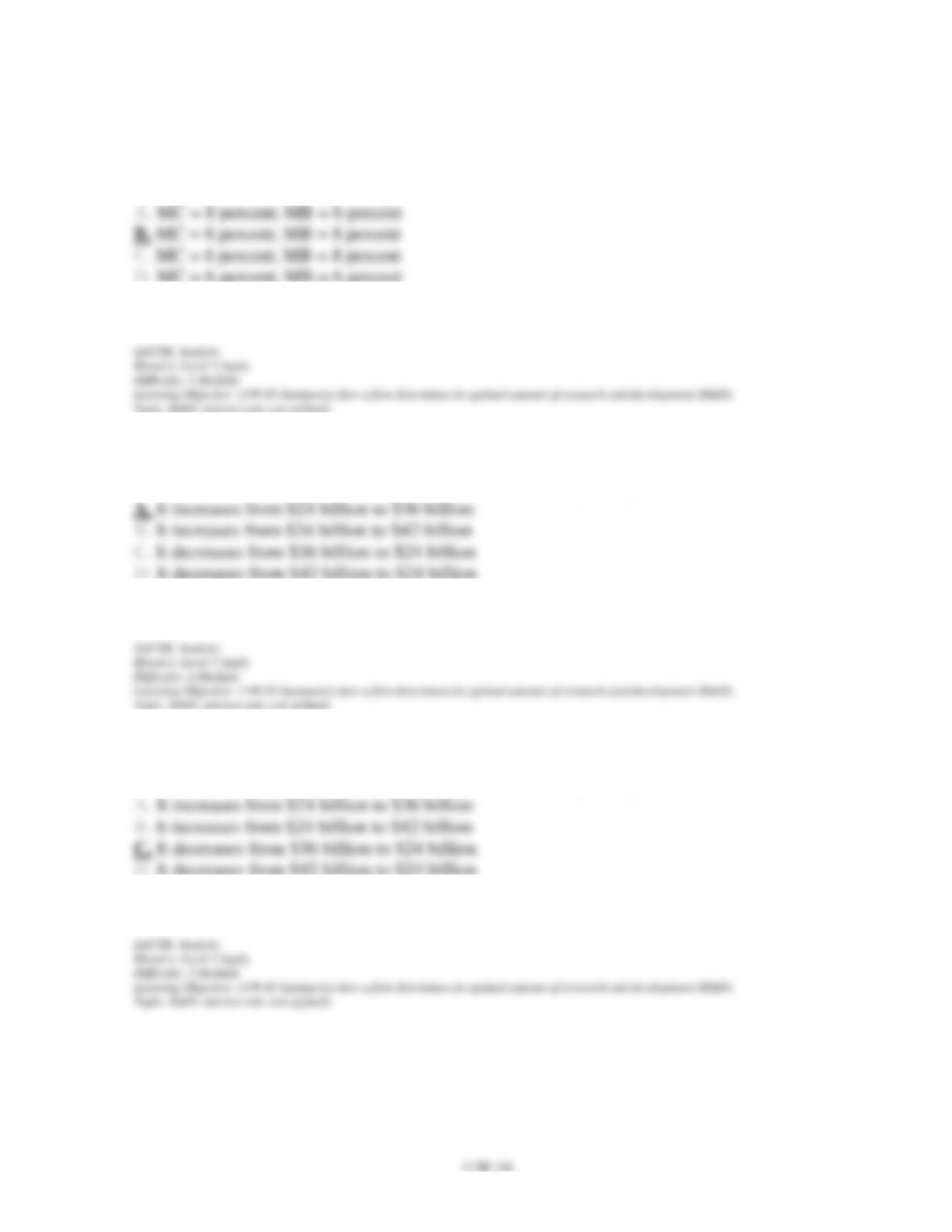
The table below shows the rate of return and R&D spending for a hypothetical firm
41. Refer to the above table. Assume the interest-rate cost of funds is 8 percent. What is the
optimal amount of R&D expenditures?
Chapter 11W – Technology, R&D, and Efficiency
42. Refer to the above table. Assume the interest-rate cost of funds is 8 percent. What will be
the marginal cost and the marginal benefit (expected rate of return) in percentage terms of this
optimal amount of R&D spending?
43. Refer to the above table. Assume the interest-rate cost of funds falls from 10 percent to 6
percent. What will happen to the optimal amount of R&D spending?
44. Refer to the above table. Assume the interest-rate cost of funds rises from 6 percent to 10
percent. What will happen to the optimal amount of R&D spending?
Chapter 11W – Technology, R&D, and Efficiency
45. An amount of R&D spending that is less than the optimal amount indicates that the:
46. An amount of R&D spending that is greater than the optimal amount indicates that the:
47. A firm should increase the amount of R&D expenditures to:
Chapter 11W – Technology, R&D, and Efficiency
48. The outcomes from R&D expenditures by a firm are:
49. The following can increase the profits of an innovating firm, except:
50. Consumers will make a decision to purchase a new product only if it:
Chapter 11W – Technology, R&D, and Efficiency
51. A consumer had been consuming product X for some time. This period, she buys fewer X
in order to try some units of a new product Y. She finds that her marginal utility of X is 20 (at
a price of $10 per unit), while the marginal utility of Y is 36 (at a price of $12). The utility–
maximizing rule suggests that this consumer should:
52. Assume that a consumer purchases a combination of products. Product A is an old and
reliable product. Product B is a new and appealing product. The MUa/Pa = 40 and MUb/Pb =
45. To maximize utility without spending more money, the consumer should:
53. Assume that a consumer purchases a combination of new product Y and old product Z and
that the MUy/Py = 50 and MUz/Pz = 50. To maximize utility without spending more money,
the consumer should:
Chapter 11W – Technology, R&D, and Efficiency
54. In choosing between an old reliable product versus a new attractive product, the consumer
will:
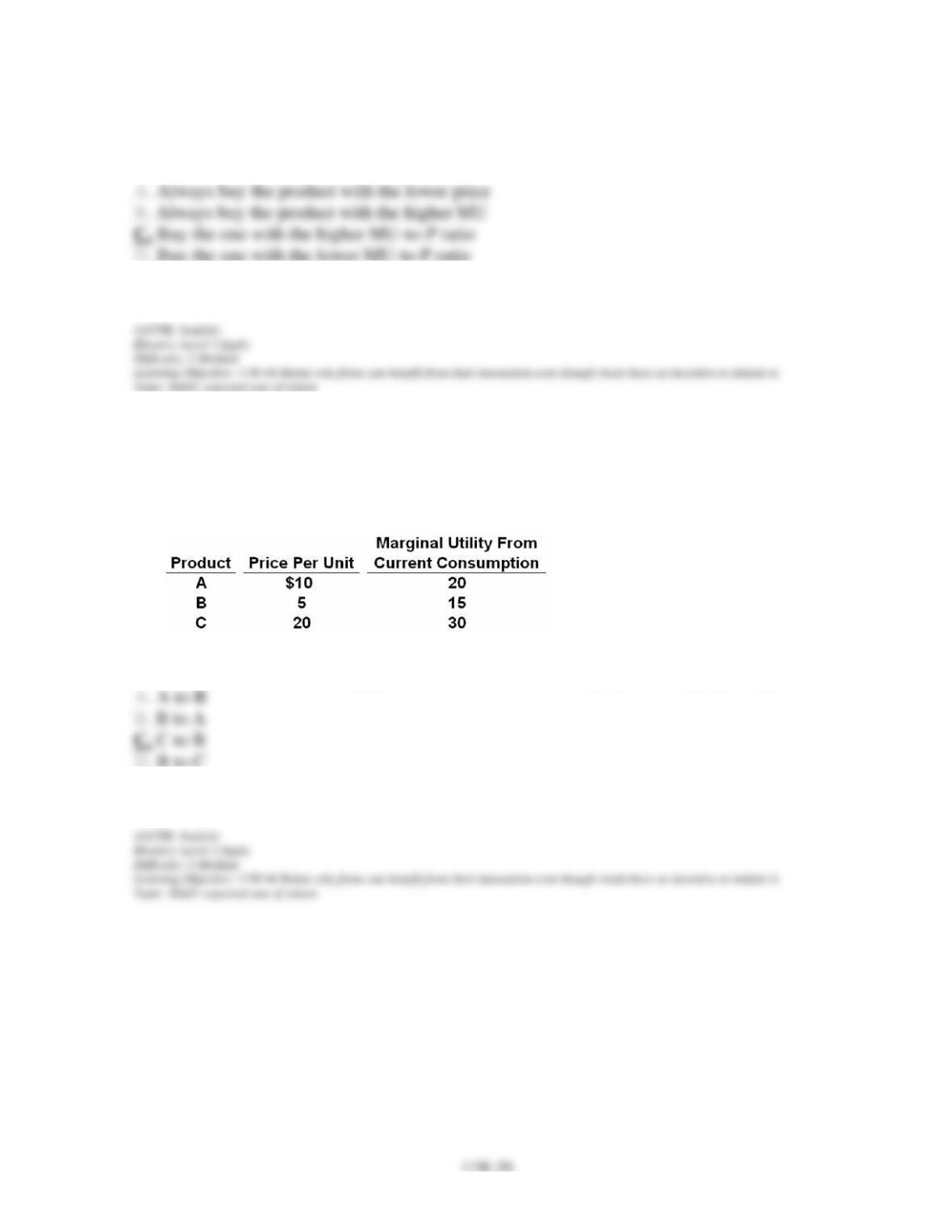
55. The following table shows the marginal utilities derived from current consumption levels
of three new products, A, B, and C, that are now being sold in the market at the prices listed
below.
The consumer can immediately gain the most extra total utility by switching spending from: