Chapter 11W – Technology, R&D, and Efficiency
1. Broadly defined, technological advance:
2. In economists’ models, technological advance occurs in:
Chapter 11W – Technology, R&D, and Efficiency
3. Technological advance is shown as a(n):
4. Technological advance is a three-step process involving:
5. The first discovery (as distinct from first commercial application) of a product or process is
called:
Chapter 11W – Technology, R&D, and Efficiency
6. The successful commercial introduction of a new product, the use of a new method, or the
creation of a new form of business enterprise is called:
7. The wide imitation and spread of an innovation is called:
8. The first commercial introduction of transparent tape is an example of:
Chapter 11W – Technology, R&D, and Efficiency
9. The first discovery of the water-soluble material used in contact lenses is an example of:
10. The spread of innovation through imitation refers to:
11. As pizza topped with barbecue chicken became popular at specialty restaurants, Pizza Hut
introduced a similar pizza. This imitation illustrates:
Chapter 11W – Technology, R&D, and Efficiency
12. Kodak introduced to the marketplace a digital camera which uses no film, but which takes
photos that can be shown on personal computers. This is an example of:
13. Suppose firm X implements a new method for extracting copper from copper-bearing ore.
This is an example of:
14. Which of the following is a true statement?
Chapter 11W – Technology, R&D, and Efficiency
15. Innovation:
16. In the United States, research and development spending as a percentage of GDP is:
17. Which of the following correctly orders, highest to lowest, the relative magnitudes of U.S.
spending by businesses on components of R&D?
Chapter 11W – Technology, R&D, and Efficiency
18. When economists view technological change as internal to the economy, they mean that
it:
19. U.S. firms collectively devote the largest portion of their total R&D spending to:
20. About ____ percent of business R&D spending is for basic research.
Chapter 11W – Technology, R&D, and Efficiency
21. The modern view of technological advance is that it:
22. Entrepreneurs:
23. Entrepreneurs:
Chapter 11W – Technology, R&D, and Efficiency
24. The major source of new scientific knowledge in the United States is:
25. New scientific knowledge mainly comes from university and government laboratories, not
private firms, because:
26. As it relates to the R&D decision, the interest-rate-cost-of-funds curve:
Chapter 11W – Technology, R&D, and Efficiency
27. Funds lent to startup firms in return for shares of the profit if the firms succeed are called:
28. In exchange for a share of ZYX’s profits if it succeeds, Firm ABC provides development
funds to newly formed ZYX which is developing an innovative product. ABC funds are called
____________ while ZYX is known as a ____________.
29. The retained earnings that corporations often use to finance R&D are also known as:
Chapter 11W – Technology, R&D, and Efficiency
30. A major source of funding of R&D in large, established corporations is:
31. The marginal benefit to a firm from its R&D expenditures is depicted by its:
32. As it relates to R&D, the expected-rate-of-return curve, r:
Chapter 11W – Technology, R&D, and Efficiency
33. Suppose a firm anticipates that a R&D expenditure of $100 million will result in a new
production process that will reduce costs and thus create a one-time added profit of $112
million a year later. The firm’s expected rate of return is:
34. As it relates to R&D, a firm’s expected-rate-of-return-curve, r:
35. The corporate decision on type and level of R&D activity is difficult because:
Chapter 11W – Technology, R&D, and Efficiency
36. A profit-maximizing firm should not undertake a R&D project for which the:
37. In deciding on an optimal amount and type of research and development, firms should
adhere to the rule: Expand R&D until:
38. Suppose a firm anticipates that a particular R&D expenditure of $100 million will result in
a new product and thus create a one-time added profit of $108 million a year later. The firm
will:
Chapter 11W – Technology, R&D, and Efficiency
39. Suppose a firm anticipates that a particular R&D expenditure of $20 million will result in
a new product and thus create a one-time added profit of $22 million a year later. The firm
will:
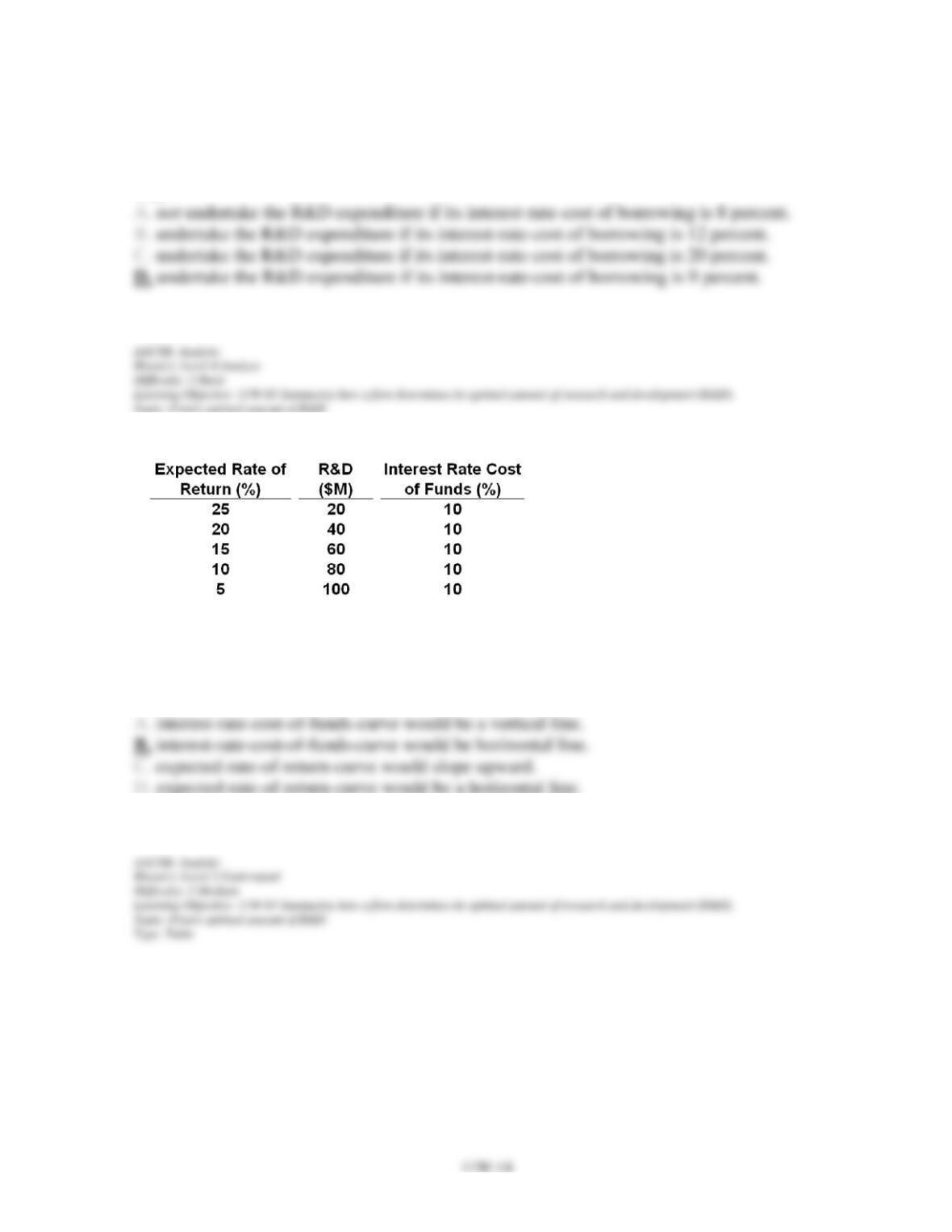
40. If we plotted the above data on a graph with R&D expenditures on the horizontal axis,
the:
Chapter 11W – Technology, R&D, and Efficiency
41. If we plotted the above data on a graph with R&D expenditures on the horizontal axis,
the:
42. Refer to the above data. The firm’s optimal amount of R&D spending is:
43. Refer to the above data. At $100 million of R&D expenditures, the:
Chapter 11W – Technology, R&D, and Efficiency
44. Refer to the above data. At $20 million of R&D expenditures, the:
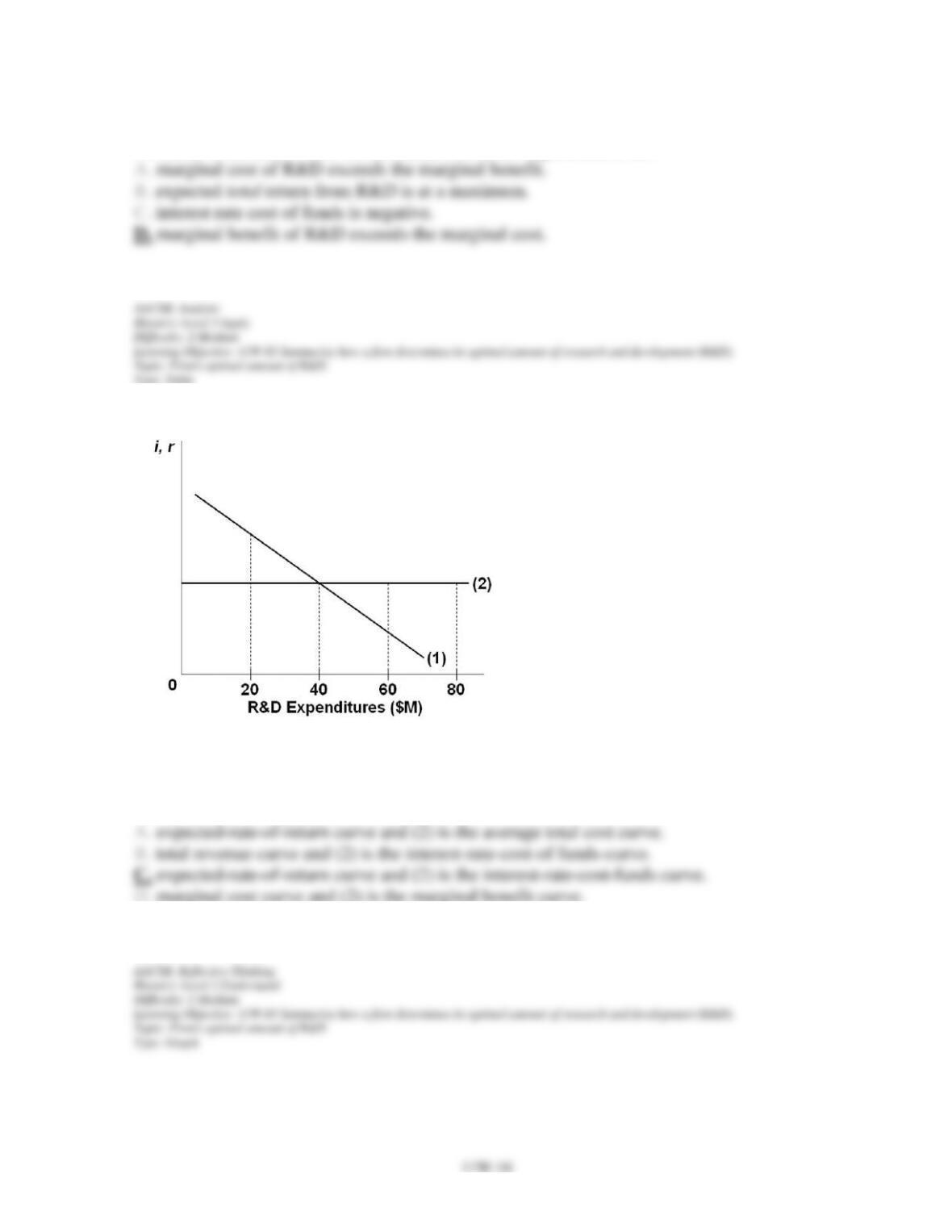
45. In the above diagram, (1) is the:
Chapter 11W – Technology, R&D, and Efficiency
46. In the above diagram, the optimal amount of R&D is:
47. In the above diagram, at $10 million of R&D expenditure the:
48. In the above diagram, at $60 million of R&D expenditure the:
Chapter 11W – Technology, R&D, and Efficiency
49. Assume that a firm’s interest-rate-cost of funds curve for R&D is perfectly elastic. Which
of the following would increase a firm’s optimal R&D expenditures and, in equilibrium,
reduce the expected rate of return on the last dollar of R&D?
50. Assume that a firm’s interest-rate-cost of funds curve for R&D is perfectly elastic. Which
of the following would decrease a firm’s optimal R&D expenditures and, in equilibrium,
increase the expected rate of return on the last dollar of R&D?
51. Assume that a firm’s interest-rate-cost of funds curve for R&D is perfectly elastic. Which
of the following would increase a firm’s optimal R&D expenditures and, in equilibrium, leave
the expected rate of return on the last dollar of R&D unchanged?
Chapter 11W – Technology, R&D, and Efficiency
11W–19
52. A consumer will buy a new product rather than an existing product:
53. We know with certainty that a consumer will buy a newly introduced product rather than
an existing product when the:
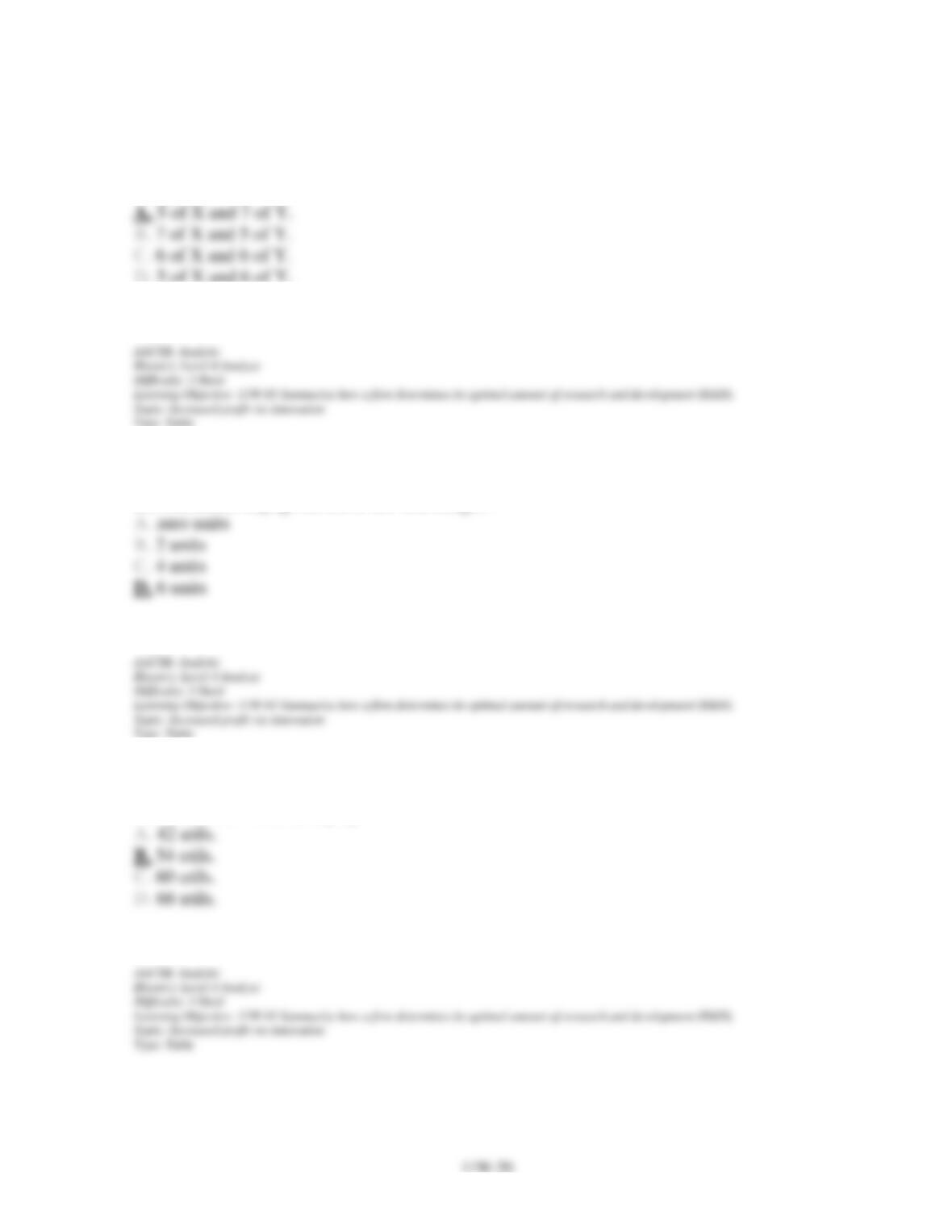
Consumer’s income = $12
Chapter 11W – Technology, R&D, and Efficiency
54. Refer to the above data for a utility-maximizing consumer. Assume that new product Z
doesn’t exist. How many units of X and Y will this consumer buy, given his or her $12
budget?
55. Refer to the above data. Assume new product Z is introduced. How many units of Z will
this consumer buy, given his or her $12 budget?
56. Refer to the above data. In equilibrium, the introduction of new product Z has increased
this consumer’s total utility by: