CHAPTER 11: Price Discrimination
MULTIPLE CHOICE
1. Price discrimination exists when a firm sells ________ goods at more than one price to ________
groups of customers.
a. different; similar d. identical; different
b. existing; distinct e. limited; restricted
c. discounted; large
2. Price discrimination exists when a firm is able to sell the same good at more than one price to
different groups of
a. producers. d. promoters.
b. firms. e. commodities.
c. consumers.
3. A firm can be identified as practicing price discrimination when
a. consumers engage in comparison shopping to find the lowest advertised price.
b. firms behave as price takers, whereas consumers react with price-making behavior.
c. buyers in a perfectly competitive market are able to influence the prices that firms set.
d. producers pass on differences in costs to those price-conscious consumers willing to buy in
bulk.
e. producers set different prices for distinct groups of consumers, despite selling identical
products to each group.
4. Which of the following best describes price discrimination?
a. charging different prices to different people and the prices are perceived as unfair and harmful
b. a firm selling the same good at more than one price to different groups of customers
c. when differences in cost are reflected by differences in price
d. commission of an act that is always illegal and not beneficial to buyers or sellers
e. a practice available only to competitive, price-taking firms
5. In 1996, Victoria’s Secret shipped different catalogs to customers based on their buying habits.
Frequent customers received catalogs with lower prices, whereas new customers received catalogs
with higher prices for those same items. Victoria’s Secret was practicing
a. monopolistic competition. d. efficient pricing.
b. reservation pricing. e. price discrimination.
c. price retention.
6. A price maker is a firm that
a. sets the prices that the market makes.
b. has a price that covers all of its costs.
c. sets prices that maximize consumer surplus.
d. sets prices equal to that of the market.
e. has some market power.
7. For a firm to be able to practice price discrimination, it must be a
a. price maker. d. price taker.
b. cost producer. e. profit maker.
c. price practitioner.
8. One reason that firms may be unable to utilize price discrimination as a viable strategy is because
a. it is always illegal to price discriminate.
b. firms are unwilling to maximize profits.
c. most consumers’ reservation prices are well publicized.
d. firms are unable to prevent resale of the product they offer for sale.
e. firms are unlikely to increase profits after paying for increased marketing costs.
9. Which of the following conditions is a requirement for price discrimination?
a. There is no reselling allowed in the market.
b. People have homogenous preferences.
c. Firms face different costs of production.
d. There are multiple firms in the market.
e. There is only one firm in the market.
10. Price discrimination allows firms to make more money by partitioning their customers into at least
two distinct groups, those who
a. the firm wants to retain as customers and those who will decide to buy elsewhere.
b. have a similar elasticity of demand and those who are unaware of their demand elasticity.
c. will get a discount and those who are willing to pay more.
d. differ from their usual customer type and those with characteristics common to their customer
base.
e. are willing to pay more and those who buy whenever they see the word ‘discount.’
11. Which of the following statements is true?
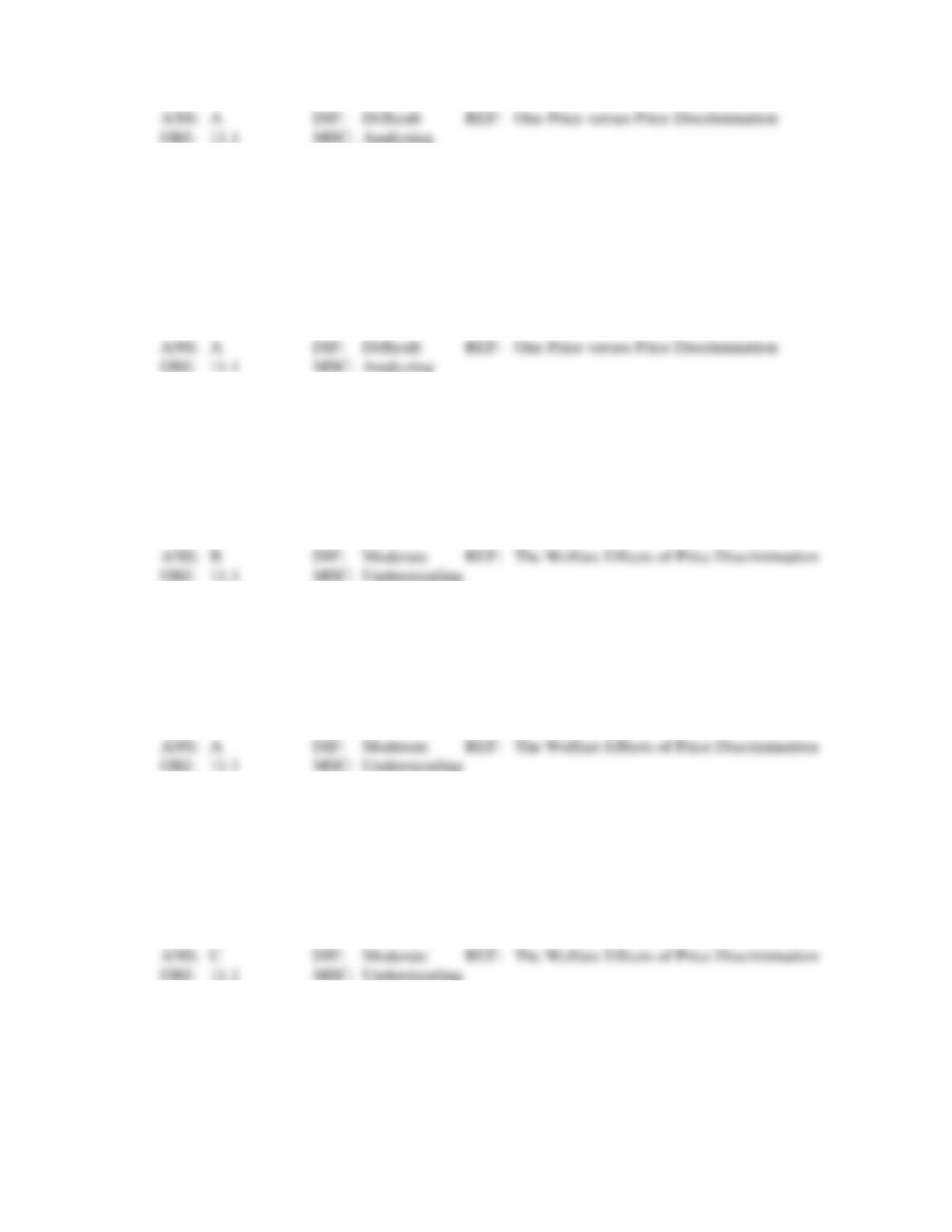
a. Firms that can identify two types of consumers can price discriminate perfectly.
b. Firms can price discriminate only if there is zero competition in the market.
c. Firms that price discriminate will not reach higher profits.
d. Firms that can prevent reselling may be able to engage in price discrimination.
e. Firms can usually price discriminate if they are in a perfectly competitive market.
12. A firm cannot price discriminate if it
a. operates in a competitive environment.
b. has a downward-sloping demand curve.
c. has a business that is regulated.
d. has perfect information about market demand.
e. can prevent resale of its product.
13. Airlines require every passenger with a ticket to have a matching, government-issued photo
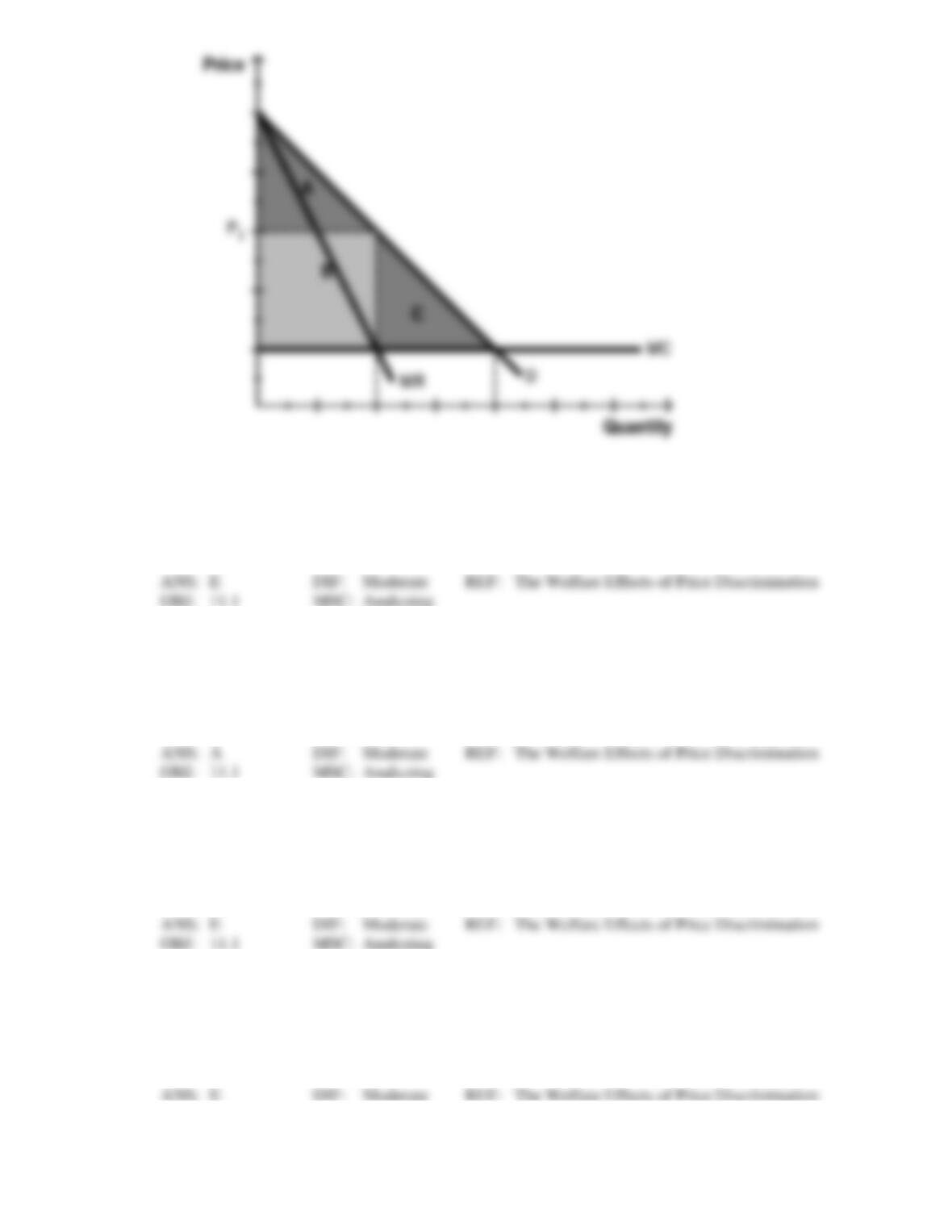
identification. Price discrimination is made easier because
a. this practice prevents a passenger who purchased a discounted fare from reselling that ticket to
another customer who is willing to pay more.
b. this practice allows airlines to determine the different personal characteristics of their buyers at
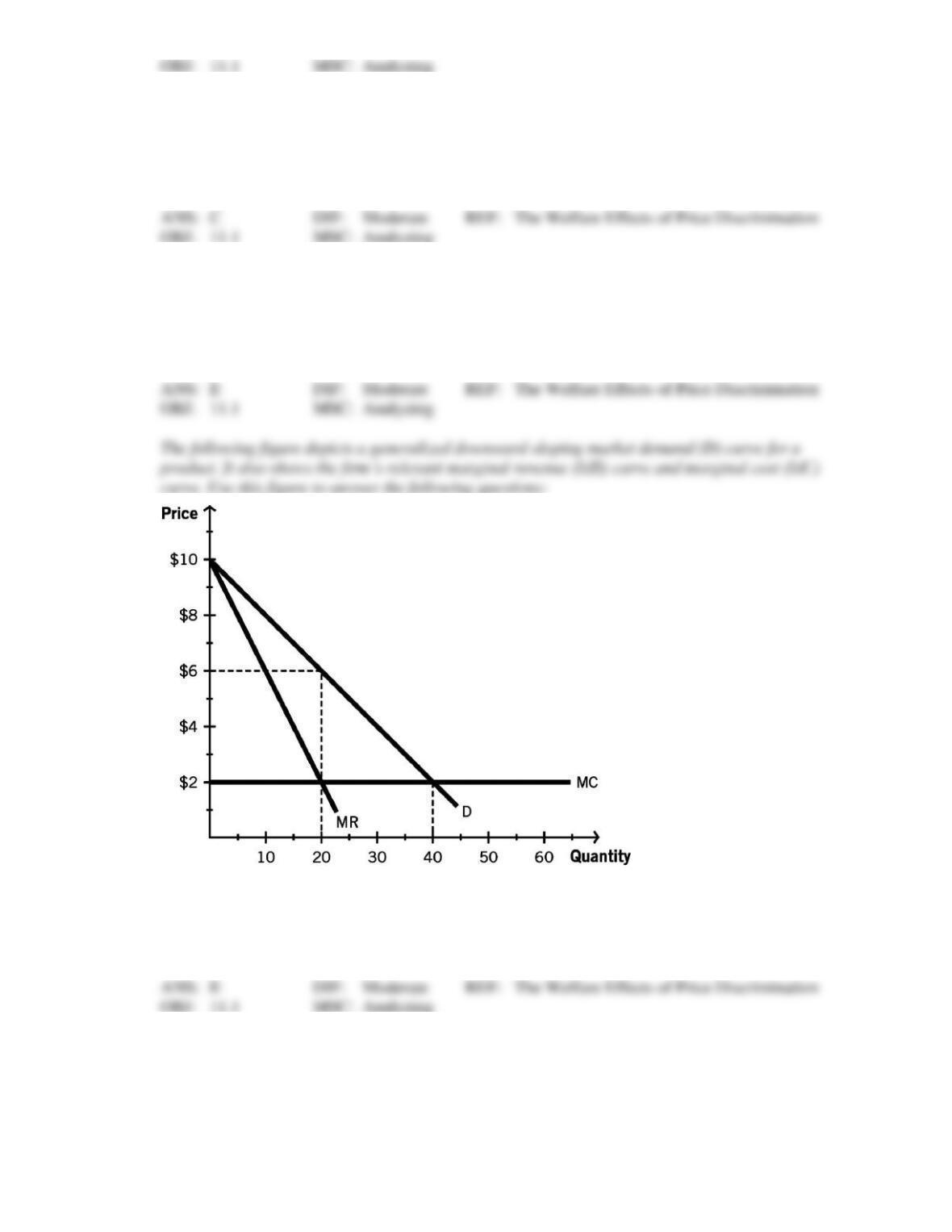
a zero cost.
c. this type of price discrimination is mandated and supported by the federal government.
d. customers acknowledge that they are exchanging higher ticket prices for decreased safety
regulations.
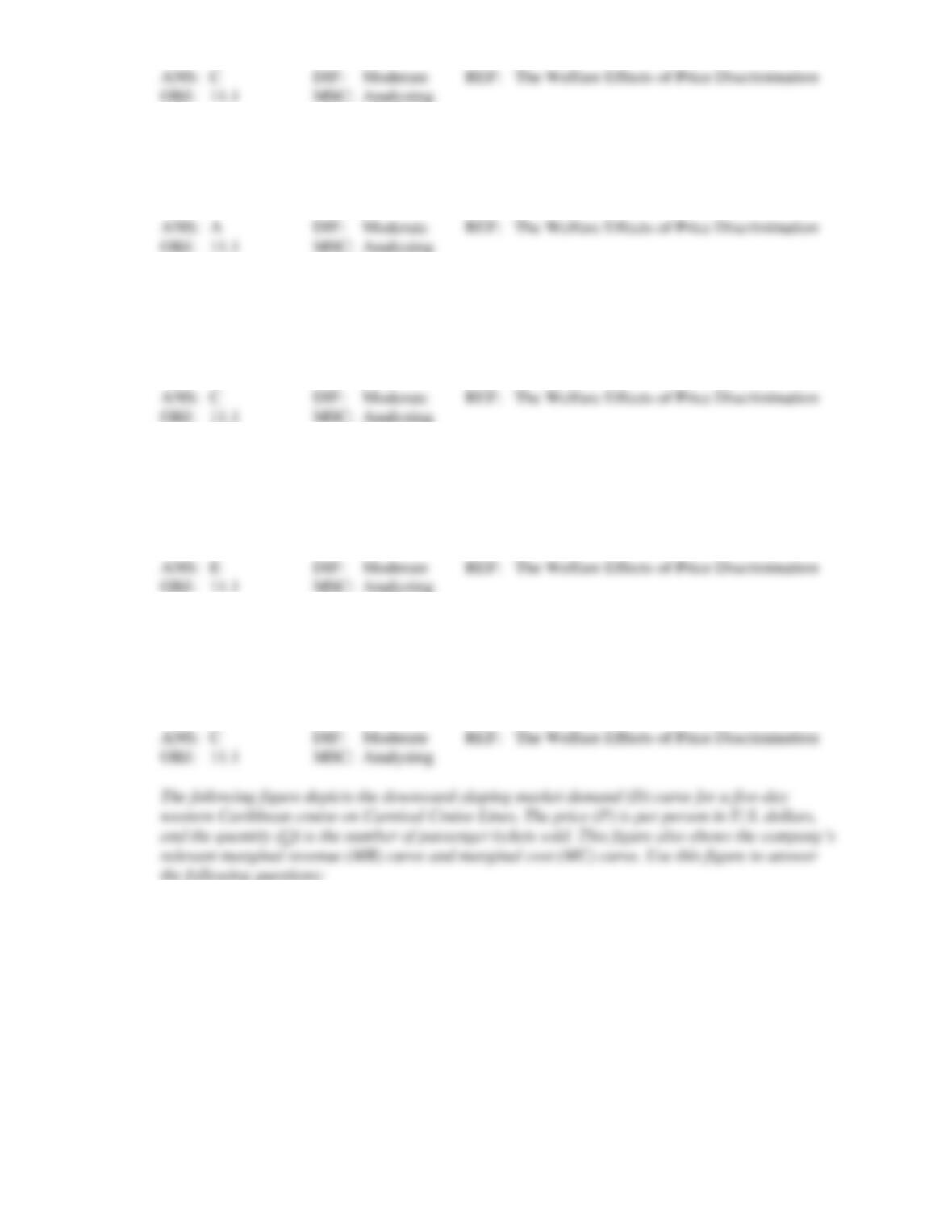
e. customers are then willing to divulge relevant information to the airline about their reservation
price.
14. If a firm is unable to distinguish which of its buyers has inelastic demand and which has a
relatively elastic demand, then the firm will be unable to price discriminate because it will
a. not know how much of the product to offer for sale.
b. not know enough about its customer base to prevent resale.
c. not know which price to charge which customer.
d. not know how many of its customers will buy the product when it is offered for sale.
e. be unable to predict how much of its sales will be retained as profit.
15. Which of the following is necessary for price discrimination to occur?
a. The firm must be able to produce the good at a low cost.
b. The firm needs to decrease profits.
c. The market allows for reselling goods.
d. Consumers’ preferences are hidden from the firm.
e. The firm is able to distinguish among groups of buyers easily.
16. Hotwire.com, an online travel company specializing in cheap and discounted hotel rates and
airfares, often asks customers if their travel dates are flexible when pricing potential bookings.
This practice helps Hotwire.com practice price discrimination by allowing it to
a. easily distinguish between different groups of buyers.
b. book reservations for customers who are most likely to travel before those who are less likely
to travel.
c. post higher prices initially and then lower the price based on room availability.
d. determine which customers are simply comparison shopping and which ones are ready to make
a purchase.
e. offer high prices to customers with flexible travel dates and low prices to those who are on a
fixed income.
17. The hotel attempts to distinguish between groups of buyers in order to
a. attract buyers who wish to practice conspicuous consumption.
b. assign prices based on the differing price elasticities of demand.
c. control the rising costs of hotel ownership.
d. appear to offer choices to the consumer.
e. deter last-minute reservations.
18. Why would the hotel require a guest to provide appropriate identification to receive the American
Association of Retired Persons (AARP) member rate, the military rate, or the government rate?
a. to prevent resale of discounted rooms to other buyers who are not eligible for the discounted
price
b. to honor those who serve in the military and offer support to the troops
c. to encourage active membership in AARP
d. to ensure that distinguished government guests are assigned the appropriate costs
e. to limit the number of patrons who receive each type of rate
19. Which price discrimination condition was satisfied by requiring students to show an ID card for an
initial ticket purchase?
a. The concert promoter was able to encourage the resale of the product or service to another
student.
b. The concert promoter was able to distinguish easily among groups of buyers with different
price elasticities of demand.
c. The concert promoter was able to prevent the resale of the product or service to another
consumer who is willing to pay more.
d. The concert promoter was able to distinguish easily among groups of sellers with different
price elasticities of supply.
e. The concert promoter was able to distinguish easily between true fans of the Band Perry and
those who just wanted to see a cheap concert.
20. Why would the Center for Student Involvement complicate the ticket-pricing scheme by using four
different ticket prices?
a. to see how many students will support an on-campus event
b. to keep the general public out of the rowdier student section on the concert floor
c. to separate the concert attendees into distinct groups so that they can maximize profit
d. to ensure that enough people attend the concert so that they minimize any potential loss
e. to gauge student interest in case the concert must be canceled and rescheduled to maximize
profit
21. In the past, the University of Georgia (UGA) sold enrolled students a pack of paper tickets that
granted them discounted access to all home football games. Recently, the university changed its
policy to the following: “Student tickets will be inscribed on your valid UGA ID. There will be no
physical tickets for home games.” This rule change was most likely implemented to
a. encourage greater student attendance at home football games and thus gain higher profits.
b. keep students from actively practicing price discrimination at sporting events.
c. prevent students from reselling their discounted tickets to other buyers who are willing to pay
full price for their tickets.
d. prevent ticket scalpers from being less willing to engage in price discrimination or other illegal
activities near college campuses.
e. promote the use of a technological advance in card inscribing in order to avoid the negative
externalities associated with the overprinting of paper materials.
22. Firms are most likely to engage in price discrimination if
a. the goods can be resold in the market without any loss in value or quality.
b. the goods can be resold in the market, but there is a large loss in the value or quality of the
product.
c. the goods cannot be resold in the market.
d. consumers all have a similar reservation price for the goods produced.
e. consumers of all ages have similar preferences for the goods produced.
23. Despite the gain from higher profits, firms are not always able to price discriminate because
a. they are unable to partition their customers into distinct groups.
b. it is always illegal to price discriminate in the United States.
c. they already hold a large degree of market power.
d. they already provide their goods at the lowest-possible prices.
e. they can easily determine each customer’s reservation price.
24. Price discrimination can help improve efficiency in the market because goods are sold to more
people, thus increasing profits. If all consumers have the same tastes, will a firm be able to price
discriminate?
a. yes, because the market is homogeneous
b. yes, as long as reselling is prohibited in the market
c. no, because the firm will not be able to distinguish among groups of consumers
d. no, because the similarities among consumers will lead to collusion among buyers
e. yes, because there will be a monopoly in the market (because all consumers want to purchase
the same goods and services)
25. An executive, a surfer, and a schoolteacher each decide to fly from Atlanta, Georgia, to Honolulu,
Hawaii. The schoolteacher can travel only during the months of June and July. The executive must
travel in May for a meeting with her overseas board of directors. The surfer can travel anytime
during the calendar year, but he faces a limited budget. The lowest airfare for each month is
summarized in the following table. Assuming that the airline faces a constant cost of production
each month for a flight, why is it beneficial for the airline to charge different prices each month?
January $804
February $804
March $843
April $843
May $1,052
June $943
July $949
August $829
September $804
October $804
November $829
December $829
a. The airline wants to attract more business executives as customers.
b. Because the airline is able to separate its customers into distinct groups—those who must
travel during the summer months and those who can travel any time of the year—it is able to price
discriminate and enjoy higher profits.
c. The airline wants to restrict the number of customers who fly on a limited budget because it
makes less profit on those ticket sales.
d. Many schoolteachers travel with their families, so airlines prefer to make ticket prices
reasonable for them.
e. Because surfers often travel with oversized luggage, airlines want to make ticket prices
attractive to these customers so that the airline can claim the extra baggage fees.
26. Internet service providers such as Comcast are able to price discriminate easily for many reasons.
Which of the following is a reason for them to price discriminate?
a. They offer better services than the competition.
b. They can easily identify new customers from old customers.
c. They let the customers choose from different packages based on income.
d. There are many competitors providing Internet services.
e. Some companies offer additional services such as cable and phone.
27. Firms engage in legal price discrimination if they
a. charge different prices for the same good based on tastes.
b. charge different prices for the same good based on race.
c. charge different prices for the same good based on the locational costs associated with
producing the good.
d. charge the same prices to all.
e. never reveal their pricing plan to ineligible customers.
28. The main reason firms cannot price discriminate under perfect competition is because
a. firms are price takers and cannot set prices for their goods.
b. firms cannot identify different kinds of consumers perfectly.
c. some goods are being resold in the market.
d. there is a lot of heterogeneity among consumers’ tastes.
e. all firms share the same production technology.
29. Price discrimination allows businesses to make additional profits and allows markets to work more
a. equitably. d. realistically.
b. efficiently. e. unfairly.
c. independently.
30. One benefit of price discrimination is that
a. firms are able to provide goods to consumers at a consistent price.
b. some consumers are able to buy the product at a lower price than would otherwise exist.
c. all consumers are able to gain monopsony power.
d. most firms minimize revenue.
e. it exists only in theory, not in the real world.
31. The producer, who can charge each customer according to his or her willingness to pay for a
product, can
a. minimize producer surplus by using price discrimination.
b. maximize consumer surplus by using perfect price prejudice.
c. minimize market efficiency by using two-tiered price discrimination.
d. maximize profits by using perfect price discrimination.
e. minimize loss by using perfect price determination.
32. For the consumer who might have to pay based on “where you live and who you are,” perfect price
discrimination may feel unfair because it results in a
a. decrease in total welfare. d. decrease in deadweight loss.
b. loss of consumer surplus. e. loss of market efficiency.
c. loss of producer surplus.
33. Firms engage in price discrimination primarily to
a. avoid a harmful activity. d. keep prices hidden.
b. retain monopoly power. e. make additional profits.
c. use customers efficiently.
34. A firm that is able to differentiate between each of its customers by selling the same good at a
unique price to each customer is practicing ________ discrimination.
a. reservation price d. idealized price
b. perfect price e. exclusive price
c. inelastic demand
35. Perfect price discrimination exists when a firm sells ________ good at a unique price to ________.
a. a complementary; each group of buyers
b. a similar; most of its customers
c. a substitute; different customers
d. a discounted; a few of its customers
e. the same; each customer
36. Perfect price discrimination occurs when a firm is able to
a. charge each buyer the highest price that he or she is willing to pay for the good.
b. identify at least two different groups of buyers.
c. determine the difference between a seller’s reservation price and the buyer’s reserve price.
d. prevent frequent reselling of its product.
e. determine the prices that should be charged to generate the largest amount of consumer
surplus.
37. Cart Vader is a new business venture aimed toward selling golf carts to be used as neighborhood
recreational vehicles. The new Cart Vader business owner is uncertain about what price to charge
for the golf carts. After consulting with multiple sources, the owner has decided to set a high
sticker price, but to allow potential buyers to negotiate down to their individual reservation price.
The business owner is attempting to practice
a. reservation price discrimination. d. perfect price discrimination.
b. perfect price maximization. e. consumer price preservation.
c. potential price segmentation.
38. In New York City’s Chinatown, tourists flock to shops to buy souvenirs from local retailers. Each
store sells similar items, but each salesperson tries to determine a customer’s reservation price
before reaching a deal. In this scenario, the salesperson is attempting
a. perfect price discrimination. d. to maximize buyer behavior.
b. to minimize producer loss. e. price-taking discrimination.
c. to minimize consumer loss.
39. Which of the following is a real-world example of an attempt at perfect price discrimination?
a. a restaurant’s blue plate special
b. a discount on preinstalled computer software
c. a car dealership selling an automobile
d. a college’s varying tuition rates, depending on state of residence
e. an advertisement for “buy one, get one free” pizza before 3:00 P.M.
40. Suppose two brothers own identical skydiving companies but have decided to experiment with
different pricing structures. The older brother’s company, Air Adventures, sets its prices using the
profit-maximizing rule, while the younger brother’s company, Sky Warriors, sets its prices using a
two-tiered, price-discrimination model. Assuming that both companies face the same market
demand curves, marginal costs, and costs of production, and wield significant market power for
their service area, which of the following is most likely to occur?
a. Air Adventures will generate a similar net revenue to Sky Warriors.
b. Sky Warriors will generate a higher net revenue than Air Adventures.
c. Sky Warriors will generate a lower net revenue than Air Adventures.
d. Air Adventures will generate a higher net revenue than Sky Warriors.
e. Sky Warriors will eventually switch to the Air Adventures model.
41. Another market that is well-known for this practice is the market for
a. airline tickets. d. economics textbooks.
b. secondary education. e. college dorm rooms.
c. online music.
42. When teams are able to change ticket prices minute to minute based on demand, they are
attempting to
a. discount tickets to their most loyal fans.
b. transfer surplus from consumers to producers.
c. prevent the resale of tickets through ticket reselling websites like StubHub.
d. confuse the fans of their rivals in order to gain a home-field advantage.
e. break down the technical and emotional barriers that exist between fans and team owners.
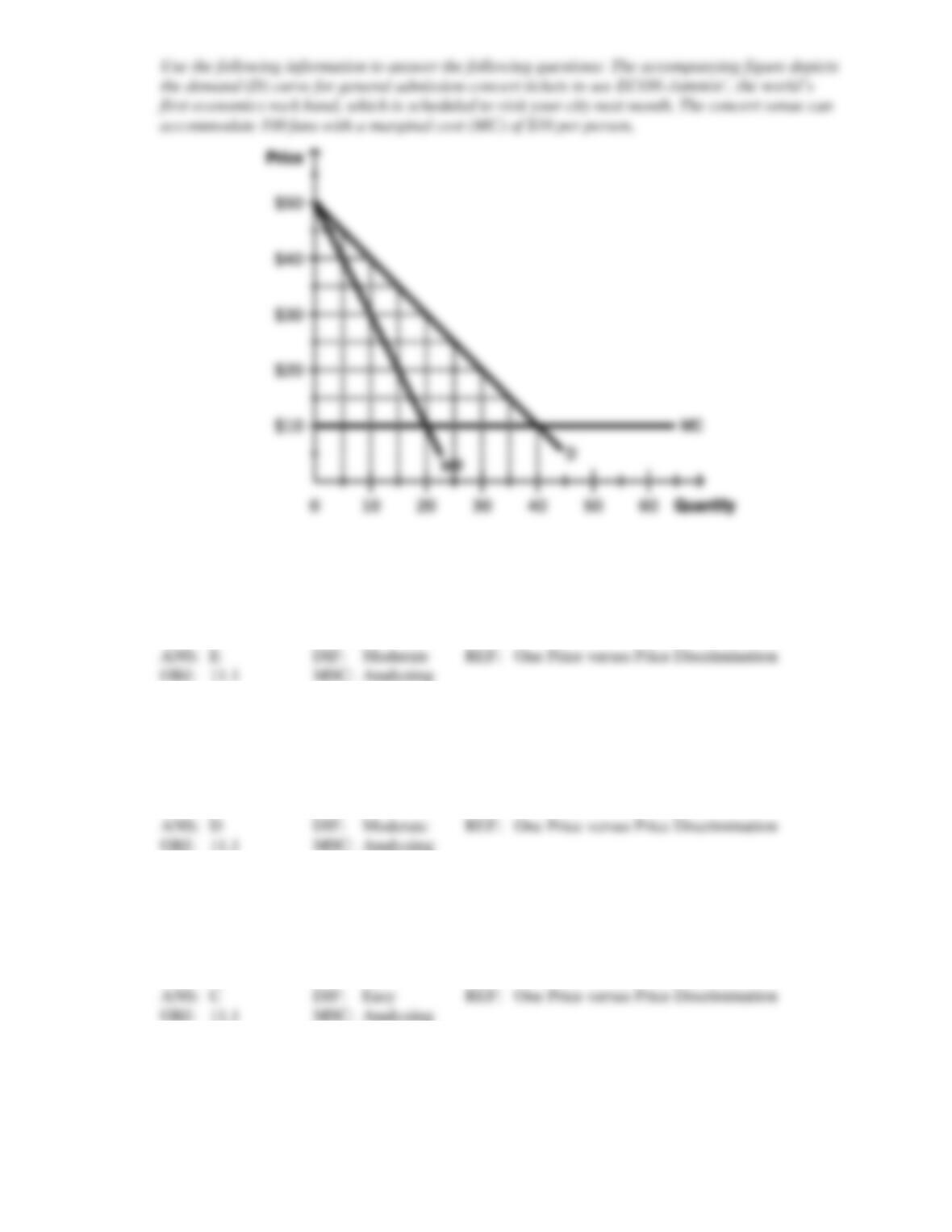
43. If ECON-Jammin’ charges a single price for its concert tickets and follows the profit-maximizing
rule for a monopoly, what will be the price that is charged per ticket?
a. $50 d. $35
b. $45 e. $30
c. $40
44. If ECON-Jammin’ charges a single price to see the band in concert and follows the
profit-maximizing rule for a monopoly, how many people will attend the concert?
a. 50 d. 20
b. 40 e. 10
c. 30
45. If ECON-Jammin’ charges a single price to see the band in concert and follows the
profit-maximizing rule for a monopoly, how much net revenue will be generated?
a. $1,600 d. $350
b. $600 e. $200
c. $400
46. ECON-Jammin’ has recently discovered that its fans are made up of two distinct groups that can be
easily distinguished. The band has decided to utilize its economic knowledge and offer a
high-priced ticket of $40 per person and a low-priced ticket of $20 per person. Based on this
information, what is the net revenue earned by the sales of the high-priced ticket?
a. $500 d. $200
b. $300 e. $150
c. $250
47. ECON-Jammin’ has recently discovered that its fans are made up of two distinct groups that can be
easily distinguished. The band has decided to utilize its economic knowledge and offer a
high-priced ticket of $40 per person and a low-priced ticket of $20 per person. Based on this
information, what is the profit earned by the sales of the low-priced ticket?
a. $200 d. $500
b. $300 e. $600
c. $400
48. ECON-Jammin’ has recently discovered that its fans are made up of two distinct groups that can be
easily distinguished. The band has decided to utilize its economic knowledge and offer a
high-priced ticket of $40 per person and a low-priced ticket of $20 per person. Based on this
information, what is the gain in net revenue from using price discrimination versus a single-price
model?
a. $200 d. $50
b. $150 e. $0
c. $100
49. What will be the amount of EJH Cinemas’ total revenue if the price is $7 per ticket?
a. $250,000 d. $140,000
b. $210,000 e. $105,000
c. $180,000
50. What is the amount of consumer surplus if the price is $7 per ticket?
a. $120,000 d. $40,000
b. $90,000 e. $0
c. $80,000
51. What will be the amount of EJH Cinemas’ total revenue if the price is $9 per ticket?
a. $250,000 d. $140,000
b. $210,000 e. $105,000
c. $180,000
52. What is the amount of consumer surplus if the price is $9 per ticket?
a. $120,000 d. $40,000
b. $90,000 e. $0
c. $80,000
53. If EJH Cinemas decides to practice price discrimination, charging $9 for a standard ticket available
to everyone, but only $7 for a ticket if you show your university identification (students, faculty,
and staff), what will be the movie theater’s total revenue?
a. $250,000 d. $170,000
b. $200,000 e. $150,000
c. $180,000
54. If EJH Cinemas decides to practice price discrimination, charging $9 for a standard ticket available
to everyone, but only $7 for a ticket if you show your university identification (students, faculty,
and staff), what will be the amount of consumer surplus?
a. $0 d. $20,000
b. $5,000 e. $25,000
c. $15,000
55. What will be the amount of the Varsity’s total revenue before the offer of a student discount when
the single price of $9 per combo meal goes into effect?
a. $90,000 d. $45,000
b. $85,000 e. $35,000
c. $60,000
56. What is the amount of total consumer surplus if the Varsity offers the combo meal at the single
price of $9 per meal?
a. $20,000 d. $5,000
b. $15,000 e. $0
c. $10,000
57. What will be the amount of total revenue for the Varsity if the owners offer a single price of $8 per
combo meal?
a. $90,000 d. $65,000
b. $85,000 e. $40,000
c. $80,000
58. What is the difference in the amount of total consumer surplus if the Varsity offers the combo meal
at the single price of $8 per combo meal instead of the previous single price of $9 per combo
meal?
a. no change d. $10,000 increase
b. $16,500 decrease e. $5,000 increase
c. $15,000 decrease
59. If the Varsity decides to practice price discrimination, what will be its total revenue if it charges
most customers $9 for a standard combo meal, but charges a reduced price of $8 for only those
customers who show their student identification cards?
a. $95,000 d. $80,000
b. $90,000 e. $75,000
c. $85,000
60. If the Varsity decides to practice price discrimination, what will be the amount of consumer
surplus if it charges most customers $9 for a standard combo meal, but charges a reduced price of
$8 for only those customers who show their student identification cards?
a. $0 d. $2,500
b. $500 e. $5,000
c. $1,000
61. Which of the following examples is the closest to perfect price discrimination?
a. nontransferable goods that are sold in an auction
b. Internet-access package deals for new and old customers
c. monthly versus daily bus tickets
d. daily deals in an electronics store
e. clubs offering waived cover charges for “ladies night”
62. Mirabella Creations is a custom jewelry company that specializes in unique, handmade, wearable
artwork. Each piece of jewelry offered for sale is made after an extensive customer consultation
that results in a one-of-a-kind piece of heirloom jewelry. To maximize profits, the firm owner
should charge
a. the same price to all customers.
b. the price that the market will bear.
c. a price that will cover the firm’s fixed costs.
d. a price that is close to each customer’s willingness to pay.
e. a price that is competitive with mass-market jewelers available in their service area.
63. Liza is the only provider of bottled water for three cities. Because she has access to a natural
spring, the marginal cost to produce an additional bottle is $0. How many bottles of water would
Liza need to produce to maximize her profits and at what price would she sell it?
a. 111 bottles at $11 each d. 88 bottles at $12 each
b. 10 bottles at $10 each e. 115 bottles at $7 each
c. 115 bottles at $7 each
64. Kenneth is the only provider of bottled water for three cities. Because he has access to a natural
spring, the marginal cost to produce an additional bottle is $0. If he could price discriminate by
charging a different price in each city, how many more people would have access to bottled water
compared to when he charges only one price for all three cities?
a. one more person d. four more people
b. two more people e. exactly the same number of people
c. three more people
65. Isabelle is the only provider of bottled water for three cities. Because she has access to a natural
spring, the marginal cost to produce an additional bottle is $0. As she knows, firms discriminate to
improve profits. How much would her firm earn in additional profit if she practiced price
discrimination across cities, charging a different price in each city versus charging everyone a
single price?
a. $9 d. $30
b. $10 e. $5
c. $20
66. Kaleb is the only provider of bottled water for three cities. Because he has access to a natural
spring, the marginal cost to produce an additional bottle is $0. Imagine he could price discriminate
perfectly in this market. How much more profit would his firm earn if he practiced perfect price
discrimination instead of practicing imperfect price discrimination (charging different prices in
each city)?
a. $55 d. $20
b. $30 e. $10
c. $25
67. Perfect price discrimination transfers the gains from trade from ________, but it also creates
maximum efficiency.
a. firms to buyers
b. consumers to producers
c. corporations to sole proprietorships
d. producers to consumers
e. monopolies to profit-maximizing firms
68. For the companies that are able to engage in price discrimination, the practice
a. is profitable.
b. increases the welfare of consumers.
c. is sometimes inefficient for the market.
d. is difficult to maintain over the long run.
e. decreases the welfare of producers.
69. The reason economists use the term “perfect” for firms that are able to charge each customer a
price exactly equal to the price the customer is willing to pay is because it
a. is a perfect example of capitalism.
b. always works perfectly, just like the theoretical model.
c. describes a market outcome that produces no deadweight loss.
d. charges each customer his or her own perfect price.
e. works perfectly to benefit the producers selling the product.
70. Suppose the market for golf clubs has moved from a perfectly competitive market to one that is
completely dominated by firms practicing perfect price discrimination. Which of the following
statements is true about the change in welfare?
a. The change creates a deadweight loss.
b. Society’s total welfare is zero after the change.
c. There is a decrease in deadweight loss accompanied by a decrease in producer surplus.
d. Some surplus has been lost to society, but consumers are better-off overall.
e. All of the surplus previously enjoyed by consumers has been shifted to producers.
71. When a market model moves from that of a monopoly to one in which perfect price discrimination
is practiced, the deadweight loss
a. increases.
b. remains unchanged.
c. can increase or decrease depending on the type of loss.
d. decreases.
e. fluctuates.
72. Despite creating maximum market efficiency, perfect price discrimination is often disliked by
consumers because it transfers the gains in trade from
a. consumers to producers. d. buyers to consumers.
b. producers to consumers. e. firms to buyers.
c. firms to producers.
73. One of the benefits of perfect price discrimination over a monopoly is that it can increase
a. marginal welfare. d. cost of production.
b. total welfare. e. marginal cost.
c. average welfare.
74. In 1996, Victoria’s Secret shipped different catalogs to customers based on their buying habits.
Frequent customers received catalogs with lower prices, whereas new customers received catalogs
with higher prices for those same items. What is the firm’s motivation for practicing price
discrimination, despite knowing that if its customers found out, the company could potentially
experience a loss in sales?
a. Price discrimination increases profit.
b. Reservation pricing decreases cost.
c. Price determination offsets risk.
d. Efficient pricing clears the market.
e. Price discrimination decreases deadweight loss.
75. For a perfectly competitive market, which of the following areas would be designated as consumer
surplus?
a. A d. A + B
b. B e. A + B + C
c. C
76. For a monopoly that charges a single price of P1, which of the following areas would be designated
as consumer surplus?
a. A d. A + B
b. B e. There is no consumer surplus.
c. C
77. If the firm can price discriminate perfectly, which of the following areas would be designated as
consumer surplus?
a. A d. A + B
b. B e. There is no consumer surplus.
c. C
78. For a perfectly competitive market, which of the following areas would be designated as
deadweight loss?
a. A d. A + B
b. B e. There is no deadweight loss.
c. C
79. For a monopoly that charges a single price of P1, which of the following areas would be designated
as deadweight loss?
a. A d. A + B
b. B e. There is no deadweight loss.
c. C
80. If the firm can perfectly price discriminate, which of the following areas would be designated as
deadweight loss?
a. A d. A + B
b. B e. There is no deadweight loss.
c. C
81. For a perfectly competitive market, what would the producer surplus be?
a. $160 d. $40
b. $120 e. $0
c. $80
82. For a monopoly that charges a single price of $6, what would the producer surplus be?
a. $160 d. $40
b. $120 e. $0
c. $80
83. If the firm can price discriminate perfectly, what would the producer surplus be?
a. $160 d. $40
b. $120 e. $0
c. $80
84. If the firm moves from a perfect competition model to a monopolist model that charges a single
price of $6, there would be ________ in total welfare.
a. a loss of $160 d. a gain of $120
b. a gain of $80 e. no change
c. a loss of $40
85. If the firm moves from a perfect price-discrimination model to a perfect competition framework,
there would be ________ in total welfare.
a. a loss of $160 d. a gain of $120
b. a gain of $80 e. no change
c. a loss of $40
86. If the firm moves from a monopolist model that charges a single price to a perfect competition
model, there would be ________ in total welfare.
a. a loss of $160 d. a gain of $120
b. a loss of $80 e. no change
c. a gain of $40