Chapter 10 – Pure Monopoly
148. Assume the above figure applies to a pure monopolist, and that MC is the same for both
graphs. If this firm is able to price discriminate between children and adults, its profit-
maximizing level of output will be:
149. Assume the above figure applies to a pure monopolist, and that MC is the same for both
graphs. If this firm is able to price discriminate between children and adults, its economic
profit will be:
150. Other things equal, a price discriminating monopolist will:
Chapter 10 – Pure Monopoly
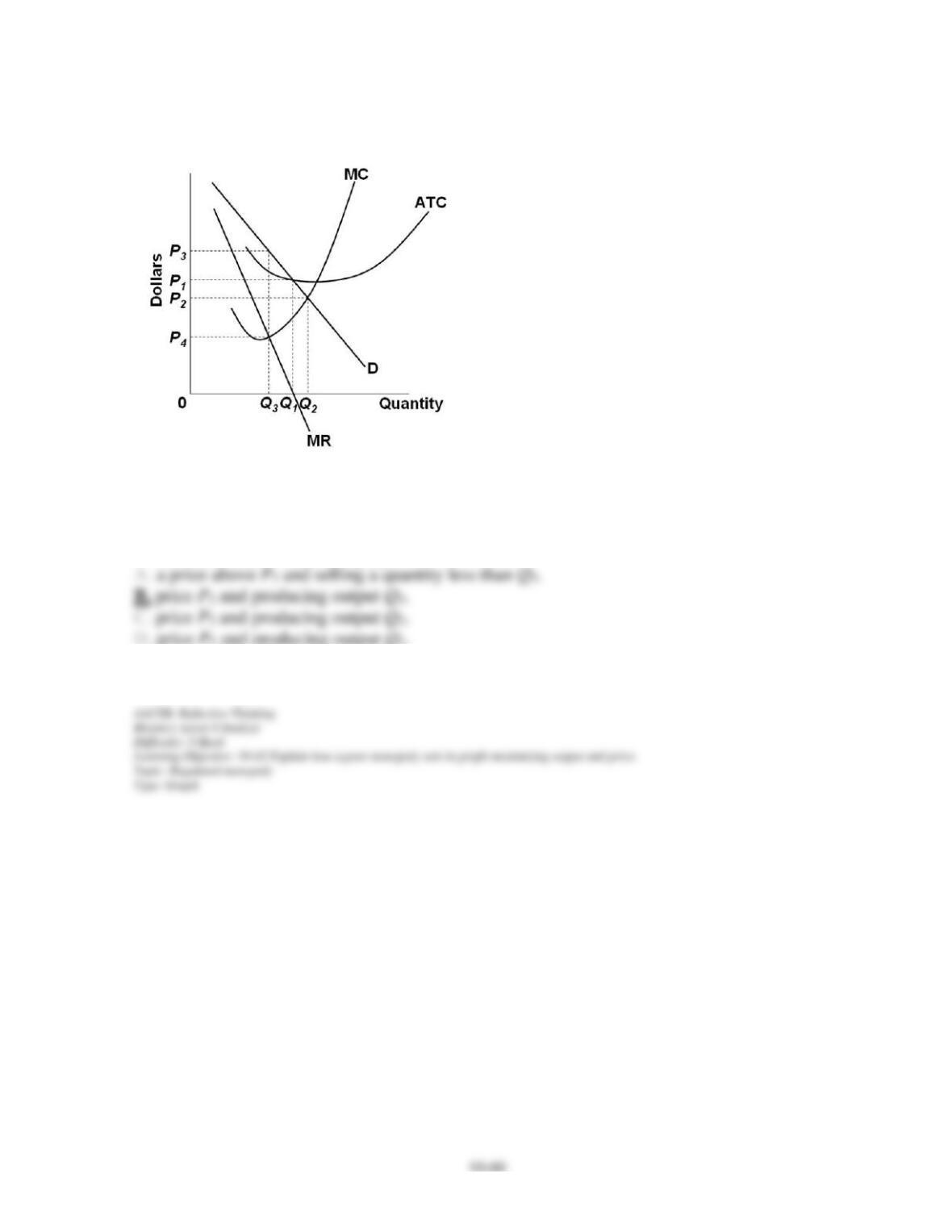
151. Refer to the above diagram for a pure monopolist. If the monopolist is unregulated, it
will maximize profits by charging:
Chapter 10 – Pure Monopoly
152. Refer to the above diagram for a pure monopolist. Suppose a regulatory commission is
created to determine a legal price for the monopoly. If the commission seeks to provide the
monopolist with a “fair return,” it will set price at:
153. Refer to the above diagram for a pure monopolist. If a regulatory commission seeks to
achieve the socially optimal allocation of resources to this line of production, it will set a price
of:
Chapter 10 – Pure Monopoly
154. Refer to the above diagram for a pure monopolist. If a regulatory commission sets the
price to achieve the socially optimal allocation of resources, it will have to:
155. A dilemma of regulation is that:
156. If a regulatory commission wants to provide a natural monopoly with a fair return, it
should establish a price that is equal to:
Chapter 10 – Pure Monopoly
157. If a regulatory commission wants to establish a socially optimal price for a natural
monopoly, it should select a price:
158. Suppose for a regulated monopoly that price equals minimum ATC but price exceeds
MC. This means that:
159. If a regulatory commission imposes upon a nondiscriminating natural monopoly a price
that is equal to marginal cost and below average total cost at the resulting output, then:
Chapter 10 – Pure Monopoly
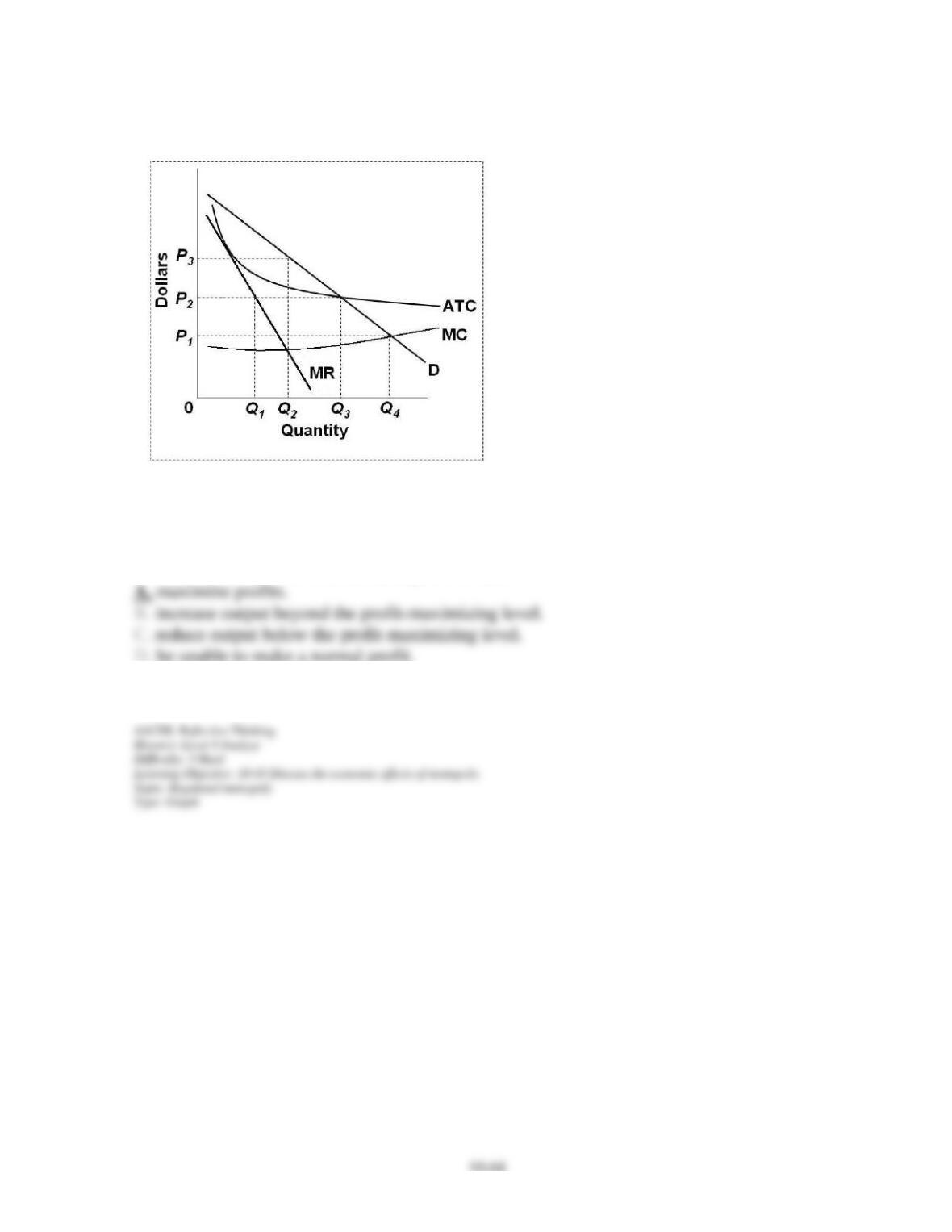
160. Refer to the above diagram for a natural monopolist. If a regulatory commission were to
set a maximum price of P3, the monopolist would:
Chapter 10 – Pure Monopoly
161. Refer to the above diagram for a natural monopolist. If a regulatory commission set a
maximum price of P2, the monopolist would:
162. Refer to the above diagram for a natural monopolist. If a regulatory commission set a
Chapter 10 – Pure Monopoly
163. (Consider This) Children are charged less than adults for admission to professional
baseball games but are charged the same prices as adults at the concession stands. This
pricing system occurs because:
164. (Consider This) Children are charged less than adults for admission to professional
baseball games but are charged the same prices as adults at the concession stands. Which of
the following conditions of price discrimination explain why this occurs?
Chapter 10 – Pure Monopoly
165. (Last Word) DeBeers Consolidated Mines markets about:
166. (Last Word) In a recent policy change, DeBeers has decided to:
167. A pure monopolist will maximize profits by producing at that output where price and
marginal cost are equal.
Chapter 10 – Pure Monopoly
168. In the short run a pure monopolist will maximize profits by producing at that level of
output where the difference between price and average total cost is at a maximum.
169. In the short run a pure monopolist will charge the highest price the market will bear for
its product.
170. Pure monopolists always earn economic profits.
171. If the XYZ Company can sell 4 units per week at $10 per unit and 5 units per week at $9
per unit, the marginal revenue of the fifth unit is $5.
Chapter 10 – Pure Monopoly
172. Because of their large-scale level of production, pure monopolists overallocate resources
to their industry by producing beyond the P = MC output.
173. Because of the ability to influence price, a pure monopolist can increase price and
increase volume of sales simultaneously.
Chapter 10 – Pure Monopoly
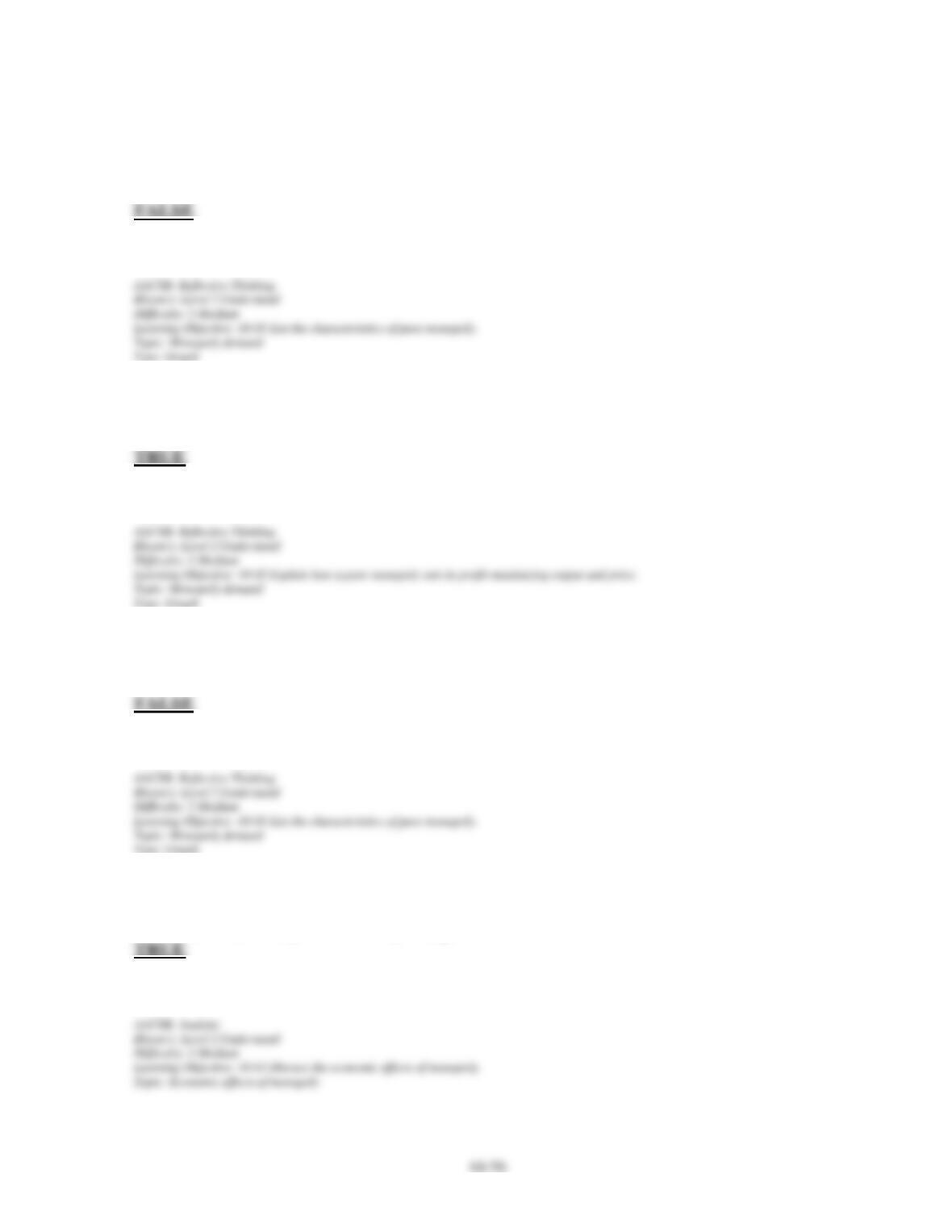
174. Refer to the above diagrams. Both firms are selling their products in purely competitive
markets.
175. Refer to the above diagrams. The demand for Firm B’s product is elastic at all prices in
excess of $4.
176. Refer to the above diagrams. Firm B’s average revenue curve coincides with its marginal
revenue curve.
177. Natural monopoly may result where products produce substantial network effects and
can be simultaneously consumed by a large number of consumers.
Chapter 10 – Pure Monopoly
178. Extensive network effects may drive a market toward natural monopoly because
consumers tend to choose a common, standard product that everyone else is using.
179. Price discrimination occurs whenever a firm sells a good for two different prices.
180. Price discrimination will result in consumers with more elastic demand purchasing more
of the good than when a single price is charged to all consumers in the market.
181. Successful price discrimination requires that buyers charged the different prices be
physically separated.
Chapter 10 – Pure Monopoly
182. Price discrimination is illegal in the United States under antitrust regulations.
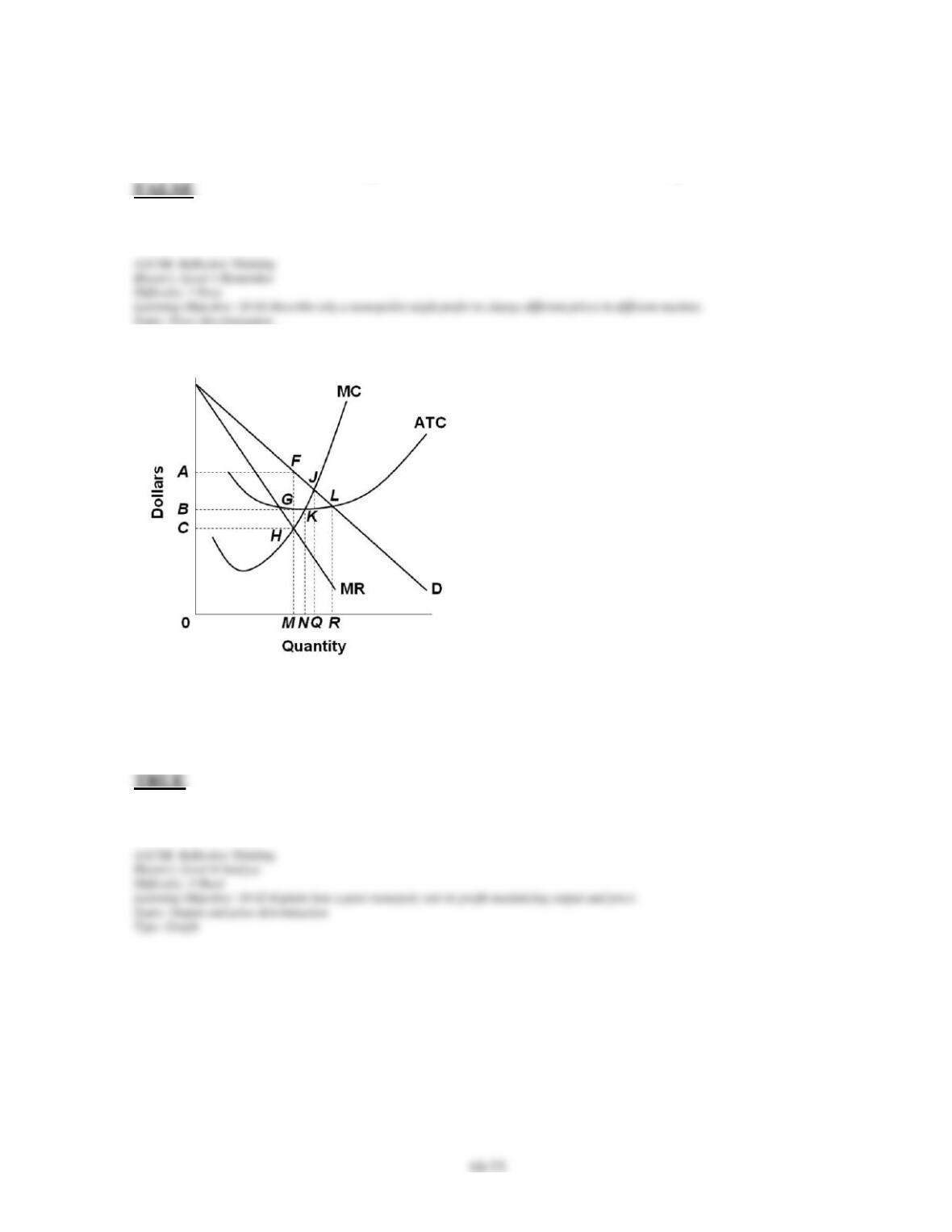
183. Refer to the above diagram for a nondiscriminating monopolist. The profit-maximizing
output for this firm is M.
Chapter 10 – Pure Monopoly
184. Refer to the above diagram for a nondiscriminating monopolist. At the profit–
maximizing output the firm’s economic profit will be BAFG.
185. Refer to the above diagram for a nondiscriminating monopolist. At output R economic
profits will be zero.
186. Refer to the above diagram for a nondiscriminating monopolist. At output Q production
will be unprofitable.
187. Refer to the above diagram for a nondiscriminating monopolist. The profit-maximizing
price for this firm is J.
Chapter 10 – Pure Monopoly
188. Refer to the above diagram for a nondiscriminating monopolist. At output M total cost
will be 0CHM.
189. Refer to the above diagram for a nondiscriminating monopolist. From society’s point of
view it would be desirable to have the monopolist produce a larger output than M.
190. Refer to the above diagram for a nondiscriminating monopolist. If the government
regulates the monopolist so that it charges the “fair return” price, the monopolist will produce
output N.
Chapter 10 – Pure Monopoly
191. Refer to the above diagram for a nondiscriminating monopolist. If the government
regulates the monopolist so that it charges the socially optimal price, the monopolist will
produce output Q.