Chapter 10 – Pure Monopoly
103. Refer to the above diagrams. The demand for Firm B’s product is:
104. Refer to the above diagrams. If $4 is Firm B’s profit-maximizing price, its:
105. Economic profit in the long run is:
Chapter 10 – Pure Monopoly
106. Which of the following statements is correct?
107. Confronted with the same unit cost data, a monopolistic producer will charge:
108. An important economic problem associated with pure monopoly is that, at the profit
maximizing outputs, resources are:
Chapter 10 – Pure Monopoly
109. A single-price monopoly is economically inefficient because, at the profit maximizing
output:
110. If a pure monopolist is producing more output than the MR = MC output:
111. At its profit-maximizing output, a pure nondiscriminating monopolist achieves:
Chapter 10 – Pure Monopoly
112. The profit-maximizing output of a pure monopoly is not socially optimal because in
equilibrium:
113. A single-price pure monopoly is economically inefficient:
114. Comparing a pure monopoly and a purely competitive firm with identical costs, we
would find in long-run equilibrium that the pure monopolist’s:
Chapter 10 – Pure Monopoly
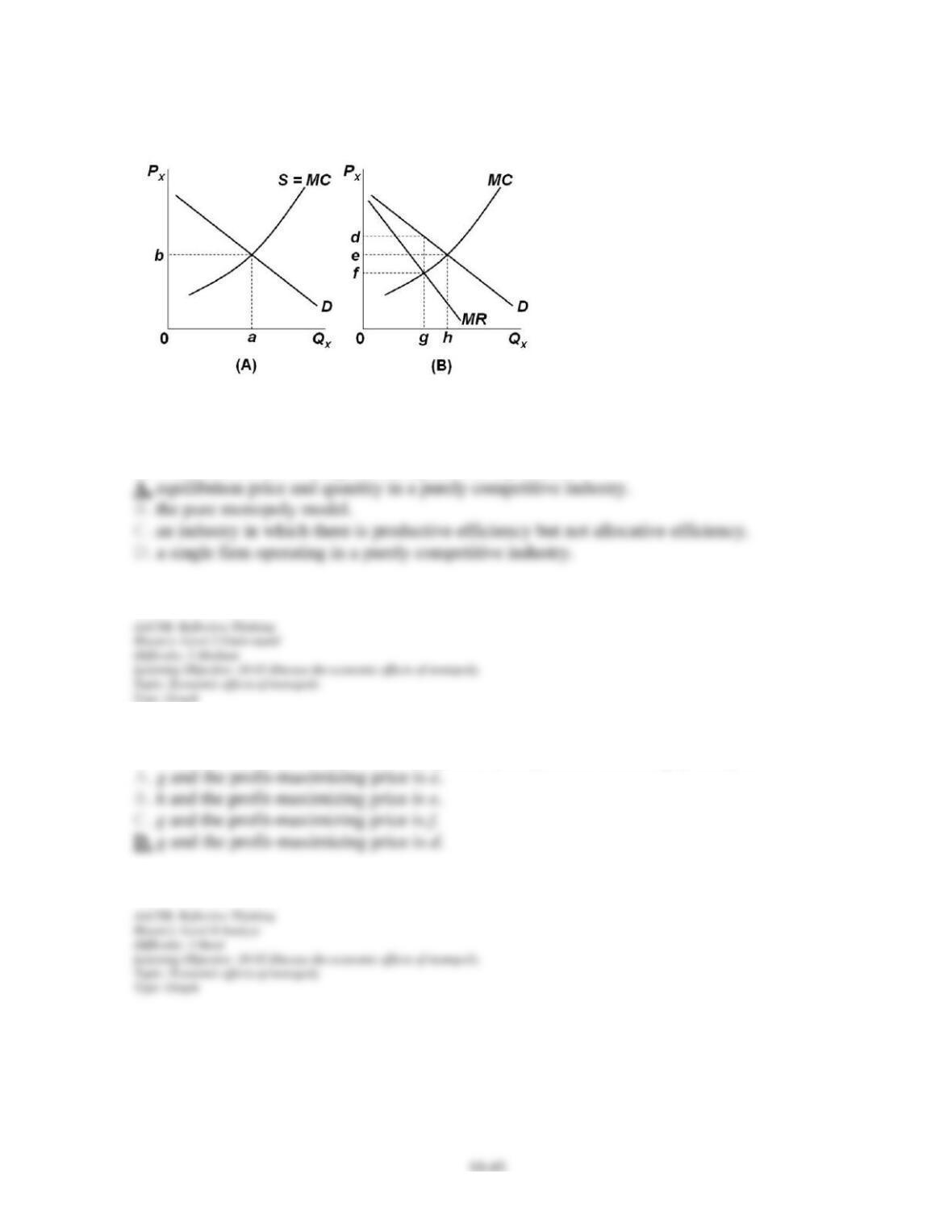
115. Refer to the above diagrams. Diagram (A) represents:
116. Refer to the above diagrams. In diagram (B) the profit-maximizing quantity is:
Chapter 10 – Pure Monopoly
117. Refer to the above diagrams. With the industry structure represented by diagram:
118. Refer to the above diagrams. With the industry structure represented by diagram:
119. Refer to the above diagrams. The price will be _______ and the quantity will be _______
with the industry structure represented by diagram (B) compared to the one represented in
(A).
Chapter 10 – Pure Monopoly
120. The higher prices charged by monopolists:
121. The gains to monopolists from exercising market power:
122. X-inefficiency refers to a situation in which a firm:
Chapter 10 – Pure Monopoly
10–48
123. Which of the following is not a possible source of natural monopoly?
124. There is some evidence to suggest that X-inefficiency is:
Chapter 10 – Pure Monopoly
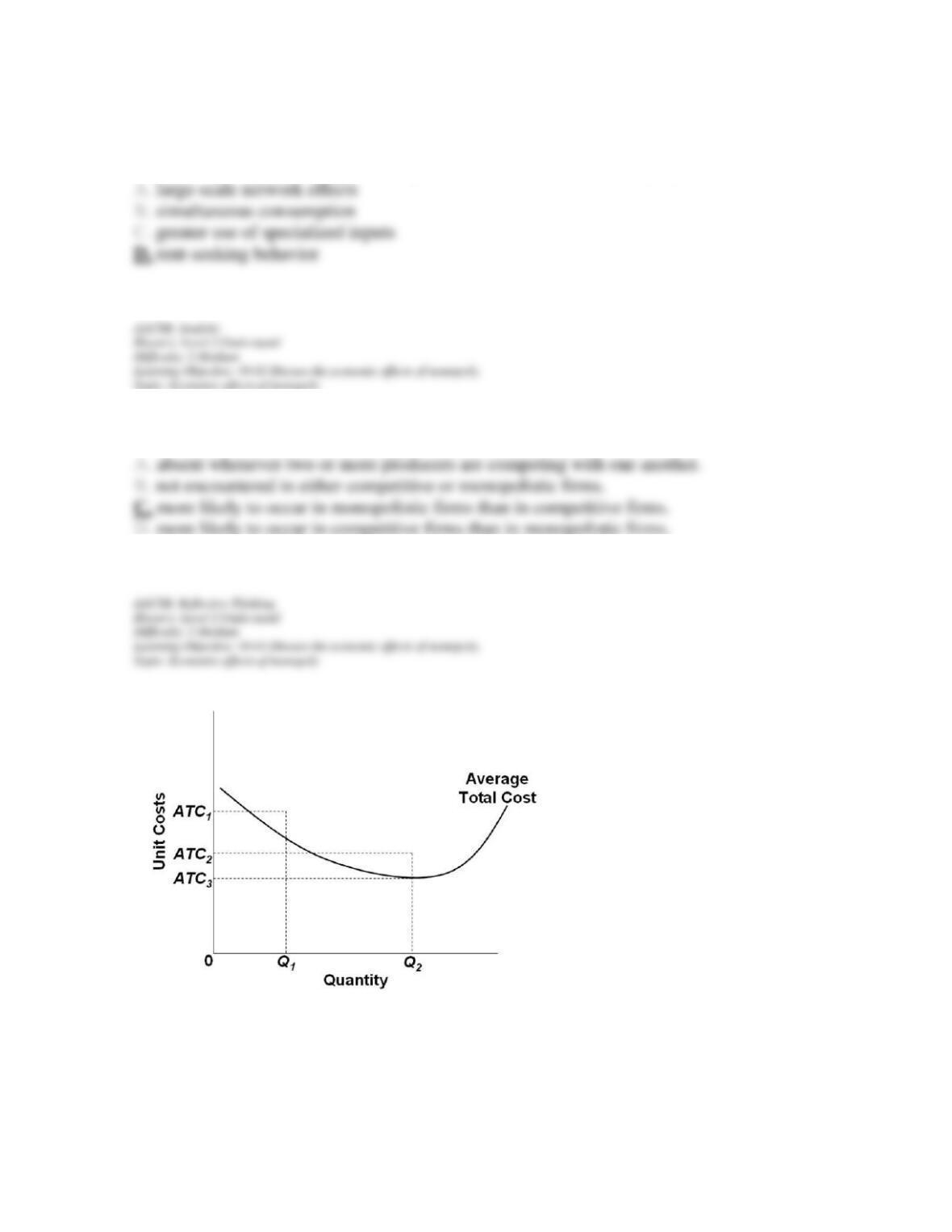
125. Refer to the above long-run cost curve for a firm. If the firm produces output Q1 at an
average total cost of ATC1, then the firm is:
126. Refer to the above long-run cost diagram for a firm. If the firm produces output Q2 at an
average cost of ATC2, then the firm is:
Chapter 10 – Pure Monopoly
127. Refer to the above long-run cost diagram for a firm. If the firm produces output Q2 at an
average cost of ATC3, then the firm is:
128. In which one of the following market models is X-inefficiency most likely to be the
greatest?
129. In which one of the following market models is X-inefficiency least likely to be present?
Chapter 10 – Pure Monopoly
130. Price discrimination refers to:
131. Which of the following conditions is not required for price discrimination?
132. The practice of price discrimination is associated with pure monopoly because:
Chapter 10 – Pure Monopoly
133. Which of the following is not a precondition for price discrimination?
134. A price discriminating pure monopolist will attempt to charge each buyer (or group of
buyers):
135. Other things equal, in which of the following cases would economic profit be the
greatest?
Chapter 10 – Pure Monopoly
136. If a pure monopolist can price discriminate by separating buyers into two or more
groups:
137. If a monopolist engages in price discrimination, it will:
138. Price discrimination is:
Chapter 10 – Pure Monopoly
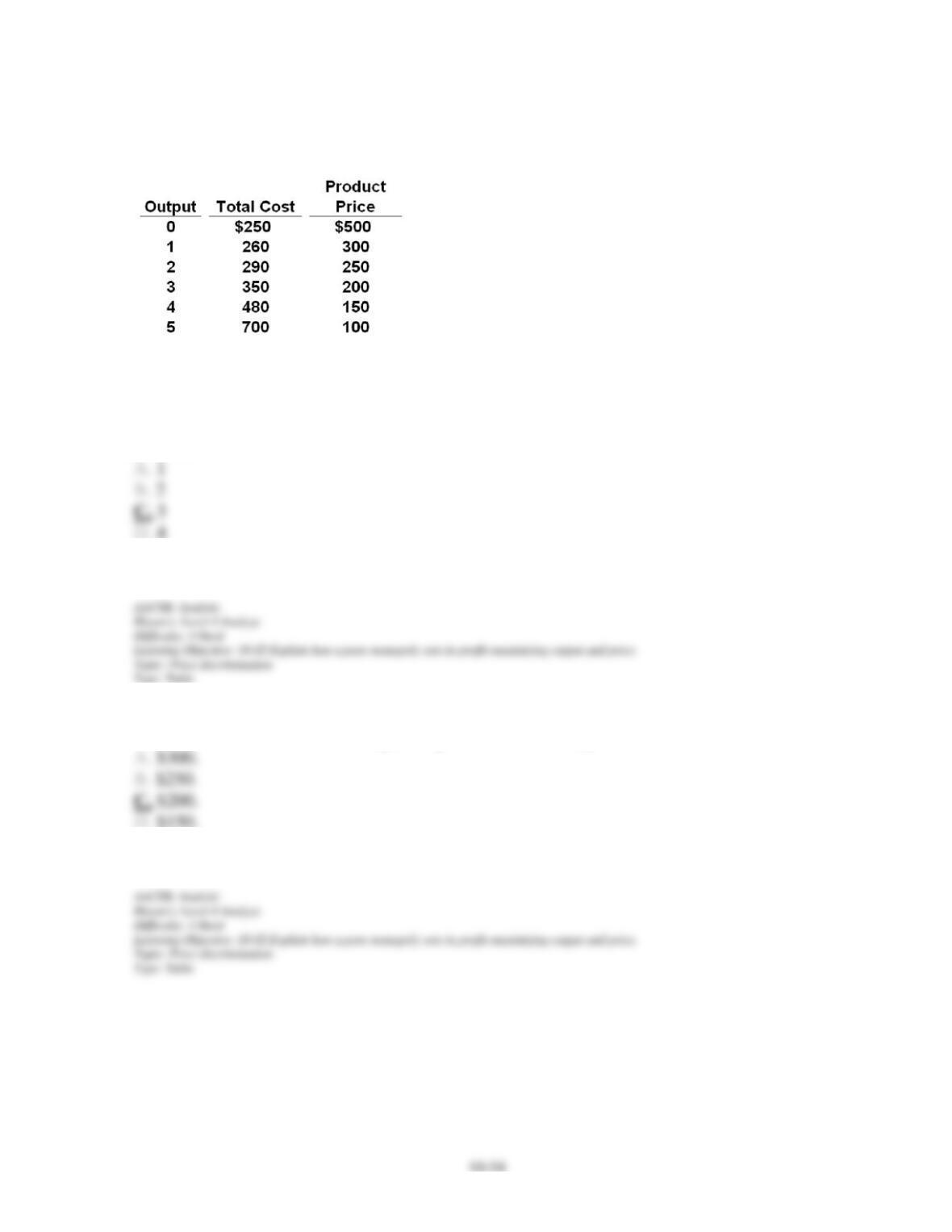
Answer the question on the basis of the following information for a pure monopolist:
139. How many units would the above profit-maximizing nondiscriminating monopolist
produce?
140. The above nondiscriminating monopolist should set its price at:
Chapter 10 – Pure Monopoly
141. At its profit-maximizing output, the above nondiscriminating monopolist:
142. If the above profit-maximizing monopolist is able to price discriminate, charging each
customer the price associated with each given level of output, how many units will the firm
produce?
143. If the above profit-maximizing monopolist is able to price discriminate, charging each
customer the price associated with each given level of output, how much profit will the firm
earn?
Chapter 10 – Pure Monopoly
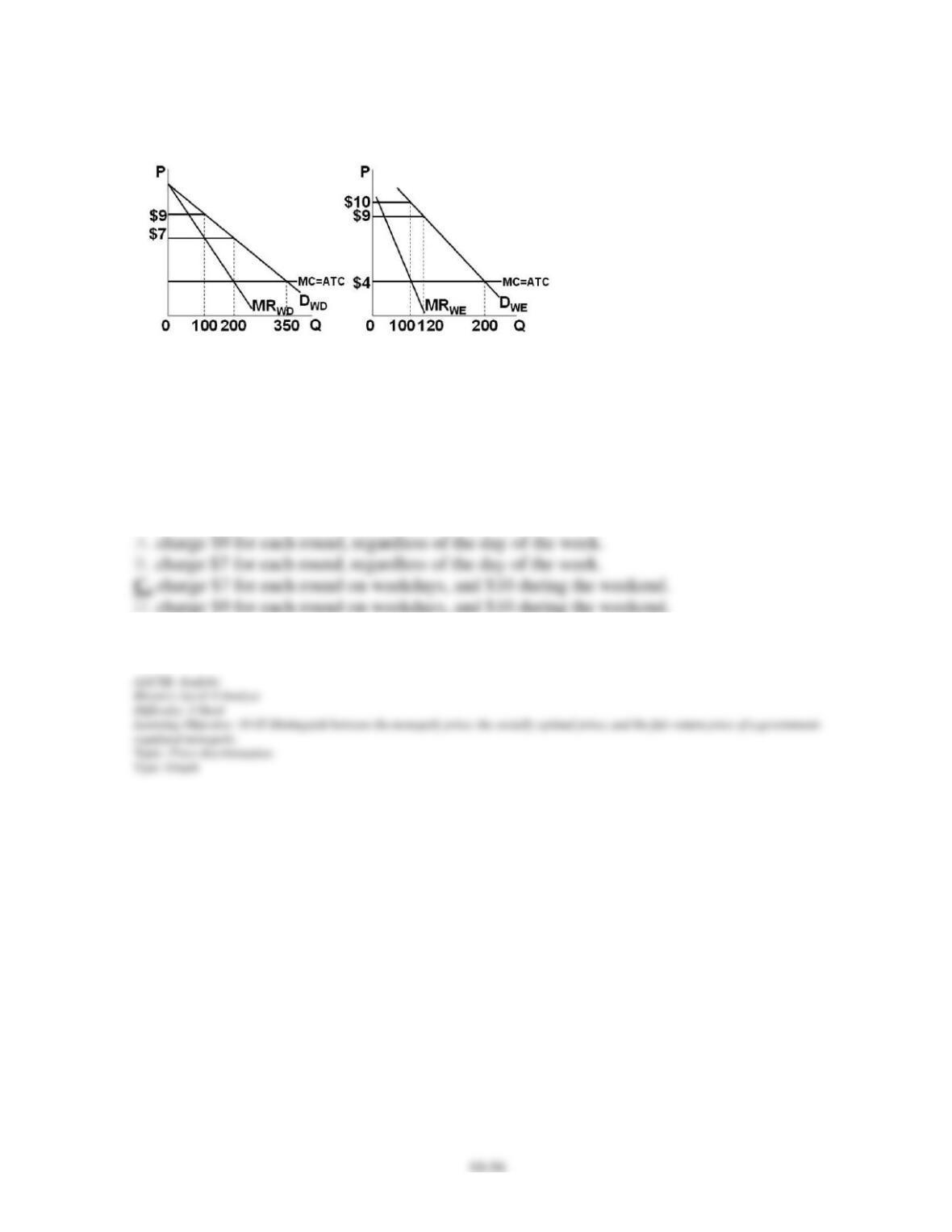
144. Refer to the figure above. Suppose the graphs represent the demand for use of a local
golf course for which there is no significant competition (it has a local monopoly); P denotes
the price of a round of golf; Q is the quantity of rounds “sold” each day. If the left graph
represents the demand during weekdays, and the right graph the weekend demand, this profit-
maximizing golf course should:
Chapter 10 – Pure Monopoly
145. Refer to the figure above. Suppose the graphs represent the demand for use of a local
golf course for which there is no significant competition (it has a local monopoly); P denotes
the price of a round of golf; Q is the quantity of rounds “sold” each day. If the left graph
represents the demand during weekdays, and the right graph the weekend demand, then over
the course of a full seven-day week this price-discriminating, profit-maximizing golf course
should sell at total of:
146. Refer to the figure above. Suppose the graphs represent the demand for use of a local
golf course for which there is no significant competition (it has a local monopoly); P denotes
the price of a round of golf; Q is the quantity of rounds “sold” each day. If the left graph
represents the demand during weekdays, and the right graph the weekend demand, this profit-
maximizing golf course will earn how much economic profit over the course of a full seven–
day week?
Chapter 10 – Pure Monopoly
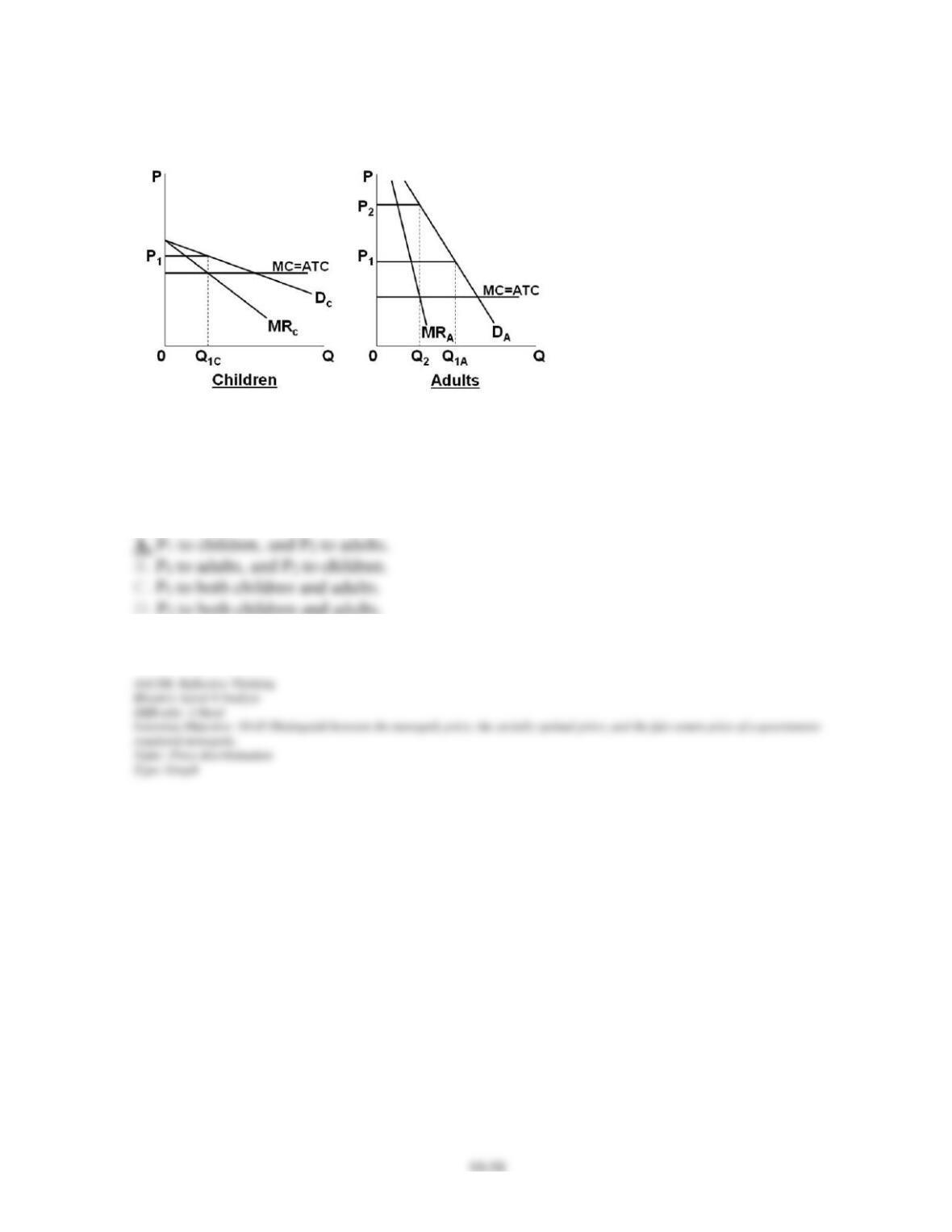
147. Assume the above figure applies to a pure monopolist, and that MC is the same for both
graphs. If this firm is able to price discriminate between children and adults, it should charge
prices of: