Chapter 10 – Pure Monopoly
96. Network effects and simultaneous consumption tend to foster the development of:
97. X-inefficiency is said to occur when a monopolist’s:
98. Possible reasons for X-inefficiency include the following, except:
Chapter 10 – Pure Monopoly
99. Which statement is correct?
100. Any activity designed to transfer income or wealth to a particular individual or firm at
society’s expense is called:
101. Assume that the owners of the only gambling casino in Wisconsin spend large sums of
money lobbying state government officials to protect their gambling monopoly. Economists
refer to these expenditures as:
Chapter 10 – Pure Monopoly
102. The economic incentive for price discrimination is based upon:
103. To practice long-run price discrimination, a monopolist must:
104. Which of the following statements is true of price discrimination?
Chapter 10 – Pure Monopoly
105. Which is not true of price discrimination?
106. Which would definitely not be an example of price discrimination?
107. Which case below best represents a case of price discrimination?
Chapter 10 – Pure Monopoly
108. Which is the best example of price discrimination?
109. Which is true of a price discriminating pure monopolist?
110. Price discrimination is more common in service industries because:
Chapter 10 – Pure Monopoly
111. Successful price discrimination requires that:
112. Consumers who clip and redeem discount coupons:
113. Electric utilities generally charge higher prices for electricity used for illumination and
lower prices for electricity used for heat. These lower prices for electric heat result primarily
from:
Chapter 10 – Pure Monopoly
114. If a price-discriminating monopolist sells the same product in two markets but charges a
higher price in market X and a lower price in market Y, the pricing difference indicates that
demand is:
115. Refer to the above cost and demand data for a pure monopolist. Suppose that this
monopoly is subjected to a regulatory commission. If the commission seeks to achieve the
most efficient allocation of resources for this industry, it should set the socially optimal price
at:
Chapter 10 – Pure Monopoly
116. One argument for having the government regulate natural monopolies is that without
regulation:
The following questions are based on the demand and cost data for a pure monopolist given
in the table
117. Refer to the above table for a monopolist. A non-discriminating monopolist would
maximize profits at a price and quantity of:
Chapter 10 – Pure Monopoly
118. Refer to the above table for a monopolist. If the monopolist perfectly price-discriminated
and sells each unit of the product at the maximum price the buyer of that unit would be
willing to pay, and if the monopolist sold 4 units, then total revenue would be:
119. Refer to the above information. If the monopolist were forced to produce the socially
optimal output by the imposition of a ceiling price, the ceiling price would have to be:
Chapter 10 – Pure Monopoly
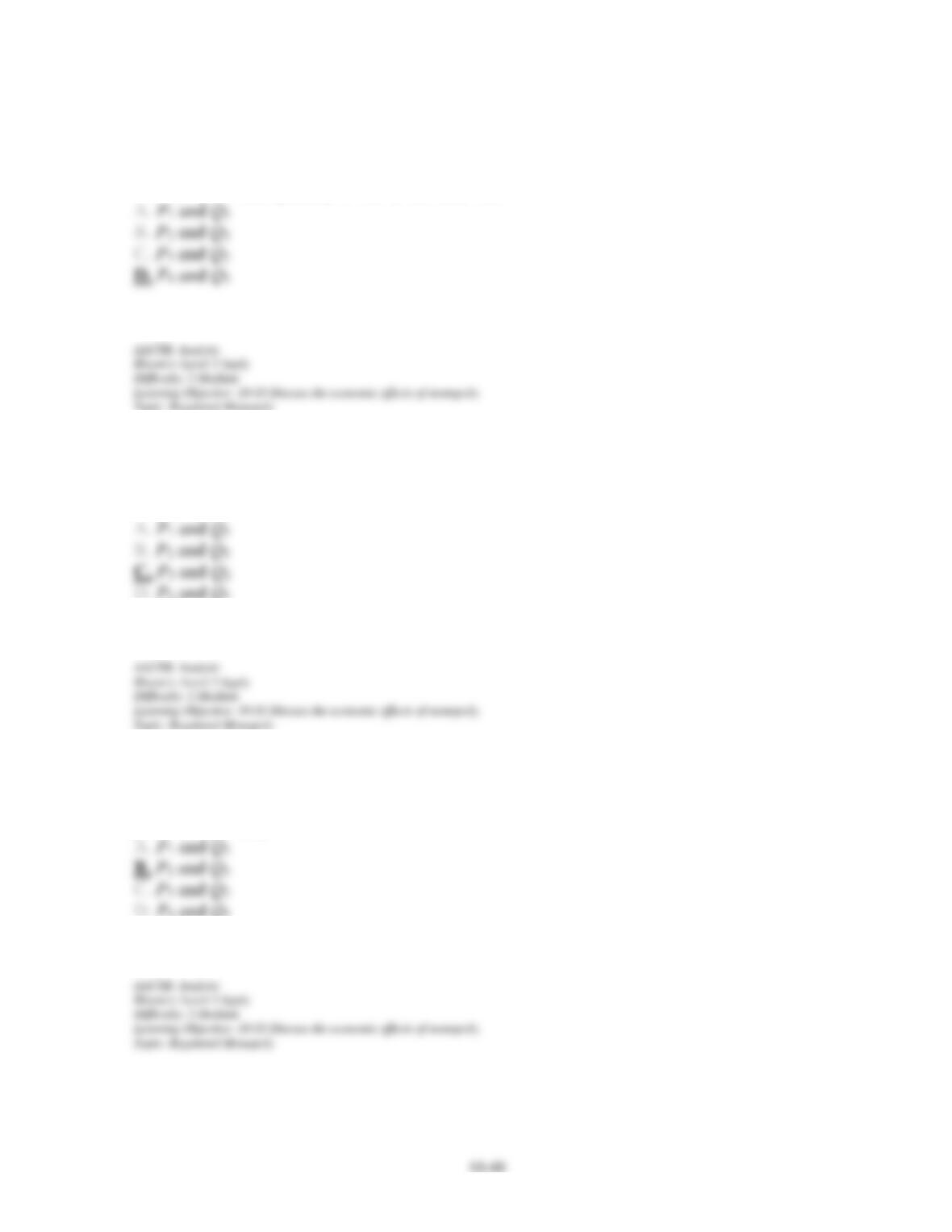
120. Refer to the above graph for a pure monopoly. A profit-maximizing monopolist would
set what price and quantity levels in the short run?
121. Refer to the above graph for a pure monopoly. If the government regulated the monopoly
and made the firm set a fair-return price, what price and quantity levels would we observe in
the short run?
122. Refer to the above graph for a pure monopoly. If the government regulated the monopoly
shown and made it produce the level of output that would achieve allocative efficiency, what
price and quantity levels would we observe in the short run?
Chapter 10 – Pure Monopoly
123. The usual problem with socially-optimal pricing through regulation of a natural
monopoly is that:
124. The usual problem with adopting a fair-return pricing policy for a natural monopoly is
125. An argument for making regulated monopolies adopt marginal cost pricing is that this
Chapter 10 – Pure Monopoly
126. With a natural monopoly, the fair return price:
127. What is the meaning of the phrase “dilemma of regulation”?
128. Price discrimination for concessions at ball parks is not applied to adults and children
because:
Chapter 10 – Pure Monopoly
129. What type of barrier to entry was used by De Beers throughout much of its history to
maintain its monopoly position?
130. When De Beers acted as a monopolist, at the profit-maximizing level of output:
131. The DeBeers’ diamond monopoly has weakened in recent years primarily due to:
Chapter 10 – Pure Monopoly
132. The government may create legal barriers to entry that serve to foster monopoly power
of firms.
133. A firm sells 99 units of output when price equals $10, and 100 units of output when price
equals $9. Its marginal revenue for the 100th unit of output is negative.
134. The monopolist’s demand curve is more elastic than the industry demand curve.
135. In the inelastic portion of a monopolist’s demand curve, the marginal revenue of each
extra unit of output is positive.
Chapter 10 – Pure Monopoly
136. As a monopolist lowers the price of its product, it finds that its total revenue may at first
increase and then, below a certain price, its total revenue begins to decrease.
137. A monopolist will avoid setting a price in the elastic segment of the demand curve and
prefer to set the price in the inelastic segment.
138. A monopolist will try to charge the highest price that it can charge.
139. A monopolist, being the sole seller in a market, is assured of positive economic profits.
Chapter 10 – Pure Monopoly
140. The supply curve for a monopolist is the upward-sloping portion of the marginal cost
curve that lies above the average variable cost curve.
141. A monopolist seeks maximum profits per unit (or unit margin).
142. In the long run equilibrium, a monopolist will earn zero economic profits.
143. In a monopoly at equilibrium, price is greater than marginal cost.
Chapter 10 – Pure Monopoly
144. In an unregulated monopoly at equilibrium, production of the output is higher than the
economic efficient level.
145. One of the economic effects of monopoly is an income transfer from consumers to the
firm.
146. Price discrimination is not viable if consumers can resell the products they purchase.
147. In most cases, a monopolist practicing price discrimination will end up earning less
economic profits than a non-discriminating monopolist.
Chapter 10 – Pure Monopoly
148. A price-discriminating monopolist will set a higher price when demand is more elastic
and a lower price when demand is less elastic.
149. Without regulations, monopolists will produce at an output level where marginal benefit
is greater than marginal cost.
150. In a natural monopoly case, the socially-optimal pricing policy rule will often yield a
higher price than the fair-return pricing rule.