Chapter 10 – Pure Monopoly
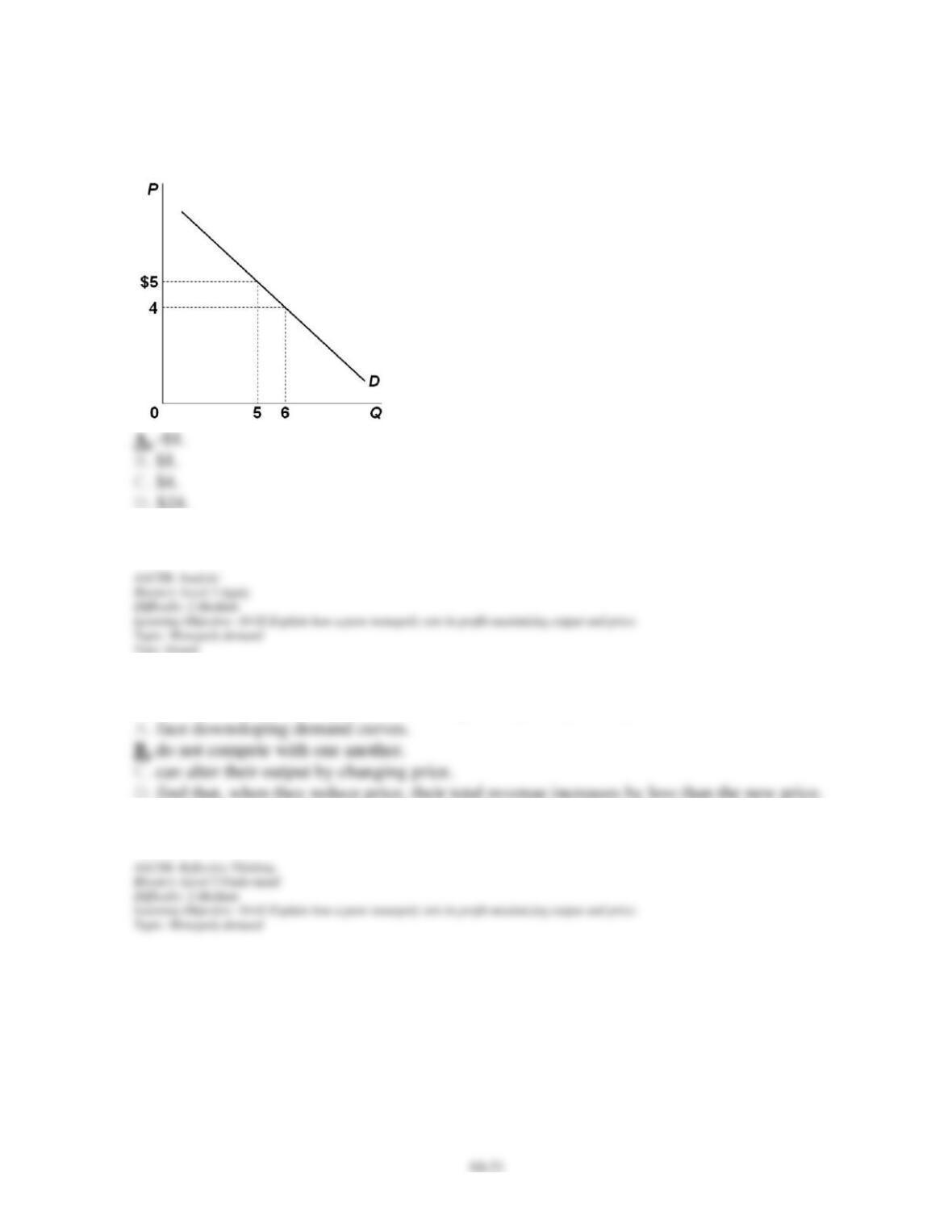
53. The above diagram indicates that the marginal revenue of the sixth unit of output is:
54. Which of the following is incorrect? Imperfectly competitive producers:
Chapter 10 – Pure Monopoly
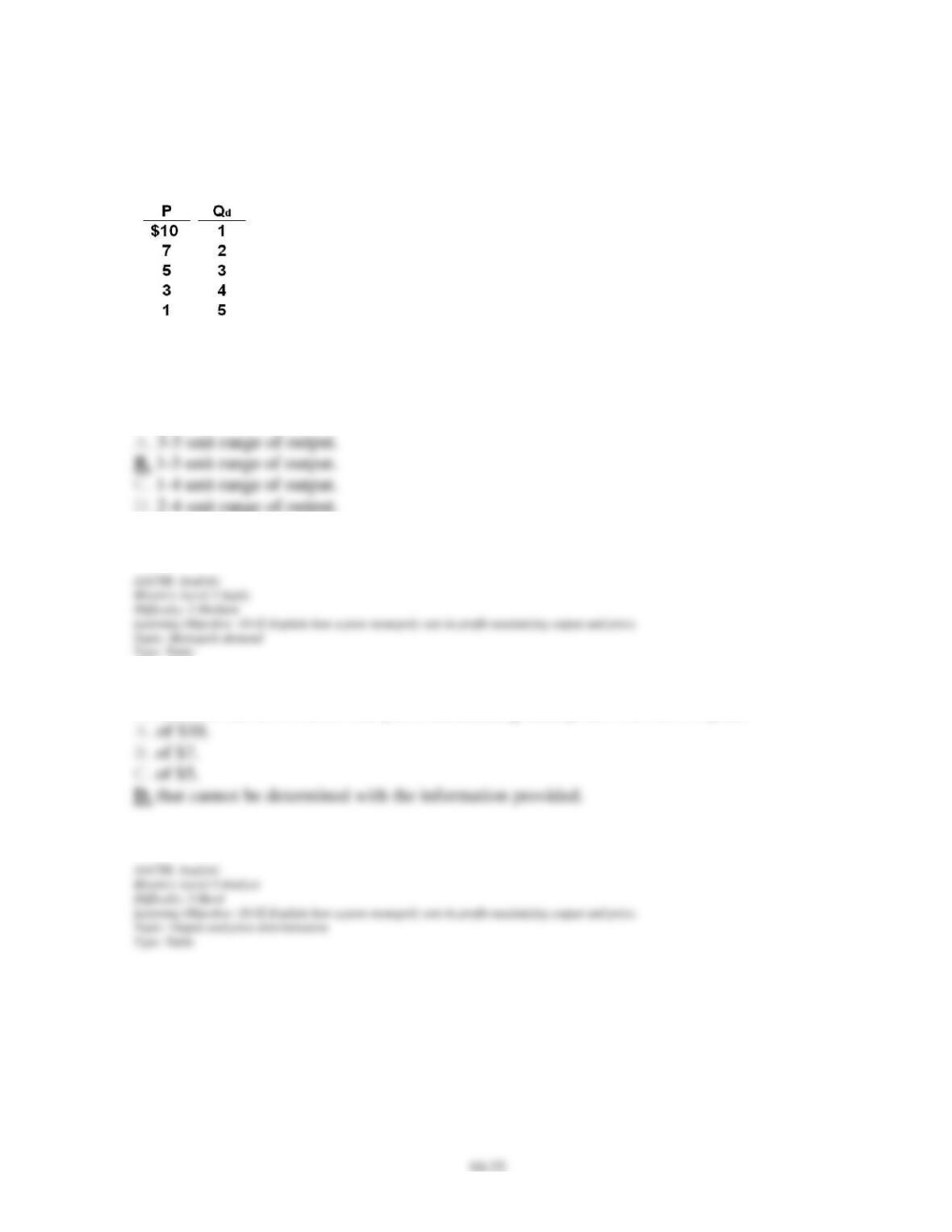
Answer the question on the basis of the following table showing the demand schedule
facing a nondiscriminating monopolist:
55. Refer to the above table. The monopolist will select its profit-maximizing level of output
somewhere within the:
56. Refer to the above table. The profit-maximizing monopolist will sell at a price:
Chapter 10 – Pure Monopoly
57. Refer to the above table. Assume that this monopolist faces zero production costs. The
profit-maximizing monopolist will set a price of:
58. A nondiscriminating pure monopolist finds that it can sell its fiftieth unit of output for
$50. We can surmise that the marginal:
59. If a nondiscriminating pure monopolist decides to sell one more unit of output, the
marginal revenue associated with that unit will be:
Chapter 10 – Pure Monopoly
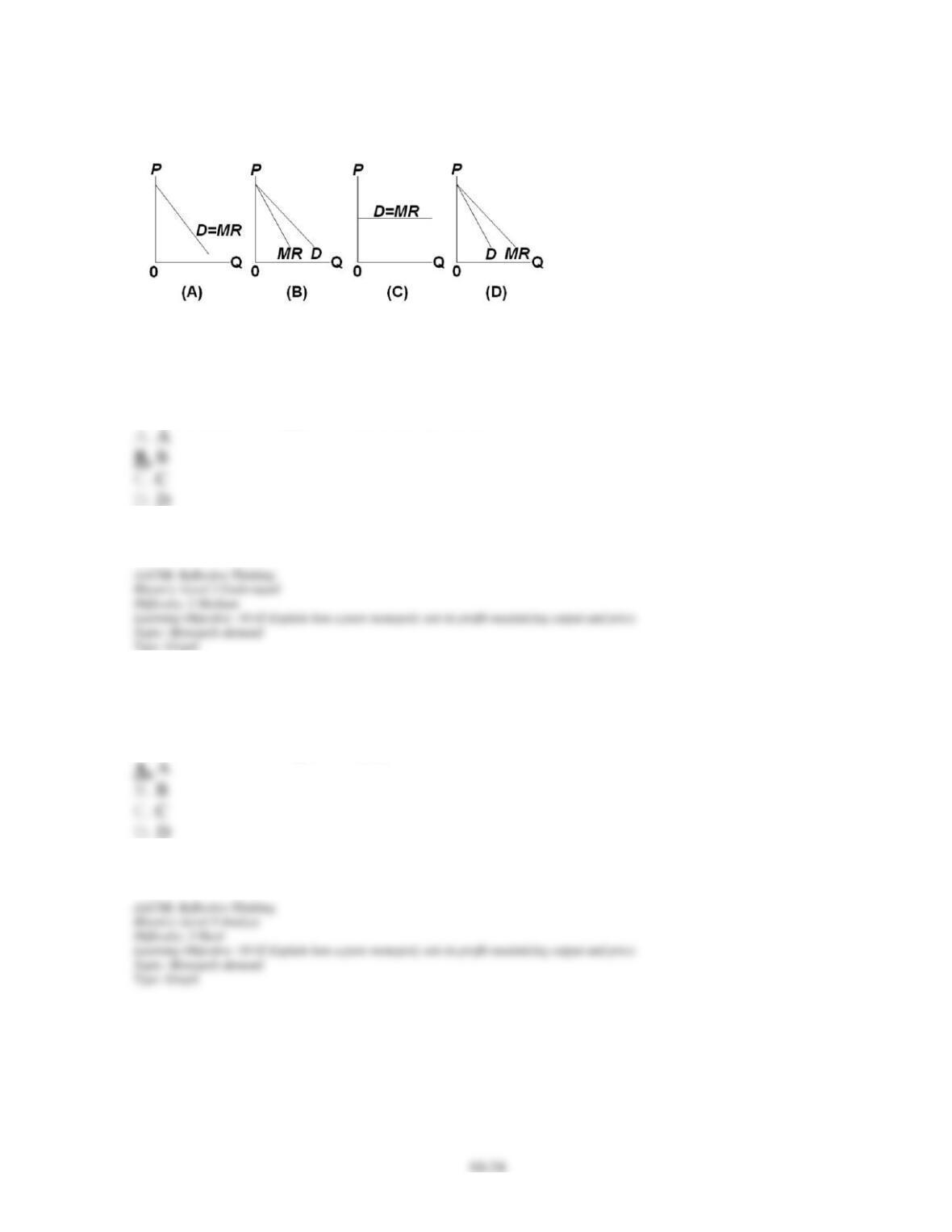
60. Which of the above diagrams correctly portray a nondiscriminating pure monopolist’s
demand (D) and marginal revenue (MR) curves?
61. Which of the above diagrams correctly portray the demand (D) and marginal revenue
(MR) curves of a pure monopolist that is able to price discriminate by charging each customer
their maximum willingness to pay?
Chapter 10 – Pure Monopoly
62. Which of the above diagrams correctly portray the demand (D) and marginal revenue
(MR) curves of a purely competitive seller?
63. Suppose that a pure monopolist can sell 20 units of output at $10 per unit and 21 units at
$9.75 per unit. The marginal revenue of the twenty-first unit of output is:
64. The MR = MC rule:
Chapter 10 – Pure Monopoly
65. In the long run a pure monopolist will maximize profits by producing that output at which
marginal cost is equal to:
66. An unregulated pure monopolist will maximize profits by producing that output at which:
67. Suppose that a pure monopolist can sell 5 units of output at $4 per unit and 6 units at
$3.90 per unit. The monopolist will produce and sell the sixth unit if its marginal cost is:
Chapter 10 – Pure Monopoly
68. Suppose that a pure monopolist can sell 4 units of output at $2 per unit and 5 units at
$1.75 per unit. The monopolist will produce and sell the fifth unit if its marginal cost is:
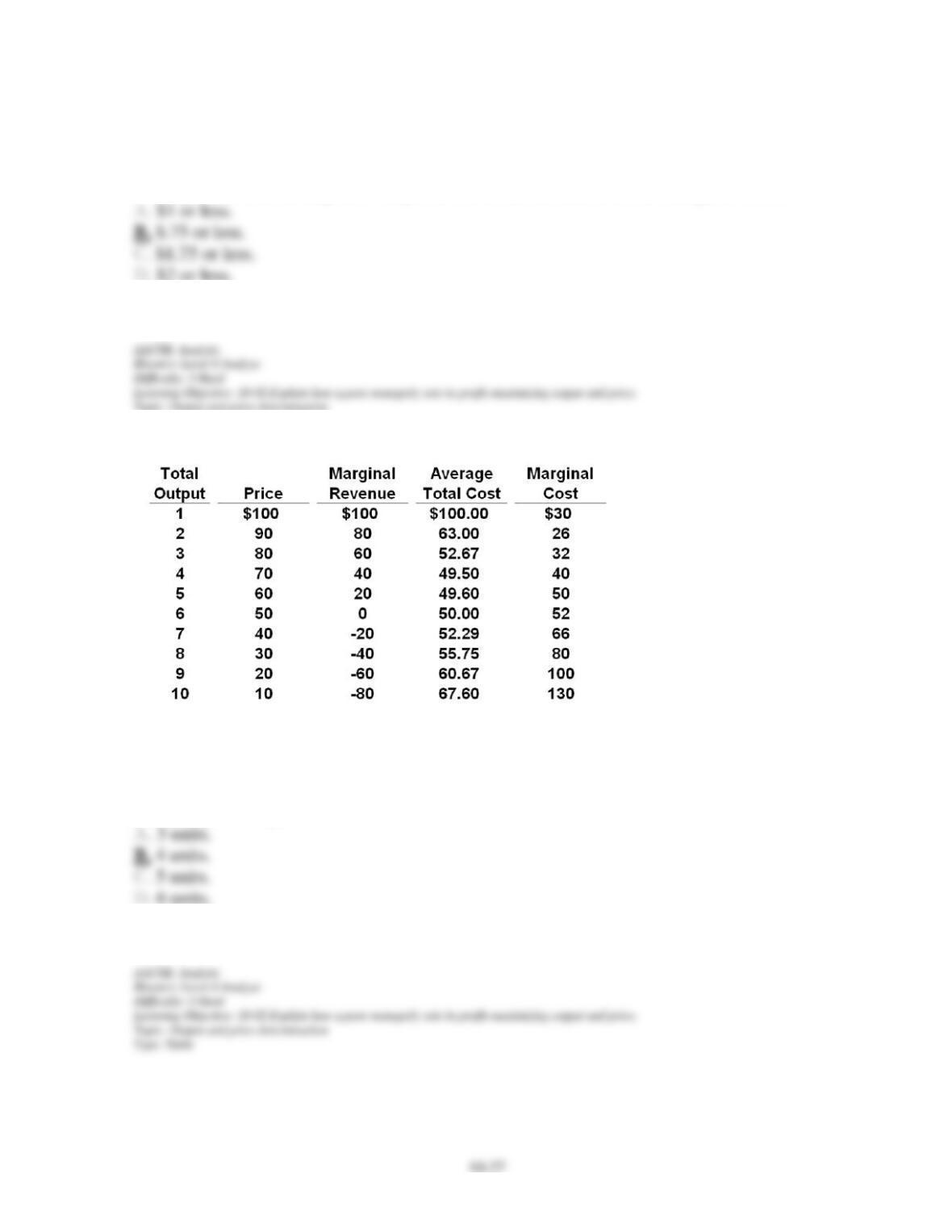
69. Refer to the above data for a nondiscriminating monopolist. This firm will maximize its
profit by producing:
Chapter 10 – Pure Monopoly
70. Refer to the above data for a nondiscriminating monopolist. At its profit-maximizing
output, this firm will be operating in the:
71. Refer to the above data for a nondiscriminating monopolist. At its profit-maximizing
output, this firm’s price will exceed its marginal cost by ____ and its average total cost by
___.
72. Refer to the above data for a nondiscriminating monopolist. At its profit-maximizing
output, this firm’s total costs will be:
Chapter 10 – Pure Monopoly
73. Refer to the above data. At its profit-maximizing output, this firm’s total revenue will be:
74. Refer to the above data for a nondiscriminating monopolist. At its profit-maximizing
output, this firm’s total profit will be:
75. A pure monopolist is producing an output such that ATC = $4, P = $5, MC = $2, and MR
= $3. This firm is realizing:
Chapter 10 – Pure Monopoly
76. If a monopolist’s marginal revenue is $3.00 and its marginal cost is $4.50, it will increase
its profits by:
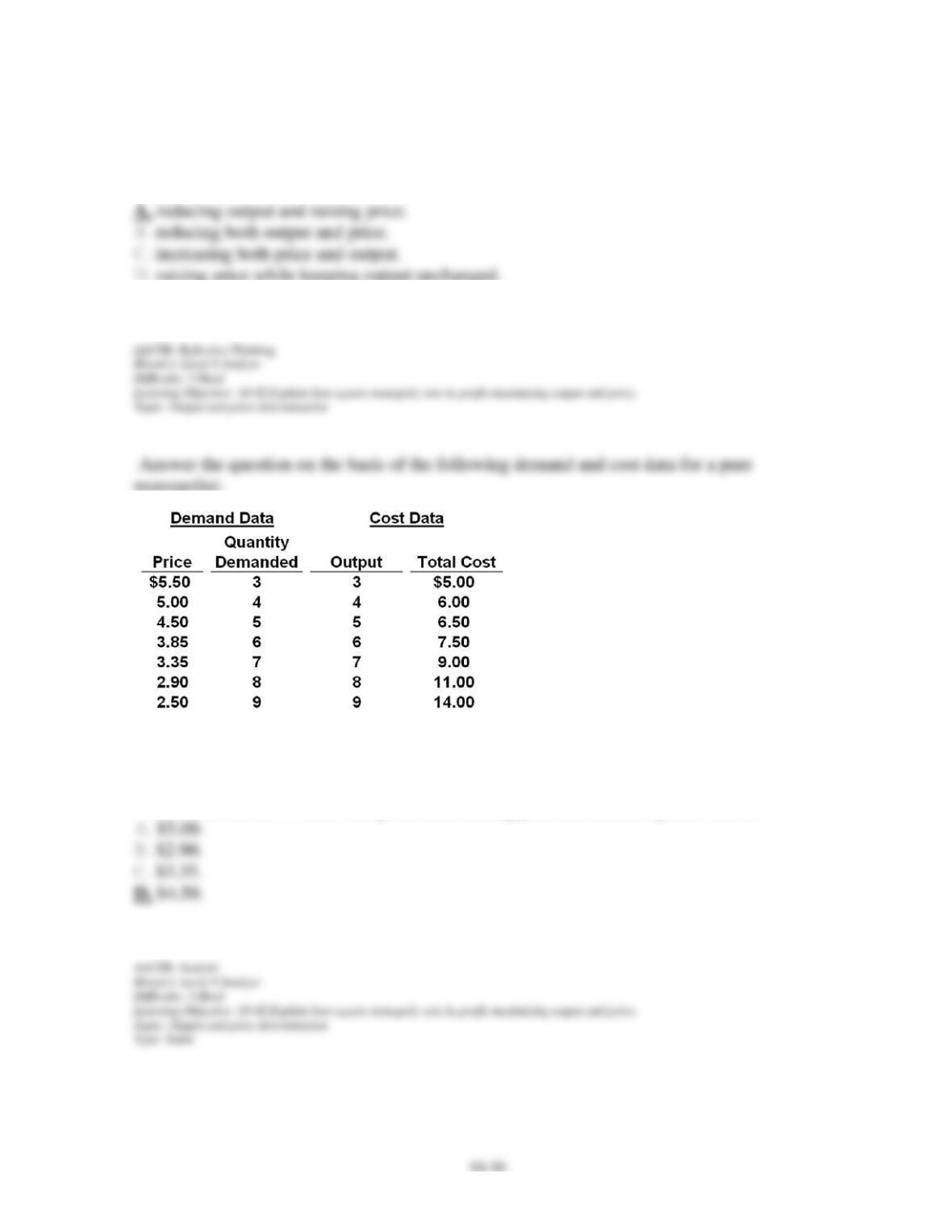
77. Refer to the above data. The profit-maximizing price for the monopolist will be:
Chapter 10 – Pure Monopoly
10–31
78. Refer to the above data. The profit-maximizing level of output will be:
79. Refer to the above data. The profit-maximizing monopolist will realize a:
Chapter 10 – Pure Monopoly
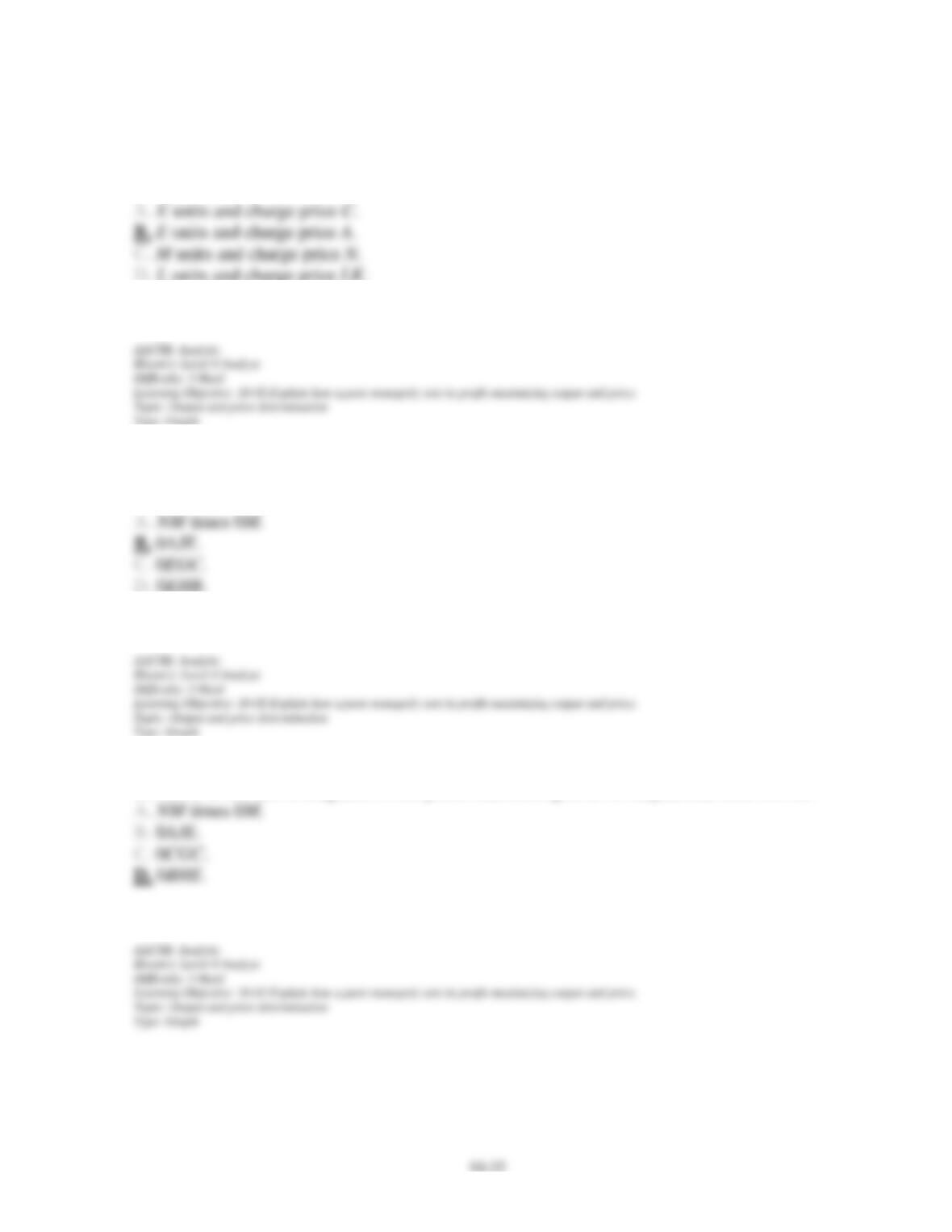
80. Refer to the above diagram. To maximize profits or minimize losses this firm should
produce:
81. Refer to the above diagram. At the profit-maximizing level of output, total revenue will
be:
82. Refer to the above diagram. At the profit-maximizing level of output, total cost will be:
Chapter 10 – Pure Monopoly
83. Refer to the above diagram. At the profit-maximizing level of output, the firm will
realize:
84. If profits are maximized (or losses minimized), which of the following conditions is
common to both unregulated monopoly and to pure competition?
85. A pure monopolist:
Chapter 10 – Pure Monopoly
10–34
86. If a pure monopolist is producing at that output where P = ATC, then:
87. A pure monopolist’s short-run profit-maximizing or loss-minimizing position is such that
price:
Chapter 10 – Pure Monopoly
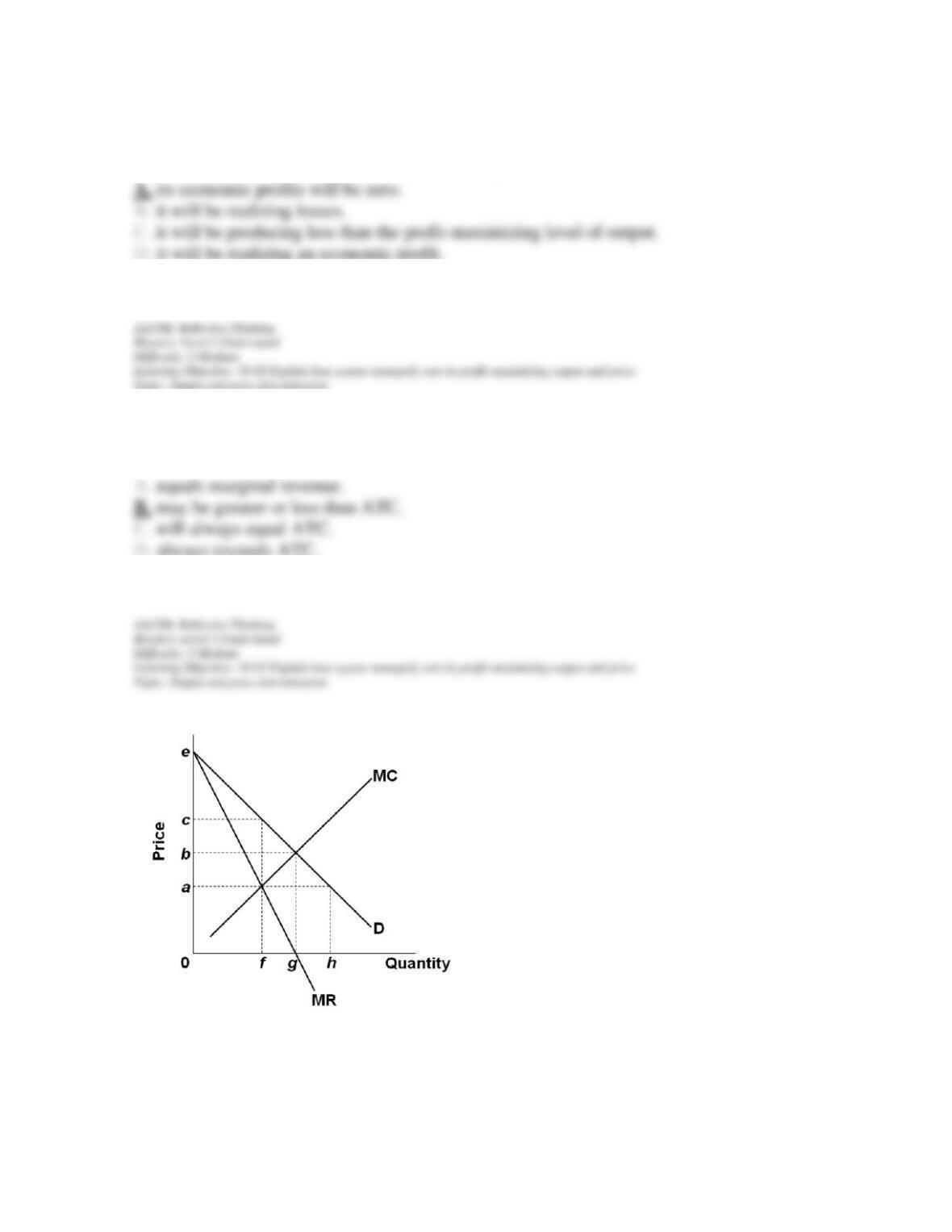
88. Refer to the above diagram for a pure monopolist. Monopoly price will be:
90. Refer to the above diagram for a pure monopolist. Monopoly profit:
Chapter 10 – Pure Monopoly
10–36
91. In the short run, a monopolist’s economic profits:
92. Under which of the following situations would a monopolist increase profits by lowering
price (and increasing output):
Chapter 10 – Pure Monopoly
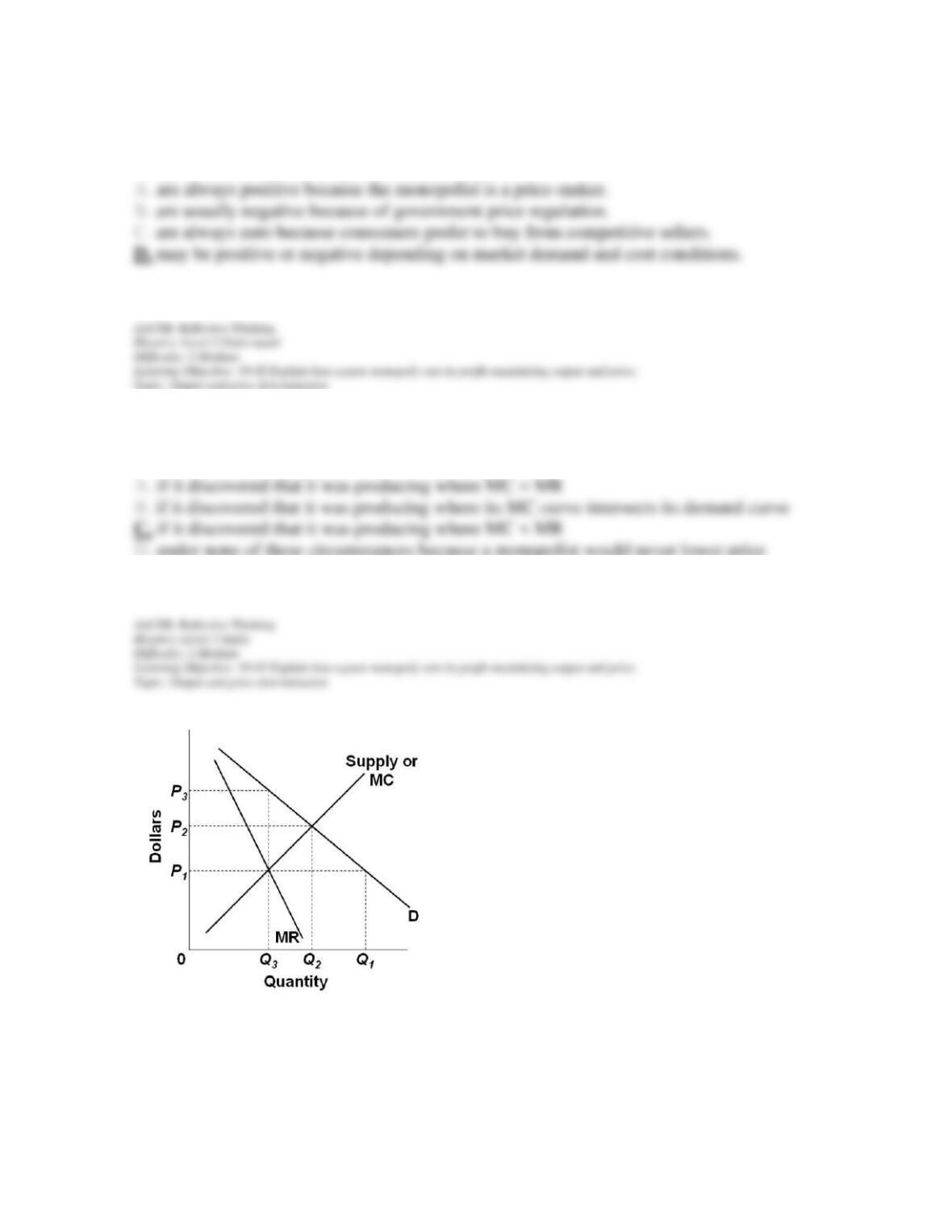
93. Refer to the above diagram. If this industry is purely competitive, the profit-maximizing
price and quantity will be:
94. Refer to the above diagram. If this industry is comprised of only one seller, the profit-
maximizing price and quantity will be:
95. When a pure monopolist is producing its profit-maximizing output, price will:
Chapter 10 – Pure Monopoly
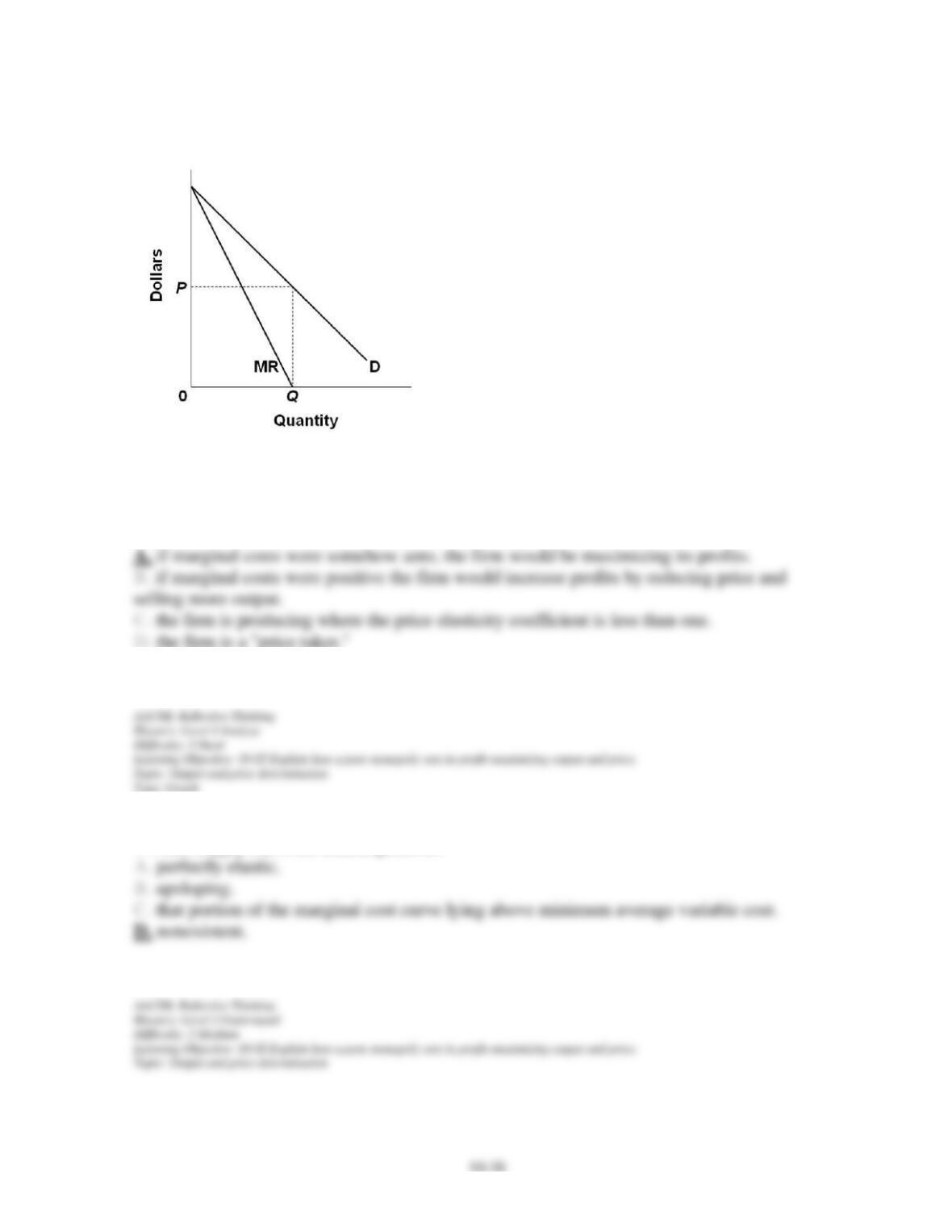
96. Assume a pure monopolist is charging price P and selling output Q as shown on the above
diagram. On the basis of this information we can say that:
97. The supply curve for a monopolist is:
Chapter 10 – Pure Monopoly
98. The supply curve of a pure monopolist:
99. If the variable costs of a profit-maximizing pure monopolist decline, the firm should:
100. To maximize profit a pure monopolist must:
Chapter 10 – Pure Monopoly
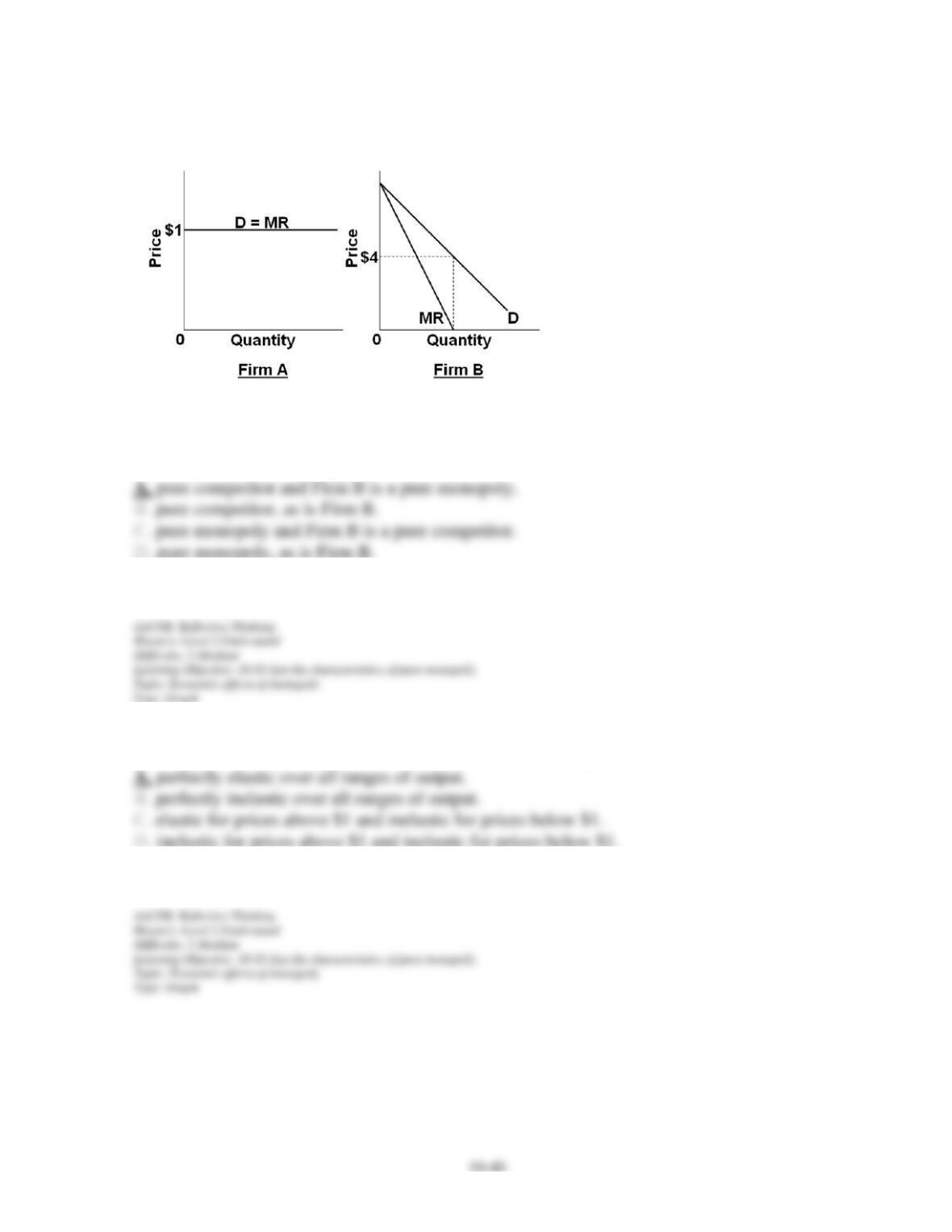
101. Refer to the above diagrams. Firm A is a:
102. Refer to the above diagrams. The demand for Firm A’s product is: