Chapter 10 – Pure Monopoly
1. Pure monopoly refers to:
2. Which of the following is correct?
Chapter 10 – Pure Monopoly
3. A purely monopolistic firm:
4. Pure monopolists may obtain economic profits in the long run because:
5. Which of the following best approximates a pure monopoly?
Chapter 10 – Pure Monopoly
6. Which of the following is a characteristic of pure monopoly?
7. Which of the following is not a barrier to entry?
8. Barriers to entering an industry:
Chapter 10 – Pure Monopoly
9. A natural monopoly occurs when:
10. Large minimum efficient scale of plant combined with limited market demand may lead
to:
11. What do economies of scale, the ownership of essential raw materials, and patents have in
common?
Chapter 10 – Pure Monopoly
12. The nondiscriminating pure monopolist’s demand curve:
13. The nondiscriminating monopolist’s demand curve:
14. If a nondiscriminating imperfectly competitive firm is selling its 100th unit of output for
$35, its marginal revenue:
Chapter 10 – Pure Monopoly
10-6
15. For an imperfectly competitive firm:
16. When a firm is on the inelastic segment of its demand curve, it can:
Chapter 10 – Pure Monopoly
10-7
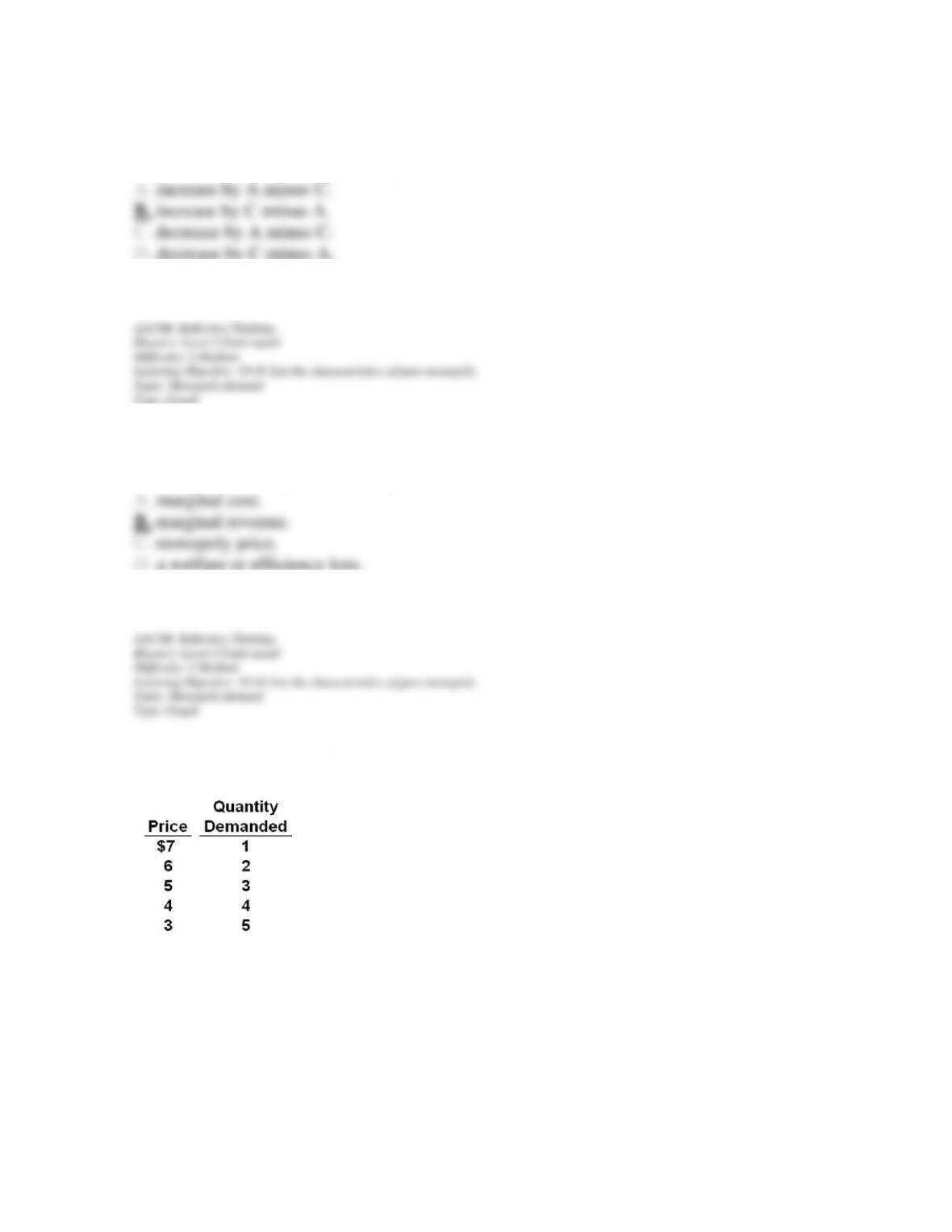
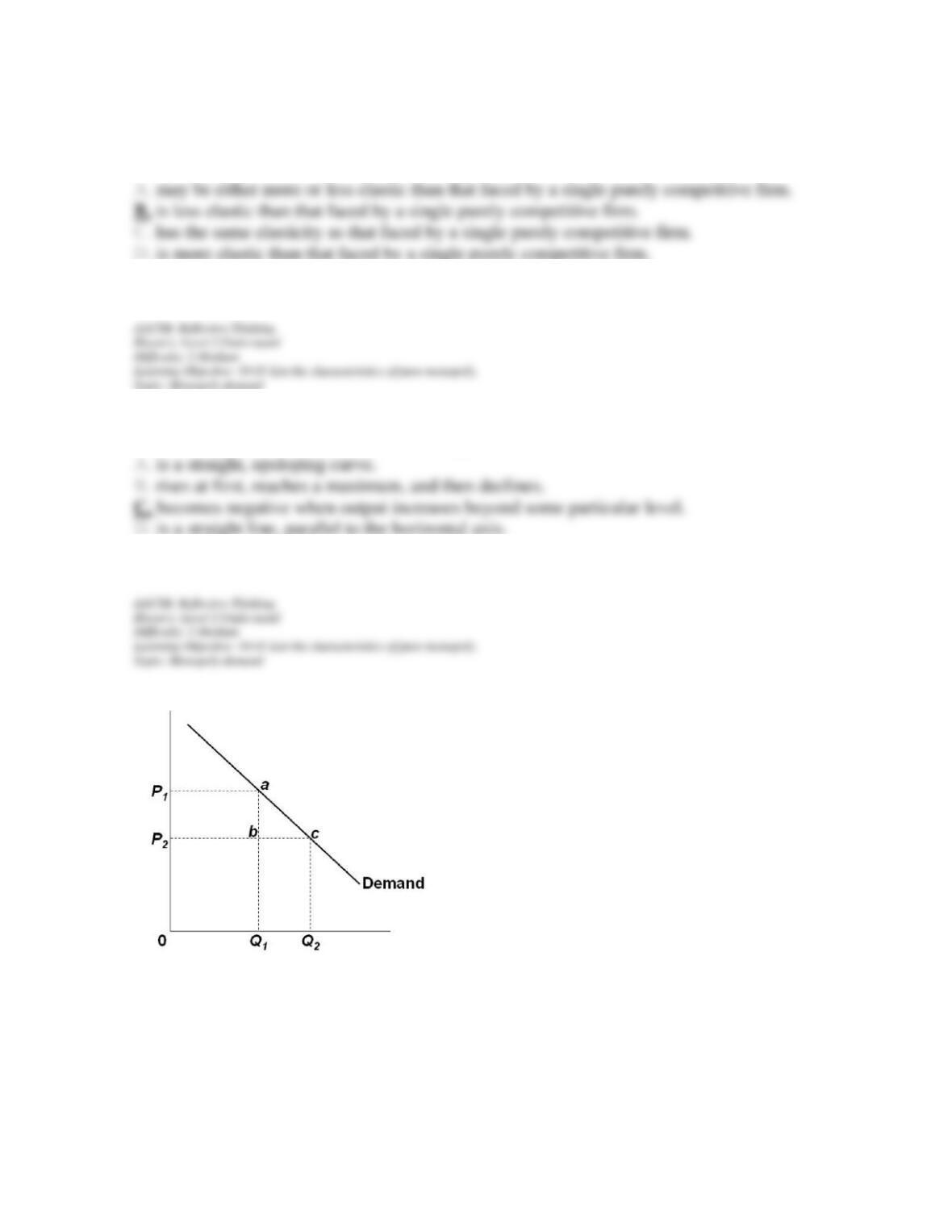
17. Refer to the above diagram. If price is reduced from P1 to P2, total revenue will:
18. Refer to the above diagram. The quantitative difference between areas A and C for
reducing the price from P1 to P2 measures:
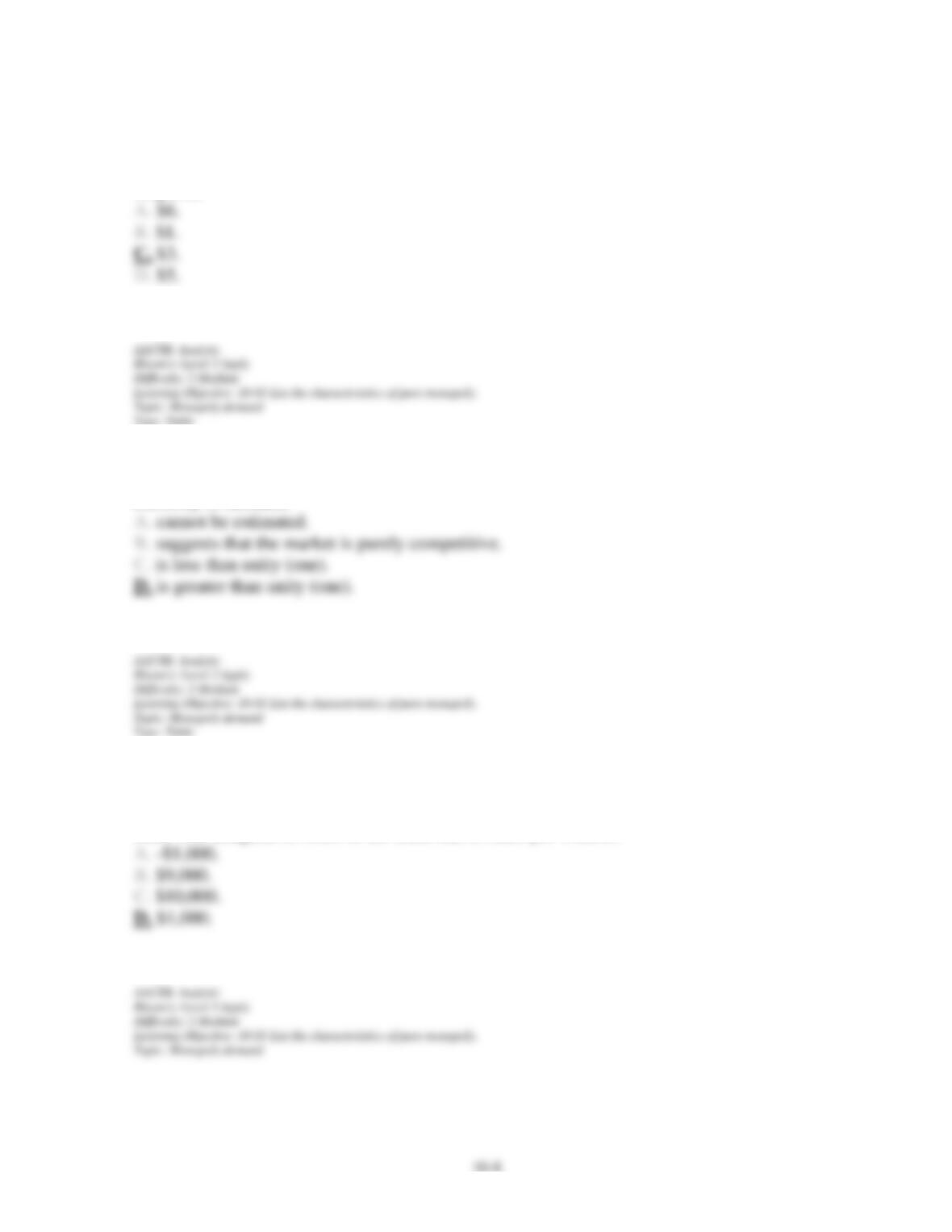
Answer the question on the basis of the demand schedule shown below:
Chapter 10 – Pure Monopoly
19. Refer to the above data. The marginal revenue obtained from selling the third unit of
output is:
20. Refer to the above data. At the point where 3 units are being sold, the coefficient of price
21. A monopolistic firm has a sales schedule such that it can sell 10 prefabricated garages per
week at $10,000 each, but if it restricts its output to 9 per week it can sell these at $11,000
each. The marginal revenue of the tenth unit of sales per week is:
Chapter 10 – Pure Monopoly
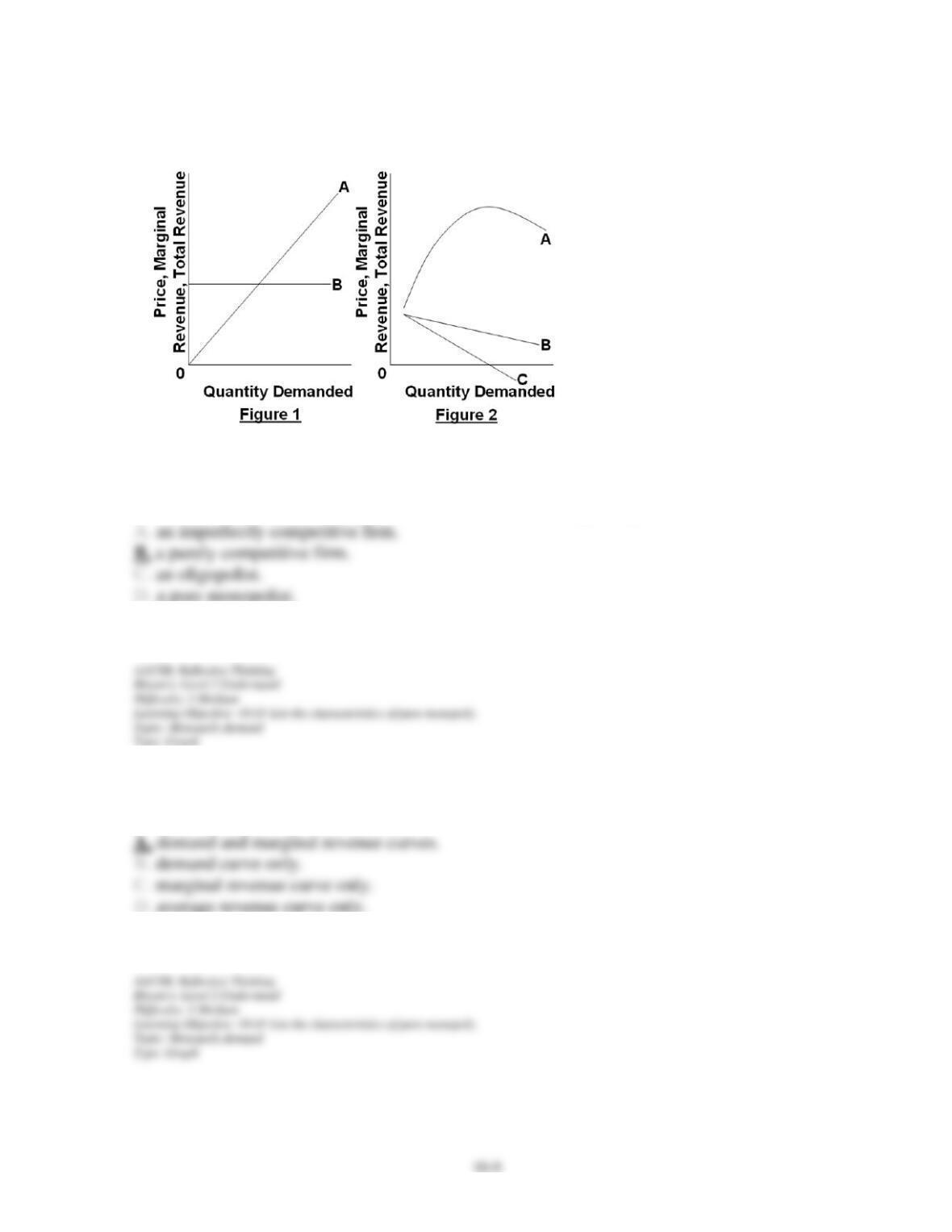
22. Refer to the above two diagrams for individual firms. Figure 1 pertains to:
23. Refer to the above two diagrams for individual firms. In Figure 1 line B represents the
firm’s:
Chapter 10 – Pure Monopoly
24. Refer to the above two diagrams for individual firms. In Figure 1, line A represents the
25. Refer to the above two diagrams for individual firms. Figure 2 pertains to:
26. Refer to the above two diagrams for individual firms. In Figure 2 the firm’s demand and
marginal revenue curves are represented by:
Chapter 10 – Pure Monopoly
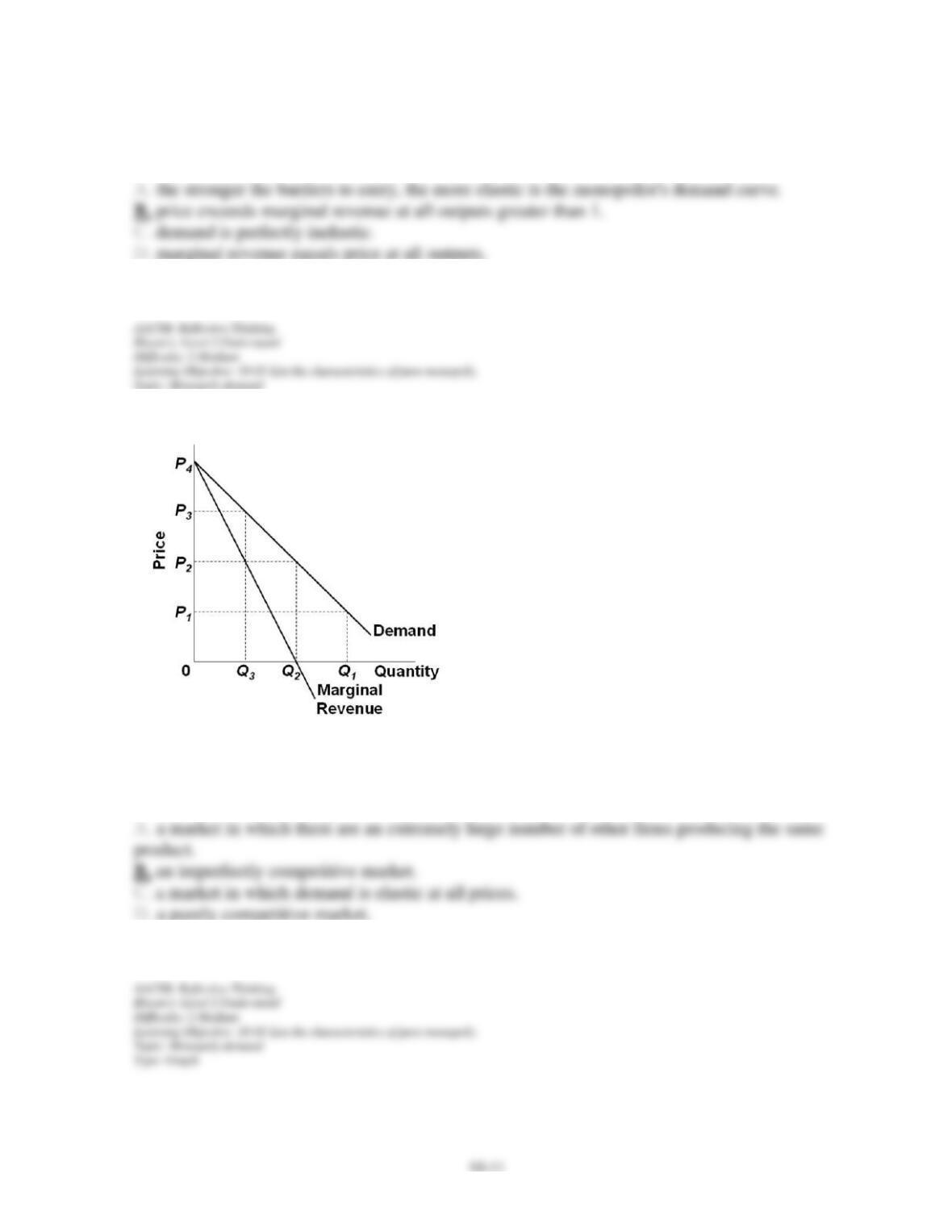
27. With respect to the pure monopolist’s demand curve it can be said that:
28. Refer to the above diagram. This firm is selling in:
Chapter 10 – Pure Monopoly
29. Refer to the above diagram. Demand is relatively elastic:
30. Refer to the above diagram. Demand is relatively inelastic:
31. Refer to the above diagram. If this somehow was a costless product (that is, the total cost
of any level of output was zero), the firm would maximize profits by:
Chapter 10 – Pure Monopoly
10–13
32. The demand curve faced by a pure monopolist:
33. The marginal revenue curve for a monopolist:
Chapter 10 – Pure Monopoly
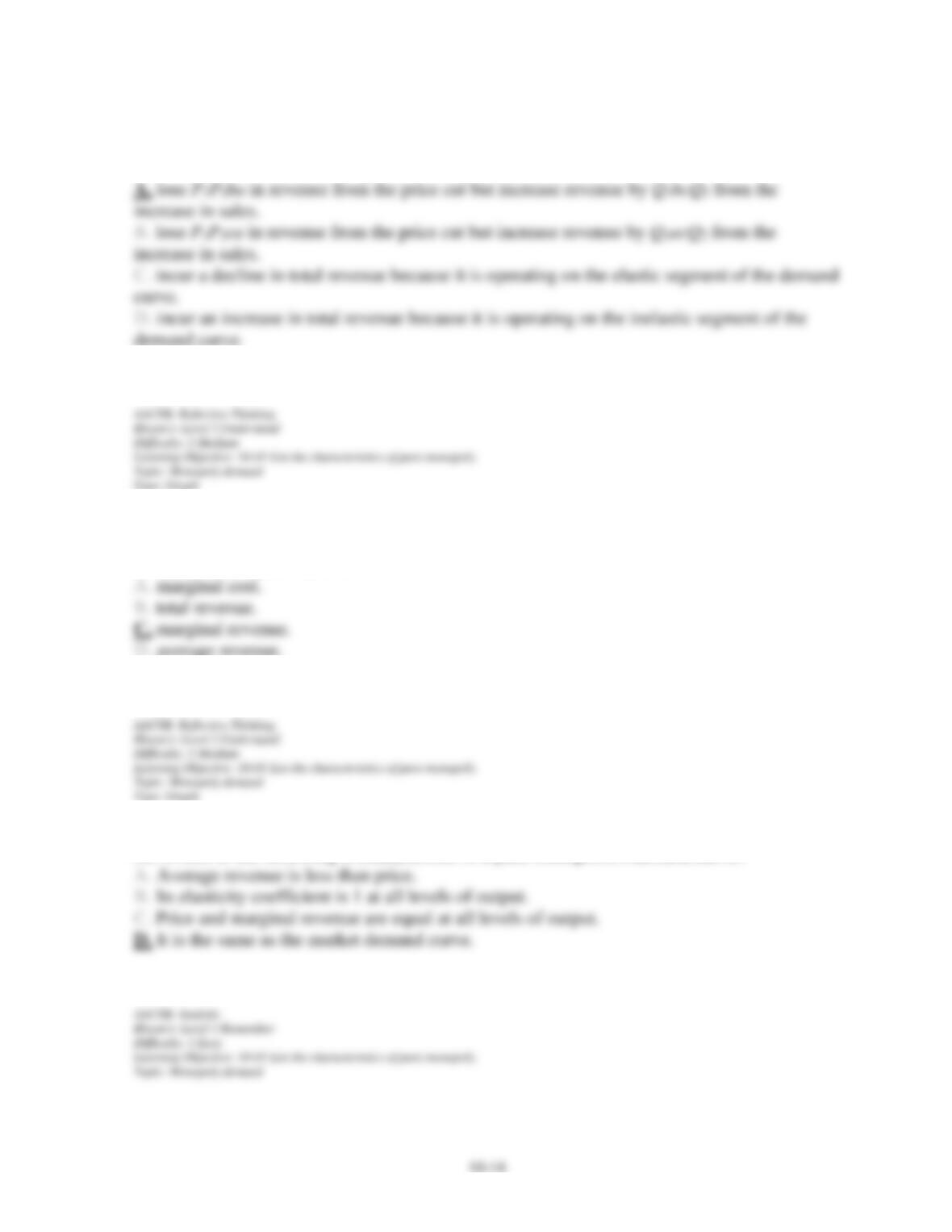
34. If the firm in the above diagram lowers price from P1 to P2, it will:
35. Refer to the above diagram. The quantitative difference between areas Q1bcQ2and P1P2ba
in the above diagram measures:
Chapter 10 – Pure Monopoly
37. Because the monopolist’s demand curve is downsloping:
38. The pure monopolist’s demand curve is relatively elastic:
39. A nondiscriminating profit-maximizing monopolist:
Chapter 10 – Pure Monopoly
10–16
40. For a pure monopolist the relationship between total revenue and marginal revenue is such
that:
41. For a pure monopolist marginal revenue is less than price because:
Chapter 10 – Pure Monopoly
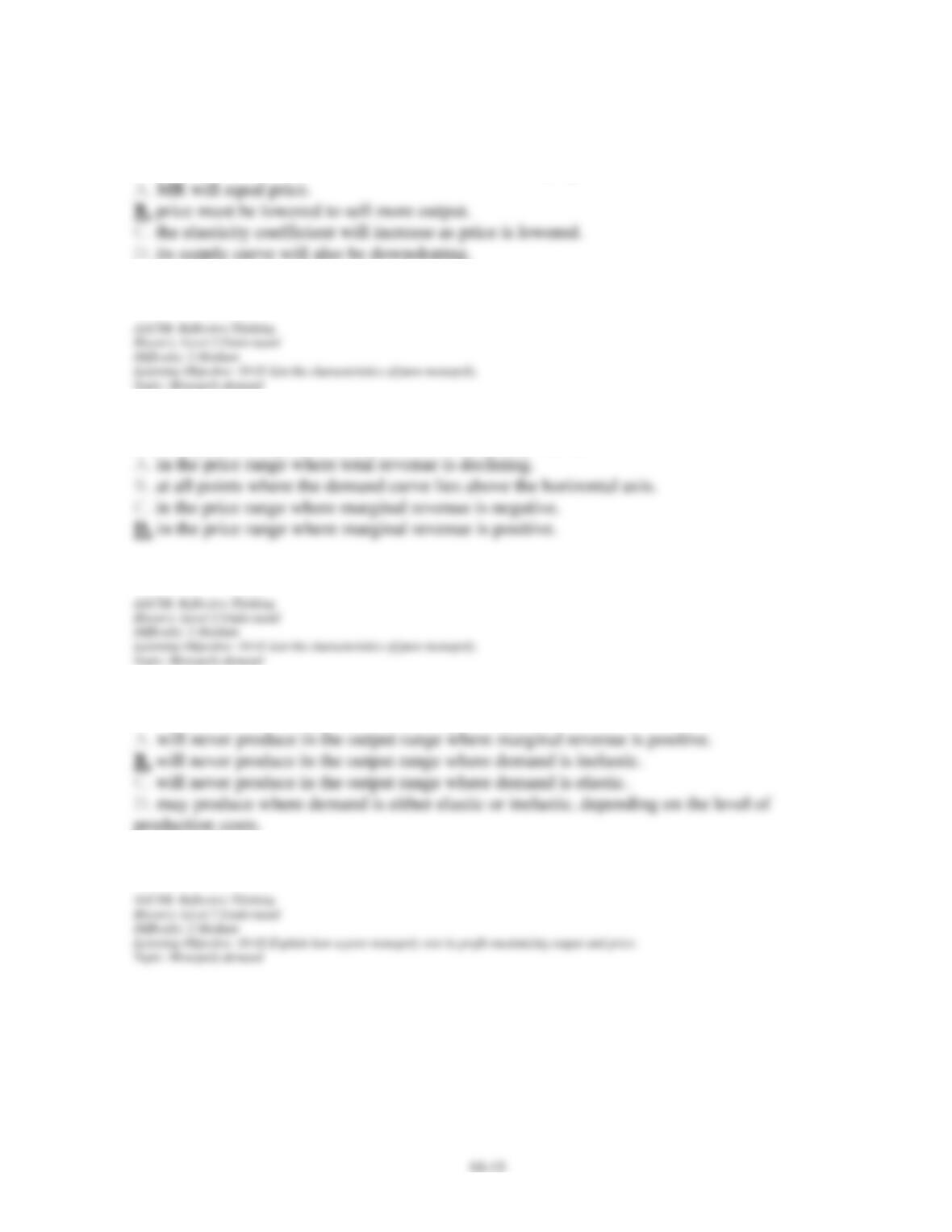
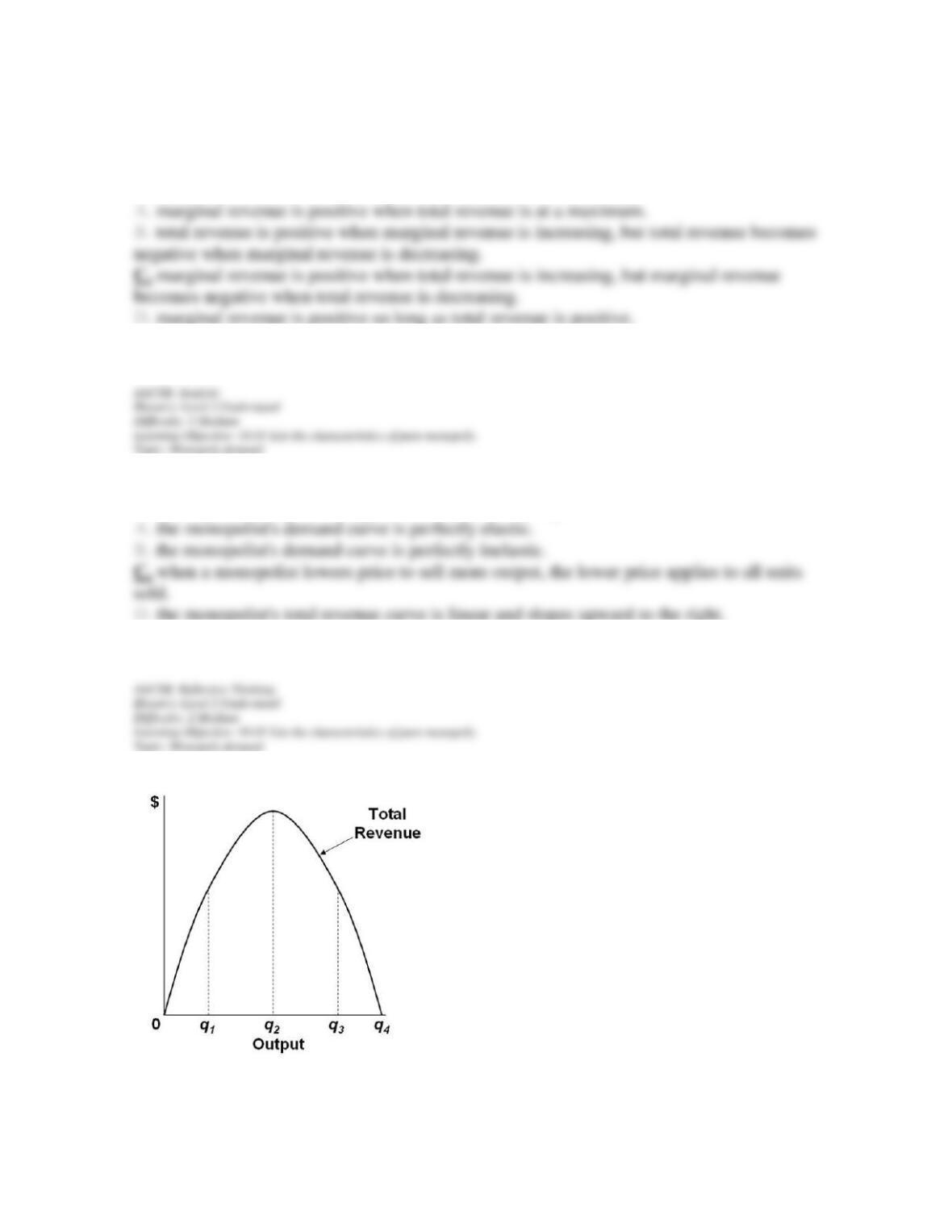
42. Refer to the above diagram for a nondiscriminating monopolist. Demand is elastic:
43. Refer to the above diagram for a nondiscriminating monopolist. Marginal revenue will be
zero at output:
44. Refer to the above diagram for a nondiscriminating monopolist. The profit-seeking
monopolist will:
Chapter 10 – Pure Monopoly
45. Assume a pure monopolist is currently operating at a price-quantity combination on the
inelastic segment of its demand curve. If the monopolist is seeking maximum profits, it
should:
46. A pure monopolist should never produce in the:
47. Assuming no change in product demand, a pure monopolist:
Chapter 10 – Pure Monopoly
48. If a monopolist were to produce in the inelastic segment of its demand curve:
49. If a pure monopolist is operating in a range of output where demand is elastic:
50. Suppose a pure monopolist is charging a price of $12 and the associated marginal revenue
is $9. We thus know that:
Chapter 10 – Pure Monopoly
51. A pure monopolist is selling 6 units at a price of $12. If the marginal revenue of the
seventh unit is $5, then:
52. The vertical distance between the horizontal axis and any point on a nondiscriminating
monopolist’s demand curve measures: