Chapter 10 – Pure Monopoly
1. One feature of pure monopoly is that the monopolist is:
2. One defining characteristic of pure monopoly is that:
Chapter 10 – Pure Monopoly
3. Which phrase would be most characteristic of pure monopoly?
4. The classic example of a private, unregulated monopoly is:
5. One major barrier to entry under pure monopoly arises from:
Chapter 10 – Pure Monopoly
6. Barriers to entry:
7. Which of the following is a barrier to entry?
8. A monopoly is most likely to emerge and be sustained when:
Chapter 10 – Pure Monopoly
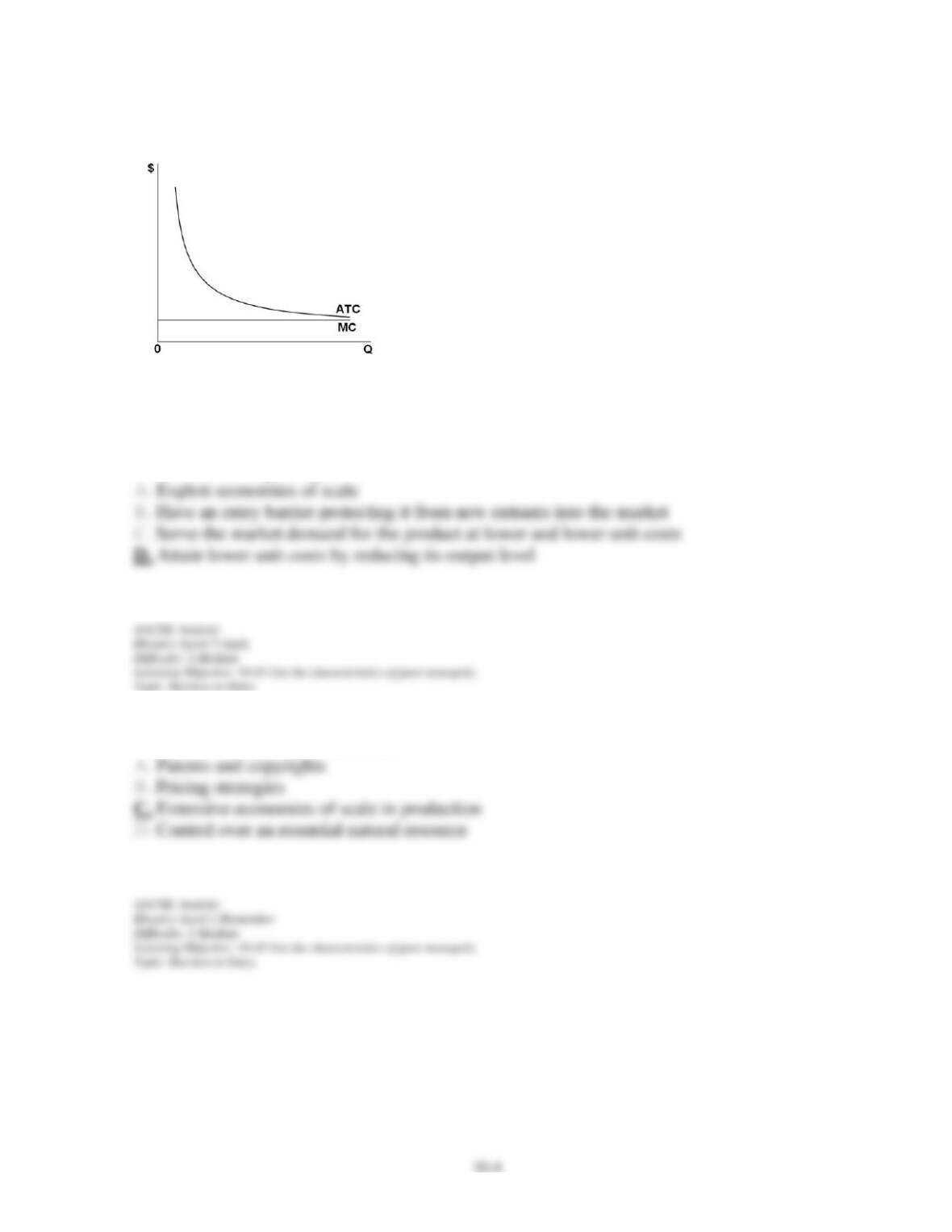
9. A firm that has the long-run cost curves shown in the graph above would be able to do or
have the following, except:
10. Natural monopolies result from:
Chapter 10 – Pure Monopoly
11. Which of the following is not a barrier to entry in an industry?
12. In many large U.S. cities, taxicabs operate as near monopolies because of:
13. An exclusive right granted by government for twenty years to an inventor of a product is
a:
Chapter 10 – Pure Monopoly
14. One feature of pure monopoly is that the demand curve:
15. The non-discriminating pure monopolist must decrease price on all units of a product sold
in order to sell more units. This explains why:
16. The demand curve confronting a non-discriminating pure monopolist is:
Chapter 10 – Pure Monopoly
17. Under pure monopoly, a profit-maximizing firm will produce:
18. Given a downward-sloping linear demand curve, if total revenue decreases as quantity
rises, marginal revenue must be:
19. At which combination of price and marginal revenue (P, MR) is the price elasticity of
demand greater than 1?
Chapter 10 – Pure Monopoly
20. A non-discriminating monopolist will find that marginal revenue:
21. If a monopolist is operating at an output level where marginal revenue is positive, the
firm:
22. Suppose a monopolist produces output where total revenue is maximized. At that output,
the price elasticity of demand for the monopolist’s output is:
Chapter 10 – Pure Monopoly
23. A pure monopoly firm will never charge a price in the inelastic range of its demand curve
because lowering price to get into this region will:
24. The region of demand in which the monopolist will choose a price-output combination
will be:
25. In the inelastic portion of a monopolist’s demand curve, an increase in price will:
Chapter 10 – Pure Monopoly
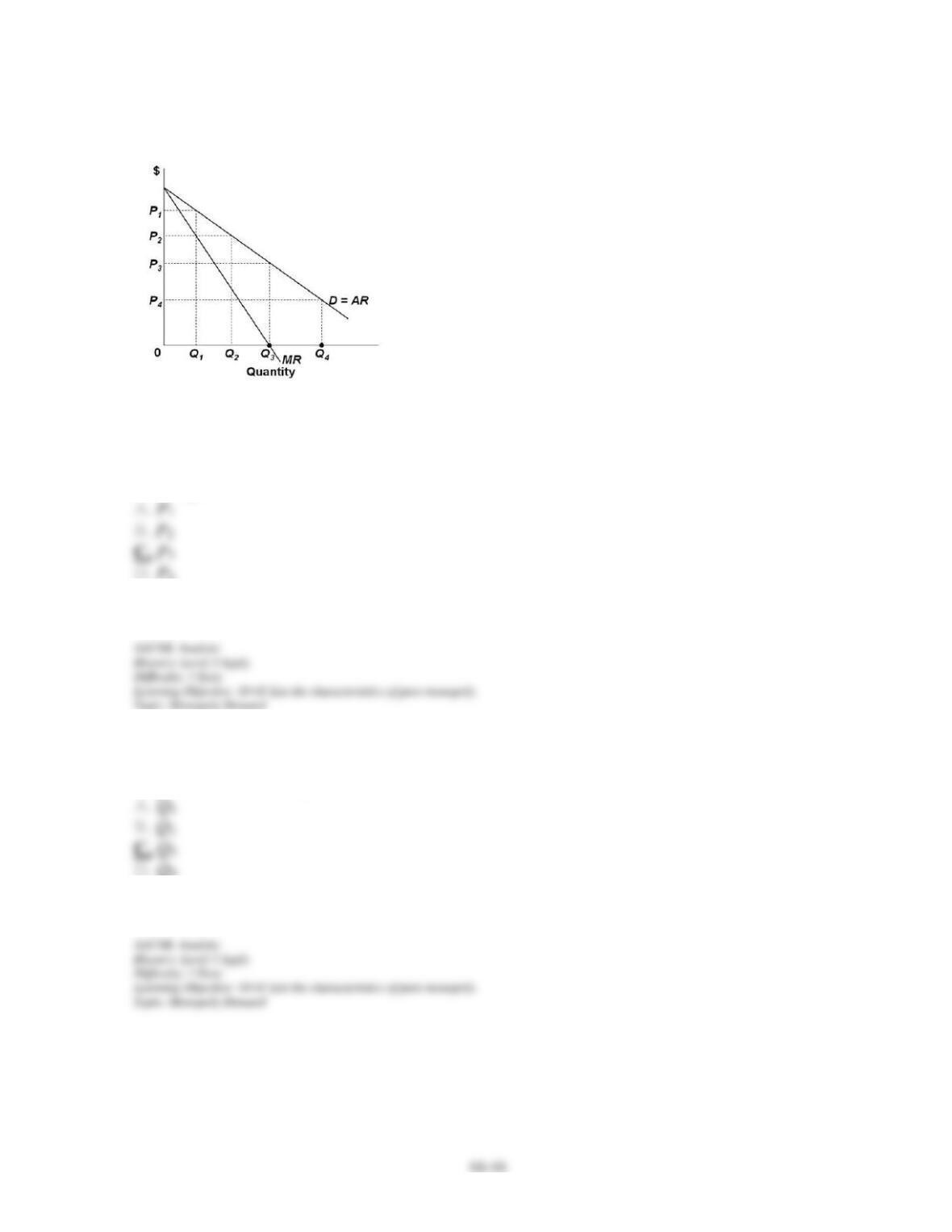
26. Refer to the above graph showing the revenue curves for a monopolist. What price should
be charged in order to maximize total revenue?
27. Refer to the above graph showing the revenue curves for a monopolist. Total revenue will
be greatest at what output level?
Chapter 10 – Pure Monopoly
28. Refer to the above graph showing the revenue curves for a monopolist. The elastic portion
of the demand curve ranges from quantity:
29. Refer to the above graph showing the revenue curves for a monopolist. At what output
level is demand inelastic?
30. Refer to the above graph showing the revenue curves for a monopolist. If it wants to sell
quantity Q1, it must charge a price:
Chapter 10 – Pure Monopoly
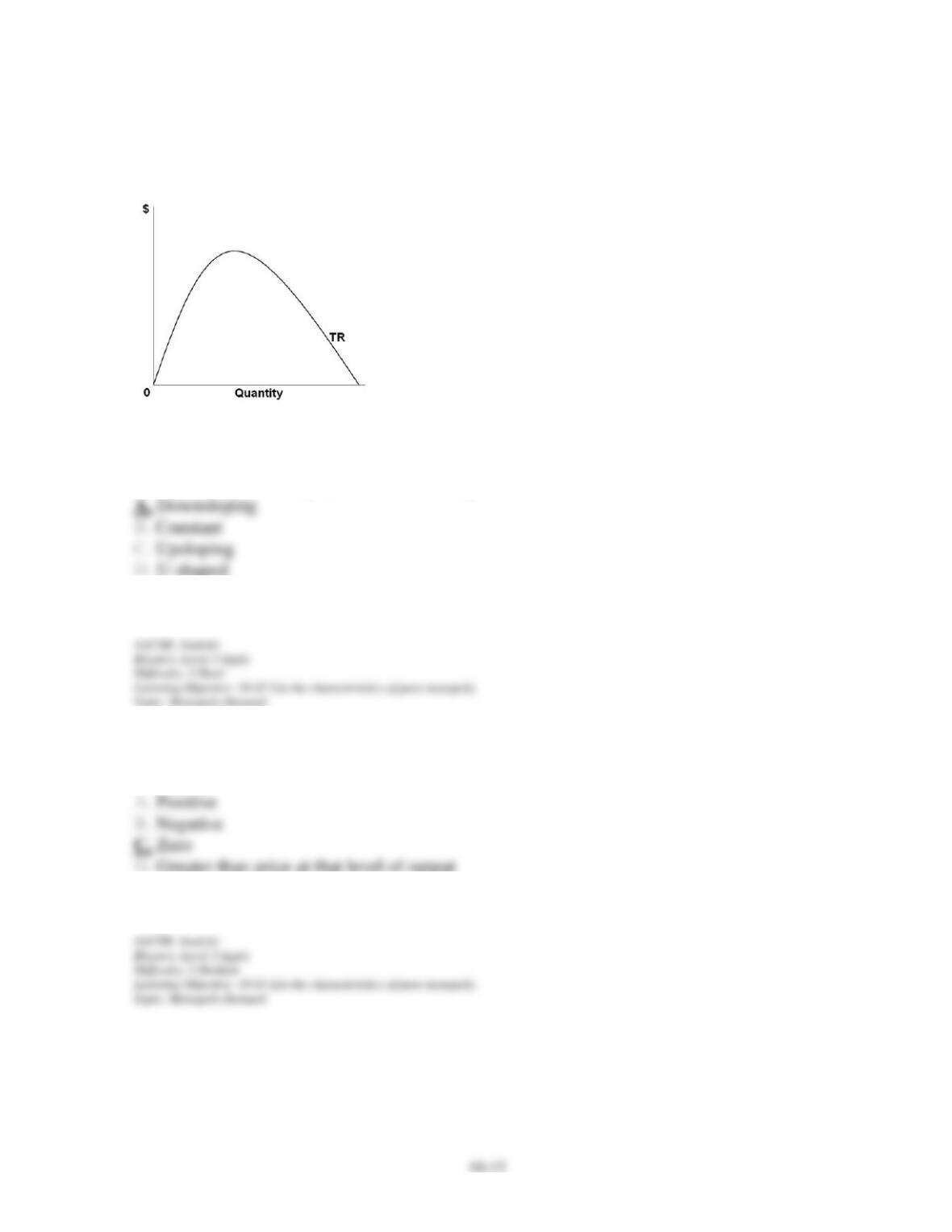
The following graph shows a total revenue curve for a monopolist
31. Refer to the above graph. The firm’s marginal revenue curve must be:
32. Refer to the above graph. When the total revenue curve reaches a maximum, marginal
revenue is:
Chapter 10 – Pure Monopoly
33. Refer to the above graph. When total revenue declines as output expands, demand is:
34. Refer to the above graph. When total revenue falls as output expands, marginal revenue
is:
35. Refer to the above graph. The profit-maximizing firm will produce in that output level
where total revenue is:
Chapter 10 – Pure Monopoly
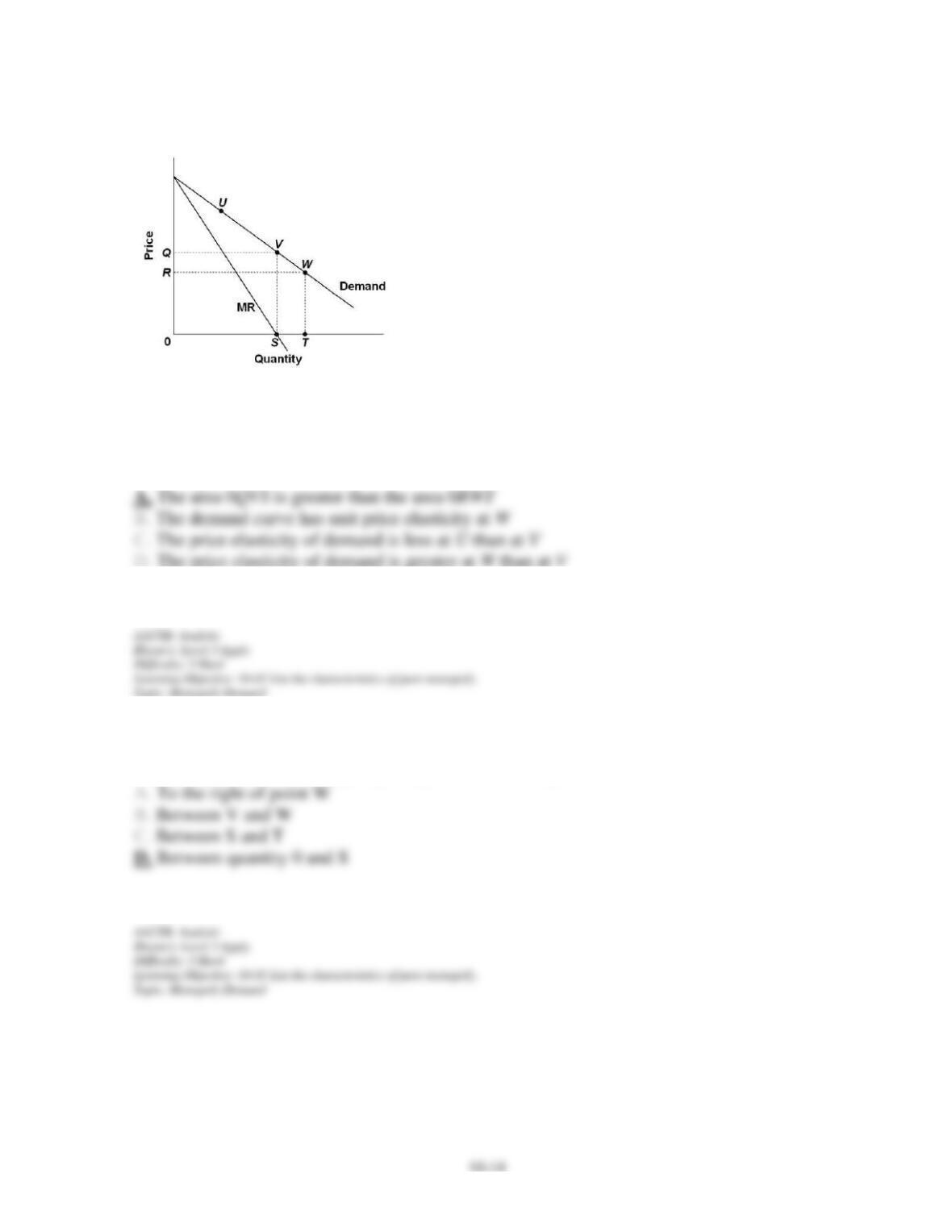
36. Refer to the above graph showing a linear demand curve for a monopolist. Which of the
following statements is correct?
37. Refer to the above graph showing a linear demand curve for a monopolist. In which range
of the demand curve (or output quantity) will the firm operate?
Chapter 10 – Pure Monopoly
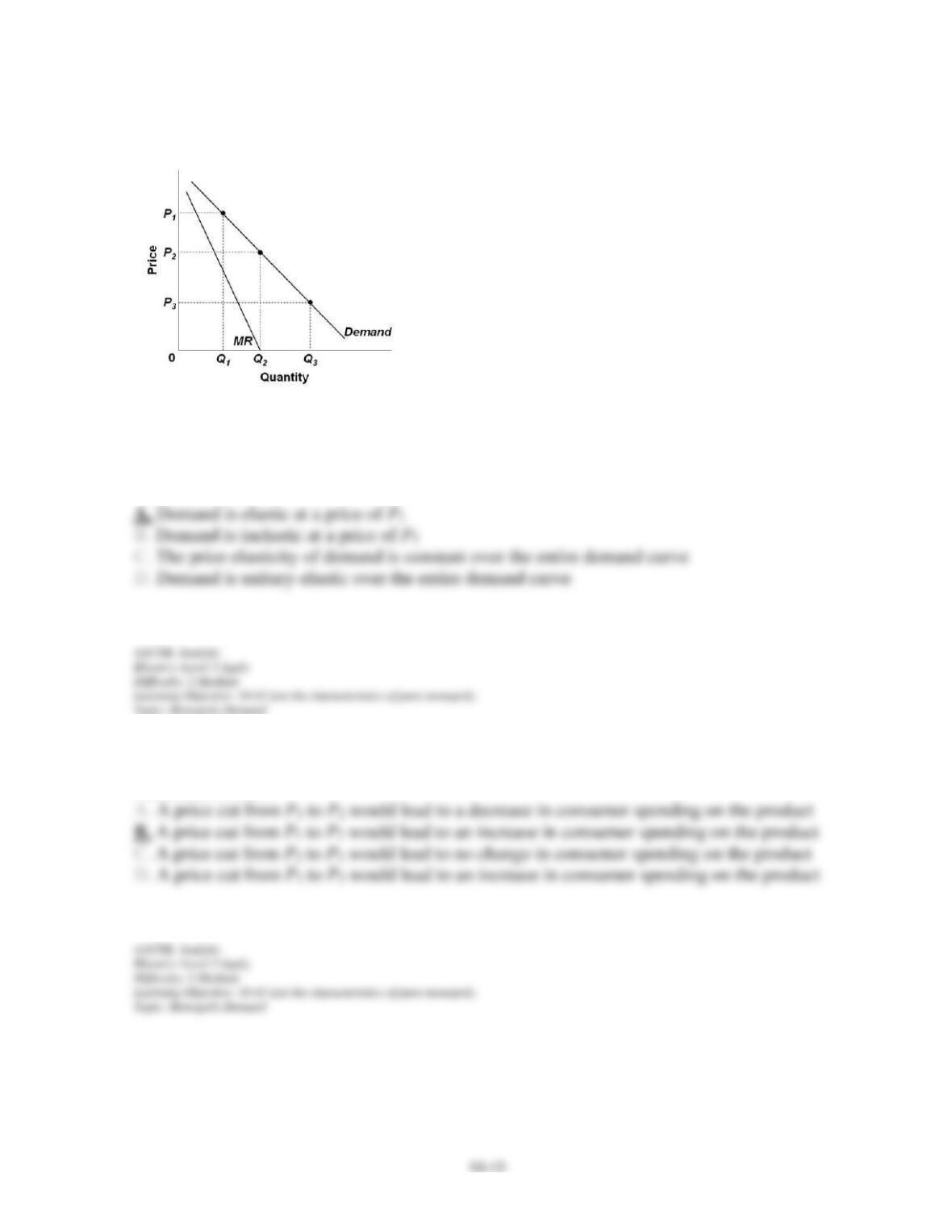
38. Refer to the above graph of D and MR for a monopolist. Which of the following
statements is true?
39. Refer to the above graph of D and MR for a monopolist. Which of the following
statements is true?
Chapter 10 – Pure Monopoly
10–16
40. Refer to the above graph of D and MR for a monopolist. We know that to maximize
profits the firm will set a price:
41. At its present level of output, the marginal revenue for a pure monopolist is zero. Its price
elasticity of demand at that level of output must be:
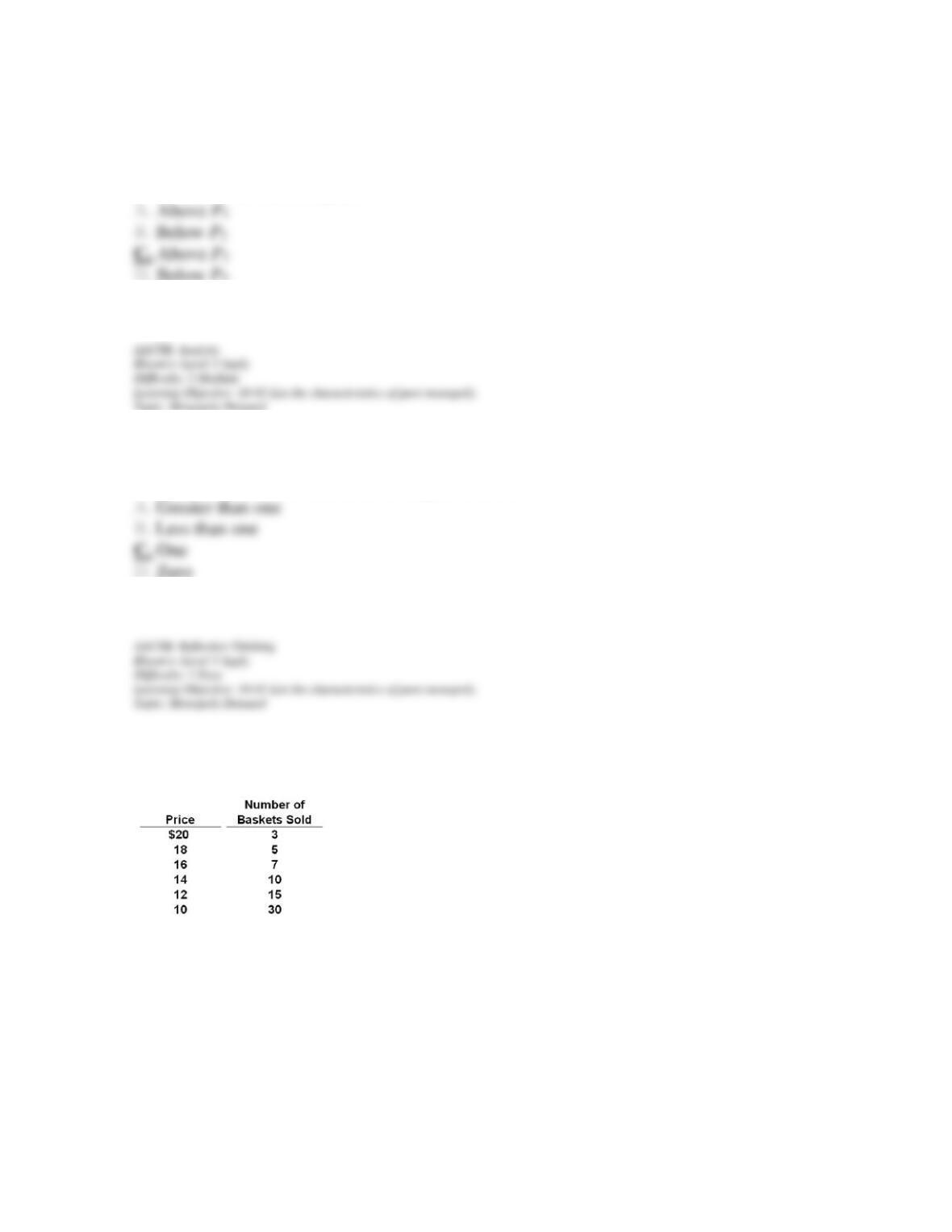
The table shows the demand schedule facing Nina, a monopolist selling baskets.
Chapter 10 – Pure Monopoly
42. Refer to the above table for Nina. What is the change in total revenue if she lowers the
price from $20 to $18?
43. Refer to the above table for Nina. What is the change in total revenue if she raises the
price from $10 to $12?
Chapter 10 – Pure Monopoly
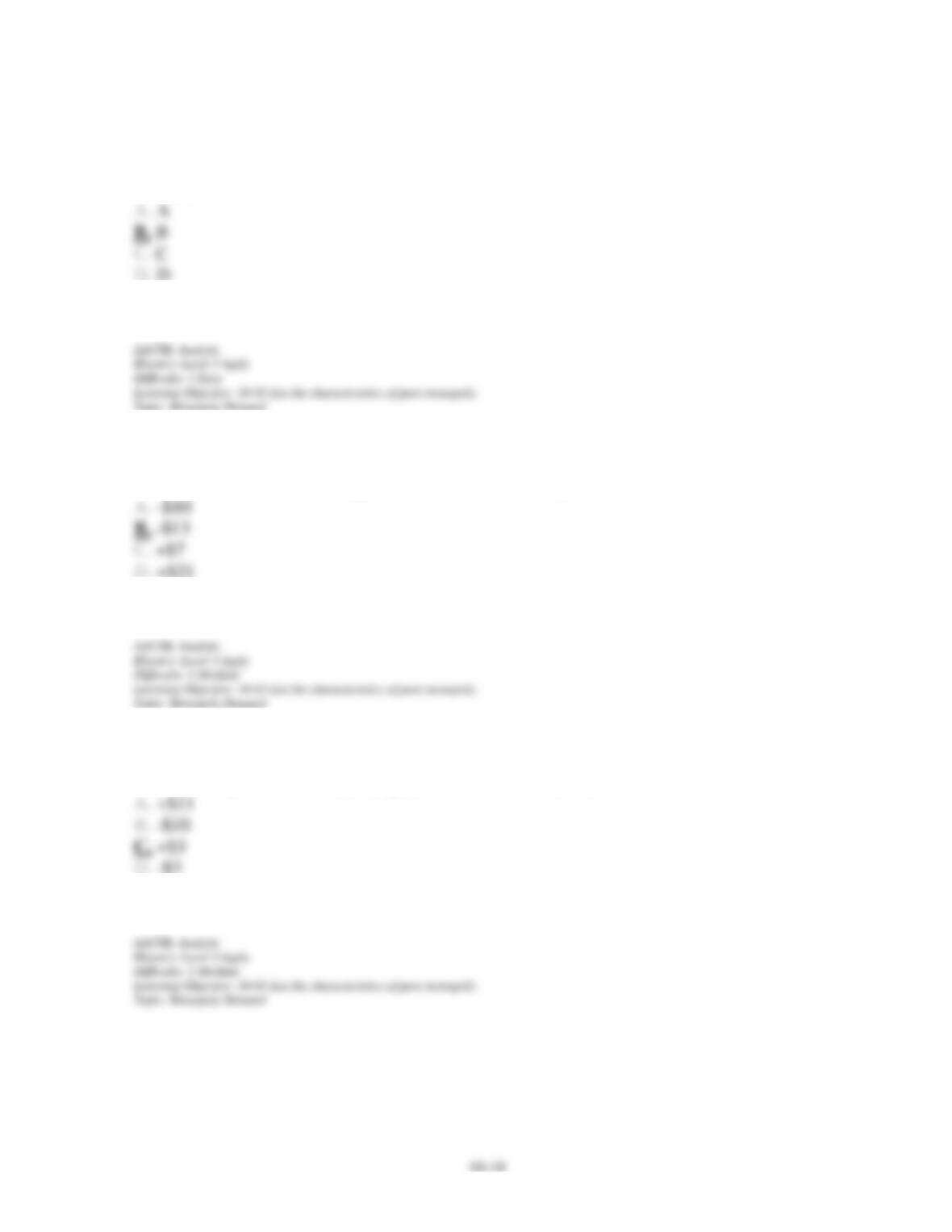
44. Which of the above shows the correct relationship between demand and marginal
revenue?
45. A monopolist can sell 20 toys per day for $8.00 each. To sell 21 toys per day, the price
must be cut to $7.00. The marginal revenue of the 21st toy is:
46. A monopolist can sell 8 units of a product per day at a unit price of $12. To sell 9 units, it
must reduce price to $11. The marginal revenue of the 9th unit is:
Chapter 10 – Pure Monopoly
47. A monopolist sells 6 units of a product per day at a unit price of $15. If it lowers price to
$14, its total revenue increases by $22. This implies that its sales quantity increases by:
48. A monopolist can sell 10 units at $12 per unit, and 9 units at a price of $13 per unit. The
marginal revenue from the 10th unit is:
49. For a monopolist to sell an output level of 10 units, the price must be $8. MR at this
output level will be:
Chapter 10 – Pure Monopoly
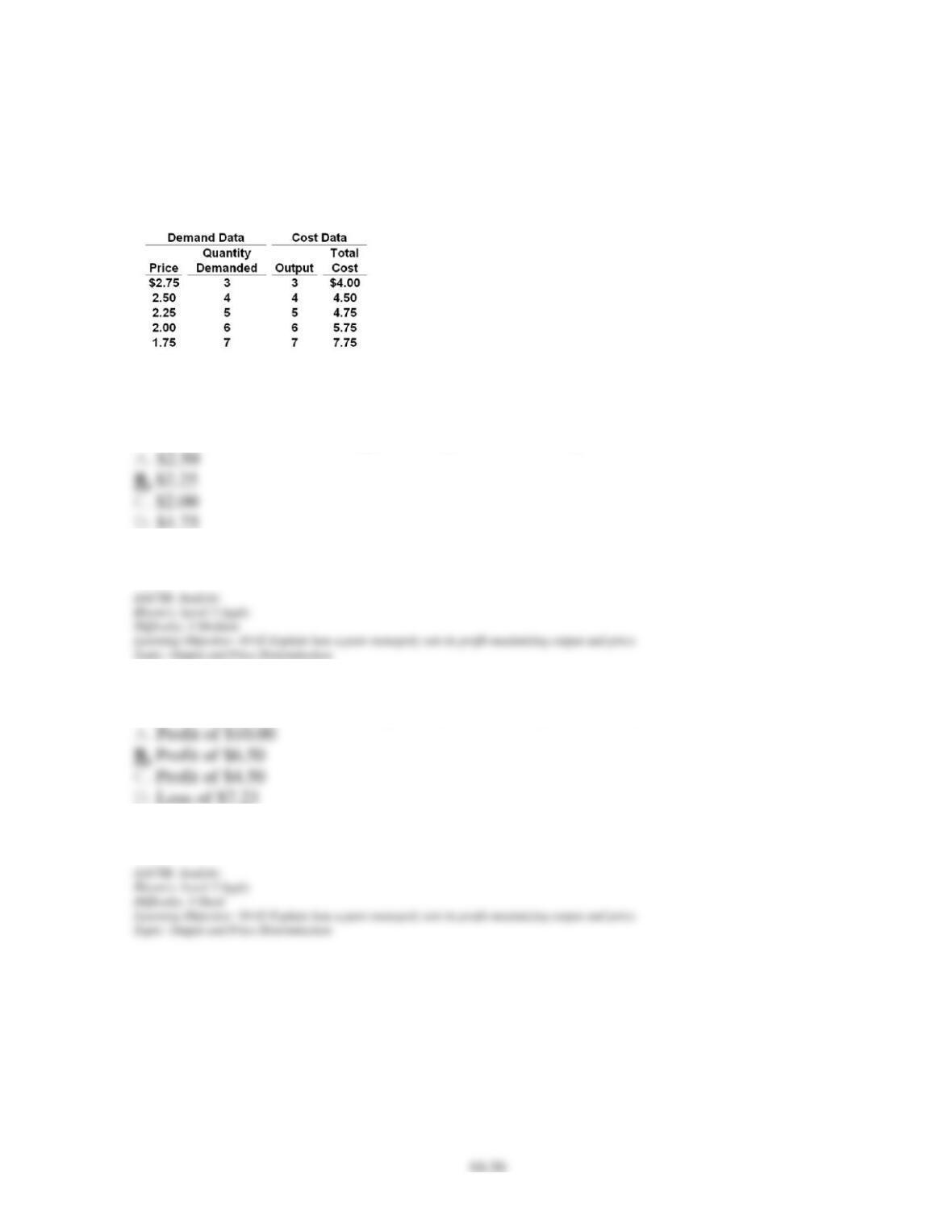
Answer the question below on the basis of the following demand and cost data for a pure
monopolist.
50. Refer to the above table. Equilibrium price of the monopolist will be:
51. Refer to the above table. At equilibrium, the monopolist will realize a: