b.
an industry in which numerous firms produce identical products.
c.
an industry untouched by government regulation.
d.
the kind of industry any American would support.
DISC: Perfect competition
United States – BPROG: Analytic
Perfect competition
Perfect Competition Defined
76. Economists study perfect competition
a.
because many markets are perfectly competitive.
b.
for its descriptive realism.
c.
to establish a benchmark by which to measure the performance of the economy.
d.
All of the above are correct.
DISC: Perfect competition
United States – BPROG: Analytic
Perfect competition
Perfect Competition Defined
77. Which of the following is closest to the economist’s definition of perfect competition?
a.
the airline industry
b.
the soft drink industry
c.
the fishing industry
d.
cellular telephone service
DISC: Perfect competition
United States – BPROG: Analytic
Perfect competition
Perfect Competition Defined
78. The result that perfectly competitive firms produce at the lowest per-unit cost is derived from the assumptions of
a.
homogeneous products.
b.
few sellers.
c.
firms facing horizontal demand curves.
d.
free entry and exit.
DISC: Perfect competition
United States – BPROG: Reflective Thinking – BPROG: Analysis
Perfect competition
Perfect Competition Defined
79. In a market with perfectly competitive firms, the market demand curve is usually ____ and the demand curve facing
each individual firm ____.
a.
upward sloping; horizontal
b.
downward sloping; horizontal
c.
horizontal; downward sloping
d.
downward sloping; downward sloping
DISC: Perfect competition
United States – BPROG: Analytic
Perfect competition
The Perfectly Competitive Firm
80. A firm facing a horizontal demand curve
a.
cannot affect the price it receives for its output.
b.
always produces at an output at which P = MR.
c.
faces perfectly elastic demand for its product.
d.
All of the above are correct.
DISC: Perfect competition
United States – BPROG: Analytic
Perfect competition
The Perfectly Competitive Firm
81. What is the nature of the elasticity of the demand curve faced by perfectly competitive firm?
a.
Perfectly inelastic
b.
Perfectly elastic
c.
Unit elastic
d.
Highly elastic
DISC: Perfect competition
United States – BPROG: Analytic
Perfect competition
The Perfectly Competitive Firm
82. Which of the following decisions cannot be taken by a firm in a perfectly competitive market?
a.
Market exit decision
b.
Market price of the product
c.
Quantity of output it can produce
d.
Entering a market
DISC: Perfect competition
United States – BPROG: Analytic
Perfect competition
The Perfectly Competitive Firm
83. For a perfectly competitive firm, marginal revenue equals average revenue because the
a.
firm’s supply curve is horizontal.
b.
industry’s demand curve is horizontal.
c.
firm’s demand curve is horizontal.
d.
industry’s supply curve is horizontal.
DISC: Perfect competition
United States – BPROG: Analytic
Perfect competition
The Perfectly Competitive Firm
84. In a perfectly competitive industry, influence over price is exerted by
a.
individual sellers.
b.
individual buyers.
c.
the largest firms.
d.
the forces of supply and demand.
DISC: Perfect competition
United States – BPROG: Analytic
Perfect competition
The Perfectly Competitive Firm
85. The perfectly competitive firm has no influence over price because
a.
its output is so insignificant relative to the market as a whole.
b.
anti-trust laws constrain perfectly competitive firms.
c.
consumers establish the prices of products.
d.
it doesn’t know its demand curve.
DISC: Perfect competition
United States – BPROG: Analytic
Perfect competition
The Perfectly Competitive Firm
86. Which of the following observations is not true?
a.
Demand curve of the perfectly competitive firm is perfectly elastic.
b.
There is only one price for a product in a perfectly competitive market.
c.
A firm in a perfectly competitive market can sell as much as it wants at market price.
d.
Demand curve of the perfectly competitive industry is perfectly elastic.
DISC: Perfect competition
United States – BPROG: Analytic
Perfect competition
The Perfectly Competitive Firm
87. At a perfectly competitive firm’s short-run equilibrium level of output,
a.
P = MR = MC.
b.
P = MR, but MR does not equal MC.
c.
P = MC, but MR does not equal MC.
d.
MR = MC and P < MR.
DISC: Perfect competition
United States – BPROG: Analytic
Perfect competition
The Perfectly Competitive Firm
BLOOMS: Application
88. In short-run equilibrium, a perfectly competitive firm
a.
may earn a profit or a loss.
b.
always earns a profit.
c.
never earns a profit.
d.
earns a profit only if the firm has no fixed cost.
a
Easy
DISC: Perfect competition
United States – BPROG: Analytic
Perfect competition
The Perfectly Competitive Firm
89. A firm in short-run equilibrium always earns positive profits if
a.
AC > P > AVC.
b.
AR > AC.
c.
MR = MC.
d.
AC > MC.
Moderate
DISC: Perfect competition
United States – BPROG: Analytic
Perfect competition
The Perfectly Competitive Firm
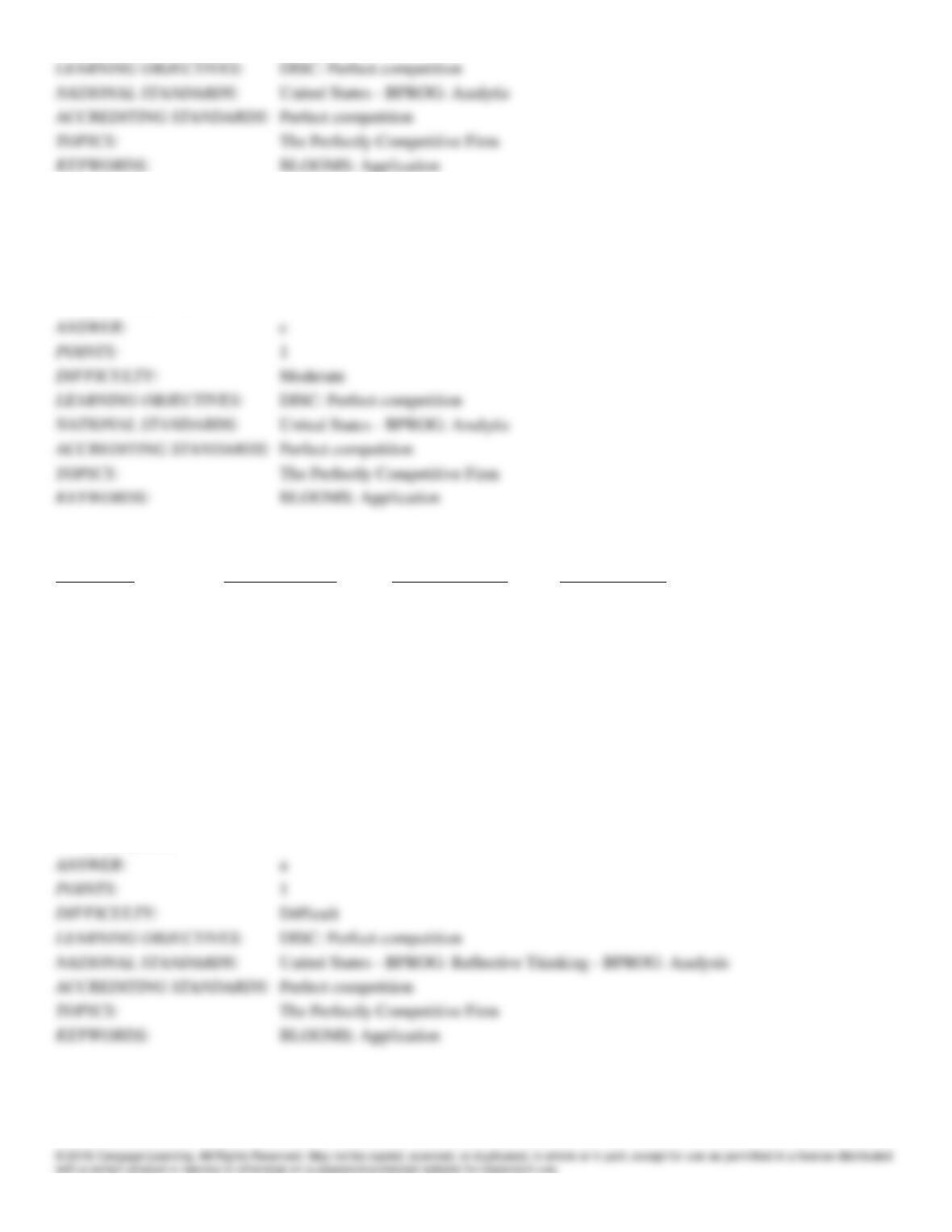
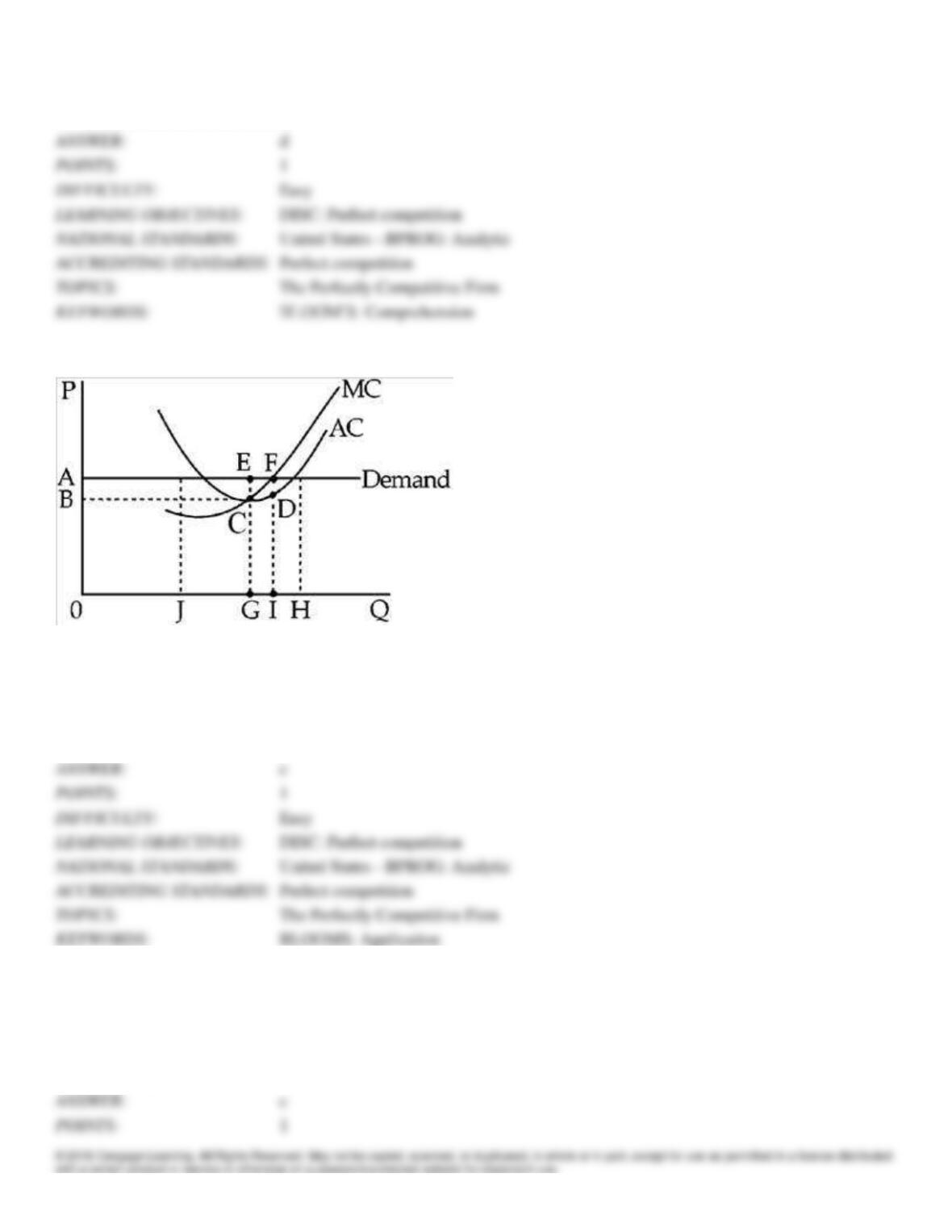
90. If the profit-maximizing firm depicted in Figure 10-1 is perfectly competitive, how much output should it produce?
a.
A
b.
B
c.
C
d.
D
Easy
DISC: Perfect competition
United States – BPROG: Analytic
Perfect competition
The Perfectly Competitive Firm
BLOOMS: Application
91. A firm earns a profit of exactly zero at its optimal output level only if
a.
P = MR.
b.
P = MC.
c.
P = AC.
d.
P = SR AVC.
c
Moderate
DISC: Perfect competition
United States – BPROG: Analytic
Perfect competition
The Perfectly Competitive Firm
BLOOMS: Application
Table 10-1
Q (in units)
AFC (in dollars)
AVC (in dollars)
MC (in dollars)
0
C
C
C
2
2.5
18
10
4
1.25
14
14
6
0.83
18
42
8
0.63
30
94
10
0.5
50
170
92. In Table 10-1 are the short-run cost schedules of a perfectly competitive firm. If the market price of output is $50, the
firm will produce ____ units and earn a profit of ____.
a.
6; $187.02
b.
6; $48
c.
8; $154.96
d.
8; $245.04
a
Difficult
DISC: Perfect competition
United States – BPROG: Reflective Thinking – BPROG: Analysis
Perfect competition
The Perfectly Competitive Firm
BLOOMS: Application
Figure 10-2
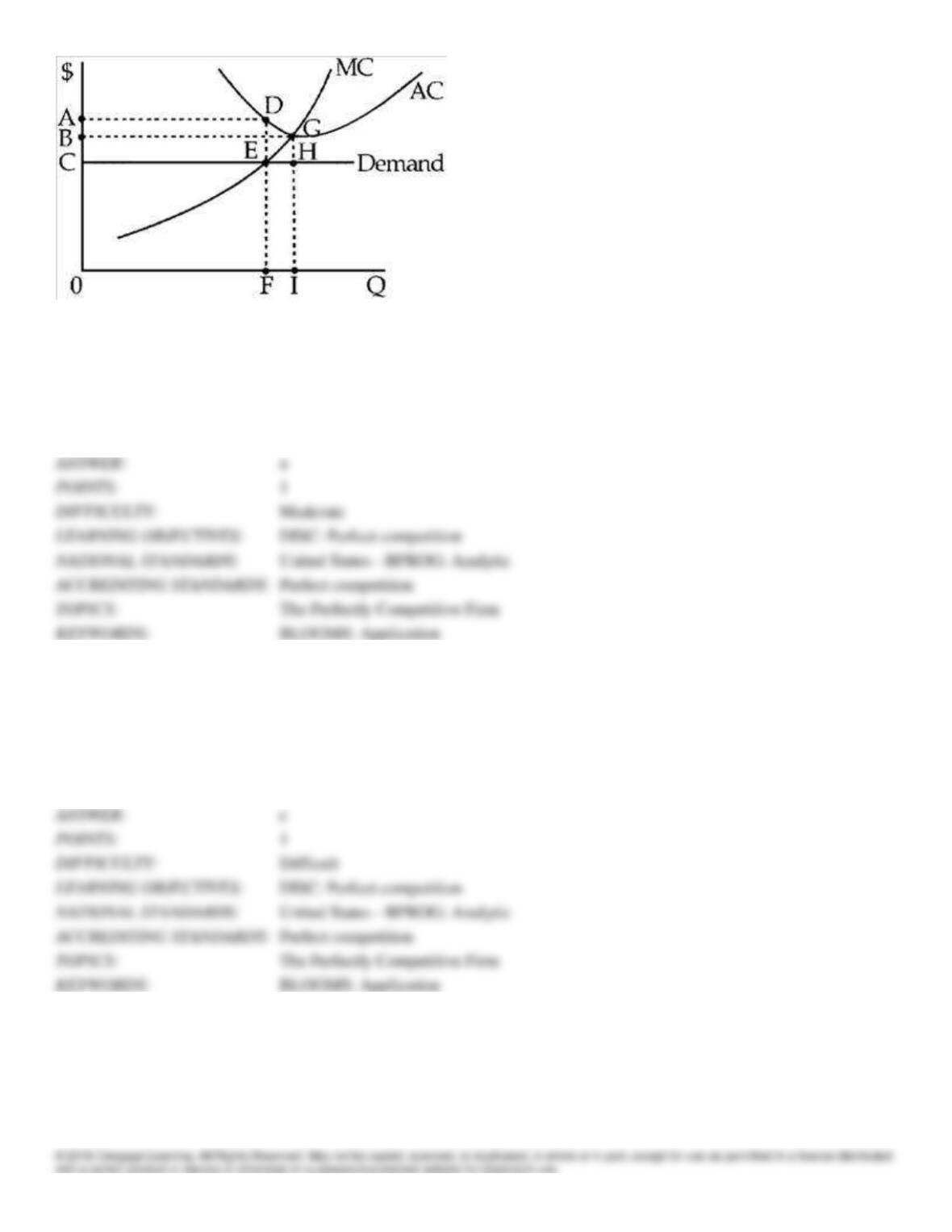
93. Figure 10-2 shows demand and short-run cost curves for a perfectly competitive firm. At its profit-maximizing level
of output, the firm’s short-run TC is represented by area
a.
ADFO.
b.
BGHC.
c.
BGIO.
d.
ADGIO.
a
1
Moderate
DISC: Perfect competition
United States – BPROG: Analytic
Perfect competition
The Perfectly Competitive Firm
BLOOMS: Application
94. Figure 10-2 shows demand and short-run cost curves for a perfectly competitive firm. At its profit-maximizing output,
the firm’s total ____ is represented by area ____.
a.
loss; GBHC
b.
profit; ADGHC
c.
loss; ADEC
d.
profit; EGH
c
1
Difficult
DISC: Perfect competition
United States – BPROG: Analytic
Perfect competition
The Perfectly Competitive Firm
BLOOMS: Application
95. Figure 10-2 shows demand and short-run cost curves for a perfectly competitive firm. In the short run, this firm would
a.
earn positive economic profits.
b.
earn economic losses.
c.
go out of business.
d.
Cannot be determined with the information given.
b
1
DISC: Perfect competition
United States – BPROG: Analytic
Perfect competition
The Perfectly Competitive Firm
BLOOMS: Application
Exhibit 10-1
A perfectly competitive producer has the following short-run average cost curve and marginal cost curve:
SR AC = 2Q + 3
MC = 4Q + 3
where costs are measured in dollars and Q represents the firm’s output in units.
96. If the market price of wangdoodles is $15 each, the profit-maximizing producer whose short-run cost curves are given
in Exhibit 10-1 should produce ____ wangdoodles.
a.
0
b.
3
c.
6
d.
15
b
1
DISC: Perfect competition
Perfect competition
The Perfectly Competitive Firm
BLOOMS: Application
97. The firm whose short-run cost curves are given in Exhibit 10-1 has a long-run fixed cost of
a.
$0.
b.
$2.
c.
$3.
d.
$4.
1
DISC: Perfect competition
United States – BPROG: Analytic
Perfect competition
The Perfectly Competitive Firm
BLOOMS: Application
98. In the short run, perfectly competitive firms can
a.
make an economic profit.
b.
take a loss.
c.
break even.
d.
All of the above are correct.
Easy
DISC: Perfect competition
United States – BPROG: Analytic
Perfect competition
The Perfectly Competitive Firm
Figure 10-3
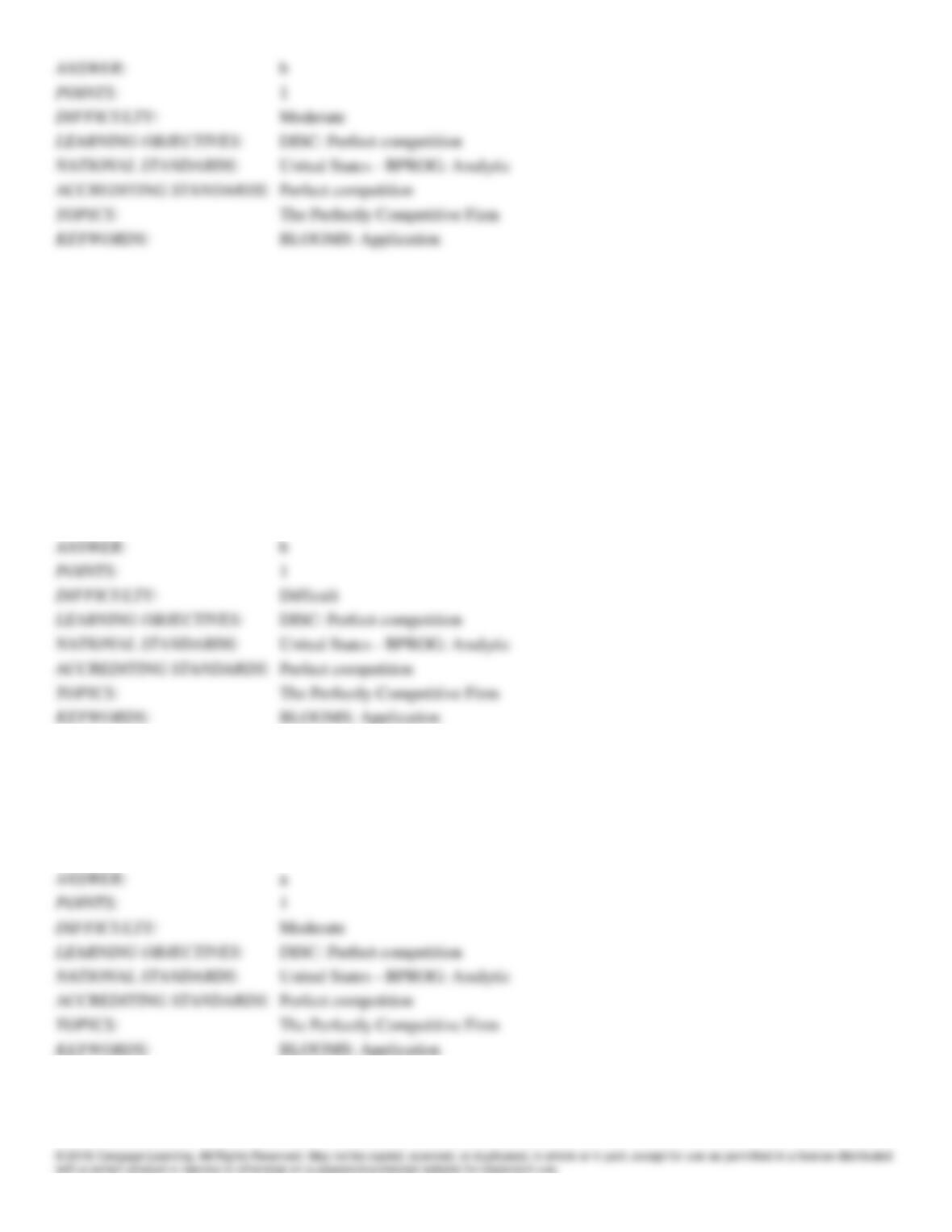
99. In Figure 10–3, the profit maximizing firm will operate at a level of
a.
OJ.
b.
OG.
c.
OI.
d.
OH.
c
Easy
DISC: Perfect competition
United States – BPROG: Analytic
Perfect competition
The Perfectly Competitive Firm
BLOOMS: Application
100. In Figure 10–3, the perfectly competitive firm is realizing a
a.
loss equal to ABCE.
b.
profit equal to ABCE.
c.
profit equal to ABDF.
d.
loss equal to ABDF.
c
Moderate
DISC: Perfect competition
United States – BPROG: Analytic
Perfect competition
The Perfectly Competitive Firm
BLOOMS: Application
101. In perfect competition, marginal revenue always equals
a.
total revenue.
b.
price.
c.
average cost.
d.
marginal fixed cost.
Easy
DISC: Perfect competition
United States – BPROG: Analytic
Perfect competition
The Perfectly Competitive Firm
102. A perfectly competitive firm should continue to expand output until
a.
total revenue exceeds total costs.
b.
total revenue exceeds variable costs.
c.
marginal revenue equals marginal costs.
d.
average revenue equals variable costs.
c
Easy
DISC: Perfect competition
United States – BPROG: Analytic
Perfect competition
The Perfectly Competitive Firm
103. A perfectly competitive firm will always maximize profits by producing where
a.
per-unit costs are lowest.
b.
total costs and total revenue are equal.
c.
P = MC.
d.
P = AC.
c
Easy
DISC: Perfect competition
United States – BPROG: Analytic
Perfect competition
The Perfectly Competitive Firm
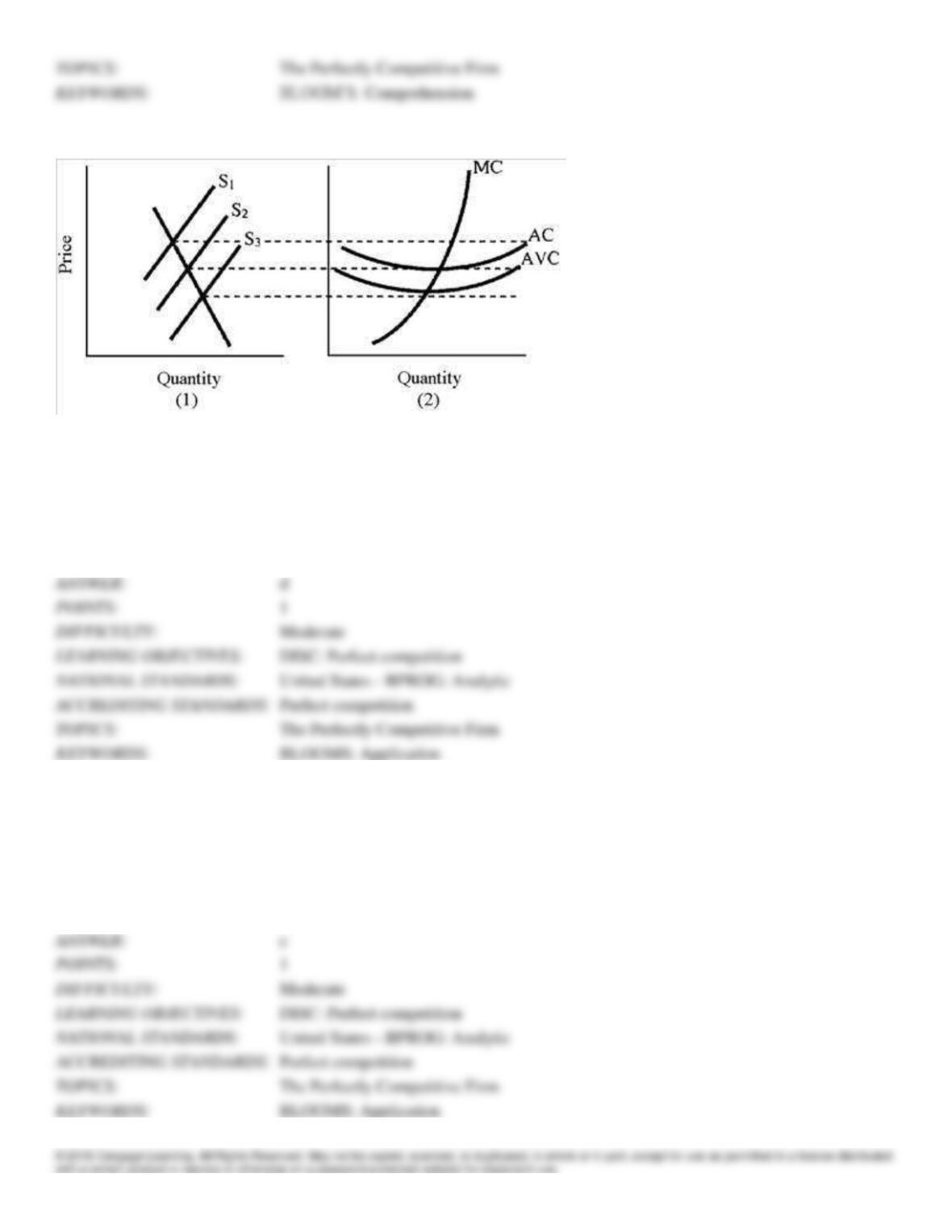
Figure 10-4
104. Figure 10-4 shows the industry’s supply and demand curves in panel (1) and the cost curves of a firm in the industry
in panel (2). At S1, the firm is
a.
preparing to shut down.
b.
incurring losses.
c.
earning zero economic profits.
d.
earning economic profit greater than zero.
DISC: Perfect competition
United States – BPROG: Analytic
Perfect competition
The Perfectly Competitive Firm
BLOOMS: Application
105. Figure 10-4 shows the industry’s supply and demand curves in panel (1) and the cost curves of a firm in the industry
in panel (2). At S2, the firm is
a.
going to shut down.
b.
incurring losses.
c.
earning zero economic profits.
d.
earning economic profit greater than zero.
DISC: Perfect competition
United States – BPROG: Analytic
Perfect competition
The Perfectly Competitive Firm
BLOOMS: Application
106. Figure 10-4 shows the industry’s supply and demand curves in panel (1) and the cost curves of a firm in the industry
in panel (2). At S3, the firm is
a.
going to shut down.
b.
incurring losses.
c.
earning zero economic profits.
d.
earning economic profit greater than zero.
1
DISC: Perfect competition
United States – BPROG: Analytic
Perfect competition
The Perfectly Competitive Firm
BLOOMS: Application
107. If a competitive firm’s short run average cost curve lies above the price of the product, we can conclude that the firm
a.
is earning a huge profit.
b.
is incurring losses.
c.
is earning zero economic profits.
d.
is earning a normal profit.
b
1
DISC: Perfect competition
United States – BPROG: Reflective Thinking – BPROG: Analysis
Perfect competition
The Perfectly Competitive Firm
108. The perfectly competitive firm’s short-run shutdown rule is to shut down immediately if
a.
TR < TC.
b.
TR < SRFC.
c.
TR < SRVC.
d.
TR < MC > Q.
1
DISC: Perfect competition
United States – BPROG: Analytic
Perfect competition
The Perfectly Competitive Firm
109. At a firm’s profit-maximizing level of output, its price is $200 and its short-run average total cost is $225. The firm
a.
has a profit of $25 per unit of output.
b.
should shut down if its short-run average fixed cost is less than $25.
c.
has a loss of $100 per unit of output.
d.
should shut down if its short-run average variable cost exceeds $25.
b
1
DISC: Perfect competition
United States – BPROG: Reflective Thinking – BPROG: Analysis
Perfect competition
The Perfectly Competitive Firm
110. A firm can stay in business while taking a loss in the short run as long as it covers its
a.
fixed costs.
b.
variable costs.
c.
fixed and variable costs.
d.
A firm can never stay in business when it experiences losses.
b
1
DISC: Perfect competition
United States – BPROG: Analytic
Perfect competition
The Perfectly Competitive Firm
111. A firm will shut down in the short run if
a.
TR − TC > TFC.
b.
TR + TC > TFC.
c.
TC − TR > TFC.
d.
TFC + TVC > TR.
1
DISC: Perfect competition
United States – BPROG: Reflective Thinking – BPROG: Analysis
Perfect competition
The Perfectly Competitive Firm
BLOOMS: Application
112. A firm will shut down in the short run if
a.
P < AVC.
b.
P > AVC.
c.
AVC > AFC.
d.
TR > TC.
1
Moderate
DISC: Perfect competition
United States – BPROG: Analytic
Perfect competition
The Perfectly Competitive Firm
BLOOMS: Application
113. If a firm shuts down in the short run, its losses are equal to
a.
TC − TR.
b.
TFC.
c.
TVC.
d.
MC.
b
1
Moderate
DISC: Perfect competition
United States – BPROG: Analytic
Perfect competition
The Perfectly Competitive Firm
BLOOMS: Application
Table 10-2
Firm A
Firm B
Firm C
Firm D
Total revenue (TR) $
100
150
100
100
Total variable cost (TVC)
180
160
60
140
Short-run nonvariable cost
60
20
60
100
114. Refer to Table 10–2. Which firm is better off staying in business in the short run?
a.
Firm A
b.
Firm B
c.
Firm C
d.
Firm D
c
1
Moderate
DISC: Perfect competition
United States – BPROG: Analytic
Perfect competition
The Perfectly Competitive Firm
BLOOMS: Application
115. Which of the following is a characteristic of perfect competition?
a.
large barriers to entry
b.
a small number of firms
c.
firms selling unique goods
d.
None of the above is correct.
Moderate
DISC: Perfect competition
United States – BPROG: Analytic
Perfect competition
The Perfectly Competitive Firm
116. If a firm shuts down, its
a.
fixed costs remain unchanged.
b.
revenue will fall to zero.
c.
short-run variable costs will fall to zero.
d.
All of the above are correct.
Moderate
DISC: Perfect competition
United States – BPROG: Analytic
Perfect competition
The Perfectly Competitive Firm
117. The short-run supply curve of a perfectly competitive firm
a.
intersects the minimum point of its short-run average total cost curve but not its short-run average variable
cost curve.
b.
intersects the minimum point of its short-run average variable cost curve but not its short-run average total
cost curve.
c.
intersects the minimum point of both its short-run average variable cost and its short-run average total cost
curves.
d.
intersects the minimum point of its short-run average total cost curve and may or may not intersect the
minimum point of its short-run average variable cost curve.
c
Moderate
DISC: Perfect competition
United States – BPROG: Analytic
Perfect competition
The Perfectly Competitive Firm
118. In perfect competition, an increase in fixed costs will eventually cause all except
a.
reduction in industry output.
b.
reduction in a firm’s output.
c.
reduction in the number of firms.
d.
decrease in industry supply.
Difficult
DISC: Perfect competition
United States – BPRPOG: Analysis
Perfect competition
The Perfectly Competitive Firm
119. The short-run supply curve of the perfectly competitive firm is the firm’s
a.
MC curve.
b.
AVC curve.
c.
MC curve above the minimum point on the AVC curve.
d.
MC curve above the minimum point on the ATC curve.
c
Moderate
DISC: Perfect competition
United States – BPROG: Analytic
Perfect competition
The Perfectly Competitive Firm
120. If the price falls below minimum SRAVC, the quantity supplied by the firm will be
a.
the quantity at minimum MC.
b.
zero.
c.
the quantity at the point where MC intersects AC.
d.
the quantity at minimum AC.
Moderate
DISC: Perfect competition
United States – BPROG: Analytic
Perfect competition
The Perfectly Competitive Firm
121. The quantity which a firm will supply in the short run
a.
can be read from its average cost curve.
b.
can be read from its average variable cost curve.
c.
can be read from the firm’s marginal cost curve above average variable cost.
d.
is always zero above minimum average variable cost.
c
Moderate
DISC: Perfect competition
United States – BPROG: Analytic
Perfect competition
The Perfectly Competitive Firm
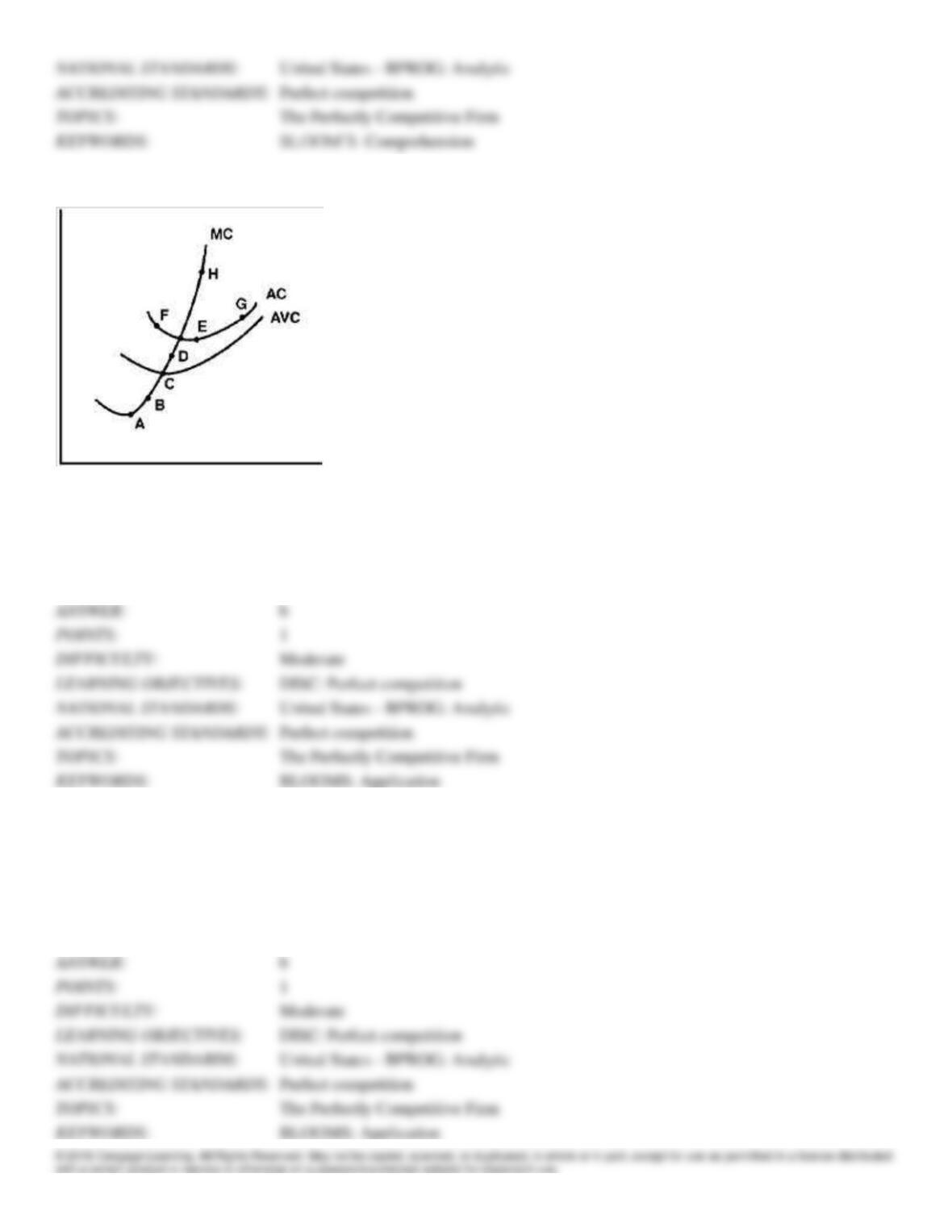
Figure 10-5
122. In Figure 10–5, points which lie on the firm’s short-run supply curve are
a.
A, B, C.
b.
C, D, H.
c.
F, E, G.
d.
A, C, H.
b
1
DISC: Perfect competition
United States – BPROG: Analytic
Perfect competition
The Perfectly Competitive Firm
BLOOMS: Application
123. Figure 10-5 shows supply and demand conditions in a perfectly competitive industry and for a firm in that industry.
At point C, the firm would
a.
earn zero economic profit.
b.
earn negative economic profit.
c.
have a zero opportunity cost of capital.
d.
have a negative opportunity cost of capital.
b
1
DISC: Perfect competition
United States – BPROG: Analytic
Perfect competition
The Perfectly Competitive Firm
BLOOMS: Application
124. The supply curve for a perfectly competitive industry is obtained by
a.
making an empirical study of historical data.
b.
vertically summing the supply curves of firms in the industry.
c.
horizontally summing the average cost curves of firms in the industry.
d.
horizontally summing the supply curves of firms in the industry.
DISC: Perfect competition
United States – BPROG: Analytic
Perfect competition
The Perfectly Competitive Industry
125. The short run for the industry is defined as a period
a.
too brief for new firms to enter the industry.
b.
too brief for old firms to leave the industry.
c.
in which the number of firms in the industry is fixed.
d.
All of the above are correct.
DISC: Perfect competition
United States – BPROG: Analytic
Perfect competition
The Perfectly Competitive Industry
126. The long run for the industry is defined as a period of time long enough for
a.
any new firm that desires to enter the industry.
b.
any old firm that desires to leave the industry.
c.
all aspects of production to vary and there are no fixed costs.
d.
All of the above are correct.
DISC: Perfect competition
United States – BPROG: Analytic
Perfect competition
The Perfectly Competitive Industry
127. When a firm leaves a perfectly competitive industry,
a.
the individual demand curves facing remaining firms shift towards the point of minimum average cost in the
long run.
b.
short-run industry equilibrium is re-established at a new point along the original short-run industry supply
curve.
c.
the short-run industry supply curve shifts to the right.
d.
at the new long-run equilibrium, the remaining firms in the industry will each receive a higher profit.
a
DISC: Perfect competition
United States – BPRPOG: Analysis
Perfect competition
The Perfectly Competitive Industry
128. The short-run supply curve of the perfectly competitive industry is found by summing the
a.
AC curves of the individual firms in the industry.
b.
AVC curves of the individual firms in the industry.
c.
MC curves above AVC of the individual firms in the industry.
d.
There is no short-run supply curve in a competitive industry.
c
Moderate
DISC: Perfect competition
United States – BPROG: Analytic
Perfect competition
The Perfectly Competitive Industry
129. A firm in a perfectly competitive industry
a.
is unaffected by the entrance of new firms into the industry, since entering firms affect only the prices they
themselves receive.
b.
always produces more output in the long run than in the short run.
c.
may choose a different output in the long run than in the short run.
d.
earns economic profit in the long run but not in the short run.
c
Moderate
DISC: Perfect competition
United States – BPROG: Analytic
Perfect competition
The Perfectly Competitive Industry
130. We expect the demand curve in the perfectly competitive industry to be
a.
negatively sloped.
b.
vertical.
c.
horizontal.
d.
perfectly elastic.
a
Easy
DISC: Perfect competition
United States – BPROG: Analytic
Perfect competition
The Perfectly Competitive Industry
131. When new farmers enter the wheat industry, the equilibrium price of wheat
a.
always falls.
b.
falls only if existing firms gang up on the entrant.
c.
falls only if existing firms are earning no economic profit.
d.
falls only if the new firm is more efficient than existing firms.
a
Easy
DISC: Perfect competition
United States – BPROG: Analytic
Perfect competition
The Perfectly Competitive Industry
132. Firms entering a perfectly competitive industry will cause the price of the product to
a.
fall.
b.
rise.
c.
remain constant.
d.
become more responsive to consumer demand.
a
Easy
DISC: Perfect competition
United States – BPROG: Analytic
Perfect competition
The Perfectly Competitive Industry
133. When a perfectly competitive industry is in long-run equilibrium, firms maximize profits, and entry forces the price
down
a.
until all loss making firms leave the industry.
b.
until each firm can earn acceptable level of economic profit.
c.
until price becomes tangent to the long run average cost curve.
d.
until the long average cost curve rises above the demand curve.
c