31) One reason that the aggregate demand curve has a negative slope is that when the domestic
price level rises,
A) firms produce more goods and services.
B) firms produce fewer goods and services.
C) people substitute toward more imported goods and services.
D) peoples’ wealth increases.
32) One reason that the aggregate demand curve has a negative slope is because
A) firms supply more when prices rise.
B) people buy more foreign goods when the domestic price level rises.
C) the amount of money in the economy increases when the price level rises.
D) firms supply less when prices rise.
33) There are several reasons why the aggregate demand curve is downward sloping. Which of
the following CORRECTLY describes one of these explanations?
A) A rise in the price level raises the purchasing power wealth and increases desired
consumption.
B) A rise in the price level raises interest rates and increases investment spending.
C) A fall in the price level, holding foreign prices and the exchange rate constant, increases net
exports.
D) A rise in the price level lowers the interest rate and increases investment spending.
34) When the prices of U.S.-produced goods rise and the price of foreign-produced goods do not
change, the result is
A) an increase in exports.
B) a decrease in exports.
C) a decrease in imports.
D) no change in imports or exports.
42
35) When the price level in France increases while the exchange rate and the price level in the
United States remain the same, the result is
A) U.S.-made goods become relatively cheaper compared to French-made goods.
B) French citizens are more likely to buy U.S.-made goods.
C) U.S. citizens are less likely to buy French-made goods.
D) All of the above answers are correct.
36) A change in ________ creates a movement along the aggregate demand curve but does not
shift the aggregate demand curve.
A) tax rates
B) the price level
C) fiscal policy
D) None of the above because they all shift the aggregate demand curve.
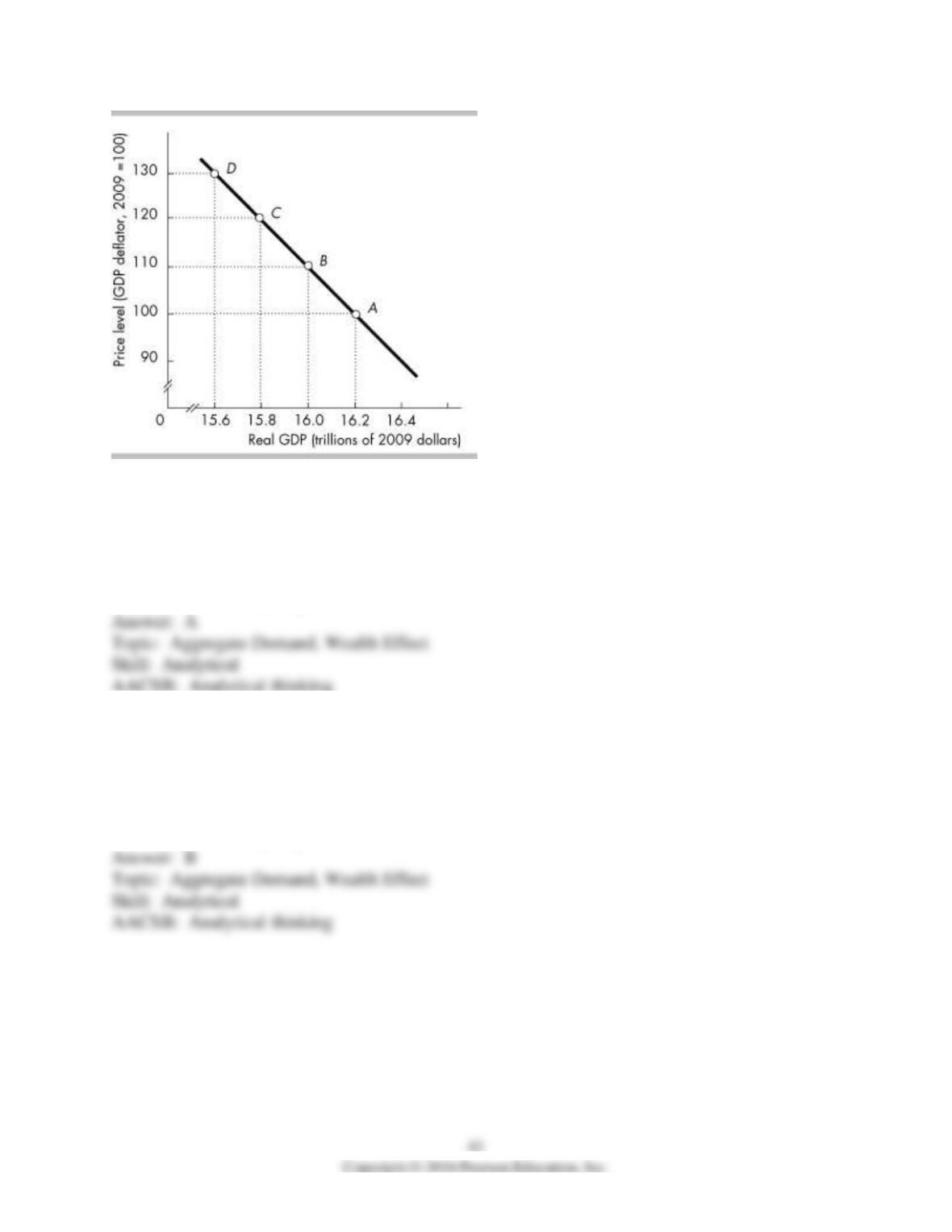
37) In the above figure, the economy is initially at point B. Then the price level falls by 10. The
wealth effect will help
A) move the economy to point A.
B) move the economy to point C.
C) move the economy to point D.
D) keep the economy to point B.
38) In the above figure, the economy initially is at point B. Then price level rises by 10. The
wealth effect will help
A) move the economy to point A.
B) move the economy to point C.
C) move the economy to point D.
D) keep the economy to point B.
39) In the above figure, the economy initially is at point C. Then the domestic price level rises by
10. A
A) substitution effect would help move the economy to point D.
B) substitution effect would help move the economy to point B.
C) substitution effect would keep the economy at point C.
D) wealth effect would help move the economy to point B.
40) An increase in aggregate demand is shown by a
A) rightward shift of the AD curve.
B) movement upward along the AD curve.
C) movement downward along the AD curve.
D) leftward shift of the AD curve.
41) Which of the following does NOT shift the aggregate demand curve?
A) a decrease in the quantity of money
B) an increase in people’s expected future incomes
C) an increase in the price level
D) an increase in current foreign income
42) Which of the following would NOT shift the U.S. aggregate demand curve?
A) a change in income in Canada
B) a change in the quantity of capital in the United States
C) an expectation that inflation will be lower in the future
D) U.S. monetary and fiscal policy
43) Which of the following changes would NOT shift the aggregate demand curve?
A) a change in fiscal policy
B) a change in monetary policy
C) a change in expectations about future income
D) an increase in technology
44) Aggregate demand increases when
A) foreign incomes fall.
B) interest rates rise.
C) the exchange rate rises.
D) None of the above answers is correct.
45) Which of the following does NOT shift the aggregate demand curve?
A) a decrease in the quantity of money
B) an increase in investment
C) an increase in the price level
D) a decrease in taxes
46) A key issue in the presidential election of 2012 between President Obama and Mr. Romney
concerned tax rates. President Obama favored increasing taxes, especially on the rich. As a result
of a tax increase
A) the aggregate demand curve shifts leftward.
B) the aggregate demand curve shifts rightward.
C) the aggregate supply curve shifts leftward.
D) the aggregate supply curve shifts rightward.
47) Which of the following issues prominent in the presidential election of 2012 shifts the
aggregate demand curve rightward?
A) raising taxes on the rich
B) increasing Medicare, Medicaid, and Social Security payments
C) loosening immigration policies
D) allowing more oil drilling on Federal lands
48) A change in ________ creates a movement along the aggregate demand curve, while a
change in ________ shifts the aggregate demand curve.
A) expected profits; tax rates
B) the price level; government expenditures
C) foreign income; the foreign exchange rate
D) real wealth; human capital
49) Which of the following shifts the aggregate demand curve rightward?
A) a decrease in consumption
B) an increase in investment
C) a decrease in net exports
D) a decrease in government expenditure on goods and services
50) Which of the following shifts the aggregate demand curve rightward?
A) an increase in tax rates
B) an increase in government expenditure
C) an increase in the exchange rate
D) an increase in imports
51) Suppose consumers decrease their consumption expenditure because they worry about what
their income will be in the future. There is
A) a rightward shift of the aggregate demand curve.
B) an upward movement along the aggregate demand curve.
C) a downward movement along the aggregate demand curve.
D) a leftward shift of the aggregate demand curve.
52) If the expected future inflation rate decreases, then
A) aggregate demand increases.
B) short-run aggregate supply increases.
C) aggregate demand decreases.
D) long-run aggregate supply decreases.
53) If higher inflation is expected in the future, then the
A) SAS curve shifts rightward.
B) AD curve shifts rightward.
C) LAS curve shifts rightward.
D) None of the above answers is correct.
54) People expect their incomes will decrease next year. As a result, the ________ will shift
________.
A) short-run aggregate supply curve; rightward
B) aggregate demand curve; rightward
C) aggregate demand curve; leftward
D) long-run aggregate supply curve; rightward
55) People expect that the El Niño effect will cause drought in Australia in coming years. If most
Australian firms expect their profits will fall during the next five years, Australia’s ________ this
year.
A) aggregate demand will increase
B) long-run aggregate supply will increase
C) aggregate demand will decrease
D) short-run aggregate supply will increase
56) Which of the following statements is FALSE?
A) Fiscal policy is the attempt to influence the economy using taxes, transfer payments, and
government expenditures.
B) Government expenditure affects aggregate demand directly because government expenditure
is a component of aggregate demand.
C) Taxes and transfer payments affect aggregate demand by changing disposable income.
D) An increase in disposable income leads to a decrease in aggregate demand.
57) A decrease in government transfer payments
A) increases aggregate demand.
B) increases the aggregate quantity demanded.
C) decreases the aggregate quantity demanded.
D) decreases aggregate demand.
58) An increase in government expenditure on goods and services
A) increases aggregate demand.
B) increases the aggregate quantity demanded.
C) decreases the aggregate quantity demanded.
D) decreases aggregate demand.
59) A decrease in government expenditure on goods and services
A) increases aggregate demand.
B) increases the aggregate quantity demanded.
C) decreases the aggregate quantity demanded.
D) decreases aggregate demand.
60) A decrease in government expenditure shifts the AD curve ________ and a decrease in taxes
shifts the AD curve ________.
A) rightward; rightward
B) rightward; leftward
C) leftward; rightward
D) leftward; leftward
61) Which of the following events shifts the aggregate demand curve leftward?
A) an increase in consumption expenditures
B) a decrease in taxes
C) a decrease in government expenditures on goods and services
D) an increase in net exports of goods and services
62) Disposable income ________ when ________.
A) decreases; taxes increase
B) decreases; transfer payments increase
C) increases; government expenditures decrease
D) decreases; aggregate income increases
63) The aggregate demand curve
A) shifts rightward when the price level increases and leftward when the price level falls.
B) shifts rightward when taxes are decreased.
C) shifts rightward when foreign incomes decrease and shifts leftward when foreign incomes
increase.
D) does not shift, unlike market demand curves.
64) If taxes are increased, the AD curve
A) is not affected because a change in taxes is a nominal change not real change.
B) shifts rightward and aggregate demand decreases.
C) shifts leftward and aggregate demand decreases.
D) does not shift but there is a movement down along the curve.
65) Which of the following shifts the aggregate demand curve rightward?
A) a decrease in government expenditure
B) expectations that future incomes will fall
C) a decrease in the quantity of money and an increase in interest rates
D) a tax cut
66) Which of the following decreases aggregate demand?
A) The government increases taxes on both business and personal income.
B) Foreign incomes rise.
C) The quantity of money in the economy increases.
D) Households believe that the economy is headed for good times, with higher future incomes.
67) Which of the following increases aggregate demand?
A) a decrease in taxes
B) a decrease in foreign income
C) a decrease in government expenditure
D) a rise in the interest rate
68) Which of the following shifts the aggregate demand curve rightward?
A) an increase in the tax rate
B) a decrease in the price level
C) an increase in the quantity of money
D) an increase in the exchange rate
69) Which of the following increases aggregate demand?
A) an increase in taxes
B) an increase in the quantity of money
C) an increase in the exchange rate
D) a decrease in government expenditures
70) If the quantity of money increases, the
A) price level rises and the AD curve does not shift.
B) AD curve shifts leftward and aggregate demand decreases.
C) AD curve does not shift and there is a movement upward along the curve.
D) AD curve shifts rightward and aggregate demand increases.
71) Which of the following shifts the aggregate demand curve rightward?
A) a decrease in the price level
B) a decrease in government expenditures
C) an increase in the quantity of money
D) a decrease in transfer payments
72) The U.S. aggregate demand curve shifts leftward if
A) the economic conditions in Europe improve so that European incomes increase.
B) there is a tax cut.
C) the Federal Reserve increases the interest rate.
D) the exchange rate falls.
73) Which of the following increases aggregate demand and shifts the AD curve rightward?
A) a fall in the price level
B) an increase in the quantity of money and a resulting fall in the interest rate
C) predictions of a recession that lead to expectations of lower future income
D) an increase in the exchange rate that makes imports less expensive
74) Aggregate demand increases if the quantity of money ________.
A) decreases or tax rates increase
B) or transfer payments decrease
C) remains constant or tax rates increase
D) increases or tax rates decrease
75) The U.S. exchange rate rises. As a result, there is a
A) movement along the U.S. aggregate demand curve but the curve does not shift.
B) rightward shift in the U.S. aggregate demand curve.
C) leftward shift in the U.S. aggregate demand curve.
D) rightward shift in the long-run U.S. aggregate supply curve.
76) When the exchange rises, then the
A) AD curve shifts rightward.
B) AD curve shifts leftward.
C) LAS curve shifts rightward.
D) LAS curve shifts leftward.
77) Suppose the exchange rate falls from $1.20 Canadian per U.S. dollar to $1.10 Canadian per
U.S. dollar. U.S. exports will ________, U.S. imports will ________, and U.S. aggregate
demand will ________.
A) decrease; increase; decrease
B) decrease; increase; increase
C) increase; decrease; increase
D) increase; increase; increase
78) A decrease in foreign incomes
A) increases aggregate demand in the United States.
B) increases the aggregate quantity demanded in the United States.
C) decreases the aggregate quantity demanded in the United States.
D) decreases aggregate demand in the United States.
79) An increase in foreign incomes
A) increases aggregate demand in the United States.
B) increases the aggregate quantity demanded in the United States.
C) decreases the aggregate quantity demanded in the United States.
D) decreases aggregate demand in the United States.
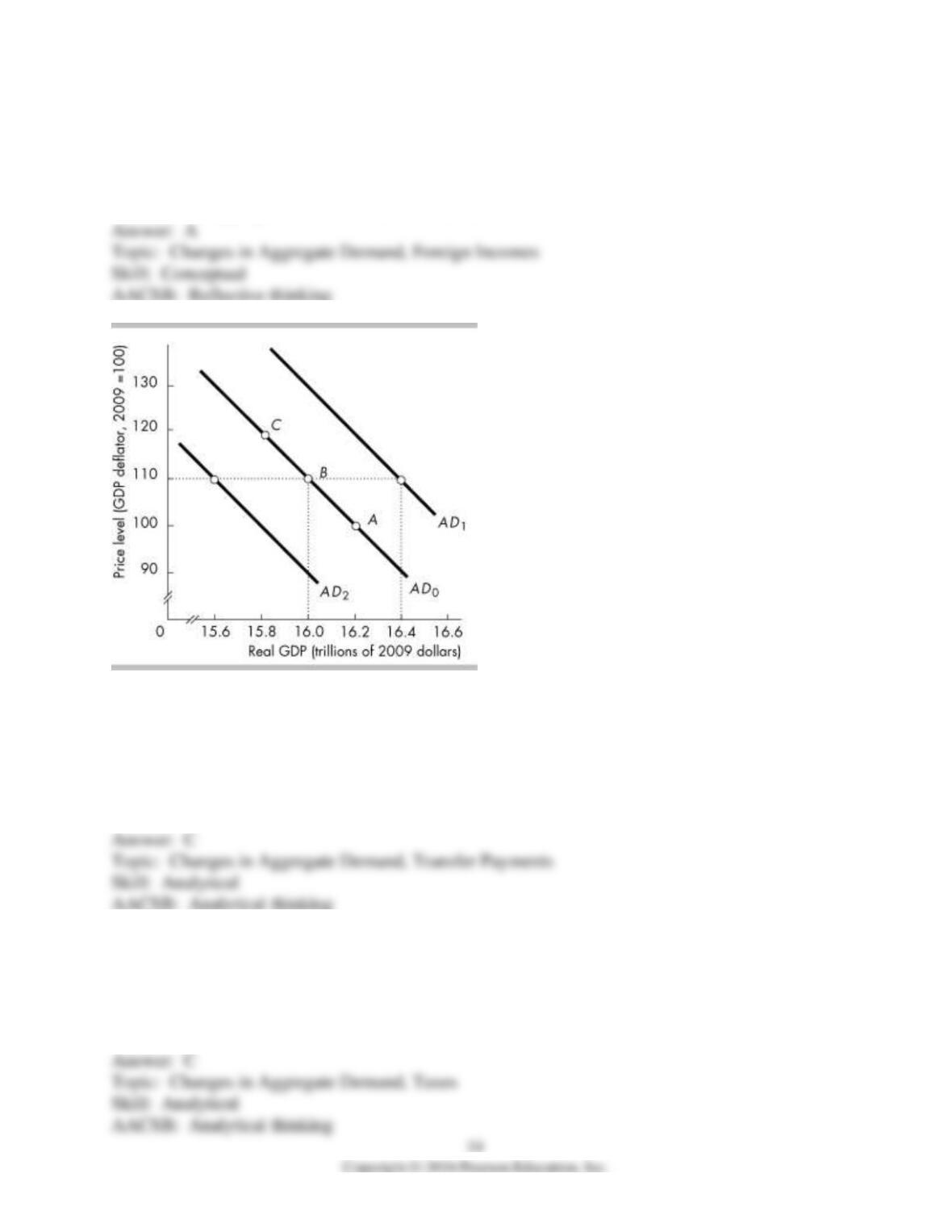
80) In the above figure, the economy is initially at point B. If the government decreases transfer
payments, there is
A) a movement to point C.
B) a movement to point A.
C) a shift to AD2.
D) a shift to AD1.
81) In the above figure, the economy is initially at point B. If taxes increase, there is
A) a movement to point C.
B) a movement to point A.
C) a shift to AD2.
D) a shift to AD1.
82) In the above figure, the economy is initially at point B. If the Fed decreases the quantity of
money, there is
A) a movement to point C.
B) a movement to point A.
C) a shift to AD2.
D) a shift to AD1.
83) In the above figure, the economy is initially at point B. If the Fed increases the quantity of
money, there is
A) a movement to point C.
B) a movement to point A.
C) a shift to AD2.
D) a shift to AD1.
84) In the above figure, the economy is initially at point B. If the exchange rate falls, there is
A) a movement to point C.
B) a movement to point A.
C) a shift to AD2.
D) a shift to AD1.
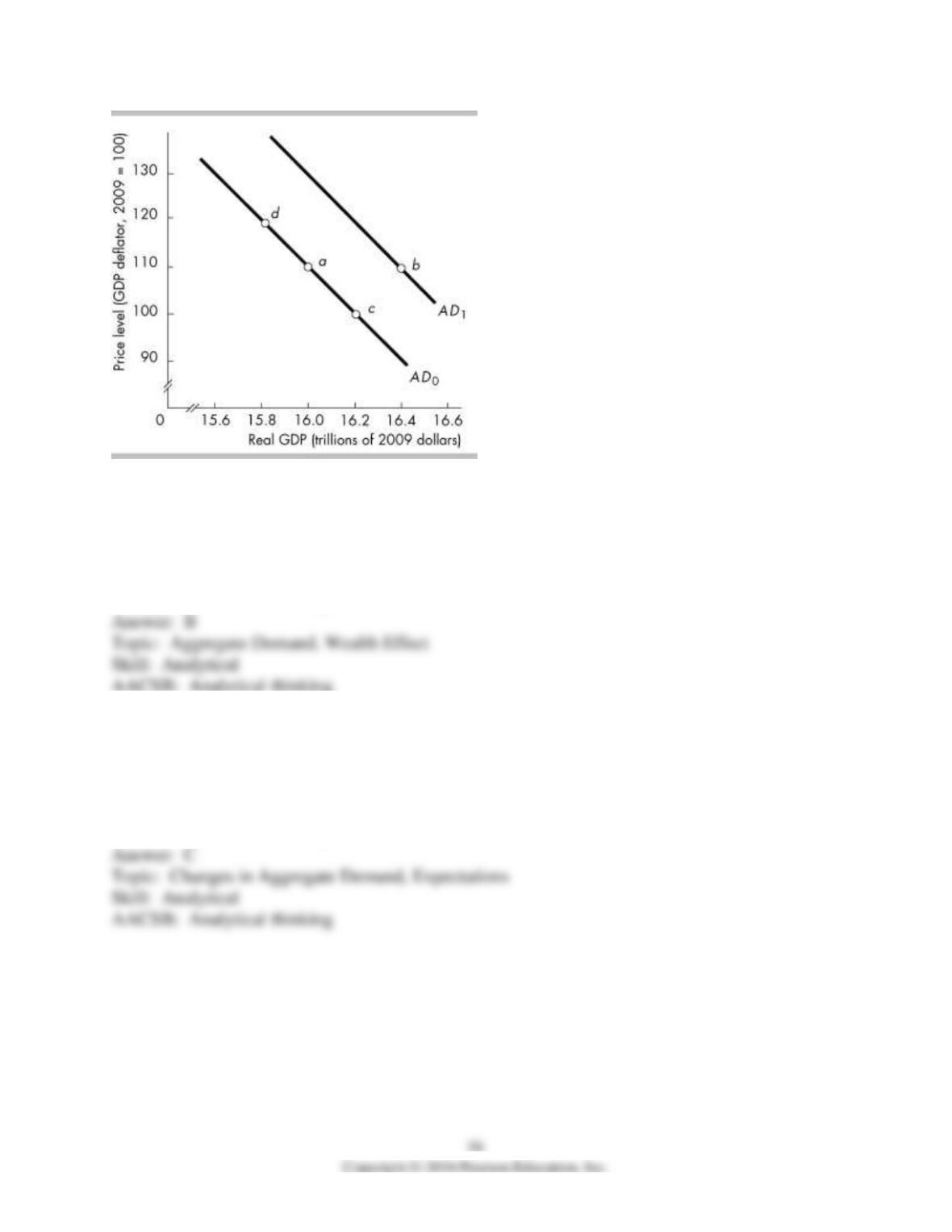
85) In the above figure, if the economy is at point a, an increase in ________ will move the
economy to ________.
A) real wealth from the fall in the price level; point b
B) real wealth from the fall in the price level; point c
C) expected future income; point c
D) expected future income; point d
86) In the above figure, if the economy is at point a, an increase in ________ will move the
economy to ________.
A) real wealth; point d
B) real wealth from a fall in the price level; point d
C) expected future income; point b
D) expected future income; point d
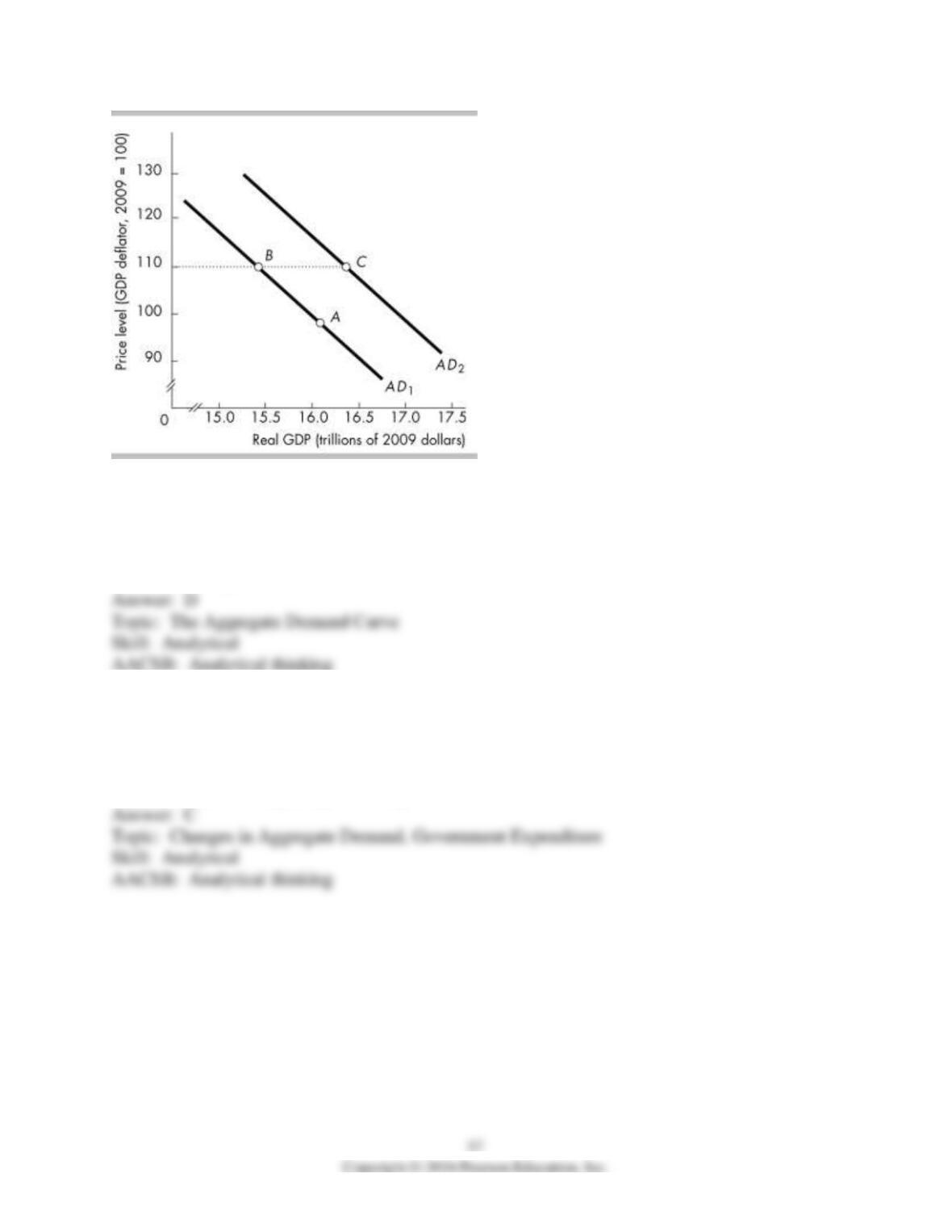
87) In the above figure, the movement from point B to point A might be the result of
A) an increase in government expenditures because of a war.
B) an increase in government expenditures because of increases in education expenditures.
C) an increase in the demand for manufacturing goods because of new technology.
D) a fall in the price level.
88) In the above figure, the shift from point C to point B might be the result of
A) an increase in the price level.
B) a decrease in the price level.
C) a decrease in government expenditures.
D) an increase in the quantity of money.
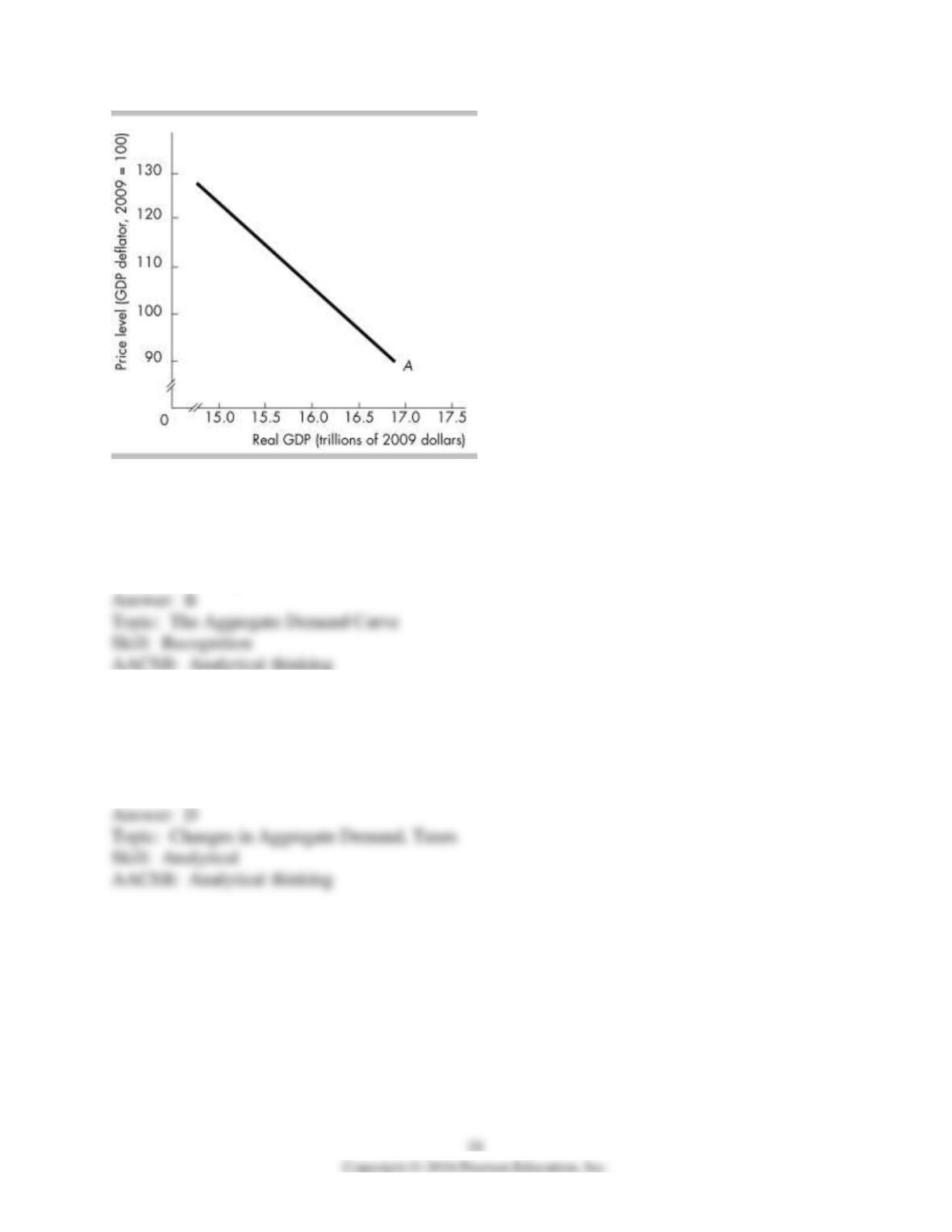
89) The curve labeled A in the above figure is
A) a short-run aggregate supply curve.
B) an aggregate demand curve.
C) a long-run aggregate supply curve.
D) a production possibilities curve.
90) In the above figure, the curve labeled A shifts rightward if
A) expected future profits decrease.
B) the quantity of money decreases.
C) the substitution effect occurs.
D) taxes decrease.
91) The U.S. fiscal policy implemented in 2008 was an attempt to
A) give billions of dollars to businesses and low- and middle-income Americans in order to
stimulate business investment and consumption expenditure, and thereby increasing AD.
B) give billions of dollars to businesses and low- and middle-income Americans in order to
stimulate business investment and consumption expenditure, and thereby increasing SAS.
C) decrease interest rates in order to stimulate business investment and consumption expenditure,
and thereby increasing AD.
D) decrease the exchange rate in order to boost net exports, and thereby increasing AD.
92) The U.S. monetary policy implemented in 2008 was an attempt to
A) give billions of dollars to businesses and low- and middle-income Americans in order to
stimulate business investment and consumption expenditure and thereby increasing AD.
B) decrease interest rates in order to stimulate business investment and consumption expenditure,
thereby increasing SAS.
C) decrease interest rates in order to stimulate business investment and consumption expenditure,
thereby increasing AD.
D) decrease the exchange rate in order to boost net exports, thereby increasing AD.
93) The aggregate demand curve illustrates that, as the price level rises
A) the quantity of real GDP demanded increases.
B) the quantity of real GDP demanded decreases.
C) the AD curve shifts rightward.
D) the AD curve shifts leftward.
94) As the price level falls, the quantity of real wealth ________ and the aggregate quantity of
real GDP demanded ________.
A) increases; increases
B) increases; decreases
C) decreases; increases
D) decreases; decreases
3 Explaining Macroeconomic Trends and Fluctuations
1) The AS/AD model studies the relationship between
A) the price level and unemployment.
B) the price level and real GDP.
C) unemployment and real GDP.
D) nominal GDP and inflation.
2) By using only the aggregate demand curve, we can determine
A) only the price level.
B) only the quantity of real GDP.
C) both the price level and quantity of real GDP.
D) neither the price level nor the quantity of real GDP.
3) In the short-run macroeconomic equilibrium
A) real GDP equals potential GDP and aggregate demand determines the price level.
B) the price level is fixed and short-run aggregate supply determines real GDP.
C) real GDP and the price level are determined by short-run aggregate supply and aggregate
demand.
D) real GDP is always less than potential GDP.
4) The economy is in its short run equilibrium at the point where the
A) price level is stable.
B) SAS curve intersects the LAS curve.
C) AD curve intersects the LAS curve.
D) AD curve intersects the SAS curve.