
Chapter 10: Capital Budgeting: Decision Criteria and Real Option Considerations
65. What is the NPV of a project that required a net investment of $500,00 and produced net cash flows of
$150,000 per year for 5 years and $110,000 for the next 5 years? Assume the cost of capital is 14%.
a. $211,080
b. $392,580
c. $588,710
d. $160,920
66. Kinetics is considering a project that has a NINV of $874,000 and generates net cash flows of $170,000 per
year for 12 years. What is the NPV of this project if Kinetics cost of capital is 14%?
a. $252,760
b. $110,840
c. $88,200
d. $47,570
67. Using the profitability index, which of the following projects should be accepted?
Project M:
NPV = $60,000
NINV = $200,000
Project N:
NPV = $10,000
NINV = $30,000
Project O:
a. Project M
NPV = $2,000
NINV = $5,000
b. Project N
c. Project O
d. All projects should be accepted
68. ZPS Models is considering a project that has a NINV of $564,000 and generates net cash flows of $105,000
per year for 10 years. What is the NPV of this project if ZPS has a cost of capital of 12.45%?
a. $47,625
b. $18,503
c. $17,490
d. none of these
Chapter 10: Capital Budgeting: Decision Criteria and Real Option Considerations
69. Decode Genetics purchased lab equipment for $600,000 that will generate net cash flows of $130,000 per
year for 10 years. What is the IRR for this project?
a. 16.76%
b. 17.26%
c. 18.13%
d. 17.76%
70. What is the net present value of a project that has a net investment of $148,000 and net cash flows of $25,000
in the first year, $45,000 in years 2-7 and a negative net cash flow of $27,000 in year 8? Assume the cost of
capital is 11 percent.
a. $34,302
b. $74,847
c. $57,738
d. –$2,238
71. What is the internal rate of return for a project that has a net investment of $169,165 and net cash flows of
$25,000 in the first year and 40,000 in years 2-7?
a. 2.5%
b. 13%
c. 12%
d. 13.5%
72. What is the internal rate of return for a project that has a net investment of $60,000 and the following net cash
flows: Year 1 = $15,000; Year 2 = $20,000; Year 3 = $25,000; Year 4 = $30,000?
a. 17.3%
b. 16.7%
c. 15.7%
d. 16.3%
Chapter 10: Capital Budgeting: Decision Criteria and Real Option Considerations
73. Road Hawk Inc. is adding a new production line that will cost $720,000. The line will be depreciated on a
straight- line basis over a 7-year period and will generate net cash flows of $160,000 in each of the 7 years. At
the end of the project, it is expected the line can be sold as scrap for $10,000. If the firm’s marginal tax rate is
40% and its required rate of return is 14 percent, what is the net present value of this project?
a. $70,091
b. –$27,920
c. $64,091
d. –$31,520
74. Consider a capital expenditure project that has forecasted revenues equal to $32,000 per year; cash expenses
are estimated to be $29,000 per year. The cost of the project equipment is $23,000, and the equipment’s
estimated salvage value at the end of the project is $9,000. The equipment’s $23,000 cost will be depreciated
on a straight-line basis to $0 over a 10-year estimated economic life. Assume that the project requires an
initial $7,000 working capital investment. The company’s marginal tax rate is 30%. Calculate the project’s net
present value using a 12% discount rate.
a. about –$10,610
b. about –$12,530
c. about –$9,954
d. about +$9,462
75. Calculate the net present value for an investment project with the following cash flows using a 12 percent cost
of capital:
Year
0
1
2
3
Net Cash Flow
a. $56,560
–$100,000
$80,000
$80,000
–$30,000
b. $30,000
c. $13,840
d. cannot be determined with information given
Chapter 10: Capital Budgeting: Decision Criteria and Real Option Considerations
76. Ecogen is considering the purchase of some new equipment that will cost $340,000 installed. The equipment
will produce a product that must be FDA approved and this will require at least a year. Net cash flow in Year
1 will be a negative $110,000 but is expected to be a positive $50,000 in Year 2. Net cash flows will be
$150,000, $240,000, and $330,000 in the next 3 years. At the end of 5 years the equipment and the product
will be obsolete. If the firm’s marginal tax rate is 40% and their costs of capital is 15%, should they invest in
the new equipment?
a. Yes, NPV = $2,090
b. Yes, NPV = $12,390
c. No, NPV = –$63,210
d. No, NPV = –$12,210
77. G-III Apparel is considering increasing the size of a warehouse. The cost of the expansion is $825,000 and the
increase in inventories and accounts payable will be $410,000 and $360,000 respectively. G-III expects that
the expansion will increase net cash flows by $150,000 a year for the next 5 years and $200,000 a year for
years 6-12. G-III has a 14% cost of capital and a marginal tax rate of 35%. What is the NPV of the warehouse
expansion?
a. –$3,450
b. $60,050
c. $10,050
d. –$338,570
78. What is the internal rate of return for a project that has a net investment of $370,000 and net cash flows of
$60,000 in year 1, $75,000 in year 2, and $85,000 in years 3 through 8?
a. 15.5%
b. 13.6%
c. 17.4%
d. none of these are correct
Chapter 10: Capital Budgeting: Decision Criteria and Real Option Considerations
79. Rollerblade, a manufacturer of skating gear, plans to expand its operation in Brighton, England. The
expansion will cost $18.5 million and is expected to generate annual net cash flows of 2.2 million pounds for
a period of 15 years and nothing thereafter. The cost of capital for the project is 16%. Using the spot exchange
rate of $1.60 per British pound, compute the net present value of the expansion project.
a. –$6.235 million
b. $2.458 million
c. $1.124 million
d. –$10.83 million
80. Zimmer, a manufacturer of modular rooms, plans to expand its operation in Landshut, Germany. The
expansion will cost $14.5 million and is expected to generate annual net cash flows of DM4.5 million for a
period of 12 years and then the operation will be sold for DM2 million. The cost of capital for the project is
14%. Using the spot exchange rate of $0.60 per DM, compute the NPV of this expansion project.
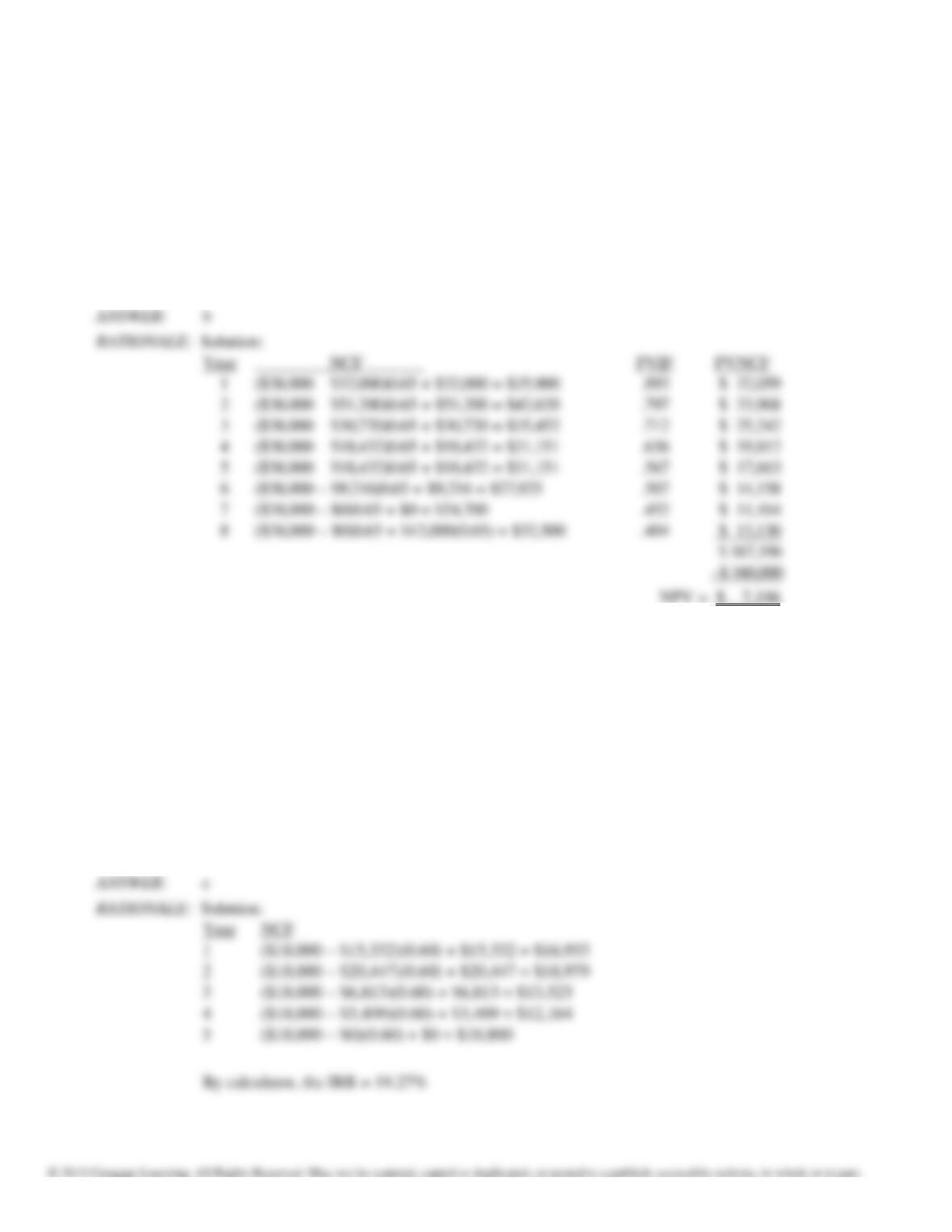
a. $0.78 million
b. $1.03 million
c. $2.58 million
d. $11.39 million
Chapter 10: Capital Budgeting: Decision Criteria and Real Option Considerations
81. A digital assembly system that costs $160,000 is expected to operate for 8 years. The estimated salvage value
at the end of 8 years is $12,000. The system is expected to save the company $38,000 in labor costs before
taxes and depreciation. The company will depreciate this system on a 5-year MACRS schedule. If the firm’s
cost of capital is 12% and its marginal tax rate is 35%, compute the NPV for the project. (Note: Requires
MACRS tables)
a. $4,045
b. $7,196
c. $20,873
d. $167,196
82. TexMex is considering replacing its tortilla machine with a new model that sells for $46,000 including the
cost of installation. The old machine has been fully depreciated and has a $0 salvage value. The new machine
will be depreciated as a 3-year MACRS asset. Revenues are expected to increase $18,000 per year over the 5
year life of the new machine. At the end of 5 years the new machine is expected to have no salvage value.
What is the IRR for this project if TexMex has a required rate of return of 14% and a marginal tax rate of
40%? Operating costs are not expected to increase from the current level of $8,000 per year.
a. 21.0%
b. 14.0%
c. 19.3%
d. 5.7%

Chapter 10: Capital Budgeting: Decision Criteria and Real Option Considerations
83. Colex wishes to bid on a contract that is expected to yield after-tax net cash flows of $25,000 in year 1,
$30,000 in year 2, and $35,000 per year in years 3-8. To obtain the contract, Colex will need to invest
$110,000 to reconfigure a packaging system, $20,000 (after-tax) to retrain current employees, and $15,000
(after-tax) on an environmental impact study that is required to be completed on acceptance of the contract.
What is the project’s internal rate of return?
a. 16.7%
b. 14.1%
c. 16.2%
d. 14.9%
84. Which of the following statements about comparing capital budget techniques is/are correct?
I. The payback period is easy to understand and helps the firm identify how long it will be unable to use
the initial investment for other projects.
II. Mutually exclusive projects allow a firm to do other like projects (mutually exclusive) simultaneously as
long as the budget restraints are met.
a. I only
b. II only
c. Both I and II
d. Neither I nor II
85. Which of the following statements about comparing the techniques of net present value (npv) and internal rate
of return (irr) is/are correct?
I. The net present value assumes that all cash flows are reinvested at the cost of capital and is therefore
realistic.
II. The internal rate of return is stated as a percent and is therefore easy to communicate to decision-makers
who may not understand the fine points of finance.
a. I only
b. II only
c. Both I and II
d. Neither I nor II

Chapter 10: Capital Budgeting: Decision Criteria and Real Option Considerations
86. What is the net present value of the following project if the required rate of return is 15%? The initial
investment is $150,000
Years
Cash Flows
1
$30,000
2
$80,000
3
$100,000
4
$200,000
a. $203,690
b. $180,665
c. $150,000
d. $116,681
87. Should the following project be accepted if the cost of capital is 12%?
Initial Investment is $50,000
Years
Cash Flows
1
$25,000
2
$35,000
3
$55,000
a. Yes, because the internal rate of return is 10.5% which is less than 12%.
b. Yes, because the internal rate of return is 35% which is more than 12%.
c. No, because the internal rate of return is 8.7% which is less than 12%.
d. Yes, because the internal rate of return is 48% which is more than 12%.
88. In comparing the techniques of net present value and internal rate of return:
a. The npv and irr techniques will generate the same accept-reject decision provided the projects have
conventional cash flows.
b. The differences between the underlying assumptions of npv and irr can cause them to rank projects
differently.
c. Both a and b
d. Neither a nor b
89. In considering the payback period:
a. The maximum period allowed by a firm is a specific time period based on objective criteria.
b. It considers the time value of money in determining the maximum allowable time period.
c. It gives some indication of a project’s desirability from a liquidity viewpoint.
d. It is based on cash flows both during and after the payback period.

Chapter 10: Capital Budgeting: Decision Criteria and Real Option Considerations
90. In considering the payback method,
a. It is a method of determining the financial exposure of a firm for a project.
b. It is a complicated but accurate capital budgeting method.
c. Both a and b are correct.
d. Neither a nor b is correct.
91. The payback method has all of the following advantages EXCEPT:
a. It considers the time value of money
b. It determines a firm’s financial exposure
c. It is easy to calculate
d. It determines if the project under consideration will be able to replace the start-up costs.
92. A weakness of the payback period is that it disregards:
a. Projects with shorter payback periods
b. Cash flows during the payback period
c. Start-up costs
d. The time value of money
93. Real options in capital budgeting can be classified. The classification that means that the project is delayed
and can be termed “waiting to invest” is:
a. Investment timing option
b. Abandonment option
c. Shutdown option
d. Growth option

Chapter 10: Capital Budgeting: Decision Criteria and Real Option Considerations
94. Barnacle Bob’s Fish and Tackle Shop is planning an expansion. The initial investment is $480,000 and
anticipates cash inflows as listed below. The cost of capital is 12.2%. Based on the profitability index, should
Barnacle Bob go ahead with the project?
Years
Cash Inflows
1
$ 90,000
2
105,000
3
105,000
4
195,000
5
195,000
6
195,000
a. No, the profitability index is 2.
b. No, the profitability index is .95
c. Yes, the profitability index is 1.18
d. Yes, the profitability index is .78
95. Based upon the following cash flows, should Ooey Gooey Candy Makers introduce a new product, Skinny
Minnie Diet Cuisine? The initial investment is $780,000 and the cost of capital is 12.2%.
Years
Cash Flows
1
$ 90,000
2
105,000
3
105,000
4
195,000
5
195,000
6
195,000
a. Yes, the npv is $288,410.60 and the irr is 38.2%.
b. Yes, the npv is $175,478.98 and the irr is 20.42%.
c. No, the npv is -$211,589.40 and the irr is 3.24%.
d. No, the npv is -$75,375.18 and the irr is 11.75%.
Chapter 10: Capital Budgeting: Decision Criteria and Real Option Considerations
96. Based upon the following cash flows, should Chipper Nipper Cookie Company introduce a new product,
Rolling In Dough Pies? The initial investment is $180,000 and the cost of capital is 11.5%.
Years
Cash Flows
1
$ 80,000
2
95,000
3
95,000
4
110,000
5
110,000
6
110,000
a. Yes, the rounded npv is $228, 940 and the irr is 46.62%
b. Yes, the rounded npv is $75,428.63 and the irr is 12.27%
c. No, the rounded npv is -$57,277.32 and the irr is 8.75%
d. No, the rounded npv is -$221,275.39 and the irr is 9.97%
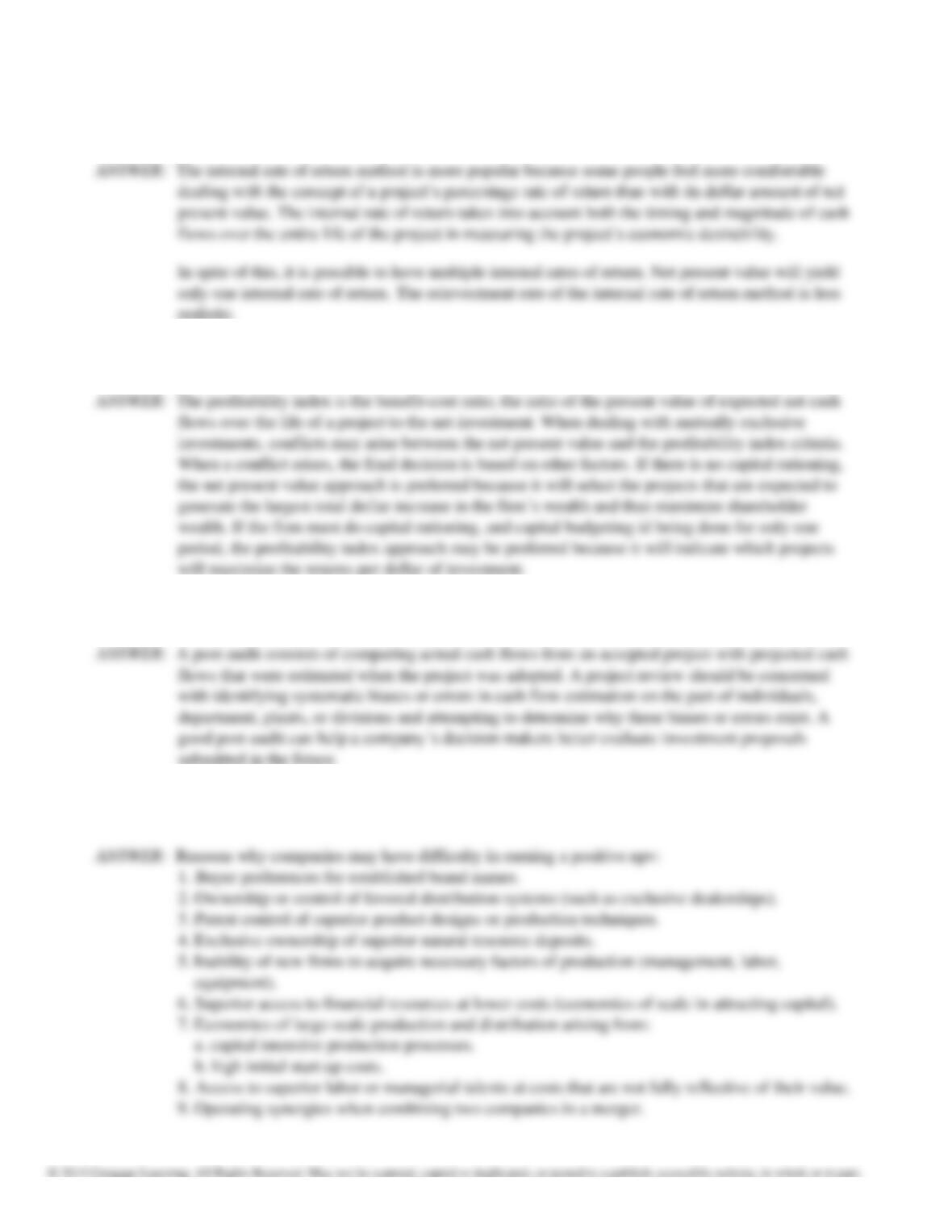
97. List the advantages and disadvantages of the payback method.
98. Why is the net present value method of evaluating projects better than the internal rate of return method?
Chapter 10: Capital Budgeting: Decision Criteria and Real Option Considerations
99. Explain why the internal rate of return method is more popular than the net present value method. What are
some potential problems with relying on the IRR method?
100. How does the profitability index differ from the net present value and when would each method be preferred?
101. In working with capital budgeting, what does a post-audit do?
102. There are various reasons why companies may have difficulty in earning a positive net present value. These
reasons include barriers to market entry and other factors. List these factors.
Chapter 10: Capital Budgeting: Decision Criteria and Real Option Considerations
103. Why are there differences in the capital expenditure analysis practice between large and entrepreneurial
firms?
104. The choice to accept or reject projects based on the payback period is:
a. an objective decision.
b. as subjective decision.
c. will always give the same results as using the net present value method.
d. will always give the same results as using the internal rate of return method.
105. The payback period can be considered justified on the basis of:
a. it can account for the risk of the project.
b. it can account for the time value of the project.
c. it can account for the return on investment.
d. it can account for the objective rationale of the project.
106. When considering projects for implementation, management generally has three options. All of the following
reflect possible managerial options EXCEPT:
a. Management could attempt to find another combination of projects that would allow for a more complete
utilization of available funds.
b. Management could accept the current project or projects and hope that the preliminary analysis is correct.
c. Management could choose to reject the projects under consideration and place the available funds in a
short term security until the next period.
d. Management could sell stock to raise sufficient capital to invest in the project if it is required to make it
profitable.
107. A firm’s capital expenditures may be limited due to externally imposed constraints. All of the following are
external constraints EXCEPT:
a. The firm’s loan agreements may contain restrictive restraints.
b. The firm may decide to place an upper limit on the amount of funds allocated to capital investment.
c. If the firm has a weak financial position, it may be too expensive to float a new bond issue.
d. There may be market-imposed difficulties such as a tight money policy of the part of the Federal Reserve
System.