4) According to classical economists, unemployment rises in recessions due to an increase in
________ unemployment, not ________ unemployment.
A) cyclical; frictional and structural
B) frictional and cyclical; structural
C) structural; frictional and cyclical
D) frictional and structural; cyclical
5) According to classical economists, in recessions, not only does the unemployment rate
increase, so does the
A) interest rate.
B) level of fiscal stimulus.
C) natural rate of unemployment.
D) level of potential output.
6) According to classical economists, in recessions, the government should
A) stimulate the economy to increase demand.
B) actively use fiscal policy to combat the recession.
C) increase the minimum wage so that poor people will be able to afford necessities.
D) eliminate barriers to labor market adjustment, such as burdensome regulations on businesses.
7) Davis and Haltiwanger showed that ________ churning of jobs occurs and that this churning
reflects closing of old plants and opening of new ones ________.
A) little; in different industries
B) little; within the same industry
C) much; within the same industry
D) much; in different industries
8) In recession years, ________ jobs are lost than created, and vacancies and job openings
________.
A) more; increase
B) more; decline
C) fewer; decline
D) fewer; increase
9) Because employment actually continued to fall at the beginning of the recoveries that began in
1991, 2001, and 2009, these recoveries have come to be known as
A) pseudo recoveries.
B) non-recoveries.
C) double-dip recoveries.
D) jobless recoveries.
10) A jobless recovery occurs when
A) no jobs are created in an economy after a recession ends.
B) employment continues to fall at the beginning of a recovery.
C) only low-quality jobs are created in a recovery.
D) most of the new jobs created in a recovery are overseas.
1) Classical economists believe that
A) money is neutral.
B) an increase in the real money supply affects output.
C) inflation is determined by wage growth.
D) monetary policy should be used to combat recessions.
2) Assuming that money is neutral, an increase in the nominal money supply would cause
A) an excess supply for goods.
B) an increase in the real money supply.
C) a fall in the price level.
D) a rise in nominal wages.
3) Assuming money neutrality in the classical model, a 10% increase in the nominal money
supply would cause
A) a 10% increase in the real money supply.
B) a 10% decrease in the real money supply.
C) no change in the real money supply.
D) a less-than-10% change in the price level due to a shift in the aggregate supply curve.
4) The idea that expected future increases in output cause increases in the current money supply
and that expected future decreases in output cause decreases in the current money supply, rather
than the other way around, is known as
A) Granger causality.
B) money neutrality.
C) nominal adjustment.
D) reverse causation.
5) Reverse causation is the idea that
A) current increases in output cause future increases in the money supply.
B) current increases in the money supply cause future increases in output.
C) expected future increases in the money supply cause increases in current output.
D) expected future increases in output cause increases in the current money supply.
6) The basic classical model can account for the procyclical behavior of money if there
A) are real business cycles caused by productivity shocks.
B) is reverse causation from future output to money.
C) are rational expectations among the public.
D) are propagation mechanisms in the economy.
7) Friedman and Schwarz argue that money is not neutral because
A) theoretical models of the economy don’t show monetary neutrality.
B) money is a leading, procyclical variable.
C) they found several historical incidents in which changes in the money supply were not
responses to macroeconomic conditions, and output moved in the same direction as money.
D) they found no evidence that productivity changes or changes in government spending
contributed to business cycles; only monetary changes preceded every recession.
8) Romer and Romer found evidence that money is not neutral because
A) in several episodes, such as 1979-1982, changes in monetary policy led to recessions.
B) they found that inflation was highly correlated with the rate of growth of the money supply.
C) if money were neutral, no one would care what the Fed does.
D) they found no evidence that productivity changes or changes in government spending
contributed to business cycles; only monetary changes preceded every recession.
9) You and a friend are arguing over the issue of the nonneutrality of money. You believe that
money is not neutral, and to prove your point you would cite all of the following except
A) large gold discoveries that increased the money supply preceded an economic boom.
B) a change in monetary institutions preceded a boom or recession.
C) a change in the leadership of the Fed and its policy was followed by noticeable changes in the
money supply and a recession or inflation.
D) the fact that every recession was preceded by a drop in the money supply.
10) Why do many economists believe that money affects output? What is the empirical evidence
in support of that belief?
11) A classical economy is described by the following equations:
Cd = 500 + 0.5(Y – T) – 100r.
Id = 350 – 100r.
L = 0.5Y – 200i.
= 1850.
πe = 0.05.
Government spending and taxes are equal where T = G = 200. The nominal money supply M =
3560.
(a) What are the equilibrium values of the real interest rate, the price level, consumption, and
investment?
(b) Suppose an economic shock increases desired investment by 10, so it is now Id = 360 – 100r.
How does this affect the equilibrium values of the real interest rate, the price level, consumption,
and investment?
(c) Returning to the initial situation in part (a), suppose an economic shock increases desired
consumption by 10, so it is now Cd = 510 + 0.5 (Y – T) – 100r. How does this affect the
equilibrium values of the real interest rate, the price level, consumption, and investment?
12) Suppose the money demand of individuals and firms depends on what they perceive to be the
probabilities that the economy will expand or contract over the following six months. Suppose
their money demand is given by the equation L = 0.5Y – 100i + 20z, where z is the probability
that the economy is expanding six months in the future. If z = 1, the economy will certainly be in
recovery, if z = 0, the economy will certainly be in recession, and for z between 0 and 1 there is
some uncertainty about the future state of the economy. Use a classical (RBC) model of the
economy. If the Fed moves the money supply to target the price level, how does the money
supply relate to the expected future state of the economy? Is this an example of reverse
causation?
10.5 The Misperceptions Theory and the Nonneutrality of Money
1) The misperceptions theory was originally proposed by ________ and rigorously formulated
by ________.
A) Milton Friedman; Robert Lucas
B) John Maynard Keynes; Robert Solow
C) Edward Prescott; Robert King
D) James Tobin; Greg Mankiw
2) If producers have imperfect information about the general price level and sometimes
misinterpret changes in the general price level as changes in relative prices, then
A) the short-run aggregate supply curve is vertical.
B) the short-run aggregate supply curve slopes upward.
C) the aggregate demand curve is vertical.
D) the aggregate demand curve is horizontal.
3) The short-run aggregate supply curve can slope upward because
A) prices are fixed in the short run.
B) wages adjust immediately to changing economic circumstances.
C) producers have misperceptions about the aggregate price level.
D) prices adjust instantaneously.
4) According to the misperceptions theory, when the aggregate price level is higher than
expected,
A) the aggregate quantity of output supplied rises above the full-employment level.
B) the aggregate quantity of output supplied falls below the full-employment level.
C) the aggregate quantity of output demanded falls below the full-employment level.
D) the aggregate quantity of output demanded rises above the full-employment level.
5) According to the misperceptions theory, when the price level falls below the expected price
level
A) the economy’s SRAS curve shifts up.
B) the economy moves along its AD curve.
C) the economy moves along its LRAS curve.
D) the economy moves along its SRAS curve.
6) If you expect a general price increase of 5% this year and the price of the hamburgers you sell
increases by 10%, you would conclude that the relative price of your good has
A) declined, and you would increase your output.
B) declined, and you would decrease your output.
C) increased, and you would increase your output.
D) increased, and you would decrease your output.
7) You are likely to think that the relative price of your good has risen and you should increase
your output if you expected
A) the inflation rate to be 10% and the price of your good rose 7%.
B) the inflation rate to be 10% and the price of your good rose 10%.
C) the inflation rate to be 10% and the price of your good rose 13%.
D) the inflation rate to be 0% and the price of your good fell 10%.
8) Short-run aggregate supply is greater than long-run aggregate supply in the misperceptions
theory if
A) the actual price level is greater than the expected price level.
B) the actual price level equals the expected price level.
C) the actual price level is less than the expected price level.
D) output is less than its full-employment level.
9) Which of the following equations is most likely to represent short-run aggregate supply
according to the misperceptions theory?
A) Y = 6000
B) Y = 6000 + 50(P – Pe)
C) P = 2
D) PY = 12,000
10) According to the misperceptions theory, when P < Pe, output is ________ its full-
employment level and the short-run aggregate supply curve must shift ________ to restore full
employment.
A) below; upward
B) below; downward
C) above; upward
D) above; downward
11) According to the misperceptions theory, the amount by which producers increase their output
when the general price level rises depends on
A) the slope of the aggregate demand curve.
B) the slope of the long-run aggregate supply curve.
C) the size of the Solow residual.
D) how much they think their relative prices have increased.
12) If producers believe that the increase in their relative prices is small relative to the increase in
the general price level, then the slope of the short-run aggregate supply curve will be
A) zero.
B) small.
C) large.
D) negative.
13) If producers believe that the increase in their relative prices is large relative to the increase in
the general price level, then the slope of the short-run aggregate supply curve will be
A) infinite.
B) small.
C) large.
D) negative.
14) According to the misperceptions theory, an unanticipated decrease in the money supply shifts
the AD curve ________, causing output to ________ in the short run.
A) up and to the right; rise
B) up and to the right; fall
C) down and to the left; rise
D) down and to the left; fall
15) According to the misperceptions theory, after an unanticipated increase in the money supply
has occurred, the SRAS curve must shift ________ to restore general equilibrium; as it does so,
the price level ________.
A) downward; rises
B) downward; falls
C) upward; rises
D) upward; falls
16) According to the misperceptions theory, an anticipated decline in the money supply leads to
a shift of the AD curve ________ and a shift of the SRAS curve ________.
A) down and to the left; downward
B) down and to the left; upward
C) up and to the right; downward
D) up and to the right; upward
17) According to the misperceptions theory, an anticipated 10% decrease in the money supply
leads to a short-run reduction in the price level of
A) 0%.
B) 5%.
C) some amount between 0% and 10%.
D) 10%.
18) Which of the following statements is true about the misperceptions theory?
A) Both anticipated and unanticipated changes in the nominal money supply have real effects on
the economy.
B) Neither anticipated nor unanticipated changes in the nominal money supply has real effects on
the economy.
C) Unanticipated changes in the nominal money supply have real effects, but anticipated changes
are neutral.
D) Anticipated changes in the nominal money supply have real effects, but unanticipated
changes are neutral.
19) If the money supply grows 7% during the year, and people expected the money supply to
grow by 5%, what happens to the short-run aggregate supply curve, according to the
misperceptions theory?
A) It shifts down.
B) It shifts up.
C) It doesn’t shift.
D) It shifts down unless Ricardian equivalence holds, in which case it doesn’t shift.
20) According to the misperceptions theory, if the Fed wanted to use monetary policy to
influence the real economy it would have to
A) increase the money supply whenever the economy was in a recession.
B) decrease the money supply whenever the economy was in an inflationary boom.
C) surprise the public with unexpected changes in monetary policy.
D) abide by the monetary targets it announced.
21) The reason why some economists believe that attempts by the Fed to surprise the public in a
systematic way cannot be successful is that
A) information about the Fed’s plans will inevitably be leaked to the public.
B) the Fed announces its goals before Congress and publishes its policy actions in the Federal
Reserve Bulletin six weeks after they take place.
C) the public would eventually figure out what the Fed’s policies were, negating the Fed’s
surprise.
D) competition in the money markets would neutralize the Fed’s intervention.
22) The primary reason why the Fed cannot systematically surprise the public with its monetary
policy is
A) the nonneutrality of money.
B) the presence of productivity shocks that generate real business cycles independent of the
monetary side of the economy.
C) the presence of rational expectations among the public.
D) the presence of propagation mechanisms within the economy.
23) The theory of rational expectations suggests that
A) people never make forecast errors.
B) people make intelligent use of available information.
C) people make systematic forecast errors.
D) people are slow to incorporate new information into their forecasts.
24) According to the misperceptions theory, short-lived shocks may have long-term effects on
the economy because of
A) multiplier effects.
B) propagation mechanisms.
C) accelerator effects.
D) automatic stabilizers.
25) The primary reason that short-lived shocks can have long-run effects is
A) the nonneutrality of money.
B) misperceptions by the public over the actual price level and the expected price level.
C) the presence of rational expectations among the public.
D) the presence of propagation mechanisms.
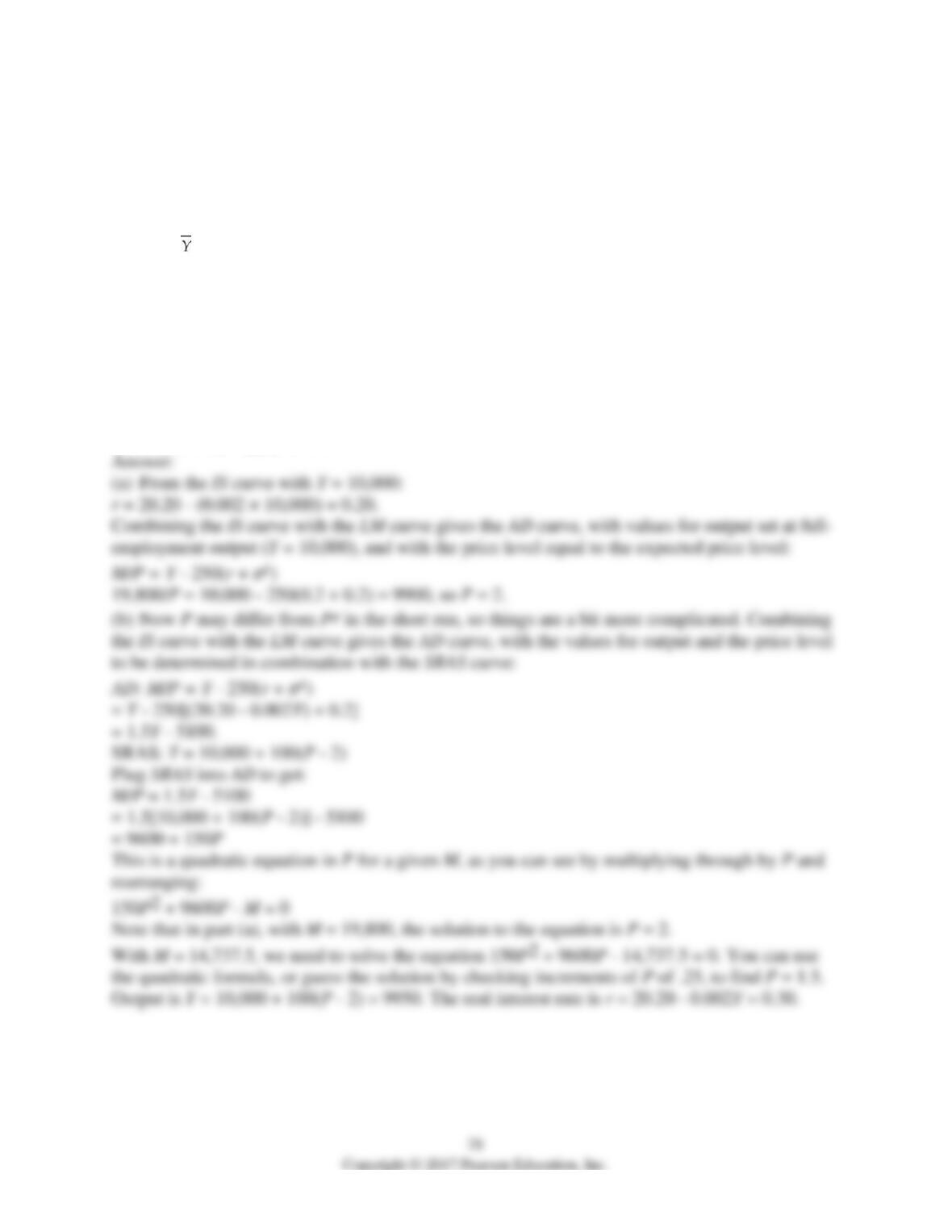
26) Suppose the economy is characterized by the following equations.
IS curve: r = 20.20 – 0.002Y
LM curve: M/P = Y – 250(r + πe)
SRAS curve: Y = + 100(P – Pe)
The nominal money supply is M = 19,800, expected inflation is πe = 0.20, and full-employment
output is = 10,000.
(a) If the economy begins in general equilibrium, what are the equilibrium values of the price
level, output, and the real interest rate?
(b) If the expected price level is the price level you found in part (a), what happens to the price
level, output, and the real interest rate in the short run if there’s an unanticipated decrease in the
nominal money supply to 14,737.5? {Hint: guess some price levels that differ from the one you
found in part (a) by increments of 0.25.}
(c) If the expected price level is the price level you found in part (a), what happens to the price
level, output, and the real interest rate in the short run if there’s an unanticipated increase in the
nominal money supply to 24,937.5?
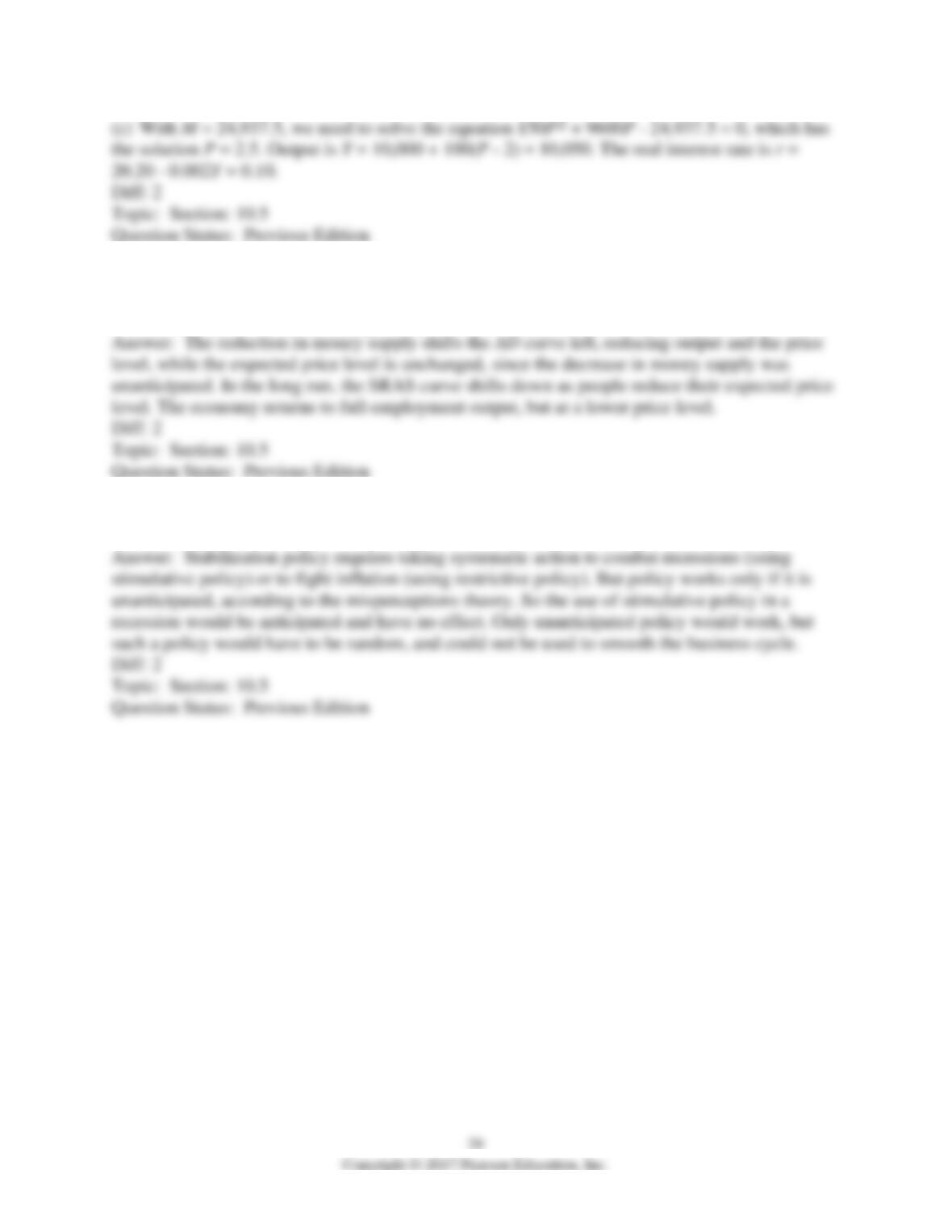
27) Analyze the short-run and long-run effects of an unanticipated decrease in the money supply
in the misperceptions model. Tell what happens to output, the price level, and the expected price
level in both the short run and long run.
28) Why doesn’t stabilization policy work, according to economists using the misperceptions
theory?